Loading summary
Transcript43 lines
- [00:00]
Narrator/Advertiser
One of the hardest parts of getting older is feeling like something's off in your body but not knowing exactly what. It's not just aging, it's often your hormones too. When they fall out of balance, everything feels off. But here's the good news. This doesn't have to be the story of your next chapter. Hormone Harmony by Happy Mammoth is an herbal formula made with science backed ingredients designed to fine tune your hormones by balancing estrogen, testosterone, progesterone and even stress hormones like cortisol. It helps with common issues such as hot flashes, poor sleep, low energy, bloating and more. With over 40,000 reviews and a bottle sold every 24 seconds, the results speak for themselves. A survey found 86% of women lost weight, 77% saw an improved mood, and 100% felt like themselves again. Start your next chapter feeling balanced and in control. For a limited time, get 15% off your entire first order at happymammoth.com with code NextChapter at checkout. Visit happymammoth.com today and get your old self back.
- [00:59]
Michelle Graf
Naturally, the coroner on the case was somebody that was very diligent in his investigation and he didn't let it go. He knew something was odd about this mystery. And when he began his inquest, his inquiry, witnesses came forward telling a different story of what was happening to Sarah in the home.
- [01:25]
Renita Hora
Welcome to the True Fiction Project, a podcast series that explores the origins of fiction. Every week we begin with an interview nonfiction followed by a creative piece, fiction inspired by something from the interview. The idea is to demonstrate, of course, that fiction is born out of our life experiences. Now, here's your host, storyteller, author, public speaker, health and wellness expert, Renita Hora.
- [01:55]
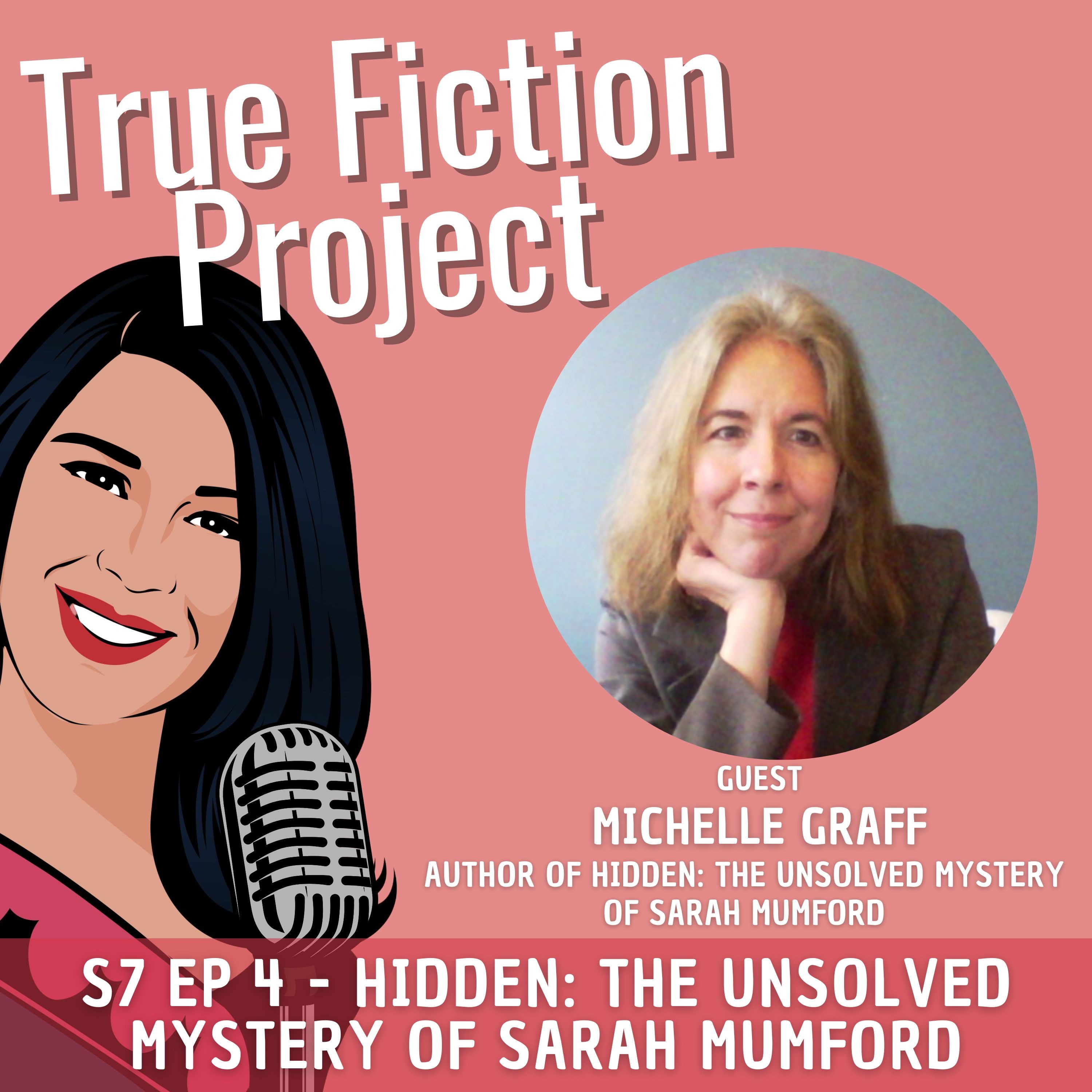
Welcome to the True Fiction Project. I am your host, Renita Hora. And the question for today is, who killed Sarah Mumford? Who is Sarah Mumford? Well, my guest today will reveal all. Well, maybe not all, because she is the author of a mystery fiction book. And what a fascinating one. It's called Hidden. And to explain why it's so fascinating, let's go straight into our discussion with Michelle Graf, author of Hidden. Hi, Michelle. Welcome to the True Fiction Project.
- [02:33]
Michelle Graf
Hello, Renita. Thank you for having me.
- [02:36]
Renita Hora
So great to have you on the show. So I have to ask you right off the bat, who is Sarah Mumford?
- [02:43]
Michelle Graf
Sarah Mumford is a young girl who lived in 1899. Well, actually, she died in 1899 at the age of 15. And her death remains a mystery to this day. Historians, local history buffs still talk about her in the town of Pendleton, New York. And her death remains a mystery.
- [03:07]
Renita Hora
So I have so many questions because just even with that little piece of information, why. I mean, any death is important, of course, you know, but why was Sarah Mumford so talked about so important? Why is her death a mystery? How you involved in it? I mean, this is from 1899. I'm going to stop asking my questions for now.
- [03:31]
Michelle Graf
Well, my interest in Sarah has to do with my own great grandmother. And I have to tell you, I have been compelled to tell my great grandmother's story since before I even knew her name. Because. Because I grew up, my father didn't know the name of his grandmother. My grandmother didn't know the name of her mother. And I found this very odd and concerning. So when I was old enough to start researching, I began doing my family history, very focused on this woman who was my great grandmother. Her name was Amelia. And I discovered the reason why her name had been forgotten is she was an unwed mother. She was a teenager when she gave birth to my grandmother. And it got me thinking about. I wanted to know so much more about the story. So I started researching that time period in the town that she was in. And that's how I came across the mystery of Sarah Mumford. Sarah Mumford was also a teenager in the same town, same time, and she was rumored to be pregnant at the time of her death. And she was also unmarried. She was a young girl that was a ward of a family. They called her her adopted daughter. But there was a lot more to the story than that. So I became intrigued in learning more about Sarah in order to learn about my great grandmother. And the more I researched, the more I discovered so many parallels to their story.
- [05:07]
Renita Hora
Oh, my goodness.
- [05:08]
Michelle Graf
And I also became obsessed, upset, outraged, but also wanted to solve the mystery. And so it took sort of an investigative turn in my research, and I really wanted to find out more about Sarah, tell her story at the same time, tell my grandmother's story. Her story did not have necessarily a happy ending either. And I just felt like it was my way of perhaps giving justice to these two girls who lived in a time where women and children were not treated well. And there are many things I came across that really parallel things that we struggle with today.
- [05:49]
Renita Hora
What were the circumstances of her death? Or is that the mystery that hasn't been solved?
- [05:54]
Michelle Graf
Well, that's the mystery. But I discovered there was really a lot that I could learn in doing the research in old newspapers because it was very popular at the time. People were very Interested, not just in the town of Pendleton, but the circumstances of the case really caught the attention of the whole nation at the time. And the circumstances were that she was found on train tracks. So originally they thought it was a suicide, and probably in most circumstances, it would have just been brushed off as a suicide or an accident. People were hit by trains often then because there weren't train crossings. But the coroner on the case was somebody that was very diligent in his investigation, and he didn't let it go. He knew something was odd about this mystery. And when he began his inquest, his inquiry, witnesses came forward telling a different story of what was happening to Sarah in the home. And she was not necessarily the loved adopted daughter that the family had portrayed her to be. They were using her more as a servant, which was something that often happened to children taken in by families from orphanages. And they were, in a sense, indentured servants. That was not that uncommon at the time. But the real mystery took a turn when an autopsy was done. They actually exhumed her body and discovered that Sarah was dead before the train hit her. And they could tell that at the time by the lack of blood evidence on the scene.
- [07:43]
Renita Hora
Interesting. And all of this was published in newspapers. I mean, that's your research?
- [07:48]
Michelle Graf
Yeah, it was. Nobody had, since that time, really compiled all the facts together. There had been articles written about it, but I went back and found all of the articles and tried to piece together the timeline. Also did background research on the different participants, the different suspects, to find out how they connected together. I also did research on Sarah and found her orphanage records and found more information about who she was. And I don't want to give away too many spoilers in the story, but thank you. Things were different than they appeared to be. And so the mystery, the more that was uncovered, both by the investigator at the time and myself doing the research, the more questions there were and the more interesting the case became.
- [08:41]
Renita Hora
My goodness, this is fascinating. So I can only begin to imagine the kind of research you've done and you've talked about going through old newspapers. Was that the primary source or what else did you look at?
- [08:56]
Michelle Graf
Much of my primary sources were the newspapers, and I had to consider those primary sources, though I did have to fact check them, because in some cases they were very accurately based on transcripts from the inquest. In some cases they were sensationalized because even in 1899, there was fake news. And so I did have to do something. I also used a lot of the skills I learned as a Genealogical hobbyist. I do my own family research, and a lot of those genealogy techniques I was able to apply to my research. I am neither a historian or a professional genealogist, but I use some of the techniques of both to string together the story. So I found a lot of things in the records, the genealogical records. I also found a lot of context by studying the history of the child welfare system, how, you know, forensics at the time, all of everything to put the story into a context, because context matters when you want to really understand what happens in a story.
- [10:13]
Renita Hora
Fascinating to hear you say that, because 1899 is obviously way too early to go through a 23andMe DNA test. So it's amazing that you could find all of these other sources and had the energy and put in the effort, you know, to do so. So I have to ask the inevitable question. Was Sarah Mumford, or do you think she was your great grandmother?
- [10:38]
Michelle Graf
Well, this is. Spoiler alert. I believe somebody was responsible for her death and that her body was placed on those tracks to cover a more horrific crime than even murder. And it has to do with how she was treated. It has to do with really something larger and bigger than just a story about human trafficking is what we would call it today. But how children left in orphanages, or who found their way in orphanages for whatever reason, and she was not actually an orphan, were vulnerable and exploited by people who wanted to profit or gain things for their own reason.
- [11:29]
Renita Hora
So are you suggesting, or do we understand from this, that she was maybe sold by her family to.
- [11:37]
Michelle Graf
Not stolen. She was put in the orphanage for legitimate reasons, but she had family that wanted her and she was indentured out for profit.
- [11:47]
Renita Hora
Oh, my God.
- [11:48]
Michelle Graf
And then once that happens, the family loses contact and she doesn't have any way to get back to them, even though she desired to.
- [11:56]
Renita Hora
My gosh.
- [11:57]
Michelle Graf
Because she was bound by a contract.
- [11:59]
Renita Hora
And where did your grandmother go when she was born?
- [12:03]
Michelle Graf
So my grandmother, her story, my grandmother, the baby in the case. Yes, the baby was born the summer this whole inquest was happening. And as it turns out, she was eventually raised by my grandfather's family. So I needed to find out how she got separated from her mother, too. Her family did not want her to be in an orphanage. She did spend a very short time in an orphanage, but they wanted that baby and wanted to keep her and did everything they could. But unfortunately, some other circumstances happen and. And she also met a terrible fate. Her mother did. And the shame and the stigma behind the fact that she was illegitimate. I believe became the reason why her mother's story was not shared with her, not even her name. And so then lost to her ancestors. And for me, sharing her name was Amelia. And sharing Amelia's name is very important to me in Sharon Sarah's name. Because the name of the story is hidden for a reason. Because there are so many of these young girls that were hidden away. What happened to them was hidden away. And they were literally hidden away because there was so much shame and stigma around unwed pregnancies. But there were other reasons why girls were hidden at the time. And so there's different layers to that title. But I believe that for me, the truth was hidden, and the greatest form of justice is the truth. And so I just want to tell these stories. And I think a lot of what happened to these girls is still relevant today. Maybe not to the same extreme, but we still have issues of human trafficking throughout our world. And I think there's some relationship to what happened then and what's going on now. Different circumstances, of course, but I still think it's an important issue for people to talk about.
- [14:13]
Renita Hora
Very, very important. I mean, there's so many issues that you touch upon. Human trafficking, hidden truths, identity, which is huge. I can completely understand why you have just spent your life doing this. So what did you do? You wrote a book? When did that come out? Tell us a little bit more about how the story has evolved for you.
- [14:34]
Michelle Graf
So when I decided to tell the story, I knew they fit together for many reasons that I won't reveal here. So I wrote the story. It's two alternating narratives of the two girls lives. One follows the investigation of Sarah Mumford in that summer of 1899. And that one is a narrative nonfiction. Even the descriptions came from my research. Any quotes came from primary sources. Amelia's story, my great grandmother's story, follows the same timeline. It was that summer that Amelia was pregnant with my grandmother. It is also a true story. So all the major events, all the characters or the people are true. But I did create dialogue, and that's where the nonfiction part comes in. That would be historical fiction. It's based on a true story. But I don't know what she was thinking or those conversations she had with her parents. I tried to make sure I based them on what I had learned in my research. How women were treated at the time, how townspeople in the town of Pendleton viewed the murder, and things they were saying about the case. And I also found out in my research that my family had other connections to the case that I won't reveal here today. So they were very connected to this case in many ways. The stories made sense to tell them together. Right.
- [16:09]
Renita Hora
Okay. Well, I cannot wait to hear your read. Before we do, though, let us know where we can find your book and your books in general.
- [16:17]
Michelle Graf
It is on Amazon. It's wide, so you could find it with any bookstore, but probably the easiest way would just be on Amazon. Its name is Hidden the Unsolved Mystery of Sarah Mumford.
- [16:30]
Renita Hora
Amazing. I cannot wait to sort of dig into it. This sounds like a perfect binge read.
- [16:37]
Michelle Graf
Okay.
- [16:38]
Renita Hora
And having said that, you're going to read for us.
- [16:40]
Michelle Graf
I picked a passage first about my grandmother. So this is not about the case of Sarah Mumford. This is one of the stories about my grandmother. I'm going to just set it up, you know, Amelia was an unwed mother. She was at the time not sure what would happen to her. Her parents had not made her leave the home. But this is not something you could just tell everybody was going on. So she didn't know. Because of the tension, her father couldn't look her in the eye. She was having arguments with her mother. She wasn't sure that they would even allow her to stay after the baby was born. She also had not revealed the father yet and she was afraid to do so because he didn't want her to tell anyone who he was. And so this passage takes place the day my grandmother was born.
- [17:34]
Renita Hora
I can't wait till our listeners check out this podcast episode and go straight to Amazon. Straight to your book. Thank you so much for joining us today on the True Fiction Project.
- [17:45]
Michelle Graf
Thank you for having me, Renita.
- [17:46]
Renita Hora
That was Michelle Graf, the author of Hidden Definitely. Check out her book immediately on Amazon. All links are in the show notes. And for our paid subscribers, she's going to read us something else a little extra special. This is the True Fiction Project. I am your host, Renita Hora.
- [18:08]
Michelle Graf
Stuck in a dinner rut. Let Cook Unity handle dinner with chef crafted meals delivered right to your door. Cookunity makes it easy with new menu drops, weekly recommendations and a growing community of award winning chefs. Plus over 400 flavorful meals for every palate. Shake up your meal routine. Go to cookunity.com mealtime50 or enter code mealtime50 before checkout for 50% off your first week. That's cookunity.com mealtime50.
- [18:41]
Renita Hora
And now to the premise of the True Fiction Project, which of course is to create fiction out of nonfiction.
- [19:04]
Michelle Graf
Amelia opened her heavy eyelids and tried to lift her head. Exhausted, she laid it back on the pillow and closed her eyes again. The last thing she remembered was her mother placing the baby on her chest to feed the baby. Where's my baby? She opened her eyes again and tried to focus on the objects around her. She heard a tiny cry. The doctor was standing near her. Where's my baby? She said, her voice hoarse from the screams of her labor. Her mother placed a hand on her shoulder. She had been standing at her bedside all along. It was Rika, not the doctor, that did most of the delivery. The doctor arrived when it was almost over. Dr. Helweg is checking her over, amelia's mother said. Amelia looked at the doctor as he examined the infant. She recognized him. It was the same doctor who had come the night her sister Rachel had died four years earlier. Dr. Helwig handed the baby back to Rika. She looks healthy, he said. Rika swaddled the baby and placed her back in Amelia's arms. Amelia felt a wave of relief. She had been so afraid. Afraid of the pain, afraid of what would happen to her. But it had not occurred to her to be afraid of the baby. Until now. Dr. Helweg placed his stethoscope back in his leather satchel and pulled out a pencil and a dark green notebook. He sat down in the chair next to the bed and jotted a few things in his book. What would the child's name be? He asked. Maude, amelia answered. Maude Amanda. The doctor scribbled the name. Amelia looked down at her daughter. She was so small, so helpless. It was her job to protect her. She thought about what her mother said, about facing her problems. She looked at Dr. Helweg. He closed his book and held it in his hand. And the father's name is Owen Ryan, she said. I did not think there was a husband. Dr. Helweg looked directly at Rika. He's not my husband. But he is the baby's father, amelia said. Her voice regained some of its strength. I'm afraid it's not customary to record the father's name when there's no marriage. Unless he is here to vouch for the child, helweg said. My daughter can vouch he is the father, rika interjected. Promises were made. Dr. Helweg turned back to Amelia. You're sure? He asked. Amelia ignored the insult. Why should Owen get a choice when she has none? I'm sure, she said. Her jaw stiffened. Owen Ryan. He lives in Lockport and he knows he is the father. Owen would be furious, but Amelia refused to hide his secret any longer. He was older than her and had a good job in the paper mill. Maude was the one who needed protection. If you put his name in the book, rika said, he will have to be responsible. Helweg hesitated as if he was considering what to do. He looked at each of the women and then rested his eyes on the small child. It won't force him to do anything, he said. But I suppose it might help. Slowly, he reopened the book and wrote down the name. Rika nodded her head at Amelia. She seemed pleased. Helwig stood to leave. Rika thanked the doctor and walked him to the door. Before he left the room, he turned back to Amelia. You're a brave girl, helwig said. Like your mother. Amelia looked at her mother and then at Maude. She did not feel brave. She felt tired and terrified. She didn't know what would happen, and she did not think she could do it alone. Rika came back into the room with Amelia's father following behind her. In his arms he carried a wooden cradle. Amelia could smell the freshly cut wood. For the baby, he said. Her father placed the cradle next to Amelia's bed. He rubbed his calloused hands over the wood. It's sturdy. Made it myself. Amelia could feel the tears filling her eyes. It's lovely, Papa, she whispered. Donka Henry nodded and left the room. Amelia looked up at her mother. You should try to feed the baby and then try to sleep some more, rika said. She moved to the bedside to help her daughter. I thought he hated me. Rika shook her head, heartbroken. Yes. But still your papa. Rika placed her hand on the baby's head, then moved to her daughter. She brushed back some hair from Amelia's face. Someday, Amelia, she said, you'll learn to see through other people's eyes.
- [24:23]
Renita Hora
Here at the True Fiction Project, we are always looking for great stories that make for compelling fiction. So if you have a great story or know somebody who does, or if you are a writer who would like to contribute, then please do get in touch with us@renita.com contact.
- [24:45]
Thank you for listening to the True Fiction Project with Renita Hora. Be sure to subscribe to the newsletter to receive more inspiring stories showing how fiction is born from our everyday experiences. For more information, visit www.TrueFictionProject.com. Did you know Microsoft has officially ended Support for Windows 10? Upgrade to Windows 11 with an LG Gram laptop Voted PCMag's Reader's Choice to Top Laptop Brand for 2025 Thin and ultra lightweight, the LG Gram keeps you productive anywhere, and Windows 11 gives you access to free security updates and ongoing feature upgrades. Visit lgusa.com iheart for great seasonal savings on LG Gram laptops with Windows 11. PCMag reader's choice used with permission. All rights reserved.