Loading summary
Transcript59 lines
- [00:01]
Grainger Announcer
If you're an H VAC technician and a call comes in, Grainger knows that you need a partner that helps you find the right product fast and hassle free. And you know that when the first problem of the day is a clanking blower motor, there's no need to break a sweat. With Grainger's easy to use website and product details, you're confident you'll soon have everything humming right along. Call 1-800-GRAINGER, click grainger.com or just stop by Granger for the ones who get it done.
- [00:30]
Eva Moon
I started songwriting when my groups that I was performing with had a summer hiatus and I just didn't have anything musical to do. And then things sort of evolved from there. I started performing my original songs and then I started doing patter between the songs, and the patter and the songs kind of blended together and started doing stories where three songs with some storytelling in between would make a single unit of story. And I started focusing more on the stories and less on the songs.
- [01:07]
True Fiction Project Narrator
Welcome to the True Fiction Project, a podcast series that explores the origins of fiction. Every week we begin with an interview, nonfiction, followed by a creative piece, fiction inspired by something from the interview. The idea is to demonstrate, of course, that fiction is born out of our life experiences. Now, here's your host, storyteller, author, public speaker, health and wellness expert, Renita Hora.
- [01:37]
Renita Hora
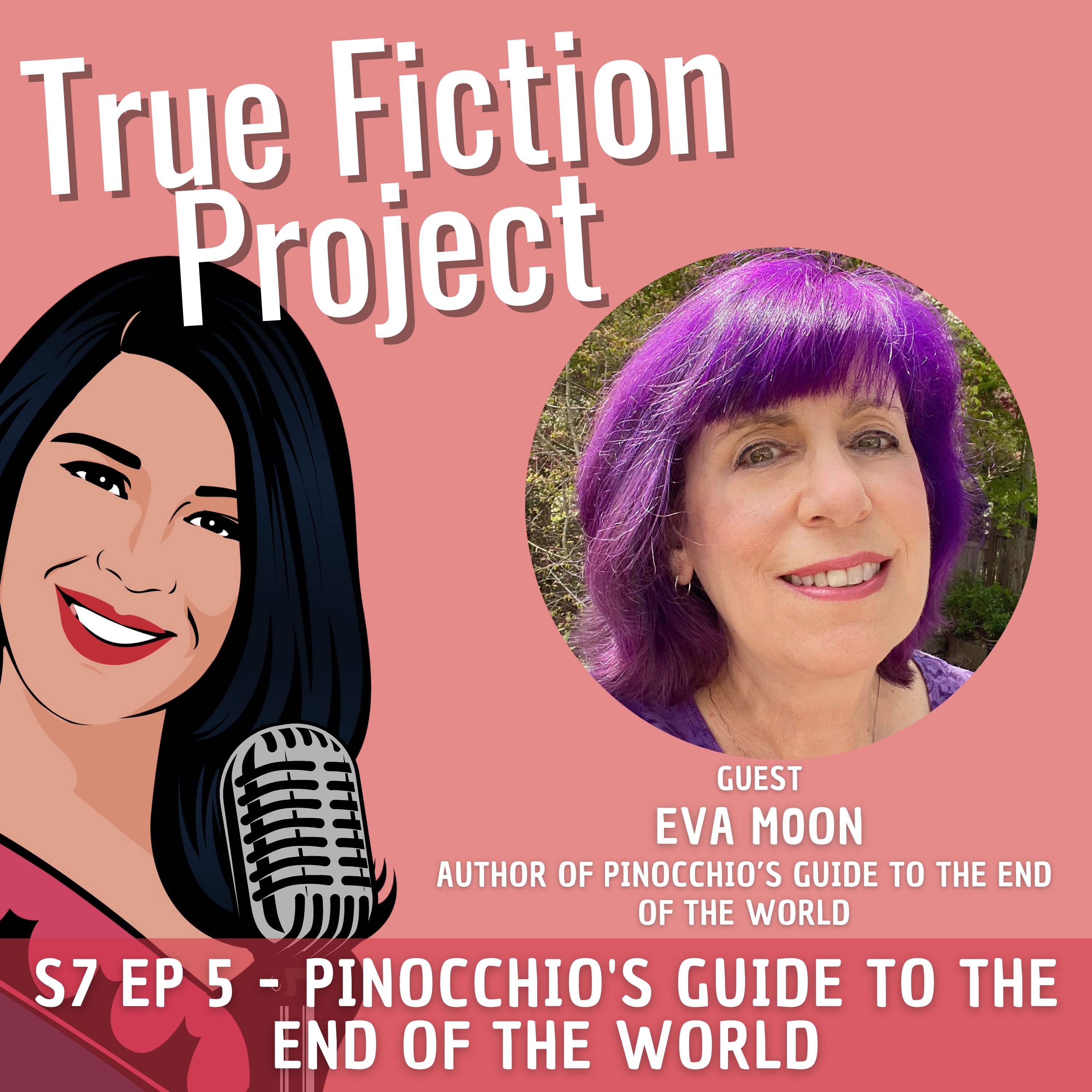
Welcome to the True Fiction Project. I'm your host, Renita Ahora, always here to bring you a plethora of creative people. And today I bring you Eva Moon. She is an author, a songwriter, a playwright, a screenwriter, a performer, and a former Huffington Post blogger. Oh, my gosh. So prolific. And her plays and musicals have been staged across the US and uk. She is certainly who I want to be when I grow up. And her solo musical, Mutant Diaries Unzipping My Jeans, is streaming on Amazon's. But today she's gonna talk about something else, a book that she's written, her first novel called Pinocchio's Guide to the End of the World. I can't wait to hear about that. So. Hi, Eva. Welcome to the True Fiction Project.
- [02:28]
Eva Moon
Hi, Renita. Thank you for having me on your show.
- [02:31]
Renita Hora
Great to have you on your show. And first off, is it Eva or Ava?
- [02:37]
Eva Moon
Eva. You did it, right?
- [02:38]
Renita Hora
Okay. Eva, you are writing so much and in so many different formats. I mean, I've just got to straight off the bat ask you how you manage. It's so impressive.
- [02:52]
Eva Moon
I'm old. I guess it didn't happen all at the same time, but it's gone back a few years. And I'm a storyteller and it just takes different forms. Songs are stories, plays are stories, screenplays are stories, books are stories. The story kind of tells me what format it wants to be in. And I've had different phases.
- [03:15]
Renita Hora
And I have to ask you, because people always ask me as well. I mean, do you have the luxury of deciding which format or are you assigned to something or has that changed?
- [03:29]
Eva Moon
It's entirely up to me what format I work in. Well, it's not entirely up to me. I think of my writing as sort of like the movie Alien. And whatever comes out is whatever is chewing its way through my chest. I see.
- [03:45]
Renita Hora
How did you break into all of these different formats? Was that easy? I cannot imagine. It's been a slam dunk.
- [03:51]
Eva Moon
Well, I've been a musician for a very long time. That's where it started. And I started songwriting when my groups that I was performing with had a summer hiatus and I just didn't have anything musical to do. So that's when I got into songwriting. And then things sort of evolved from there. I started performing my original songs and at clubs and restaurants and places like that. And then I started doing patter between the songs, and the patter and the songs kind of blended together and started doing stories where three songs with some storytelling in between would make a single unit of story. And so the one woman shows sort of grew out of that and I started focusing more on the stories and less on the songs. And then screenwriting started when I had this idea for a play, but it just wouldn't work on stage. It needed to be a movie, but that involved like three years of screenwriting school. So there's things to learn everywhere along the line, clearly.
- [04:57]
Renita Hora
And patter between the songs. Is that industry terminology or is that what you call it?
- [05:02]
Eva Moon
Oh, I'm sorry. Yeah, it's just. It's just the chat you have with the audience between songs and you tell them little stories. They might ask you questions or they respond, and then you respond to that. So it's a kind of impromptu story.
- [05:17]
Renita Hora
Amazing. So your Amazon show, the Mutant Unzipping My Jeans. G E N E S. Sounds very intriguing. How did that come about and how did it get to Amazon? Give us a little insight.
- [05:32]
Eva Moon
Well, it wasn't produced by Amazon. It was my own production and it's available, streaming through Amazon. That is quite a story in and of itself because I had been performing my one woman shows and my music. And then about 10, 12 years ago, I learned that I Had a genetic mutation that gave me an 87% chance of breast cancer and a 55% chance of ovarian cancer.
- [06:00]
Renita Hora
Oh, my goodness.
- [06:01]
Eva Moon
And at the time, my mother was dying of cancer from the same mutation. So at that point I stopped. I thought I would never write a word again or never sing a word. I thought, I'm done. I can't deal with this. And I ended up having a preventive double mastectomy and total hysterectomy and, you know, trying to care for my mother who was dying of cancer. And I had to deal with the emotional fallout of all of that. And that's what led to the Mutant Diaries. Musical Diaries is a one woman show about that whole experience. It's not a downer, it's a comedy. Comedy, actually. But as kind of how I processed everything that happened to me during that time. And I've been able to take that on tour and around the country and twice to the UK to help other people who are going through traumatic upheavals in their lives and how, you know, like, I'm on the other side of it and I'm good right now.
- [07:06]
Renita Hora
As you speak, it's reminding me of the idea, although it's different. A fleabag one woman show.
- [07:13]
Eva Moon
I love that show.
- [07:14]
Renita Hora
Yeah, it started off as a one woman show on stage, a show on Amazon. You wrote this, you produced this. It now streams on Amazon. Is that the way to get on Amazon? Would you say rather than waiting around for Amazon to pick up your show, pitch it to them, produce it? I know there's no slam dunk, but this is a question that many, many people will be asking our listeners, so I might as well ask you.
- [07:40]
Eva Moon
Well, it's like selling a book on Amazon or selling a tea set on Amazon. You know, you can be a vendor and you know, I produced the show is actually a live recording of the performance I did in Los Angeles. And I had it put together as a DVD that was for sale. And as more and more people were abandoning DVDs, I just put it on Amazon as a vendor. So it makes it easy because people don't have to. They don't have to pay for shipping. Then they don't have this thing that they watch once and have no more use for.
- [08:15]
Renita Hora
Right.
- [08:16]
Eva Moon
And they can watch it anytime for just a couple of bucks.
- [08:19]
Renita Hora
Absolutely.
- [08:20]
Eva Moon
It's worked out well to distribute it that way.
- [08:24]
Renita Hora
So. Pinocchio's Guide to the End of the World. This is a novel.
- [08:28]
Eva Moon
It is a novel.
- [08:30]
Renita Hora
Your first novel, Your debut novel. Wow, look at It. Okay. And tell us a little bit about it. How did it come to be?
- [08:39]
Eva Moon
It actually sort of the end point of the journey that started with the discovery of my genetic mutation after I did the Mutant Diaries. And that was very autobiographical. That was the exact story. But even after there were things that I was dealing with in terms of my body image, even though I felt healthy and strong and recovered from my surgeries, that this emotional fallout that stays with you. And I wrote this short play called Geppetto's Funeral, and it was about Pinocchio at midlife.
- [09:17]
Renita Hora
Okay, interesting.
- [09:18]
Eva Moon
Looking back his life with regrets. What had he done with this human life that he'd been given? And should he have just stayed a wooden boy? It was like a 20 minute play. But the character stayed with me even after the play had been produced and I had moved on to other things. But I kept thinking about him as this person who had been made of wood. And then the blue fairy comes along and waves her magic wand and turns him into a real boy. And everyone assumes that it's like happily ever after after that and that he was just fine with all of that. And I had this perspective that I had gone through enormous physical change, physical transformation, and I wasn't fine with it. I mean, I know his was desired and mine wasn't desired, but there was this disconnect between how I felt on the inside and the outside. And I thought he had to have had some feeling of imposter syndrome, you know, that he's walking in the world wearing this human body, but inside he knows that he still feels like that same wooden boy. And how did he. And so I sort of used him in my novel as a way to figure out how you reconcile externals with internals, how you feel on the inside and how the world perceives you on the outside. And what did it take to. For him to finally integrate into one authentic self.
- [11:01]
Renita Hora
Self. Absolutely. So, so much of your own journey, your own discovery. And in the form of fiction. Fantasy. Fiction. But even in fantasy, everything is not neatly wrapped up in a bow. Which I love.
- [11:18]
Eva Moon
I love.
- [11:19]
Renita Hora
Because that's. The fantasy is not reality. But that's a reality of fantasy. I don't.
- [11:25]
Eva Moon
Sometimes through fantasy, you can get at truths that are harder to get to if you're just trying to be completely realistic.
- [11:35]
Renita Hora
Realistic.
- [11:37]
Eva Moon
Explore things that are hard to explore in other ways.
- [11:40]
Renita Hora
Amazing. Well, I cannot wait to hear you read so in your hands. Eva.
- [11:47]
Eva Moon
Okay, I'll read you the first couple of pages from the book. And this is. And Pinocchio's voice.
- [11:56]
Grainger Announcer
If you're an H Vac technician and a call comes in, Grainger knows that you need a partner that helps you find the right product fast and hassle free. And you know that when the first problem of the day is a clanking blower motor, there's no need to break a sweat. With Grainger's easy to use website and product details, you're confident you'll soon have everything humming right along. Call 1-800-granger. Click granger.com or just stop by Granger for the ones who get it done.
- [12:37]
Eva Moon
Sure, I can tell you what happened. No one will believe it, even though they all know I can't lie. It's been so long, nearly everyone who was involved in that business is gone. God rest their souls. But someone should know if it's true what those scientists say, that if you wait long enough, dry land becomes sea and sea becomes dry land, and someday the bottom of the sea might rise up into mountains. And on one of those mountains a tree might grow. It's a little different from from the others. Whoever finds that tree might discover what's hiding inside. And then where will we be? You and I won't even be Dust's own memory of Dust. By then, the day she made me a real boy, I was maybe 10, 11 years old. It's not the kind of thing I can be exact about. When would you count? From the day Papa carved me. The day the tree fell. The day the acorn pushed out? The day its first white rootlet. It was the summer of 1910. The first automobile anyone had seen with their own eyes had driven through our dusty little Tuscan town a month before, and people were still talking about it. The weather was so blazing hot even the crickets couldn't be bothered to chirp. But I took off running, just for the joy of feeling bone beneath muscle beneath skin.
- [14:03]
Renita Hora
For the time. First.
- [14:04]
Eva Moon
First time. By the time I got home, she was gone, and it would be many years before I saw her again. I'd promised her I'd always be truthful and obey my papa. Being truthful was easy. I can't lie. The last time I tried was when Father Mateo asked me if I knew who painted Kiss me on his forehead when he fell asleep in the vestry. My nose hadn't grown more than a pimple since I was changed. But even if I thought about lying, it itched like hell, and if a lie managed to get past my lips, I couldn't stop sneezing until I confessed the truth. I had no such disability when it came to obedience. But I did my best anyway. Hardly ever skipped school, and I worked in the shop nearly every day before and after. I swept up enough wood shavings to build an army of marionettes and carried enough buckets of water to drown every one of them. But there were lapses, mostly thanks to Ludovico, that ham faced bully. He hated me for the crime of being different. The other boys might have just let it go in time, but with him egging them on, I got into fights almost daily. It didn't help that he was right. I had been given a human body, but inside I. I still felt the same as before. Papa tried to tell me it didn't matter, but he and every other person in the world had been made the usual way. No magic could erase the fact that I was more closely related to the chair you're sitting on than my own papa.
- [15:44]
Renita Hora
I can't wait to read the rest of it. Oh my gosh. That is so.
- [15:48]
Eva Moon
Wow.
- [15:49]
Renita Hora
Grabby. An opening.
- [15:52]
Eva Moon
Thank you, Eva.
- [15:53]
Renita Hora
Thank you so much. Where can we find your work? Please let our listeners know.
- [15:58]
Eva Moon
Well, I have a website@evamoon.net not.com, it's.net or if you search my name, it's all over Google and the book is available on Amazon. The audiobook is a really. I'm very happy with the audiobook. The man who read it did just a fabulous job and it's on all the major booksellers. It's in libraries. It was one best independent novel of 2023 in Washington state last year. So it's through the. That was from the Library association and you can ask any bookseller and they'll order it. So.
- [16:39]
Renita Hora
Fantastic. Well, we'll make sure to include all of this in the show notes and link to all of that.
- [16:44]
Eva Moon
Thank you below.
- [16:47]
Renita Hora
So, Eva, good luck with it. Would love to have you back on the show and talk about some of your musicals. I mean, that'd be fab.
- [16:56]
Eva Moon
All right.
- [16:57]
Renita Hora
Thank you so much for being our guest today.
- [17:00]
Eva Moon
Thank you.
- [17:02]
Renita Hora
That is Eva Moon. She is a songwriter, a playwright, a screenwriter, a novelist, a prolific writer of seems like whatever needs to be written. And this is the True Fiction Project. I'm your host, Renita Hora. Here at the True Fiction Project, we are always looking for great stories that make for compelling fiction. So if you have a great story or know somebody who does or if you are a writer who would like to contribute, then please do get in touch with us@renita.com contact.
- [17:42]
True Fiction Project Narrator
Thank you for listening to the True Fiction Project with Renita Hora. Be sure to subscribe to the newsletter to receive more inspiring stories showing how fiction is born from our everyday experiences. For more information, visit www.TrueFictionProject.com. If you're the purchasing manager at a manufacturing plant, you know having a trusted partner makes all the difference. That's why, hands down, you count on Grainger for auto reordering. With on time restocks, your team will have the cut resistant gloves they need at the start of their shift and you can end your day knowing they got safety well in hand. Call 1-800-GRAINGER Click grainger.com or just stop by Granger for the ones who get it done.