Loading summary
Transcript223 lines
- [00:04]
A
Hi, I'm Alan Sepinwall. I'm a TV critic.
- [00:07]
B
I'm Katherine Van Arendonk. I am also a TV critic.
- [00:10]
A
We're friends and neighbors and we love to talk about TV with each other.
- [00:14]
B
So we're gonna talk about it with
- [00:15]
A
you and every week we're gonna try to answer an important question. Is the TV good?
- [00:20]
B
We are TV critics who have been friends for a very long time. We live near each other in the wilds of suburban New Jersey.
- [00:29]
A
It's very wild here. I'm a native ca. Karen is, is an immigrant. And I have to keep explaining things to her, like the fact that Central Jersey does not exist.
- [00:38]
B
I am still uncertain about this. But fine, that's fine.
- [00:43]
A
If, if you go, if you go to a deli around us, they're going to know what Taylor Hammond egg is. They're not going to know what pork roll is. This is northern New Jersey.
- [00:51]
B
I know what those things mean culturally and from a culinary perspective. Okay, so we, we have been covering TV for, for a very long time. Alan, when is the first year that you wrote professionally about television?
- [01:07]
A
All right, so we're, we're going to establish right up front that I'm old. The very first year that I started covering TV was almost exactly 30 years ago. I graduated from college in May of 96. The next week I started an internship at the Star Ledger RIP in New Jersey. And a few weeks after that they sent me to my very first Television Critics association press tour. So anniversary coming here, celebrating with a new podcast.
- [01:30]
B
Hooray. New podcast. And so yeah, I have been covering tv. I wrote a lot about television for my graduate dissertation, which was around the years of like 2010, 2015. Ish. And shortly after that started writing for Vulture, where I currently work and where you can read my written work. And so we are both big fans of this, this medium, but we also have quite different tastes and like interest areas of sub interests in what television is. So how is this going to work, Alan?
- [02:10]
A
I don't know. One of the challenges is as we're trying to figure out what's something that we both want to talk about and what is something, what is something that I can basically force Catherine to watch and vice versa.
- [02:21]
B
We are going to be coming out every Monday. This is the kind of show where we are planning to talk about what's happening currently in television. So new releases, upcoming things we're excited about, big season finales, series, series finales. But we're also planning to be combining those conversations with look backs at where television has been, how previous works by creators are influencing what they're doing now. Yeah, I think it's going to be fun. I'm excited about it.
- [03:00]
A
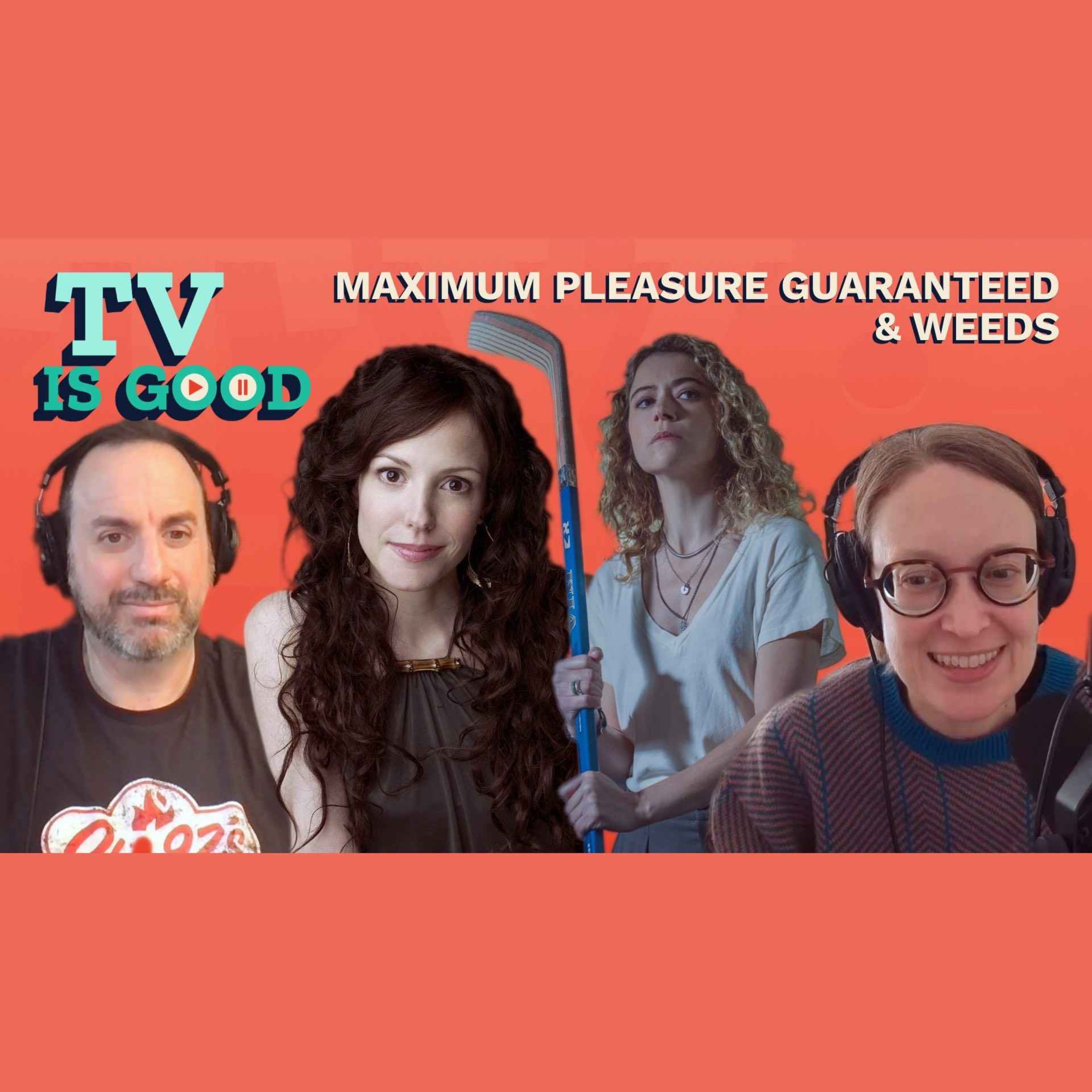
I'm very excited. And so the goal is, like the title says, we want to as much as possible, celebrate the things we love about television. And that doesn't mean that we're going to shine you on and we're going to talk about something that's mediocre and hype it up to be great, just to live up to the title. It's, you know, we're going to be honest with you. But as much as possible, we want to talk about the things that are good because there's a lot in the world that is not good. So let's find things that make us happy. And sometimes that will be, you know, in this episode, for instance, we're going to talk about Maximum Pleasure Guaranteed, which is the new Apple show with Tatiana Maslany. But we're also going to talk about Weeds, which is a great classic show from the 2000s. Oh, that's also fits into the mode of TV moms gone bad. So.
- [03:40]
B
Yes.
- [03:41]
A
And some weeks the two shows like that will be connected. Some weeks they won't. Eventually, we're going to have to do a whole long dissertation about Bottle episodes because you have me and Catherine working together. And some weeks you'll have a lot about the new show and a little about the old show and vice versa. It really depends on what is happening. And some weeks you may even have a third segment. We could go crazy here. So, like I said, today we're going to talk about Apple's new comic thriller, Maximum Pleasure Guaranteed, starring Canadian treasure Tatiana Maslany.
- [04:09]
B
And we're going to be talking about the classic Showtime comedy Weeds. And the reason that we were thinking Weeds would be a really useful way of getting, of adding and sort of expanding this conversation about Maximum Pleasure Guaranteed is that there is this whole genre of shows about moms gone bad, crime moms, if you will.
- [04:32]
A
Moms Do Crime Moms.
- [04:34]
B
Do Crime Moms. What if. What if they weren't maternal? Oh, no. So, yeah. So this is this conversation I'm really excited about, about doing this. But let's talk about Maximum Pleasure Guaranteed.
- [04:47]
A
All right. So Maximum Pleasure Guaranteed, it debuts on Apple on Wednesday, May 20, right?
- [04:56]
B
I believe that that is the case. Yes.
- [04:59]
A
Well, but here's the thing that's confusing and annoying as hell, especially if you're writing about television like we do, is Apple shows actually debut at like 8 or 9pm on the night before the official premiere date. And they never want to come out and say it. And I don't understand why.
- [05:14]
B
Yeah, so it, it comes out May 20th plus or minus 12ish hours or 3.
- [05:20]
A
I don't know. Anyway, you will be able to definitely see some of Maximum Pleasure Guaranteed by later this week. So let's explain what it is. First of all, Tatiana Maslany plays Paula, a recently divorced mom in Queens who works as a fact checker for a magazine called the Margin. She's having a custody fight with her ex husband, played by Jake Johnson, and she is lonely and horny. So she starts up a relationship with a camboy named Trevor. Seems harmless and fun until something bad seems to happen to Treasure Trevor during one of their private video chats and Paula finds herself pulled into a dark web of conspiracies and crimes. Katherine, what'd you think of Maximum Pleasure Guaranteed?
- [05:57]
B
I had a very good time with this series and I was concerned about several things going into it. One of them was I, as we'll talk about later in the Weeds conversation. This is a genre that I have seen some of before, and there are mom things that can happen in these kinds of, kinds of shows that make me a little bonkers that I find to be frustrating ways of representing the sense of like, what, what Momdom is and then being like, ooh, what if she's bad? And. And so I was concerned about the Camboy elements I was and whether and how it was going to treat sort of sexiness and horniness. I was a little curious about tone because sometimes these things, like I don't, I didn't want it to go full Barry, you know?
- [06:57]
A
Yeah.
- [06:57]
B
You know, you never know if it's just going to be like, I kind of wanted to enjoy this and instead it's a deep, dark slog.
- [07:04]
A
My Barry, Barry wasn't a slog. I think there's a lot of those shows that do get sloggy, but I look at Barry as like one of the ones where they got the tone kind of just right.
- [07:14]
B
Yeah, I didn't, I didn't want it to be quite as dark as Barry. Sure. Even when they are making me laugh in Barry, I am laughing in a way where I'm like, it hurts me so much. And I, it's hard for me to be here and I didn't want to feel quite that much pain in this context. The title, after all, does guarantee my Maximum Pleasure, and that felt like something that I wanted a little bit of at least my, my biggest concern Is that I think sometimes Apple Drama y things can get slow. You can have a feeling of, clearly someone pitched this as a feature, and then they stretched it out into 10 episodes.
- [08:00]
A
That never happens in contemporary streaming television. Catherine, I don't know what you're talking about, and I'm offended on behalf of all streaming creators who are failed screenwriters.
- [08:09]
B
No, I know. I know it's bad. And so that was honestly my biggest concern. And I think you and I had the exact same reaction, which was that we hit play in the first episode and went, it's only 40 minutes.
- [08:21]
A
Yep, yep. Some. Some episodes are close to 30. That's the best thing is, you know, we'll put on a screener and I'll see it's 63 minutes, and my heart sinks. And occasionally you'll get a show where it is worth 63 minutes, and I'm like, God, you know, I would watch 90 minutes of this. It's good. Almost nothing is. And so when you get something that's like, we are a half hour ish show and maybe a little bit longer. Great, you know, that's. You're not padding out the story, especially when you're doing, I think 10 episodes. Like, this is. It's get on, get off. Let Tatiana be horny. Let Tatiana be clever. Let her do some fun things, and then there's a crime of some sort, and then, you know, cut to the producer credit, move on to the next one. I really appreciated that. And I really like the pacing of it.
- [09:04]
B
Yeah. And I just want to be clear. Like, you could be like, yes, of course. You're TV critics and you complain when an episode is long. Like, you have a lot of stuff that you're trying to watch, and it's just more work for you. And that is true. But the reality is that when we turn on long episodes and they are like 70 minutes.
- [09:22]
A
Yeah.
- [09:23]
B
It is not a reflection of, like, oh, I don't want to be spending time with this show. It is like, probably that is an indication that nobody asked them to kill their darlings. It is a suggestion to me that nobody sat down and really put pressure on, like, whether we need every single one of these scenes and what they're doing and how to make this a more compact, concise, exciting thing.
- [09:47]
A
Yeah. I mean, you and I, we're work on separate books right now, and one of the books I'm doing is the Wire. And the Wire, all episodes are about 60 minutes. You want 60 minutes of that show because there's dozens and dozens of characters and you would not be able to properly service them without that. You're doing a book on Bluey. And Bluey installments are what, seven ep? Seven minutes.
- [10:07]
B
Seven minutes. Some of them are like six. Yeah, yeah.
- [10:09]
A
And I don't think you want. I mean, they did the one special episode that was 30, but I don't think you want regular Bluey stories that are 30 minutes.
- [10:17]
B
I do not. Other people may disagree. And I think one of the reasons that this show works well at this length and with this pacing is that it is not like the Wire. It is not a show that has a billion different plots, that it's all weaving together. It is really entirely about Tatiana Maslany's experience of this crime situation that she's fallen into. And so I think it's worth really talking about her and. And what this character and performance are, because it. Like, if that doesn't work, this show does not happen. Yeah.
- [10:51]
A
And she's a treasure. She is so good. Like, you know, I had never heard of her before. I watched Dorfin Black, and I got into, you know, to the end of that first episode, and I said, who the hell is this? You know, when can I get the next one? And that's a show that ultimately kind of spiraled into incoherence. And I stopped watching after a while, but I kept watching longer than I should have, just for her, because it's not just that she could play multiple versions of the same character. It's that she's so compelling. She's so, like, emotionally present in everything that she's doing. And so I've seen versions of this kind of show before. And we're going to talk about that in the next segment. And not just moms do crime, but dads do crime, or, you know, teachers do crime, whatever. And a lot of them get really tedious really quickly. And part of it is because I don't think that they have a good handle on who the main character is. And I understand immediately who Paula is, because the writing by David J. Rosen of her is really sharp. Some of the areas may be less so, but. And she is just so good. And I want to watch whatever it is she's doing. The opening scene, I think, is she's on her laptop talking with the Camboy, and she's in her kitchen, and she's brushing her teeth, and she's just moving around, and they're talking about nothing. And you don't even know initially what the relationship is about. And it doesn't matter because it's her like, that's sort of how it's a star vehicle that actually knows how to use its star.
- [12:07]
B
The thing about Maslani is she has all of these incredible colors in her voice. I think she, and, and her performance. And she can in. In Orphan Black, you watch her. The premise of that show, if you haven't seen it, is that she's many clones, and in some of them, she is like a soccer mom, not unlike the character that she's sort of trying to be in. In Maximum Pleasure Guaranteed. In some of them, she's like an assassin. She can do a bunch of different accents. And the magic trick of Orphan is how, how incredible. All of those women seem as different from each other. And I think one of the reasons Maximum Pleasure Guaranteed works as well as it does is she is able to have that same kind of shift happen for this character where it's like, she's being the mom, she's being her professional self. She's doing, like, crazy crime things, but you feel, she lets you feel the shift between them. As stressful as something that she is, like, able to be all these different kind of modes of who this person is. But it is also exhausting for her to have to toggle back and forth between all these different things that are happening in her, in her life. And that I find to be an incredibly compelling quality to why the show works as well as it does. I find a lot of the mom crime shows to be frustrating when it's like, I don't actually believe that you are the same person, or, like, it doesn't make sense to me that you were able to just walk back into your house with blood spatter all over you, and then. And then, you know, go on.
- [13:56]
A
And there's stuff she does in the show that's so incredibly stupid. Like, you just want to scream at the tv, like, no, call the cops here. No, don't do this. But, like, for the most part, I think they sell it. They make it feel earned because it's, you know, like, something happens when, when she's, like, has to step away from her daughter's birthday party.
- [14:15]
B
Yeah.
- [14:15]
A
And it's like, she should call the cops after. But no, she has to get back to the party. And she's just sort of, like, so disassociating that that's all she can think about. And I bought that.
- [14:26]
B
Yeah. I, I, There are moments where stupid. She makes stupid choices, and every single time those things happen, either the show itself or someone else in her life goes like, that was a stupid choice. And we have to, like, reverse this somehow. For instance, she gets into this whole scenario involving this Camboy. And I was very concerned that she was going to try to, like, keep this a secret from all of the people in her life for, you know, eight episodes of this show.
- [15:04]
A
Oh, I hate that. I hate it so much.
- [15:06]
B
I hate it so much. And when that is not what happens, I was so, so relieved because it is a bad idea for a number of reasons. One, you know, they will find out, like, no show, no story would ever have this not be a situation where it's like. And then they never found out the end. So you know it's gonna come. And by withholding it, you're only trying to extend this thing that I know will happen. And you're also making it harder for your protagonist to have conversations with people who question her and push back and help her and, like, feel connected to the rest of the world. And it's so important, I think, for a show like this, that she is not just solo wandering around trying to, like, stuff blood stained clothes into laundromat. Laundromats and then, like, turn around and cut up oranges for soccer. Like, you need.
- [16:07]
A
You need partners in this kind of show. You don't necessarily need a massive Scooby Scooby gang, but you need somebody, you know?
- [16:13]
B
Yeah.
- [16:13]
A
Unless it's Dexter where he's just talking to you in voiceover and you're his partner. You need some kind of sidekick in there. And she's got two in the other fact checkers at the margin. And we'll talk about the margin because I know you have some opinions on that, but. And that's interesting because on the one hand, I think the scenes with her, scenes with the two of them are really good. And then when we start following the two fact checkers in their own little stories, that's less exciting. Like, I want. It's a Maslany vehicle and I want her and I want other people involved with her, but I don't necessarily care about other people's lives that are not connected to her.
- [16:46]
B
Yeah, I mean, we should talk a little bit about the creator and other things that he's done.
- [16:52]
A
That is David J. Rosen. He wrote for Sugar, our favorite show of ours that we're gonna hopefully talk later this summer. He wrote for Citadel, one of the worst shows that either Katherine and I ever reviewed. He was not the creator of that. He wrote for the odd Cameron Crow Showtime series, Roadies. He created a series called I Just Want My Pants Back that was produced by Doug Lyman for MTV about 12, 13 years ago. So between I Just Want My Pants Back and Maximum Pleasure Guaranteed, this guy does not believe in small and subtle
- [17:22]
B
titles, which is fine. That's fine with me. And I will say, like, that from my perspective is not the most confidence building list of TV shows.
- [17:35]
A
It's not. And that's always a concern for me. It's like if you, Yeah, I, you know, I'm sort of a trust but verify where, like, give me a showrunner who's done it before or at least give me a new showrunner who's written for like really good shows and worked with really good showrunners. That excites me. If it's either a first time TV writer, period, who's just a screenwriter who doesn't know how to write for tv, that's always a warning sign. Or if it's someone whose resume is a bit sketchy like this, it's a warning sign. And yet I thought this was for
- [18:06]
B
the most part really good, really well done. And, and when it's making choices that I didn't like, it doesn't stay with them for so long that you're like living in this, this entire thing that you just hated the initial choice and now you're stuck in it for six episodes.
- [18:24]
A
Yeah, I just finished writing about the new season of Daredevil Born Again. And it's like they've got this one story that they've been telling for two seasons and you are trapped in it and a lot of it ain't working.
- [18:35]
B
Yeah, yeah, yeah. I think also the, the way that this show stitches together the family tension there. So she has a lot of family tension with her daughter and her ex husband who's played by Jake Johnson. And he is, there are a couple of scenes with him where he slips into like new girl mode and it is so compelling. And yet also you're like, I, that is one of the few relationships in this show that I kind of never understood because he obviously wants to just be like her funny friend who's like, man, what are you doing? How did you get involved in all of this? And then he like, you know, he wants to go kooky and then the show has to keep kind of reigning him back into like, but probably you shouldn't have custody of our daughter. And every time it happened I was like, I don't, I don't believe this guy actually doesn't love this woman and wants to be with this intense, straight laced, like, other woman he's marrying and wants to move To Utah.
- [19:46]
A
Jesse Hodges, who's Jake Johnson's new wife, is kind of the real villain of the piece.
- [19:50]
B
Ye. Yeah. And every single time she's like, why do you want to move to Utah? And he's like, no, no, no.
- [19:56]
A
Boise, Boise, Boise, Boise.
- [19:58]
B
Excuse me. Jake Johnson is like, I don't know. It seems like a good idea and it just. It never quite sells.
- [20:05]
A
Yeah. That senior, that first scene you're referring to, where he's being interviewed by the cop played by Donna De Leon, who's really delightful. Dolly De Leon, who's really delightful in it, and he starts going full Nick. It was just like, oh, that's the guy I love.
- [20:19]
B
And that's the guy.
- [20:21]
A
Yes. And when he's being the scold, that's just not a good use of Jake Johnson.
- [20:24]
B
No, no. I mean, if it is, I can kind of believe that there's a weaponized charm in him that you could make be quite sinister and evil. You know, you could take all of that fondness and turn it into something that's really creepy and crawly and upsetting. But if you are trying to play him as sinister and then you also let him be fumbling, cuddly, it it not. None of the pieces really add up. Even then, even as I was watching it and thinking like, this makes no sense, I was like, oh, he's. He's so fun to watch, though.
- [21:03]
A
I'm.
- [21:04]
B
I'm not mad at it. It just doesn't make sense.
- [21:08]
A
Yeah, he. It's. It's more of a straight character than you necessarily want from a guy whose specialty is being weird.
- [21:14]
B
Yeah. Yes, I think so. I think that's right. I really like Dolly De Leon as the cop with a lot of sort of straightforward, no nonsense energy. Except she's clearly also a weirdo in ways that the show just kind of gently sprinkles into the background.
- [21:37]
A
It is just the right amount of that. I don't want a whole show about that character. But she is a very good accent.
- [21:43]
B
Yeah. Yes. She's obsessed with sports betting in a way that I sort of tracks, but feels just enough in Congress that I think it makes sense. And I mean, I think it's probably time to talk about the most important thing about this show.
- [22:07]
A
Fact checking.
- [22:08]
B
Yeah. Generally with a show like this, the protagonist is in some way extraordinary, and the show is about the fact that that protagonist is extraordinary. Sometimes the extraordinary thing is just like they're the most ordinary person in the world. Sometimes it's like they're a superhero. Sometimes it's like they're a cop and they're good, but bad. And in this case, the thing that this show is telling me is extraordinary about Tatiana Maslany's character is that she is a regular mom, a single mom, and that she is involved with the crime syndicate and the Camboy and the sub conspiracy goes all the way to the top. But actually the most extraordinary thing about this woman is that she is one of the last employed magazine fact checkers in the world. How is this not a show about like the last bastion of what it is like to to be paid to prove that things are true or false?
- [23:09]
A
Ah, man. When I worked at Rolling Stone, I loved our fact checkers. And I was so like appreciative that they still had that department when so many places are getting rid of it. And the margin newsroom seems real robust to me.
- [23:22]
B
Yes, they have a three person fact department. And the other fact checkers are her sort of possibly frenemies, possibly partners, possibly nemesis. You never. That sort of shifts throughout the season in a way that I think works really well. I also really like it as that classic thing where so Tatiana Maslany is both detective and criminal in this show.
- [23:55]
A
Yes.
- [23:55]
B
And often the detective figure in TV is like, they're a detective magician, they're a detective doctor, they're a detective house contractor. And that's how they know all of the clues in why the nails are bent. Or if you watch the Comeback, Detective Gardner Mrs. Hat. In this case, like detective fact checker is such an obvious good fit, you know?
- [24:24]
A
Yeah. A lot of the time when you get the character who puts up the murder board, you're like, well, where's. How are they making these connections? And you totally get where this is coming from. And she's. And she does these clever things that don't seem too clever. Like she gets a hold of somebody, one of the criminal's phones, and she can't unlock it because she doesn't know the passcode. But then she figures out a workaround and it's a very smart and simple workaround that I 100% believe somebody in her position would have come up with.
- [24:49]
B
Yes, you bring up the phones. And so I do need to mention an element of this show. It is an Apple show and as such is full of Apple devices. And often that is annoying. You're just aware of how much in an Apple show the plot hinges on people imessaging each other or like faced important like load bearing FaceTime scenes, you know what I mean? And in this show there is Some of that she's on a computer a lot, tippy, tippy tapping on those Mac keyboards. But the apple centric device that I found almost too effective in this show is that she keeps getting called with an apple ringtone. And every single time it is something else stressful that is happening in her life. And just the repeated like. And I was like, no, just leave this woman alone. And it is because that sound is also carved into my brainstem as like, please stop contacting me. Do not have time for whatever this is. And I found it effective.
- [26:02]
A
So the last question I got about this show is, and it's another sort of plague of modern television is you get the thing that should be a single season close ended story. And then there's a setup in the finale. Oh, this is how a second season would work. Did you feel like the setup at the end of this season made you want to watch a second season of Maximum Pleasure, guaranteed?
- [26:22]
B
I don't think the setup made me want to watch a second season of Maximum Pleasure, guaranteed. I think Tatiana Maslany and Jake Johnson and Dolly De Leon made me interested in watching a second season of this show. But I found this setup to be like,
- [26:43]
A
yes, I'm, I'm. I'm with you. I'm like, okay, I guess this is the way that they have to do it. But it's more, you know, if it's a Maslany delivery vehicle, I will accept that.
- [26:53]
B
Fine, fine, fine. I don't care at all about this thing that you are telling me is very important, but fine. Having now considered this show about a soccer mom who keeps running into the cops all the time, I started thinking about. We both started thinking about the history of this genre on tv. And there's this whole trajectory of Mom's Gone Bad television. It's been a kind of a mainstay of premium cable and streaming. And one of the things that I think is really curious about that is that we have this dividing line. It's. It's not sharp, but this rough dividing line between the sort of network era of what television is and the premium and eventually premium cable and eventually streaming era of television that tends to be about difficult men. Right? It's like we used to all have. Everybody used to have to be a hero on network television. And then we have premium cable and streaming shows. We can have the Shield and we can have Sopranos and we can have the Wire. Our heroes don't have to be a celebratory. They can. They can be these nightmare people and almost always the shows that we associated with that era are dudes, but there has been an almost cont, like, simultaneous background thread of being like, what if the women were also bad?
- [28:26]
A
Women can't be bad. Catherine, what are you talking about? Men are allowed to be bad. Only men.
- [28:32]
B
And I think it's. I think it's interesting, first, that there is a pretty healthy selection of shows that have been playing with this idea. Second, that they are never the shows that we think of as like, defining what prestige television is.
- [28:50]
A
Correct.
- [28:52]
B
And I think, third, that they tend to be. Not always, but tend to have been shows that have to have this comedic gloss to them. They are more likely to be this like, half hour, sad trauma comedy kinds of things. They don't tend to get the full hour long sprawl that the Difficult Men do. And they are not forgotten, but definitely not canonized as like, typical of this era in the same way that Sopranos, et cetera.
- [29:31]
A
I feel like I'm being attacked because I wrote a whole book about this era called the Revolution Was Televised, which is pretty much all about the dude shows. So maybe I should be attacked. Maybe. Yeah, maybe I'm the difficult man as well.
- [29:44]
B
I mean, it's. It's food for thought is all I'm saying.
- [29:48]
A
No, you're absolutely right. And I think, you know, I think of something like Nurse Jackie, which is another one of these shows which was half an hour, you know, I. What my buddy Matt Zoller Seitz refers to as a comedy in theory, where like, you know, Edie Falco goes and wins an Emmy for it and goes up on stage and says, I don't understand this. I'm not funny at all. And that show was very good at times and not at other times. And I mean, Weeds was the case as well, and we'll talk about that soon. But a lot of the canonized shows could be uneven as well. Yes, some of them are really good for a while and some of them fall off a cliff. And when you get your breaking badge, your wires, which are pretty great all the way through, that's unusual for any kind of tv. So. But for whatever reason, because our society is the way our society is, we value men over women and we value drama over comedy. And a drama is more important and a show with a man is more important. So if you have a drama with a man, automatically that's up here. You know, the lady show is down here.
- [30:49]
B
Yeah, I think there's something else about it too, which is we associate the masculine protagonist with a career or a Calling in a way that is functional for television. Right? It's like, he's a bad man doctor, He's a bad man teacher. You know, he's a bad man mob guy. That's his job. Whereas the mom shows, I mean, Nurse Jackie, you can see the strain of it being like, okay, she's a nurse. She's a bad, bad nurse. And then it's like, well, she can't. She can't be, like a young mom because that. How does she do that? Then we have to do, like, her character, like, all the family drama. How does she take care of all that? Doesn't make any kind of sense. And. And Weeds, as we'll talk to, really struggles to understand how to integrate family drama with event, with Nancy Botwin's chosen career. And. And I do think there is something that seems to short circuit a little bit in the how. In the how to stitch all of these things together when it becomes female protagonists instead of men, which I think is, you know, another, like, zero percent surprising thing about culturally, how we. How we portray men versus women.
- [32:14]
A
And part of also of it is like, if you look at the protagonists of the Difficult Men show, some of them are, like, you know, what you would call conventionally attractive. You got your Dominic west, for instance, but, like, you can have Bryan Cranston in his tighty whities, and he is a master of the universe. You can have Jim Gandolfini, who ultimately some people did find super attractive because he was the most charismatic man alive.
- [32:38]
B
He is hot. What are we talking about?
- [32:40]
A
But you know what I'm saying, like, he's. I do. Oh, he's unconventionally hot. Whereas these shows, like Mary Louise Parker, like, every man has to be in love with her and justifiably so. Like, a lot of these shows are just. It's not just Moms do Crime. It is hot Moms do crime.
- [32:56]
B
Hot Moms do crime. Yes. And in case you're thinking, like, what other shows are they even thinking of? I don't know what they are. A list of things that sort of came to mind as we were talking about them. Orphan Black sort of is a part of this Smilf.
- [33:13]
A
There was a TV show called Smiling
- [33:16]
B
TV show called Smilf, and I think we need to all remind. Remind ourselves that that did exist. Physical on Apple is also Rose Byrne doing Mom goes bad.
- [33:27]
A
Mom goes aerobics, then goes bad.
- [33:30]
B
Yes, well, her job took over her life. See, this is exactly the problem dead to me on Netflix. The Good Girls, which is a network show, but sort of exists because shows like Weeds came first. I will say also, Desperate Housewives is really one of the important forerunners of this, of this genre. And then there you get sort of interesting other related things like Big Little Lies, like Kevin Can Fuck Himself. Bad Sisters. I said the full word. I'm not.
- [34:03]
A
That's. The title is Bowlerized. Katherine, I don't know what you're doing over here.
- [34:08]
B
Yeah, and I, I think, you know, there are differences that are. That are notable in all of these examples, but as a collection, they tend to be teasing some of the same. Same big ideas. Okay, so talk to me about Weeds. Where did, what happened? Where did Weeds come from?
- [34:28]
A
Weeds was created by Ginger Cohen, who would later go on to make maybe the best of these kinds of shows. It's not quite Moms Do Crime, but it's Women Do Crime. It's Orange Is the New Black, which got to be an hour because, like, the Wire had a million cast members. And that could be an incredible show. This was a fantastic show for several years. And so it's. Mary Louise Parker plays Nancy Botwin. She lives in the planned California community of Agrestic. Her husband has recently died. She is at sea. She's underwater financially. And she figures out the way that she's going to make money is she is going to sell pot. And this was back in the days before legalization. Although there's an episode early on in the first season where she has to go to a medical marijuana dispensary and realize that her business model is already endangered. And so the first three seasons of the show are Nancy in this suburb dealing with, you know, her troubled sons, who are also grieving the loss of their dad, dealing with her sort of the. The queen bee of the neighborhood. Celia, played by Elizabeth Perkins, wonderful. Justin Kirk, eventually shows up as. As her late husband's brother, you know, who's always causing trouble as well. And you've got Kevin Nealon, as, you know, one of her top clients. And her financial advisor, Romani Malko plays one of the members of the family who is selling her the weed in the first place to sell to the suburbanites. So there's a lot there going on. And also she's always. Is she drinking iced coffee? What is. Or is it Jamba Juice? I can't remember now.
- [35:54]
B
I can't either, but I mean, either one. Iced coffee is kind of the.
- [35:59]
A
Yes. In every scene, she's sort of like, you know, John Chen on the pit. She always has to have a big cup and a straw in her hands at any given moment, otherwise you wouldn't recognize her. So what is great about Weeds, Catherine?
- [36:11]
B
Weeds was one of the first examples of these half hour shows where you got to play with. Oh, you know what I just remembered? The United States of Tara.
- [36:22]
A
Yes.
- [36:23]
B
Shows, half hour shows where your mom, your mom is not trustworthy as your mom and how do we even function if that is the case? And they were contemporary with each other, these two shows, and they were early examples of what then became one of the mainstays of like current streaming television. The like half hour. Is it a comedy? Is it a dark drama show? And Jenji Cohen's tone is really palpable here and becomes then the, the major feature of Orange is the New Black, which then sort of defines the whole run, like long running tradition in, in streaming television. Nancy Botwin. Mary Louise Parker is incredible.
- [37:15]
A
Oh my God.
- [37:16]
B
Like, really, it's really what it comes down to. It is very funny revisiting the first episodes of this show because she's so herself. And I remember watching this show at the time and being like, like, it's so dark and perverse and fun that she sells pot. And now I'm just like, is so naive.
- [37:41]
A
How quaint.
- [37:42]
B
It's so quaint. Like, she's got these baggies of, of pot and they're like, everyone's like, oh God. I mean, it's.
- [37:49]
A
And she can't let Elizabeth Perkins find out no matter what, otherwise everything is ruined.
- [37:53]
B
The. The whole charade of the suburbs will fall down. Yes. So that, that stuff. It's really crazy to take your mind back to a time when it felt that subversive to be selling and consuming marijuana. I think the other thing is that she is like Tatiana Maslany, but in a very different expression of it, able to feel like she is playing in these like, suburban, uptight mom spaces, but then translates incredibly well into when she has to be vicious and brutal and intense in these, like, crime settings.
- [38:39]
A
Yeah, no, she always, she always sort of seems like amused in every situation, but it's. You recognize very quickly how much of that is a cover because she's also grieving, but she's also really desperate. She needs this money, she needs this to go work. She's just in so much trouble in so many ways. And as happens in all of these kinds of shows, it's like you make, you go down one step along this path and suddenly you're now going to roll down 50 more steps and you just, you cannot get back to the start of it. And That's. I mean it should be a cliche, but this is one of the ones where it really works. And you know, as with Maslany on Maximum Pleasure Guaranteed, it's. If you don't have the performance, none of the rest of it matters.
- [39:18]
B
Yeah, 100%. 100%. I did not realize that in picking this show I we would be destroying my mental health.
- [39:32]
A
Oh, I'm so. Well, first of all, congratulations. You played yourself because I believe you were the one who picked this.
- [39:37]
B
I did as a parallel and explain
- [39:40]
A
what happened to you.
- [39:41]
B
What I had forgotten was that while Weeds was on the theme song. Not the theme song, the opening credits song of that they play over this graphic of sort of suburban houses is one of the most ear wormy things that I've ever experienced in my entire life. And when it was on, I would be like, I could not escape it. It was there in my head all the time. And for years after this show ended, it would still show up sometimes. Like was truly cockroach esque in its ability to just like survive and thrive in my head. And the second, the second that I hit play, I have been, as I think I texted you, clean and sober on the Weeds.
- [40:34]
A
Yep.
- [40:35]
B
Credit song for at least six years. And it's the, the moment that I hit play, I was back with the little boxes on the hillside. Little boxes made of ticky tacky. And I. And I don't know when I will.
- [40:49]
A
How.
- [40:49]
B
How long will this relapse take me?
- [40:52]
A
You know, I was so happy. I was driving in a car with my daughter somewhere and you know, we're getting it through the carplay and I'm. It's. Siri's reading out your distress about this and I just, I just, you know, talk to. Texted back little boxes on the side. Little boxes made of ticky tacky. And my daughter turns to me and says, dad, you're mean.
- [41:12]
B
I think it must have just been me being like, God damn it. God damn it. Here is what I will say about that thing about that song, though I do think it was incredibly smart. Aside from the fact that it is also psychological warfare, an incredibly smart tone setting choice for what that series is. Because so often I think these shows work best when they are playing up something about how impossible and false this entire kind of mom environment is. And in the case of Weeds, it's really interesting in the idea that suburbia is covering up all of this darkness that nobody wants to see or admit to. And the, the way that that song immediately conveys how fake And Samey, everything is on the surface. Means that the second you then see Mary Louise Parker as Nancy Botwin, you're like, oh, yeah, no, this is all she's not made of. Ticky, tacky. She's not like those people. It's. It's so. So incredibly compelling as a way of dealing with, like, this is why this setting is interesting, and here's how we're gonna feel about it.
- [42:34]
A
But I want to dig into that because I think the theme of the suburbs are not what they seem like. That's everywhere, and that can be done so badly and so tritely. And, you know, American Beauty won a fricking Best Picture Oscar for doing the worst, most obvious version of that.
- [42:51]
B
We do not have time to get into the many problems with American Beauty.
- [42:54]
A
But, yes, that's okay. I'm getting this way off topic. So let's go back to Weeds. I agree with you. I think Weeds does it really, really well. And it's. I don't like a lot of these. I roll my eyes, and I feel like these are things being written by people who either do not actually live in the suburbs or move to the suburbs against their will and are just sort of hostile about it. And this feels very lived in to me. And while some of the characters, like Celia, are a bit larger than life, nobody feels too cartoonish or too caricatured. So what do you think it is that Ginger Cohen is nailing about this idea that allows it to feel interesting and not like the oldest, you know, boringest cliche that there is?
- [43:33]
B
I think part of it is this desperation of it. I think often when these shows are like, the suburbs are fake. It's just sort of the difference between the external and then how actually screwy everyone is in the background and you're like the. It is a little bit like the political thing where you feel like you point out the hypocrisy and that's going to be enough. And we're all going like, oh, no. Like, you're right. They were lying this whole time, the end. And what. What works so well about Weeds is how absolutely frantic she is while never being able to sort of show that on her face. And also the. The incredible performances from the kids, actually, which. There's really. It's unusually good kid performances, and they're so.
- [44:29]
A
Alexander Gould.
- [44:31]
B
They're so sad and so messed up.
- [44:34]
A
Yeah.
- [44:34]
B
And that's.
- [44:34]
A
And that's a thing I think that they do really well, is they. Some of these shows do not really want to deal with the ways in which the bad mom or the bad dad is affecting the kid. Like Breaking Bad. Perfect show. There's, like, Walter Jr. You ultimately see, like, this upsets him, but it is not nearly to the degree and the. On an ongoing element in the way that it is here with Silas and Shane.
- [44:57]
B
Yeah, yeah. I mean, the Americans, I think, is another show that sort of is interesting in this context and that.
- [45:03]
A
Can we do a whole episode about the Americans, Catherine?
- [45:05]
B
Yes, of course. Obviously.
- [45:06]
A
Okay. God damn. All right.
- [45:09]
B
But. But without those. Without that kind of emotional grounding, it, you know, it feels like you're just pointing out something fairly, fairly empty. I also think it is legitimately funny. Like, they are perpetually finding absurd ways of getting Nancy into scrapes and then trying to extricate her. And so the tone never slips too far into, like, grim. Well, eventually it does, because this show does go wildly off the rails where
- [45:43]
A
we're getting to next.
- [45:44]
B
Yeah. But in the beginning, when everything's really cooking, like, it understands quite well how to live in all of its tonal spaces.
- [45:54]
A
Okay, so let's talk about this. That one of the among the many. And I feel weird saying this because again, our show is called TV is Good, but there are a lot of problems with current tv. And another of those is shows are too short. Seasons are too short, and there are not enough seasons of a lot of shows at the same time. Certain stories you do not necessarily want to run for 20 episodes a year for seven, eight years. And Weeds is kind of an example of that. They did. We're going to get into some spoilers here. They did three seasons in Agrestic in the suburb. And then at the end of the third season, Agrestic burns down. And after that, Nancy and the family keep moving to different locations, different places, getting involved in lots of different kind of trouble. And while I admire the boldness of what Cohen was doing there and just sort of trying and not because I think if the show had stayed in Agrestic, it would have just become boring and it wouldn't have worked at all. So I understood what she was doing. I don't think most of it worked. And now, Catherine, how much do you remember of those later seasons? There were five of them.
- [46:59]
B
I think almost nothing.
- [47:02]
A
Okay. All right, so what I'm going to do now is I'm going to give you a true false quiz on things that happened in the post Agrestic seasons of Weeds. I'm going to tell you a plot point. You are going to tell me if it actually Happened or not? Are you ready?
- [47:18]
B
Yes.
- [47:19]
A
Okay. Number one. Nancy gets pregnant with the child of a Mexican drug kingpin.
- [47:26]
B
I think this happened. I think this happened.
- [47:28]
A
This did happen.
- [47:30]
B
Great. Great.
- [47:30]
A
Okay. All right. One for one. Okay.
- [47:32]
B
Yeah.
- [47:33]
A
Number two. Nancy's younger son, Shane, murders a Mexican politician with a croquet mallet.
- [47:43]
B
That's so stupid. He. He definitely murders people. But did he murder someone with a croquet mallet?
- [47:51]
A
He murdered her with a croquet mallet, and she fell into a swimming pool.
- [47:55]
B
No, that can't be real.
- [47:58]
A
I'll send you the link after it absolutely happened.
- [48:02]
B
What?
- [48:03]
A
Okay, number three, Celia is kidnapped and held for ransom, but nobody cares enough to pay. That.
- [48:10]
B
I remember that I remember happening.
- [48:13]
A
Okay.
- [48:13]
B
Yeah.
- [48:14]
A
All right, number four, Nancy moves the family to Manitoba, where she sells weed through her cover job running a bait and tackle shop.
- [48:24]
B
No, that's not real.
- [48:25]
A
You nailed that. I originally want to say lumberjack, but that was going to be too. Obviously.
- [48:29]
B
That one's not real. No.
- [48:30]
A
Okay. All right. So clearly I'm not as creative a writer as the people making the later seasons of Weeds.
- [48:35]
B
I mean, the. The. The croquet mallet. Like what?
- [48:38]
A
Yes. Okay, number five, Celia begins dressing up as Nancy so she can sell weed.
- [48:48]
B
Um, I'm gonna go with true.
- [48:53]
A
True. That happens.
- [48:54]
B
Yes.
- [48:56]
A
Yep. All right, number six, Silas develops. Silas, the older son, develops an addiction to chat roulette.
- [49:10]
B
False.
- [49:12]
A
It is false. Chat roulette. Chat roulette was born around the time that the show was on.
- [49:16]
B
So, yeah, yeah, yeah.
- [49:18]
A
It absolutely could happened.
- [49:20]
B
Could absolutely have happened. Yeah.
- [49:21]
A
All right. Okay, number seven. We got two more. Nancy goes to prison for three years at the end of one season. And while she's gone, the rest of the family moves to Copenhagen.
- [49:32]
B
Isn't that what happens in Barry? No, that's got to be false. That can't happen.
- [49:38]
A
That absolutely happened. No.
- [49:41]
B
Why do they speak Danish? What?
- [49:44]
A
I. I think. I don't think we actually see much of them in Copenhagen. It's just. She goes to prison, she comes out in the new premiere, and you find out that Justin, Kirk and the sons were in Denmark.
- [49:54]
B
But again, do they come back speaking date? What?
- [49:58]
A
What is this?
- [49:58]
B
The bear?
- [49:59]
A
I don't remember. I do not remember. I'm sorry.
- [50:02]
B
Are they pastry chefs now?
- [50:05]
A
Okay, last one in a throwaway line. In the series finale, we find out that Celia's younger child came out as trans years later.
- [50:16]
B
Gotta be true, that.
- [50:17]
A
Absolutely. 100%.
- [50:18]
B
Gotta be true. 100%. Yep, yep, yep, yep, yep.
- [50:21]
A
Trans. Off screen. Very, very classy.
- [50:24]
B
Honestly, that's inspiring. I feel like this is a quality of television that we've lost. You know what I mean?
- [50:32]
A
Yeah.
- [50:34]
B
And. And I'm not ready to say that it's good that we lost it because. Because he killed somebody. He killed a Mexican politician with a croquet mallet.
- [50:45]
A
Yes. No. You want to be able to talk about these things. I mean, even Dexter Lumberjack is like, you can talk about that. On Friday Night Lights, Landry killed a dude and, you know, disposed of the body and nobody ever talked about it again. Yes, but we saw it, and we can. We have that shared cultural experience. We know that we're better for it.
- [51:04]
B
Landry's a murderer.
- [51:06]
A
We're just spoiling all kinds of old TV here without any warning whatsoever in the future. This is our first episode. A lot of trial and error. We will do our best to prepare
- [51:14]
B
you for everything, but I'm not going to apologize for telling you that Landry is a murderer. That one's. That one I'm okay with.
- [51:23]
A
Okay, so that is Weeds. That is Mom's Gone Bad on tv. Moms Do Crime tv, however you want to refer to it. Next week we will be talking about Star City, Apple's new spin off of For All Mankind. We will all set in Russia, but nobody speaks Russian. We'll have to get into that. And we'll also.
- [51:42]
B
Nobody has any feelings about that.
- [51:43]
A
No, I have no feelings about that whatsoever. We will also get into a little bit about what's going on with For All Mankind itself this season. And because For All Mankind and this show were co created by Ronald D. Moore, Catherine is going to attempt to explain Outlander to me. I've only seen the first season. I need to hear about everything that's happened since then. You yourself do not have any homework to do this week. Some weeks you will. This week you don't need to know anything about Outlander. We're just going to talk at length about it. But if you want to, you absolutely can.
- [52:12]
B
I will be giving Alan a similar quiz to the one I was forced to take today.
- [52:18]
A
Oh, God. Oh, God. And he.
- [52:20]
B
Well, he hasn't seen it. He just has to guess.
- [52:22]
A
Yes. All right. Katherine, was the TV good this week?
- [52:26]
B
Yeah, it was. It was a good TV this week.
- [52:29]
A
All right. I'm very happy about that. If we've done this right, you should be able to subscribe to TV Is Good. Wherever you get your podcast. You can also Watch us on YouTube at TV is Good Pod. Follow us on all the socials on
- [52:41]
B
@TVIsGoodPod we are gonna be launching a Patreon sometime in the next month and the idea is that we're gonna do one bonus episode a month doing deeper dives into some subjects. And I think we're also planning on doing like DVD style commentaries on some of our favorite episodes where we sit down and watch things that we really love and talk about, you know, recite all of the lines. Everyone will love very much that we talk completely over all of the favorite parts. But I think it like we have a lot of feelings about some of these episodes that are going to be fun to just sit and revisit together.
- [53:22]
A
Catherine, I have to ask you, you respect Jesus and not us?
- [53:28]
B
Yes, that is right. So that's going to be at. That's@patreon.com tvisgoodpod we're gonna have more details about that in a. But if you want to go there and get ready and think about supporting us so that you can also then help us decide what episodes and deeper dives we need to be watching and thinking about, that is where that's going to happen and it's going to be so good.
- [53:57]
A
Yeah. We want this to be a collaborative thing and obviously there's, we both know a million shows and there's lots and lots and lots we can talk about in the weeks and months and hopefully years to come. All right.
- [54:08]
B
Yes.
- [54:08]
A
When we are not podcasting, we are also writers. You can find me@whatsalan watching.com and katherine@vulture.com I'm at.
- [54:18]
B
I'm on Blue Sky. It's. I don't know if you've heard of it. It's. It's a weird sort of social media experiment full of totally normal people. But I hang out there way more than I should. So if you are interested in that, I am at Cave and Aaron there and I on Instagram. Avanarandonk.
- [54:41]
A
Yeah, Blue sky is sort of like remember good Twitter or at least goodish Twitter. It's sort of like that. I'm there as well. I'm also on Instagram and threads@seppinwall. I am on Facebook at Alan Seppenwall.
- [54:54]
B
So please help us out. It's. We're a new podcast. We are really excited to be here. We're really excited to find all of you and hope connect. Hope we can connect with all of you. The best way that you could help us do that is if you rate an review and subscribe to this podcast so that other people can help find it. We, we are pretty significantly anti algorithm and we.
- [55:26]
A
We hate the algorithm.
- [55:27]
B
Yeah. And the only way that we can connect with real people is, unfortunately, if you help us participate in the process of connecting with real people. So if you could do us a solid, we. We would be grateful.
- [55:41]
A
Yes, we would. We hate the algorithm, but we love tv.
- [55:44]
B
Thanks to Joe Kennedy for our theme music and Kate Bergener for our artwork and Riley Routh for editing.
- [55:49]
A
Thank you for listening.