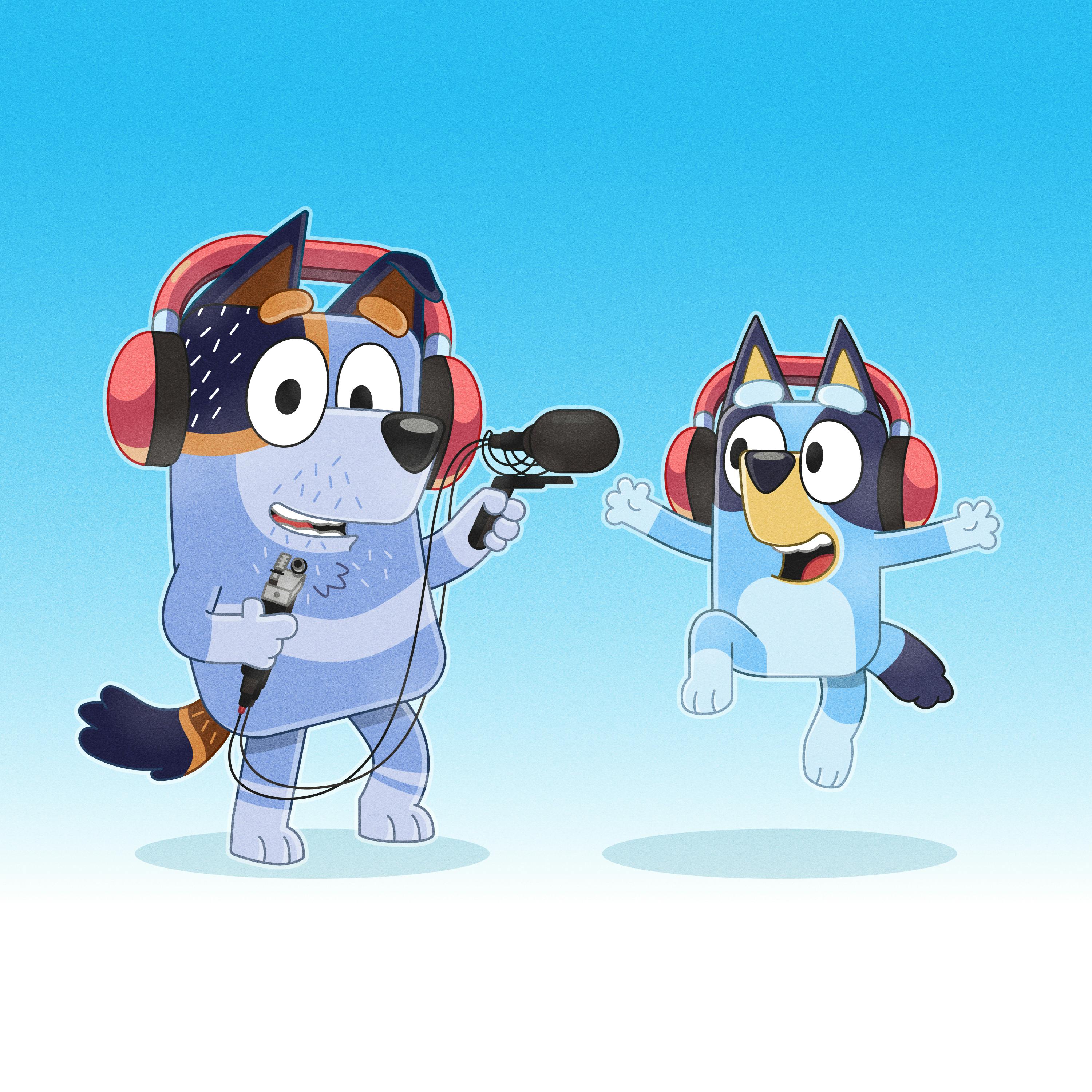
Loading summary
Transcript144 lines
- [00:00]
Dallas Taylor
You're listening to 20,000HZ. I'm Dallas Taylor. As the father of three young daughters, I end up watching a lot of kids shows. Now, some of these shows are clearly just meant to appeal to kids, but there's one kids show that I like just as much as my girls do, if not more. This show has made me laugh out loud and sob uncontrollably more times than I can count. It's an animated series from down under called Rodney. Can you tell me what Bluey is about?
- [00:35]
Child
It's about a family of dogs living together in Australia.
- [00:40]
Dallas Taylor
That's my 11 year old.
- [00:42]
Child
Kind of like an ordinary, not ordinary family who like go on big adventures, except not too big.
- [00:51]
Dallas Taylor
My oldest daughter is now a few years older than the kids in Bluey, but she still loves the show, as does my 8 year old.
- [00:58]
Child
My favorite character is Muffin because she's crazy like me.
- [01:05]
Dallas Taylor
Crazy like you. And there's the youngest, my four year old.
- [01:10]
Child
I like it because I watched Bluey when I was born.
- [01:21]
Dallas Taylor
My family and I discovered Bluey about four years ago and we've been obsessed with it ever since. If you're a parent of a younger child, you probably know this show too. Since its debut in 2018, Bluey has been broadcast in 160 countries and dubbed into 20 different languages. In 2023, it was the second most streamed show in the US and over on IMDb, it's the 14th highest rated TV show of all time. The show is about two dog parents named Bandit and Chilli and their kids, Bluey and Bingo. The episodes are usually only seven minutes long and the stories typically center around the imaginary games the kids invent. There's often a small moral or message, but it's never really heavy handed. Great works are performed not by great strength, but by perseverance.
- [02:10]
Child
Hang on, are you trying to teach us something?
- [02:14]
Dallas Taylor
One must persevere. Aw, he is for me. I love how Bluey shows a version of parenthood that's sweet, but also very realistic. Bandit and Chilli often have bags under their eyes as they try to keep up with their kids. Endless games.
- [02:29]
Child
Can we play delivery chair?
- [02:30]
Dallas Taylor
No, no.
- [02:31]
Child
Oh please.
- [02:33]
Dallas Taylor
Oh, don't use your please face. Oh, right, yeah.
- [02:39]
Child
Bingo. Delivery chair.
- [02:41]
Dallas Taylor
The please face gets me every time.
- [02:45]
Dan Brum
Parenting is a very unique adventure.
- [02:48]
Dallas Taylor
That's Bluey's sound designer and mixer, Dan Brum.
- [02:51]
Dan Brum
It's tough and it's really emotional and you love these kids but you also sometimes you're a bit tired and the games are crazy and the adventures are wild. And that's just represented so sincerely on screen.
- [03:07]
Dallas Taylor
Dan also happens to be the brother of Bluey's creator and main writer, Joe Brum.
- [03:13]
Dan Brum
A lot of the games were straight out of games my brother created to play with his kids. He came back to Brisbane and started a family and he had young kids and he realised just the absurd games that you play with these young kids to keep them entertained and to have fun with them. And so he thought that that would make a great kids show. And you know, he was obviously right.
- [03:36]
Dallas Taylor
But of course it takes more than just a great idea to get a show off the ground.
- [03:42]
Dan Brum
This all started off as a fairly guerrilla operation. A small production company, ragtag new animators. A lot of them were straight out of university and it was very low budget because it was such an untested, unproven show. So low budget that I was the only sound person involved.
- [04:00]
Dallas Taylor
That means one person to gather all the sound, carefully craft it for each episode and then mix it in with dialogue and music. On top of all that, Dan's also a parent of young kids himself. Let's just say it was a lot to juggle.
- [04:14]
Dan Brum
Looking back now, it's crazy. There should have been a team of me because it was such a hectic schedule as 52 episodes in that first season, one per week for sound design, music mix and final mix and corrections.
- [04:29]
Dallas Taylor
With that kind of time crunch, you might think that Dan relied on a lot of pre recorded sounds, but he actually took the opposite approach.
- [04:36]
Dan Brum
I tried to record my own sounds because I wanted this show to feel original and I wanted it to feel natural and warm and organic. So that on one hand you've got a stylised picture and the second hand you've got realistic audio.
- [04:53]
Dallas Taylor
Dan still remembers when he first saw the show's animation.
- [04:57]
Dan Brum
It's so beautiful, the art is so amazing and they've represented my city so well.
- [05:03]
Dallas Taylor
Bluey is set in Brisbane, where Dan and Joe grew up.
- [05:07]
Dan Brum
So I feel this duty to embellish that with as beautiful an audio background as I can. So I. In the early days I would go around my city and my suburban, recording all the different atmospheres, like the nice bird sounds. Then I would work those into the backgrounds of the show.
- [05:26]
Dallas Taylor
You sure you don't want some help?
- [05:28]
Child
No.
- [05:32]
Dallas Taylor
The sounds of Brisbane are so important that even when the characters are inside, you can often hear birds chirping and bugs buzzing in the background.
- [05:41]
Child
Daddy, you didn't come and see the walking leaf.
- [05:46]
Dallas Taylor
Ah, I'm sorry, I didn't hear you.
- [05:48]
Child
That's okay.
- [05:51]
Dallas Taylor
What is your favorite sound from Bluey?
- [05:54]
Child
Um, just like the nature sounds.
- [05:57]
Dallas Taylor
The nature sounds.
- [05:58]
Dan Brum
In regards to the nature sounds, that's a really big thing for me because Brisbane is such a beautiful sounding city and it doesn't sound like any other city because we've got this wild array of unique Australian birds, including the kookaburras. So now crows and magpies. There's this one bird called a cockatoo which is this beautiful white kind of parrot with these yellow. It's like a yellow Mohawk. But the sound they make is the most prehistoric dinosaur like screech. If you can't see one on screen. It's a really terrifying sound to be in a kids show.
- [06:43]
Child
Ooh.
- [06:45]
Dallas Taylor
The kids in Bluey also like to play in the creek by their house.
- [06:49]
Dan Brum
And I've recorded a lot of the creeks around my place. Like in the episode Creek. That's me down splashing in my local creek.
- [06:58]
Dallas Taylor
Still looks the same.
- [07:01]
Child
So what are we supposed to play?
- [07:04]
Dallas Taylor
Ah, don't know.
- [07:05]
Child
It's the creek.
- [07:06]
Dallas Taylor
You just sort of muck around. Oh yeah.
- [07:11]
Dan Brum
And in Grandad, that was all the local creek. Here.
- [07:14]
Child
Do you want me to do it, Grandad?
- [07:16]
Dan Brum
Okay.
- [07:17]
Child
My tongues play up a bit these days. Is that why mum wants you to rest so your thumbs get better?
- [07:24]
Dan Brum
Yeah, probably. It's the most calming sound and it's so beautiful. I love the idea that people from around the world just fall in love with how Brisbane sounds.
- [07:43]
Dallas Taylor
But achieving that level of detail wasn't easy.
- [07:47]
Dan Brum
The first few episodes that was. It was a hard time in my life. Everyone was trying to figure out what the sound of this show would be. I was given a lot of free rein to take it in a certain direction. But then it wasn't quite how my brother was hearing it in his head. He has a really phenomenal grasp on sound for animation. And sometimes it's a hard thing to describe how you want something to sound because that's such an emotional, feeling based thing. So that led to, yeah, a few terse arguments and fairly stressful situations of these deadlines. And it was, you know, 10 hours in the studio of just trying ideas that were some were getting across and some weren't. And then it was going home and trawling my neighborhood and local schools for different sounds that I could record to use the next day and then coming home and sort of editing them. All the while I've got a four year old and a two year old and then you go to sleep, but you're just thinking about this show. I was probably sleeping about two hours a day in those first few weeks just out of sheer stress. And it actually weirdly led to alopecia in this weird spot on my neck and my head where I noticed these bald spots from stress. So I kind of grew my hair long for season one and grew a beard to kind of hopefully mask all of those. And yeah, that's season one was hard.
- [09:10]
Dallas Taylor
Imagine this sleep deprived, haggard looking man wandering around parks and playgrounds with a strange electronic device in his hand. Suffice to say, he landed himself in some pretty hairy situations.
- [09:21]
Dan Brum
There's an episode, Kids, which is set in a supermarket and Bluey and Bingo are like ramming a shopping trolley into an aisle. There really is only one way you can capture that sound is to go to a supermarket and ram a trolley into an aisle. So I did, I went down with my microphone and I found like an empty ish aisle and I just was ramming this trolley into the aisle while recording it, trying to just get the sounds as quickly as possible before management came and asked me what I was doing.
- [09:57]
Dallas Taylor
Now that Bluey's an international phenomenon, Dan could probably tell the employees that he's recording sounds for the show and the manager would ram carts into the shelves for him.
- [10:07]
Dan Brum
But back then he just kind of looked like a bit of a crazy person. All the scenes at playgrounds where the kids are going down slides or playing on the monkey bars, I go to playgrounds and I record the slides and you know, often I actually have to go down a slide myself with the microphone, which is pretty awkward and weird as a 40 year old at a playground. But you have to get those sounds right because kids play in playgrounds and they're so intimately familiar with how the slides sound. There's another time for Shadowlands. There's a scene where a council bus goes past. So I wanted that sound of a Brisbane council bus driving past. And I was driving home from the studio one day and I noticed that there was a bus driving alongside me. I went, oh great. So I went down the window and put my mic out and started recording and the bus just slammed on the brakes really suddenly and I went, oh, why did that happen? Then I realized that my mic is on a pistol grip and it's a long shotgun microphone. So it literally looked like I was pointing a gun out the window at this bus driver who's just freaked out and slammed on the brakes. So yeah, I was sort of a little bit more careful with where I waved that thing around. In the future episodes.
- [11:34]
Dallas Taylor
Dan would Take these recordings back to the studio and then start cutting them into the scenes. It was an exhausting process, but the whole crew was in the same boat.
- [11:44]
Dan Brum
This whole show was in its infancy, so everyone was working as hard as they could to figure out what the show would look like and, for me, sound like. But they just loved the show so much that you wanted to. You wanted to pour your heart into this show.
- [11:57]
Dallas Taylor
For Dan, a big motivator came from the work that the animators did.
- [12:01]
Dan Brum
It's just so precisely animated. The beat of a joke or the beat of a certain sequence, and then if I could sync up the sounds and punctuate those different beats, it suddenly just brought it all to life.
- [12:17]
Dallas Taylor
Eventually, Dan started to find that rhythm. A good example is an episode called Magic Xylophone. There are lots of great little sound design moments in it, like when Bingo finds the magic xylophone in the toy chest.
- [12:31]
Child
Bluey, look.
- [12:33]
Dallas Taylor
Or later in the episode when Bingo cinches up the hose so that their dad can't spray Bluey with it.
- [12:42]
Dan Brum
Magic Xylophone was the first real episode, I think, where I was really happy with how the sound communicated with the episode.
- [12:49]
Dallas Taylor
If you watch Bluey, in order, Magic Xylophone is listed as the first episode, but it was actually the fifth one they made.
- [12:56]
Dan Brum
The previous four, I think, ended up in really good places as well. But from sort of 5 on, we basically landed on what the sound of the show was, and I started sleeping a little more after that.
- [13:08]
Dallas Taylor
Good sound design is like a conversation between audio and picture. And for Bluey, that conversation conversation starts before the animation is even complete. When Dan first sees an episode, it's in the form of something called an animatic. It's got all of the dialogue in place. Meanwhile, the pictures on screen are rough black and white sketches of what will happen in the scene. But while the animatic may look simple.
- [13:32]
Dan Brum
It'S in that first stage where you get all the performances, you get the timings, and you communicate the story. So a lot of effort is put into getting that stage right, and then everything flows on from there.
- [13:45]
Dallas Taylor
Once he gets the animatic, Dan notes down every moment that needs a sound.
- [13:49]
Dan Brum
If something moves, you can tell that it's been very specifically done by the animators. So any kind of movement I track a sound to. Certain sounds are to tell a joke or they're to tell part of the story.
- [14:05]
Dallas Taylor
Let's do this.
- [14:07]
Dan Brum
But lots of incidental things like footsteps, which obviously are very important, but in Bluey, they're really important. Because kids, when they're playing a game and they're running, they are running back inside.
- [14:21]
Dallas Taylor
Lingo. Bluey, come back here.
- [14:24]
Dan Brum
And it's this thunderous sound and it's this calamity of footsteps. But also a standard footstep is kind of heel to toe. But dogs are dogs, right? They've got paws. They need to be really quick. So I just did a lot of one shot sounds. So it's just a heel sound and that really helps give that staccato speed of someone just running across a room as part of a game.
- [14:50]
Dallas Taylor
No, no, no.
- [14:51]
Child
Quick, quick. Aw, mum, you're making it harder.
- [14:54]
Dallas Taylor
But these staccato running sounds aren't all the same.
- [14:58]
Dan Brum
Bandit is a big, heavy, stomping male adult.
- [15:02]
Dallas Taylor
Ah, maybe they went downstairs.
- [15:06]
Dan Brum
Bingo was a tiny little four year old girl. So we tried lots of things and I think we landed with Bingo. Even tapping on the back of a guitar for that really light pitter patter of wood. And it's such a subtle thing that most people would never notice. But it really sells the movement in the show and communicates so much that you don't quite notice. But I think you feel as the audience.
- [15:35]
Child
She'S trying to stop us from getting to Chloe's party.
- [15:39]
Dallas Taylor
Great sound design isn't something you're meant to notice if it's doing its job right. It just immerses you in the scene.
- [15:45]
Dan Brum
Joe's point of view is not just what would it sound like, what would it feel like to the kids. So that was a really important thing that I had to switch gears a little and I wanted to keep the realism of the sounds. But you also had to communicate those feelings in the sound without scaring kids. Like if there's a dad falls over heavily on the stairs, you want to thunderous sound that's sort of impactful of the dad kind of hurting himself. But at the same time you don't want the kids freaking out. And it's those little moments like in the episode Dragon, the big dragon that stomps on at the end, you want that to sound big and ferocious and huge and scary. But it's also a kid's picture so it's gotta sound comic. So while you've got these thunderous footsteps, you blend in a little toy squeak on each step so that it's suddenly it's kind of oddly comic.
- [16:44]
Dallas Taylor
Here it is in the episode I see it's eyes.
- [16:49]
Child
Here it comes.
- [16:54]
Dan Brum
So there's realism and then there's kids realism. It's this fine dance of sort of having these big sounds that also are quite soft in their way. And particularly Joe didn't want any really harsh sounding sounds. So often everything from an audio geek point of view, everything is sort of rolled off from about sort of 8k onwards. So you don't get those really bright sort of hissy sharp elements to the sounds.
- [17:19]
Dallas Taylor
What Dan is talking about is called a low pass filter. Essentially it cuts out the higher frequencies while leaving the lower ones intact. For example, here's the sound of a gift being unwrapped without any filter. And here it is with a low pass filter on it.
- [17:37]
Dan Brum
If you take that out, it just kind of, particularly in Bluey, it just gave everything a more rounded sound.
- [17:43]
Child
See ya mom.
- [17:43]
Dallas Taylor
See ya finger.
- [17:45]
Child
See ya, have fun.
- [17:49]
Dallas Taylor
What do you think about the sound of Bluey?
- [17:53]
Child
Well, some of the sounds are very cool. There's like super duper sweet music.
- [18:00]
Dan Brum
I've heard the music in these shows so many times, but I'll still listen to them and go, my God that is beautiful music.
- [18:05]
Dallas Taylor
After the break, the unforgettable music of Bluey and the episode that I can barely bring myself to watch with most things we pay for, the cost is pretty straightforward. But somehow with wireless providers that's often not the case. You might think the price is one thing, but then when you get the bill there are extra fees and charges tacked on. Thankfully, Mint Mobile does things differently, which is one of the reasons that I use them. Mint Mobile is a simple and straightforward wireless company where what you see is what you get. New users get three months of premium wireless service for just 15 bucks a month. All of their plans come with high speed data and unlimited talk and text. That means you won't get any surprise charges for going over some limit you never knew about. To get this new customer offer and your new 3 month premium wireless plan for just 15 bucks a month, go to mintmobile.com 20k that's mintmobile.com 2 0k cut your wireless bill to 15 bucks a month at mintmobile.com $20045 upfront payment required, equivalent to $15 per month. New customers on first 3 month plan only speeds slower above 40gb. On unlimited plan, additional taxes, fees and restrictions apply. See Mint Mobile for details. Congratulations to Andrew Hildebrand for getting last episode's Mystery Sound. That sheep noise plays in Adobe After Effects when there's a render failure. According to Adobe, the noise was recorded by the mom of one of the After Effects software developers. And here's this episode's mystery Sound. If you know what that sound is? Submit your guess at the web address mystery.20.org anyone who guesses it right will be entered to win a super soft 20,000Hz t shirt. There are lots of ways you can try to predict the future, like Tarot cards, palm readings, and Magic eight balls. Sadly though, these probably won't be very useful for your business. And that's where NetSuite by Oracle comes in. NetSuite brings your business software needs into one package. That means you can take care of your accounting, inventory, project management, and even HR tasks on a single platform. Now, consolidating your business software comes with lots of advantages. For a start, it'll save you a ton of time when you don't have to transfer info from one platform to another. It also means that you don't have to train people on multiple systems. But there's another benefit of having all those data points in one place. It means that you can spot patterns more easily, which can help you predict the future of your business. With real time insights and forecasting, you'll get a clear advantage over the competition. 40,000 companies have signed up to future proof their businesses with Netsuite. No Magic 8 ball required. And speaking of the future, you can now download the CFO's guide to AI and machine learning@netsuite.com 20,000. The guide is free to you@netsuite.com 20 thousand. That's netsuite.com 20.
- [21:29]
Dan Brum
The holidays are here.
- [21:30]
Dallas Taylor
At the Home Depot, so let's get to decorating. Find your perfect tree in our huge.
- [21:34]
Dan Brum
Assortment of shapes, sizes and styles.
- [21:37]
Dallas Taylor
Like the easy to assemble Jackson Noble fir with pre lit branches perfect for styling with all your favorite ornaments. Or the Flock Starry Light Frasier fir with over 1900 pre lit memory wire branches that keep their shape so it's ready right out of the box.
- [21:53]
Dan Brum
Ooh, find the perfect tree now at the Home Depot.
- [22:01]
Dallas Taylor
Since Bluey began, Dan Brum has been the show's main sound designer and mixer. But another crucial component of the show's sound is its incredible music, which is created by composer Joff Bush.
- [22:13]
Dan Brum
Anything musical in the show is Joff. He is just beyond talented. It was just week by week he was just coming up with these pieces. Whether they were kind of reorchestrations of classical pieces or mostly his own compositions.
- [22:31]
Dallas Taylor
Of course, one of Joff's most well known pieces for Bluey is the show's theme song. During the intro, the characters dance along with the music. Whenever it stops, they freeze and shout out the name of one of the characters.
- [22:54]
Child
Dad.
- [22:59]
Dallas Taylor
These little pauses vary in length, so if you're trying to sing along, it's really hard to get the timing right.
- [23:05]
Dan Brum
Bingo.
- [23:10]
Child
Rolly.
- [23:12]
Dallas Taylor
Now, the Internet has had a field day trying to figure out if there's an actual pattern to these pauses or if it's just random. And on a radio show called Up Late With Zach and Dom, composer Joff Bush gave a hint. Three, two, one, Bluey. That's the design.
- [23:28]
Dan Brum
I won't give away any more sequences. It's like the Da Vinci Code. Oh, I feel so much pressure because I don't want to stuff this up.
- [23:33]
Dallas Taylor
But in other interviews, Joff has explained what he means by 3, 2, 1, bluey. Essentially, the first rest before they shout mom. Is three beats long. Then each rest gets one beat shorter than the one before it. So by the time you get to Bluey, there's no rest at all. It's not as complicated as it sounds. Here, I'll show you. One, two, three. Mom. One, two. Dad. One. Bingo. Bluey. From the very beginning, Bluey's creator, Joe Brum, told his brother Dan to be pretty heavy handed when mixing the music.
- [24:26]
Dan Brum
Music always had to be loud and as loud as you could kind of get away with. In one episode, particularly Shops, it was already loud. And right at the very end when the big music comes on at the climax of that episode, I remember Joe just going, push it up even louder.
- [24:42]
Dallas Taylor
In the episode, the kids and their friends are trying to play an imaginary pet store game. But Bluey keeps coming up with new ideas and stopping them before they can start playing. The kids get more and more impatient. And to match that pent up energy, Joff Bush adapted the classical piece Infernal Gallop, better known as the can can song.
- [25:01]
Child
Is anyone gonna stop me? No, Daddy. Hi, I'm here to buy a lead for my other kitten. Certainly, customer. My assistant will get that for you.
- [25:14]
Dan Brum
And there's been a couple of times I've watched that where I thought, ooh, maybe that was too far. But the music is so carefully considered and it's so important to telling the story and the emotion of these episodes that to have it just sort of low down in the mix would be a real waste of its power. The music is just meant to hug you basically for the whole episode, and hopefully that's what it does in the mixes.
- [25:40]
Dallas Taylor
There's one episode in particular that really shows the lengths the creators go to finally craft the musical palette. It features several reimagined classical pieces woven in seamlessly with original music. The episode is called Sleepy Time. It barely has any dialogue in it, but the story arc is a beautiful metaphor for growing up in it. Bluey's little sister Bingo is struggling to sleep through the night in her own bed. She wants to be a big girl, but she always gets lonely and ends up going to cuddle with her parents. As Chilli puts Bingo to bed, the music is sweet and gentle, like a lullaby.
- [26:17]
Child
Mom, I want to do a Bingo sleep tonight and wake up in my own bed.
- [26:22]
Dan Brum
You do your best, honey, but remember.
- [26:25]
Child
I'm always here if you need me. Sweet dreams.
- [26:36]
Dallas Taylor
Then Bingo has a dream where she hatches from the Earth like it's an egg and floats through space with her stuffed rabbit.
- [26:47]
Child
Ooh.
- [26:48]
Dallas Taylor
The music becomes dreamy and ambient with modern electronic. Next, Bingo visits different planets, and the music becomes playful and orchestral. For this sequence, Joff adapted three pieces from Gustav Holst's orchestral suite, the Planets. The three pieces we hear are called Jupiter, the bringer of Jollity, Venus, the bringer of peace, and Saturn, the bringer of old age. So the music that plays as Bingo visits each planet is actually a classical piece named after that same planet. This is Bingo playing on Jupiter.
- [27:34]
Dan Brum
You got the impression right from the start that Sleepy Time, it was a layer above again, like, everyone was just really working on this episode. And then eventually I get the music, and you're already so attached to the story by this point.
- [27:52]
Dallas Taylor
At one point, while she's sleeping, Bingo loses her blanket and her stuffed rabbit. Chilli notices Bingo alone in her bed, crying, so she goes and lays next to her. In Bingo's dream, she zooms toward the sun and experiences her mom as the sun itself, bathing her in warmth and light. The music in this section is a refrain of Holst's Jupiter piece.
- [28:21]
Dan Brum
Suddenly, I'm hearing that piece of music for the first time over those visuals of Bingo being enveloped by the warmth of a mum. It was a really beautiful experience.
- [28:33]
Child
I have to go. I'm a big girl now. Remember, I'll always be here, even if you can't see me, because I love you.
- [28:47]
Dallas Taylor
As a father whose kids are growing up faster than I can believe, this episode really gets to me. Just the credits are, like, the most emotional credits I can imagine. It's just the music is huge. It just grows and grows. My kids are looking at me like, oh, that's a really good episode, huh? And I'm just like. Like, every time I tell, they know dad can't watch Sleepy Time. It's too much for me. I love it though.
- [29:14]
Dan Brum
Yeah. And even us working on it. Like, I've seen these episodes a million times, but Sleepy Time. Yeah, and Bumpy and the Wise Old Wolfhound and Cricket and Grandad. I could go on and on like the episodes that just emotionally affect you despite how many times you've seen it.
- [29:32]
Dallas Taylor
For me, Sleepy Time is the perfect encapsulation of what makes Bluey so special. The brilliant writing, the vibrant animation, the precise sound design, the gorgeous music. It all comes together to take me on this nine minute emotional journey that's just as powerful as some of the best films I've ever seen. Crafting something like that takes a ton of passion and a ton of hard work.
- [29:58]
Dan Brum
There's nothing that's appeared in this show that was just a throwaway thing or just, ah, that'll do. Every single element of this show, whether it's animatic, recordings, sound design, music, every single element is just pored over.
- [30:11]
Dallas Taylor
One of the elements that gets poured over is the show's incredible voice acting. Bluey features some truly stellar performances from both the adult actors and the kids. And just like the crew of Bluey, the cast is a tight knit family, often literally.
- [30:28]
Dan Brum
And then I saw a script which was Horsey Ride come across my desk and I thought, great, I think that character might be written for me.
- [30:38]
Dallas Taylor
That's coming up next time.
- [30:48]
Child
20,000 Hz is produced out of the sound design studios of Defacto Sound. Hear more@defactosound.com this episode was written and.
- [30:57]
Dallas Taylor
Produced by Nicholas Harder and Casey Emmerling with help from Grace East. It was sound designed and mixed by.
- [31:04]
Dan Brum
Brandon Pratt and Jade Dickey.
- [31:06]
Child
A huge thanks to sound designer Dan Brahm.
- [31:10]
Dallas Taylor
I'm Dallas Taylor. Thanks for listening. Over at our sister company, Defacto Sound, we mix and sound design tons of advertisements. And for some of the more ambitious ads, refining just the sound can take weeks of work. Then here at 20,000 hertz we produce our own ads and we spend a lot of time crafting them to deliver the most powerful message in just 30 or 60 seconds. The point is, making good ads takes a lot of care and effort. Fortunately, there's a whole podcast dedicated to the art and craft of audio advertising. It's called Ad Infinitum and it's hosted by my good friend Stu Redwine. The show is thoughtful, insightful and a great way to stay informed about the latest innovations in the world of audio ads. As it happens, I was actually a guest on Stu's very first episode, which is called starting right. Here's a clip right now.
- [32:04]
Dan Brum
I think something you're seeing a lot.
- [32:05]
Dallas Taylor
Of is a lot of people are using synth voices. What I want to play for you. Okay. Can I. I know this is. How patronizing is that to a human? Like, how patronizing is that? Like, step back for a second and. And making a synth voice ad. How patronizing is that? Like, on a fundamental level? Subscribe to Ad Infinitum right here in your podcast player. And be sure to start with episode one, featuring yours truly. That's Ad Infinitum.