Loading summary
Transcript64 lines
- [00:01]
Indeed Advertiser
When you need to build up your team to handle the growing chaos at work, use Indeed Sponsored Jobs. It gives your job post the boost it needs to be seen and helps reach people with the right skills, certifications and more. Spend less time searching and more time actually interviewing candidates who check all your boxes. Listeners of this show will get a $75 sponsored job credit@ Indeed.com podcast. That's Indeed.com podcast. Terms and conditions apply. Need a hiring hero? This is a job for Indeed Sponsored Jobs.
- [00:30]
Uber Eats Advertiser
You know those tiny back to school emergencies that somehow become your problem? That's why I love Uber Eats. You can order school supplies, snacks and lunchbox essentials for $5 or less. So when your kid casually drops I don't like peanut butter anymore or I need five green highlighters for a project due tomorrow, Uber Eats has you covered. Get everything you need for Back to School today from your favorite brands like Aldi and Staples on Uber eats. Order now ends 97. $5 or less before taxes and fees. Select items only. Availability varies. See app for details.
- [01:00]
Chris Rutkowski
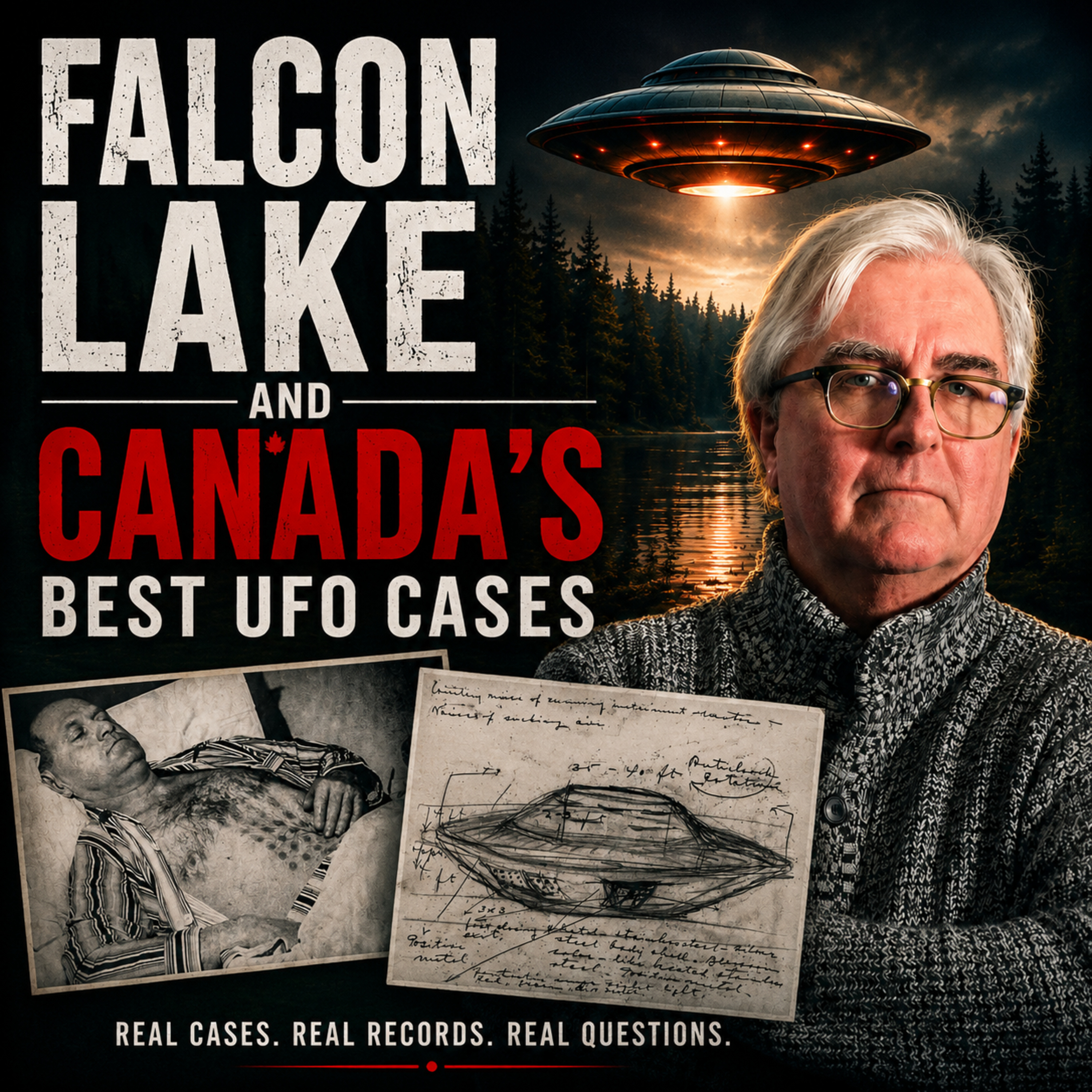
He saw a Hollywood style flying saucer that looked like this land on a flat rock outcropping near him. He had walked up to it. As a consequence he was burned by a blast of hot gas that came out of what was seemed to be an exhaust port.
- [01:19]
Narrator
The Falcon Lake incident was widely regarded as one of Canada's most profound UFO cases, arguably one of the strongest close encounters with physical effects cases ever reported. Unlike many UFO sightings, it involved alleged physical injuries, medical examinations, police reports, military involvement and years of investigation. Even today, it remains officially unexplained.
- [01:44]
Interviewer
On 20 May 1967, Stefan Michalak, 51
- [01:47]
Narrator
year old industrial mechanic and amateur prospector, was searching for quartz near Falcon Lake in Manitoba's White Shell Province Park. Around midday he reported seeing two glowing disk shaped objects descending from the sky. One flew away while the other landed on a rocky outcrop roughly 45 meters away. Michalak wasn't someone who immediately assumed aliens. In fact, he initially believed it might be an experimental American military aircraft. He approached the object while wearing wielding goggles as the light was reportedly extremely bright. According to Michalak, the object was metallic and around 10 meters across. It emitted heat and smelled of sulfur. An opening or doorway appeared on the side. He heard voices from inside and called out in English, in Polish, in Russian and in German, receiving no reply. Curious, he touched the craft and the fingertips of his gloves reportedly melted from the heat. Then things became much stranger. As the craft prepared to depart, a panel closed and a grid like vent became visible. A blast of hot gas or air erupted from it. He said it set his shirt on fire, knocked him backwards and leaving a distinctive pattern of burns across his abdomen. Now there is medical evidence and this is where the Falcon Lake separates itself from many UFO stories. Following the encounter, Michal reported suffering burns to his chest and abdomen, nausea, vomiting, headaches, dizziness, diarrhea, weight loss and fatigue. Doctors documented the burns and police officers also observed injuries shortly after the incident. Early photographs show irregular burns, while later photographs famously show a more geometric grid like pattern that became associated with the case. No conventional explanation satisfied every aspect of the report. One of the most debated aspects of concern was the radioactivity. Some materials he later produced showed elevated radioact. Radioactivity and traces of radiation were found in parts of the area. What an incredible UFO case with tons of verifiable evidence. Right. Today I sit down with Chris Rutkowski, a man with a degree in astronomy, an author, a man responsible for Canada's UFO survey, one of the most comprehensive UFO sightings databases in existence. He's been investigating and indexing UFO cases for over 50 years. Let's jump into it
- [04:18]
Interviewer
before I get in. I mean, I know that you've been cataloging UFO cases and you've been deep into the sort of investigation side of it and the data side of it, especially in Canada for such a long time. But before I get into that, I'd kind of like to know what first peaked you're interested in this. How did you first become interested in this subject and then kind of stick with it for such a long period of time?
- [04:38]
Chris Rutkowski
Well, that's an interesting question and a long answer, unfortunately. But when I was in undergrad university, there were a lot of UFO reports that were coming into the astronomy office. And my profs were not at all interested in UFOs. They thought it was all nonsense. People were a bit daft. So me being an undergrad thought, oh, well, here's my big chance to suck up with my profs. I said, you know, my carrel, where I'm studying is right around the corner from your office. Call comes in, just give them to me. And so my profs started giving me these phone calls from people who had seen unusual objects. And you know, for the most part they were stars and planes and satellites, but there were some that were not easily explained and that sort of piqued my curiosity. And then about a year and a half later, there was a weekly colloquium that was being presented in the physics Department and somebody, a visiting professor, had canceled for some reason. So my Prof. Came to me and said, why don't you give a presentation about what you've heard from people about UFOs? People are kind of curious about it. So I said okay, not realizing that they had moved the colloquium from the small departmental meeting room to the largest lecture hall on the entire campus. And I found myself in front of 500 people, including TV cameras and newspaper reporters, because word had got around that I was going to be talking about UFOs. And that was my baptism by fire. Wow.
- [06:13]
Interviewer
Okay. Superb. And what kept you? I mean, how long ago was that? Was that.
- [06:19]
Chris Rutkowski
That was in the 1970s.
- [06:21]
Interviewer
Okay, so that's quite a few years.
- [06:22]
Chris Rutkowski
I've been at this for a while.
- [06:24]
Interviewer
Yeah, yeah, that is quite a few years now. So what kept you hooked on the subject then? I mean, for all of these years, that's gotta be pretty intense.
- [06:36]
Chris Rutkowski
Well, I was curious as to what people were seeing because my astronomy background, I did eventually get my astronomy degree and then education degree. I wanted to teach people about science and good science and, you know, is it possible there's life out there? I wanted to take advantage of people's interest. So the more I studied, the more reports I spoke with and the more sincere people I did speak with, the more I realized there was more to the subject than my scientific background would allow me to say.
- [07:07]
Interviewer
So,
- [07:09]
Chris Rutkowski
and then I got documents. There had been a lot of documents that had been released by the Canadian government. I know people are really excited about all the American releases now, but Canada had been releasing documents quite a bit before that. And to the present day, we actually have a good record of military and pilot aviation documents from about 1947 to today. And some of them are fascinating. You know, pilots alone. I think there was something like three or 400 cases of pilots reporting UFOs, not UAP. In Canada, they're still called UFOs between about year 2000 and about 2015. 2020. And, you know, I've spoken to very good observers, astronomers, air traffic controllers, police who have seen some unusual things. And I can't really come up with an easy explanation for some of them. Doesn't mean that they're aliens. It just means that these are cases that I think need to be looked.
- [08:13]
Interviewer
Yeah, absolutely. So what does a. I mean, you've documented thousands of cases. What does it. What does a case. What does your investigation into that look like? So a case would land on your desk. What do you do with that from that point? Onwards.
- [08:27]
Chris Rutkowski
Well, I'll give you example. I've had a number reported to me just this week. The Canadian UFO survey, which we publish every year, has a link for people to report new UFO reports. And coming through that this week was a report from a woman in Nova Scotia who had said that a black triangular object with lights had appeared over some trees, moved towards their car and then moved off, and then moved, flew away again. And I checked with flight records, I checked with astronomical sky charts. There's not really any explanation for that because it's in a long way from me. I'm not in Nova Scotia. I checked with colleagues there. They hadn't been aware of anything. So it's an ongoing investigation. The case isn't closed in the sense that we've explained it as something. It's officially unexplained, but that doesn't mean it's alien. But it just adds to the Canadian UFO Survey, of which we have about 1,000 reports every year in Canada, not just from ordinary people on the street, but from military personnel, pilots and so forth. So, you know, it represents a body of data that can't be used as scientific data, but can be used as humanistic data. And it allows us to try and get a better understanding of what people are experiencing and what might be happening.
- [10:03]
Indeed Advertiser
When you need to build up your team to handle the growing chaos at work, use Indeed sponsored jobs. It gives your job post the boost it needs to be seen and helps reach people with the right, the right skills, certifications and more. Spend less time searching and more time actually interviewing candidates who. Check all your boxes. Listeners of this show will get a 75 sponsored job credit@ Indeed.com podcast. That's Indeed.com podcast. Terms and conditions apply. Need a hiring hero? This is a job for Indeed Sponsored jobs.
- [10:33]
Uber Eats Advertiser
You know, those tiny back to school emergencies that somehow become your problem. That's why I love UberEats. You can order school supplies, snacks and lunchbox essentials for $5 or less. So when your kid casually drops I don't like peanut butter anymore or I need five green highlighters for a project due tomorrow, Uber Eats has you covered. Get everything you need for back to school today from your favorite brands like Aldi and staples on UberEats. Order now ends. 97. $5 or less before taxes and fees. Select items only. Availability varies. See app for details.
- [11:03]
Interviewer
Yeah, fascinating. So from over those years that you've looked into the subject and documented it, have you found characteristics that repeat over and over and things that you see again and again and are the things that sort of jump out at you, like, hey, this is a common theme of things that I'm seeing, or totally random. What do you get from all those years, you think, in terms of characteristics?
- [11:28]
Chris Rutkowski
Well, we began looking at the national picture back in the 1980s and since then we've cataloged something like 26, 27,000 separate cases. And out of that do come some patterns. I was shocked to find out that after we had done it for a few years, really no other country was going into the data and doing analysis like we'd been doing. There's a lot of anecdotes, there's things published in books and in tabloids and you know, the Daily Mirror has all sorts of great UFO stories. But you know, tell me more data, we want to know more details. So over those years we found things like, you know, the number of cases had been increasing up till about 2012 when it peaked. It started going down a little bit, is up, ticking again slightly. I think in 2012 we had something, almost 2,000 UFO reports. It's gone down again, but it's on the way up. We found that about 3% or so of all the cases that we get every year don't have easy explanations and are very, very cur. The rest either have explanations, plane, star, satellites, or we have insufficient information regarding them. Curious thing that fell out was it's not just one person who sees a UFO or uap. It's usually somebody with somebody else. In other words, somebody's driving on a road, sees something and gives an elbow to his or her companion, says, hey, do you see that over there? So it's not just one single person. It's usually by the stats alone, more than one people, at least two people. And then time of night. The peak of sightings is somewhere around 11 o' clock at night, local time. And people said, well, people are drunk and whatever. Well, the pubs get out around 1 o'. Clock. So you'd think that would be when the more people would be seeing them if that was the explanation. But of course, most UFOs and UAPs are simply lights in the sky. The vast majority are simply little dots of light, star like lights, blobs of light, the orbs that some people are calling them now. Very few of them have, you know, some sort of structure or differentiate into a triangle or, you know, the old flying saucer, long gone. We haven't heard from those very often at all anymore. And the close encounters that people are really keen on seeing. The creatures themselves almost far removed from the actual reports themselves. Once in a while now, we'll get a case like that. But the typical UFO these days is simply a light in the sky.
- [14:16]
Narrator
Yeah.
- [14:17]
Interviewer
And does the. So if you were to get a sighting through landed on your desk as a case, I guess, would that be something that you would then have to go and manually cross reference with flight data and satellite data, or do you have, like, some software built in place that would help with that?
- [14:33]
Chris Rutkowski
I would say if you'd asked me that question a couple of years ago, the answer would be yes. I do have colleagues across Canada who handle and look into cases elsewhere. But recently we've been able to use some AI agents that have been developed that if I put in the input for date and time and location, it. The AI agent goes out and sees if there's any aircraft, identifies which aircraft had been in the area at the time and lets us know that. So there are things that are being developed right now that are making quantitative ufology a little more palatable.
- [15:15]
Interviewer
Yeah, yeah, absolutely. Yeah. I've been developing with a friend something called Vector Point, which. Very similar to that, which is able to tell you what's in the sky at the time of your sighting, and airplanes and satellites and stuff because it feeds the real time. But I think that's something that seems to be very new to the ufology, I guess, in the UFO investigation world.
- [15:38]
Chris Rutkowski
Yeah, indeed. As a matter of fact, I'm part of the group out of Harvard. Avi Loeb, Dr. Avi Loeb in Harvard Physics has put together a group of people that are developing and have developed a number of observation stations in the United States as a test run that have cameras and videos and magnetometers and, you know, all sorts of other devices attached. And the idea is to triangulate objects that are moving in the sky and get real solid scientific data on what's moving. This is really, really new. Just over the past year, they've already acquired probably a million images of things. So far, nothing stands out as being a spacecraft of any kind. But they're actually training AI, for example, to differentiate between stars and planets and birds and planes and helicopter and plastic bags borne by the wind, all that sort of stuff. So it's a slow process developing the technology from the ground up, almost literally, but it's something that's hopefully going to be helping science better answer the question of what UAP really are.
- [16:54]
Narrator
Yeah.
- [16:55]
Interviewer
Is that the Galileo project that you mentioned?
- [16:57]
Chris Rutkowski
Yes.
- [16:57]
Interviewer
Yeah, yeah. Oh, fantastic. Yeah. I interviewed Ezra Kelderman, who I think was the project manager The Harvard project manager for Professor, Professor Avi Loeb on some of the hardware.
- [17:07]
Narrator
And it's some fantastic stuff.
- [17:09]
Interviewer
But it's also really exciting because I think because of AI and the cost of technology coming down, it seems like it's more achievable for everyday sort of citizen science and everyday hobbyists, I guess, to get hold of some of that technology, which is quite exciting for the future.
- [17:27]
Chris Rutkowski
Yeah. In fact, personal observation stations for UFO detection have been around for a long time, since the 70s even, I think Project Stylus Starlight International was in the 1970s down in Texas. And over the years there have been a number of attempts to do this. There's a organization called UFO dap and I'm not quite remember what DAP stands for, but again, it's a personal observation station, largely video and photographic, that the average person can install. I think a lot of amateur astronomers have these in conjunction with their observatories. And I've been in touch with a couple of them who have sent me interesting videos of things that they've been able to rule out. You know, most conventional objects, not birds and insects and so forth, but they have videos of things zipping by that don't seem to have an easy explanation. And these things are of the order of five to $10,000 now, which is reasonable for most people. You can buy kits now much cheaper than that and get yourself a Raspberry PI to drive it or something like that. It's in the realm, but the problem is because there's no standardization, what might be used in England to detect and gather data would be completely different from what might be seen in British Columbia and used by a different system. So they wouldn't be compatible. And the idea behind Galileo, for example, is to have a series of completely compatible systems across around the world ideally. But right now that's in just in a few locations that would be shareable and be able to re verify it.
- [19:13]
Narrator
Yeah.
- [19:15]
Interviewer
How do you deal with or take into account things like secret technology, for example. So, you know, let's say, let's say Lockheed Martin are working on some new terrestrial technology that they're flying around. It's not got a, you know, it's not got tracking on it. So it won't, it wouldn't necessarily be in the ad adsb. I think it is the tracking systems. And I guess the same with, the same with military operations where they may be, you know, trying to be stealth intentionally. So it might not necessarily be experimental technology, but maybe just, you know, they're on some Sort of mission to do something, and therefore they've switched off their transponders, that sort of thing. How it must be very difficult to take those terrestrial bits of tech into consideration when looking at some of these cases. It certainly feels that way for me, and I'm very new to the investigation side of things.
- [20:11]
Chris Rutkowski
Well, I mean, there's no question that the transponders are part of it. In fact, one of the things that I look at are civil aviation Daily observation reports from pilots in Canada. Every day there's reports of transponder anomalies. So that's a separate issue. But in the case of the Galileo, for example, they're physically observing things, and whether there's a transponder on or not wouldn't really matter. So, I mean, there are so many possibilities now that things could be. I mean, the whole thing about drones in the United States, for example, there's a fury about all the drones that might be flying. Well, we get reports of supposed drones outside aircraft at 20,000ft. Well, those aren't drones, or there must be some sort of secret technology like you said, but that wouldn't be anything that we'd have any input or control over and must be something else. And a lot of what was described as drones turned out after investigation to be simple aircraft that were seen over particular areas. So I'd have to say that, you know, there's a lot to be taken into consideration. I would say that most cases can be resolved or we don't have enough information that allows them to be resolved. And that's the key. We get very little information. In fact, the United States, with all these releases of information and all the videos that they've released now there are interesting little blobs and things darting around, but we have no information on the dates, the times, exactly who took it, the location exactly, because some of them were in military theaters. I mean, there were. Some of these videos were taken over the Strait of Hormuz for our sake when we wouldn't have any access to that type of information. So there's no question that the military aspect, the secret aspect is part of it. What I counter that with is that there have been releases in a number of other countries, including Canada, of formerly classified and formerly secretary documents that do show UFOs and UAP in the skies. The one case that I point to usually is people might remember in 2023, these balloons or whatever they were, were shot down over Canada and the United States. The big one off the east coast of United States, of course, seems to be a Chinese spy balloon. The others are much smaller. And in Canada, we have this access of information request that you can put in trying to get public access to certain documents. Through that, we found more than 500 pages of documentation on something called UAP23, which was the object that was shot down over the Yukon in Canada. It was shot down by an American jet under orders from a Canadian commander through norad, because Canada has partnered with NORAD in the United States. And the documents describe what was involved, and there was a photograph that was released and that type of thing. Yet there hasn't been a single page of documentation coming from the United States about what it had been done. And so Canada has actually been much more transparent. We've gotten access to cases marked secret and formerly secret of pilots seeing things, things that have been reported by pilots on missions. So we've had the same type of thing, but we have much more information than what's been released by the United States. Now, whether that's going to change or not, people are very much interested in disclosure, whatever that means. That implies that somebody's in charge and is letting people know drips and drabs at a time. But in Canada, we have a complete record of objects that were seen over Canada between 1947 and today from various government documents as well as civilian records. We don't have that in the United States. In fact, after Project Blue Book that most people are familiar with, it closed in 1969. Between 1969 and 2005, let's say, or actually later than that, 2015, when we found out about this secret project, AATIP, AF, SWAP, whatever you want to call it, that we don't know what was reported in the military between that period. So there are. There is a lot that we need to know and a lot that does need to be disclosed. But it does seem that other countries seem to have a leg up on the United States at this point, which is interesting because the United States has partnered with Canada and other countries in maintaining a military presence. But Canada just signed an agreement for monitoring of the Arctic with Australia, of all places. But the technology is being shared through there, and NORAD base has been moved or has been increased in size. As a matter of fact, it's a new one's under construction in the center of Canada in Manitoba, and that's part and parcel with the Americans. So, you know, I think international cooperation is probably what's needed to a greater extent.
- [25:35]
Interviewer
Yeah, absolutely. So from all of your research to date, then, has there been anything that is there Any indication that at least in Canada, that there are things that are happening in terms of investigating. So I'm not perhaps not necessarily as far as they've covered craft and the reverse engineering. But to go as far as they are investigating the anomalies in the sky and maybe not necessarily releasing that information to the public. So they're kind of investigating it more than they're saying that they are.
- [26:03]
Chris Rutkowski
Well, I suspect they are investigating more than they're saying they are. I mean, especially if something's being seen over a military theater. And as I mentioned, a lot of the information has been deleted. So the public does not have a right to know everything because it could endanger the servicemen and women who are involved. However, I'm very, very skeptical and dubious about crashes and crash retrievals and that type of thing because, you know, we've heard from so called whistleblowers without any documentation. So they're not really blowing any whistles about anything. They're just making these statements that they've seen pieces and there's wreckage and the creatures and nhis or whatever. But we have records of things that have crashed already, spacecraft and the process that's involved in retrieving them. The one that immediately comes to mind is Cosmos954. In the early 1980s, a Russian spy satellite crashed in northern Canada. And there are reports and documentation and details of the study and crash and retrieval of this satellite, which was radioactive because it had a nuclear power system on board. It fell into a sparsely populated area, but there were people living there. There's studies on the people themselves, the flora and the fauna. The largest piece recovered by a joint American and Canadian operation was the size of a refrigerator. The smallest were pinpoints of things that were radioactive, found on the surface of frozen lakes, that type of thing. And we have reports on what is actually done when there is a crash and a retrieval. What was being claimed by a lot of people seems to be completely different from that. And we have other examples of things that have fallen to the earth and been investigated in Canada alone. In my book, I document a number of things that appear to have fallen from the sky and have been investigated by researchers in the Air Force and by the Royal Canadian Mounted Police. There's a classic case in nova Scotia in 1967 called the Shag harbor case, where something was seen to fall into the ocean off the coast of Nova Scotia. And it was admitted that something happened. The Canadian government and military described the investigation. It was in a lot of newspapers. Canadian divers were sent in from the Canadian Navy to try and find what was at the bottom of the ocean. The Royal Canadian Mounted Police, some of them had actually witnessed the object falling through the sky. You know, there's a lot involved. And yet in the case of Roswell, for example, the United States government still refuses to admit that anything really happened at Roswell. So I would say that, you know, the people pointing fingers and claiming disclosure or wanting disclosure are looking in the wrong direction.
- [29:05]
Indeed Advertiser
When you need to build up your team to handle the growing chaos at work, use Indeed Sponsor Jobs. It gives your job post the boost it needs to be seen and helps reach people with the right skills, certifications and more. Spend less time searching and more time actually interviewing candidates who check all your boxes. Listeners of this show will get a $75 sponsored job credit@ Indeed.com podcast. That's Indeed.com podcast. Terms and conditions apply. Need a hiring hero? This is a job for Indeed Sponsored Jobs.
- [29:35]
Uber Eats Advertiser
You know those tiny back to school emergencies that somehow become your problem? That's why I love Ubereats. You can order school supplies, snacks and lunchbox essentials for $5 or less. So when your kid casually drops I don't like peanut butter anymore or I need five green highlighters for a project due tomorrow, Uber Eats has you covered. Get everything you need for back to school today from your favorite brands like Aldi and Staples and Uber Eats order now ends 97. $5 or less before taxes and fees. Select items only. Availability varies. See app for details.
- [30:06]
Interviewer
Interesting. Interesting. So from all of your investigations and all of the documentation that you've gathered throughout the years and indexed, what would you say is the most interesting case? Which case has really stuck with you that you thought there's something to that?
- [30:23]
Chris Rutkowski
Yeah, well, I mean, there's a number that could be in that category. One is actually the subject of one entire of my books, the Falcon Lake case, which also happened in 1967. The short version is that a weekend prospector had been in a very rugged, forested area of Canada. He saw without, you know, elaborating, a Hollywood style flying saucer that looked like this. This is a 3D print of the object land on a flat rock outcropping near him. He had walked up to it. As a consequence, he was burned by a blast of hot gas that came out of what was seemed to be an exhaust port, setting the pine needles and leaves on fire, setting fire to his clothes and to him. He was treated in hospital. We have the medical records. We have the records from the Royal Canadian Mounted Police and the Royal Canadian Air Force both investigated there was radioactive material found at the site. And the case was investigated very thoroughly. Again, hundreds of documents detailing the interrogation, the interviews with the witness and his family and people in the area. And according to the Royal Canadian Mounted Police and the Royal Canadian Air Force, they had no satisfactory explanation for what happened. So you have a case where you have injury to a person, you have interesting description of what was seen, material found on the ground, radiation, medical effects, medical records, detailed records from government officials. What else do you want in a UFO case? Really?
- [32:06]
Narrator
Yeah.
- [32:07]
Interviewer
That's fantastic. Well, that's what we're desperate for, isn't it? We're seeing. We're getting releases of videos, as you say, without date, times, locations, and there's not a lot of context behind it. It's like, okay, this looks interesting, but actually, if, you know, if. If we've got cases out there where, I mean, the argument is, look, if we've got recovered craft and alien bodies or, you know, at least kind of specimens or whatever, like, show us that stuff. Stop showing us the footage. Just give us, you know, give us the. The photographs of the craft that you've recovered. And they're sitting in a hangar. So it's almost like.
- [32:41]
Chris Rutkowski
Yeah, yeah, just don't give me the nonsense about all that's top secret. I can't really.
- [32:44]
Interviewer
Yeah, yeah.
- [32:46]
Chris Rutkowski
You know what?
- [32:46]
Interviewer
So frustrating.
- [32:48]
Chris Rutkowski
Yeah. You can tell us a little bit more than that. And, you know, even the location would be too secret. Well, I just don't buy that. It's just there's too many red flags. And in the case of the Falcon Lake incident, it's, you know, like Roswell. It's developed a mini industry in the area. You can go on a horseback ride to the site. There are souvenirs that you can get. The witness had done a number of interviews. Some of his family is still alive and have spoken about it. So, you know, we do have a lot of information about a lot of these cases. And it's just a matter of. I think that the public needs to be aware that there's more to it than what you see on tabloid television.
- [33:32]
Interviewer
Yeah, completely agree. Completely agree. Fantastic. Well, where can people get hold of your book? Where can people find you on social media? On the Internet?
- [33:42]
Chris Rutkowski
Yeah, I'm all over social media, ufology research. My name Chris Ratkowski. I'm on Facebook X Blue sky and YouTube and on LinkedIn. The latest book, Canada's UFO Secrets, is currently out. It just came out last week and is available in fine bookstores or online. And you can check out the Canadian UFO survey at canadianuforeport CA and has a lot more information.
- [34:16]
Interviewer
Fantastic. Brilliant. Well, look, I'll whack some of those links in the video description when this comes out for people. And look, I really appreciate your time, Chris, and really appreciate your effort, your energy and your time over the, you know, the decades in looking into this subject. It's fantastic to have people like you of your caliber still, you know, still pounding the beat, so to speak.
- [34:36]
Chris Rutkowski
And I'm speaking at an upcoming conference, June 24th to the 6th or sorry, July 24th to the 26th in Toronto, National Conference of the Society or the Scientific Coalition for UAP Studies being held in Toronto, Canada this year. And SCU has contributed a lot of science to the subject and it'll be interesting to see what people are talking about.
- [35:04]
Interviewer
Fantastic. We'll have to check that out. Superb. Thanks very much, Chris. Take care of yourself and hopefully we'll speak again soon.
- [35:10]
Chris Rutkowski
Absolutely. Thank you. Sam. Foreign.
- [35:45]
Uber Eats Advertiser
You know those tiny back to school emergencies that somehow become your problem? That's why I love Uber Eats. You can order school supplies, snacks and lunchbox essentials for $5 or less. So when your kid casually drops, I don't like peanut butter anymore or I need five green highlighters for a project due tomorrow, Uber Eats has you covered. Get everything you need for back to school today from your favorite brands of like Aldi and staples on UberEats. Order now ends 97. $5 or less before taxes and fees. Select items only. Availability varies. See app for details.
- [36:15]
Chris Rutkowski
Close your eyes.
- [36:16]
Narrator
Exhale.
- [36:17]
Chris Rutkowski
Feel your body relax and let go of whatever you're carrying today.
- [36:22]
Uber Eats Advertiser
Well, I'm letting go of the worry that I wouldn't get my new contacts in time for this class. I got them delivered free from 1-800-contacts. Oh my gosh, they're so fast.
- [36:31]
Chris Rutkowski
And breathe.
- [36:32]
Uber Eats Advertiser
Oh, sorry. I almost couldn't breathe when I saw the discount they gave me on my first order. Oh, sorry. Namaste. Visit 1-800-contacts.com today to save on your first order.
- [36:43]
Chris Rutkowski
1-800-contacts.