← Ukraine: The Latest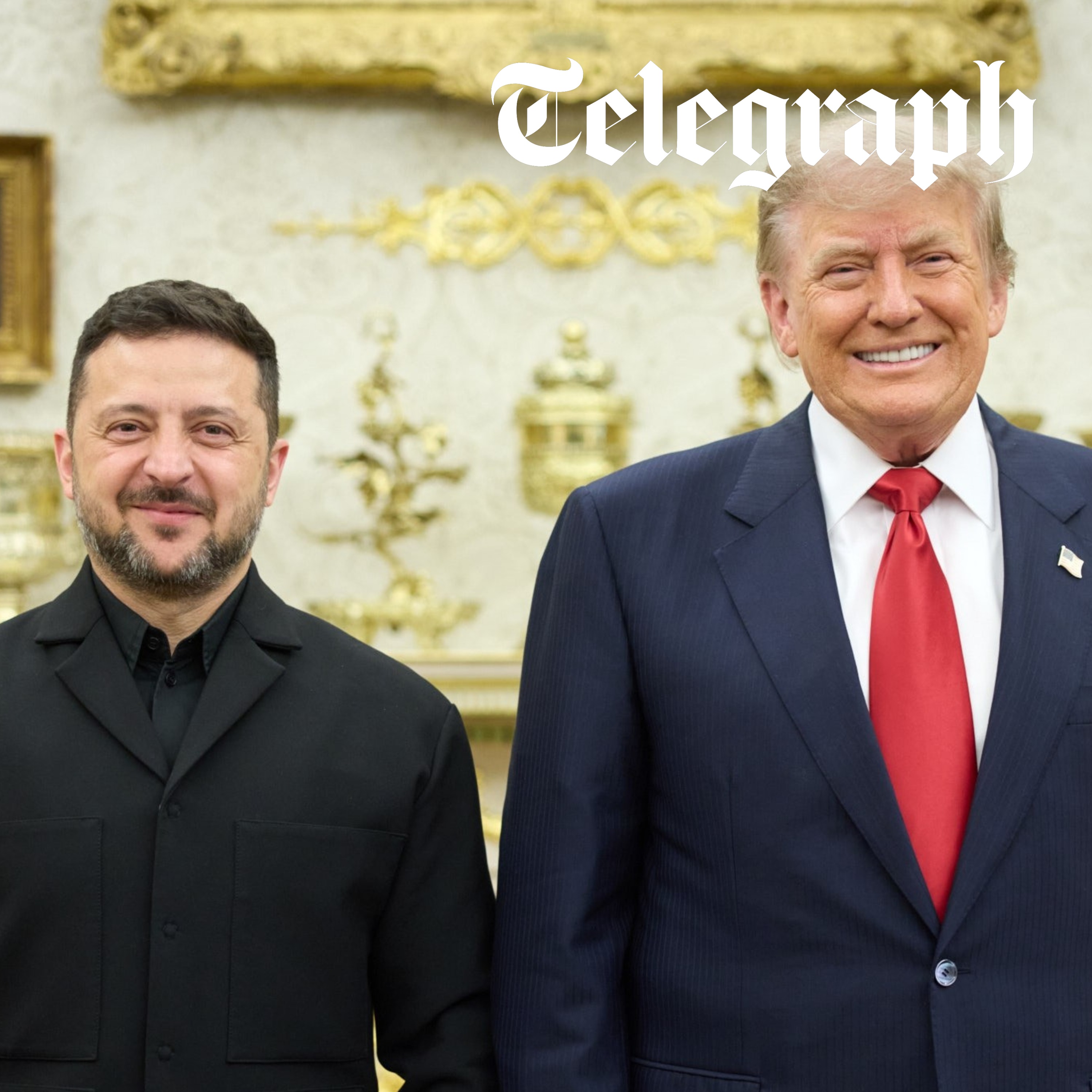
Loading summary
Transcript72 lines
- [00:04]
David Knowles
The telegraph.
- [00:12]
I'm Francis Darnley and this is Ukraine. The latest today, as Ukraine carries out another strike on a target more than 1300 kilometers from Kyiv, we assess the significance of President Zelenskyy's visit to Washington where alongside a memorial to Senator Lindsey Graham, a attention is focused on Congress as lawmakers prepare to decide the fate of the bipartisan sanctions bill that would impose sweeping tariffs if passed on countries continuing to buy Russian energy. And later, we take a deep dive into the Black Sea grain corridor, once more exploring why it's returned to the center of the war after recent attacks on merchant shipping and what it means for global food security.
- [00:53]
Bravery takes you through the most unimaginable hardships to finally reward you with victory.
- [01:02]
Alex Nichol
Russia does not want peace.
- [01:13]
Donald Trump
If I'm president, I will have that
- [01:14]
David Knowles
war settled in one day.
- [01:16]
Donald Trump
24 hours.
- [01:17]
Alex Nichol
I'll be making very clear to President
- [01:19]
David Knowles
Zelensky there is no change. I will be with him 120%. Nobody's going to break us.
- [01:30]
We're strong.
- [01:31]
Donald Trump
We're Ukrainians.
- [01:33]
David Knowles
It's Tuesday 28 July, four years and 154 days since the full scale invasion began. And today I'm joined by Telegraph journalist Alex Nichol and later Andre Sizov, a Black Sea grain expert. But let's start with the updates a little bit of a quieter 24 hours. Alex, where do you want to start?
- [01:55]
Alex Nichol
Yeah, well, it certainly seems so after the weekend and yesterday's reports, but the strikes continue. So starting with Ukraine last night, the state owned Russian priorite fuel storage facility in Borok in the Udmurt Republic. So that was struck and that's the one you're referencing, 1300 kilometers from Ukraine's border. Now, I quote, that serves as a major oil depot of national importance and that was struck by long range Ukrainian drones and that store sort of fuel, petroleum products, lubricants, all things that support both general logistics, but also importantly the military. Now Russia, they've said they repelled some of the attacks, but really this has been a critical attack. And even they admitted that this has probably been the most intense attack in this region, certainly for a long time. Now that wasn't the only significant attack from Ukraine. We had a strike or a couple of strikes in Moscow oblast last night. And one to note in particular was in the town of Chekhov and that hit a steel fabrication plant. We've had confirmation on Exxonova plus, so independent telegram channels and from local Russian governors continuing wild berry strikes. Oh gosh, again they go again. And Again, it's a repeat strike on a warehouse in the Moscow district, in Kolodino district in Moscow. And that came under strike early this morning. Also a third party logistics hub next door. We've seen footage of large scale fires erupting there.
- [03:21]
David Knowles
So it's about the seventh or eighth day now of the Wildberrys being a target.
- [03:25]
Alex Nichol
Lose track of the Wildberry strikes. But yeah, it seems that this is, you know, a sort of concentrated effort to get these. I think we worked out last week there's about 200 facilities across Russia and Ukraine does seem intent on striking all of them perhaps.
- [03:40]
David Knowles
Yeah. And just as a reminder, the reason that they're striking Russia's Amazon, as it's known, is because of their role in supplying drones own components that people can order who are in the military. And so that's the particular. It's not really we understand to be hitting the regular consumer, but rather it's because of this military.
- [03:57]
Alex Nichol
Well, certainly this like this term dual tech. So that's the sort of radio components, fiber optic cables, but also, I mean we went on the website last week and see body armor, helmets, etc on there. So, you know, Russian soldiers literally ordering from these facilities to the, to the front line, basically. So, yeah, continue strikes there, but moving down into the occupied territories. So Robert Brody, Ukraine's unmanned systems commander, gave his update yesterday and he reported that 14 different energy facilities across Crimea have been struck across the past three days. He gave his sort of concerted update yesterday. And so that report comes as the Russian installed energy operator Cramenigo said yesterday that restrictions are in effect across Crimea and that the situation was difficult now clearly relatively played down language, but the fact that they're coming out and saying that shows just how serious this continued energy strikes are for Crimea and other locations. And he goes on Robert Brobdy in his update to say that Kherson, Luhansk and Donetsk oblasts, their sort of substations, electricity grids have all been hit. So we're seeing power outages all around Russian, not only occupied territories, but Russia, Russian oblasts, etc.
- [05:08]
David Knowles
And I should say that also in a future episode, we've been working on doing a sort of explainer on how the Crimea campaign has been carried out over the last few weeks with maps and everything else. So stay tuned for that. I think that's a big, big project of Alex's.
- [05:22]
Alex Nichol
Yes, look forward to that. Now as we will discuss later about the Black Sea strikes with our guest Andre. One key one to note from the last 24 hours has been on Russia's Rostov Oblast in which a Ukrainian drone mass drone strike, I should say occurred yesterday. President Zelensky came discuss that last night. Now two people were killed at the port facility on Rostov on Don, the further five injured. That's a report coming from local Russian governor and we'll see why Rostov is such a key export terminal later during the interview. But that was a significant strike, a mass drone strike. Now moving on, Russian strikes. Now just an update. Yesterday I believe you talked about the strike on the sort of arms expo in Kyiv.
- [06:05]
David Knowles
That's right. That was coming in I think as breaking news on Friday's episode. Yes, and we now know more about that. I talked about it yesterday.
- [06:12]
Alex Nichol
Yes, the figures are, I think 11 people were killed and sort of multiple wounded. Now we now know that the organizer of the event, a man named Vassil Honchok, who's the head of the Armada Organization, they organized the event. He's actually been arrested or remanded in custody and, and he'll be doing that for 60 days according to the Kyiv Independent. And that's under the charge of culpable negligence that caused the death of other people and that's all we know. But President Zelensky came out and said there certainly shouldn't have been an event there. And Russia's Defense Ministry also confirmed the strike. Not that they needed to saying that had been a demonstration of Ukrainian and foreign main drones. But I think the important question is for a private event, how did Russia know that this was taking place? And clearly pretty large breach of security there.
- [07:01]
David Knowles
It's interesting that I think, as I was reporting yesterday on the podcast, that the President's office has clearly felt it very important to clamp down on this and to say that there will be criminal charges pressed because of clearly rules being broken here which has allowed so many people to be died. And I think it's over 100 injured.
- [07:18]
Alex Nichol
Yes, I think it was a ballistic missile that struck this event directly. Yes, a mass casualty event looking wider across Ukraine. So from the last 24 hours, Russian attacks have killed at least nine people, injuring 69. Mainly attacking seems to be gas stations and general civilian infrastructure, whether it's housing or other logistics parks. Overall, 131 drones launched by Russia according to Ukraine's air force, 107 shot down. However, casualties being reported in Donetsk and Kherson, Kharkiv and Dnipropetrovsk oblasts from the last 24 hours. And that's all the updates I have from the military and Strikes.
- [07:58]
David Knowles
Well, thanks very much, Alex, for talking us through then. Let's do a bit of a US deep dive, then. So we had Lindsey Graham's death, of course, recently. Zelenskyy has just flown to Washington for the memorial. I think I'm right in saying that he'd seen Graham only two days before his death, actually, in Kyiv. And there are two key pillars that I think it's worth us taking some time to reflect on today of Zelenskyy going over there. One, of course, is Graham's bipartisan bill, which has been in the ether now for many, many months, but it's about to be voted upon within the next 10 days or so. Now, this is the one that if it were brought in by the Senate, if it were voted through, that there would be 100% tariffs on countries that are currently buying Russian energy. Originally in the draft proposal, it was 500%, but now it's been watered down to 100%. The countries include China, Turkey and India. So this would have quite significant ramifications for the Russians because Europe is no longer purchasing the energy to be selling it to Turkey, to China, to India instead. Now, the other objective for Zelenskyy, of course, is meeting Trump, and that's taking place more or less at the time of our recording. And we'll cover what they say in tomorrow's episode, but I'll come back to that in a moment for a little bit more context of the relations between the two of them. But first, this bill. So in one of Graham's final days in office, he was pushing once again for this sanctions legislation to go through. We understand today there's going to be a tribute that is paid to Graham later on in Congress. President Zelenskyy will be part of that. And then there is an opportunity for all senators, all 100 senators, to meet with President Zelensky afterwards. We don't know, of course, how many are going to take them up on that. But the big question really is whether, with Graham's death, this will be the moment within the next 10 days or so that the bill finally does the Senate. And there are some obstacles. The first is the calendar. So we understand that Senate is due to have its break for August recess very soon. So there are question marks about whether it's going to pass before that recess or not. The other concern, though, is whether there will actually be this support in the Senate for it, because there are some Democrats, we understand and report in the Telegraph today, who fear that this will be a piece of Trojan horse legislation, perhaps Somebody was watching the Odyssey when they came up with that term, saying that because of the way that President Trump has used tariffs in the past, that if this legislation is moved forward, then this could give the President a blank check for him to do similar things that he was doing last year involving China and putting it on allies. So this would give him more freedom of maneuver. So they're trying, in a sense, to reconsider elements of the bill that would stop presidential having all considerable power to do that potentially, whilst at the same time still trying to pass it, that it's strong enough. So there is the bipartisan support in the Senate, we understand, but there are concerns among some Democrats which might hold
- [11:02]
Alex Nichol
the whole thing, and is that some Democrats may essentially traditionally very supportive of pro Ukraine policies or bills that might actually be like, well, we're going to hold back on this one.
- [11:12]
David Knowles
Exactly. So it's an interesting combination of factors here, because you've got legislators who want to pass the bill, but are concerned of the secondary effects the bill may have beyond the Ukraine theater. In essence, they fear that this will establish a precedent where the President can establish more levies in the future. So we will know in 10 days whether that is going to pass or whether it's going to be delayed even further. As I say, the fear really is that this would establish a precedent under which the White House will be able to impose further levies in the future. So stay tuned. We certainly will be now coming back to this meeting between President Zelenskyy and Trump, which is taking place, I say, more or less, as we speak. It comes as Zelenskyy is trying to underscore the connections between Russia and Iran. And I imagine that that will be something that will be a subject of conversation today. But here's what Trump had to say on it yesterday when pushed on it by a journalist.
- [12:12]
Zelensky says that Russia is giving Iran satellite imagery of US Bases in the Gulf to help them target. What can you do about that?
- [12:20]
Donald Trump
Well, we'll find out if that's true. I'll ask Putin about it. We'll find out. Hasn't had much impact. Knock the hell out of it, would you think, if that's the case? Look, you know, they gave Venezuela a lot of equipment. Venezuela had all Russian equipment. How did that work out? Not too good. So they may be giving, but if they are, it hasn't worked out because they have no army, they have no air force, they have no navy, they have no nothing. So it hasn't worked out. Well, I don't think. I don't think they've been doing it, certainly not at a high level and if they have, it has been very unimpactful.
- [12:58]
David Knowles
Now, I'm sure another subject of conversation between the two leaders will be the package of hundreds of millions of dollars which we've been talking about for many months now. And this is the more overt military support rather than the Graham Tariff bill. In essence, the latest on this isn't the most encouraging for the Ukrainians because whilst they confirmed that there would be a trickling through of support that there was going to be a plan as it were laid out, the latest on this is that the administration has told members of Congress it will not finish spend $400 million that Congress has already authorized for Ukraine until the end of the fiscal year 2029.
- [13:37]
Alex Nichol
Okay.
- [13:38]
David Knowles
So, so obviously that has major ramifications because we're years away from that and the Ukrainians obviously feel that the important thing is to get the money as soon as possible to get the support as soon as possible. So Congress is also frustrated about that aspect of this. And I think that that may also play not only to the conversations between the leaders, but also play into some of the dialogue that we see around the tariffs bill on if indeed it is put forward. So it's not the most hostile context that we've seen for President Zelenskyy in Washington. Bear in mind that he's not felt he needs to go out there with any European leaders support. You remember last year after the Anchorage summit that Zelensky went with all of those Western leaders. He's not done so this time and clearly doesn't feel that he needs to. But nonetheless, this is not quite the positive environment that perhaps some people are trying to push at the moment. Obviously, we've seen Laura Looma in Ukraine at the moment and some people are trying to read into this the fact that Trump is really warming very strongly to Ukraine. I think that that's possibly going a little bit too far, but nonetheless an interesting one. And as I say, we will continue to monitor that. So I've got a few more updates on this, but any reactions to any of that, Alex?
- [14:56]
Alex Nichol
Well, I saw again, air defence seems to be main topic conversation. I believe I saw one report saying that that's going to be something Zelensky's going to be hammering home. And even though we feel very much we're in the, you know, a heat wave, summer heat wave, the Ukrainians, Zelensky, they're looking towards the winter now. Yes, you know, only, only A few months away and it's going to, you know, potentially be a very hard one without those interceptors.
- [15:17]
David Knowles
Yes, well, we're already seeing as we've been talking about for weeks now, higher fatality rates in Ukrainian cities. And I think the expectation is that as you say, this winter will be worse because of the shortage of those interceptors, in part, of course, because of the war in Iran and shortage that there's been. But I say a few more updates. I think you talked about this story again at the end of last week, so perhaps you can just give people a very short reminder of the latest on this. But Ireland, we understand that EU officials are rather hesitant to do anything further around this plant, that is the Russian owned alumina plant in Ireland, because in essence, and this is quoting an EU official in the Financial Times, if we sanctioned the company, we would be cutting ourselves off. Now can you just remind us, Alex, when we, we were talking about Ireland last week, what was the latest on this subject when it was being talked about with the Ukrainians?
- [16:09]
Alex Nichol
Well, it was sort of done in the context Ireland said they were going to give all these donations to Ukraine, all this non lethal aid, which was great. But they also sort of slipped in that. Well, the Prime Minister, Ireland's prime Minister said that in their own investigations internally in Ireland, they hadn't actually found any links to Russia. And the giving of the Illumina products, which was interesting and I felt like it was sort of quite clever wordplay making the big announcement, there's all this port we're going to give and then saying, you know, investigations are going on, but we've not seen any links. And it felt sort of to me at least that they were going to let it kind of settle under the carpet, you know, whether that comes out again to haunt them. I mean, it feels like there's plenty of evidence suggesting, not suggesting, proving that there are direct links. So it was interesting that they were, the Prime Minister was able to say that.
- [16:58]
David Knowles
Well, it's an interesting piece in the Financial Times. It's saying EU capitals believe that if they actually were to do anything on this plant or if it would not to necessarily shut it down but to put any sanctions on it, that that would actually impact Europe's own flow of alumina. So an interesting story we'll continue to monitor. Now I mentioned Romania yesterday. The ambassador was summoned, the Russian ambassador, as a consequence of another drone incursion into Romania, which had to be shot down by an F16 fighter jet this time. Well, we now understand that Romania has actually expelled a Russian diplomat as a consequence of that. Now there is a sort of escalatory ladder in diplomacy. I'm not talking in the military contest in diplomacy. And one of the quite significant things that one can do is expel a diplomat. And we've seen a lot of that tit for tat. And I imagine that something similar will happen. Russia will probably do this with a Romanian in Russia, but nonetheless, the Romanians are understandably very upset about that.
- [17:52]
Alex Nichol
Of course, earlier this year they had one drone crashed into an actual residential building, I think injuring at least two people. Yes, it's interesting. We've had quite a lot recently from Baltic and Polish security services talking about a looming threat, some sort of type false flag type situation. One of the things that they've been talking about is either Ukrainian drones or Russian drones landing in within NATO territory. And I'm not saying that these past three incursions are that, but it feels like we're getting closer and closer to these sort of predictions by those security services.
- [18:25]
David Knowles
Yes, and I remember that Dom and I were on the episode when that incident took place with the injuries, and we were asking the question, I think it is a fundamental one, which is, what if people have been killed? Is that an Article 5 moment, or is that the moment where conversations begin around that? Or is this another example where, because it's been incremental, you know, drones have almost injured people. If anyone was killed now, that wouldn't be considered an Article 5 moment, whereas two years ago it might have been. So it's a very, very important one for us to continue to monitor, even if sometimes the details can seem rather granular. One last story. Antonia Langford for the Telegraph has written a very interesting piece reflecting on the domestic turmoil in Ukraine relating to Fedorov. And just a very quick update on this saga. There are still protests taking place in Ukraine at the moment. It does seem some of the political pressure has been reduced around Fedorov being returned to the administration. Now, as I say, people are still very active, angry about this. There is still an expectation that in some way he might become involved and this issue is not going to go away. But it doesn't feel like Zelenskyy is under the intensity that he was, which ultimately led to the sacking of Syrsky. Now, the reason I bring this up in relation to Antonia's piece is that Fedorov, of course, was, I'm simplifying here slightly trying to push through military reforms, that conscription, of course, has a lot of issues in relation to Ukraine. We've talked about that many times. Syrsky was very hesitant to adopt those, but is one of the key. And so in the piece, she draws attention to what life is like for those who are Ukrainian men, particularly who are draft dodgers, and how these issues can blow up. And there has been, as we've talked about at the time, protests in Lviv, which led to quite considerable violence on the streets in relation to this issue. So it's not going to go away that these issues that we were talking about last week are bigger than Fedorov, they're bigger than Syrsky, they come to be seen as representative of the issues such as military reform or Soviet versus modernizing doctrine. But really they are actually only aspects of much wider conversations taking place at the moment in relation to Ukrainian society. So I just point that piece out for those who are very interested in that subject in particular. But another deep dive worthy subject is, of course, the grain corridor, something that we've been talking about a lot more recently. Interestingly, it really does feel like the Black Sea is back, if it was ever, if it was ever away. Tell us who you spoke to.
- [20:53]
Alex Nichol
So I spoke to Andrey Sivov. So he's essentially a Black Sea agricultural expert. So he focuses a lot on grain exports, but wheat, other sort of products like that, but also general sort of maritime trade in the region. And we go into sort of a deep dive on the threat to that ability for all countries to navigate their trade, et cetera, but also the sort of diplomatic risks. Again, food scarcity is a big one. Now. Clearly there's been a few big events recently. We saw over the weekend the Golden Leo, which was a Guinea Bissau flagship, sank and that had been carrying grain. There were reports, not just reports, confirmation that the grain corridor did officially close for a few days in the past week, which hadn't happened since earlier in the war. And so all these sort of key events have been sort of upticking over the past few weeks. And it felt sort of a good time to really have a look at sort of the wider ramifications, not just for Ukraine and Russia, but also the globe.
- [21:49]
David Knowles
Well, let's hear that interview now, Andre.
- [21:51]
Alex Nichol
Well, thank you very much for joining us on the podcast today. I'd like to start with yesterday's UN Security Council meeting, which is a session originally declared by Ukraine. But several of the delegates warned the council over a recent surge in attacks on Black Sea ports, civilian vessels and agricultural infrastructure in the region. I was wondering if you could slightly unpack what they discussed Yesterday, particularly with regards to wheat grain food exports and just the general freedom of maritime navigation in the region.
- [22:20]
David Knowles
So it's. We had just more attacks last night in the Odessa region and it has been happening for several weeks already. Attacks on their supports, there's infrastructure, vessels near death, one of the vessels, and it was an indication of how hard, how, how strong this escalation was. One of the vessels just recently sunk this weekend. Also there were attacks on other terminals on the Danube, which is an alternative to Odessa for Ukraine. And before that there were many attacks in the Azovsky, which actually stopped the flow of green from the Azov Sea and the Kerch Strait, which is very important export route for Russian green as well. So currently both Russian and Ukrainian export flows are heavily disrupted.
- [23:17]
Alex Nichol
And would you say that the situation now is probably the worst it's been throughout the conflict so far?
- [23:26]
David Knowles
No. If we look at prices, if we look at volatility, it's obviously way lower than it was at the beginning of the conflict. In February, March, April, May 2022, we prices are, are roughly two times lower than they were at that time. But I think we are getting close to the level of uncertainty and volatility that we saw in summer 2023 when so called green deal collapsed. If you recall that. Yes, in July 2023 the prices rallied, volatility rallied. It was a big disruption and a lot of uncertainty. So we are close to that level right now which we saw three years ago.
- [24:07]
Alex Nichol
Okay. And sort of stepping back slightly looking at sort of wheat in general. I was wondering if you could explain to the audience just how important Russia and Ukraine are for, you know, world food exports, wheat, etc. Who do they supply? And for example, as sort of British, American, European consumers, are we likely to be consuming Russian wheat products or Ukrainian wheat products at breakfast or whatever that
- [24:32]
David Knowles
to put it simply, I think for the wheat market it could be comparable to the straight of Hormuz. So you have straight ramus supplying around 20% of global seaborn crude. And you have Black Sea Russia and Ukraine, they supply around one third of total wheat for the global market. Tradable wheat. So they supply more than 60 million tons of wheat per year, while the global wheat trade is around 220 million tons months per year. So this is the largest wheat export hub by far. The main destinations are first of all Mina countries, Middle East, Northern Africa, Turkey, Egypt, Algeria, those are the main destinations. And some more distant countries like Bangladesh, like Indonesia. If we talk about the U.S. no, of course, but sometimes actually U.S. and Mexico for example, its neighbor, they're buying wheat from Russia. But we also should add that it's not wheat only, it's also corn. And Ukraine, one of on top of being one of major wheat exporters, Ukraine, also a big corn exporter, and the European Union is a number one destination for Ukrainian corn. So you're unlikely to have it in your cereal during your breakfast. But animals in Spain, in Netherlands are very likely to be fed by Ukrainian coal.
- [26:03]
Alex Nichol
Okay. And so clearly Black Sea, a key sort of corridor for moving these products. Just how important in terms of percentages is the Black Sea region, Sea of Azov, and therefore how much have the recent strikes on infrastructure in the area had on sort of prices in recent few weeks?
- [26:25]
David Knowles
Around two, three weeks, the global prices rose by around 20%.
- [26:30]
Alex Nichol
I mean, to me that sounds sort of quite alarming in the sort of field of experts. Is that a shocking rise?
- [26:38]
David Knowles
Not really shocking rise. Wheat is called often a widowmaker because it could be very unpredictable. It's financial, not such a big market like corn, for example. So it could be moved relatively easily. And it could move easily, make big swings, reacting to geopolitical shocks. For example, when we saw a start of war in Iran, it also spiked by around 10, 15% very, very promptly. So, no, it's not a shock. But the question is whether we see some normalization here, some kind of new deal and where a lot of rumors last week that it could happen and the prices in fact tumbled on Friday. But if we don't see any agreement here, more strikes on ports on both sides, it could be just the beginning. Because right now, in July, late July, it's the start of the new green season. Russia is only harvesting grain. Ukraine is only harvesting grain. Export flows are relatively limited. So those infrastructure bottlenecks that both countries have right now, they're not so important right now because expert flows are small. But starting from August, both countries typically substantially increase the pace of exports. And it will be hard to do that this year if infrastructure will be still attacked and there will be no more or less free navigation.
- [28:08]
Alex Nichol
Okay, so following on from that, you know, it's well known that Russia has deliberately targeted Ukraine's agricultural and food sector. Strikes on grain terminals, storage facilities, the burning of crops, and of course, the illegal occupation of a huge portion of of Ukraine's agricultural land. Just how detrimental has this been for Ukraine's economy and how has Kyiv sought to overcome this and adapt during the conflict?
- [28:33]
David Knowles
Yes, around 20% of Ukrainian territory is controlled by Russia. So it's as we know it's for south east. Fortunately for Ukraine, it's not the most productible land. So actually average yields have been relatively high after the start of the war in Ukraine. Overall, I think the production was way more resilient than many were expecting at the start of the war. So we obviously saw some decline because of that lost territory which wasn't the most productive. But overall yields and production have been very strong and they remain very strong. And Ukraine has quite good. We think they could produce a very good crop again this year. Balls and wheat and corn.
- [29:22]
Alex Nichol
And so that sounds a bit of a surprise because obviously we've seen reports as clearly, you know, machinery has been targeted, they've got a shortage in manpower for a lot of the farms. So is more of the issue in their ability to export it because of attacks on ports and vessels etc, opposed to the actual production in country?
- [29:40]
David Knowles
Yes, yes, that's correct right now. And it has been an issue. I think it has been a growing issue. 2026 because attacks started to not only in last week, they escalated during the last few weeks, but they started a long time ago. What was new Russia also started to hit a railroad infrastructure more effectively and let me down that anyone was trying to burn fields. It just doesn't make any sense. But railroad infrastructure, that was a substantial escalation and railroad deposit. And so it was both hits on terminals and railroad which was supposed to bring the grain into terminals. Yes. So right now export infrastructure is the biggest bottleneck for Ukrainian farmers. And there are also some more additional things that are an issue for them because right now, as you know, it has been very hot in Europe. And I mentioned quickly some time ago that one of the main important alternatives to ADESA terminals, the terminals on the Danube and now water levels have dropped substantially and which means that typical vessel can load only 80% of its normal dead weight because otherwise it can pass the Danube.
- [31:08]
Alex Nichol
That's a good point about the effect on changing different ports etc. How much of a shift has there been recently in terms of using alternative sites to facilitate grain movement?
- [31:19]
David Knowles
Yes, let's start with a quick overview how they typically ship their grain. So for example, before the war, early 2022, they had two major export hubs, one in Odessa which mentioned another one was Mika Live Nikolaiv has been blocked and is still blocked despite the fact Russian authorities Russia for Tetrodam still hit me just. It doesn't make a lot of sense right now. And then for some time both ADES and Mykolaiv were blocked at the beginning of the War. And they started to shift their expert flows to the Danube tunnels, which were almost forgotten by that time. Because they're shallow sea terminals, they can accept only small vessels, 5,000 tons, 7,000 tons, you can launch 60,000 easily in Adesa, even more. And they also started to move grain via railroad more actively to final destinations in Europe or to Constanta in Romania, where it can be loaded on a bigger vessel, Panamax again, and also by trucks to the U to final destination. So they had to switch from those big deep seaports to Danube and land transportation. And then there was a green deal, and so green corridor. And then they switched back to the desse in 2024, 2025, 2026. And for example, in early 26, Odessa was accounting for around 95% of the total exports. So it was a major expat route by far. Now it is blocked, not fully, actually. There are reportedly one vessel entered Odessa last week, and now they have to switch to other destinations, which is more costly. And the problem is it won't be able to offset ADESA fully. So with Adesa they could ship around 5, 6 million tons, maybe a month. But we do doubt that they can ship without addresses. They can ship more than 4 million tons, 4.5 million tons a month, or maybe even less, because of the problems in the Danube, which I mentioned.
- [33:40]
Alex Nichol
Okay, so it seems Ukraine's had to be quite flexible throughout the conflict, changing these corridors, the sites of export, etc. What about Russia? How adaptive have they had to be throughout the conflict, if at all? And bearing in mind, clearly Sea of Azov seems to be a problem now, but are there other areas of change that they've had to make?
- [33:58]
David Knowles
Yes, for Russia, it's also quite challenging. Azov. And so it's not only Azov, it's Azov. First of, there were several terminals in the Azov Sea, and then you have green terminals on, on the Don river and Volka rivers. They're connected via canals to the Azov. And from there they go to final destinations like Turkey, or they've been unloaded from small boats into a big vessel. And that expert route accounted for around 25% of total Russian exports. For now it's not such a problem, as I mentioned, because it's very start of the new export season. But starting from August, which is starting pretty soon, it will become bigger and bigger problem, because similar to Ukraine, Russia won't be able to offset lack of navigation via Azov through other terminals. Those main deep sea terminals on the Black Sea and some terminals near St. Petersburg.
- [35:04]
Alex Nichol
Looking away from Russia and Ukraine, one of the points raised in yesterday's UN Security Council meeting was the effect that this conflict was having on countries facing food scarcity. Now both Russia and Ukraine export to third world countries. As you talked about earlier, how much of a worry is the current situation for some of those countries? If you could just also discuss some of which countries those are.
- [35:30]
David Knowles
When we talk about commodities, and this is a commodities market, it's not like country A always buys from country B. So if country B B has problems with experts, country A has, is in trouble. So it's not like that. It always, the country A looks at different options and they buy from different countries. And for example, if right now because of higher freight, Black Sea grain is becoming more expensive, they're buying from other suppliers, like EU for example, like Romania, for example. So to answer your question very simply, the, the poorer the country, the bigger problems it face. And by poor country here we mean a country roughly where an average household spend more than more than 50% of its income on food. For example, in the US that metric is around 10%. In Europe it's from 10 to 20%. In Russia it's around 30%. And Afghanistan, Sudan, places like that, it will be more than 50%. And those countries will suffer more because they have a large food bill, they rely a lot of inputs and those regions will face big problems, especially if prices continue to rise. So for example, it's Afghanistan and I would say Central African countries, they will suffer the most.
- [36:55]
Alex Nichol
Okay, so in terms of, on the diplomatic level, you know, it's important to differentiate Ukraine strikes on sort of. We've talked a lot about the shadow fleet tanks, et cetera, targeting oil and military supplies, and now Russia's targeting grain vessels. They are clearly separate issues, but it feels like overall the sort of maritime confidence in the region is decreasing. I've seen warnings from sort of the Indian government, for example, for its sailors in the area, Turkish maritime organizations. Is there a tipping point in which either Ukraine and Russia says that the issue is becoming so large that they need to sort of go back towards another sort of deal or initiative and we'll come back to the Black Sea grain initiative in a bit, or do you think that actually there's enough resilience globally that there isn't going to be pressure on the countries to sort of stop what they're doing? In terms of Ukraine and Russia and
- [37:49]
David Knowles
these strikes, I don't see any signs of de escalation right now. Those problems with Korean experts, they hurt both countries. But probably it's more important for Ukraine because as a reminder, food experts account for more than 50, 60% of total good exports out of Ukraine. For Russia, it's way less important. Russia, obviously energy experts are way more important than Ukraine exports. At the same time, to be honest, I doubt that neither Russian or Ukraine really care about potential problems with food security in the world practically. But both countries would want to play that card that they trying to help the Global south care about the Global South. Actually the Security meeting Council was a lot dedicated to that. That and also as you can recall that in 2022, 2023, Russia was talking a lot about how it should help Global South. But at the same time, that initiative itself is not enough to just try to strike a deal. And I think those strikes could continue unless they could be some kind of agreement, not direct one, but involving a third party party. And that third party is likely to be the US As I suspect. And one of the important factors, I think not just green experts, but attacks on vessels carrying oil. First of all, vessels carrying oil from CPC Caspian pipeline consortium based in the Black Sea around it's owned by Russia, Kazakhstan and around 1/3 of it all owned by U. S major oil companies. And we already saw leaks, media leaks that they do talk to the Trump administration and asking him, asking the administration to stabilize navigation in the region. And I think it could be more important than that, concerns about rising green prices and also in fact Russia and again Russia and Ukraine, they would benefit from rising grain prices. But obviously the US could play a role here potentially with Turkey involvement, as we saw during the previous green deal. And Alcara already hinted that it would be interesting to strike a new agreement. And President Erdogan, he really likes the idea of the green deal. It was called Erdogan's deal in Turkey. He felt like it was his personal achievement and in fact it was partly so don't think we see an agreement between Russia and Ukraine. But if, for example, the US backed by Turkey, perhaps with some European involvement would try to calm both sides down, this could happen. But obviously for that I think Russia would need need Ukraine to stop attacking Azov Sea and Black Sea ports as well. Okay, so there are many ifs right now, but again, and it also reminds me, 2023, we talked about it already. So when that green deal collapsed, it was like escalation and escalation, escalation, attacks on both sides, prices rising very fast. But then, then in the second half of 2023, everything settled down without any public announcement. Without any statements from any sides. But those attacks just abruptly stopped. I think we'll need more escalation and high prices so the many, many people will, could get concerned and after that put some pressure both on Russia and Ukraine to make some agreement here.
- [41:51]
Alex Nichol
Well, Andre, thank you very much for joining us today on the podcast.
- [41:55]
David Knowles
Thank you, Foreign.
- [42:03]
Sisov there. Well, thanks Alex, for doing that really interesting and topical interview. Still, one of my favorite pieces of reporting that we did last year was seeing the grain corridor out on the Black Sea with the Ukrainian Navy. There is a video out there somewhere of Domini in awe at the scale of it. It really is quite something extraordinary. But any other thoughts on that interview before we go to final thoughts?
- [42:22]
Alex Nichol
Yeah, I think, I think really I sort of went in it thinking we're going to talk about again, food scarcity is a real issue. But one of the things I thought was most interesting was just the resilience of Ukraine's agricultural sector, bearing in mind clearly there's war going on, a lot of these industries are being attacked, farmers are being used to fight in the conflict. But also 25% of Ukraine's agricultural land is actually under occupation and yet they've been able to bounce back and produce almost a surplus of grain, which I just thought was extraordinary. And I before the interview, I hadn't realized that before doing my research. So a really interesting subject and hopefully explained in good detail there.
- [43:02]
David Knowles
Well, thanks for that, Alex. Where do you want to leave listeners then?
- [43:05]
Alex Nichol
So my final thought today is I know we have reported or you've reported on the podcast many times about Wagner. Clearly since the demise of Prigozhin, less of a topic. However, I read a really fascinating piece in the Wall Street Journal about his son, Pavel Prigozhin, who it turns out is alive. I don't know if he's well, but alive certainly in the Central African Republic. And he's running a drugs empire, according to the Wall Street Journal, with a sort of focus on the tramadol trade. And sort of essentially him and 500 Wagner fighters have installed themselves and are basically funding their operation, which is in sort of hundreds of millions of dollars, if not more, through the selling of these sort of prescription drugs. And it's just a reminder that whilst we see the sort of demise of key figures, the organizations do go on. And I know we focus more on the sort of Africa core and what they're doing in Africa. But it turns out the remnants of this organization, which has basically become a criminal organization. And so I recommend to listeners to have a look at that report from the Wall Street Journal.
- [44:12]
David Knowles
Definitely add that link in the show notes. I remember when Wagner moved into Africa, that was the moment that the Ukrainians tried to build more relationships diplomatically with African countries because they said, look, Wagner is there. It's causing all of this damage or might do as mercenaries. And they have. To your point, they've also done a lot in Mali as well. You need to be building relations with us because we know how to fight them. So an interesting and ongoing saga. Very much. Speaking of ongoing sagas, you may have seen that yesterday Putin had to make do by standing by a picture of a submarine rather than the usual theatrics of the St Petersburg Navy Day Parade. I just thought I would leave you with quite a amusing clip from Kaliningrad, the Russian enclave where they have been able to do a Navy Day Parade, but doesn't actually involve any boat. Rather it looks more like a raft of some kind with a few soldiers playing trumpets on top of it. Doesn't quite look like the most formidable navy in the world.
- [45:12]
Alex Nichol
It's not been a great year for Russian parades. Obviously the the main 9th parade didn't go exactly to plan. Lack of equipment there.
- [45:19]
David Knowles
Yeah, so thought I'd leave you with that. But that's all we've got time for today, everybody. We'll be back same time, same place tomorrow. Ukraine the Latest is an original podcast from the Telegraph created by David Knowles. Every episode featuring us in the studio maps and battlefield footage is now available to watch on our YouTube channel. You can subscribe at www.YouTube.com crane the latest there's a link in the description. If you appreciate our work, please consider following Ukraine the Latest on your preferred Podcast Appreciate app and leave us a review as it helps others find the show. Please also share it with those who may not be aware we exist. You can also get in touch directly to ask questions or give comments by emailing ukrainepodelegraph.co.uk we continue to read every message even if we can't reply to all of them. You can also contact us on X. You'll find our handles in the description. As ever, we're especially interested to hear where you're listening from from around the world. And finally, to support our work and stay on top of all of our Ukraine news, analysis and dispatches from the ground. Please subscribe to the Telegraph. You can get one month for free, then two months for just one pound at www.telegraph.co.uk Ukraine the latest my name is David Knowles.
- [46:43]
Alex Nichol
Thank you all for listening.
- [46:45]
David Knowles
Goodbye.