← Ukraine: The Latest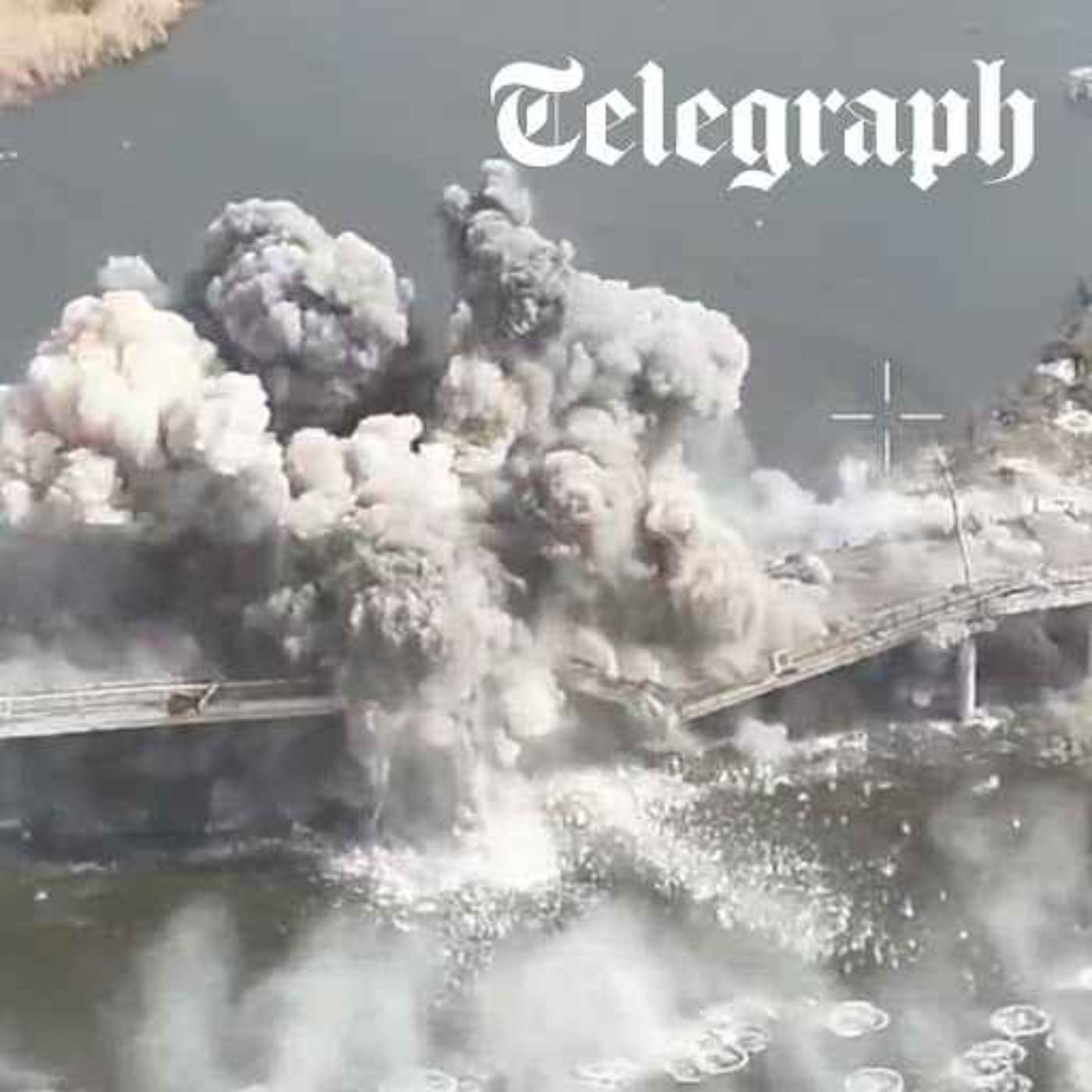
Loading summary
Transcript79 lines
- [00:04]
David Knowles
The telegraph.
- [00:09]
Progressive Insurance Announcer
You're listening to this podcast, so I know you've got a curious mind. Here's a helpful fact you might not know yet. Drivers who switch and save with Progressive save over $900 on average. Pop over to progressive.com, answer some questions and you'll get a quick quote with discounts that are easy to come by. In fact, 99% of their auto customers earn at least one discount. Visit progressive.com and see if you can enjoy a little cash back Progressive Casualty Insurance Company and affiliates national average 12 month savings by $946 by new customers surveyed who saved with Progressive between June 2024 and May 2025. Potential savings will vary.
- [00:45]
Boost Mobile Announcer
The longer you stay alive, the longer you can enjoy Boost Mobile's unlimited plan with a price that never goes up. So here are some tips. Do not parallel park on a cliff if you want to enjoy an unlimited plan with a price that never goes up. Do not mistake a wasp nest for a pinata if you want to enjoy an unlimited plan with a price that never goes up. Do not microwave a hard boiled egg if you want to enjoy an unlimited plan with the price that never goes up. Stay alive and enjoy Unlimited Wireless for $25 a month forever with Boost Mobile. After 30 gigs, customers may experience lower speeds. Customers will pay $25 a month as long as they remain active on the Boost Mobile unlimited plan.
- [01:15]
VRBO Announcer
With Verbal's last minute deals, you can save over $50 on your spring getaway. So whether it's a mountain Escape, Savings City Break or a week at the beach, there's still time to get great discounts. Book your next day Now. Average savings $72 select homes only.
- [01:35]
Dom Nicholls
I'm Dom Nicholls and this is Ukraine. The latest today after another set of attacks on Russian oil and gas infrastructure, it's clear Ukraine is not going to heed calls from some international leaders to stop striking Russian energy facilities. President Zelensky has continued his whirlwind diplomatic tour, visiting Syria and Turkey over Easter. And we hear from our senior foreign correspondent about how a drone designed for herding cattle helped destroy a bridge being used by Russia. And later, Francis has a special report on the upcoming Hungarian elections. Bravery takes you through the most unimaginable
- [02:13]
Francis Durnley
hardships to finally reward you with victory.
- [02:18]
David Knowles
Russia does not want feast. If I'm president, I will have that
- [02:29]
Francis Durnley
war settled in one day.
- [02:31]
Dom Nicholls
24 hours we are with you. Not just today or tomorrow, but for a hundred years.
- [02:41]
David Knowles
Nobody's going to break us. We are strong. We are Ukrainians.
- [02:48]
Dom Nicholls
It's Tuesday the 7th of April, four years and 42 days since the full scale invasion began. And today I'm joined by the Telegraph senior foreign correspondent Adrian Bloomfield and Francis Durnley. I'll start with the diplomatic and military news from over the weekend. So over the weekend Ukraine appeared to defy calls from allies to stop striking Russian energy facilities amid the global oil and gas squeeze triggered by the war in Iran. Russian officials claimed Ukrainian drones had hit an oil refinery operated by Lukoil and a Baltic pipeline near St Petersburg. Kyiv acknowledged that its allies had cautioned against drone strikes on Russian infrastructure to avoid any further fuel price spikes. Now on Sunday, the governor of Russia's Nizhny Novgorod region that's about 300ks east of Moscow, said air defence units had repelled a 30 drone barrage. Gleb Nikitin said as a result of falling debris to two facilities of the refinery were damaged. Now, images and video on social media appeared to show large flames coming from the refinery site and explosions lighting up the night skies over the city of Khostovo. Russian authorities claimed that air defenses in the Leningrad region had down 19 Ukrainian drones but debris had damaged a section of an oil pipeline near the Baltic port of Primorsk that dreaded drone debris again now alluding to for this foreign pressure to ease strikes on Russian energy assets as the U. S Israel war on Iran continues. But without naming any countries that may have asked for the pauses, General Kurollo Budanov said let's answer this diplomatically. We are receiving certain signals about this. He was speaking to Bloomberg then on Sunday night Ukrainian forces hit the Shiskaris oil terminal near the port of Novorossiysk and Krasnodor Kraif or down the road Russian Black Sea coast southeast of the Kirch Bridge. This happened yesterday. Geolocated footage subsequently showed large fires at an oil tanker or at a number of oil tanker berths at the port and that attack has been acknowledged by the Russian mod. Ukraine's Unmanned Systems Forces Commander Major Robert Magyar Brovdi said that Ukrainian forces had hit an Admiral Grigorovich class frigate also in the port of Novorossiysk around the same time there's social media footage purporting to show it firing Kalibr missiles whilst in port just before it's hit. Now six of the Terminal 7 oil loading stands used to load and unload tankers are said to have been damaged. That's according to a source in the SBU Ukrainian Security Service speaking to the Kyiv Independent now as well as oil and gas sites Defence industrial areas in Russia were also hit. The Institute for the Study of War, the US based think tank says that overnight on Friday, Saturday a a plant in Tolyati that's about 800ks east of Ukraine was also hit. The third time it was hit since late March. This continues a pattern of these long range Ukrainian strikes importantly against the same targets, compounding efforts to get them back online all speaks of a very porous Russian air defence network. I don't think it's on the edge of collapse but it's certainly very porous. Now as an indicator of how effective Ukraine's long range strike campaign is at damaging these Russian oil export capabilities, it's worth noting that Bloomberg are reporting that ship tracking data indicates that the dual oil tanker began loading at the oil export port of US Luga in Leningrad Oblast on Saturday. That is nine days after the Ukrainian strike against that port halted all oil loadings. Now staying with US Luga that was hit again in the early hours of Today Tuesday Regional Governor Alexander Durchenko said that 22 Ukrainian drones had been downed amid an attack on the region. Now he didn't specify the target of that attack, but very helpfully photos and videos were posted to social media by local residents appearing to show a number of explosions rising out of the area of the Usluka port beginning around 5am local time. Now these repeated strikes have not gone unnoticed by the Russian MIL blogger community. One Kremlin affiliated MIL blogger said that Russian air and missile forces are being stretched to the limit with ammunition being used at an accelerated rate. I think that's a bit of a sweeping statement. I mean it's a massive country. How is this individual to know quite what the rate of usage is across the whole country? But it's still interesting the comments that are made. They said Russia cannot simply produce thousands of missiles for Pantsir air defence systems out of thin air. I also remember wasn't it a few months ago that we were told that the Russian conscripts that were being brought up as part of the normal or biennial conscripted service were going to be defending these sites anyway. They don't seem to be doing a very good job. Now connected to that, you may have seen some Russian reporting about the Baltic states saying that they had allowed Ukrainian drones to cross their airspace on the way to hitting US Luga and Primorsk. It was roundly denied. But that hasn't stopped Russian Foreign Ministry issuing veiled threats towards the Baltic states. So speaking to reporters in Moscow yesterday, Russian Foreign Ministry spokesperson Maria Zakharova said that the Baltic states have received an appropriate warning. If the regimes of these countries have enough sense, they will listen, she said. If not, they will have to deal with a response. Sounds like we need another game of breach or reach coming up. Also on Sunday, a general cargo vessel foundered in the Kherson region of the Sea of Azov. It's all northeast of Crimea, southeast of Russian occupied Kherson region. Now, Ombre Intelligence, that's the global maritime risk management firm, says the vessel was reportedly transporting grain out of occupied Ukraine at the time of the incident. Nine individuals, all of whom were Russian citizens, abandoned ship. One fatality was reported by official sources at the time. 9. Two other crew members were initially reported as missing but later found dead on board the vessel when search and rescue assets got on board. Russia says it was hit by a Ukrainian aerial drone. The vessel has been towed to Khashuguri. That's just east of the Kirch Bridge in Krasnodar Krai region. Now, Ukrainian Commander in Chief Oleksandr Syrskyi visited Ukrainian troops in the Oleksandriivka and Prokrosp areas over the weekend. There's been next to no movement on the front line, which underlined President Zelenskyy's comments from Friday that Ukraine's front line is in the strongest position for nearly a year, according to him. Somewhat unusually, he was citing a report by Britain's Secret Intelligence Service, better known as MI6. He said, I received MI6's assessment. The situation on the front is currently the best for Ukraine in the past 10 months. This is their conclusion and our partners see it as well. However, over the weekend, at least six people were killed across the country. On Friday after Moscow launched nearly 500 missiles and drones in a major daylight attack, Ukraine's proposed Easter truce never materialized. When asked about the suggestion, Dmitry Peskov, the Kremlin spokesperson, he just re emphasized Moscow's demands Ukraine withdraws forces from the whole of the eastern Donbas region, including the parts that held by Ukraine. Blah blah blah blah blah. Nothing new there. Now you may remember last year there was an Easter truce partially observed, with Putin announcing a temporary truce on Easter Saturday until the Sunday which largely held although there was some fighting along the front line. Fighting never totally stopped, however. On ceasefires. In his nightly address last night, President Zelenskyy proposed another energy ceasefire, saying US Officials were going to act as intermediaries. He said, if Russia is ready to stop strikes on our energy infrastructure, we will be ready to respond in kind. This proposal has been conveyed to the Russian side through the Americans. Now just to underline the point, that statement was made just before US Luga was hit again this morning. There's no suggestion that there had been a ceasefire in place at the time, but it does underline your argument slightly if you demonstrate the ability to get through the air defences. There were more civilian deaths across Ukraine on Saturday when Russia continued the recent trend of daylight attacks with a Russian drone strike on a covered market in the eastern city of Nikopol. Five people were killed there, 25 wounded, officials said. Now the market in Nikopol, that's in Dnipro Petrov region, was hit about 9:50am local time. This comes from the local prosecutor's office. It followed a night when 260 of 286 Russian drones were brought down. Now Nikopol was hit again this morning when a Russian FPV drone. That's important. I'll come back to that in a moment. An FPV drone hit a passenger bus during morning rush hour, killed three people, injured 16. Three of the wounded said to be in a critical condition. I say the FPV bit is noteworthy because obviously it's been driven by a pilot. It's not remote. That was deliberate. That passenger bus was selected by the drone pilot for attack. Now earlier in the day an 11 year old boy was killed and five other people injured in another attack across Dnipropros oblast, Governor Oleksandra Hanja reported this morning. Another three people were killed last night in Odessa with more people possibly trapped under the rubble. This comes from Deputy Prime Minister Alexi Kuleba. Now, images on social media show a toddler still in a napi being carried out of the bombed site. In total, there were eight people killed and 52 injured across Ukraine yesterday. Now on the diplomatic front, President Zelenskyy met Turkey's leader Recep Tayyip Erdogan in Istanbul on Saturday. Then on Sunday he was in Syria continuing this whirlwind diplomatic tour of the region. He met with Syrian President Ahmad Al Sharar in Damascus. The two countries pledged greater security cooperation. Blah, blah, blah comes after last week's visits, you'll remember to several Middle Eastern countries where President Zelenskyy signed defense agreements with Qatar and Saudi Arabia. Now at the press conference on Friday, Mr. Zelenskyy said, I believe that we have changed the attitude of the Middle east and the Gulf region toward Ukraine for many years ahead. Now he was out there in particular looking for help on anti ballistic missiles. And on that front it's worth noting comments from the chief designer and and co founder of Ukrainian defence manufacturer Firepoint. He was speaking to Reuters over the weekend. This is Dennis Schilliman. He said that the Firepoint plans to intercept its first ballistic missile by the end of 2027. So they're making the Flamingos at the moment, but they are trying to develop an anti ballistic missile capability. They're trying to replace Patriot basically. Now Ukraine's Foreign Minister Andrei Sibir posted on X this morning, Moscow is extremely upset with Ukraine's rapid strengthening of ties with Gulf countries in the wake of Iranian air terror. They understand that Ukraine's unique experience has dramatically changed its role in the region. Thus they turn to propaganda to try to undermine Ukraine's contribution. They spread fakes about Ukrainian experts being hit or Ukraine not fulfilling its obligations and so on. We expect more of such nonsense in the coming weeks, he said. This propaganda will not succeed. Our partners in the Gulf perfectly know how Ukraine supports the the development of a modern, high tech and cost efficient protection. President Zelenskyy's visit has laid a solid foundation for a multi year mutually beneficial cooperation, Mr. Sibio reported. Finishing we take this Russian disinformation campaign as a proof that Moscow admits Ukraine's success and its own failure. Now elsewhere on the diplomatic front, Slovakia's Prime Minister Robert Fico has called on the European Union to end sanctions on Russian oil and gas imports in order to tackle the energy crisis stemming from the war in Iran. After a call with Hungarian Prime Minister Viktor Orban, Fico said the EU should renew dialogue with Russia. Now, speaking of Viktor Orban, he's currently hosting US Vice President J.D. vance ahead of this Sunday's crucial election. I want to help as much as I possibly can, the prime Minister as he faces this election season, Mr. Vance said before insisting, I won't tell the people of Hungary how to vote. Now that does sort of fly in the face of the U.S. state Department order sent to all diplomatic posts last July that said there would be no more election related statements from Washington unless there is a clear and compelling foreign policy interest. I wonder what the clear and compelling foreign policy interest for the US in getting Viktor Orban re elected is anyway. Mr. Orban traveled to Hungary's southern border with Serbia yesterday, a day after Serbia had said it had found explosives of devastating power near a pipeline that carries Russian gas to Hungary. Orban, seeking to raise concerns that the war in Ukraine will drag Hungary in, had implied that Ukraine was behind this incident. It's been denied by Kyiv and Peter Magyar Hungary's opposition candidate, who's currently leading in the polls, said it was a possible false flag operation aimed at influencing Sunday's ballot. Just in the last few minutes, I've seen a Bloomberg News exclusive saying that Viktor Orban had offered to be a mouse helping the Russian line. This was during a phone call last October. So according to a Hungarian government transcript of the call, which had been reviewed by Bloomberg, Victor Orban told Vladimir Putin yesterday, our friendship rose to such a high level that I can help in any way, in any matter where I can be of assistance. I am at your service. The more friends we make, the more possibilities we have to resist our adversaries. Interesting context. Bloomberg says that to underline the point, Orban recalled a children's story that he said was popular in Hungary. The Aesop fable involves a mouse fleeing a lion caught in a net after it earlier spared the rodent's life. The remark drew a laugh from Putin, the transcript shows. Now we expect to hear more from Hungary and Viktor Orban this week ahead of the election. Francis has produced a special report that will be running over a number of days. You'll hear his first segment a little bit later, but for now I'd like to turn to our senior foreign correspondent, Adrian Bloomfield. Adrian, delighted to chat to you again. You've got a great story out today that we'll link to in the episode Notes where you talk about drones built in Britain, British drones that helped destroy a bridge near Kherson that hampered a number of Russian operations. And you say this drone was originally a flying motorcycle designed for herding cattle. What's happening there?
- [16:59]
Adrian Bloomfield
Adrian yes, well, I think it evolved over time. So the chap who was behind it, a fellow called Chris Malloy, I think he's British. Anyway, he founded Malloy Aeronautics, the company behind this drone, a heavy lift drone called the T150. He founded it in the UK, but he initially invented it. I think it was inspired actually by the film Return of the Jedi. So it was a kind of flying motorbike. The idea was that it could fly over those vast cattle ranches in Australia to help muster and count cattle. But over time, as he started a defence company, it was repurposed for military means. It's a heavy lift drone. So this incarnation of the Malloy drone can lift 68 kilos. But it was repurposed by the unit I was with to drop shape charges over time onto a key bridge over the Dnipro River.
- [17:59]
Dom Nicholls
Because you've just come back from Ukraine, I believe you're elsewhere now covering another war. But you were in southern Ukraine, I understand, embedded with the unit for a short time. So the drone didn't have an explosive warhead itself, as you say, it was a heavy lift drone. And this was being used to place charges, these shaped charges, explosive charges, to place them very delicately at the most vulnerable points of, of a bridge. How did the Ukrainians know where those vulnerable points were?
- [18:27]
Adrian Bloomfield
Yeah, so this is a very interesting story. So what I was told, I was with a unit called 426th Unmanned Aerial Systems Brigade of the Ukrainian Marines. And the Ukrainians had been trying to destroy this Russian held bridge over the Dnipro river in Kherson, or more accurately over a distributory river called the Konka. And this plays into what's happening in Iran at the moment. Apparently it's very difficult to destroy a bridge from the air. It's much easier to destroy it from underneath. So they had tried repeatedly to hit this bridge with himars rockets, with missiles, nothing doing. And this bridge was key because Russia was using it to resupply its positions on islands in the river from which it was hitting Kherson. So it was handed over to this unit that I was with and they're well known for their innovation. I was with the head of the research and development unit. Each unit within many units within the Ukrainian armed forces have a research and development team. So he came up with this plan and they were able to identify from an Instagram picture by a Russian soldier, this Russian soldier took a picture of himself or someone took it of him sitting underneath this bridge and you could see the struts of the bridge. So they were able to identify the vulnerable points of it and that's what they knew they could hit. So they then said, well, how can we hit it? So they thought about this British drone which was being used to drop off various kinds of kit and weapons to soldiers on the front line. They developed a shaped charge and this drone flew 30 missions over 60 days. And the shape charge was lowered by cables. In the video you can see them sort of spiraling down onto key points on the bridge. And they basically peppered this bridge full of holes over time until finally it was so weak that they just needed a missile to come in and destroy it. And according to the Ukrainian military, they believe it's the first time in the history of warfare that that drones took the lead in bringing down a bridge in combat.
- [20:40]
Dom Nicholls
Well, it is quite extraordinary. I mean, the amount of innovation we've seen throughout this war, but particularly drone innovation both in the Aerial and maritime and ground land vehicle itself, but also in what they're doing. This is quite extraordinary. Have you seen this anywhere else, Adrian, or any other types of innovation that you saw while you were embedded out there?
- [21:00]
Adrian Bloomfield
Well, I think, I mean, the ingenuity and the pace of it is just absolutely extraordinary. So, you know, some of the things that I found particularly striking, and you've probably heard this many times, is that, for example, the obsolescence period of any kind of kit can be anything from as little as 48 hours, generally up to about five or six weeks. And then things have to change. So that Malloy drone, for example, can no longer be used. That's why we're now able to report the story, because it was kept a secret because they wanted to use this. But the Malloy only has a range of 6 km and the kill zone in Ukraine is now much wider. This is the drone saturated area in which it's basically no longer possible to move. So last year that kill zone was very much smaller. So the Mallow could be used for this purpose. It can't be any more. And this is one of the areas in which I think there's a good symbiosis between Western defence companies and, and Ukraine, because Ukraine is basically a laboratory for Western defense companies and they all have their representatives on the ground. And one of the criticisms that I heard is that Britain is slightly slower in the feedback loop to bring in the upgrades that are needed by Ukrainian defense forces on the ground. So Britain, as was explained to me, should have a natural advantage. Lots of Ukrainians see it as their closest ally. But there are other European defence firms, particularly Germany's Quantum and Portugal's Takeva, that are getting an edge over British companies, largely because they employ hundreds of Ukrainians who have connections with military units. So those relations and have a much smaller feedback loop and that works for both sides. But British companies, at least according to what I was told, tend to send one or two people out there who don't necessarily speak Ukrainian. And so the feedback loop is longer. So British companies are losing that edge and that agility to some of their European rivals.
- [23:03]
Dom Nicholls
Absolutely fascinating how that it's one thing having the troops at the front end and the industrial capacity at the back end, but as you say, it's that feedback loop in the middle. If you can't knit those things together in a time that is appropriate for the battle you're facing, then it's. It's irrelevant. Amazing. Adrian, thanks so much for joining us today. We will link to your story in the episode notes, but best of luck where you are covering. Like I say, another war. Look forward to seeing you again when you're back in town. Cheers Adrian.
- [23:29]
Adrian Bloomfield
Thanks very much indeed. Dom.
- [23:37]
Progressive Insurance Announcer
You're listening to this podcast, so I know you've got a curious mind. Here's a helpful fact you might not know yet. Drivers who switch and save with Progressive save over $900 on average. Pop over to progressive.com, answer some questions and you'll get a quick quote with discounts that are easy to come by. In fact, 99% of their auto customers earn at least one discount. Visit progressive.com and see if you can enjoy a little cash back Progressive Casualty Insurance Company and affiliates national average 12 month savings by $946 by new customers surveyed who saved with Progressive between June 2024 and May 2025. Potential savings will vary Unlock the savings
- [24:14]
Boost Mobile Announcer (Alternate)
at Boost Mobile and save up to $600 a year I've been scouting these big carriers for a minute now and I've seen them pull the same play a thousand times. They promise you the world, then hit you with a price hike right when the game gets tight. But boost mobile, their $25 a month unlimited wireless plan is the most consistent player on the floor. No contracts, no price hikes. Unlock the Savings today@boostmobile.com Unlock based on average annual single line payment of AT&T Verizon and T Mobile customers compared to 12 months of the Boost Mobile Unlimited Wireless plan as of January 2026. For full offer details, visit boostmobile.com when
- [24:44]
Paylocity Announcer
everything is moving all at once. Your workforce, your tech stack, your business. You don't need more tools. You need one solution. That's why Paylocity built a single platform to connect hr, Finance and IT with AI driven insights and automated workflows that simplify the complex and power. What's next. Because when everything comes together in one place, growth comes easy experience. One place for all your HCM needs. Start now at paylocity.com 1
- [25:16]
Dom Nicholls
well thanks Adrian. And now over to Francis for the first of his special reports.
- [25:22]
Interviewer (possibly David Knowles or Francis Durnley)
While making our three part documentary series on Hungary, we found ourselves granted exceptionally rare access to the inner sanctum of Viktor Orban's government in Budapest, speaking to the key decision makers in the country. That is of course, the key blocker of the 90 billion euro loan to Kyiv. Given that access and the privilege of having such an informed audience, we wanted to share with you some of the extended conversations I had with those figures. So you can hear straight from the horse's mouth. It's also, I hope, an interesting historical record, as it looks possible that Viktor Orban could be voted out of power in just a few days time. To hear rebuttals of many of the points made, you'll need to listen to the documentaries themselves. In this first half we bring you two interviews. The first is with Zoltan Kovacs, a key confidant of the Prime Minister, attending his cabinet as State Secretary for International Communication and Relations. Long standing listeners may recall my clash with Mr. Kovacs last year and I picked up where I left off then, asking why Hungary will not acknowledge well recorded Russian war crimes like Bucha. Thanks to Elliot Daly who was with me in Budapest and filmed and recorded all of this footage. It's been a few months since we last spoke to each other in London. Then you were, I think it's fair to say, rather reluctant to acknowledge certain war crimes that took place in Ukraine committed by Russian forces. We've since then seen copious reports, including a new one from the United nations, that Russia has been carrying out a systematic approach in parts of Ukraine, including in the Donbas. I just wonder if in the last few months your attitude here in Hungary towards what Russia is doing in Ukraine has changed at all.
- [27:11]
Francis Durnley
I believe the attitude would be the very same I mentioned to you last time. And that is what is happening on the ground. Claims cases should always mean substantiated, taken to court and it's the court's decision that should be respected by all. And that has always been the Hungarian position. So claims, sometimes ideological claims or driven by interest kind of claims about alleged or even real but not proved atrocities cannot be taken into consideration. So this is the Hungarian position. If an international court would like to take itself serious, seriously, then it should stick to the rules. I mean, how claims should be substantiated and how a legal process is due to follow.
- [28:03]
Interviewer (possibly David Knowles or Francis Durnley)
So you still refuse to acknowledge that incidents like those that are, that took place in Bucha did occur?
- [28:10]
Francis Durnley
I never refused to acknowledge. I always claimed that it should be substantiated by all sides. And since it's a raging ongoing war, it's very difficult to claim that there is only one reality or one claim that should be justified or accepted.
- [28:26]
Interviewer (possibly David Knowles or Francis Durnley)
If I may say, Hungary adopts this line that it is a common sense country based on facts rather than the ideology they say that's seen in Brussels. But if you're refusing to acknowledge what clearly are facts, such as the Russian war crimes I just described in Ukraine, how is that being a common Sense country. Isn't that an ideology of a different sort of.
- [28:48]
Francis Durnley
Now again, what is true should be established by credible information by all sides. And the Hungarian claim is very simple. If we see all the evidence that is substantiating something, we are going to accept this. And the way for this is having a court ruling on it, a thorough investigation, by all means. And let me remind you what I've already told to basically many Western media. Starting and waging a war itself is not a war crime, it's very unfortunate to say, because we all dislike war and we all dislike atrocities that is happening in a war. But war itself is not a crime. Otherwise many investing European countries actually who have started wars in different regions of the world would be in trouble.
- [29:37]
Interviewer (possibly David Knowles or Francis Durnley)
I wasn't asking whether the Poke invasion was a war crime. Many would argue that it was. But I was just asking specific cases of recorded war crimes taking place in Ukraine and are continuing to take place today whether Hungary has an official position on that. And it seems to me you heard all sides have to be acknowledged and
- [29:57]
Francis Durnley
I believe you heard the Hungarian position and that is every claim should be substantiated, thoroughly investigated and the results should be accepted and followed according to the rules established by the international courts.
- [30:14]
Interviewer (possibly David Knowles or Francis Durnley)
But all sides, I mean, Russia is never going to give accurate information of what its troops are known to have came up.
- [30:20]
Francis Durnley
No, I don't believe I can tell you more. What I've repeated to you a couple
- [30:23]
Interviewer (possibly David Knowles or Francis Durnley)
of times, we've seen Russia abandon multiple partners. I'm not saying allies, I'm saying partners. So Syria, Iran, Etrea, Armenia, Venezuela now, and it's actively abandoning Transnistria. Russia's become much less reliable to its friends. So how does that affect your long term thinking?
- [30:44]
Francis Durnley
What do we have to do with Russian foreign policy in those directions you mentioned?
- [30:49]
Interviewer (possibly David Knowles or Francis Durnley)
Well, as we've talked about before, you've worked very closely together on energy policy. For instance, you're trying to persuade President Trump to come to Budapest in order to sign some sort of peace agreement. I mean, you're a friendly country towards Russia.
- [31:05]
Francis Durnley
We are a pragmatic country.
- [31:06]
Interviewer (possibly David Knowles or Francis Durnley)
Pragmatic.
- [31:08]
Francis Durnley
Again, the claim which we see for more than a decade by now to come is a complete misconception. I mean, frankly, by Hungarian terms certainly would mean something completely different. What we mean by friendly Russian relationship is based on pragmatism and respect, as a matter of fact, which we try to portray and broadcast towards all partners around the globe. So disregarding if we have an Arabic, Indian, Chinese, American or European partner, we always try to Be respectful actually of the culture, of the political environment, of the interests of that particular country or region. So why claim that we shouldn't have that attitude towards Russia? And claiming that we have a special relationship with Russia when Hungarian energy consumption is a fraction of what Europe still is getting from Russia is a claim which is laughable in many respects. There's only one instance in which we have a technological bound technological issue, and that is the atomic cooperation on which we work in a way that is acceptable for our European partners and for the Americans too. So the reality that we have a Russian nuclear plant working for the past 40 years by now in Hungary, and the extension and the lifespan issues of that plant can only be done with the Russians is sheer and very simple political recognition, or rather reality recognition on the ground. Why change a technology that has been proven good and is reliable? And why have two technologies? Look around the globe. No country has chosen to have two technologies on this road.
- [33:00]
Interviewer (possibly David Knowles or Francis Durnley)
So you don't fundamentally see realpolitik as an ideology.
- [33:05]
Francis Durnley
Energy certainly is not an ideological issue.
- [33:08]
Interviewer (possibly David Knowles or Francis Durnley)
But we're not just talking about energy. We're talking about numerous elements of foreign policy that you've just been describing in relation to.
- [33:14]
Francis Durnley
Yes, but if it's about national interest, we have always claimed, and the Prime Minister was pivotal about this, that it shouldn't be based on ideology. I'll tell you one example, claiming as it's by the one commissioner actually, that never ever again Europe, whatever it means, because he was not speaking in our name, will ever purchase the Russian gas or oil, is a complete nonsense. It's certainly based on ideology, which has nothing to do with common sense and the recognition of the reality that the war is going to end at some point and Russia is going to be there. We like it or not.
- [33:51]
Interviewer (possibly David Knowles or Francis Durnley)
You talk about events though, as if they're inevitably going to happen. And it just seems that Hungary doesn't want to acknowledge any agency in events. Events can happen to you as Hungary experienced in the 20th century. Even if Hungary had adopted a far more pragmatic approach, surely the Soviet armies, the Nazi armies would still have torn through your country whether you adopted this kind of policy or not. So I'm just a little bit confused about this idea of hot historical agency, which on the one hand you seem to acknowledge and on the other seem to disavow.
- [34:24]
Francis Durnley
I don't really see what you mean by this question.
- [34:27]
Interviewer (possibly David Knowles or Francis Durnley)
Well, when you talk about history happening, you're talking about things as being inevitable, right? Certain processes, as if Hungary has no role to play in These kinds of events, just the opposite.
- [34:38]
Francis Durnley
What I'm trying to say.
- [34:39]
Interviewer (possibly David Knowles or Francis Durnley)
Okay, explain.
- [34:40]
Francis Durnley
Nothing is inevitable and Hungary is trying to play a role for certainly for itself that our own decisions are going to determine what is going to happen. And that's why.
- [34:51]
Interviewer (possibly David Knowles or Francis Durnley)
But what about if events were to happen that would be non favorable to you, you would about turn and you would become a far more, as you would call it, ideological.
- [35:00]
Francis Durnley
This is the lesson we've learned in terms of 20th century that we've tried very hard and eventually because of other structures who are trying to push or pull us into a war, into conflicts, eventually overcame the Hungarian interest. And that's why Hungary is trying to stand on its heels and resist all these pushes which we believe according to the Hungarian electorate is against the Hungarian interest.
- [35:24]
Interviewer (possibly David Knowles or Francis Durnley)
So you don't believe that Austro Hungary was a primary driver of the First World War? Primary, for instance, that you were a.
- [35:30]
Francis Durnley
Now that's a difficult historical question actually. Who was the prior.
- [35:34]
Interviewer (possibly David Knowles or Francis Durnley)
That's why I asked it.
- [35:35]
Francis Durnley
The number one driver of the first World War, claiming that it was Austria, Hungary who was responsible for it is a complete misconception. If it's about the outbreak of a war, it's very rare. It's very rare that there is only one who is responsible for it.
- [35:51]
Interviewer (possibly David Knowles or Francis Durnley)
We then moved into a press conference with a small pool of journalists for a wider conversation, particularly pertaining to Hungary's need for Russian energy.
- [36:00]
Francis Durnley
They try to establish a common gas market, but you know, the energy mix is completely a member state competence. What we think about the energy mix, how we construct it, how we, how we, how we get there, where we buy the components is completely member state. They try to go around, buy trade issues imposing, they don't call it sanctions, but drive out the Russian gas and oil from the European Union. And you know, it cannot be executed. And it's against common sense because nobody asked actually the question about competitiveness of the European Union. But the Prime Minister every time tells how is it possible to even talk about the competitiveness of the European Union when the energy prices are 2, 3, 4 times higher than in the United States or China. We are not. Let's step out from Europe. Whatever the ideological stupidities you see announcing that you have to get rid of all the molecules coming from Eastern Europe and that is Russia, the most easily accessible, the cheapest and most reliable energy source Europe has ever had. Instead of that you go for the Arab countries, North Africa, the closest you go for U.S. energy supplies, which is a nonsense in terms of competitiveness. It cannot be cheaper transferred here by tankers and LNG than the natural gas coming from through the north stream. So how on earth the Germans would like to would be competitive in a new era when the energy prices, so that's the fundamentals of any production are 2, 3, 4 times higher than anything else. The thing is that you cannot explain it because it's the fifth year basically has started. It doesn't work. They find the way around and it is not bringing down Russia on its knee. And you know, the level of obsession in Western Europe with Russophobia goes beyond rationale. It goes well beyond. You know, there is a level where you would have to stop and say that, come on, stop for a moment. Think twice about war. Think twice about is it good? Is it good for me? Because it's not good for any of the European countries. There's not one country that is benefiting what is happening towards Russia. There's not one country, you won't be able to tell one country that is benefiting what has been imposed on Russia. That's the sheer fact. So don't look for sympathies or where the heart is, as you put it. The heart is here in Central Europe. We've seen that and I'm coming back to what we've seen. Hungary has always been at the crossroads of history. You know, we've been through many things, let's put it that way, since the foundation of the Hungarian state. We've seen the Tatars come in, we've seen the Turks come in, we've seen the Germans coming, we've seen the Russians come in in waves, in many, how to say, recurring formats during the past thousand years. So don't try to tell us a lesson actually how we should adjust ourselves. We exactly know actually where the Hungarian interest is and that is here in the Carpathian reason in Hungary and most of the Central European countries know that no good ever came actually from one sided reliance or belief that some other is going to help you. Take a look at the Poles, I mean the Polish, no wonder, no wonder they are in trouble actually between Germany and Russia today. So we have a very bitter historical experience in, in Central Europe which teaches us that the only way actually out of challenges and peril and problems is common sense and your self interest sticking to it as long as possible. The prime minister is very outspoken. Two times in the 20th century Hungary wanted to resist the push to go to war. We were the last to go to war and we were the ones actually who'd been blamed for the war. This is what we have received from the two world wars. We were blamed for the two wars. Hungary was the scapegoat for the First World War, dismembered. And at the Second World War, we were the last allies of the Germans. That's how they called us. So don't teach us any historical lesson, that we shall look for a different approach to anything that is happening in Europe around the globe than Hungarian self interest and the way how war could be and should be avoided. And also, when the Prime Minister is asked why he claimed that, it's not clear who started the war. We all know who started the. Who invaded, who started the military element of this. But there's a lot. Let me finish this. But there's lots of talk about hybrid warfare and all kinds of things in Western Europe. Have you ever tried to consider what the Russians thought about what was happening in the Ukraine and in their immediate neighborhood? You know, we wouldn't like to put ourselves into a position in Hungarian. There's a good term for it, and that is acknowledging, maybe acknowledging and understanding the Russian logic, completely different. But you have to acknowledge, you have to recognize that there is something like that. You like it or not, and this is happening. That's what the Prime Minister is talking about. You like it or not, the world has already changed. We are in the midst of it. We don't know how long it's going to take, but the end of the day, there's going to be a new international order claiming that, say, international law is perpetual and forever and, you know, cannot be disrupted. It has always changed.
- [42:03]
Interviewer (possibly David Knowles or Francis Durnley)
The next voice you'll hear is Balash Higvegi, the current parliamentary state secretary of the Prime Minister's cabinet office. He talks about the lies he believes Kyiv is being told by its allies, especially in Brussels. As well as reflecting on Hungarian history, he claims Hungary is in a unique position to know what a bad peace treaty looks like, as well as the cost of losing a war. A crucial pillar of the Hungarian position is their belief that Russia is ready to do a deal and that Ukraine is essentially being told not to accept it by its European allies. As you'll hear, I press him on what it would mean for Hungary and the entire continent if he's wrong in that assumption and Moscow has no intention of stopping.
- [42:50]
David Knowles
This European elite, I think, has become, in a maddening way, pro war, in a silly way, actually. And I obviously make reference to the Russia Ukraine war. It's a larger geopolitical confrontation in our analysis, and also it is in no way in the EU's interest to accelerate this process or to escalate this war and getting involved in it. Rather, what we should do and should have done would have to be trying to reach a deal that takes into account European interests First, the EU's interests First, Russia's strategic interests, the Ukrainians interests, and reach a deal that creates a balance instead of pushing for a confrontation that has only had actually negative effects on both Europe and also the Ukrainians. And it's turned into a very dangerous situation in many ways. Politically, I don't think the European people want a war with Russia. I don't think many people believe the often stated or repeated sentence that Russia is about to attack NATO or attack the European Union. No, I don't think they are going to do that. And I don't think it's a realistic thing to say. But there can be, you know, you can maneuver yourself into ways or into roads where after a certain point it's very difficult to turn back. And that's also true for any military confrontation. We only had negative experiences about wars and large wars that take place or took place in Central Europe as a front where larger powers crashed or crashed with each other. We don't want to be a frontline country again. And we don't think that the Brussels declarations about supporting Ukraine forever with no limit in terms of financial involvement, with no limit in terms of security concerns or security considerations. We don't think that's a responsible policy at all. So that's where we are. In conclusion, I think the European continent and the EU is at a dangerous point right now. We also see very clear signs of how the post Second World War world has already changed. And I refer to Trump's actions, obviously, and the new attitude towards international affairs. I think it would be high time for the EU to soberly take a step back, clarify its own interests, and primarily represent European people's interests, not some other ideology or whatever else. And it is still immoral to tell Ukrainians to keep fighting, keep sending their boys to the front, tell them to die, and that in the end they will win. I don't think they will win. It's a deep Central European historical experience that. If you believe too much what greater powers tell you, then you most often come out negatively out of it. You know, it's easy for Western powers to tell Ukrainians to keep fighting and keep dying. They are losing this war. They are paying an incredible price. Are they in any way better off now than they were before the war? Would it not have been much better for Ukraine if We just talk about Ukraine now. Would it not have been much better for them to. Play a political, to pursue a political role in where they are in Eastern Europe, which politically and economically cooperates freely with both Russia and the European Union, with even eventual membership? Perhaps, but militarily and strategically maintains a neutral position. Instead of that, they kept moving closer and closer to NATO. And we heard, and NATO was involved in that. The Americans were involved in that. The British were involved in that. Was it worth it? Why was it so? Why was it necessary? Would it not have been better to say this area, it's an independent country now, will not join the NATO alliance? The NATO alliance stops where it is economically, politically free cooperation, neutral status. I'm not saying that the fair deal is easy to make. And as I said, Hungary has had a very clear example or experience, national experience, of an unfair deal. That was the Trianon Treaty after the First World War. The colleagues who joined me here today, David, his mother was born in Carpathia in the region which belongs now to Ukraine, in western Ukraine. Zakarpathia Chilla is from Transylvania. She's a Hungarian from Romania. It's not just a treaty that was signed 100 years ago in 1920. It's not just in the history books. It's an everyday experience for this nation. We know what an unfair treaty is very much. And I'm not saying it's going to be easy and fair treaty. There's been a war since 2022. Close to a million people have died on both sides. Wouldn't it be better to stop this?
- [49:03]
Interviewer (possibly David Knowles or Francis Durnley)
It would.
- [49:04]
David Knowles
Or keep telling. Sorry, just. Or keep telling by, you know, in a condescending way, by really second or third class Brussels bureaucrats who are now in political positions. Keep telling Ukrainians that you should fight. We will support you as long as it takes, and we'll send soldiers. Is that a good strategy?
- [49:27]
Interviewer (possibly David Knowles or Francis Durnley)
I totally understand Hungary's geopolitical position, but just on a human level, it seems that many officials are almost, I would say in sometimes almost gleeful at the fact that this is embarrassing Brussels. It's embarrassing some of the Western powers that have caused Hungary so many issues over the years. And I just, I wanted to give you the opportunity to express sympathy for the Ukrainians on a human level for the horrors that they've been enduring.
- [49:51]
David Knowles
That's without question, of course. And we have, you know, silently, perhaps not so many times, talking about it in the public. The country, my country, has been involved in its largest humanitarian aid action because I think it's now over 1.5 million Ukrainians have crossed the border from the Carpathian, small Carpathian border we have with them. Many of them were Hungarian, ethnic Hungarians who lived there and by the way, whom the Ukrainian state suppressed, increasingly taking away their rights of language use, their rights of forming or living as Hungarians there. But that's another story. I didn't even get into that. So some of them were Hungarians, but mostly were Ukrainians. And not only from that area of obviously, but from deeper areas, war torn areas. We have every single one of them.
- [50:53]
Interviewer (possibly David Knowles or Francis Durnley)
That's a slightly different.
- [50:54]
David Knowles
Yeah, but there's no question about the human suffering. That's why we keep saying that a war brings suffering, incredible human suffering. But, but listen, if you have, for instance, you have a generation of Ukrainians, if you just talk about Ukrainians, although the Russians are also human beings, they also die. The Russian soldiers, they also leave, are left dead there, many of them. That's human suffering too. Is it a good. I said immoral. And I maintain that the Western European attitude towards this conflict is deeply immoral because it wants to continue this war and it keeps telling Ukraine that they will in the end, in one way or another, win. They will, they conquer. They will come out of it in a better shape than they entered it. It's a lie. It's a lie. They're in a much worse situation politically. They have been and they are going through an immense human suffering. They're losing a generation of, of young people and older people on the front. Whereas this war in this current format cannot be won by Ukraine. They are in a worse and worse situation. Why is it not better to end this strike a strategic deal with Russia? And even if you don't like Putin, even if you don't like the way they are or don't agree with their imperial considerations, you don't have to agree with that. You don't have to like that. But that's what it is. They are the partner. You know, they are there. You have to reach an agreement with them. I tell you how it could be done, because it could be done. It could be done with a war where NATO is involved fully, the US and the whole alliance is involved military. If there is a confrontation with Russia between Russia and NATO, then I think NATO would win that confrontation, could take back Crimea, could win that war through, I don't know, hundreds of thousands of dead, probably after the use of nuclear weapons, perhaps, surely on both sides, if it once begins. Is that a good thing? Is that a good strategy? Is that what you would like? If you keep Talking about. If you keep talking about this conflict only in a totally one sided way, then you have to take the next step, right? If it's so black and white, then you need to enter the war, right? You don't need to tell Ukrainians to keep fighting then you need to have them really with soldiers, arms, et cetera, get into the war. If they keep saying that you should, we will support you and you will, you should fight because it is also our war and in the end you will come out victorious. That's a monstrous lie. They will never come out of this victoriously. They will go through enormous human suffering. They will lose hundreds of thousands of people as they have already lost it. They have lost territory, their infrastructure and cities is demolished. It's an incredible suffering and it's not going to produce the results that they keep saying they will reach. They could win the west could win this war if it entered it with its full force. We don't want that. We didn't join NATO to start a new war against Russia. We have had our wars with Russia. We've lost them. We know what it is like when Soviet, Russian, Ukrainian, whatever, soldiers march here. We have had that. We've had, also had Germans here. We don't want this. We've only lost greatly from our wars. We've lost people, we've lost territory, we've lost a lot of things. We don't think it's a good idea. We join NATO as a defensive alliance that brings stability and that's what it should do. And we joined the European Union for political stability and that's not what it's doing right now. The European Union right now, with a completely mistaken approach about its own role, is becoming a pro war machine. It's becoming a cultural project. But it starts talking about mass migration as a good thing and starts telling us that we must accept hundreds of thousands of illegal people from other continents because this is the new thing that's completely wrong. We're not never going to accept that either of that or any of that.
- [55:40]
Interviewer (possibly David Knowles or Francis Durnley)
You're essentially portraying the European position as prolonging this war by incentivizing the Ukrainians to continue fighting when there is no hope for their position to become stronger. But I think many in Britain at least, and I don't want to speak to other European capitalists, but in Britain at least they would say, look, this is our to Charles point, this is our realpolitik position because we do not believe that the Russians want to stop. You know, they do not believe so they think the only option.
- [56:10]
David Knowles
Do they believe that the Russians, after Ukraine would attack whom uk?
- [56:15]
Interviewer (possibly David Knowles or Francis Durnley)
They don't believe that. They don't believe that the Russians want to stop in Ukraine, that they have no ambition to stop the war with a ceasefire now, to sign a peace deal, that they want to pursue maximalist objectives in Ukraine. So the seizure of Kyiv in effect politically and vast waves of territory in the east. So, as I say, I'm not quoting the British government here, I'm not a government official, but I've spoken to many of them and they've said, look, we just do not believe. Our intelligence does not say that Moscow, and this indeed comes from the United States and other European intelligence agencies. They do not see that Moscow wants to stop. So in that situation, they have, they would argue, no choice but to continue supporting Ukraine in the hope that a more favorable geopolitical situation occurs, whether it be an economic fragility caused by this war, tensions within Russian society because of the numbers of men that have been lost. So I understand the Hungarian argument, I understand the realpolitik, but it assumes that Russia believes there is a deal to be done, and many Western intelligence agencies would disagree with that notion. And if that is true, then your position is not a valid realpolitik position at all. It is an illogical position, because the only option there is really on the table is to, in a sense, increase support for Ukraine in terms of military power and put more pressure on Russia in the hope that then Moscow will recalculate.
- [57:37]
David Knowles
But that's only true. But that's only true if you accept that starting point that they will not stop and their goals are to. We don't see that. Yeah, I understand that many people say that. We don't see it that way. We see this situation as an extremely dangerous one. We see Central Europe as the geographical region, in many ways most at risk if there is finally a confrontation between Russia and the West. Because usually the confrontation takes place here. We are usually the front where all that happens. You know, it doesn't happen in London, it doesn't happen. It happens here. And that's why we keep saying there were long periods in history, not only this century, but previously long periods in history without major wars where there was a strategic balance and where there were deals. And that's what I think we should aim for. And the Central European perspective from a relatively small nation here, I don't think can be anything else than that. We are very. This is why we're critical of the Polish, you know, pro confrontation. We don't think that's a good idea.
- [58:57]
Interviewer (possibly David Knowles or Francis Durnley)
And there's no deal to be done at the moment because unless more pressure is put on Russia, then it's a really serious miscalculation not only for Europe, but for Hungary.
- [59:05]
David Knowles
Well, if they are wrong, your sources, then that's also very serious miscalculation.
- [59:09]
Interviewer (possibly David Knowles or Francis Durnley)
I'm just putting the point to you that most European countries, this is a dangerous topic.
- [59:13]
David Knowles
So whoever is wrong is in a dangerous situation. I don't share the opinion that many in your community share that they would, Putin would. Or Russia would keep on attacking Western Europe militarily. I don't think that's a realistic.
- [59:32]
Interviewer (possibly David Knowles or Francis Durnley)
No, no, that's not what I was saying. To be very, very clear, I'm not saying, saying that they believe that the war would necessarily escalate. I'm just saying that they don't believe that there is a peace to be done purely relating to Ukraine, that they believe that purely Moscow does not want to stop in the Ukraine context. But ignoring all of the rest of
- [59:48]
David Knowles
the threats for Europe, we maintain the position that we've held since the beginning that there should be, that this war is not about, not only about Ukraine, it cannot even be ended between a negotiation between the two of them. It's a larger geopolitical confrontation that is still limited for a moment, but that's also how Russia. But it has the potential of spiraling out of control like it has happened in history. And, you know, when a world war broke out, you didn't know that on the day that it was the beginning day of the war, which later on would be referred to as the first day of the world war later on. Now that's where it began, you know, so it's a dangerous situation. And we maintain the position that a larger strategic deal between the large powers, especially Russia and the U.S. in this case, should be reached. There is, I think, more of a chance to do that with Trump than before Trump. Without foreign support, US And Western European support, would Ukraine have been able to fight as long as they have? No, they haven't. They couldn't have been. They would have already lost this war a long time ago. So in many ways, this war has been kept up in many ways with foreign support for Ukraine. And since Ukraine is losing the war slowly, but it's losing the war, it's getting in a worse and worse situation, strategically, territorially, economically, is it a good strategy,
- [61:26]
Interviewer (possibly David Knowles or Francis Durnley)
Ukraine? The latest is an original podcast from the Telegraph created by David Knowles. Every episode featuring us in the studio, maps and battlefield footage is now available to watch on our YouTube channel. Subscribe@www.YouTube.com UkraineTheLast. There's a link in the description. If you appreciate our work, please consider following Ukraine the latest on your preferred podcast app and leave us a review as it helps others find the show. Please also share it with those who may not be aware we exist. You can also get in touch directly to ask questions or give comments by emailing ukrainepodelegraph.co.uk we continue to read every message. You can also contact us directly on X. You'll find our handles in the description. As ever, we're especially interested to hear where you're listening from around the world. And finally, to support our work and stay on top of all of our Ukraine news, analysis and dispatches from the ground, please subscribe to the Telegraph. You can get one month for free, then two months for just one pound at www.telegraph.co.uk Ukraine the latest the latest was today produced by Phil Atkins. Executive producers are Francis Dernley, Louisa Wells and David Knowles.
- [62:46]
Francis Durnley
My name is David Knowles. Thank you all for listening. Goodbye.
- [63:01]
Progressive Insurance Announcer
You're listening to this podcast, so I know you've got a curious mind. Here's a helpful fact you might not know yet. Drivers who switch and save with Progressive save over $900 on average. Pop over to progressive.com, answer some questions and you'll get a quick quote with discounts that are easy to come by. In fact, 99% of their auto customers earn at least one discount. Visit progressive.com and see if you can enjoy a little cash back. Progressive Casualty Insurance Company and affiliates national average 12 month savings by $946 by new customers surveyed who saved with Progressive between June 2024 and May 2025. Potential savings will vary.
- [63:37]
Boost Mobile Announcer (Alternate)
You're locked into a lot of things. You weather traffic. Hey, stay in your lane. Your wireless carrier's latest price hike. But you can unlock a better way. Unlock the savings at Boost Mobile and save up to $600 a year. Switch to the $25 a month unlimited wireless plan. No contracts, no price hikes and you keep your phone. Stop being locked into their games. Unlock the savings@boostmobile.com unlock based on average annual single line of payment of AT and T Verizon and T Mobile customers compared to 12 months on the Boost Mobile Unlimited wireless plan as of January 2026. For full offer details, visit boostmobile.com@vrbo we
- [64:09]
VRBO Announcer
understand that even the best of plans sometimes need a little support, so we plan for the plot twists every booking is automatically backed by our VRBO Care Guarantee, giving you confidence from the very start. Whenever you need help, it's ready before your stay, through the moments in between, and after your trip. Because a great trip starts with peace of mind and maybe a good playlist, but we've got the peace of mind part covered.