← Ukraine: The Latest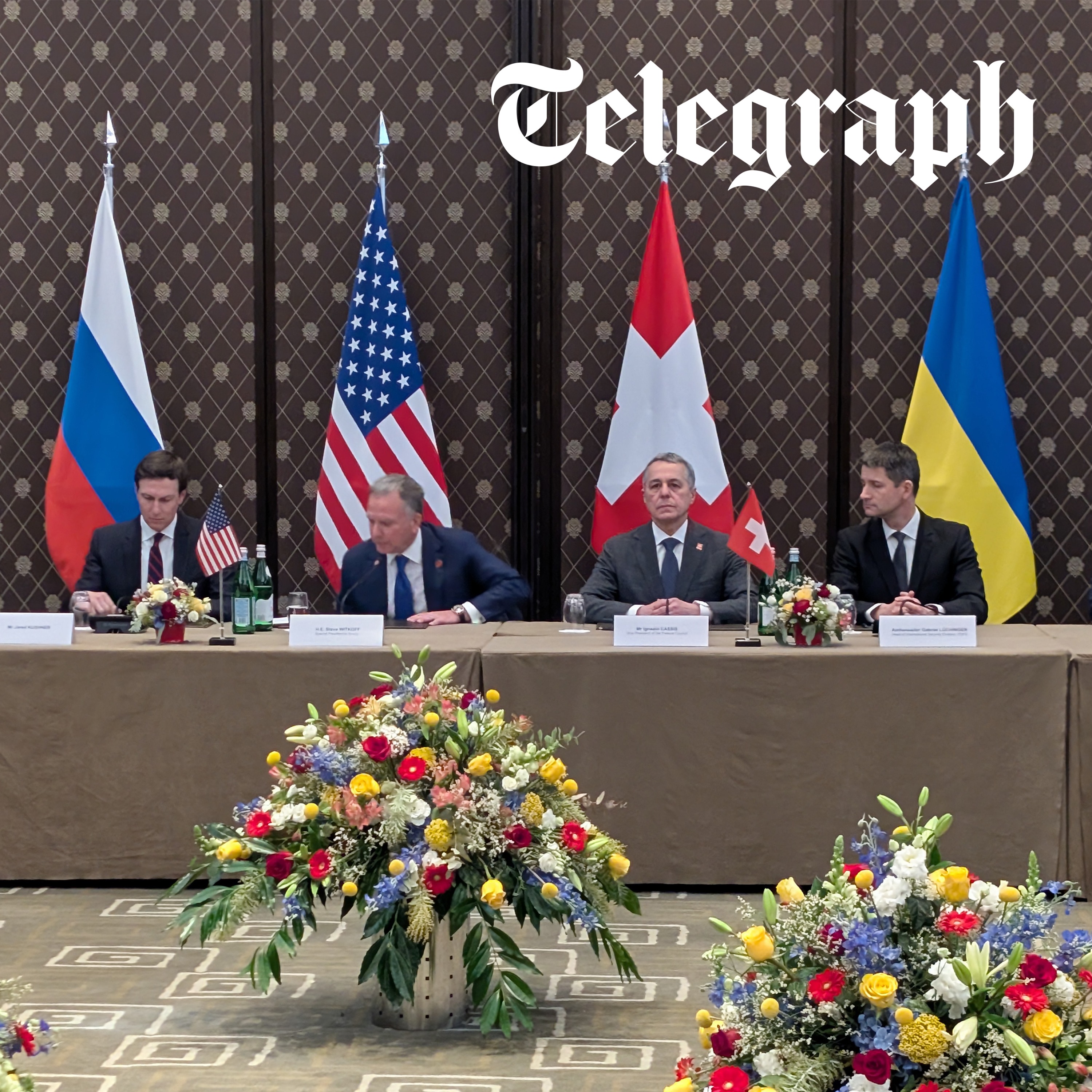
Ukraine: The Latest
Peace talks end in ‘acrimony’ after just two hours & Ukraine recaptures ‘most land since summer 2023’
00:43:14
Loading summary
Transcript92 lines
- [00:04]
Narrator/Advertiser
The telegraph.
- [00:09]
Sleep Number Representative
Why choose a Sleep number Smart bed.
- [00:11]
OnDeck Representative
Can I make my sight softer?
- [00:13]
Dom Nicholls
Can I make my sight firmer?
- [00:15]
Joe Barnes
Can we sleep cooler?
- [00:16]
Sleep Number Representative
Sleep number does that cools up to eight times faster and lets you choose your ideal comfort on either side your Sleep number setting. Enjoy personalized comfort for better sleep night after night. And now during our President's day sale, take 50% off our limited edition bed plus free home delivery with any bed and base ends Monday only at a Sleep number store or sleepnumber.com dreaming of.
- [00:40]
Narrator/Advertiser
Getting the all new iPhone 17 Pro designed to be the most powerful iPhone ever?
- [00:44]
Boost Mobile Representative
Then stay in bed and let a Boost Mobile expert deliver and set it up for you.
- [00:48]
Narrator/Advertiser
Oh actually they will have to get up and open the door.
- [00:50]
Boost Mobile Representative
Oh right.
- [00:51]
Narrator/Advertiser
Delivery available for select devices purchased@boostmobile.com terms apply.
- [00:55]
Boost Mobile Representative
Knock knock.
- [00:55]
James Kilner
Ooh, who's there?
- [00:56]
Boost Mobile Representative
A Boost Mobile expert here to deliver and set up your all new iPhone 17 Pro designed to be the most powerful iPhone ever.
- [01:02]
Narrator/Advertiser
You called that a knock knock joke?
- [01:04]
Boost Mobile Representative
This isn't a joke. Boost Mobile really sends experts to deliver and set up your phone at home or work.
- [01:09]
James Kilner
Okay.
- [01:09]
Narrator/Advertiser
It's just that when people say knock knock there's usually a joke to go with it.
- [01:12]
Boost Mobile Representative
Like I said, this isn't a joke.
- [01:14]
Narrator/Advertiser
So the knock knock was just you knocking?
- [01:16]
Boost Mobile Representative
Yeah, that's how doors work.
- [01:18]
Narrator/Advertiser
Get the new iPhone 17 Pro delivered and set up by an expert wherever you are. Delivery available for select devices purchased@boostmobile.com terms apply.
- [01:25]
Dom Nicholls
Foreign. I'm Dom Nicholls and this is Ukraine. The latest Today, as the latest round of so called peace talks breaks down after just two hours, we speak to our correspondent in Geneva to find out what happened. And we asked why the International Paralympic Committee has decided to allow Russian and Belarusian athletes to compete at the Winter Olympics under their national flags. Plus we speak to our resident Russia watcher and ask him to interpret the latest machinations from the Kremlin over Geneva Navalny Telegram and cucumbers.
- [02:00]
Podcast Narrator
Bravery takes you through the most unimaginable hardships to finally reward you with victory.
- [02:10]
Francis Durnley
Russia does not want peace.
- [02:20]
Dom Nicholls
If I'm president, I will have that war settled in one day. 24 hours. We are with you. Not just today or tomorrow, but for 100 years.
- [02:34]
James Kilner
Nobody's going to break us.
- [02:36]
Joe Barnes
We are strong.
- [02:37]
James Kilner
We are Ukrainians.
- [02:39]
Dom Nicholls
It's Wednesday the 18th of February, three years and 361 days since the full scale invasion began. And today I'm joined by our executive editor for audio, Francis Dernley. Brussels correspondent Joe Barnes dialing in live from the peace talks in Geneva and Russia expert James Kilner. I started by going straight to Geneva for the latest from the peace talks. Joe, you're there in Geneva, the Intercontinental Hotel, I believe, what's happened this morning.
- [03:08]
Joe Barnes
So the Russian delegation entered about 9:30am and then less than two hours after that, talks were over. I was sat in the lobby and I saw lots of movement. I saw Vladimir Badinski walk down the stairs and head for the exit or the entrance, whatever variation you use at hotel. And then at that point, he made clear to some Russian journalists, who I later sort of was told he described the talks as tough but businesslike. And then Rustam Umarov, Ukraine's chief negotiator, he came down, why saw him, and I happened to be on my own in the hotel lobby at that point and gave him a wave and went, Mr. Umaroff, it's Joe Balms in the Daily Telegraph. Can I have a quick word? And he just waved and smiled and walked past me. But do not fear. He was on his way to brief some visiting Ukrainian journalists who had been invited into the hotel. And I managed to smuggle my way in. And he basically delivered the same line in a different variation as what Madinsky had said. Look, talks have been tough. We were talking serious business, getting somewhere, and we're going to meet again. That was his, essentially his underlying message. And then Zelensky came out, he gave a short briefing to journalists in Kyiv and elsewhere, and he basically said, look, negotiations were not easy. So we've got this narrative of overnight. They were described as tense, and that mood has continued. But what I think we should drill into is what was actually being spoken about. And the talks essentially broke off into two formats. One part was a political discussion that was on the future and the fate of the Donbas, especially the Ukrainian held Donbass territories, the Zaporizhzhia nuclear power plant, and then the future of any security guarantees. That was the political room. That was Vladimir Madinsky and I assume Rusty Uberov speaking. But then there was a second room, a military technical room, which is where the progress seems to have been made. And actually I spoke to a Ukrainian official involved in those talks and they were telling me, actually, look, we are close to a deal on essentially the technical aspects of what happens when a ceasefire is agreed, the terms of the withdrawal from the front, how do we disengage, how do we monitor a ceasefire, what do we do in that? But then they went on to say, look, what is the use of a technical deal if we don't have a political one. So on one hand we've got progress on what happens after a ceasefire, but we've got no progress. We are still in the same sort of logjam dead end, because essentially Russia is refusing to drop its demands for the entirety of the Donbass. Even the Ukrainian held land, when I sort of get the feeling from the Ukrainians that they would agree to a ceasefire straight away, as long as it was on that line of contact. But it's been a really interesting two days here in Geneva, which has been sort of this extraordinary two days of shuttle diplomacy. From here. On one hand, you've got Steve Witkoff and Gerard Kushner hosting talks between Ukraine and Russia to end the largest ground war since the Second World War. And then on the other hand, you've got these separate talks between Iran and the US on stopping Iran from acquiring a nuclear weapon. They weren't in the intercontinental, those talks, but they were close by. But they were essentially being led by the US delegation here. I don't know if you've got any questions. Maybe that's the better way, rather than me rambling on.
- [06:31]
Dom Nicholls
Yeah, well, yeah, I mean, we hear that officials from Germany, Italy and the UK sort of muscled their way in, shouldered their way in, demanding to be part of it, not sidelined or overlooked. Did that happen? Did you see them sort of pitch up and try to sort of sneak in the tradesman's entrance?
- [06:48]
Joe Barnes
I think I've seen tweets and suggestions that they had bustled their way in and demanded a place at the table. But I think that is probably a slight bending of the reality of what happened yesterday. I was speaking about Jonathan Powell and Steve Wyckoff having breakfast together. Steve Wyckoff didn't look like he was interrupted by Jonathan Powell. He looked like he had invited him to be there. And in fact, last night, after the talks broke up, Steve Wyckoff went to have dinner with Jonathan Powell and these European officials from France, Germany, Italy, Switzerland, at the Four Seasons Hotel down the road in Geneva. So I think far from muscling their way in and coming in uninvited, as it was suggested on social media, they were actually here at the invite of the Ukrainians, of the Americans. So, yeah, maybe not muscling in the right way, but they were here and they were being well briefed. At one point, I saw one of them, Ukraine's top negotiators, coming down to speak, to speak to Jonathan Powell's team of diplomats, literally just after the talks are broken up and sort of giving them a run for a blow by blow of what happened. So they are being as well briefed as people inside the room.
- [07:53]
Dom Nicholls
So what's your spider sense telling you, Jode? Are the Europeans part of these quote, unquote, peace negotiations or are they still very much on the sidelines?
- [08:01]
Joe Barnes
So in terms of direct involvement at the negotiating table, they're clearly not what we saw. I've not been in the room because apparently I did ask to go up and visit it, but apparently people are still working in there, so I'm going to try before I have to catch a cab to the airport and all the bugs out. At the table, you had Steve Witkoff top of the table next to Switzerland's foreign minister, who is hosting the talks, as the hosting party. Then on either side, you had the Russians and Ukrainians. So it's clear that the Brits and the other Europeans aren't involved at that level. But what they are involved in is that sort of secondary path where the Ukrainians and Americans are speaking about security guarantees and the like. And that is where the Europeans are very much involved. So they have the right to sort of the information in the room as much as anyone else, because ultimately they're the ones that are going to have to be changing or editing or ultimately deploying troops to Ukraine depend on how the wider ceasefire deals take shape.
- [09:03]
Dom Nicholls
So now the blame game starts, I suppose, both sides desperate not to be held by Donald Trump as the reason the talks ended so, so abruptly. Have they already started positioning themselves?
- [09:12]
Joe Barnes
No, quite interestingly, we have a mini information truce. So I speak to a Ukrainian official and I was like, why didn't you say anything yesterday? And they said, look, it's because we agreed with the Russians and the Americans that we weren't going to criticize each other. We weren't going to speak on the details of what happened inside the negotiations after the talks. We're going to. Basically, the first thing that we should all hear from each other is we should return on this morning, on Wednesday morning to negotiating table. And that is the next noise from both sides that we should hear. And that truce did largely hold. I think President Zelensky came out and sort of blamed the Russians for allowing talks to drag on and trying to drag them out. But largely between the two negotiating teams, that truce held. And I spoke to the same official after talks wrapped up today, and they said, look, that agreement is still in place. So I don't think we are going to get too much criticism from either side until both chief negotiators Umarov and Babinsky get to speak to their principals, Zelensky and Putin, and basically debrief them and say, look, where do we go from now? What's been quite interesting is Medinsky left and then returned after sort of the building had cleared out. And I happen to be still sitting in the lobby waiting for my flight later this evening. And he came back up and he went upstairs. He then left and then one of the Ukrainians came back and did the same. So it's clearly there is still some shuttle diplomacy between maybe not trilateral, but bilateral talks between Moscow, Kyiv and D.C. happening. So basically the Americans are trying to find out what are the parameters for us to hold and next round of talks. And both the Ukrainians and Russians are trying to basically convince Donald Trump and his people that they're still interested in talking, even though there isn't a clear sign or a clear way out of this conflict for now.
- [11:01]
Dom Nicholls
Either that or they both left their phone charges in the room, which is what I always do. But mini information truce, that's the most positive thing I think I've heard from these peace negotiations, well, through any rounds, because that is a sign of a grown up negotiation, in my opinion. Francis, what's your reaction to Geneva?
- [11:19]
Francis Durnley
Well, surprise, surprise. Nothing came of it. Something that struck me, speaking to people over the last couple of days is how many informed individuals actually believe that these peace talks are meaningful. It seems that there has been a lot of cut through as to the idea that we are very, very close to a meaningful negotiated settlement. And that is obviously very troubling because that will stall support for Ukraine and it will stall efforts to try and see Moscow put more in the dock, as it were, and actually have a meaningful discussion that brings things to a close. A lot of other people seem to be quite shaken by this and think, well, what does this mean? Does this mean now that the war's gonna continue? The war is continuing the whole time as we're gonna hear later on in terms of the battlefield. So that's a key takeaway for me from all of this really, is that this is something people are still thinking is actually a meaningful negotiation. Unless, of course, you're inside Ukraine or the Kremlin or our listeners to this podcast.
- [12:20]
Dom Nicholls
Now let's turn to our resident Kremlin ologist, James. A lot going on at the moment. Donald Trump's attention is being diverted. You've got midterms just around the corner. In diary terms, you've got Iran, the build up there. So actually his attention is looking Elsewhere, do you think Russia sees that their window of opportunity for getting something done here is closing and hence they might have come to these talks with a little bit more willingness to actually produce something than we've seen in the past. What's your takeaway from Geneva?
- [12:48]
James Kilner
My Dom, Francis and Jay. Well, okay, so it's been a pretty muted reaction in the Russian media, which as we keep describing accurately is a mouthpiece for the Kremlin. They quote Vladimir Medinsky, he's the leader of the Russian delegation, as calling it difficult but businesslike. So I mean, that's a good question, Dom. I mean, my sense is that seeing Madinsky head up the delegation again is an important point. He was involved last year and he was involved initially in the 2022 was April 22 talks in Istanbul, but he wasn't involved in the Abu Dhabi talks earlier this year, which did generate a prisoner swap and did generate a very short lived energy ceasefire, you know, targeting energy installations in both Ukraine and Russia. That was only a very short lived ceasefire, but nonetheless. So seeing Medinsky back I would say is an important point. Now he is an aide for Putin, a presidential aide, but he's also very much used by the Kremlin, by Putin to, you know, for their, to push the propaganda gimmicks. One of his big projects was rewriting all the textbooks in Russia, you know, editing out history that the Kremlin doesn't like and promoting Trump, etc. Etc. That was all part of Madinsky's thing. He heads up a sort of a real time historical reenactment group. You know, he's considered a clever guy, but he's also considered a bit of something of a lightweight gimmick. So I would say this is my reaction that seeing him head these talks again and knowing how he was sent down to Istanbul in April 22to head talks down there, talks which weren't taken particularly seriously by the Kremlin. I'd say, you know, the attitudes of the Kremlin again towards these talks is one of sort of not disinterest, but not really in the best will in the world sort of thing. I would caveat a bit saying that Kil Dmitriev, he's the Kremlin's envoy to the talks, and Admiral Igor Kosiakov, head of the foreign military intelligence agency, both of those guys were in Abu Dhabi. They were also in Geneva this week on the talks. So mixed signs. I think Medinsky heading it up is a red flag.
- [15:01]
Dom Nicholls
Yeah, as advertised. That's what all the comment was ahead of the talk starting in Geneva, But I do think time's running out, you know, midterms, not that far away anyway, away from Geneva. James, what else happening in Russia this week? Obviously, Monday marked two years since the death of or the murder of Felizonda Navalny. How's that gone down in Russia? What's happened there?
- [15:20]
James Kilner
No coverage of this whatsoever in the Russia media, as you can imagine. The Kremlin has officially denied that it poisoned Navalny with his Ecuadorian frog poison. I have to say there were 19 people detained across Russia on, on February 16, the second anniversary of his murder.
- [15:38]
Narrator/Advertiser
For.
- [15:41]
James Kilner
How to correctly frame this for mounting sort of makeshift memorials or going out there not protesting, but marking the event. It really shows the totalitarian nature of Russia, not that we need in particular reminding that people can't mark the event two years on of the death of a very high public figure. So, I mean, typical lockdown over the Navalny issue. Dom.
- [16:07]
Dom Nicholls
Yeah, and another issue that we've been speaking about recently, we spoke with our correspondent Lily Shanaher last week about Cuba. Russia is supporting Cuba and its hour of need for energy, but that's going to bring it into direct confrontation, confrontation potentially with the United States, isn't it?
- [16:20]
James Kilner
Right, yeah. This is an interesting story. So we've got the foreign minister of Cuba in the Kremlin today. He's due to meet Putin, I think, later. I don't think he's met Putin yet, but he met Lavrov earlier. And it seems to me that Russia, Kremlin is definitely, you may be using this as a leverage. As we know, the US have basically put Cuba under fuel embargo. There's been lots of stories about how, you know, since effectively regime changing Venezuela, which had been a major supplier of fuel to Cuba, that Washington wants to sort of create all this pressure on Cuba and various services, etcetera, have been failing there. It does seem. There were statements, I think, at the end of last week by the Kremlin that they're going to start sending fuel to Cuba in a sort of humanitarian capacity. As you know, Dom, Russia and Cuba are great Cold War allies. Russia and the Kremlin very much. See, Cuba is an important Caribbean ally. It's still a major destination for Russian tourists, etc. Etc. And we now have this sort of quite remarkable sight, I'd say, coming up, of the. Of the Cuban foreign minister meeting Putin. What Putin says afterwards is going to be interesting. We know that Trump is keen on changing the regime in some capacity in Cuba, if you know which really creates a limited amount of maneuverability, I think for Putin. If he comes out quite hard against any US intervention or sort of regime change in Cuba, I think that will impact on the Ukraine peace talks and the Russia US Dynamic. There have been some same as Peskov, he's the Kremlin chief spokesman. He said that the meeting between Putin and the Cuban foreign minister holds special significance because of the difficult period that friendly and brotherly Cuba is currently experiencing. So quite a strong statement there which really suggests that Russia may start trying to send fuel to Cuba as promised, which probably won't go down very well at all in the White House, I'd imagine.
- [18:24]
Dom Nicholls
Well, exactly. It'll be interesting, as you say, to see if Putin actually does say anything about it because it would be such a flag to the US Administration. I wonder if he will actually come out and make any statement. Telegram We've spoken of the Starlink shutdown and the Telegram shutdown as well. Trying to push Russian citizens onto the Kremlin zone. Messaging at Max. That's taken another turn this week. What's your take on that and do you think this is anything to do? I've seen some comment that Putin might be trying to mobilize again by stealth or even more overtly and he doesn't want the society to be able to communicate and talk to each other and perhaps organize in the event of such mobilization. Hence Telegram. That might be a little bit of a conspiracy theory too far, but what's your take on it, James?
- [19:05]
James Kilner
Fascinating story this. So as sources, unknown sources, but sort of government sources have been telling BASA that's a sort of a quite well connected Telegram channel ironically is saying that Telegram will be blocked from April 1st. So it does seem that the Kremlin is determined to go through with this. I wonder if you're onto something. If the Kremlin censors that Telegram is actually the breeding ground for any anti war, anti Putin sentiment and you know, the sort of the vehicle that can be used to mobilize this and any nascent opposition against Putin and his war and just wants to stamp it out. It certainly feels like it's impossible really to overstate the sort of pillar that Telegram serves as a communication tool, as a social media tool in Russia, it really is absolutely critical. So to knock it down is a massive play by the Kremlin and Smacks is possibly biggest censorship project so far in the war. And given it's already been centering the Internet, YouTube, you know, what people can listen to, etc. And read that saying something. So I really think that the Kremlin has decided that the stakes are so high that it's so worried about something that the economy may be so fractured, possibly another mobilization. I'm not convinced by that. But it's worried about the sentiment of the public that it's just gone for this. And we have to say that there has been stories accurately reported that frontline Russian troops are relying on telegram to communicate. Partly because the Russian military communication kit has been so poor. The Kremlin has come out and said we're going to ban or block telegram, except for on the front line. So, you know, this is effectively acknowledgement that this ban on the telegram is actually going to happen, but it's tactile announcement that you know it's going to try and ring friends and protect the front line. So, yeah, I think it's happening and I think it's a high stakes thing. What the credit wants to do is push it onto a messaging system that it built last summer called Max. There has been a story floating around and I can't confirm it, but it's worth flagging up to listeners, Dom, that Putin may own a stake in Max's controlling company, Vere. He has a son of a cousin, so. So not a direct cousin who lives a rather low key life up in St. Petersburg as a fencer who owns a 13% stake in Vaca, which is the big sort of Facebook mega communication company linked very strongly to the Kremlin and Kremlin propaganda. Vaca was is the official vehicle for Max. So there is another element to the story playing out as well.
- [21:50]
Dom Nicholls
When you say Putin's relative is a fencer, do you mean he's a sportsman or a dealer in stolen goods?
- [21:57]
James Kilner
Sorry, I mean he literally mends fences.
- [22:00]
Dom Nicholls
Oh, he mends fences, right. Option three. Right, okay, fair enough.
- [22:06]
James Kilner
But he apparently owns a 13 stake in Becker, so I'll let listeners be the judge.
- [22:12]
Dom Nicholls
Yeah, fencing industry must be good. Before you go, James, or do hang around if you're able to, for final thoughts again before you go, vegetable gate, what's the latest on cucumbers?
- [22:21]
James Kilner
Right, okay. The cucumber story, it actually really does keep playing out and it's getting a lot of airtime, not just in Telegram in a reverent way, but also in the mainstream Russian media, which is remarkable. Cucumber prices keep rising. Apparently they're now costing about 700 rubles for a single cucumber in the regions. I think that's about seven quid. It seems to go up two or three fold every week. There's lots of complaints on Telegram about how cucumbers in Russia are 10 times more expensive than cucumbers in Dubai. Russians are very irritated about this. Molska Pravda, that's the sort of very nationalistic Red top newspaper in Moscow. Very pro. Kremlin has been giving away cucumber seeds in its issues and a very large Russian retailer has said it's going to start growing cucumbers to get in on the sort of profit margins. Apparently, cucumbers are an important vegetable in Russia. They're eaten a lot. They're a symbol of sort of Russian daches and food and opulence. Irritating Russians at that sort of level. So there's a cultural element to this, this whole thing as well, as well as an economic thing. The price rise is linked to the strong winter, lack of labor and fields, et cetera, lack of planning, the lack of, you know, much more interest in the war, and also this sort of wider collapse of the Russian economy. There's a very good quote by a Russian economist earlier this week that, like in the Russian economy to being in the death zone, Mountaineer being in the death zone above 8,000 meters, running out of oxygen, but determined to keep going to the. To the peak, despite dying, you know, the body literally closing down. This is kind of where the Russian economy is at. And to give you a very quick list of the stories I've been reading about in the last few days, Dom, we've had masses of comment from ordinary Russians on Telegram and even seeping through onto mainstream websites about hugely rising utility bills. Some of these are getting quite emotional, you know, water and gas prices doubling, et cetera. Obviously irritating all new Russians. We've had a list of smaller Russian oil companies going bankrupt. The price of Russian oil has been massively pushed down by sanctions. They're struggling to sell it even to Indians and Chinese. Abdovaz, that's the largest Russian car maker, said that sales are probably going to be down another 15% this year. Every year they drop by 15, 20%. And also there's a Putin car story rolling around. His project to build Russia's version of a Rolls Royce is it had to be stopped because it's just too expensive and no one wants to buy it anyway. So the sense is the Russian economy is really on its knees. At the same time, the Russian central bank is really scrambling around to try and get a grip of it all. It cuts interest rates. Last Friday, I think it was by 50 basis points, down to 15.5%. It's steadily been cut from about 21%, but the interest rate wasn't cut anywhere near as enough, as much as business wants to see it. But at the same time, as we know, as we discussed at some gray length, inflation in Russia is soaring, pushed by the war and also by VAT rises that the government has introduced to try and raise money for the war. So the central bank is in an absolute bind. It's got to try and stimulate growth and at the same time it has to try and keep inflation under control.
- [25:44]
Dom Nicholls
Fascinating stuff from cucumbers to oil companies. Thank you, James. That's the gift you bring. Let's stick on the diplomatic side, on the international side at least. Francis, what have you been looking at? First of all, have you got any reaction to any of the stuff that James has been raising there?
- [25:56]
Francis Durnley
Well, nothing quite as important as cucumbers, Dom, But I would just add on the Navalny story, I think it is just worth us taking a moment to recall the first anniversary of Navalny's murder and how much publicity there was around the world relating to that. There were hundreds, possibly even thousands of people who attended his funeral when he died in Russia. And then of course, there was the commemorations last year around his grave. There were flowers being left and it was a story, at least not saying this was a mass mourning or anything akin to that. But the fact that there's so little recognition of this in the way that James has described, I think is worthy of note, particularly when, of course, British intelligence and others have just released this information about the nature of his murder. I imagine there'll be a little bit of disappointment that there hasn't been more of a pickup of that. But of course, Navalny, a very controversial figure in Ukraine for issues that we've talked about before, but nonetheless an important one in terms of other stories. A quick update on sanctions in relation to Belarus. The Ukrainians have imposed another package of them on Lukashenko's government. To quote Zelenskyy, in the second half of 2025, the Russians deployed a system of relay stations on the territory of Belarus to control strike drones, which significantly, the Russian army's ability to launch strikes on our northern regions from Kyiv Oblast to Volyin, Russia would not have been able to carry out those strikes, particularly against energy infrastructure and railways, without Belarus's assistance. So punchy words as we've come to expect, I imagine that we'll get the usual bombast in response from Lukashenko, but nonetheless, I think interesting. In other news, an update on stolen children, of course, A subject we've spoken about many, many times. Whenever there is a significant update on this, we always try and bring it to the fact that there isn't. A lot, I think, reveals the state of play, frankly. The President's office has, though, just announced that 2,000 Ukrainian children have now been brought home from under Russia's control through the Bring Kids Back initiative. In a statement, they've said that each of these returns was made possible thanks to the daily efforts of our people, civil society organizations and international partners. We're grateful to everybody who has contributed to this fight, our country and the entire free world. The road ahead remains long and difficult. Thousands of children are still being held captive, becoming victims of Russia's crimes every day. But we will not stop until every Ukrainian child is back home. So a reiteration of arguments that they've made before, but it just bears repeating that the last statistics that we had that are trusted from Yale were at 35,000. I'm guessing that was probably eight or nine months ago now. So you can do the maths of how many more there could be that have been taken from the occupied territories and taken for re education or worse. We've obviously spoken about that. Adlie at the moment is actually working on this subject very closely, so expect more from her over the coming months on this. But whenever there is an update, we always want to bring it to you. The scale of this is just unimaginable, frankly. And I think the fact that with all these negotiations going on at the moment, they're not even part of the conversation, once again, is indicative of how much this has become focused on territory from the Russian and American perspective rather than the actual human dignity point. But regardless. Lastly, I mentioned Belarus earlier and just returning to a subject we've referenced quite a lot over the last week or so, it's now been confirmed that six athletes from Russia and four from Belarus will compete under their national flags in the upcoming Winter Paralympic Games in Milan. Now that will be the first time, I think, since 2014 in Sochi at the Paralympics that Russia has been able to have its national flags flown. Just shows you how on multiple fronts, from doping to war, they have been banned. Over the years, the IPC has extended the Bipartite Commission invitations to six Russian athletes and four Belarusians. Understand, these invitations are given to individuals rather than their international federations, so they allow entry for competitors who may not otherwise qualify via typical channels due to what they call extraordinary circumstances such as international sanctions. So the timeline here, the IPC previously suspended Russia in 2016 because of the doping scandal. Then Belarus and Russia were banned in 2022 following the full scale invasion of Ukraine. In 2023, there was the partial suspension instituted, allowing athletes from Russia and Belarus to participate as neutral competitors. And we saw quite a bit of that over the subsequent years. And then we had the IPC's decision in September last year, which we reported on, to reinstate the membership rights of Russia and Belarus. So this is the next step after that. So you can imagine Ukraine's Paralympic Committee is outraged. They said, I am very, very angry, their spokesman, and outraged by the decision to allow Russian athletes to compete under their national flag. This is terrible. I think it just begs the question, Dom, that we've been asking, really the last two weeks whilst the Olympic Games have been going on. Why now? Why do this now? What is the justification for this? Given that the war is still at such an intense level, is still ongoing, why are Belarus, why are Russia being rewarded with this? Belarus has just received that extra package of sanctions from Russia. They are still very heavily implicated in this war on multiple fronts. Why are they doing this? Well, we can speculate as we have, but there is no logical justification for this. Anybody who is arguing that this is trying to bring the sides closer together, it's all guff. I think this is really a decision made. I think, on assuming that this war is winding down, and as we spoke about earlier on, there is no evidence for that.
- [32:06]
Dom Nicholls
Yeah, exactly. I mean, what has changed? What evidence has changed? What information has changed upon which the International Paralympic Committee have made their judgment? Interesting. But as you say, they are competing as individuals, not as their national federation. So I presume they are paying their own way to get to Italy and all their hotel and food and everything. They're paying as individuals, I presume, the Russian Federation, it's not quite clear, but.
- [32:30]
Francis Durnley
I assume, though, that if they're under the Russian flag and the Belarusian flag, that there will be money still being given to them by the state. And it's interesting. What we don't know is why these individuals have been picked. What's been the reason that these particular candidates have been picked out? So more questions than answers on this.
- [32:48]
Dom Nicholls
Okay. There's not an awful lot to say on the military front, but there are a few things I need to bring to your attention before we wrap up for today. There's not been a huge amount of movement on the ground. Ukraine has continued to push back the Russian advances or whatever in the vicinity of Zaporizhzhia, Dnipro, Petrovsk Oblast boundaries. We've been reporting on it for a few days. This comes after the Starlink switch off and telegram and what have you. I've said I think this is more Ukraine reclaiming or taking back land that had been considered to be under Russian control but probably wasn't. It might have been two or three individuals dashing forward and you know, the lines on the map change. It's all very confusing, but it's thought Ukraine is taking advantage of the confusion that's been caused by the Starlink shutdown and is using this opportunity to mop up those small and disconnected groups of Russian troops that are no longer able to coordinate or get resupplied, et cetera, et cetera. So my assessment is still, that it is still a mopping up operation, mopping up that any Russian opportunistic advance, but I caveat that with the area where this pushback is happening is fairly geographically defined, it is small, it is limited in scope. So it could indicate that whilst it may have started as opportunistic reclaiming of land, perhaps Ukraine is looking to reinforce the success that they've achieved, the relative success that they achieved, they've achieved and try and turn it into a more coordinated advance. We will see. But I still think it's small and opportunistic rather than think broader than that. Certainly the data I think would back that up. The data show that Ukraine has recaptured territory at its fastest pace in nearly three years. Ukraine regained 78 square miles. Was that about 110 square kilometers, something like that. In the five days between Wednesday and Sunday Just gone. That was equal to Russia's entire advance for the month of December. Just gone. This is analysis by the Institute for the Study of War, the US based think tank. They say these Ukrainian counterattacks are likely leveraging the recent block on Russian forces access to Starlink, which Russian mill bloggers have claimed is causing communications and command and control issues on the battlefield. Now just on that, there's an interesting point made I saw online by the online media outlet Malcontent News talking about OPSEC operational security. That is, does all this talk. Well, our access, the public's access to open, open source information and maps and all the rest of it, satellite imagery and what have you. Does that come at a cost to, well, to Ukrainian troops and their security? Basically, does it benefit the Russians? Now Malcolm 10 News are saying if the information is in the public domain, using that information isn't breaking operational security. But they say what's unusual about this tactical operation, that Ukraine is Doing down in Zaporizhzhia Dnipropetrovsk opseg is more important than it was just a month ago. They say Russian area commanders no longer know because of the Starlink shut shutdown. They no longer know where all their forward units are or their status. They say Russian surveillance capabilities have been degraded due to the Starlink and telegram bans. So in this particular case the argument that Russian area commanders see and know everything isn't factual. Maybe we are being unhelpful by saying exact movements, where and where we think they don't have that real time information anymore. The Russian aligned maps. This is malcontent news speaking. The Russian aligned maps are a hot mess due to six months of picture reports, particularly from the Pokrovsk area. Let them cook in the juices of their own Kool Aid, they've said Many Russian mill bloggers have been warning for months that this is going to be happening. When we see flag wavers rushing forward claiming ground, then Russian MOD saying they've taken that village, that leads to all this confusion and it means that Russian commanders on the ground can't then call in airstrikes and all the rest of it because according to the Russian mod, you already hold the land. So, so they saying that this was always going to happen, they've overextended. This was always going to. There was going to be a reckoning and that reckoning has been brought forward by the Starlink shutdown. Malcontent says four Russians holding up a flag for a drone who are eliminated five minutes later or run for their lives are not proof of territorial gains. But for the Kremlin it is now just on that former Australian General Mick Ryan has put out a substack post titled Starlink Surprise and he says eventually the shock wears off, responses are developed and counter punches delivered. This will be the case with the Starlink shutdown. Ukraine will have limited time to exploit the opportunities of the degraded command and control environment now endured by Russian ground forces. We'll put a link to Mick Ryan's substack in the episode notes for today. Now, yesterday across Ukraine, Russia fired one ISKAND M ballistic missile and 126 drones at Ukraine. This comes from Ukraine's Air Force. Air defense has intercepted 100 drones, but at least, well, the missile and 23 drones made it through, hitting 14 locations, killing five, injuring 30. Most of the dead were in Donetsk, but also Zaporizh and Dnipro, Petrovsk. And just finally a source in the sbu, the security service of Ukraine, speaking to friends of ours at the Kyiv Independent, said that an operation overnight on Monday, Tuesday that's only been reported today successfully hit a large Russian chemicals plant that supplies the country's explosives production. They say deep strike drones operated by the SBU's Alpha unit attacked the Matafax chemicals plant in Perm Krai. That's a plant that is under international sanctions. It's about 1,500 kilometers northeast of Ukraine, so a very long range strike. The governor there, Dmitry Makonin, confirmed a Ukrainian drone attack in the region, but did not provide any further details other than to say that there had been no casualties recorded. So clearly he's not on the Kremlin's narrative. And I think Mr. Makonnen is going to be another Russian official we're unlikely to see in front of the press again. Okay, a very quick update on the military.
- [38:29]
Sleep Number Representative
Why choose a Sleep number? Smart bed?
- [38:30]
OnDeck Representative
Can I make my sight softer?
- [38:32]
Dom Nicholls
Can I make my sight firmer?
- [38:34]
Joe Barnes
Can we sleep cooler?
- [38:36]
Sleep Number Representative
Sleep number does that cools up to eight times faster and lets you choose your ideal comfort on either side your sleep number setting Enjoy personalized comfort for better sleep night after night. And now during our President's day sale, take 50% off our list. Limited edition bed plus free home delivery with any bed and base ends Monday only at a Sleep number store or.
- [38:56]
OnDeck Representative
Sleepnumber.Com ondeck is built to back small businesses like yours. Whether you're buying equipment, expanding your team or bridging cash flow gaps, Ondeck's loans up to $400,000 help make it happen fast. Rated A by the Better Business Bureau and earning thousands of five star Trustpilot reviews, OnDeck delivers funding you can count on. Apply in minutes at OnDeck.com, depending on certain loan attrib. Your business loan may be issued by Ondeck or Celtic Bank. Ondeck does not lend in North Dakota. All loans and amount subject to lender approval. We interrupt this program to bring you an important Wayfair message. Wayfair's got style tips for every home. This is Stiles MacKenzie helping you make those rooms sing. Today's Style Tip when it comes to making a statement, treat bold patterns like neutrals go wild like an untamed animal. Print area rug under a rustic farmhouse table from wayfair.com fierce this has been your Wayfair style tip to keep those interiors superior.
- [39:56]
Joe Barnes
Wayfair Every style, every home.
- [40:00]
Dom Nicholls
Good friend. Now let's go to our final thoughts. Where should we start? Where should we start? James, what have you got for us on final thoughts.
- [40:07]
James Kilner
I don't, I just want to flag out one, one issue to listeners. One of my pet interests is the south caucuses in Central Asia. And we've had the, well, I call it remarkable, almost remarkable sight of Ilham Aliyev, he's the President of Azerbaijan meeting with Zelensky at the Munich Security Conference last week. It's really a signal for by Baku, by Aliyev, that it is increasingly falling out with Putin and the Kremlin. We know, we discussed this at some length, that relations between Azerbaijan and Russia really collapsed, have really collapsed since Christmas Day 2024, when Russian air defense systems shot down an Azerbaijani airliner and subsequently Putin really botched his apology cleanup and really irritated Aliev. And we've seen Aliyev meet with Zelensky two or three times now since that incident. And to put it into the wider FSG context, the wider context of Central Asia and South Paul says the leaders in these countries have been incredibly careful about who they meet and how. And Zelensky is, to put it bluntly, has been pretty much off limits to Central Asian leaders, for example. And so for Aliyev, to me, I think it's the third time since the, since the Russian air defense system shot down the airliner. A big deal. Again, the context is at the beginning of last week, JD Vance was in Azerbaijan and Armenia, the first US vice president to visit Azerbaijan since 2008, the first ever to visit Armenia. So this was a big week essentially for Western relations with Azerbaijan. That's what I want to leave our listeners with. Sort of a movement on the geopolitical front down in Russia's backyard.
- [41:48]
Dom Nicholls
Thanks, James. Do stay in touch, please. Francis, what have you got?
- [41:52]
Francis Durnley
Just a quick one shout out to Ian and 40 volunteers joining him on the latest convoy delivery to Ukraine under the umbrella charity of Convoy for Ukraine. Total funds raised since the start of the war to just under 2 million pounds. They're currently delivering 22 4x4 pickup trucks and a minivan, one 150,000 pounds worth of medical aid as well to a hospital in Lviv, among other things. And I know many of them are listeners. I just thought I'd give them a shout out today for more information about them. We'll have a link in the show Notes as usual.
- [42:24]
Dom Nicholls
Thanks, Francis. Well done, Ian and gang. Joe, you're still in the Intercontinental. Still got Euro trash in your ears, I imagine, in the lobby. What's the latest there? Anyone still hanging around or are they all headed off?
- [42:34]
Joe Barnes
There's a few people in and out. I can't actually see them because we're sat to try and get a quiet location to speak to you guys. I can't see the lobby, which is not a problem. No. But for my final thought, I want to go back to what you said, Don, about the idea of silence being a good thing. There's two ways of looking at this. I am of the opinion, like you, that silence is a good thing. When I covered the Brexit negotiations, people used to always speak about the thing called the tunnel, and that was a very secretive area where the negotiators would enter. They wouldn't speak to the outside world until they saw light at the end of it. This sort of moment feels like actually have Ukraine and Russia reached a position where actually it might be worth talking and trying to have a go at brokering a ceasefire, as both of them publicly claim they want to do? Or are they at a situation where they both know that these peace talks have basically run their course, but they are both desperate to keep Donald Trump on side one for the Ukrainians to keep that supply of weapons and intelligence and and for the Russians, their perspective for keeping Donald Trump on side is limiting support for Ukraine in terms of maybe things like Tomahawks. So there's two ways that you could look at that, and I think it's fascinating either way. But I am slightly siding on the fact that I think both of them may see some light at the end of the tunnel and they want to further explore that with their political leaders back home before they start the abuse.
- [44:00]
Dom Nicholls
Well, thanks Joe. Do stay in touch. If there's any more developments during the day, let us know what happens in Geneva. Otherwise, good luck getting that breakfast bill through the Telegraph expenses and we'll speak soon, soon. Thanks mate.
- [44:13]
Podcast Narrator
Ukraine the Latest is an original podcast from the Telegraph created by David Knowles to support our work and stay on top of all of our Ukraine news, analysis and dispatches from the ground. Please subscribe to the Telegraph. You can get one month free, then two months for just one pound at www.telegraph.co.uk the latest deployment Enjoying cutting edge technology, we also release Ukrainian and Russian versions of this podcast. These translations retain our voices and delivery so that it can reach listeners in every region of Ukraine and those parts of Eastern Europe where Russian is still widely spoken. Links to those can be found in the podcast description to this episode. You can also now sign up to the New Ukraine, the latest weekly newsletter. Each week Francis Nye answers your questions, provide recommended reading and give exclusive analysis and behind the scenes insights. Plus maps of the front lines and diagrams of weapons to complement our daily reporting. It's free for everyone, including non subscribers. You can find the link to sign up in the descriptions for this episode. We regularly have a Ukraine Life blog on our website where you can follow updates as they come in throughout the day, including insights from regular contributors to this podcast. We also do the same for other breaking international stories. If you appreciate our work, please consider following Ukraine the latest on your preferred podcast app and leave us a review as it really helps others find the show. Please also share it with those who may not be aware we exist. You can also get in touch directly to ask questions or give comments by emailing ukrainepod telegraph.co.uk we continue to read every message. You can also contact us directly on X. You'll find our handles in the description for this episode. As ever, we're especially interested to hear where you're listening from around the world. Executive producers are Francis Durnley, Louisa Wells and David Knowles.
- [46:08]
Joe Barnes
My name is David Knowles. Thank you all for listening.
- [46:11]
Dom Nicholls
Goodbye.
- [46:18]
Narrator/Advertiser
Dreaming of getting the all new iPhone 17 Pro designed to be the most powerful iPhone ever.
- [46:22]
Boost Mobile Representative
Then stay in bed and let a Boost Mobile expert deliver and set it up for you.
- [46:26]
Narrator/Advertiser
Oh actually they will have to get up and open the door.
- [46:28]
Boost Mobile Representative
Oh right.
- [46:29]
Narrator/Advertiser
Delivery available for select devices purchased@boostmobile.com terms apply.
- [46:33]
Boost Mobile Representative
Big news. Boost Mobile is now sending experts nationwide to deliver and set up customers new phones at home or work.
- [46:38]
Narrator/Advertiser
Wait, we're going on tour?
- [46:39]
Boost Mobile Representative
Not a tour. We're delivering and setting up customers phones so it's easier to upgrade.
- [46:43]
James Kilner
Let's get in the tour bus and hit the road.
- [46:45]
Boost Mobile Representative
No, not a tour bus. It's a regular car we use to deliver and set up customers phones at home or work.
- [46:50]
Narrator/Advertiser
Are you a groupie on this tour?
- [46:51]
Boost Mobile Representative
We deliver and set up phones. It's not a tour.
- [46:54]
Narrator/Advertiser
Oh you're definitely a groupie.
- [46:55]
Boost Mobile Representative
Introducing store to door switch and get a new device with expert setup and delivery wherever you're at.
- [47:00]
Narrator/Advertiser
Delivery available for select devices purchased@boostmobile.com.