← Ukraine: The Latest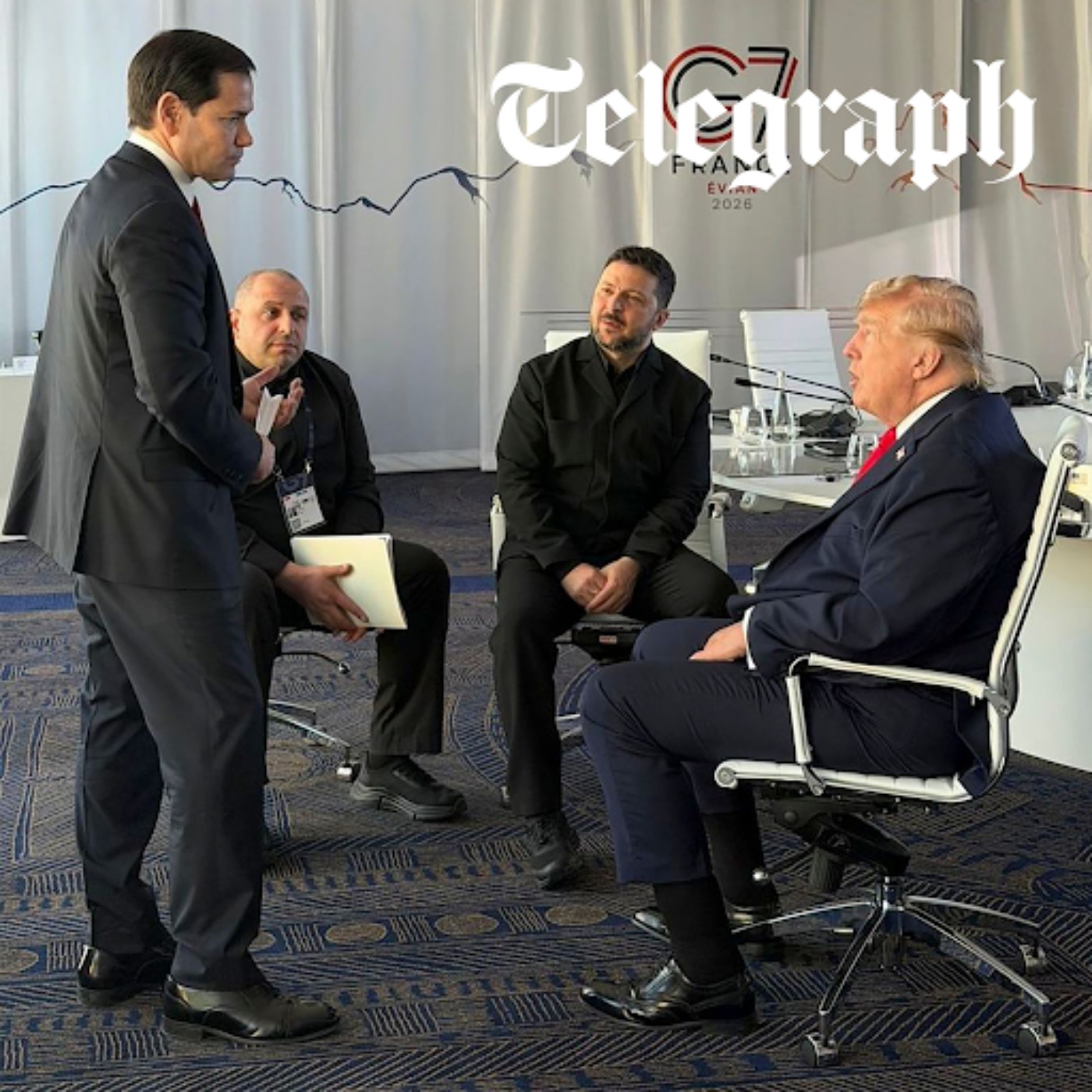
Ukraine: The Latest
Revealed: Trump backed Ukraine’s ruthless new campaign & exclusive interview with EU's first defence commissioner
00:32:37
Loading summary
Transcript37 lines
- [00:00]
Acast Announcer
Foreign.
- [00:09]
Boost Mobile Advertiser
The longer you stay alive, the longer you can enjoy Boost Mobile's unlimited plan with a price that never goes up. So here are some tips. Do not parallel park on a cliff if you want to enjoy an unlimited plan with a price that never goes up. Do not mistake a wasp nest for a pinata if you want to enjoy an unlimited plan with a price that never goes up. Do not microwave a hard boiled egg if you want to enjoy an unlimited plan with the price that never goes up. Stay alive and Enjoy Unlimited for $25 a month forever. With Boost Mobile, after 30 gigs, customers may experience lower speeds. Customers will pay $25 a month as long as they remain active on the Boost Mobile Unlimited plan.
- [00:40]
Rails to Trails Conservancy Narrator
Being outside is good for us. It's that simple. And trails make it easy for us to walk, bike and be active outside in our own backyards. On the trail we see people moving, connecting with their communities, making the places where they live great. For 40 years, Rails 2 Trails Conservancy has led the way, creating trails across the country, making it safer and easier for everyone to get outside. They want you to get involved, find your trail and start your journ journey today at railstotrails.org iheart and follow @railstotrails on Social
- [01:11]
Acast Announcer
Acast powers the World's best podcasts. Here's a show that we recommend.
- [01:19]
Taryn and Cami (Staying Up Podcast Hosts)
Do you want to know the best part about being married to a woman? That there's no man involved. I mean, true, but I was gonna say that it's a sleepover every single night with your best friend. Oh yeah, that part's cute too. I'm Taryn, she's Cami. We're married. And staying up is our weekly pillow talk out loud with you. We're giggling, we're gossiping, we're arguing. Classic marriage stuff. Just having fun being wives while we navigate growing up and building a family together. Then our sleepover grows. Our listeners call the PP hotline with their own gossip, burning questions, late night spirals, all the stuff they'd only tell their best friends. So it's a private sleepover, but you are invited. Staying up with Taryn and Cami. New episodes weekly. Follow wherever you listen.
- [01:58]
Acast Announcer
ACAST helps creators launch, grow and monetize their podcasts everywhere.
- [02:11]
Joe Barnes (Ukraine The Latest Host)
I'm Dom Nichols and this is Ukraine. The latest Today after Donald Trump reportedly told President Zelensky to act more boldly toward Russia. As the clock ticks down on Ukraine's threat to remove drone relay stations in Belarus, we report on the Kremlin's demand that Alexander Lukashenko report to Moscow for tips on how best to safeguard his country's sovereignty, a threat so thinly veiled even the well upholstered Mr. Lukashenko will feel the chill. We bring you the latest Ukrainian strikes to isolate Crimea and show the folly of expecting a long line of slow moving trucks edging over a hastily constructed pontoon crossing could go unnoticed by drones that are seemingly operating with impunity. And later we interview the EU's first Defence Commissioner who outlines the European bloc's thoughts on countering a belligerent Russia. Bravery takes you through the most unimaginable
- [03:04]
Acast Announcer
hardships to finally reward you with victory.
- [03:08]
Taryn and Cami (Staying Up Podcast Hosts)
Russia does not want peace.
- [03:19]
Acast Announcer
If I'm president, I will have that war settled in one day, 24 hours.
- [03:23]
Joe Barnes (Ukraine The Latest Host)
We are with you. Not just today or tomorrow, but for a hundred years.
- [03:32]
David Knowles (Interviewer/Host)
Nobody's going to break us. We're strong. We are Ukrainians.
- [03:38]
Joe Barnes (Ukraine The Latest Host)
It's Tuesday 23 June, four years and 119 days since the full scale invasion began. And today I'm joined by our diplomatic editor Joe Barnes, who interviews the EU's first commissioner for defence and former Lithuanian Prime Minister Andris Kuberas. But first, the latest updates. Now one we missed from Sunday. Ukrainian forces hit Russia's space communications center in Dubna, just northwest of Moscow city. This is a major ground hub connecting satellites with terrestrial communication networks. The state space communications company said yesterday that a large scale Ukrainian drone strike had hit the center, but television broadcasts and communications were not disrupted. We can't verify that claim. Next and more footage has emerged of yesterday's strike on the Russian defence industrial facility in Voronezh Oblast, about 200 kilometers northeast of Kharkiv. The site is used to produce components including semiconductors for Russian KH101 and Iskander K cruise missiles and Pantsir S1 air defense systems. Foreign air job blast Governor Oleksandr Gusev said Russian air defenses had downed 18 drones and several unspecified high speed aerial targets over Voronezh, but acknowledged that Ukraine had hit a production facility in the city. And one more update. The Ukrainian General Staff said yesterday that Sunday's strike on the Kavkaz port in Krasnodar Krai damaged port infrastructure and two ferries. It's thought Russia only has three ferries to get supplies across the channel there and into Crimea. Now sticking in Crimea and Ukraine's unmanned systems forces say today that they hit oil storage tanks at the Kirch thermal power plant and the Simferopol gas distribution station last night, as well as numerous air defense assets, fuel Tankers in Crimea on the way to the peninsula and across the southern land corridor were also struck. They say multiple fires were reported across occupied Crimea and traffic on the Kirch bridge was suspended for more than five hours, according to monitoring groups cited by Crimean telegram channels. The the Kyiv Post reporting here now the hor Ukraine's military intelligence also claimed on social media that they had hit trucks at the bottleneck Ukraine has created by blowing the main bridges into Crimea. Trucks slowing and bunching together to get over the hastily installed pontoon bridges are easy targets for drones, especially if the airspace is favorable to Ukrainian operations. And that's putting it mildly. Now there's been a lot of activity but no significant move along the front lines. Russian troops have conducted more infiltration events in Kupyansk in the northeast and Slovyansk in the Donbas a little to the northeast of the last one. And although it's very violent in the vicinity of Lyman, it's thought Russian claims of advances there are based more on these AI generated images of flag wavers that we've been reporting recently. The situation is a bit more serious at the bottom of the fortress belt. Ukrainian soldiers Speaking to the BBC's Russian service yesterday said that the situation in Konstantinivka is is not as catastrophic as Russian officials claim, but is serious with particular pressure from the south and east. The Ukrainian service personnel said Ukraine's intermediate range strike campaign against Russian logistics in southern Ukraine is not yet having a significant impact on the situation in Konstantinivka. Some additional reporting there from the Institute for the Study of War now across Ukraine Yesterday Russia killed five civilians and injured nearly 50 more. Three of the deaths occurred in in Kryvy Ri when it was hit by a ballistic missile. And the so called drone safari continues. In Kherson, a bus stop was hit by a drone yesterday morning at around 7am injuring one man. 13 of 135 Russian drones got through air defenses now onto the diplomatic front and President Zelenskyy has said the Ukraine will decide who represents Europe in any future negotiations with Russia following discussions among European leaders about their role in peace efforts. He said the issue received unprecedented attention at a recent European Council meeting. Europe will consider the format and propose several options, he said, but Ukraine will decide who represents Europe in the negotiations. That is fair. He also revealed that the United States had for the first time responded positively to Ukraine's request for licenses to produce U.S. designed Patriot missile interceptors locally. He said expanding production in Europe and Ukraine could help address growing air defense shortages. Now will the worsening relations between Ukraine and Poland overshadow the Ukraine Recovery Conference that's going to take place in GDASK on Thursday and Friday of this week. Poland's President Karel Novodsky has said he will not attend the conference after Prime Minister Donald Tusk did not extend an invitation to him. That's likely an effort to try to calm the situation and not have a public spectacle of the president snubbing Zelenskyy, although that concern has been overtaken by events this morning. More in a moment. Now, this dispute stems, you'll remember, from Mr. Novodsky revoking the Order of the White Eagle previously awarded to President Zelenskyy after Ukraine named a military unit after the Ukrainian insurgent army that resisted Soviet occupation during the Second World War. But that in Poland is remembered Chiefly for the 1943-45 Volyn massacres, the mass killing of Poles in what is today western Ukraine, then under Nazi occupation. Kyiv has called the issue over invitations to the recovery conference an internal matter, while stressing the need to maintain dialogue with Warsaw despite the dispute. The issue rumbles on with six Polish and Ukrainian media outlets today issuing a rare joint appeal, warning that the escalating tensions between the two countries risk playing into Russia's hands. The statement says that the time for historical reconciliation will come after Russia's defeat, warning that the escalating crisis is helping Moscow drive a wedge between Poles and Ukrainians. Furthermore, the letter underscores Polish Ukrainian Solidarity at the outbreak of the full scale Russian invasion, but says the current crisis is souring public attitudes in both countries. We are aware of the tragic chapters in Polish Ukrainian history that politicians exploit for their own ends, the group say. However, AD's shared task today is to stop Putin's Russia. The time for a serious conversation about the past acknowledgment of guilt and reconciliation will come when Ukraine, with the support of its allies, defeats the aggressor. Now, I said events were moving fast earlier, just in the last couple of hours, Ukraine's Prime Minister, Yulia Sverodenko, has said that she and not President Zelenskyy will lead the Ukrainian delegation. She said our team has a clear task to achieve concrete agreements that will enhance Ukraine's defense capability and and resilience and expand economic cooperation with our partners. We expect to sign a number of important agreements with international partners, particularly regarding the strengthening of our energy sector. So she's steering well clear of any controversy. But still in Poland, and in what some will view as a controversial statement, Poland's foreign minister has warned Britain risks global irrelevance unless it rebuilds its military and meets NATO defence spending commitments. In an exclusive interview with our colleague Adrian Bloomfield, Radislav Sikorsky urged the government here to present a credible defence plan at next month's NATO summit in Ankara, warning that Britain would struggle to retain its voice on the world stage if it surrendered its military heft. If you want to be a global player, you need to back up your diplomacy with force, he said. Either you pay for it or it will wane. Britain has unique convening power, a global outlook for first class intelligence and all that. But when push comes to shove, you either have the ships to send to the Gulf or the brigades to deploy in Ukraine, or you don't. We'll put a link in the episode notes to Adrian's interview. Next, into another dispute that we've been covering, but one that could have immediate and much more serious consequences. We reported yesterday how President Zelensky has given Belarus an ultimatum to remove repeater stations located in its territory that help guide and extend the range of Russian drones flying into Ukraine. These are thought to be relay systems mounted on communications towers. In a surprising move and one Francis and I discussed at length yesterday, President Zelenskyy has given Lukashenko until the end of the week to remove them, saying if he does not, we will. Now, we suggested yesterday that this brinkmanship may be political as well as making good military sense. We discussed whether President Zelenskyy felt so emboldened after recent military successes in the south of the country and with that extraordinary attack on MOSC Thursday, plus a recent cooling in tensions between Ukraine and Belarus, that he would seize this moment to try to drive a wedge between Lukashenko and Putin, in effect making Lukashenko demonstrably choose between getting closer to Moscow or perhaps looking to improve relations with Kyiv. Well, yesterday Moscow said Lukashenko and Putin would meet in the near future to discuss Zelenskyy's ultimatum. The Kremlin Kremlin Dmitry Peskov said. As for the threat itself, of course it is utterly aggressive interference in the internal affairs of another country and an encroachment on another's sovereignty. But we have no doubt whatsoever that the Belarusian leadership and Belarus itself are capable of safeguarding their sovereignty. Now, there are two ways of interpreting this hastily arranged meeting between Putin and Lukashenko. Either Lukashenko has decided to get closer to Russia and Zelenskyy has pushed Belarus further away, snuffing out any potential diplomatic overtures. Or Moscow is scared and sees this as a threat, sees the possibility that Lukashenko removes the relay towers and thereby demonstrably distances himself from Putin. That would be a bold move, but one Moscow cannot in my opinion leave to chance. It puts yet more pressure on Lukashenko and the clock is ticking to the end of the week. It is important to note, however that Belarus exiled opposition is said to have warned President Zelenskyy that Minsk soon plan to enter Russia's war against Ukraine. In a document written by the United Transition Cabinet of Belarus and handed to Ukrainian Foreign Minister Andrei Sibier yesterday, Kyiv is warned of recent constitutional changes canceling Belarus status as a neutral non nuclear state. The report also notes a doubling in the recruitment of new contract soldiers and a five fold increase in military spending in the state budget. Now the news comes as the Kyiv Independent are reporting today that Ukraine believes it has secured Donald Trump's backing to act more boldly towards Russia. Ukraine now believes it has secured White House support for a campaign aimed at forcing Russia into meaningful negotiations. They say the Belarus ultimatum may well be a manifestation of this new Trump backed bold approach. Speaking anonymously to the Kyiv Independent, a senior Ukrainian official who had been briefed on the recent Trump Zelensky meeting at the G7 summit said Trump says he doesn't really believe Putin will do anything without pressure, adding that he'd given his support for President Zelensky to act more boldly. And finally, the Kyiv Post is reporting today that Russia may be ready for dialogue with the European Union. Citing Russia's state owned RIA Novosti news agency. They say the Kremlin foreign policy aide Yuri Ushakov was asked by reporters earlier today whether Moscow was prepared to engage in talks with the eu, to which he reportedly answered ready now let's bring you Joe Barnes exclusive interview with Andrij Kubulis, the former Lithuanian Prime Minister and the EU's first Defence Commissioner who has the unenviable task of ensuring the bloc can be responsible for its own defence and ready to face down an armed attack from Russia. He goes into detail on how Europe needs stronger defence, governance and decision making structures. For more on this subject from Joe, we've added a link to his long reading in the episode notes over to him.
- [15:18]
David Knowles (Interviewer/Host)
One of your key pitches entering the role was the creation of a European Defence Union. Where do you see this fitting in in Europe's wider efforts to become military and defensively independent of the United States?
- [15:30]
Acast Announcer
Yeah, that's very much related with exactly with general developments which in Europe are happening at the moment and from one side of course what we are facing, we're facing threats, first of all Russian threats. Now also in the south we can call Iranian threats or Middle east destabilization. From another side, we are facing challenge of our transatlantic partners more and more, putting very clear strategy that they want us Europeans to take primary responsibility for European defense in conventional sense on our shoulders. So in order to take that responsibility, of course we need to look not only how to replace assets which are now provided by Americans, but also how we need to build what can be called institutional defense readiness. How we shall organize ourselves, how we shall become more united. And here of course it's very clear that NATO is staying as in some way the basis for transatlantic partnership and for defense planning. But in order to implement those plans, we as Europeans need to be more united. And that is very clear. This legacy which we have now from European Union treaties, which speaks very clearly that defense is national prerogative, it in some way does not allow us to achieve the goals which we need to achieve in order to be really defence ready. Even in terms of industrial development, in terms of development of some pan European defence projects like air defence shield or space defence shield. And that is why in some ways this unity which can be strengthened through European defence union is very much needed. Also European Defence Union in my view could be broader than just no European Union. So that is why we need to look how to open this defense union for participation, for example of United Kingdom of Norway. And even what is in my view very important is to find the place how we can have also Ukraine integrated into such kind of arrangement. Because definitely Ukrainian battle tested defense industry is very important for the role of European defence posture. Because even as Marco Rubio is saying that the Ukrainian army is the strongest in Europe. So it would be really not understandable if we shall not look into how we can integrate that strongest military force into our common defense position.
- [18:12]
David Knowles (Interviewer/Host)
One of the major problems is command and control. The current plans through NATO are all focused around an American general. But as we know there are concerns over American involvement. So how do you see this process becoming more European?
- [18:26]
Acast Announcer
Yeah, it's again, it's a question which what I call is a big question which demands began with. I'm sometimes saying that, well, we have in Europe, in European Union the problem that again, because defense policy is very much national one, so we have lack of proper platforms where to look for big answers to big questions. That is why I proposed this idea of Macron and Mercury from 2018 to establish European Security Council in order really to have proper debates and proper answers and one of them we are talking about this institutional defense readiness. We are talking also about European pillar of NATO. For example, during Munich Security Conference all the speeches and statements of different European leaders, all of them were using those words European pillar of NATO. Then the question comes, what does it mean? And of course the question is very simple. Command and control system headquarters. And at least in the different debates in the European Parliament, I see two directions. And we shall need at some time to have a proper decision which way we're going. Some experts and politicians are proposing to have a separate European Headquarters. Others are saying that what we need to look really not to create a separate headquarters, but to look out to what is much more Europeanized NATO headquarters in Europe, which I see as rational approach. What does it mean, how much it should be in our demands more detailed debates. And again, it would be good to have a platform where what to debate among Europeans those issues.
- [20:08]
David Knowles (Interviewer/Host)
It's interesting to see that you've advocated for non European Union countries like the uk, like Norway, like Ukraine joining. But how do you see the leadership model working? Could you perhaps program it like the European Political Community, where you have a rotating leadership structure? One year an EU country, the next year a non EU country?
- [20:28]
Acast Announcer
I have no proper answer, but my view was that this is an European Security Council which could be the model of the leadership for European Defence Union should be established in very clear way. First of all, we have permanent five or six permanent members of that Security Council representing the big and military strong countries, including United Kingdom, Germany, France, Italy, Spain, Poland, United Kingdom, and then to have several, maybe three or whatever rotational members who would change themselves from time to time, and then to have institutional representation from commission, from council leaders of both institutions. And that would be somewhere out of 10 or 12 people really taking those responsibilities of that is. But it's my own vision. I cannot say that this is exactly how it can go. But because we have now quite an effective informal model. We have so called this E5 model, where again United Kingdom is participating. And then besides E5 we have coalition of willing. So that is the model which really shows its effectiveness, its significance. What I see as next step is to make it a little bit more formal with that establishment of Security Council and the whole European Defence Union whose members we want to join.
- [21:54]
David Knowles (Interviewer/Host)
Before our discussion today, I sat down with Tobias Bilstrom, who was Sweden's former foreign minister. He negotiated his country's accession to NATO and he said one of the key reasons for pursuing NATO membership was the fact that he didn't believe the EU's Article 42.7 carried as much weight as NATO's Article 5. How do you change this to give Member states more reassurance?
- [22:20]
Acast Announcer
Well, procedurally, Article 427 is even maybe easier to implement than Article 5 because it does not demand any kind of consensus in the Council and so on. So now we are really discussing very much about how to make 487 as president. First of all, we need to see very clearly that there are two areas where 427 needs to be defined. One area is what we can call mutual assistance in civilian area, because if you are hit by military aggression, of course you are facing all the problems on civilian side. And that is why European Union has really quite well developed institutions and policies how to assist member States in different areas. And that is what we can simply put into one place what I think will be good. I remember my own experience being Prime Minister. So I saw that, well, if I would be Prime Minister of the country which is hit by military aggression, I would be very happy to have what I call handbook or playbook on the table where all those possibilities of civilian assistance put down in a very clear way. So that's the easy part. And maybe some things need to be updated, harmonized in terms of how that assistance can be triggered. But that's not a big issue. Another part, of course, is the area of military assistance. And here, of course, are two cases. One case is that NATO Article 5 is invoked for NATO members. And then of course, European Union has almost nothing to do from that point of view of military assistance. But here can be occasions when Article 5 is not invoked, especially for some countries like Cyprus, which are not members of NATO. And then we need to look how we can organize in a proper way this mutual military assistance. And here comes two points in my view. One is what I call preparedness stage, that we can put some language on preparedness before Article 427 is invoked. If member State is considered that clouds are becoming dark around now, then some kind of this preparedness stage can be invoked. And then Member States which can provide mutual assistance would start to prepare to give that mutual assistance. Then one article 427 is invoked again. As a former Prime Minister, from my point of view, it would be very important to assist the Prime Minister of the country which is facing military aggression with some kind of coordination assistance from EU institutions. That's a whole picture what I see as possibility, really, to have much more clear protocols or whatever. Commission President Xi spoke recently about emergency protocol as some kind of proper document which would Allow us to have this personalization of Article 42 7.
- [25:24]
David Knowles (Interviewer/Host)
And then on 42.7, Frederick Mertz, the German Chancellor, set out that this could be used for Ukraine in the future. So again, that's going to need some extra weight on it. How do you see this fitting around a Ukraine after peace?
- [25:43]
Acast Announcer
I see really that Chancellor has some kind of broader vision on Article 42 7. And I think that this is very important, very interesting and it really brings a lot of material for future discussion because when he was speaking in Munich, he spoke about European pillar of NATO which should be built on Article 427 principle. And now second step he is saying, well, we should provide guarantees of Article 427 to Ukraine, of course, when peace will be established. And I think that this is a significant proposal. In my view. European Defense Union should be built on the principle of Article 42. And when we are talking about Ukraine, then perhaps we need to speak about that Ukraine will get those guarantees of Article 427 only after the war when peace will be established.
- [26:40]
David Knowles (Interviewer/Host)
One criticism and complaint that NATO may have of the European Union is that it sees the EU trying to move in on capability targets on battle plans and military planning. How do you see this tension being resolved when you are trying to make Europe more able to defend itself without the support of America inside NATO?
- [27:07]
Acast Announcer
Well, I'm always repeating that I do not see any kind of possibility of competition in between of NATO and European Defense Union as we're talking about because NATO really is for military planning and so called military capability targets. This is now their job and they are doing that. What we doing and what we're trying to do is really to help member states and the whole European Union or European Defense Union to be ready to implement those military plans, to be ready to implement capability targets with our industrial policy and with our possibility to raise additional funds like we did with safe loans and so on. NATO do not have such a power. NATO can demand that member states should spend 3.5 for core defense. They did their job. It's really historical achievement. But additional funds they cannot raise. We are able to raise. So that's one thing. Now second, definitely both NATO and we as Europeans need to take into account American national defense strategy to take into account their statements about so called perspective of NATO. 3, 0 what Albrecht Kolbe, Undersecretary in War Department is speaking about, which means that really Americans are asking us to take primary responsibility for conventional defense and they are staying with secondary responsibility in Europe. And definitely they have very clear logic why they are Asking to do that, and I do not have any rational arguments against the question is to know how to make this transition to NATO 30 and with very clear timelines for us to be ready. We need to be ready to replace so called strategic enablers what Americans now are providing. It will take some time. There are good expertise now. Very influential German paper came out which is showing that during next five years, from five up to 10 years, we can build those capabilities. It will cost around of 500 billion. So it's quite an amount of money. But if we are looking into what amounts of money Europeans pledge to spend during the next 10 years, raising their defense spending up to 3.5% till 2035, so it will be around 6.8 trillion euros. So 500 billion questions how to organize those money and so on, but we can manage. So that is what I see as very practical challenges to us to have clear plans, to have good agreement with our transatlantic partners, how to build these European capabilities in terms also replacing some of American capabilities which now they are providing. But Americans are staying in NATO and NATO is staying as a backbone platform for all the military planning, capability planning. Whereas Europe needs to step up with our defense production, with our proper financing of pan European projects. We need to learn a lot how to do pan European projects. So plenty of job to do.
- [30:15]
David Knowles (Interviewer/Host)
And interestingly, one of Mark Rutter's arguments for keeping Donald Trump involved in NATO is for European allies to buy more US Weapon systems. This doesn't tally with what you are trying to achieve and what member states are trying to achieve by boosting Europe's defence industry and buying domestically.
- [30:35]
Acast Announcer
Well, first of all, definitely we need to see that Europe really needs to ramp up production because for time being, Russia is out producing us and they see that as a bad political signal because really we are creating temptation for Putin to test us. So that's one thing. Second, definitely on both sides of Atlantic, I see the same problem that we need to ramp up production quite intensively because from public sources the data how much Americans emptied their stockpiles during the war with Iran. So some of the experts and even American militaries are saying that next four or five years, everything what they will produce, especially in some areas like missiles, anti missiles and so on, will go to replenish their stockpiles. So this is not an answer that we shall buy more American production. The question is, first of all, will there be enough of that production in United States and also on the European side for us to be really defense ready?
- [31:38]
David Knowles (Interviewer/Host)
And then one final question. Interestingly, over recent interventions you've raised the idea of haute couture missiles and how that we need to move away from these sort of high level, high end legacy systems to more nimble startup systems like the Ukrainians are using. Could you set up why you believe this?
- [31:58]
Acast Announcer
Yeah, that's what some of European industries were speaking to me when we were visiting with that missile tour. Because really when we are looking into publicly available numbers, we can see that Russians produced last year, for example cruise missiles around 1,200, Europeans less than 300. And Ukrainians started to produce last year the famous flamingo somewhere here you can see and during this year they will produce 700. And some European industries they said very simply till now we were producing haute couture, very technologically sophisticated, very expensive and very difficult to ramp up production. And we need to move to what they call themselves to good enough production and what Ukrainians are producing. So that's it comes from the industry and I am very much supportive of that approach.
- [32:59]
Boost Mobile Advertiser (Alternate)
Unlock the savings at Boost Mobile and save up to $600 a year I've been scouting these big carriers for a minute now and I've seen them pull the same play a thousand times. They promise you the world, then hit you with a price hike right when the game gets tight. But boost mobile, their $25 a month unlimited wireless plan, is the most consistent player on the floor. No contracts, no price hikes. Unlock the Savings today@boostmobile.com Unlock based on average annual single line payment of AT&T Verizon and T Mobile customers compared to 12 months of the Boost Mobile Unlimited Wireless plan as of January 2026. For full offer details, visit boostmobile.com Being
- [33:29]
Rails to Trails Conservancy Narrator
outside is good for us. It's that simple. And trails make it easy for us to walk, bike and be active outside in our own backyards. On the trail we see people moving, connecting with their communities, making the places where they live great. For 40 years, Rails to Trails Conservancy has led the way, creating trails across the country, making it safer and easier for everyone to get outside. They want you to get involved, find your trail and start your journey today at railstotrails.org iheart and follow RailsToTrails on social
- [34:02]
Joe Barnes (Ukraine The Latest Host)
thanks Joe. That's us for today folks. The team will be back tomorrow. Do hope you can join us if you have the time. Thanks folks.
- [34:12]
David Knowles (Podcast Producer/Host)
Ukraine the latest is an original podcast from the Telegraph created by David Knowles. Every episode featuring us in the studio. Maps and battlefield footage is now available to watch on our YouTube channel. You can subscribe at www.YouTube.com Ukraine the latest there's a link in the description. If you appreciate our work, please consider following Ukraine the Latest on your preferred podcast app and leave us a review as it helps others find the show. Please also share it with those who may not be aware we exist. You can also get in touch directly to ask questions or give comments by emailing ukrainepodelegraph.co.uk we continue to read every message even if we can't reply to all of them. You can also contact us on X. You'll find our handles in the description. As ever, we're especially interested to hear where you're listening from around the world. And finally, to support our work and stay on top of all of our Ukraine news, analysis and dispatches from the ground, please subscribe to the Telegraph. You can get one month for free, then two months for just one pound at www.telegraph.co.uk Ukraine the latest Ukraine the Latest was Today, produced by Phil Atkins in Audio and Sophie o' Sullivan in Video. The Executive editor is me, Francis Durnley. The series creator is David Knowles.
- [35:37]
David Knowles (Interviewer/Host)
My name is David Knowles. Thank you all for listening.
- [35:40]
Acast Announcer
Goodbye. Acast Powers the World's Best Podcasts Here's a show that we recommend.
- [36:02]
Naomi Ekparagan and Andy Beckerman (Couples Therapy Podcast Hosts)
Hey everybody, I'm Naomi Ekparagan. And I'm Andy Beckerman. We're a real life couple and a real life couple of comedians and we're the hosts of the podcast Couples Therapy. We're the only comedy relationship podcast ever. Yeah, I said it and we're so good. We've been written up in both the New York Times and and we made Grindr's list of top podcasts. Yes, we're giving you that high, low appeal trust on the show. We talk to guests like Bob the Drag Queen, Angelica Ross, Bowen Yang, Janelle James, Danny Pudi, Darcy Cardin, Paul F. Tompkins and more. All about love, mental health and everything in between. And we answer your relationship questions. We are two unlicensed comedians just trying to help you out. So open your hearts, loosen your butts because we got a lot of laughs and a lot of real talk just for you. Download Couples Therapy Wherever you get your podcasts.
- [36:54]
Acast Announcer
Acast helps creators launch, grow and monetize their podcasts everywhere. Acast.com.