← Ukraine: The Latest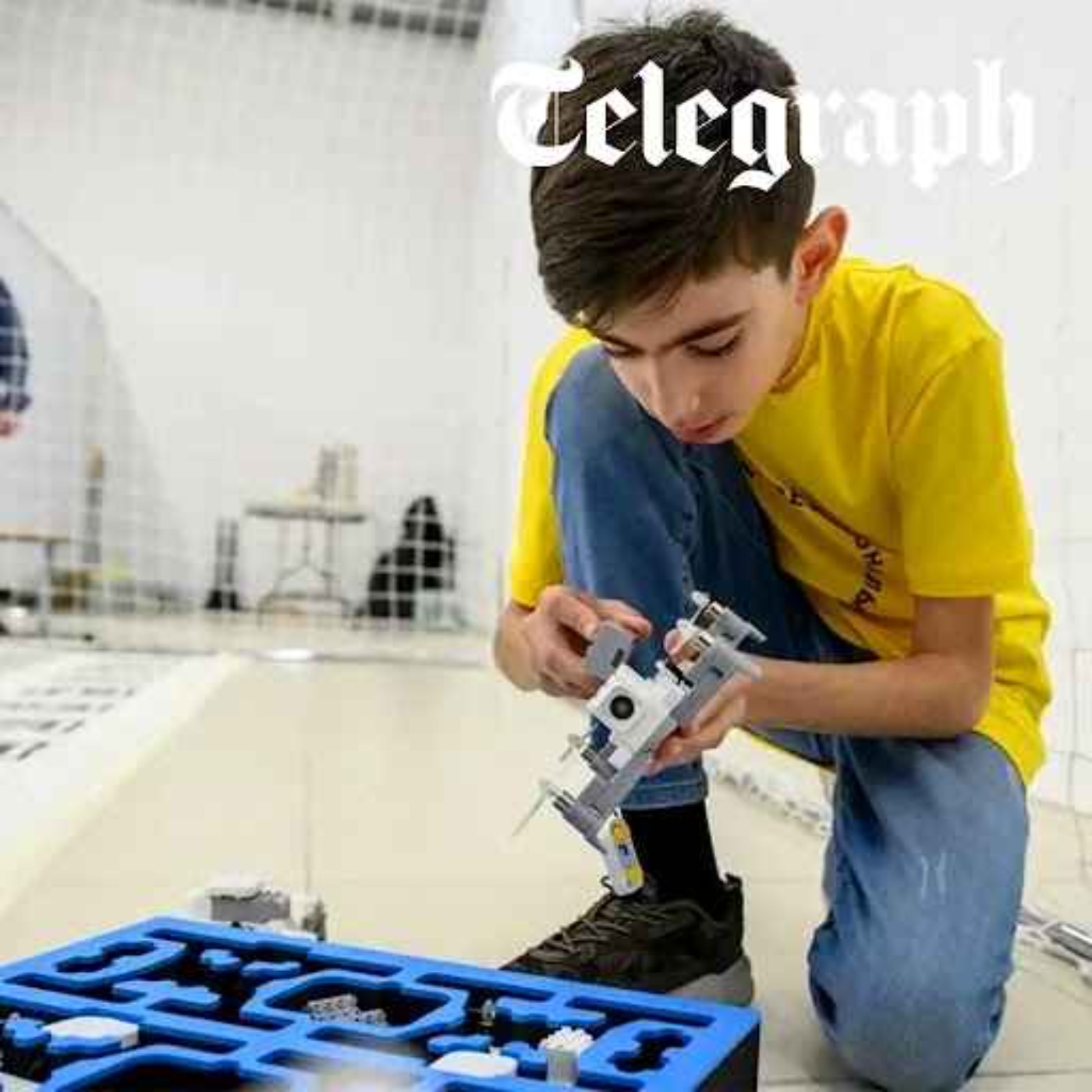
Ukraine: The Latest
Russian nursery-school children ‘taught to fly drones’ & reviewing controversial thriller 'The Wizard of the Kremlin'
00:51:07
Loading summary
Transcript67 lines
- [00:04]
Narrator
The telegraph.
- [00:09]
David Knowles
You're listening to this podcast, so I know you've got a curious mind. Here's a helpful fact you might not know yet. Drivers who switch and save with Progressive save over $900 on average. Pop over to progressive.com, answer some questions and you'll get a quick quote with discounts that are easy to come by. In fact, 99% of their auto customers earn at least one discount. Visit progressive.com and see if you can enjoy a little cash back. Progressive Casualty Insurance Company and affiliates national average 12 month savings by $946 by new customers surveyed who saved with Progressive between June 2024 and May 2025. Potential savings will vary what's the most
- [00:48]
RealReal Advertiser
sustainable way to love fashion? It's changing the way you shop by shopping with the RealReal the RealReal is the world's largest and most trusted source for authenticated luxury resale. When you shop with the RealReal, you'll find the luxury brands you love like Prada, Celine and Loewe, all for up to 90% off retail. And when you're ready to refresh your wardrobe, you can sell the pieces you no longer wear to fund your next new to you finds. Buy. Sell. Repeat. Guilt free. The RealReal extends the lifecycle of luxury by by keeping coveted items in rotation. Sell to shop, Shop to sell with the RealReal, it's better for the planet and better for your closet. Plus, during Earth Month you can earn $100 extra when you sell with the RealReal. Go to therealreal.com to get started. Earn $100 extra during the entire month of April at therealreal.com that's therealreal.com Terms apply
- [01:46]
Robbie Collin
Acast powers the World's Best Podcasts Here's a show that we rec
- [01:54]
Brooke Devard
hello hello, it's Brooke Devard from Naked Beauty. Join me each week for unfiltered discussion about beauty trends, self care journeys, wellness tips and the products we absolutely love and cannot get enough of. If you are a skincare obsessive and you spend 20 plus minutes on your skincare routine, this podcast is for you. Or if you're a newbie at the beginning of your skincare journey, you'll love this podcast as well. Because we go so, so much deeper than beauty. I talk to incredible and inspiring people from across industries about their relationship with beauty. You'll also hear from skincare experts. We break down lots of myths in the beauty industry. If this sounds like your thing, search for Naked Beauty on your podcast app and listen along. I hope you'll join us.
- [02:37]
Robbie Collin
ACAST helps creators launch, grow and monetize their podcasts everywhere. Acast.com Foreign.
- [02:50]
Adelie Pojman Ponte
I'm Adelie Pojman Ponte and this is Ukraine. The latest Today, amid another exchange of drone and missile strikes between Ukraine and Russia, we report on growing speculation that the EU's 90 billion euro loan for Kyiv could finally be approved as early as tomorrow. We also examine Ukraine's efforts to develop its own alternative to US made patriot and air defense systems. Then later, we take a deep dive into a major new Western film, the wizard of the Kremlin, exploring how accurately it portrays Putin's rise to power and the wider questions raised by telling Russia's story through a pre war fictional lens.
- [03:30]
Narrator
Bravery takes you through the most unimaginable hardships to finally reward you with victory.
- [03:40]
Adelie Pojman Ponte
Russia does not want peace.
- [03:50]
Francis Darnley
If I'm president, I will have that war settled in one day.
- [03:53]
Narrator
24 hours.
- [03:54]
Robbie Collin
We are with you, not just today or tomorrow, but for 100 years.
- [04:03]
Francis Darnley
Nobody's going to break us. We are strong. Where are Ukrainians?
- [04:10]
Adelie Pojman Ponte
It's Tuesday 21 April, four years and 56 days since the full scale invasion began. Today I'm joined by my co host Francis Darnley, chief film critic at the Telegraph, Robbie Collin, and political scientist Anna Kolar Libidev. But first, let's turn to the military realm with Francis.
- [04:30]
Francis Darnley
Thanks very much, Adelaide. Let's resume where Dom left off yesterday in terms of the Ukrainian strikes on Russia. More footage has emerged of Russian Black Sea port of Tuapse ablaze, sight of that plume of smoke visible for miles. That has prompted commentators to liken the site to a volcano. Following the two strikes of the past 48 hours or so, it's yielded some of the most dramatic footage that we've seen of the entire war. Russia's Defence Ministry claims that nearly 100 drones were shot down across multiple regions during overnight attacks. New explosions were reported in the Russian city of Novocherkassk in Rostov Oblast, directly east of Ukraine's border, sparking a fire and power outages in the city. Russian sources also report drone activity and explosions in other regions further east, including Volgograd, formerly Stalingrad, of course, and Saratov oblasts. Regarding the latter, an official from Ukraine's SBU Security Service claimed that an oil pumping and dispatch facility near the village of Prozvet was the target. Now that matters because of its connection to the Druzhba oil pipeline, something they're going to talk a little bit more detail about that, of course, transports, energy to countries like Hungary. And that matters given the big story of the day, which is the potential passing of the 90 billion euro loan at last. But hold that thought. Now, we've talked before about how Orban's government was using the pipeline's closure as justification for blocking that loan. And the question will be, is a prolonged closure going to cause problems for the unlocking of that for the new prime minister, Petter Magyar? But as I say, more on that shortly. Now, one last word on Ukrainian strikes. Dom was discussing yesterday, unconfirmed reports of one or two ships possibly hit in Sevastopol Bay. But according to the open source intelligence community, not only were the ships Yamal and Nikolai Filchenkov damaged, but also the large landing ships Azov and Olshanki, and furthermore a large reconnaissance ship. So that's five ships in total. So thanks to everybody who reached out about that in that community. In terms, in terms of Russian aerial attacks on Ukraine, drones struck Dnipropetrovsk and Kharkiv oblasts, killing three and injuring 18 others, according to authorities. Several residential buildings, a home and cars were damaged there. A 10 year old boy was also hospitalized following Russian strikes on Krivy? Ri Zelensky's hometown, of course. But it was Sumy city in the northeast that was the worst hit, leaving at least 15 injured, according to local authorities, three of them children. A strike on an energy facility also cut power to 54,000 people in Chernihiv oblast in Northern Ukraine. And in Slovyansk in the east, airstrikes destroyed a school and injured three people. Now, Defence Ministry adviser Serhii Beskresnov is claiming that he was injured in a targeted Russian drone strike on his home outside Kyiv the night before, alleging, and I quote, this is the first time I've seen the enemy try to eliminate somebody using shahed type drones in such a target manner. He was making those claims on national tv. Now if that is true, that would indeed mark a significant shift in the tactical use of shahed drones. But I think we should just caution as to whether that is really what happened here. But nonetheless interesting and quite a big story in Ukraine, hence why we're talking about it now. Across the front line regions, shelling claimed at least three lives and left 49 people injured. Just worth always bearing in mind that when we're talking about the aerial bombardments, there are also just those ground targeted attacks on the front lines too. On the ground war specifically, there are reports of Ukrainian forces counterattacking near Kharkiv city. According to the isw, a Kremlin affiliated Russian Milburgher claimed that large numbers of Ukrainian drones are complicating Russia's ability to advance and that Ukrainian counterattacks have prevented Russian forces from consolidating positions near Orokhryvka, northeast of the city. Otherwise, the picture remains the same. An active front, but casualties constantly being reported with no major shifts to the frontline positions. Not that it seems to matter to the Russian high command, with Putin's top military officer, General Gerasimov, declaring for the fifth time the capture of the entirety of Ukraine's Luhansk region, which the Ukrainians once again are contesting. He just can't help himself, can he? Doesn't Putin ever ask in these meetings that he has with him how it's possible for a territory to have been taken five times? To what extent does Grasov actually believe this himself? I think that's something relevant to the conversations we'll be having later about the new big film, big blockbuster that's come out now. Finally, a few military related stories before we get to that. In the political realm, President Zelenskyy has confirmed that with support from its European partners, Kyiv aims to develop an anti ballistic missile air defence system within a year, seeking to reduce its reliance on the US made Patriot system. We've known about this intention for a while, something that Dom has talked about at length. But this is the first time that officials have actually given a timeline for that ambition. In terms of options, our friends at the Kyiv Independent put forward the following which we've mentioned previously. So one of them would be a joint upgrade of the French Italian built SAMP T surface to air system that's already in service. There'd be a prospect of a new SAMP T system delivered by France which could be tested against ballistic missiles. Or Ukraine develops its own low cost Patriot alternative. We know that that is being developed at the moment by certain companies, so we will have to see. But just to end with a very different kind of missile, specifically an atomic one, the Telegraph's foreign editor Louis Emanuel has sat down with a name who will be familiar to long standing listeners. Rafael Grossi, the head of the UN's atomic agency. You remember, we used to talk about him all the time on his early visits to Zaporizhzhia and the power plant there. Now, in the interview, which we'll link to in the show notes and which you'll be able to hear clips from on our sister podcast Iran, the latest, he says the world is at risk of a fresh arms race with rising conflicts, meaning that as many as 20 other countries are pursuing a bomb. He told Louis that renewed debate about whether to acquire such weapons in countries like Poland, South Korea and Japan could leave the world in a very fragile position. His words. Now, there'd be other countries that I would add to that list as being more of a risk than Poland and South Korea. But you take his point in terms of the global tallies. Of the world's 12,000 warheads. Russia has about 5,500, the US about 5,200, and they account for roughly 90% of the world's warheads. China has 600, but it's developing them rapidly. And France around two hundred and ninety. And the UK two hundred and twenty five. But as we've been speaking about on the podcast now for, oh, gosh, many months, really, France's continues to be the most interesting because theirs is so independent of any other country. Britain's, it's believed, has some relationship still with the US in the longer term, Trident specifically. Whereas France, because of de Gaulle, has kept its completely strategically autonomous. That will really matter in the longer term. If indeed has been speculated, France might extend its nuclear umbrella to include Ukraine or at the very least, other European countries. So a very big story. And I think that when the history books are written of the consequences of the Ukraine war, one of the big ones, depending on what happens in the years ahead, will be nuclear proliferation as a consequence of this conflict. Something, of course, which we've returned to time and time again. But that's us up to date in the military realm. Adelaide.
- [12:12]
Adelie Pojman Ponte
Thank you, Francis. And yes, as you mentioned in your segment, big news from the big ship that is Brussels and may be at last changing directions inch by inch, maybe turning around, because tomorrow, as you mentioned, the EU might be poised to unlock the €90 billion loan to Ukraine. And that's really, really big. How long have we been talking about this? So I don't want to jinx it. I mean, don't put it on me if it doesn't go through, however, because I don't want to be too enthusiastic. But the loan is on the agenda for a meeting of the EU's 27ambassadors tomorrow. Kaya Kallis, your favorite, said she expected some positive decisions. There's one condition, however, that the Russian oil flow resumes to Hungary through the Druzhba pipeline, as you've mentioned. Now, you'll remember that repairing the Druzhba pipeline was a contentious issue in the already stormy relationship between Hungary and Ukraine. A Russian strike in January allegedly severely damaged the pipeline in Ukraine, and it stopped the oil flow from Russia to Hungary and Slovakia, who have been complaining for several months. Now. Ukraine has committed to repairing the pipeline, but Hungary complained Ukraine was dragging its feet. But there has been a sudden turnaround with Hungary's election. After Peter Madyar was elected on Sunday, Zelenskyy said he would be repairing the pipeline very shortly indeed. Now, should the oil flow resume before the meeting tomorrow in Brussels, there is an understanding that Hungary has agreed to drop its veto, therefore allowing potentially the 90 billion euro loan to go through. Now, it's also all a bit confusing because, as you have mentioned, Francis, while Ukraine is indeed repairing the pipeline on its own territory, it has also struck an oil pumping facility in the region of Samara in Russia, which is part of the supply chain of the same pipeline. And that was just last night. So will it have consequences for the meeting tomorrow? Will it have consequences on the oil flow to Hungary within the next 24 hours or down the line? Could it change these strikes, the tone of the conversation in the next 24 hours? We'll have to see. We'll follow up tomorrow, Obviously, should the loan go through, however, Kyiv would be able to receive the money by May, I think. Francis, you had thoughts on that?
- [14:35]
Francis Darnley
Yeah. I mean, if this does go through, it's seismic. I think we shouldn't underestimate how important Kyiv is saying this is for their survival. I mean, some people say that economically they can only survive a few weeks, certainly only a few months, if they didn't get this loan. And there was all sort of talk behind the scenes, as we've been reporting on the podcast, of this needing to go through bilaterally because they didn't believe it was going to go through because of the. Through the EU mechanisms. It was only going to go through, as it were, by Germany, France and the other European countries giving it independently what they would have been giving to the eu, just giving it independently to Kyiv. That's a complicated political process and a controversial one potentially in certain countries, too. So it would have been a big boon to Moscow. I do think it does sound like they're expecting this to pass. And I know some of you will be listening with, well, but you were so cautious about this. I think we should still be cautious. There is still fear that certain countries, even if they are approving this de facto, that the reality is there's still caution and fear among certain countries. And I spoke to several officials in one country in particular, which I won't name, that really did not believe that this would go through. And so as I say, it is just worth us bearing that in mind that even if this does seem to be going through as it should be, there might well be some bumps in
- [15:50]
Adelie Pojman Ponte
the road, as you said. Is Hungary the tree hiding the forest of other countries not wanting to see this go through. But there's also another fight that Ukraine is waging about its budget currently happening. And that one is happening in Washington because Prime Minister Yulia Zveridenko is meeting with the imf. And that's because in February the International Monetary fund approved an $8 billion program for Ukraine. But again, there are conditions and one of them has been unsurprisingly unpopular in Ukraine. It is raising taxes. Where is that popular, you ask me? By agreeing to the program, Ukraine agreed to implement four new taxes. Now I'm not going to get into the intricacies of the Ukrainian tax system and labor code, spare me please. But I'll just mention one of them because it's important. The most unpopular measure is a new VAT tax on self employed entrepreneurs. So that's freelancers and contractors factors. And it's a very common employment status for almost 2 million Ukrainians. That's for example the status that use our fixers and our drivers when we out there in the field. And so that tax could potentially have repercussions on outside of Ukraine, on the media covering and the budgets that we need to allow for our trips. There's a long read on this particular point of tax from the Kiev Indy. So I'm going to put that in the show notes if you are interested and I think that will be interesting for those of you who either have business in your Ukraine or the volunteers. All of these organizations that may be relying on Ukrainian workforce so worth looking at because it's making everyone very angry. Now the IMF argues that the levy is needed to help the country raise its revenue for its war effort and to formalize the economy by bringing businesses out of the shadows. Kyiv is trying to renegotiate that condition with the IMF in the spring meetings it's currently having. And the Ukrainian PM Yuliyas Velydenko said it was a sensitive topic and a non constructive idea. It seemed a few days ago that the IMF were willing to reconsider some of the toughest measures of that program. So we'll have to keep an eye on it. And finally, two updates on the topic of children. One, Europol held an open source intelligence hackathon to track missing Ukrainian children. It brought together 40 experts from 18 countries alongside the International Criminal Court, and produced over two days leads on the locations of 45 children, as well as some other leads on the people instructors involved in their deportation. And then the second item is that in Russia, Novaya Gazeta reports that the Kremlin has spent over $200 million on educational drones since 2022 in preschools, schools and universities. The investigation shows that Russia continues to militarize its society with a specific focus on children. That's something that we've been reporting for a very long time, whether that's by militarizing Ukrainian children or Russia's own children, in order to prepare the next generation to join the country's future war. Apparently, in Russia, schoolchildren are often taught to fly drones at a very young age. I don't think that's part of a curriculum here, but the article pointed out that it is not really possible to determine exactly what the drones bought would be used for. So, under the COVID of educational drone flying, what are they really learning? And once you can fly a drone, you can fly any sort of drone, I suppose. And that's it today for the political and diplomatic realm. Let's turn to our guest today. We have Robbie Collin, our film critic at the Telegraph, in the studio, as well as Anna Colin Lebedeff, French political scientist, specialist of Russia and Ukraine, who's been one of the leading expert commentators in France for the last four years. So we're going to talk about a film that's just come out in the UK last Friday. It's the wizard of the Kremlin and it's adapted from this book by Giuliano d'. Ampoli. We'll talk about the differences between the and the film. But, Robbie, do you want to start us off by explaining what this film is about and what the reception has been here?
- [19:59]
Robbie Collin
Yes. To me, it's a kind of a fictionalised primer on how Russia got to where it is today. And it does this through a character who was inspired by Vladislav Surkov, who was a figure, a political strategist, within Putin's Kremlin for at least a decade. It transposes what he did onto this fictional character, Vadim Baranov, who's played by Paul Dane and essentially says, look, this guy who had his beginnings in revolutionary theater during the post Communist chaos in Moscow and then moved from there into television and understood this new rising power of the media in order to shape national narratives by following along this breadcrumb trail, this is how we end up with Putin in power. And how we end up with Putin's regime that's followed since, and how it's just been so kind of strong and unshakable to a degree that I think even Daniel's character doesn't appreciate is happening as it's happening.
- [20:52]
Adelie Pojman Ponte
What did you think of the film? What has been the conversation around it?
- [20:55]
Robbie Collin
Well, I mean, I will say so. I've seen the film twice now. The first time in Venice Film Festival last year where it premiered, and then again this week. I enjoyed it a lot more the second time around, not least because it's been fairly considerably trimmed since it screened at Venice. I think it's lost about 20 minutes of its running time, and it's now much more pacey in terms of getting into the narrative at the start. Although it still holds back Putin himself, who is played brilliantly by Jude Law, of all people, it still holds back his appearance for a good half hour after the film begins. But it's certainly much pacier. The framing narrative, I think, which has Jeffrey Wright as this American academic who travels to Russia to meet Baranov, that's been tightened up much more now, so there's less fussing around with him in his hotel and coming over to knock heads with this guy about this Russian distant novelist that they're both fascinated by. And then he gets the inside story of his time in terms of shaping Putin's career.
- [21:46]
Adelie Pojman Ponte
Yeah, and it's interesting, this American academic, because he is a narrative device, he travels to Russia, meets the wizard out of the blue, doesn't expect it, as you say. They end up being fans of the same Russian writer. And then he goes to the wizard's country house, Baranov's country house, and then Baranov just tells him his life story. That's what we read in the book, and that's what we hear and see in the film. And it's really sort of his retelling of his memories, his rise to power, how he got into the political realm, also his personal life as well. And so one key thing that I think we'll come back to in this conversation, I'm sure Anai will talk about it, is the fact that we have to take this man's retelling of his own life and the way the political scene in Russia unfolded for the last 20 years at his words. And the American academic offers a counterbalance. He will sometimes pitch in, he will sometimes nuance something. So he's kind of like the voice of a fact checker. But essentially what we're getting is a view from inside the Kremlin of what may have been the last 20 years of Russian politics. Francis, what did you think of the film?
- [22:57]
Francis Darnley
So I think it's important to frame it in the way that we have, which is that you're being asked to watch this from a perspective of a Russian figure. Right. Who is an unreliable narrator in their own story. Well, I think there's lots of problems people will find with it as being this is an introduction to this period of history, and we'll get into that shortly. But I think it's important to underscore that he, in telling his story, portrays himself as being of a Western disposition, himself almost. He describes having read Machiavelli and lots of Western political thinkers, that despite his own father being somebody that was part of the Soviet machine, that his father actually educated him in Western ways and allowed him to see things freely now as a fictional character. Fair enough. And as I said, there are elements of a real historical figure here. But this idea of introducing somebody to 1990s Russia and the Putin period through the eyes of somebody who is sympathetic to the West, I think is problematic, to say the least, because as we've talked about on the podcast many times, there are many, many aspects and questions that need to be asked about how these officials around Putin perceive themselves. Many of them, I would question, as we heard from Mark Bennett, the Russia correspondent at the Times yesterday, don't necessarily see things through that Western prism which we are being asked to as an audience, see it as we are being asked to watch this film from the perspective of somebody who knowingly, to a certain degree, knows about the manipulation that they are carrying out, knows about the distortions of the historical record. Whereas I'm not convinced that all these officials around Putin really see it in that manipulative way necessarily. They actually believe it. And so I think it's an on that score. But there are others, too.
- [24:48]
Adelie Pojman Ponte
Anna, I want to bring you in because obviously you have been commenting on this war for the last four years. This book is originally a French book, and the film came out in France in January, and there was quite an outcry in France from experts like yourself, but also from the cultural world around the film. Can you take us through that reception? And I think you've labeled the film as dangerous. Can you take us into your view?
- [25:15]
Narrator
You. Well, the way the discussion started in this studio today is itself very telling. We start by describing Russia from the point of view of the film. What kind of position does it show us for the functioning of the Russian society? But actually the first thing we have to start with is that Giuliano Da Empoli, who is the author of the novel, is not a specialist of Russia. And the authors of the film, same thing, don't have a deep knowledge of Russia. Even the. The co seniorist Emmanuel Carrer, who is a quite famous writer in France, well, he has a personal knowledge of the country, but not an academic understanding or just a general understanding as a specialist of Russian society. So the main problem actually of the novel and the, the film is that they pretend to say something about the way. Way contemporary Russia functions, when actually they are supposed to be a fiction. Right? And we as specialists of Russia have seen a lot of things in the, in the book and of course the same, the same in the movie, because the movie is a very exact like parallel of the book. Many things that are not very accurate. Knowledge of Russian politics, of Russian society. When you release a novel on Russia in 2022, you are in a context in which people are in disarray. They desperately seek for a knowledge or an understanding of what's going on in Russian politics and what's going on in Putin's head. For this reason, actually, the fiction happened to be transformed in some kind of true vision of Russia from the inside. Something that make people understand what's going on, going on. And from my point of view, this is dangerous. This is dangerous because actually it's promoting a narrative that is clearly in line with what Kremlin wants us to think about Russia.
- [27:14]
Adelie Pojman Ponte
Do you feel like the reception has changed from the French public between 2022 and now?
- [27:21]
Narrator
Well, a few years before the invasion of Ukraine, I think the idea of Russia was to promote some kind of Russian mode, model the Russian world, a model of political development and a model of, let's say, close relationship with the former imperial center. Today, Russia's aim is to promote an image of strength, an image of power, an image of control over the society. And this is exactly what we find both in the, in the novel and in the field. We don't see any Russian population in this field. We only see these personalities inside the elites. But the idea that we can like hear through the film is an idea of a political power that totally controls its population, able to manage the wishes and the actions of the society. And the idea of a political leader who has a clear goal and who shows himself as some kind of a monk in his lifestyle as compared to the, to the others, ready to promote his political project and never stop in, in doing that. Well, this is exactly what Russia wants us to hear today and to see today. This is the way they want to be, to be represented and to hide all the aspects of, let's say, greed, political conflicts inside the country, conflicts of loyalty, need of repression, to control what the political power does not control. All these things that you see very clearly when you dig into the Russian society. But by focusing on this figure of Putin and Baranov Zukov, well, we don't see that anymore.
- [28:56]
Francis Darnley
I was just going to add something, Ellie. I think this is the first. Correct me if I'm wrong, Robby. This is the first western film that has been produced since the full scale invasion that has like a big all star cast. This will be the first film that a lot of people watch about Russia since the invasion of Ukraine. It's about a period before the full scale invasion. Ukraine is barely mentioned at all. And is this the film that you would want people to watch in order to understand modern Russia? To this point, I would say no, not really. Now, I'm not saying that this film shouldn't have been made. I know it takes many years for them to be prepared. But there is, I think one could argue, a responsibility here for people to understand this in a different way.
- [29:35]
Robbie Collin
I mean, look, here's, here's my view. I do take the point and I would say towards the end with the Maidan protests, those are depicted. And there's a sense, I think probably instilled in the screenplay post invasion, that this is something we're gonna need to address at least obliquely. We're gonna need to kind of foreshadow that this to be a contentious point in the years ahead. But what I thought was really interesting that they did. So the director is Olivier Yesayas, who is not by any stretch of the imagination a hack. He's a great filmmaker. He's made some terrific stuff in the past. And he wouldn't have cast Jude Law as Vladimir Putin purely because he's the biggest name he could get. He must see something in Jude Law that is a way to explain Putin to Western audiences. And I think the thing is with world leaders now, and this is a function of the modern news environment, is they eventually become their own parody, right? We see so much of them and we get so attuned to their habits and their ticks that it becomes quite hard to see these sort of half spitting image ified versions of themselves. And I think it would have been easy to make this film with that Putin, you know, find someone who is an expert mimic and someone who is, you know, facially More akin to please and then, you know, the former Dickie Green Leaf and do it that way. But instead, you have this sort of stoneily charismatic, sophisticated figure. But also you get the impression from he could be a bit tasty, you know, in a fight. You don't want to cross this guy because he could get a bit nasty. All of the stuff that we associate as a Western audience with Jude Law, I think SIS is saying this is why Putin clicks with so many Russians. Right. Because I think for us looking on from the outside, certainly for my. Myself, it's very hard to fathom what people see in them.
- [31:15]
Adelie Pojman Ponte
That's interesting. I hadn't thought of that. I was thinking in terms of the context as well. And Robbie, maybe you can talk about that. We've just had Mr. Nobody against Putin win an Oscar for best documentary. The film has been praised around the world. It's been heavily criticized in Ukraine. The fact that a film about Russia, about a very lukewarm and mild resistance to Putin's order and Putin's country has. Has received one of the highest cinema awards that exists. The whole conversation about, should the west be shunning Russian cinema? Should the west be shunning Russian artists? Do we have a responsibility in that or not? I do wonder, these two films coming off the back of one another, what sort of response it creates from the world of cinema and the world of the arts in general.
- [32:04]
Robbie Collin
Yes, I mean, there was. That argument was being had, certainly around the Cannes Film Festival, which has been historically a big supporter of Russian cinema. Cinema, you know, whether we should include anything from Russia in competition or not, because it. In order to show some kind of solidarity with Ukraine. And I think if memory serves, in 2022, they did, but it was by a director called Kirill Serabennikov, who's a dissident filmmaker and theater maker and was caught up in some horrific Kafkaesque fraud investigation. Possibly because he wasn't. His work was not to the regime's life. And I think it was seen that he was far enough removed from Russia as a political entity that, you know, you could credibly program his stuff at film festivals at Cannes this year. So this is in a month's time. There's a new film from a director called Andrey Zvyagintsev, who has been out of action for a number of years. And he's now returned with this film, Minotaur, about this oligarch who discovers his wife is having an affair. And it causes very grand ructions throughout his empire. Apparently it used to be in the favor of Putin, I think there was a film came out called Leviathan around seven or eight years ago. It was the last one he did before this new one, which Putin was apparently very impressed by. And I remember watching and thinking, how has he not seen the subtext here? Because it's set in this remote community on the far flung shores of wherever and yet there is a politically satirical component to what's going on there that I think certainly from my perspective, you could pretty cleanly cut and paste on top of the Kremlin. Clearly things have cooled between them now because he's on the outs and now is, I think, appearing again as another Russian dissident. But because I think there is that gap between the regime and Russian artists, it is slightly easier for festivals and cinemas to support Russian films than it would be if they were being, I don't know, like the Chinese main melody stuff that's handed down from the regime there and it's all very tightly controlled. You program stuff like that, you're going to take a bit of a credibility hit.
- [34:03]
Adelie Pojman Ponte
So is there a conversation about, you know, shutting these festivals to Russian filmmakers or the morality of it?
- [34:11]
Robbie Collin
No, I don't think so. I think within the arts world people are very open to, I mean, providing it's not the rubber stamped state perspective on something. They're very open to hearing voices from all around and that sort of sense of a national boycott. I mean, sometimes you get people bristling when Israeli filmmakers are programmed as well at the moment, but they still are programmed, you know, not that there's many Israeli filmmakers around, but you know, they do get programs, Iranian filmmakers at the moment massively in favor because people are really intrigued by the, you know, filmmakers in exile, filmmakers working undercover in order to get stuff done under the nose of that regime. So yeah, I think, I think certainly as far as cinemas can, there is a disconnect between the country people hail from and the nature of the stuff they're making.
- [34:58]
Francis Darnley
I mean, I don't think we're trying to say here that this film in any way is putting forward one simplistic necessarily perspective on Russia. And neither are we trying to suggest that it should be the role of films to be, I don't know, representative of something bigger of like a certain country's perspective on Russia, like France, just because it might be funded and made by French teams. So I don't want to come across as being censorious in that way because then of course it's. There is a very big difference. But I think it's right to ask legitimate questions about what an audience just watching this film without any of the political context will take from it. And of course, any work of art, you take different things. But something else that jumped out at me watching it was this sense of it trying to sort of slightly romanticize some of the tropes we hear about Russia a lot. It's exotic, it's unknowable, it's dangerous, it's ineffable, it's wild. Things operate differently there. There's something unique about the Russian character. I mean, I mean, you know, it plays into a lot of that. And in a way that of course in a two hour film, you're not gonna be able to explore it in a very complex way. But nonetheless it does. I think perhaps just because of the amount of effort we've put into exploring those things and unpacking some of them, it did make me bristle a little bit.
- [36:14]
Robbie Collin
I mean, there is that scene early in the film where Baranov goes to an avant garde party and almost immediately bumps into Alicia Vikandar in is it bondage gear that she's wearing and then she's leading around a naked guy on a lead and doing some songs. Okay, I see, I see. So this is what Moscow was like then. But then, as Vikander's character then goes on to choke. We're only doing now what New York was doing 15 years ago. So there's, I think, an understanding that this is. This is a revolution that's kind of rolling and it's happened in the west and now it's arrived in Russia and of course the effects of it will be. Will be vastly different.
- [36:47]
Adelie Pojman Ponte
Anna, do you want to talk maybe to that portray?
- [36:49]
Narrator
Yes, I would like to add something, I think. Yes, these are pieces of art. And of course the artist is free to represent the world as he or she sees it. But at the same time, the context is necessary. Here we are in context first of a scarce information of what's going on in Russia. We like journalistic reports, journalists and speaking about the French context, for example, correspondence of the main media have been pushed away from the country and cannot exercise for many of them free really anymore in Russia. So we don't have a lot of objective reports of what's going on in the country. Researchers are not free to share their words activities from the civil society or outside the country or in jail. So we lack images, right. We lack explanations. And at the same time, well, we definitely need to understand and we are in the context of information work so in this context of information work, any piece of art, whether a novel or a film or something else, well, becomes also a tool that can be used both sides. So I think there is a responsibility in this context of the artist. And of course, what we see here in the film, for example, but it's not the only example. There's a lot of pieces like that in the French context. It's an Orientalist tale. It's a tale that is telling us the story of a wild country guided by passion, not necessarily by reasons, reason or reflection. Well, it would be okay, I think, in any other context, but it's instrumentalized today. And I think this instrumentalization is something really, really need to address. And the, the artists themselves have to address them and see their responsibility. Same thing about, for example, the, the other thing that you mentioned, the documentary. Mr. Nobody against Putin showing Russia from the inside. And this is why it was seen as so powerful and so important by the, by Western audiences. But at the same time, for example, when, when you hear Russians commenting, Russians today in exile commenting on this film, they. They immediately point at the fact that everything in this film is staged. It's staged for the Russian authorities. Everything. Talamkin, the filmmaker, is filming in the, in the school life is not the natural school life. It's not a hidden character camera. It's a camera and footage done for the, the authorities. So this Russian society completely controlled by ideology and this school in which, in. In which ideology is promoted, well, it's not the real picture of Russia. It's a picture of Russia as it is shown by school authorities to the authorities, the city authority, and the party authorities, for example. So again, you have. We have a lot of distortions today on, in all these species produced on Russia. And it's extremely, I think, harmful and dangerous to be blind to the distortions.
- [39:45]
Adelie Pojman Ponte
I think there's something also very interesting when you talk about the context of the information war and because the book as well as the film present blur the lines between fiction and reality. And in fact, the wizard Baranov used to be a TV producer making soaps before, or at least that's what he's presented as in the film. And in the book before he became a political advisor, and when he gets recruited to become a political advisor, I think someone tells him, stop making fake fiction, start inventing reality. So the book as well as the film are very, very clear on the blurring of where fiction starts, where reality stops. And that's also very dangerous because it's dealing with key historical events that we know a lot about this because we report on it day in, day out, Anna. You know a lot. But I was watching the film with a friend of mine who reads the news, but, you know, average person just would not know any of the intricacies of Russian recent history. And I think there's a very good example in there, which is it mentions the bombings that happened before Putin was elected president, when he was still prime minister. There were several bombings on residential buildings across Russia that blew up during the night, killing hundreds of Russian civilians. And these bombings were attributed at the time to Chechen separatists. Now, there is overwhelming evidence, and there's actually a very interesting BBC podcast about this that I will link to in the show, notes that these bombings were actually staged by the FSB and by Putin in order to help him gain popularity and create a climate of fear around the country, that they had a common enemy, the Chechens, that. That you could fight, and then you needed a strong man at the helm of the country who had shown that he could respond to a crisis. Now, in the book, this event, this theory that is again, quite well proven now, I think, Anna, you can tell me if I'm wrong. That it was organized by the FSB is mentioned in passing. It's literally just one sentence and dismissed out of hand. And in the film that a similar point is made. And the narrative device that is the American academic says, oh, but I think, wasn't it done by the fsb? Baranov then goes on to say, oh, if that's. That was the case, I was never. I never heard such a rumor. It never came to my ear. And that's it. And I had to pause the film and ask my friend, did you. Do you know about this? Do you know what it's referring to? What are you taking out of this? And I had to break it down for him about the actual context. And he said very plainly, if I. If you had not been there, I would have come out of this film either not remembering that or remembering that it was not linked to the fsb. And that was not a viable theory. And I think that's a very good example of. Wait, hang on. What. What is the conclusion that you're taking from this film? What is the. What is the version of Russian recent Russian history that you're walking away from if you know nothing about it?
- [42:49]
Robbie Collin
It's really interesting you say that, because I agree it is skipped over quite quickly, but I think the effect of the skipping over on me at least, was to actually implant the doubt that it was a genuine bombing and in fact it was carried out by the fsb. And I know they kind of say, I think the sense that I got from that non committal response from Dano's character is because we don't know, we can't have him say, ah, yes, it was the fsb, because then the film then kind of too demonstratively takes a side on what happened. But I think the raising of the doubt, to me, that really starts. And I think also what we have to understand is this film is talking more broadly about the influence of contemporary culture, reality television, on politics. And I think for Western viewers, it's designed for us to go, oh, yeah, and that could happen here. And in ways it already is. There's the sequence towards the end when they talk about the Internet Research Agency where Daniel's character says, no, we don't want these credible pundits signing off on this stuff. We want more morons. We want, you know, the manosphere. We want makeup influencers. We want all these people who are going to just drop this stuff into commentaries about complete, you know, trivialities, because that's the way we're going to reach people. And I think when he says that, we're supposed to reflect on, well, hang on, how are we absorbing political information now? You know, it's coming via YouTubers, Twitch streamers, whoever it is, you know, certainly among. Among younger generations and. Or from Facebook feeds or wherever it is. So I think the point of the, those, those moments in the script is to also make us think about, you know, how these forces are affecting politics outside of Russia. Even though I take your point, it's not saying one way or the other, yes, this happened. But for me, as an audience member, I didn't feel that it was saying therefore it didn't. I think it's planting the idea, but it's also saying we can't come out and state this outright. And also for Dano's character to then, if it was said that he did know it then makes him a far less sympathetic figure because he's been complicit in the, you know, the murder of hundreds of civilians.
- [44:46]
Adelie Pojman Ponte
Yeah, but that does ask, should he be a sympathetic figure?
- [44:49]
Francis Darnley
That's what I was about to say is, should he be a sympathetic figure? And to borrow it from another terrific film, V for Vendetta, sometimes artists tell lies to tell the truth. But what truth are we being asked to absorb here? It's relevant to ask that here because there are so few films about Russia that are being made I think we're right to. I mean, I'm not a censorious person.
- [45:12]
Adelie Pojman Ponte
Person.
- [45:12]
Francis Darnley
I think if people want to make and watch films, they should be free to do that in a free society. But I think that given there are so few of them, whether we are recommending somebody watch this to understand modern Russia, I think, is a relevant question here, given the fact that this is Europe's largest and bloodiest war since the Second World War. Hybrid warfare, as Anna has talked about, is. Is rife and a consistent threat, if you follow the. What the intelligence chiefs are saying. So we're right to ask these slightly pointed questions, I think. And, yeah, it's also worth asking whether it's helpful, us looking at Russia at this period of history through that Western prison. Is that the helpful takeaway?
- [45:46]
Adelie Pojman Ponte
And I think, you know, it's a question of what does historical fiction and political fiction strive to do? And I think there's a slight confusion in the film here, because it's talking from a posture of authority, whereas you could argue, and I'll make a wild parallel, that we have historical fictions that are not trying to be accurate. Bridgerton, for example, is very clear on its positioning. It is taking the aesthetic of a certain era to portray something that couldn't. That did not happen. And everybody's very clear when you're watching it about what it is and what it's doing and what its posturing is. I would argue that this film, in this book. But, Anna, maybe you want to pitch in and also maybe shed some light on the bombings and the way it's treated in both the books and the book and the film.
- [46:38]
Narrator
I absolutely agree with you. The problem with the film and the book is the blurred reality boundary between reality and fiction. And one of the clear example of that is the last names, right? In the book and in the film, everybody is called by their real name except two of them. The one is the Baran of the. Which is supposed to be Vladislav Surkov. And actually the biography and the character of Baranov are very, very far from the. The real Surkov's biography and personality. And the second one is Khodorkovsky, the oligarch that has been imprisoned by Putin, who is also called by another name. But actually the fact of blurring the reality by calling Putin not by some fictional name, that would make us think that it's a fabulous. Something like a tale that is made to make us think about the exercise of political power, about the power of information, etc. By putting the real names and also by using fake archival footage, but which is very, very close to the real archival footage. Absolutely. It makes it believable and it makes us think that actually the film is telling the truth, some historical truth. And from that perspective, I think there is a huge responsibility of the filmmaker. We are not talking about art here. We're talking about the political speech that he's offering to them, to the viewers.
- [48:00]
Adelie Pojman Ponte
What is sort of the film's approach to Ukraine?
- [48:03]
Narrator
I think Ukraine does not have a huge role in the film, same as in the book, but for understandable reasons. When the book was written, it was still the war in Donbass and not the full scale invasion of Ukraine. I think the filmmakers consciously decided not to address this, this issue. And it doesn't have like much space in the book. And I think it's problematic. I think it's problematic because even during Donbass war, Ukraine was extremely important from the perspective of Russia. It took a lot of space on Russian tv and the disinformation about what was going in Russia since 2014 was extremely important in building this, this image of the country that justified later the full scale aggression, but also the, the political changes inside the country. So the role of Ukraine is here very much diminished in the political debate. And I think it's linked from my perspective, it's linked for the film to the personality of Emmanuel Carrera who has a, well, a sensibility to what is going on in Russia, but much less to what is going on in, in Ukraine. I guess this is only a hypothesis, but again, I think today doing a film on contemporary Russia aimed to describe a society which is now at war but without giving us peace to the war that is just about to happen when they were at the end of the film is maybe also problematic.
- [49:37]
David Knowles
Insurance isn't one size fits all. That's why drivers have enjoyed progressives name your price tool for years now with the name your price tool, you tell them what you want to pay and they'll show you options that fit your budget. So whether you're picking out your first policy or just looking for something that works better for you and your family, they make it easy to see your options. Visit progressive.com find a rate that works for you with the name your price tool. Progressive Casualty insurance company and affiliates Price and coverage match limited by state law with endless scroll algorithms and AI flooding feeds, Podcasting standards stands out. They're sought, not served. Audiences actively choose to hear trusted voices on topics they care about. In fact, 72% of listeners say podcasts shape cultural conversations for marketers, that means podcasts shift brand perception like no other channel. Acast's Podcast Pulse 2025 report has the proof. Get all the insights at podcastpulse2025.com.
- [50:41]
Adelie Pojman Ponte
Anna, I really wanted to ask you some other questions, but we don't have time. I'm afraid you'll have to come back to the show because I wanted for you to talk about the specific French context in which France is particularly vulnerable to disinformation. It's one of the places where hybrid warfare is most potent, coming from Russia. But you'll have to come back to the show to tell us more about that, because I'm afraid we don't have to time. Let's go to our final thoughts.
- [51:05]
Francis Darnley
Francis, just a very brief one from me. Everybody who's listening to this, I'm sure by now will know, hey, Mr. Bretton Gordon, former tank commander. He was on a couple of weeks ago with Dom and James Hewitt. He's just released a video documentary for the Telegraph looking at the new Challenger 3 tank. And so if you want to watch him on top going shooty, shooty, bang, bang, then I heartily recommend watching that. We'll add it in the show. Notes.
- [51:28]
Adelie Pojman Ponte
Very short final thought from me. Some surprising news is that Dua Lipa has been raising. Raising funds to send vehicles to Ukraine. It was through a service 95, a platform founded by her in order to raise funds and to send to retrofit vehicles for medics and military personnel. So, you know what? Didn't think that intersection of pop culture and the war in Ukraine would ever.
- [51:52]
Francis Darnley
She's writing new rules.
- [51:53]
Adelie Pojman Ponte
New rules. Maybe we should have Dua Lipa on the show. Dua Lipa, if you listen to us, come to the Telegraph. Robbie, what do you want to leave us with?
- [52:00]
Robbie Collin
Yes, Well, I would say if the massaging of the truth in this film is cause for, you know, despair, do not go and see the Michael Jackson biopic that's just coming out in cinemas this week because, my goodness, I mean, there's that. That is. That is an absolutely. I mean, just as the bad era is kicking in so mid-1980s, so after all the bad things have happened to him and then everything after that, it's just like, well, maybe we'll deal with this in a sequel, but you don't want to hear about this in. And this film has nothing on the Michael Jackson biopic.
- [52:32]
Adelie Pojman Ponte
Anna, you get the last word. Where do you want to leave us with?
- [52:36]
Narrator
Maybe with literature, since we are talking about art, we were very happy in France to see the translation of the great novel by the Ukrainian writer Sofia Andrukhovic called Amadoka. It's called one of the major and the first great historical novel in the history of Ukraine that goes through the 20th century century up to the war in Donbass. An extraordinary book, a very thick book, actually a long novel but wonderful and I hope you will have a chance to read it in English soon. Amadoka Sophia Andrew Holic that's great.
- [53:10]
Adelie Pojman Ponte
I'll put the link in the show notes and I'll get a sneak peek before you guys because I'll try and read it in French. All right, thank you very much Jacques, you everyone, thank you for joining us and we'll be there tomorrow someplace and time.
- [53:27]
Francis Darnley
Ukraine the Latest is an original podcast from the Telegraph created by David Knowles. Every episode featuring us in the studio maps and battlefield footage is now available to watch on our YouTube channel. Subscribe@www.YouTube.com crane the latest there's a link in the Description Description if you appreciate our work, please consider following Ukraine the Latest on your preferred podcast app and leave us a review as it helps others find the show. Please also share it with those who may not be aware we exist. You can also get in touch directly to ask questions or give comments by emailing ukrainepodelegraph.co.uk we continue to read every message. You can also contact us directly on X. You'll find our handles in the Description. As ever, we're especially interested to hear where you're listening from around the world. And finally, to support our work and stay on top of all of our Ukraine news, analysis and dispatches from the ground. Please subscribe to the Telegraph. You can get one month for free, then two months for just one pound at www.telegraph.co.uk Ukraine the latest the latest was today produced by Phil Atkins. Executive producers are Francis Dernley, Louisa Wells and David Knowles.
- [54:46]
David Knowles
My name is David Knowles.
- [54:47]
Robbie Collin
Thank you all for listening. Goodbye.
- [55:01]
David Knowles
Insurance isn't One size fits all. That's why drivers have enjoyed Progressive's Name your Price Tool for years. With the Name your Price tool, you tell them what you want to pay and they'll show you options that fit your budget. So whether you're picking out your first policy or just looking for something that works better for you and your family, they make it easy to see your options. Visit progressive.com, find a rate that works for you with the Name your Price Tool, Progressive Casualty Insurance Company and affiliates Price and Coverage Match limited by state law.
- [55:30]
VRBO Advertiser
Whether it's a birthday trip, a family reunion, or just a fun getaway. Booking a verbo vacation rental means no worrying about surprises. VRBoCare and 247 Life Support have your back if something's off. The Loved by Guest filter helps you find top rated homes, and verified reviews mean real feedback from real VRBO guests so you know exactly what you're booking.
- [55:49]
RealReal Advertiser
Honestly, I just booked my VRBO because there was a sweet wine fridge.
- [55:53]
VRBO Advertiser
Hey, we all have our reasons. Don't walk into a surprise if you know you. VRBO terms apply. See vrbo.com trust for details.
- [56:02]
Robbie Collin
Acast powers the world's best podcasts. Here's a show that we recommend.
- [56:10]
Brooke Devard
Hello hello, it's Brooke Devard from Naked Beauty. Join me each week for unfiltered discussion about beauty trends, self care journeys, wellness tips, and the products we absolutely love and cannot get enough of. If you are a skincare obsessive and you spend 20 plus minutes on your skincare routine, this podcast is for you. Or, if you're a newbie at the beginning of your skincare journey, you'll love this podcast as well. Because we go so much deeper than beauty, I talk to incredible and inspiring people from across industries about their relationship with beauty. You'll also hear from skincare experts. We break down lots of myths in the beauty industry. If this sounds like your thing, search for Naked Beauty on your podcast app and listen along. I hope you'll join us.
- [56:53]
Robbie Collin
ACAST helps creators launch, grow and monetize their podcasts everywhere. Acast.com.