← Ukraine: The Latest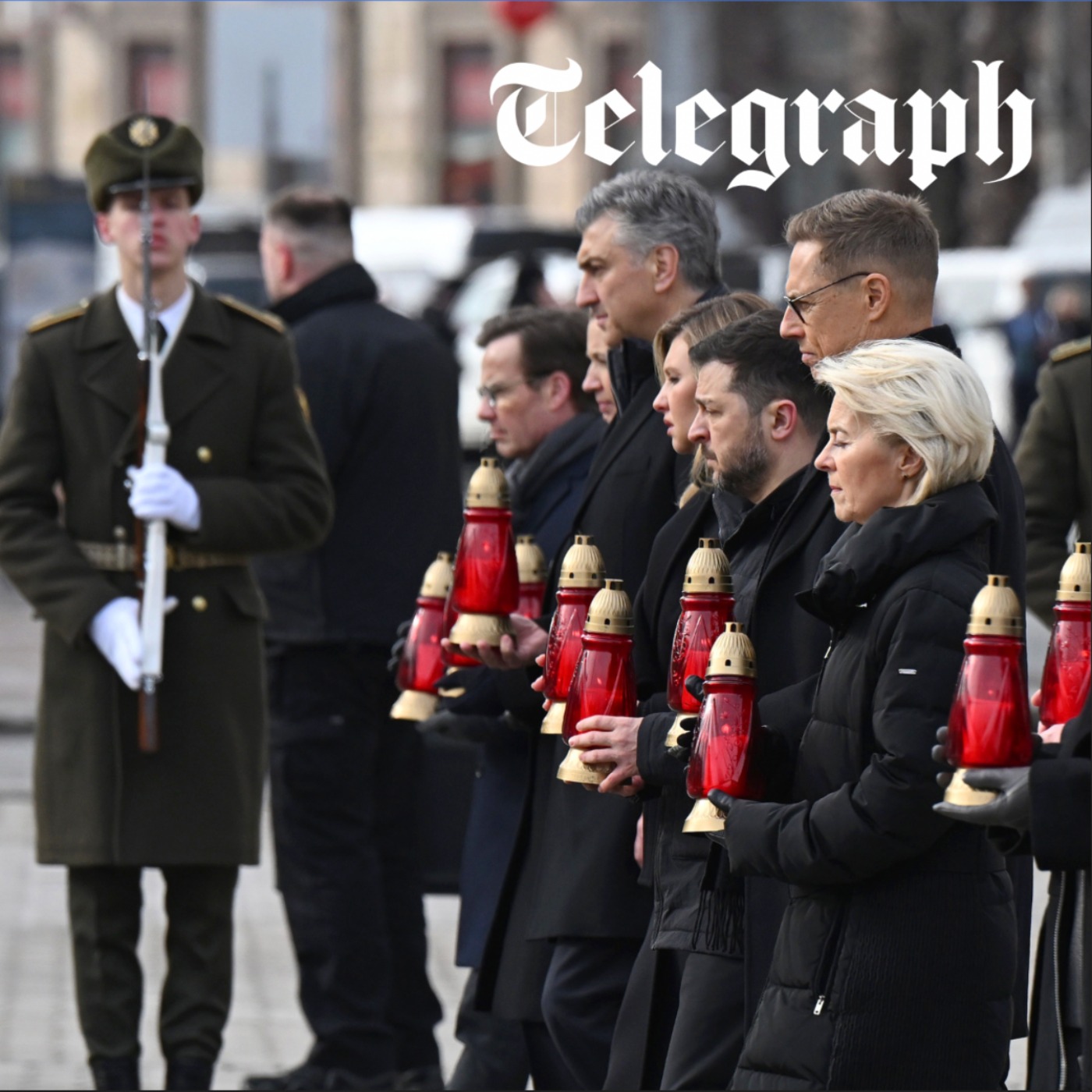
Ukraine: The Latest
Russian troops now being ‘killed faster than Kremlin can recruit’ & world leaders gather in Kyiv to mark fourth anniversary of full-scale war
00:53:13
Loading summary
Transcript92 lines
- [00:04]
Arisia Lutsevich
The telegraph.
- [00:09]
David Knowles
Let's be completely honest. Are you happy with your job? The fact is, a huge number of people can't say yes to that. Too many of us are stuck in a job we've outgrown or one we never really wanted in the first place. But we stick it out and we give reasons like what if the next move is worse? And I I've put years into this place and maybe the most common one Isn't everyone miserable at work? But there's a difference between reasons for staying and excuses for not leaving. It's time to get unstuck. It's time for Strawberry Me. They match you with a certified career coach who helps you get from where you are to where you want to be, either at your existing job or by helping you find a new one. Your coach helps clarify your goals, creates a plan and keeps you accountable along the way. Go to Strawberry Me Career and get 50% off your first coaching session. That's Strawberry Me Career
- [01:05]
Dom Nichols
Acast Powers the
- [01:07]
David Knowles
World's Best Podcasts Here's a show that we recommend.
- [01:14]
Dom Nichols
F1 has taken north America by storm in recent years and 2026 is shaping up to be the most exciting season of Formula One racing yet. With a completely fresh set of cars and engines, Lando Norris, Max Verstappen, Lewis Hamilton and the rest of the world's fastest drivers are speeding into the unknown this season. Whatever happens, the Race F1 podcast will be with you for every corner crash and controversy, starting with F1's all important pre season testing. This month, we're on the ground at every Grand Prix, including the three unmissable US Events in Miami, Austin and Las Vegas, talking to the key players and bringing expert analysis on the stories that matter. Just search for the race F1 podcast to listen or watch wherever you get your podcasts.
- [02:02]
David Knowles
ACAST helps creators launch, grow and monetize their podcasts everywhere.
- [02:08]
Lord Dannett
Acast.com.
- [02:15]
Francis Dernley
I'm Francis Dernley.
- [02:16]
Dom Nichols
I'm Dom Nichols.
- [02:17]
Adelie Persian Ponte
I'm Adelie Persian Ponte.
- [02:19]
Francis Dernley
And this is Ukraine. The latest Today as world leaders gather in Kyiv for the fourth anniversary of the full scale invasion, we hear live from two different parts of the country, report on the latest attacks from air and land, and reflect on the military picture and the remarkable resilience of Ukrainians after so many years of struggle. Plus updates of a bomb going off in Moscow and reports that for the first time, Russia is losing more men at the front than it can recruit.
- [02:49]
Arisia Lutsevich
Bravery takes you you through the most unimaginable hardships to finally reward you with victory.
- [02:59]
Adelie Persian Ponte
Russia does not want peace.
- [03:09]
Lord Dannett
If I'm president, I will have that war settled in one day.
- [03:12]
Dom Nichols
24 hours. We are with you. Not just today or tomorrow, but for a hundred years.
- [03:23]
Lord Dannett
Nobody's going to break us. We are strong. We are Ukrainians.
- [03:29]
Francis Dernley
It's Tuesday the 24th of February, four years to the day since the full scale invasion began. And today further to several dispatches woven throughout the episode from Dom and Adaly in Ukraine. I'm joined in the studio by the former head of the British Army, Lord Dannett and Arisia Lutsevich, head of the Ukraine Forum at Chatham House. Just a reminder, you can now watch every episode of the podcast on our YouTube channel, UkraineTheLast. You'll find a link in the show Notes. Thanks to the tens of thousands of you who watched yesterday and gave such enthusiastic feedback about how it all looks, especially the dispatches and the maps. We're really glad you like it. Before we start with the updates, I think given the nature of the day, Arisia, as a Ukrainian, how are you feeling? What's your overwhelming sense?
- [04:22]
Arisia Lutsevich
What is important is to understand that this day is really almost like time has stopped. The moment of first Russian missiles hitting near Kyiv. It's a different time for Ukraine and I think for Europe, but also I remember receiving calls from journalists saying, well, it's the end of Ukraine. And it was of course very anxious moment to which my answer instinctively was it's probably the beginning of the end of Russia rather than the end of Ukraine.
- [04:50]
Francis Dernley
Well, we'll come to that later on. Lord Dannett, your reflections. Four years on. How are you sensing the mood today?
- [04:57]
Lord Dannett
Well, four years and about sort of three or four days on, four years ago, one was horrified by what had happened, but I think almost from second, third, fourth day, one was in huge admiration for the way the Ukrainian people said, no, we're not going to have this, we're not going to put up with this, we're going to fight. And I think the fact that President Zelenskyy said, no, I don't want a flight out of here, just give me the ammunition, we will fight. And I think that that attitude has won through in the last four years. Now, where we go from here is a much more open question. But fantastic what the Ukrainians have done, what they've suffered on behalf of themselves, their freedom and actually for Europe as well.
- [05:34]
Francis Dernley
Well, we'll get into that later on, but before we do, let's go into the updates. At least four people have been killed and 26 injured in Russian attacks across Ukraine over the past day. Russia reportedly launched 126 drones and an Iskander M ballistic missile overnight with Ukrainian air DEF intercepting 105 of them. That means 20 drones and the missile made it through striking around 11 locations in the country. In Odessa Oblast, a Russian drone attack killed a 20 year old woman and a 45 year old man and injured three others. In Zaporizhzhia, two people were killed and four others injured. In Donetsk, four people were injured. In Kherson, Russian forces targeted 39 settlements, injuring five, including an apartment building and 15 homes. In Dnipropetrovsk, Russian strikes allegedly targeted a health resort, injuring one man. In separate attacks, four women were injured as well. In Kharkiv Oblast, a 44 year old woman and a 69 year old man were injured in drone strikes. In two villages. In Sumy, a guided bomb injured a 36 year old man with 21 settlements allegedly targeted over the past day. Now, to be clear, this is not an exceptional day for Ukraine, given the nature of the anniversary. These are pretty typical in terms of the numbers that we have come to expect. And if you ask people when were the worst bombardments that Ukraine has experienced over the course of this war, you'd expect them to say probably this time four years ago when the invasion began. Actually, all of the worst attacks Ukraine has experienced have been within the past year. Just something worth bearing in mind. Now, Ukraine also struck military targets in Donetsk and Mykolaiv Oblast and also Crimea again in the past 24 hours. A focus of renewed activity in the past week with a concentration of Russian troops and bastion missile systems, the central targets. Meanwhile, European leaders have descended on the Ukrainian capital for the commemorations marking the fourth anniversary. Several of the highest ranking EU officials, including Ursula von der Leyen, head of the Commission, of course, and Antonio Costa, the President of the European Council, have joined the prime Ministers of Denmark, Sweden and Norway on the train to Kyiv. Though sadly not the same as Adelaide's, we did check they'd originally hoped to bear the gifts of the EU's 20th package of sanctions against Russia and the support of the 90 billion billion euro loan. As we talked about yesterday, Hungary has blocked that because of the frustrations they have at the moment over Russian oil shipments via the Druzba pipeline. We'll, I'm sure, get more into that over the course of the week. Now, as for the Europeans, yesterday Dom was at a major gathering of experts and officials in Odessa. So to hear more from the Ukrainian perspective, let's hear from him.
- [08:37]
Dom Nichols
Now I'm here in Odessa at the Black Sea Security Forum, where foreign ministers, ambassadors and security experts have been talking about where Ukraine is four years into the full scale invasion and where it will go from here. The message from the Europeans and the Americans is very, very clear that they're going to stick with Ukraine until victory comes. In the wake of John Healey, Britain's Defence Secretary, making comments saying he wants to be the first British Defence Minister to deploy troops into Ukraine. He was talking about post a ceasefire. And that is a little tricky subject that no one's been able to get over the line just yet. However, the message from the Ukrainians back to the Americans and Europeans was this coalition of the willing thing needs to be the coalition of the action. Where is it? What are the boots on the ground? What are you going to do? Where are you going to step up? We've heard a lot about money, we've heard a lot about how they couldn't unfreeze the Russian assets and instead the EU comes up with a 90 billion euros loan. That's good, but why couldn't you unlock the frozen assets, says Ukraine. Nobody really had an answer for that. So a lot of the messages here were the same kind of things I've heard for years from the Europeans and from the Americans. And I detect a little bit of frustration, quite a lot of frustration from the Ukrainians that they are hearing the same thing again and again and again. However, I had it on very good authority from a very senior former member of the Ukrainian administration that they see this year 2026, as the moment of opportunity. Russia is weak economically, isolated politically, and they are not going anywhere on the battlefield. So Ukraine sees this year when they could really achieve something. And they see the United States, with one eye to the midterm elections, perhaps being less supportive or less unsupportive of Ukraine, less supportive of Russia, perhaps, than they have been in the recent past. So a lot of optimism as well as frustration here in Odessa.
- [10:29]
Francis Dernley
Thanks, Dom. More from him shortly. In the meantime, back to Kyiv. It's been four years to the day since that famous clip Lord Dannett referred to of President Zelenskyy flanked by his advisors, declaring that he was still in the capital and that he would remain there. It galvanized the Western world into supporting the country which many, including lots of world leaders, had assumed would not be able to, to resist the onslaught. To mark the anniversary today, Zelensky's released a new video reflecting on that time. In it, he says, I really like a Quote, that everyone was retweeting at the beginning. You think Ukraine is on its knees? I just tied my combat boots. He went on. We will remember every civilian, every child that Russia killed. Everyone who still buys oil from Putin. Look at these photos. Men don't fight like that. Human beings don't fight like that. Another interesting bit, when Ukraine first blew up Russian oil refineries, everyone saw it as a miracle. Now it's a normal thing. What we thought was impossible is now a tradition. And finally, people of Ukraine, you are our only strength. Thank you, everyone. We defended our sovereignty. Putin lost. He didn't achieve his goal. Glory to Ukraine. Now, Adelie arrived in Kyiv a few hours ago. Let's go to her now for a sense of the mood there.
- [12:01]
Adelie Persian Ponte
Hi, London. I've just arrived in Kyiv after a night on the night train from Odessa. This is the night train just behind me. It's a lovely morning here in Kyiv. It's actually closer to 0 degrees, which is a lot warmer than it's been in the last few weeks, where it's been -10, -15, but it's still very snowy everywhere around me. You can see the tracks right there. Quite a day, I think, for everyone. And our sense yesterday from Odessa, speaking to residents living through the energy crisis, is that everybody is very, very exhausted, that people are a lot more somber, a lot more pessimistic than they have been in the last two years that we've been coming here. I was here for the very first time exactly two years ago, in February 2024, with Francis, Dom, Jack and David, of course. And we went to the press conference held by Zelensky and the rest of his ministers in the center of Kyiv. And it was a very fancy affair, very fancy hotel. And I remember the sense then, everybody was obviously, they were asking for weapons, they were asking for help, but they were really putting on a show for the international media and for the international community of, look at how strong we are, look at how technologically advanced we are. There were displays about the microchips and everything in the missiles and in the drones sent by Russia. It was very like pedagogical. And it was very much, we need your help. Please give us your help. We need weapons. We can do this as an international community. And I think two years on, what's really striking to me in Zelenskyy's interview over the weekend and in the general mood that I've seen in just the last 24 hours speaking to residents is it's a lot more somber. People feel A lot more alone. They know that no one is coming to their help. They know they don't have enough resources. They know they don't have enough air defense. And they're on their own and they're fighting this pretty much on their own. It's a very different atmosphere than what it was because people are really, truly tired and the war is really coming into their living room. I'm going to go to a press conference about the children and I hope you can hear me. Well, one thing that I love about train stations in Ukraine is that they have music. Listen to the music at 8 o' clock in the morning in the Kyiv's train station.
- [14:28]
Francis Dernley
Thanks, Adli. Let's go to Brussels next. Where last night EU institutions were lit in the colors of the Ukrainian flag. This morning, Estonia renewed its calls for there to be a Schengen blacklist of Russian soldiers to stop them being able to travel freely across Europe. Of particular concern, following the hybrid and sabotage warfare we've been reporting over the past year so. The EU's foreign policy chief, Kaya Kallis, spoke to journalists this morning and reiterated that in her view, Moscow has failed to achieve any of its strategic objectives. Now, that didn't go down well with former Russian President Dmitry Medvedev, who posted this. Kaya, the blond rat, said she was working to ensure that hundreds of thousands of former Russian servicemen would never enter Schengen. What a loss for our fighters. Well, they can enter it without visas if they want to, like in 1812 or 1945. Happy defender of the Fatherhood day. It is remarkable that still four years on, Russian troops are still more or less able to travel freely around Europe. And it's no wonder that Estonia is still trying to raise attention to this. But there has still been no sizeable progress on that as an issue. A few more punchy remarks and announcements from current and former European leaders. British Prime Minister Keir Starmer said supporting Ukraine against Russia is the defining issue of the generation, the most critical issue of our age. It asks the question of whether Ukrainian and European freedom will endure. As part of that, London added another 297 new designations under its Russian sanctions regime this morning, the largest since the early months of the invasion. Among other things, the package targets one of the largest oil pipeline companies, PJSC Transneft, responsible for transporting over 80% of Russian oil exports, a sizable development that. But critics still, of course, say this doesn't go far enough. Former Prime Minister Boris Johnson has posted on X this morning, as this horrific and unnecessary war enters its fifth year. The west, and especially the us needs to understand the truth. Putin does not want to end this war. Putin does not want peace. Putin will not stop the slaughter until he faces much greater pressure. So for heaven's sake, let's get on with it. Impound his entire shadow fleet, unfreeze all his frozen assets and give them to Ukraine. Give the Ukrainians the weapons they need to take out the Russian drone factories. Putin will not negotiate until he feels he has no choice. That moment could come soon. The Russian economy is reeling. Russian casualties are enormous. But on this miserable anniversary of Putin's invasion, the fundamental problem is the same as it has been the last four years. The Ukrainians fight like heroes while we in the west pussyfoot and delay. The west can end the war this year. Now, just lastly, turning to the ground war, an explosion rocked a police administrative building in dnipro at around 8:30pm London last night, marking the latest in a series of blasts targeting law enforcement across Ukraine following that attack on the VIV that we reported in yesterday's episode. No casualties were reported in this one, though the blast has caused significant damage to the building's exterior. There's also been an explosion outside of a train station in Moscow which has killed a police officer and injured two others. It happened minutes after midnight near the north of the city center. Moscow's Interior Ministry says the attacker was killed in that instance, but we don't know if that is true. Of course, that follows a string of assassinations and attacks believed to have been carried out by Ukrainian special forces in retaliation to similar attacks in Ukraine. But we're only speculating that that is the case here. Finally, on the battlefield, further to 300 km of liberated territory President Zelenskyy claimed over the weekend. Ukraine's current commander in chief, Oleksandr Syrsky, has said yesterday that the army regained control of eight settlements and liberated 400 square kilometers, adding that airborne forces and adjacent units regained control in the Oleksandriivka direction and the intersection of three oblast Zaporizhzhia, Donetsk and Dnipropetrovsk. He said that despite the successful offensive operations, the situation in the area remains complicated as Russian forces continue to apply pressure with artillery, drones, armoured vehicles and small assault groups. But perhaps the most significant military news of the day is the claim from a Western official that we report in the Telegraph today that Russia is losing more troops than it can recruit. For the first time since the invasion. The source says Putin's forces were suffering almost 40,000 casualties a month in November and December, while recruiting only up to 35,000 troops in that period. Now, Al Khans, the UK's armed forces minister, who Dom interviewed on the podcast recently, said Russia's effort to train, train fresh recruits was becoming more and more difficult, with incentives by the Kremlin failing to entice new soldiers. People are realising it's a one way ticket, he said. He also added that at the operational level, the cost on Russia has been almost unimaginable. 1.25 million casualties, more casualties than America took in the entirety of the Second World War. Over 4,000 tanks and 10,000 armoured vehicles. A navy arguably destroyed from a navy without any ships, and indeed an air force that's massively stretched across mainland Russia, but without sustaining combat mission in Ukraine. Now, if that is true, that remark about the Russians being unable to replace their troops for the first time, that is a sizable milestone indeed, because of the manpower crisis that we have been talking about. If Putin were compelled to do another mass mobilisation, it would be enormously significant for the country and its ability to wage war. Indeed, he might do anything to avoid that. And that would have big ramifications on the Ukrainian theatre. And I'll be very interested to hear Lord Dannett's perspective on that in a moment. But before we go to our guests, the next dispatch from Dom as he makes his way across Ukraine.
- [20:53]
Jack (videographer)
You join us after a 12 hour overnight train ride from Odessa. We've gone further north into the country. We had a successful night's sleep. I am wearing my pajamas, which, yes, were the same clothes I wore yesterday in Odessa. I'm afraid that's just the way it is on these trains. But you can. Lovely bedding, pack a nice comfy mattress, pillow, couple of sheets, a pillowcase. It's all very clean and tidy. I slept like a baby, Had a lovely night's sleep. Jack, videographer extraordinaire, the man behind the camera had a less successful evening. He tried a graceful dismount from his top bunk in the middle of the night to go for a pee and managed to bring his entire bedding pack on top of the person on the lower bunk. Basically, we're making friends as we go through Ukraine. Anyway, we are now heading further into the country. We're going to talk to some people today to get military updates from what's happening in the south and the east. We're going to be talking drones and we're going to be meeting some people who helped organize partisan resistance activity in the occupied areas. I better go now because as Much as I've been trying to avoid it, there's a rather stern looking lady just over there who clearly doesn't want to be woken up just yet by some idiot talking about pajamas. So I will see you later.
- [22:20]
Francis Dernley
Dom has past history on Ukrainian trains, let me tell you. I still don't think the. The woman who is in charge of our carriage has recovered from when forgot to give her his bedsheets. But anyway, story for another day. Let's turn to our guests now. Lord Dannet, your reaction to Al Khan's remarks and the prospect that Russia may, for the first time, not be able to recruit as many soldiers as it's losing at the front.
- [22:45]
Lord Dannett
Well, I think if you put two or three of your points together, I think potentially this is a very dangerous moment for Vladimir Putin. The economic sanctions that the west has imposed on him are beginning to bite. We know that we should tighten them and make them bite even harder. If that happens, and he also finds that he can't recruit the manpower that he wants and has to go for some kind of conscription, then I think put those things together, then he's going to come under huge pressure. And it may just be the accumulation of those facts together that starts to turn the Russian population to put questions in their mind, is our leader really doing the right thing for us? Is this the way of life that we want? Prices are going up, interest rates are terrible, inflation is not good, the price of things in the shops is sky high. Is this really the life we want? Is this the man we want leading us? Particularly if he has to go to some kind of conscription, I think he'll be in dead trouble.
- [23:38]
Francis Dernley
Well, from your perspective as a former leader of a very important Western army, when you hear those numbers that Russia has suffered its casualties, 1.25 million casualties, just on a human level, what's your reaction to that? And then the strategic.
- [23:54]
Lord Dannett
It's quite incredible that Russia has lost over the last four years 1.25, 1.3 million casualties. Now, a large proportion of those are killed, a large proportion of those are wounded and will come back to operational service at some point. But the numbers of those are absolutely staggering. Trust that with the size of the British army today, some 70,000, how many times the size of the British army have the Russians lost? And you have to ask yourself the question, how long can this go on? How sustainable is this? And to come back to those narrow figures of losing more on a daily basis, on a monthly basis, than they're recruiting, well, any army is going to suffer if Your outflow, for whatever reason, is greater than your inflow, and your military capability is going to decrease. You have to put all these factors into the melting pot and begin to ask yourself the question, in whose interest is a ceasefire at some point in the future? Because clearly, Vladimir Putin doesn't want a ceasefire at the present moment, but there may come a point when he's forced to have one. And although we might think from a Ukrainian point of view, this would be a welcome respite, actually, of course, for the rest of Europe and Ukraine, it's potentially not because they can reconstitute themselves, they can recoup themselves. And then Putin's got the option of, does he press again in Ukraine, or does he test NATO's resolve by an attack in Estonia, Lithuania, Latvia, many of the other things that we've been concerning ourselves about, these are all realistic possibilities. And that will only be possible for him after a ceasefire and a period of reconstitution. It's challenging times, Arisia.
- [25:24]
Francis Dernley
What's your sense at the moment?
- [25:26]
Arisia Lutsevich
So what is striking also to explain to our listeners that for those horrific numbers of losses, Russians only has expanded their occupation by 13% and less than 1% last year. So they are making no gains, literally, for taking such outrageous losses waiting for the Russian population. It's a kind of supplementary factor. What we should be aiming at is actually curtailing Russians capacity to wage war, period. And that means this asymmetric innovation that Ukraine has created by facing a country four times larger by population, obviously more conventional, the aircraft, the tanks, all of that, disfavoring Ukraine enormously. But instead of capitulating or giving up, like a lot of people suspected or feared happen, Ukrainians invented a new way of warfare, distancing their human resources personnel away from the battlefield, using unmanned systems, building an incredible air defense. Because what you've just said on the how many targets Ukrainians are taking down and actually winning quite a lot in the sky. I think we need to build on that strategy because we are not there yet. We have not passed the tipping point where. You know, there's a famous saying by Machiavelli, you start the war when you went and you end it when you can. It seems like Putin, at this point, regardless of all the numbers and arithmetic, is not willing to contemplate ending the war for various reasons.
- [27:01]
Francis Dernley
I think it is an important point that in many ways, until you get to a breaking point that you've just talked about in the Russian context, there is every incentive for Putin to continue waging this war because it enables him to even further cement himself and his regime at home. We've been reporting now for the last four years on the suppressive measures that he's been able to adopt as a consequence of the invasion, the economic measures, the control over the the elites, even more particularly the economic elites, bringing them further in as opposed to being in Western countries. There are advantages for Putin of this war until, of course, something flips and it becomes the complete reverse. And often in war, it can happen very, very swiftly. Arisa was just talking, Lord Danis, about the transformations that we have seen over the last four years. I mean, for you, what is the biggest lesson that we take from the last?
- [27:49]
Lord Dannett
Well, there's an enduring lesson about warfare, and that is series of invention and counter invention. And when you're under great pressure, as the Ukrainians have been, that cycle of invention and counter invention goes faster and faster. Now, Ukrainians have been fantastic in the way they've adapted their battlefield techniques and procedures, they've adapted the way they've produced equipment and whatever. And there's a real challenge here for us other European countries, who are still pretty much wedged into our peacetime procurement cycle. All that stuff is taking far too long. If we do find that Putin at some point in the future makes an attack to test the resolve of NATO, to test the veracity of Article 5, we may find that actually we're going to rue the day, having dragged our feet in terms of not putting more money into defence and dragged our feet in the way that we haven't revolutionized and energized our procurement cycles, just the very least of which, which is not ramping up in the same way that Putin is doing the productions of munitions, just something as basic as 155 millimeter shells. And why aren't we doing it? Because industry is not prepared to fire up its capacity until contracts are signed, and contracts won't be signed until the money's on the table. So I'm afraid, Rachel Reeves, from this point of view, this country's point of view, you've got to put the money on the table so the contracts are signed, industry will pick up the slack, and then we'll start to get the wheels moving. But do we have to wait until we're under pressure? No, we shouldn't. We should be learning the lessons of today, as demonstrated to us by Ukraine.
- [29:17]
Francis Dernley
Arisia, when you look at the way that Ukraine has been able to adapt over the last four years, do you think that that adaption is still continuing, or do you Think that in a sense it's at the moment it has so many other challenges that it's learned certain lessons and is just deploying those en masse.
- [29:33]
Arisia Lutsevich
So I think it's important to understand that there are two pillars in Ukrainian resistance and something that that many people in the west underestimated four years ago. It's Ukrainian society, it's whole of society war. It's war for independence. And it's indeed existential for Ukraine because Putin said I'm going to destroy you. You either become Russians or you do not exist. What happened is that private sector immediately switched on combat mode. They've looked at civilian. A lot of drone technology was civilian or dual use. Farmers used drones on the fields and one of the first drones actually were brought in in the north of Kyiv. It's quite rich agricultural area. People forget that around Kyiv Chernihiv region, the farmers donated it to territorial defense units and they started mounting resistance to Russian encroachment and invasion. So I think it's full speed on when you think about the Ukrainian defense sector grew from 1 billion to 40 billion today. And the speed of iteration a battlefield. So the infrastructure of battlefield data center and production is two, three weeks. They having a new model that includes software and hardware and that is only possible with local production and with connection to the battlefield and feedback loop. So I think this is the model we should be looking at for the war of the future. And what's interesting, we have a feeling that sometimes Ukrainians, maybe they just want to sell us their drones, but actually they are selling the service or they're inspiring us by this model. And we should think about where the local production in the uk, in Norway, in Poland and how are we preparing our educational systems to have these engineers is private sector plugged in. They shouldn't be just there, you know, in another room discussing AI or innovation. They should be in the room building this defence ecosystem for the future.
- [31:32]
Francis Dernley
We were referring to the manpower crisis that Ukraine is experiencing at the moment. And of course it matters a lot the Russian metrics in that score as well. That's why it's so important. The story that we were talking about. What other issues has Ukraine not yet been able to fully grapple with that's impeding its ability to fight?
- [31:51]
Arisia Lutsevich
I think putting more economy on the war footing to finding that right balance between the civilian and military. It's not obvious you need a bit more strategic guidance from that. Ukrainians are good at self organizing. But I think to really persevere and prevail like Everybody wants there has to be a bit more strategic guidance on defence industrial base and how that defence industrial base can be integrated with the eu, with the uk. It's quite telling that the leaders of the European Union are now in Kyiv because that's already one of the wins. The future membership of Ukraine in the European Union and horizontal cooperation is there. I would also say economy overall and the energy. Look what has happened over these last few months by destruction of Ukraine's energy generation and 40% has been taken off the grid. This will have huge implications on economy, production, logistics. So this is our urgent task inside Ukraine to make sure that is rebuilt in a more resilient way and how it's not obvious. There is no model that Ukraine can take and borrow. There are some innovations in renewables, in decentralized generation, but Ukraine needs to come up with a way it can keep economy going, civilian heating and lights, and keep its defence industry running.
- [33:10]
Francis Dernley
Lord Janet, General Walker, one of your successors as Chief of the General Staff, he's written a piece today where he says, I believe we are on a collision course with Russia that is on a war footing, that is replenishing its lost equipment and that is rearming fast. Strong words from him. Is that your sense as well, that we're on a collision course? Because that makes it sound like war is coming.
- [33:32]
Lord Dannett
Strong words indeed. But I think what General Rowley is saying is echoing what a number of commentators have been saying for some time, that a wider clash with Russia is on the cards in two or three or four years time. I mean, and that's why it is so frustrating that you hear Keir Starmer, our Prime Minister, talking at Munich about we've got to increase our defence spending, we've got to be spending 3% by 2029 and 3.5% by 2034. But not getting on there and not putting the money in, because if we put it off till tomorrow, we actually will find that tomorrow has come too soon and we're not ready. There are many people, myself included, who draw parallels back to the mid and late 1930s. Well, this is one area where history has got a lot to teach us. And forgive me for mentioning facts which I've mentioned many times before. In 1935, we were spending just less than 3% of GDP on defence. We failed to deter or appease Hitler. In 1939, when the war broke out, it shot up to 19%. And in 1940, when we were fighting for our very lives, it was 46%. Those are the costs of having to Fight a war. How much better to find your 3, 4 or 5% now to have the military capability to deter further adventurism from Vladimir Putin or anybody else else that wants to challenge us? The logic is impeccable. The logic is there, the lessons from history are there. I mean, I published a book three years ago and gave a copy to the then Defense Secretary making exactly these points. Come on, let's get on with it. Well, now Keir Starmer is mouthing those words. There's got to be substance to it because tomorrow may be too late, two or three years time, as General Rowley says, maybe too late. Let's get real, let's get serious. And as Alicia is saying, the Ukrainians are under huge pressure and are being very inventive. We've got to feel that pressure. We've got to feel the all of one society pressure as well and be prepared to take some hits ourselves. It may mean that taxes have got to go up, it may mean a number of things have got to happen, but if we just go on hoping for better times, we're going to be disappointed.
- [35:27]
Francis Dernley
Arisia. I remember we were doing an event together at the Honourable Artillery Company back at the end of last year, and one of the questions in the audience was, which leaders from history would you want to see governing the respective countries? Now, I thought it was a great question. Now, of course, the cliched response which I'm afraid I gave at the time was, wouldn't it be great to have Churchill back? But actually, I think to your point, Lord Dunnett, in weird way, you'd almost prefer Chamberlain to most of the leaders we've got at the moment, because at the very least, Chamberlain was preparing for the worst case scenarios if appeasement failed. Our current leadership are not, are they?
- [35:59]
Lord Dannett
No. I think if you take a benign view of what Chamberlain was doing, yes, you can say that he was buying time to belatedly start the rearmament program. And I think probably history would bear that out. But it did need the crisis that brought Winston Churchill into the premiership and his leadership that enabled Britain, in the same way that Ukraine is today, Britain to stand alone against an evil foe as Ukraine is today. So there are aspects of both their leaderships which I think should be celebrated. But go back to what I was saying before, in the early 1930s when Hitler was becoming a threat, we weren't taking it seriously and we left it almost too late. We just about got away with it. Fortunately, we switched our procurement to fighters rather than bombers. My goodness, we needed that to Win the Battle of Britain, our army having been defeated in an extraordinary fashion in May, June 1940. It's often said that professional standing army of the day loses the first round and we have to then build ourselves a civilian conscripted army to win in the final round. Let's not go there again.
- [36:59]
Francis Dernley
Our Europe editor, James Crisp on the podcast yesterday was saying that really from the perspective of Europe, there are some that would agree with President Zelensky's analysis that kind of a World War III has already begun in some degree that this is the opening round. Let's hope that isn't the case. But that's of course I can understand why Zelenskyy would make that argument. Obviously he's trying to make a strong point here, but nonetheless it takes, he said, a crisis to turn the EU around and these big organizations like NATO, it takes a crisis. Why do you think that four years on they still don't see this as an existential crisis despite the strong words?
- [37:35]
Arisia Lutsevich
Well, I think first, you know, from Ukraine's perspective, it's already fighting Iranian shahed drones, which you know, when you think about it's quite mind blowing that Russians didn't have technology of its own. It had to take it from Iran. That was under sanctions for decades. And North Korean soldiers, plus North Korean artillery saved Russia in 2024 at the time when Americans were delaying 60 billion of assistance to Ukraine and of course Chinese manufacturing equipment and China buying Russian oil, sustaining its war economy. So Ukraine has all these adversaries either by proxy, but all of this unfolds in the geographical center of Europe. Ukraine is geographical center of Europe. Putin understands that control over Ukraine and we're looking here at this map, it's the largest country before the annexation of CR Crimea in Europe, bigger than France. It's a keystone for European hegemony. The question why are we not understanding this? I think we lost strategic thinking in those terms. Putin uses these 19th century power geopolitics, Mackinder, whatever in his mind, Eurasianists of Dugin. And he is willing to exercise power. He thinks it's a good method. While we think it's a method of last resort in a way it's a symmetry of a mindset. And I think Putin still maintains, despite his failures on the battlefield, some narrative control in the west over some policymakers, some societies, some opinion leaders were well, you can never defeat Russia. Why don't we just give up and try to settle? Why don't we sue land for peace? Russia is a nuclear power. They are blackmailing the rest of the world by the most scary weapon. We are not here in the west, especially explaining to the constituents, to voters. I mean, you're doing great job with your postcards, I must say. It's also to celebrate that achievement five days a week. Always find an interesting angle to explain what is going on with this big war. But it's not done by a senior leadership because the problem is political, it's not military problem. In the end, military needs to be given order to review doctrine, to review battle. You know it, right? Better than me. What do you think?
- [39:53]
Lord Dannett
Well, I mean, I agree with you one particular point you made there. The narrative is not being developed and not being communicated. This should be really coming top down from our national leaders in this country, from the Prime Minister, from the German chancellor, from the French president. They should be saying quite clearly and unequivocally to their people, this is a critical moment in our national history country, it's a critical moment in European history and go on making the case. And there are other senior ministers who've got to go on making the case. And then people will begin to understand however they take their news, whether it's through the podcast or whether it's through social media or reading an old fashioned newspaper, if the message is consistent and widely put across, people will begin to understand it. And once people begin to understand it, they'll understand the direction of travel and where we should be going and why this is just so important. Just a few words at the Munich Security Conference every now and then. That doesn't cut it.
- [40:44]
Francis Dernley
Since we've mentioned Churchill today and I've made this point on the podcast before, it is very much recommended that people read the first volume of Churchill's war memoirs, the Gathering Storm. It makes very, very striking reading, particularly with some of the parallels we've been referring to today. And he makes the point very strongly that he doesn't know any people in Europe or indeed in world history, that if a case is made compellingly enough for increased defense spending, that they will say no. But the point is that the case has not been made. The case has not been made.
- [41:14]
Arisia Lutsevich
But I also think flipping it the story because Ukraine's heroic resistance which we are marking today, opens up an amazing opportunity for indeed building a better security in Europe thanks to defeating Russian imperialism. Because if we again try to appease, we give a piece of land, we accommodate with Putin, we will end up spending more and more. So we have to very much not only celebrate Ukraine's bravery, but to actually design with Ukrainians a strategy of neutralization of Russian war effort and putting resources and strategy on the table to achieve it. Not, you know, use this mantra for as long as it takes. You remember how many times it was repeated for as long as it takes? No, it should be whatever it takes as fast as possible. Because Ukrainians are losing best of its men and women children are now growing up not knowing life without war. The kindergarten children will go this year. They grew up with this war. So I think we also should understand the time is precious and that time is bought by Ukraine's blood.
- [42:34]
Nikayla Matthews
Day or night. VRBoCare is here 247 to help make every part of your stay seamless. If anything comes up or you simply need a little guidance, support is ready whenever you reach out from the moment you book to the moment you head home. We're here to help things run smoothly because a great trip starts with the right support. And hey, a good playlist doesn't hurt either.
- [43:03]
David Knowles
Say hello to Mia.
- [43:04]
Lord Dannett
Hey there.
- [43:05]
David Knowles
Mia runs a pet grooming service in Chicago. But getting new clients was rough until
- [43:09]
Nikayla Matthews
I started using Acast. I recorded my ad targeted pet owners in the area and let ACAST do the rest. Now people all over the city know about my grooming services.
- [43:18]
David Knowles
Mia's business is to linked Looking sharp. What's your secret for happy pets and happy clients?
- [43:22]
Nikayla Matthews
A fresh cut, a friendly vibe and a well placed podcast ad.
- [43:26]
David Knowles
Get the word out about your business through Acast. Visit go.acast.com advertise to get started.
- [43:37]
Francis Dernley
Well, it's been fascinating hearing your reflections. It's been great. Obviously the the opportunity of this tragic anniversary, it affords us the ability to be able to talk in slightly broader brush terms than we usually do on the podcast, which is more granular, giving you the updates, doing interviews that are very on very specific issues. But it's always important I think to remind us of these big picture ones. Any parting thoughts from both of you as we enter the rest of this week? Perhaps Lord Dannet, you could go first.
- [44:01]
Lord Dannett
Well, we have to look answer the question for ourselves. Where is this going? How is this going to end? And I completely agree with Volodymyr Zelenskyy. There's no way that he could countenance and the Ukrainian people would accept giving up up territory that they've not lost on the battlefield. Why would you give up hundreds of thousands of your own citizens without a fight? So that is never going to happen. And when I go back to conversations I had with people four years ago, how is this going to end when it's quite clear that Putin's strategic objectives and Zelensky's strategic objectives are totally irreconcilable. So you have to draw the horrid conclusion. This is going to have to continue to be fought out on the battlefield field. And the conclusion that we have to draw from that is that we've got to go on supporting Ukraine in admiration for the way that Ukraine has adapted, has borne the cost for themselves and also for Europe. But I think from, dare I say it was from a country like the UK's point of view. Yes, of course we and others are going to give certain security guarantees to Ukraine. But go back to what we were saying about might Putin press somewhere else like in the Baltics? I think we've got to significantly increase our support for countries like Estonia. Latvia and Lithuania have much more forward deployments there. Supporting Finland, Sweden, the Scandinavian countries, because a lot of people will go on supporting Ukraine. But if he decides he can't push in Ukraine, he may decide to push somewhere else. We've got to make sure the stakes elsewhere are too high for him as well. That's critical.
- [45:30]
Francis Dernley
It once seemed far fetched that Ukraine would be invaded. So anybody who believes it would be far fetched that Estonia or other countries, particularly if Article 5 has been shredded, which it gradually has over the last couple of years, would be impossible. I would say that needs to remember that fact. But Rissia, you've got the final word today.
- [45:44]
Arisia Lutsevich
Yeah. I remember again my last expert comment for Chatham House before the full scale invasion was Ukraine will resist, but are we ready to be with Ukraine shoulder to shoulder? That moment, obviously it took some time for that truce to sink in. So I think right now, especially for Ukraine's allies, we need to strengthen the coalition because this is new Putin, not new where Putin has better chances. It cannot crash through Ukrainian frontline. It will crash through our minds here, through our unity and by manipulation for us to take decisions against our own national security. And we must not allow him a victory on that mental narrative battlefield. And you know, something to keep in mind, listen to countries, neighboring Russia, to what they say about Russia, because this is something that was always dismissed. They understand that yes, Russia is a strong adversary, but still it's a colossus and clay feat. And if we remain united, the European history shows Russia cannot win. So I think it's important to strengthen that confidence in ourselves, that we as global democracies have innovation cycles, we have resources, we have economies four times bigger than Russia combined. And I think we have something to Defend Russia are waging a war for the past. You cannot win the war for the past. Ukraine is waging a war for the future. It can go anyway still. Right. But I think together Ukrainians can really join the European family of nations.
- [47:20]
Francis Dernley
And before we go, I've got Dom live on the line from somewhere in Ukraine. We're not going to reveal where. Dom, what have you been up to since that dispatch you sent a few hours ago from the Trek train?
- [47:32]
Dom Nichols
Well, the big news, Francis, since I left the train, that I've changed my T shirt. I haven't had a shower yet, but I thought if I appeared for about the third or fourth time on camera in my, in that black and white T shirt, questions would be asked. So, no. So we left Odessa last night. We left just as the air raid alert was going, almost like a goodbye from the city. 12 hours overnight on the train. Only minor incidents, as I reported earlier on, on. And then we got to our latest location, went straight into our first interview, which was very interesting, actually. A guy who is an organizer, facilitator, logistician with the Ukrainian resistance in the temporary occupied territories. It was very interesting to talk to him in particular. And I asked this towards the end of the interview. I said, why is, why is he being so open? He was very, very happy to be on camera. We said, look, you know, we don't have to film you. You could film you from behind or we could pixelate your face or anything like this. And he said, he said, no, no, he's very happy. He said the Russians know all about him already. He felt the sort of moral authority was increased by being upfront and displaying who he was. So, you know, his choice, and I think it was. But anyway, a really interesting chat with him about how things are organized and, and how they operate in the, in the occupied territories, how how resistance activity works, the kind of operations successful. And a word I wasn't expecting to hear in that interview. He said it's a lot of fun. Basically. He summarized resistance work as saying, it's, it's a mixture of fun and fury. Burning desire to, to do something, to take the fight back to the Russians. Both people inside the occupied territories and those that have got out and are helping from, from the outside. There is that, that righteous anger that they. People feel inside them. It's fury. But the activity itself can be fun. I mean, no, skirting around the issue. He was talking, we talked about car bombs and assassinations and inflicting violence and killing people. So, you know, I don't Want to sugarcoat it, but these are the kind of people that we're interviewing and occasionally talking to in the. In the occupied territory. So it was a fascinating discussion there. And then after that we went and spoke to some other folks and now we finally, whatever time it is now, mid afternoon, finally made it to our hotel, where I'm looking forward to unpacking and having a shower.
- [49:58]
Francis Dernley
I can imagine memories of the sweaty trains traveling across Ukraine still linger in my subconscious.
- [50:07]
Dom Nichols
I need to go on.
- [50:08]
Francis Dernley
Dom Adley, in her dispatch recorded earlier today, was reflecting on the difference in mood. She sensed a little bit more pessimism than the last time that she was in Ukraine. Is that your experience as well?
- [50:21]
Dom Nichols
Pessimism? I don't. I mean, everyone's pretty glum. The weather's pretty rubbish at the moment, according to the bloke from London. I mean, most people here are pretty happy with it. It sort of hovers between minus one and plus two, really, in the time we've been here. So, you know, actually quite warm, very warm compared to what they've been experiencing recently, or hovering around the zero point. Of course, everything starts to melt, so it's just miserable out on the street. Everything's slushy and wet and the whole place is grim and. And it's raining, all that kind of stuff. So everyone's quite sort of downcast. But I wouldn't, I wouldn't. I don't see I've detected any. Any dip in support for the war. I mean, obviously we haven't spoken to a huge number of people since we've been here, but as you'll remember, Francis, the overriding impression I have is everyone's just getting on with life. I mean, the adverts around Odessa, on the street, the big sort of posters and what have you. It was a mixture recruiting adverts for the military and advertising the. The clown production in the theater, as far as I could tell, in Odessa. So, you know, normal life carries on. Everyone's out on the streets. There doesn't seem to be any diminishing in the desire and determination to carry on normal life. There was still the kind of Uber eats, moped drivers whizzing in and out of traffic. I thought, I'll get enough of that in London. I come here and it's exactly the same. So, no, I mean, the restaurant restaurants are full. There's still the curfew, obviously, 11pm or midnight. I think it is now till 5am, so the curfew is still on, but other than that, it's it's as I have seen every other time that I've been here, grim resolution, I suppose, if you wanted to put a phrase on it. But I wouldn't say there's a. There's any. Any diminishing in, in support for the direction of the war and certainly no. No chat I've heard about. Well, actually, you know what, Zelensky probably should do a deal and, and we could probably have a conversation about territory. Quite the opposite. But then of course I've been speaking to people about resistance works that are very, very clear that no possible conversation about giving up territory. And the individual I was speaking to that you'll see on the video probably next week, I would have thought he was saying that his grandparents are buried in the town he's had to leave, so he had absolutely no desire, no consideration to negotiate over losing access to that village. I wouldn't say I've detected that. That at all.
- [52:35]
Francis Dernley
You weren't tempted to join the clown show then?
- [52:38]
Dom Nichols
Well, I feel like I'm having a break from the clown show just being over here for answer, to be perfectly honest. By the way, well done yesterday on the, on the launch of the. Not that this in any way connected to your comment about the clown show, but I thought you and, and David and James, Chris did a great job yesterday back at hq. You didn't have a rosette, did you, with the sort of water and the wheels coming off and all the rest of it, but no, good job.
- [53:02]
Francis Dernley
Thanks very much. A rare compliment from Dom. I'll chalk that up. Last question, Dom, where are you heading next? What's on your itinerary?
- [53:08]
Dom Nichols
Well, we're still wobbling around in the area where we are at the moment, getting picked up in the morning, going off to a military location. I've been told it's. It's super secret and super cool, which on the one hand sounds great, but on the other hand sounds like we're not going to be able to take the lens cap off. So I have no idea quite what's going to happen tomorrow might be a day when. When Jack, our videographer supreme, sits in the stands and has a coffee. So. Yeah, but that should, that should be quite interesting. Off again round country after that, off to various other places. We'll try and tie in if we can. We'll see you. I'll see what the schedule's doing, but we'll let you know.
- [53:44]
Francis Dernley
Well, thanks very much, Dom. Good luck to you and Jack out there and look forward to hearing from you in future episodes this week. Take care.
- [53:51]
Dom Nichols
No, no, you're very welcome. By the way, I was intrigued by some of the, some of the comments I saw on the. After the video launched. There's some. Yeah, it's all good. It's all good. People saying I've done a disservice to your sartorial choices. I see today you've got one of the, the least painful suit patterns that I've, you know, personally had the pleasure of, of enjoying over the years. Very positive about your clothing. So, you know, I think you should, should take that for us. It's good. Well done.
- [54:18]
Francis Dernley
Well, somebody's got to maintain the sartorial standards at the Telegraph, given your T shirts of late.
- [54:23]
Dom Nichols
I've checked my T shirt. This is a clean T shirt. I put it on specialty. It's my NAFO T shirt. There it is. You pronounce this nonsense, not me.
- [54:31]
Francis Dernley
I think the line's breaking up, everyone. I think, I think he's. I think we've lost Dom. I think we've lost him.
- [54:37]
Dom Nichols
Chat soon. Always a pleasure.
- [54:39]
Francis Dernley
Take care, Dom.
- [54:40]
Lord Dannett
Thank you.
- [54:43]
Francis Dernley
Ukraine the Latest is an original podcast from the Telegraph created by David Knowles. Every episode featuring us in the studio. Maps and battlefield footage is now available to watch on our YouTube channel. Subscribe@www.YouTube.com CrainTheLatest. There's a link in the description. You can also sign up to the Ukraine the Latest newsletter. Each week we answer your questions, provide recommended reading and give exclusive analysis and behind the scenes insights, plus diagrams of the front lines and weaponry to complement our reporting. It's free for everyone, including non subscribers. You can find the link to sign up in the episode description. If you appreciate our work, please consider following Ukraine the Latest on your preferred podcast app and leave us a review as it helps others find the show. Please also share it with those who may not be aware we exist. You can also get in touch directly to ask questions or give comments by emailing ukrainepodelegraph.co.uk we continue to read read every message. You can also contact us directly on X. You'll find our handles in the description. As ever, we're especially interested to hear where you're listening from around the world. And finally, to support our work and stay on top of all of our Ukraine news, analysis and dispatches from the ground. Please subscribe to the Telegraph. You can get one month for free, then two months for just pound one at www.telegraph.com Ukraine the latest Ukraine the Latest was Today produced by Phil Atkins. Executive producers are Francis Dernley, Louisa Wells and David Knowles.
- [56:23]
David Knowles
My name is David Knowles. Thank you all for listening.
- [56:25]
Lord Dannett
Goodbye.
- [56:34]
Dom Nichols
Your new home is now ready. Dr. Horton, America's Builder has new homes
- [56:39]
Lord Dannett
that are ready today.
- [56:40]
Dom Nichols
With new construction communities throughout the Puget Sound and Central Washington areas And more coming, Dr. Horton has the right home for you at Dr. Horton. We're still building with more construction, more communities and more homes available every day. Tap your screen now or visit Dr.
- [56:57]
Lord Dannett
Horton.com to find your new home.
- [56:59]
Dom Nichols
Now ready. Dr. Horton, America's builder and equal Housing
- [57:03]
Francis Dernley
Opportunity Builder
- [57:06]
Dom Nichols
Acast Powers the World's Best Podcasts Here's a show that we recommend
- [57:14]
Nikayla Matthews
if you've ever dreamed of quitting your job to take your side hustle full time, listen up. This is Nikayla Matthews, aome host of side Hustle Pro, a podcast that helps you build and grow from passion project to profitable business. Every week you'll hear from guests just like you who wanted to start a business on the side. If you can't run a side Hustle,
- [57:32]
Arisia Lutsevich
you can't run a business.
- [57:33]
Nikayla Matthews
They share real tips and so I started connecting with all these people on LinkedIn and I saw Target supplier diversity was having office hours. Real advice. Procrastination is the easiest form of resistance and the actual strategies they use to turn their side hustle into their main hustle. Getting back in touch with your tangible cash and sitting down and learning to give your money a job like it changes something. Check out side Hustle Pro every week on your favorite podcast app and YouTube.
- [58:04]
David Knowles
Acast helps creators launch, grow and monetize their podcasts everywhere.
- [58:09]
Lord Dannett
Acast.com.