Loading summary
Transcript51 lines
- [00:02]
A
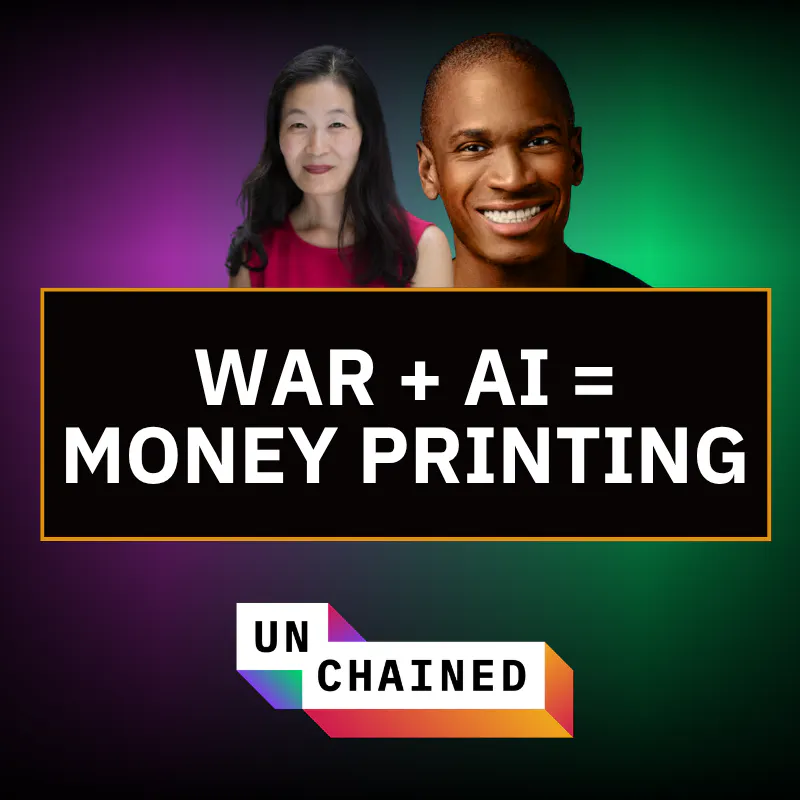
Hi, everyone. Welcome to Unchained, your no hype resource for all things crypto. I'm your host, Laura Shin. Thanks for joining this live stream. Today's guest is Arthur Hayes, CIO of Maelstrom. Welcome, Arthur.
- [00:14]
B
Hi. Thanks for having me again.
- [00:16]
A
Yeah, excited to chat. So we've had you so many times on the show and I would say if I were to just condense your thesis for bitcoin and crypto down to one thing, it usually involves money printing. And I'm sure you're very well aware that Trump is saying that the ceasefire in Iran is on life support. We're seeing this prospect of potentially some kind of energy crisis looming. And your recent crypto haze substack piece starts with you anticipating what you describe as the incipient bull market. I'd love to hear why do you think that a bull market is around the corner?
- [00:55]
B
So I think at the end of the day, wars are inflationary, especially the US Iran war is no different. And what's happening in terms of AI and defense and commodity stockpiling, I think points to inflation around the world and pretty much any fiat currency you can imagine, especially in the United States. And if you take a look at what Trump has done, whether you agree with it or not, you know, if you think about the themes that are going to continue past, whatever happens with the, how this war ends or, you know, continues into perpetuity, is nations are going to spend on AI and drones, nations are going to spend on redefining their supply lines, whether that's building pipelines, sourcing goods from other countries, stockpiling commodities. And these two things together lead to an inflationary environment. And the central banks and the commercial banks are going to step up to the plate and create the credit needed to make sure that this happens, at least in developed markets or very wealthy sort of non developed market. So unfortunately, if you're in Bangladesh, you're fucked. If you're in Philippines, you're fucked. People might starve, people might die. But at the end of the day, most people don't give a fuck. So markets don't care because they don't really buy anything anyways. So that's the unfortunate part of the situation. So I think people, when the people get hung up on, oh, yes, there's this really bad thing because all this fertilizer is not getting through this J4 moves and there's going to be this food crisis and rebellion, it's like, well, rebellion in all the places that you don't care about. Like when's the last time that you thought about Burkini Faso or what's happening in Dhaka and Bangladesh, like most people have no idea, probably couldn't locate these places on a map yet they're worried about this sort of situation that's unfolding because some commodities aren't getting through this trade. The Europeans, the Americans, the wealthy Asians, they're going to get their shit.
- [02:49]
A
Yeah, it's a very, it's probably accurate, but it's a very sobering and slightly dystopian but. So, you know, one other thing that I saw in your piece was you talked about how you felt like the war will recalibrate the allegiance or difference that different countries have to the U.S. you know, you talked about like Europe, Asia, Australia may, you know, because of the fact that their populations are going to suffer more than we will in the US that that would then lead to kind of a change in their relationship to the US and also to dollar assets. So explain how you think that will happen.
- [03:34]
B
So I think let's go back to the Asian financial crisis and sort of the late 90s and essentially you had this situation where a lot of these Asian countries like Thailand, Malaysia, Indonesia, they ran out of dollars because they borrowed all this money, they couldn't service the debt and dollars, and then all of a sudden they have a balance of payments crisis. The situation resolved. Ultimately the Fed printed money and made sure that it got to the banks to sort of roll over some of the worst loans and they muddle through. But the lesson for a sovereign reserve manager was I need to have dollars ready because if something happens, I, I need to be able to buy medicine and oil and different things and defend my currency. So if I have any savings from an export oriented economy, which most of Southeast and North Asia is, then I save those in dollars. What does that mean? I have large U.S. treasury balances, large investments in equities. And the corporates followed suit. Right. There's no investment opportunities at home. It's an export oriented economy. The people in the country can't really afford to buy your goods, but everyone can afford to buy them in America and Europe. And so therefore you save in dollar treasuries and equities and you believe that you're safe because of the last crisis which was caused by a shortage of dollars. Therefore, if I have a lot of dollars, I'm safe. And so you didn't really think about the physical world that we live in. Right. That a lot of your commodities first come from the Middle east, then they transit through what a 3 kilometer, 3 mile long waterway that's controlled by Singapore, Indonesia and Malaysia, the Strait of Malacca. And then they get to their destination. And this Iran war is making people realize the physical constraints to trade. If for whatever reason Iran can close the street or severely curtail the flow of goods. And the United States, who hold all their assets, because you believe that they'll be able to do something about it. And what are we like seven or eight weeks into the war and regardless of what Trump says about the straight being open, it's not open. And the volumes needed to supply the rest of the world with the commodities that they need it. An example would be Australia. Australia imports pretty much 100% of its refined hydrocarbons from China. Why? Because it's a little bit cheaper. And they, you know, don't believe there's any sort of reason why you would build, build your own refineries. And so then when China says, hey, we need to make sure that our people have enough fuel, we're not exporting anymore. This was at the start of the war. They put this, I think January, they stopped exporting certain refined hydrocarbons. Australia finds themselves with no jet fuel. And then no foreign airlines were to land in Australia because they don't know if they're going to have enough fuel to make the return flight. And so all of a sudden you have this country at the ass end of the world depending on China for their 100% of the refined oil products. The Prime Minister literally got on a flight to Singapore and begged the prime Minister of Singapore pay whatever it cost to get jet fuel so that his population wasn't stranded. And great, what is your treasury bond and your equities worth when you can't have a commercial flight so that your people can come and go as they please? Right? And so I think sovereign nations are waking up to the fact that, great, I have a lot of dollars, but they don't buy me anything. So why do I have these dollars? Maybe I should have built my own refinery. Maybe I should have built another pipeline out to export my hydrocarbons out of the Persian Gulf. If I'm the UAE or some other countries in the Gulf, maybe I should have Stockpiled more than 30 days worth of food or hydrocarbons and spent that money on that rather than holding this piece of paper guaranteed by the mighty US Government. And so I think that's, this is a secular trend where people are going to wake up and realize, this is the problem that I face based on this crisis. How do I solve it? Well, I either don't save in dollars, I save in another currency like gold. And I make sure that I have enough of the inputs of civilization so that if there's another sort of war or conflict, I'm not begging around the world or in certain cases my people are starving. And so that I think diminishes on a structural, secular basis this demand for Treasuries. And so people are going to recalibrate how they save at the sovereign level, which is very bad for the United States because the massive trade balance is financed with a massive capital account surplus. And this capital account surplus is this phenomenon of sovereign nations recycling their savings into dollar assets to protect their currencies and to be able to buy dollar things in the global markets.
- [08:04]
A
And so then play that out a little bit further. So then what? The reserve assets in yuan go up and then how does that affect the markets? Or does that just lead to more money printing or.
- [08:17]
B
Well, at the end of the day it means that if I hold the treasury bond and I need to, instead of holding Treasuries, I need to hold more oil and wheat and building infrastructure, then number one, I'm not going to buy as much or any U.S. treasuries with my, you know, export surpluses. And number two, I have to sell down these assets to build these physical things or stockpile these physical commodities. And if foreigners are were this inelastic bid for assets and now they're disappearing, you have a problem in the US Markets. And the US markets are they need this foreign bid of assets to have these lofty prices. These lofty prices give people capital gains taxes. They, you know, this funds the government. And so without this capital flowing into the United States, there's an issue with how the government funds itself. Interest rates go up, the cost of debt goes up, equity prices go down, people feel less wealthy, they spend less. And so this really affects the, the U.S. economy. And so my thesis is that, you know, Besson and whoever is the chairman of the Fed will print enough money to make sure that this foreign selling on a secular basis that does not impact up only for US Asset markets.
- [09:26]
A
Okay, and then one other quick question on this. Do you think the trend in stablecoins could outweigh that at all? Or is it, is that just too small right now or what are your thoughts?
- [09:37]
B
We'll see. Obviously I published some very massively bullish piece on, you know, long term stable coins generating all, all these dollars. I don't know what the stablecoin growth has been over the last, you know, year I don't think it's been that, you know, impressive in terms of the expectations. And so I guess we'll see. I'm not really sure that the stablecoin thing, you know, really moves the needle in terms of these secular flows that have driven sort of the primacy of US Asset markets from the Asian financial crisis to the present moment.
- [10:08]
A
All right, so in a moment we're going to talk a little bit more about how the Iran war is affecting markets. But first we're going to take a quick wor sponsors who make this show possible. Who in the group chat has the absolute worst sports takes you guys? It's gotta be me. I don't even watch sports unless it's a global event. But Coinbase is giving me a chance to out predict a pro basketball coach for a share of 5 bitcoin and honestly I'm built for this. I have beginner's luck, energy and absolutely nothing to lose. Coinbase is bringing in pro basketball coach Lethal Shooter to see if you can actually out predict a pro for a share of 5 bitcoin. Get more correct than lethal shooter, split 5 bitcoin and get a chance at a private coaching session in LA to perfect your jump shot. Coinbase One is the ultimate membership to make the most of your money and has been amazing for me. Zero trading fees on thousands of crypto assets, 3.5% APY on USDC boosted staking and lending rewards and up to 4% Bitcoin back with the Coinbase OneCard. If you trade crypto regularly, the basic annual membership can pay for itself. Plus the $1 million Streakk prize pool is still live. You can also get 20% off the first year of Coinbase One annual plans and a $50 Bitcoin bonus when you spend $100 on a new Coinbase Onecard in the first 30 days through May 31st. Make your predictions and split five Bitcoin. Get started at coinbase.com Unchained that's coinbase.com Unchained join today at coinbase.com Unchained to start your predictions. No purchase necessary. See rules and other ways to enter terms apply to other offers. Futures swaps via Coinbase Financial markets risk of 100% loss payouts event based not investment advice not available in Nevada. Coinbase OneCard is offered through Coinbase Inc. And Cardless Inc. Cards issued by First Electronic Bank. Bitcoin back rates are based on cardholders assets on Coinbase. Back to my conversation with Arthur. So you also ran another essay no trade Zone in which you saw a few potential scenarios for what would happen with the war. And it's so interesting because it looks like one of your scenarios is sort of playing out. You called it the Tehran tollbooth. And right now, it's that situation, like Iran is allowing friendly ships to transit through the strait. It's taking payment in Chinese yuan crypto. I think even some foreign central banks are starting to sell treasuries to source yuan. And you said essentially, quote, if this scenario occurs, it is the end of the petrodollar and the rise of the new global reserve currency or a basket of them. And you kind of, like, showed how this was starting to happen. So, you know, it's interesting to me because, like, we're also seeing that even neocons like Robert Kagan in the Atlantic was saying that the US has suffered a total defeat. So I wondered if you could just talk a little bit more about, like, how you see all of these trends playing out in the long term in terms of the geopolitical balance.
- [13:24]
B
So I think obviously there's many in the US Political elite who believe that the United States, whether it's for religious reasons or whatever, deserves to be the global superpower is the empire is the best for all these certain reasons, whatever they believe. And that this war is sort of damaging that sort of prestige. And there was the response to that is destroy Iran, right? Bomb them until they're back to the Stone Age, as Trump said in one particular tweet a few weeks ago. And then on the other hand, you have people who are a little bit more like, okay, well, empires are very expensive to run, right? This whole US Hegemonic infrastructure is expensive. That's why the US has the ridiculously high trade deficit with a capital surplus. The middle class is, how about it doesn't produce anything. It just exports finance because that's how the empire, that's the software that the empire runs on. And they say, well, that's not a great deal for Americans, so maybe we can allow China or some other nations to sort of hold the baton with us and it becomes cheaper, right? And so there's this battle in the elite methodical circles as to which one. And so do you see Trump sort of vacillating between, okay, let's, you know, nuclear bomb them or he's as he's threatened or let's, you know, try to come to some sort of deal. And again, I don't know which one of those will actually occur, but it seems that the muddle through enough gets through so that things don't completely blow up is the situation that we're, we're currently in. The ceasefire is on again, off again. Who knows what's really going on. But obviously some ships are getting through, some oil and hydrocarbons and fertilizers getting through. Obviously it's those who can pay the most is getting it. But again, the world isn't ending because of the Iran war and let's call it one or two years hence or post this. There will be more pipelines, there'll be redundant supply chains, and this card that Iran can play now will no longer be playable because everyone else will diversify the way in which they move goods. That's including China, right? So people say, oh, China is Iran's best friend. China imports more crude oil from Saudi Arabia than Iran. So to some extent they're like, okay, well if the US wants to spend billions of dollars and waste all their ammunition against Iran, cool. We've been stock planning this stuff for a long time. We'll just sit in the background and see what happens. So I think we're going to see what happens to the situation for most people in the world. Things are going to get more expensive, but you're still going to eat. Obviously there's going to be a lot of people around the world who are not going to eat and that's going to be very tragic. But again, no one cares.
- [16:07]
A
Yeah, I mean, it's. Yeah. Sad, but it is a fact. Okay, so one other part of the piece that you talked about or that I wanted to talk about was you said that you were looking at the West Texas intermediate WTI futures prices as a signal of what was going to happen in the global economy. And you said one possible outcome would result in all hell breaking loose. Explain like why you're watching those futures in particular and how, you know, the, the trend or one of the trends in those prices could pretend this all hell breaking loose in the global economy.
- [16:43]
B
Yeah. So obviously Trump and those who support him in the Republican Party, they have an election coming up and the US voter is very sensitive to gas steam prices because the US Economy is built on people driving places and spending lots of money on gas. And so the metric to look at for what's going to be the biggest indicator of what a price a gallon of gasoline is going to cost is the WTI metric. And there's so many different crude metrics depending on the type of crude, where it's located, all these sorts of things. But again, Trump is very concerned about domestic politics. Especially the election that's coming up in November. And so if you see WTI of all the measures, you know, ripping higher, that's going to be concern for him and his Republican backers. If you see the back end futures like you know, six months out, rising, basically saying, okay, well this is going to last a long time. You know, I should demand more for my barrel of crude in six or 12 or 18 months. That's also very bad. That basically means that the market is saying, okay, well this thing is going to last to a certain length of time and it's going to get worse and worse and worse. And so the spread between those is what I look at. I pull this up, this chart every morning and I say, okay, well I don't care what Trump said, I don't care what the ROGC said in Iran. Let me see what the oil market says. In the only thing that really matters to Trump. He doesn't care if the Europeans freeze the death of a winner. But if the median voter in a battleground State is paying $7 for gasoline and that means they're going to vote for the Democrat, that's when Trump cares.
- [18:11]
A
Okay, yeah, yeah, we'll have to see what happens with that. One other thing that I saw is in the, I think it's two essays ago you said that you considered Q1 a no trade zone. Why did you think that? And now what's your position for Q2?
- [18:28]
B
So in Q1 I was very worried about AI deflation. And as we've seen, starting with the tech companies, people are laying off their least productive workers and replacing them with AI tools. And my whole thesis was, and you know, this is not my original thought, there's been lots of macro analysts who pointed this out is that 10 to 20% of the workforce getting let go because of efficiencies in AI means that these high consuming individuals no longer can service their debts and no longer are buying stuff that runs the American economy. The American economy is very leveraged to the consumer and to consumer debt. So if you take out those earning, you know, 100, $200,000 a year because you know they're bottom 20th percentile company says okay, well the AI is better, I'm just going to fire you. Which we've seen, you know, 10 to 50% reductions in labor force, a lot of these large tech companies that are the leading adopters of AI, then you say, okay, well this is happening. At some point the banks are going to have a credit issue because they're holding these loans on their book at 100 and maybe they're worth zero because all these people can't service their debts. And the software etf, igv, us sold off aggressively from October till probably when the war started. Bitcoin followed suit. The NASDAQ was pretty flat over the same period. So this, to me said that Bitcoin is saying that there is not enough liquidity being created. Central banks seem to believe that AI is a productivity miracle, therefore they don't need to print any money. But Bitcoin is saying something else. There's not enough credit being created. There's a deflationary event. And so, okay, well, I know eventually there'll be a crisis and they'll print enough money to make me good, but why would I be adding risk at this particular point in time in my portfolio? And so that's why we basically did nothing for the first call. Three months for first quarter of this year.
- [20:20]
A
Okay. And so now we're in Q2. And also we're in a stage where it looks like Kevin Warsh will be confirmed as the next Fed chair. So I was curious for your thoughts on how his tenure will affect the crypto markets.
- [20:35]
B
So I think people place a lot too much emphasis on who the Fed chair is. He faces very constrained options. Right. So all the talk is war has been blasting the Fed because the Fed has too large of a balance sheet. And this has been the, the talk in the central banking community of like, what does the Fed do with the composition and the size of its balance sheet. And Steven Moran, another Fed governor, published a paper, basically an a menu option of how to reduce the balance sheet. And, you know, he's been very prescient in terms of his policy papers. And they are read and they are acted up on by those in that community. If you read through the paper, which I suggest anyone who's serious about making money does, then you see that all of his ideas are around changing regulations so that banks want to buy more Treasuries, want to conduct more repurchase operations. And the Fed can say, okay, well, if the banks are doing it, we don't have to do it. And so it's Robbie Peter to pay Paul, it's okay. Yes, the Fed balance sheet technically is declining, but it's being replaced one for one by the banks increasing their holdings of U.S. treasury. So the net effect on liquidity is zero. So Ken Washington, get up there and sound like he's this hard money advocate, Fed independence, yada, yada, yada, when in effect, in the dollar markets, it doesn't mean anything because it's not as if the Fed is actually going to go out there and start selling bonds and saying, okay, well, we need to reduce our balance sheet by 2 trillion. Okay, well then don't sell $2 trillion bonds. They're your bonds. You can do that. Right. So I think that is the policy option that nobody is talking about. Everyone's talking about regulatory changes that make the banks want to do the Fed's job for it. And so that's why I say he's a, he's a neutral sort of variable in this sort of monetary equation. But let's focus on the wartime economy and AI. How is that going to be financed? Let's focus on the impetus for commercial banks, both the United States and China, to do the bidding of the government to finance AI, to finance war.
- [22:44]
A
Okay. Yeah. I definitely want to ask you a bit more about the AI piece since that's what you wrote about. But before we do, I just have a couple more questions about the war. You've lived in Asia now for a very long time. I was so curious to hear if you knew kind of how people in Asia perceive the Iran war and the global geopolitical balance and then therefore, you know, because especially in the crypto markets, I know the Asian traders have, have a big effect on, on things and how all that might translate to some kind of effect on the crypto markets.
- [23:19]
B
Yeah. So on sort of a qualitative, squishy feely basis, I had a friend who was at the Hong Kong Sevens. It's a rugby tournament. It happens in March, March or April every year. It's a big event for Hong Kong. And I think it was a semi final quarterfinal game. And you know, the women's team, no, not the women, the men's team was out there on the pitch and the entire stadium was booing them. Right. And so I think the sentiment around Asia is, you know, the United States, all this up for, we don't know why, and we're all going to suffer. Right. Because it's not like again, Americans are going to starve or Americans aren't going to have enough oil. But my maid in the Philippines, family, they're starving. The bill, the builder that I know who's building my condo in Bangladesh, they're starving right now. We're having to work from home, we're having to get messages from the government about rationing energy. All because America decided that for whatever reason, they needed to bomb this country. We don't understand why. And so America now obviously it's not violent or anything like that, but that's the feeling out here in Asia in terms of this war. If you want to have a sort of opinion. I don't think that really matters much for crypto traders because again, it's at least a liquidity play at the end of the day.
- [24:37]
A
Okay, okay. And so this is like a segue to the AI question, but again, it's Asia focused. I was also curious how people in Asia perceived the competition between the US and China over AI.
- [24:52]
B
I really haven't asked anyone directly about that, but I guess at the end of the day everyone's benefiting. So if you're in Korea or Japan, right. Samsung has been on the tear. I think their earnings were up some ungodly number in terms of their last quarterly earnings. The Cosby has been going bananas. The Nikkei is up. Taiwan names are getting bid up aggressively. So everyone's like, great, okay, well China's going to spend on AI, America's going to spend on AI. The central banks are both printing money, the commercial banks are both printing money. This is great. People are just going to keep buying our shit, right? So Asia's loving this competition, right? Because at the end of the day you have to buy things from Taiwan, Korea and Japan. You have to buy raw minerals in Indonesia, you have to ship things through the Strait of Malacca. Right. So everybody wins in this sort of orgy of money printing and financing of this AI war, whether or not it's worthwhile, you know, 10 years time, we'll find out. But again, people are making a lot of money on this rivalry.
- [25:54]
A
Yeah, yeah, I, I don't normally see news about the Korean markets on my timeline, but just some of, yeah, the, the market happenings there are, are making their way to me. So, yeah, so it's kind of funny because here you are talking about how there is this frenzy and people are making money. But in your latest piece, you talked about seeing two catalysts that could lead to this moment of disillusion with AI. And like you, you seem to think it's kind of right around the corner. So talk about, talk about your thesis there.
- [26:28]
B
So again, we're in this. There's an excellent paper written by two folks from China, University of Hong Kong and University of Macau, based on this model phenomenon of the game theory behind capex spending in AI. And the authors call it the Red Queen effect, where they basically make a distinction between ordinary Capex, where you build a factory and regardless of if your competitor comes up with a competing product, your factory still has use. It doesn't become obsolete immediately. But in AI, the best model wins and the best is the best model, right? If you spent all this capex and your model is not as good, then nobody uses your model, right? It's like anthropic versus OpenAI. Claude is marginally better. Everybody uses Claude, right? And so they stop using OpenAI. So the hundreds of billions of dollars you spend on capex is worthless. So what do you do? Well, you constantly need to be spending money to create the frontier model. Otherwise your entire capex set is worth zero. And this generates this perpetual motion of spending. And we're seeing this now in earnings for a lot of companies, which is why you're seeing this sort of like vertical ascension in price for a lot of these inputs to AI data centers and chips and other things in the US and North Asian markets. Because people are realizing, yes, okay, if the model is good enough, people are going to use it. Anthropic revenue has gone up like something like 10x or something crazy in the last less than one year. Basically because CLAUDE is just good at doing stuff. And so there is a demand for compute and these hyperscalers have to keep spending this money. Now obviously this can't go on forever. There's no such thing as sort of an infinite perpetual motion machine in this universe. And so some others have come up with this idea, like, okay, well, what usually ends a frenzy? There's some sort of IPO or some sort of mega merger that's just so big and so ludicrous in terms of the underpinning financial assumptions that the market just can't adjust it. And so like, you know, the stock lists at 100 and the next day it's already down at 50. And like, oh fuck, you know, if people aren't buying into this, this IPO and it's just sell only, this has to be the top of the market. And so I think there's going to be a situation like that. I don't know when it's going to occur, but it's going to be pretty obvious at the time this mega merger, this mega ipo, it debuts and it gets completely flops. And at that point people are going to start asking questions, oh, is the trillions of dollars we spent on all this capex really worth it? Have we generated enough use cases for this? Or will we generate enough use cases in the immediate future? Why do I own this company at 1 million times earnings if the category leader gets IPO'd and the stock's down 20% when it should be multiples higher on the first day after listing. So I think these psychological, qualitative things feed into the, let's ask some questions about all this money that we've spent and oh fuck, guess what? I don't really think that I spent the right, you know, this money was well spent so maybe I should start selling down my holdings as well. And that's the end of, of this market, this bull market bubble, whatever you want to call it. And the second is politics. At the end of the day, most people around the world, especially in the United States, don't earn a lot of stocks. Yes, people are making lots of money hand over fist buying some random memory company and that's up 40% pre market because everyone discovered it overnight. But the majority of Americans don't own a lot of stocks. But their electricity prices are going up, the price of labor is going up to build these data centers. The price of raw material inputs into electrification and the construction of data centers is making their life more expensive and they get nothing back for it. And guess what? They're worried about losing their job at the same point. And so I think there's going to be a political backlash that's going to hand the opposition party, you know, the Teembu Democrats, a sort of a narrative on a plate which is we are at AI, we're for the worker, we're for humanity. Like there's so much good rhetoric that you can put around this that sort of catalyzes the fear that people are feeling and the inflation that they experience on a day to day basis. I think vote for me, I'm going to take us back to pre or I'm going to do responsible AI, whatever the fuck that means. It doesn't matter. It's just going to be a political slogan and it's going to be up to the Team Republicans to come up with a counter of okay, well everyone's making so much money no one gives a Fuck. But again, 90% of Americans in the United States don't own a lot of stocks. So I think again it's going to make for a very interesting 20, 28 presidential election. And again, whoever wins, it doesn't matter. The R is going to be very good from the opposition because it's true to some extent. And therefore as investors be like, well okay, well 55, 45, whatever you handicap the odds of which side winning, you still have to de risk your portfolio because there's a significant pretty much 50, 50 chance that the team Blue Democrats take control and all of a sudden this rhetoric could become policy. Oh, and all of a sudden all this money that you spent at these ridiculous valuations is no longer worth anything because they're going to tax you. There's a tax proposal put out by some leader in Korea overnight caused the cost of fall 5%. So investors are very concerned that the, you know, 95% of the population who's not benefiting at all from AI yet is going to be like, fuck this. Tax these motherfuckers. Give me my shit back.
- [31:43]
A
Okay, yeah. So one other thing that you talked about was. So you called this an AI agentic deflationary bust and you said it could rival the severity of the 2008 subprime mortgage CR crisis. You basically said, I mean, yeah, that mediocre knowledge workers are at risk of losing their jobs and that you thought that they would fall behind on consumer credit payments to banks. And then you said, quote, it's game over for the fugazi fiat fractionalized banking system. I would love to hear you expound on those comments.
- [32:17]
B
So at the end of the day, you know, you create credit to do stuff to the perpetual motion of the economy. Like a recession is when GDP falls, doesn't have to fall that much, but if the pace of the economy slows, you can't service your debts. And so if the pace of the economy falls in the short term, and I agree that in the long term, AI is going to be this awesome productivity tool, hopefully we as humanity use it wisely and create an awesome economic and life experience for everyone around the world. But we are, we are all humans, we are selfish, we don't share. And in the short term, there's going to be some pain. It's not as if there's immediately a job in some sort of AI field for the doll worker who just lost their job at Coinbase. Right? There isn't. And so that person who was making a few hundred thousand dollars a year is now at least in the United States on unemployment insurance. Well, I think usually lasts about 26 to 27 weeks. Usually it caps out around annualized $40,000 US a year, depending on your state. So you take somebody who is making 150, $200,000, now they're making 40. Okay? They have to make a lot of adjustments. They're not buying the sweet green salad, they're not buying the mocha loca fucking frappuccino from Starbucks for $10. Right? They, they can't make their car payment. They, they have to downsize their dwelling. Maybe they're missing credit card payments and all these debts are assets on the banking balance sheet. And so the banks have a, have a growing hole, their balance sheet due to the productivity gains of AI not being passed on fast enough to ordinary workers. And so it's a timing mismatch. I'm not saying that AI is not going to create this utopia of abundance in medium to long term. All I'm saying is right now, the way that we have set up our economy globally, and this is not just United States, it's every economy around the world. It's fractional financial services sector that sort of needs a constantly growing GDP activity. Well, this AI knowledge intelligence boom goes completely against that and will destroy the financial system unless they print enough money. And so I believe that they're always going to print enough money. And that's sort of, you know, my investment thesis for my entire portfolio.
- [34:28]
A
Okay, and so you made that distinction between how AI will affect the economy in the short term and the long term. So explain the long term part. Like, you know, you kind of hinted it could be more positive and utopian. So explain kind of what your vision is for how AI will affect the economy in the long term.
- [34:48]
B
So, you know, if you take Elon, you believe everything he says, right? So we're going to have robots, right? And the cost of labor is going to go to essentially almost zero, right? The cost of intelligence, of doing things is going to move to very, very little as well. And so we've got to automate all these things, right? Your babysitter is a robot. You know, you're, you're, you're not using an, a lawyer, an accountant to do random stuff, right? So anything that we do can be automated and done in an intelligent fashion as that leaves us as humanity free to pursue, you know, hanging out, doing arts and crafts, playing sports, whatever it is, right? Whatever it is that makes, makes you happy, apart from doing your bullshit job at some like, you know, company that looks like the Office, the television series. So we're going to remove all that nonsense and just focus on communing with each other and producing things that are fun to consume again. That's the utopian future. And how do you get there? You probably have to have some sort of taxation mechanism on whatever the entities that control this intelligence or these robots. Again, I don't know what that situation is, but we're going to have to have a conversation about that. Otherwise we're going to have such a hyper inequality that it's going to cause, you know, potentially a Very, very big social strife.
- [36:09]
A
Yeah, yeah, I, I am hopeful that it just like I, I feel like the days of working for a big corporation in a soul sucking way or maybe not completely over, but like it's going to be a lot less of that. So I think people, it'll enable people to be more entrepreneurial, which I think would be a positive thing. All right, so I did also want to ask because there are certain investments right now that are just making a lot of headlines due to all this AI activity. So semiconductors are going gangbusters in the last 24 hours. Now a video from COTU has gone viral for its theory that the bottleneck in AI is moving from compute to memory due to this transition to AI being more agentic. How are you thinking about these different trends in terms of investment?
- [37:00]
B
So I am not an AI investor. I think we have enough capital where I don't have to be at my screens all day trying to figure out the next thing. I'll be on the tennis court or skiing or whatever. So how do I approach AI? I have some of my homies who are in the trenches just slinging stocks all day. I literally. The post of stock that they bought, I just buy it. I don't even, I don't research it. I look at it. I read a lot of AI research. I love Citrini. They're a great research outfit. They publish long form articles. They've got different stocks. They like just buy them all, don't care. Most of them go up. It's a bubble at the end of the day, right? It's blatant speculation on a future that we all believe in is going to be so glorious and so ridiculous and therefore anything, whatever the hot new thing is, goes up 100% in a few days. That's how I'm approaching AI. I'm literally just slinging stocks. No research. I'm not. You know, maybe I'll plug a stock into Perplexity to find what this company actually does. If it sounds, you know, semi legit, okay, just buy it. Right. Investigate later and says, are you worried
- [38:02]
A
at all about like Michael Burry saying this is such a big bubble and all that?
- [38:06]
B
Or I agree with him. That's the thing. I know what I'm doing is irresponsible. And I hope that this knowledge of the fact that I'm doing something patently stupid gives me the forethought or the presence of mind that when this situation where something gets too ridiculous, okay, it's time to get off the train and Sell everything and, and just sit on the sidelines. But as Chuck Prince said, if the music's playing, I gotta dance.
- [38:38]
A
Yes, and we know you love to dance. All right, let's talk more about crypto stuff. So obviously you're big on hype and today a new Hype ETF launch. I think, I think it's actually the first Hype etf. Tell us about your hypothesis.
- [38:56]
B
So the hypothesis is very simple. Hyper Liquid is not the first decentralized exchange that has tried to do permissionless perpetuals trading. The first big one was DYDX and that, you know, for 2021 or 2022 performed very, very well. Then the baton got passed to GMX that did very well in 2023. And then Jeff and his team at Hyperliquid I think had a perfect tokenomics model with a great execution on building this decentralized exchange, right, what they've built, it's very, very good tech. But again it's not nothing novel in terms of the product suite or what they're doing, but they really got the tokenomics right. No massive VC pre sale which creates this overhang which means your token is just going to dump once it unlocks a massive airdrop to traders. And then the most important thing which so many projects just don't refuse to do. I don't give a fuck what the reason is why you don't do it. You just must do it. If you make money, you must give it back to us as a token holders, whether that's take the missions or buy back and burn. And for a hyper liquids perspective, 97% of revenue, they take it and they buy back the Hype token. So us as token holders directly benefit if they execute on this vision of permissionless trading. And that sort of is what took Hype from what I think it listed around $3 to $60 in the first respect. Obviously I came out with a piece saying I was bearish on Hype because of the competition, the low fees. And so we saw what happened and also the, the massive unlocks for the team. So when the team unlocks number one, Jeff and the team are very responsible. They said okay, let's play for the long term. We are allowed to sort of unlock 100, but we're only going to unlock, we're only going to sell one. And so if you look over time versus what they are allowed to sell, what they've actually gotten on chain versus what has actually been sold, it's something like 1 to 3% of the amount. I haven't looked at the the April numbers yet and then most importantly they are the most, they have the most real volume and I look at that as average daily trading volume over open interest. The lower that ratio, the more organic the volume because open interest grows and somebody puts up real capital to put a position. If you're just wash trading for either volumizing or some sort of liquidity rewards, then you're not really growing open interest. You'll have a massive adv to OI ratio which is what most of their competitors sport. That's why I think I can't tell you if their volume is all real. But I can tell you it's the realest of all of its competitors and they've survived the low fee sort of competition. So obviously Lightr and Aster and some and Edgex and some of these other perp exchanges sponsored by a leading sex came out and said okay great. Hyperliquid has created this great narrative on perp Dexs. We're going to launch one too and the fee is zero. Here's some tokens. Let's try to take some market share in the traditional fashion. And it worked for a bit. But after the incentives went away or the willingness to volumize and fake volume declined, then hype shone through as this amazingly robust and organic venue for real price discovery. And then I think what really cements hyper liquid in terms of getting this vision right of allowing anyone anywhere to trade anything is that during these volatile moments of the war where US President Trump likes to do stuff on a Friday night after the market's closed, where he no longer has a market signal where, which can sort of influence how he acts. But now we have hyper liquid and the price of oil is trading over the weekend. Yes, we can't deliver any of this just but it's indication of what's going to happen on, on Monday morning The S&P 500, the NAS, the largest equity indices have a perpetual trading over the weekends with leverage. Anyone with an Internet connection can now express a view based on what has happened. And so now we have more price discovery and that's where hyper liquid is bringing. And obviously these markets are much bigger than crypto. And so if now you change the trading behavior of the seven something billion people in the world who do not trade in large western financial markets for a variety of reasons and now they get a little hyper liquid man, the sky's the limit in terms of how much money they can make from fees as an exchange as the most important price discovery venue in the world. Because the most amount of retail traders can actually trade there. And that's why I love hype, because it's executing on this vision that started many, many years ago with most of us in the, in the sex game and sort of migrated to Jeff, who's got the, the best sort of iteration and expression of this idea of how trading should happen in free markets.
- [43:28]
A
Oh, that's interesting that you said the best, because I was wondering, you know, since you are the father of the perpetual swap, I wondered like, if you had kind of any reflections on seeing your baby become the basis for, you know, what has been the breakout decks in crypto and has really kind of succeeded beyond all measured, you know, obviously even recently surpassing Coinbase and notional trading volume. And I just wondered, you know, like, for you to see that what your, your creation kind of formed the basis for for this really successful decentralized product. I wonder just if you had any reflections on that.
- [44:07]
B
Oh, I'm super proud. I love it. I think it's great that someone has taken this, this financial product that we created at BitMEX and is hopefully going to render, you know, large trading exchanges obsolete. Why should anyone trade on these things? Yeah, sure, okay. If you're Citadel or Virtue or Jane street, you know, large banks, yeah, go have fun on, on CME and all these UX and these, these type of exchanges. But for everyone else in the world who basically has been locked out of the financial system or given very little visibility into financial markets and always is served dog shit products, here's a way for you to express a view, long or short, based on what's happening in the world and an open marketplace. Yes, it was obviously not perfect, but again, here's an opportunity for you to participate where you otherwise would not have been able to. And I think it's great that hyperliquid exists and I hope they continue to move from strength to strength. And obviously, as a large token holder, I, I hope we make money on that too.
- [45:11]
A
Yeah, yeah. All right. I want to ask you about another big crypto trend that you're very interested in right now, which is privacy. And you have a particular horse in the race. You talk about zcash as the bet to make there. Why have you selected zcash as the main privacy coin?
- [45:30]
B
So I think that the cryptography behind zcash is the most secure in terms of if you want to keep your transactions private. Now, obviously, you know, there's a big debate on zcash versus Monero, versus some of the other privacy coins and I think zcash is the best. Obviously I'm not a cryptographer, so I can't sort of give a super intelligent explanation as to like why zcash. You know, I've read a lot of things from different folks, good and bad. I've talked to a lot of folks who are in the trenches on developing these things, and I believe that zcash is the best option. But at the end of the day, I think privacy is important. And whether you believe in zcash or something else, I think every crypto investor needs to have some of this in their portfolio because it's going to be very highly valued, especially in a situation where Bitcoin is pseudonymous. And I don't think Bitcoin should add full privacy to it. I think there's some obviously good things about having a public blockchain in terms of transparency and accountability. But with AI, big tech and big government, it's very, you know, trivial to de anonymize transactions and people want that privacy and there will be a private alternative. I just happen to think it's zcash. And the relative value of zcash and Monero to Bitcoin is at this point very, very low. It's a very asymmetric fact that as people sort of recognize the power of these technologies, because we're humans, we're, we're stupid, we think in linear terms. We don't think of how exponentially smarter an AI is than us and how they're able to do things that we couldn't even fathom are possible or make connections that we wouldn't be able to make in a thousand lifetimes. That is going to be very apparent and the need for privacy is going to continue to grow and then these coins are going to go up in value. And so I believe in zcash and that's why it's probably by largest position outside of Bitcoin right now.
- [47:20]
A
Oh, interesting. And why did you say you don't think that Bitcoin should integrate privacy? And did you mean you didn't even think that Bitcoin should have it as an option? Like, you know, the way zcash does, shielded or unshielded?
- [47:32]
B
I mean, I guess I'm conservative in terms of this is surface area that works in Bitcoin. And I think Bitcoin should be very conservative. Right. It is the type of money that it is. It serves the use cases that it serves and it does it very, very well and very, very securely. I don't think that it should take the risk to add these other things to its offering because there's other coins that were built from the ground up to do these things and they're going to do them better. And so I think the conservative nature of Bitcoin should be maintained. And that's going to, in my opinion, maintain the larger market share versus every other coin out there. Once you start tickering with that, then I think the value proposition diminishes for Bitcoin.
- [48:14]
A
And do you have a particular privacy smart contract chain that you think is the one to bet on?
- [48:21]
B
I haven't really done much deep dive in any of those.
- [48:24]
A
Okay, okay. All right. Well, so at the end of your recent essay, you hinted that you you felt that NEAR was quote, your next favorite shitcoin. So ex. And I'm assuming that's after Hype and Zec, so explain why.
- [48:43]
B
So again, if you've used the Zodel Zodl app, Z O D L I'm an investor, so please use it, download it. It's I think, the best UI UX for using shielded zcash. So obviously you have a transparent address for zcash. You know, if you're transacting on some sort of centralized exchange or Ortiz broker, they send it to that address, then you pay a little bit of a fee to shield that zcash. And I think anyone who owns zcash and wants a price to go up should hold their zcash shielded versus on a transparent address. And now what can you do with the shield of zcash? You can literally do a swap and send somebody any type of coin like USDT on Tron or Bitcoin, the Bitcoin network, and that transaction won't point back to you. So you can do it in a completely anonymous fashion using near intents. And so I think obviously you want to have some utility in terms of payment mechanisms and different currencies for shielded decash and using near intents. And you know, in this great app Zodel, and I think there'll be other apps that come out to put the same sort of functionality in place that's going to drive demand for near and sort of change the narrative on what NEAR is. I know they're trying to do some AI stuff and maybe it works, maybe it doesn't. But I think that the core thing that is super special is that the integration between SHIELD and zcash using near intents to any crypto asset in an anonymous fashion and the economics of the near blockchain mean that every time one of these Transactions happens, the NEO protocol earns a little bit of a fee and that over time, if the volumes grow, will flip near from a deflationary to, sorry, an inflationary to a deflationary protocol and that's what will cause the price to rocket higher.
- [50:26]
A
All right, so we are talking now after a really tumultuous April for crypto where there were just a crazy number of hacks and you know, one of them was one that started somewhere, I'm talking about kelpdao, and then had just collateral damage, like really throughout the ecosystem. But you know, mainly in aave, which you know, at that time was the biggest defi protocol. I don't, I know it dropped from its top spot, but I don't know about now. But anyway, I was wondering, like, how do you think about like the risk on chain? Like there's been a lot of, you know, chatter about like whether or not it's, it's worth it and you've invested in a number of different defi protocols. Obviously you're a big promoter of hype. So how do you think about that risk?
- [51:13]
B
Number one, the risk is ever present, it is there. You cannot hand wave around it that there is no risk on chain. These are bare assets and with that comes a certain amount of risk. Now, teamers have a variety of choices to make in terms of their lifestyle to safety continuum, right, an ease of moving assets or ease of adjusting contract. And some teams take the okay, I'm going to make my life a little bit more difficult, but there's a lot more human elements to actually change things. I trust the other people who are with me in this journey to create this product and therefore I believe that I am safe in that respect. Other teams say I'm going to trust more automated solutions or I'm just going to trust myself and if I get compromised, we're fucked. One of one multisig, which we're kind of finding out is a lot of these implementations of these protocols. And so I think that if you take a look at sort of the high level of whoever is hacking a lot of these larger protocols, they're socially hacking a process that by design is not very secure because the team chose a less lifestyle impacting security architecture and have suffered the consequences. And I think this falls on you as an investor, especially professional fiduciaries like VCs and otherwise, to ask the questions about, okay, yeah, you can give me some sort of convoluted technical jargon about why this solution is not resistant to hacks, but okay, well, Talk to me about the humans involved. How does this process work? You don't have to tell me the specifics, but are you using a one of one multisig and if you say yes right away. So I think a lot of these things, unfortunately these are just bad decisions made by people who made a lifestyle choice in terms of how they want to deal with updating smart contracts and dealing with any sort of withdrawals. And obviously they were exploited and that's unfortunate. But we'll learn our lessons.
- [53:12]
A
Okay, so we only have a couple minutes left, so I'm going to just ask you an open ended question which is about Maelstrom's investments. You know, you came on the show, I think last time to talk about your private equity efforts and I don't know if you want to call out kind of any particular investment that you, you know, think is going to take off or how the private equity piece is going. But I just, yeah. Leave you to give us any update you'd like to on Maelstrom.
- [53:42]
B
So we're very close to closing our first anchor investor. I can't really say the name on the show as of yet. It'll definitely, you'll hear about it once it's signed. In terms of investments, I think that when we first talked founders price expectations were much higher than they are today, which is great. And so I think if we're able to pull off this fundraise, we are in a perfect spot of max disillusionment, disillusionment with the space. And okay, unless it's MicroStrategy or some SPAC launched by some politically connected person, you're not investing in crypto as an institutional investor or you know, you're worried about it getting hacked on some defi protocols to you're sort of, you know, abandoning the space or the VC overhang of selling has mean that everything is down. Only you didn't want to participate which again takes down the valuations for very, very good businesses. And so raising this money now we're at the perfect sweet spot. This is kind of like how I felt in 2023, where on the VC side of our portfolio, the early stage stuff we, we were starting to deploy in a perfect time of maximum bearishness and disillusionment with the sort of shitcoin investment complex. And so I, I think this is the best time to be investing. Prices have come down. We're going to get some great multiples on some amazing companies that are still very, very profitable. And when, you know, the tide turns and maybe that's when, you know, Bitcoin hits 200,000 and ETH decides that it wants to rise above whatever, 3,000, 4,000, whatever it is, people all of a sudden want to run back into shitcoins and crypto adjacent businesses. Then I think that we're going to be in a perfect position to really capitalize on our ability to invest in the downturn.
- [55:25]
A
Yeah, yeah, I would agree with that, like a million percent. Because even though the markets are down, like clearly just crypto has reached a stage of maturity that just. Yeah, has. It's just never been clear before. Well, Arthur, it's always a pleasure to chat with you. Thank you so much for coming on Unchained.
- [55:45]
B
Thanks for having me.
- [55:47]
A
Who in the group chat has the absolute worst sports takes you guys? It's gotta be me. I don't even watch sports unless it's a global event. But Coinbase is giving me a chance to out predict a pro basketball coach for a share of 5 bitcoin. And honestly, I'm built for this. I have beginner's luck, energy and absolutely nothing to lose. Coinbase is bringing in pro basketball coach Lethal Shooter to see if you can actually out predict a pro for a share of 5 bitcoin. Get more correct than lethal shooter, split 5 bitcoin and get a chance at a private coaching session in LA to perfect your jumpshot. Coinbase One is the ultimate membership to make the most of your money and has been amazing for me. Zero trading fees on thousands of crypto assets, 3.5% APY on USDC boosted staking and lending rewards and up to 4% Bitcoin back with the Coinbase OneCard. If you trade crypto regularly, the basic annual membership can pay for itself. Plus the $1 million Streakk prize pool is still live. You can also get 20% off the first year of Coinbase One annual plans and a $50 Bitcoin bonus when you spend $100 on a new Coinbase One card in the first 30 days and through May 31st. Make your predictions and split five Bitcoin. Get started at coinbase.com Unchained that's coinbase.com Unchained join today at coinbase.com Unchained to start your predictions. No purchase necessary. See rules and other ways to enter terms apply to other offers. Futures swaps via Coinbase Financial markets. Risk of 100% loss payouts. Event based, not investment advice. Not available in Nevada. Coinbase OneCard is offered through Coinbase Inc. And Cardless Inc. Cards issued by First Electronic Bank Bitcoin backed rates are based on cardholders assets on Coinbase. Nothing you hear on Unchained is investment advice. This show is for informational and entertainment purposes only and my guests and I may hold assets discussed on the show. For more disclosures, visit Unchained Crypto.com.