← Undo – How history's outliers got stuff done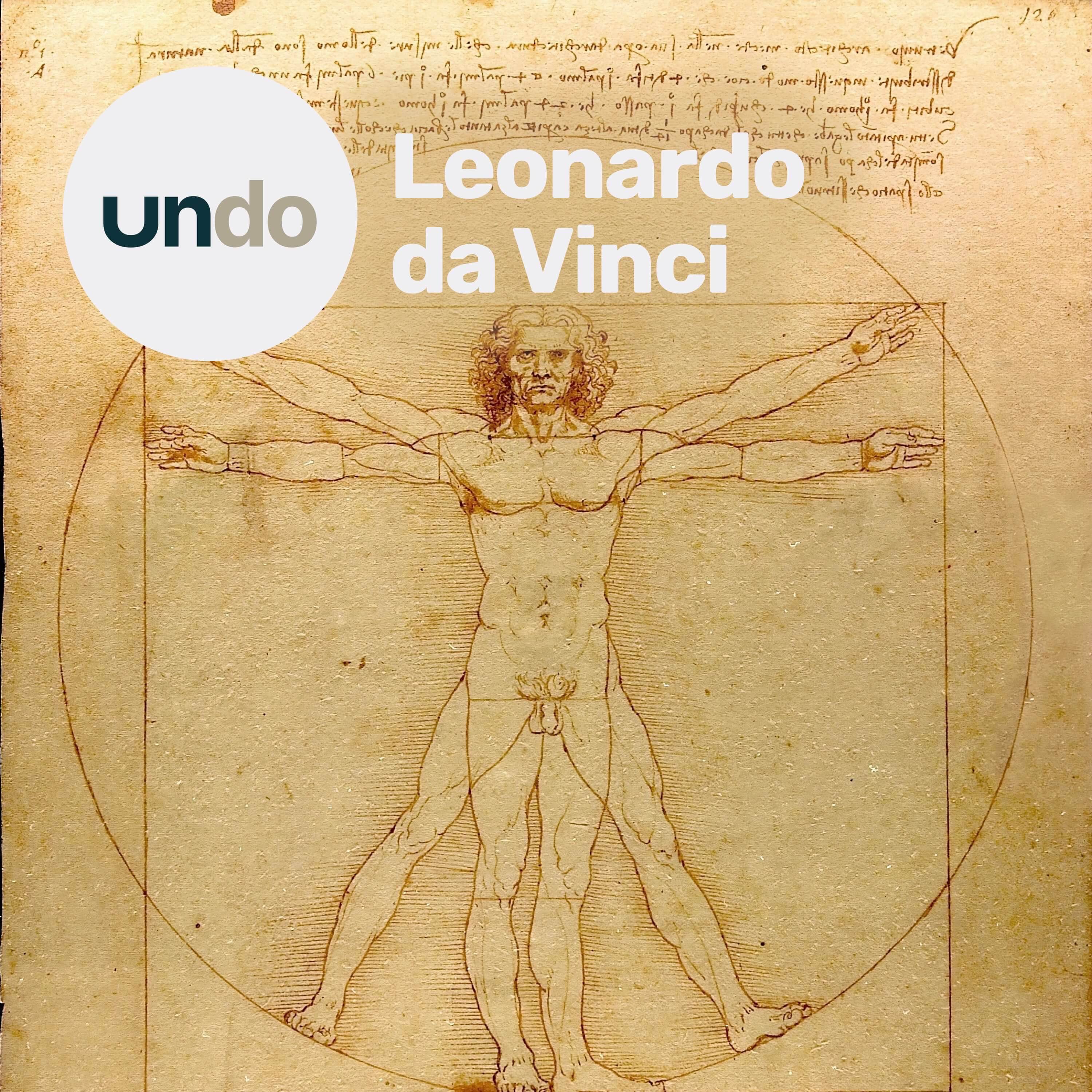
Loading summary
Transcript36 lines
- [00:06]
Mark Stedman
Who's the Renaissance redhead who's a sex machine to all the Florentines? You're damn right. Who's the man who drew one? Mother of a Vitruvian man. Right on. They say this Da Vinci's a bad mother. I'm just talking about Leo. So sorry. Sorry. It's a cheap way to open a show and it only lowers the tone. Actually, having read ahead, I think the tone might be low enough as it is. But let's see what happens when I press this button. Oh, good Lord. Sorry about that. I meant this button. That's better. I'm Mark Stedman and this is Undo Profiling. History's most productive people and the systems that made them.
- [00:58]
Eugenio Derbez
To make switching to the new Boost Mobile risk free, we're offering a 30 day money back guarantee.
- [01:03]
Unnamed Advertiser
So why wouldn't you switch from Verizon or T Mobile?
- [01:06]
Eugenio Derbez
Because you have nothing to lose. Boost Mobile is offering a 30 day money back guarantee.
- [01:09]
Unnamed Advertiser
No, I asked. Why wouldn't you switch from Verizon or T Mobile?
- [01:13]
Mark Stedman
Wouldn't.
- [01:14]
Eugenio Derbez
Because you love wasting money as a way to punish yourself because your mother never showed you enough love as a child.
- [01:20]
Unnamed Advertiser
Whoa, easy there.
- [01:21]
Yeah.
- [01:22]
Applies to online activations. Requires port in and autopay. Customers activating in stores may be charged non refundable.
- [01:29]
I used to think buying foundation online was impossible. How am I supposed to find my shade when I can't even get it right in store? Then I discovered Il Maquillage. I took their AI powered quiz to find my custom match and wow. This foundation is literally my skin in a bottle. The undertone and coverage are spot on. It's so neutral and weightless, I can't even tell I'm wearing makeup. Plus, with Try before youe Buy, you can try your full size at home for 14 days. Take the power match quiz now at ilmaquillage.com Quiz I L M A K I A G E.com Qu Dear old.
- [02:00]
Work platform, it's not you, it's us. Actually, it is you. Endless onboarding, constant IT bottlenecks. We've had enough. We need a platform that just gets us. And to be honest, we've met someone new. They're called Monday.com and it was love at first onboarding. Their beautiful dashboards, their customizable workflows got us floating on a digital cloud nine. So no hard feelings, but we're moving on Monday dot com, the first work platform you'll love to use.
- [02:32]
Mark Stedman
What do you call yourself when you're not at work or taking care of family business, a singer, an illustrator, a cook, a comedian. Maybe you're a few of those things, or maybe there's one thing you really want to do full time, but the wider world hasn't cottoned on yet. In which case you probably need to do other creative work to draw people to the real work you want to be doing. Back in episode two, we kicked around the notion of the cupcake bakery, making tiktoks and designing flyers to get people's attention. Being a creative person in this most digital of decades means needing to be good at more than one form of creative expression. That means thinking like a polymath. And luckily we have history's greatest multi hyphenate to learn from. Leonardo da Vinci was born in April 1452 in what is now modern day Florence. By the age of 30 he was taking commissions for his paintings, and in 1513 he was working for Pope Leo X in Rome where he studied human anatomy. Over his 67 years he painted some of the world's most famous works, helped reroute rivers, consulted on urban planning and pedestrianization, and sorta kinda invented the helicopter. This much we more or less know from the public works he created. But he was a prolific journaler and note taker. And yes, I used the word journaler, even though journalist would be the correct word. But I don't see him shuffling around in a donkey jacket smoking cigarettes and cultivating sauces. Although I would 100% watch that Netflix series. Da Vinci's notebooks, combined with his multiple biographies, have uncovered seven core principles Da Vinci is purported to to have lived his life by. These are curiosity, learning through doing, sensory awareness, embracing uncertainty, mind and body care, whole brain thinking, and interconnectedness. Each one of these principles can help us get a better handle on our work and our time. So let's get into it. Principle number one Be curious I think it's fair to say little Leo would have been a nightmare at school. I know teachers say they love it when kids are curious, but I think this lad may have taken it too far. He was always peppering his teachers with questions, and as he got older he was so obsessed with anatomical accuracy in his paintings that he essentially dug up corpses to study before getting famous enough that he could just rock up at a hospital and ask for a fresh one. Tell you what, this modern da Vinci Netflix series is starting to take shape, isn't it? Here he is shrugging on his donkey jacket, sparking up a cigarette and getting thrown out of a morgue in darkest London. Da Vinci and Dagenham it's got Golden Globes written all over it. There's a side to his curiosity that's a little more wholesome, still weird, but in a different direction.
- [05:31]
Eugenio Derbez
Da Vinci could write 100 questions before breakfast, which he probably ate not long before he went to bed, because Da Vinci doesn't strike me as the kind of guy who spent much time sleeping.
- [05:41]
Mark Stedman
This comes from a review of the book how to Think Like Leonardo da Vinci, where the author Michael Gelb suggests how asking yourself 100 questions from a stream of consciousness and looking for the connections the next time you're in big picture mode. It's worth sitting with this. Maybe don't go for 100 questions because that sounds both insane and boring, but maybe see what you can just come up with in half an hour. Just follow your curiosity and then review the list and see what stands out for you. Could be there's a future course of study or a hitherto unrealized hobby in there. Principle number learn by doing. What would you do if you knew you couldn't make a mistake? That's another question brought up by Gelb's book on da Vinci. It's an invitation to learn something new, to challenge your assumptions and to put your ideas to the test.
- [06:33]
Rory Sutherland
If you'd given a lot of rational people the job of coming up with a competitor, Coca Cola, they would have said, well, we need a really nice tasting drink that costs less than Coke and comes in a really big cup container. But the biggest success in competing with Coke is Red Bull, which cost a fortune, comes in a tiny can and tastes disgusting.
- [06:50]
Mark Stedman
Okay, when I grow up, I want to be a dinosaur. Then I want my DNA preserved in amber so scientists can clone my body and sell me as a protein source. I want my dino DNA infused into a sausage and eaten on an autumn afternoon by Rory Sutherland. Rory quite literally wrote the book on irrationality, and there's a big old link between these two men. We'll talk about interconnectedness later. But Da Vinci was a big fan of challenging assumptions and not just doing things by the book, but by getting hands on experience. It's all feeding into this Da Vinci and Dagenham narrative, isn't it? This guy doesn't do things by the book. He rips the book in half and throws it at the chief of police face. And now his ass is on permanent warning and he better buck up his ideas or he'll be bused down to traffic cop or something. Principle number three, hone your senses. Okay, so when's the last time you sat in a quiet room and just listened. You never know what you might pick up when you do Is that next door's dog snoring? I didn't realize I had two clocks. Who's playing the ukulele and how do I make them stop noticing the world around you is a dirt simple and really effective hack for bringing yourself out of a funk, by the way. If you're prone to anxiety or you've been lost in deep thought, look around the room and then count five things you can see. Point out four things you can feel, like your bum on the seat or the label on the back of your shirt. Name three things you can hear around you, notice two things you can smell, and focus on one thing you can taste. If you want to get better at studying the world around you, spend 10 minutes looking at a painting you really like. Notice where the brush strokes are going, or follow the line of perspective. Where has the painter made a seemingly odd choice? Why does the light fall in that particular way? Noticing rather than just looking is useful in so many fields. You can do the same thing with poetry or pottery or pastry for that matter. Get to the bottom of why something is the way it is, even if it's not your primary art form, and you'll find more you can bring into your own work. Embrace the unknown. You ever watch a cat batting at an object on a desk? The damn eegits don't have thumbs, so they just sort of knock the thing away from them, almost as if they want as little contact with the thing as possible and they just want it to be away from them. That's my relationship with ambiguity in a nutshell, and I dare say it's not far from yours either. We tend not to love the unknown. It's sketchy and sometimes unsettling. Another one of Rory Sutherland's insights is that we don't actually mind waiting around for stuff if someone gives us a clear time frame. If you've ever asked the little hobbit from it when emails will come back online, he'll probably give you some variation of when it's ready combined with a withering look. Trouble is, these guys aren't born like that. They get worn down by countless people asking them to put a time frame on things there's absolutely no earthly way of knowing. And people, project managers usually assume that because they know computers, these big brained Bilbo boffins can estimate the downtime themselves like some sort of human progress bar. I mention this not to exorcise any particular demons that might be lurking in my past as a code monkey. But to slightly overstate the point that I get it. However, if we want to cultivate our inner da Vinci, we need to be more comfortable with paradoxes, ambiguities, and unknowables. Our Dagenham da Vinci eats enigmas for breakfast and dines out on dilemmas daily. One of the paradoxes da Vinci embraced involved rest. When castigated for not working hard enough on the Last Supper, Leo apparently had this to say the greatest geniuses sometimes accomplish more when they do less. Good to note that being a dick wasn't one of his seven principles, but fair enough. I get it. We do need periods of rest to marble the meat of our productivity. And speaking of rest, let's have ourselves a quick breather before talking about DaVinci's absolutely batshit take on sleep.
- [11:11]
Unnamed Advertiser
To get people excited about Boost Mobile's new nationwide 5G network, we're offering unlimited talk, text and data for $25 a month.
- [11:19]
Eugenio Derbez
Forever.
- [11:19]
Unnamed Advertiser
Even if you have a baby.
- [11:20]
Eugenio Derbez
Even if your baby has a baby.
- [11:21]
Unnamed Advertiser
Even if you grow old and wrinkly and you start repeating yourself, even if.
- [11:25]
Eugenio Derbez
You start repeating yourself, even if you're.
- [11:26]
Unnamed Advertiser
On your deathbed and you need to make one last call or text, right? Or text the long lost son you abandoned at birth, you'll still get unlimited.
- [11:32]
Eugenio Derbez
Talk, text and Data for just $25 a month with Boost Mobile Forever.
- [11:36]
Unnamed Advertiser
After 30 gigabytes, customers may experience slower speeds. Customers will pay $25 a month as long as they remain active on the Boost Unlimited plan.
- [11:41]
Moreover, does it ever feel like you're a marketing professional just speaking into the void? Well, with LinkedIn ads, you can know you're reaching the right decision makers. You can even target buyers by job title, industry, company seniority skills. Wait, did I say job title yet? Get started today and see how you can avoid the void and reach the right buyers with LinkedIn ads. We'll even give you a $100 credit on your next campaign. Get started at LinkedIn.com results terms and conditions apply.
- [12:15]
Mark Stedman
We've talked a little before about sleep and rest. It's something that came very easily to Churchill, but not so much to Lincoln. Maggie Thatcher famously slept very little, but the more she stayed awake, the more government departments she could privatise. So that checks out. But did you know Da Vinci only slept for 20 minutes every four hours? This is called a polyphasic sleep pattern, and don't let the scientific sounding name fool you into thinking this is something worth doing. Lack of Sleep can result in high blood pressure, obesity and diabetes, which I think are printed on Scotland's coat of arms. In case you hadn't clocked it, 20 minutes every four hours equates to two hours of sleep a night. Now, da Vinci was an outlier in a number of ways, and we've still got more to explore, but we only have hearsay to go on here, so there's no actual evidence he really followed this pattern. Maybe he tried it for a bit, as people often do, then realised his body needed the rest. I mean, it's exactly the kind of trope we need for Da Vinci and Dagenham. But it does go entirely against the real da Vinci's fifth principle. Principle number five, stay healthy. Da Vinci was, as far as we know, an absolute unit. He was more toned than a laser printer sporting pecs you could cut glass with. Seriously, lads, this guy was the whole package. I bet he could cook too. Anyway, all the self help books I've read over my years that didn't suck teach us that a healthy body gives us more energy, which means we can do more of the things we want. If I think of the cumulative seconds I've spent slowly getting up out of a chair, I could weep. And as much as I'm giving it the biggin when it comes to da Vinci's physical form and brother, what a form. A healthy buddy doesn't have to mean a sculpted one. This is not about being thin, having a six pack and being able to bench press a toddler. You can be overweight and healthy. This is more about balance and moderation. It's maybe one reason people think da Vinci might have been a stoic, as temperance is one of their core principles. Da Vinci bucked the trend of the artist or the thinker whose head is in the creative clouds and doesn't spare much thought for his corporeal form. It's all part of the same machine. So put the right fuel in and you'll get the right stuff out. If you figure out how to do that without climbing the walls, hit me up. Principle number six, blend art and science. The Last Supper is a study in perspective. The paneling along the walls and the ceiling beams all gather towards the vanishing point, which is Jesus's right cheek. If you're looking at a photo and there's a link in the show notes, ignore the massive door cut into the bottom of the painting. That wasn't da Vinci's doing. That was some monk in the 17th century. The point is, you don't paint something like that without a solid grasp of perspective.
- [15:04]
Unnamed Advertiser
Now, a Last Supper I commissioned from you. And a Last Supper I want with 12 disciples and one Christ. One? Yes, one. Now, will you please tell me what in God's name possessed you to paint this? With three Christ in works, mate, the fat one balances the two skinny ones.
- [15:24]
Mark Stedman
Thank you, Professor. Monty Python, by the way. I never noticed it before, but the beginning of that sketch has Pope John Cleese introducing Eric Idle as Michelangelo. I guess one Italian Renaissance artist is as good as the next. Okay, so from the Technicolor 3D splendor of the Last Supper, we move to the pen and ink doodle that is the Vitruvian Man. You know that guy in the middle of a square that's in turn in the middle of a circle? The dude's belly button is at the center of the image and he's sort of doing jumping jacks. The legs together stage of the jumping jack depicts mankind in a square where the star jump stage puts the guy in a circle. It's an exploration of a mathematical riddle called squaring the circle, as well as a study in proportion. Since the arms and legs are roughly the same length for da Vinci, I guess there wasn't so much of a gap between art and science. My man was also a musician and even made his own instruments. If you check out this Renaissance jam, you might notice there's a level of mathematical precision in the music. Everything resolves neatly and it kind of runs like clockwork. This was the sort of stuff he'd have had on shuffle. And now I sound like an overeager secondary school supply teacher. So let's move on. Principle number seven, only connect. Da Vinci saw connections in everything, including people. You know, every episode of Da Vinci and Dagenham is going to end with him stopping midway through a perfectly normal conversation, running out of the room, and then walking calmly into the bit where all the suspects are gathered in a circle. I might be mixing my media here, but you get the idea. A holistic or systems thinking approach to life is fascinating. My friend Anya performs a many hands meditation where she invites you to think about the people behind the clothes we wear, the seats we sit in, the food we eat, and the devices we carry in our pockets. No one person can exist in the modern world alone. It takes thousands of people, all doing a tiny proportional bit to sustain a life. And that's before we get into the whole golden ratio of it all, which is a number that appears in nature, architecture, cryptography and graphic design, although not as Much in nature, as Dan Brown novels would have us believe. Da Vinci, like many before and after him, saw the interconnectedness and followed it. He was his own internal system, and he made sure to look after every part of it, nourishing not just the mind and the body, but the spirit too. And he existed as we do in a much larger system. So the actions we have, the things we make, and the people we influence have ripple effects that we might never see, but nevertheless have bigger consequences down the line. The world of productivity gets tested the most when we think about interconnected systems. Sure, I can block out time on my calendar and only open up a couple of slots per week for office hours when people are allowed to book a zoom call with me. But if a client of mine is implementing the same system, it might be months before we actually get a call on the books, if ever. Part of the work of being productive is not just about being your own individual machine, but more like a highly advanced CO processor sitting inside a bigger mainframe. So there's a lot going on inside our internal systems and there's beauty in its complexity. But it exchanges data with and draws power from a great big universe. What our Dagenham da Vinci would make of this, I'm not entirely sure. He'd probably just shrug, flick his lighter and walk off into the distance. So if you want to do like da Vinci, keep these three mantras in mind. Learn new things and put them into practice. Feed your body, mind and spirit on a healthy diet. And remember, you're part of something bigger. Undo is written and produced by me, Mark Stedman. I drew a lot of inspiration from Michael Gelb's book Think like da Vinci. You can find links to that and much, much more@ undo fm davinci. I've taken a break from social media, but I'm starting to reemerge. So if you want to say hi, you can find me at. Hello, Stedman. Pretty much anywhere you scroll. Stick around after this next brief pause and I'll give you the honest truth on why putting some of da Vinci's habits into practice is far harder for some than it might seem.
- [20:01]
Unnamed Advertiser
Hi, it's Eugenio Derbes. Did you know that with Boost Mobile you can cut your phone bill in half this tax season? Yes, half. Buy six months of service and get six months free. That's a full year of service. Paying half. That sounds good, doesn't it? And all on the boost network with 99% nationwide coverage. Don't wait. Visit your Boost Store today.
- [20:25]
Mark Stedman
Requires upfront payment taxes and fees. Extra terms and exclusions apply. Visit boostmobile.com for full terms.
- [20:31]
Unnamed Advertiser
Dear old work platform, it's not you, it's us. Actually, it is you. Endless onboarding, constant IT bottlenecks. We've had enough. We need a platform that just gets us. And to be honest, we've met someone new. They're called Monday.com and it was love at first onboarding. Their beautiful dashboards, their customizable workflows got us floating on a digital cloud nine. So no hard feelings, but we're moving on Monday.com, the first work platform you'll love to use.
- [21:02]
Mark Stedman
Race the rudders. Race the sails. Race the sails. Captain, an unidentified ship is approaching. Over. Roger, wait. Is that an enterprise sales solution?
- [21:13]
Unnamed Advertiser
Reach sales professionals, not professional sailors. With LinkedIn ads, you can target the right people by industry, job title and more. We'll even give you a $100 credit on your next campaign. Get started today. Today@LinkedIn.com results, terms and conditions apply.
- [21:35]
Mark Stedman
Hey, you. Join me in the shed for a quick debrief. One of the things that I really love about this show is the ability to really dive into some fun, deep research. You know, there's stuff I discovered that I've only either hinted at or just completely thrown out. I mean, one little bonus for you is there is an American college acapella group that is a thing that exists in America, God bless you, and I'm only a little bit jealous, called Da Vinci's Notebook. And they are very well known for a song about having an enormous penis. Link to that is in the show notes. That's just one of the fun things I get to, you know, discover as I'm doing my footling on the Internet. So I'm very grateful to be doing a podcast like this. I really am. I have so much fun and I hope you're having fun too. So let's talk about healthy body, healthy mind, all that kind of stuff. Because that is, if we're going to get, you know, personal about this stuff, that's the bit that I struggle with. There's. There's so much like I would consider myself if I were to be the kindest to myself, I would perhaps call myself something of a polymath. I'm. I'm pretty conversant in a few different forms of media. I'm better at music than my introductions would necessarily have you believe. For example, I've written kids fiction. I've done all sorts of things. I'm not a very good artist. I mean, I'm Actually, pretty terrible visual artist, but I'm a decent designer. Like, I've got a good sort of sense of proportion and good taste, you know, that kind of stuff. So there's, there's, you know, there's enough things that I can do. I've done improv, I've done stand up. But one of the big things that I struggle with if we're going to look at the da Vinci kind of model here for polymathory, is, Is moderation. I am a slave to my own dopamine levels. And there are several people I'm looking at you, Aisha, among others, who have sort of given me the backseat diagnosis of adhd. And, you know, I'm sure they're not wrong. And, you know, who knows, I may find out at some point whether that is the case. But it does mean, you know, I think, anyway, my relationship with dopamine is somewhat fraught. And so when dopamine is in short supply, perhaps just because you've had a really stressful day or you're tired or you're, you know, otherwise stressed or upset, then we can easily look for dopamine in other places. And for me, I find that in food. I've found it in substances in the past. But the way that's going to kill me the slowest is, Is food. And, you know, that's. That's sort of my, you know, the cross I'm bearing at the moment. And so as much as I absolutely laud the advice, and one of the things that I try and do with the show is not so much give advice from my own personal. Well, if you like, but try and draw the advice out from the people that we're studying. Right. Like, I'm passing along advice from other people, not saying these are the things I think you should do, because I ain't got a clue. I'm here to explore this stuff. I'm fascinated by the world of productivity and how we get things done. I, you know, I am not the expert on these matters. And so I struggle with this as. And perhaps you do, but, you know, I know many people do struggle with some form of, I want to say, like, lowercase A addiction. I don't want to put, you know, lean on that too hard. But some, you know, we have our things that we lean on sometimes to give us that extra little bit of dopamine if it's lacking. And that kind of goes against this sort of stoic principle or can go against this kind of stoic principle of moderation and temperance and that's something I'd like to be able to cultivate a little bit more. So one of the books that I'm actually looking into and I will figure out whether it does have any bearing on undo. It may not, but we will see is a book about taking a sort of dopamine diet. It's a bit more sort of on the social media aspect of things and helping people take a break from screens, which is fair enough and laudable for me. I would just like to have a slightly different relationship with the dopamine receptors and perhaps resettle things and so that dopamine is at an equilibrium and doesn't need to be found either in mindless scrolling or in other activities. That's the dream, right? I'll let you know how it goes on, you know. Yes, I will let you know in future episodes if I find any use in it. But that will probably do it for this week. Thank you so much for not only. Not only Lily listening to the episode, but making it all the way to the end. I. I'm having a lot of fun. I hope you're having a lot of fun. And as always, hello, Stedman is my handle pretty much everywhere, all over the Internet. And you can also email hello.fm and keep those reviews coming in. I'm always grateful to receive them. So thank you, thank you, thank you and chat to you again next week.