← Undo – How history's outliers got stuff done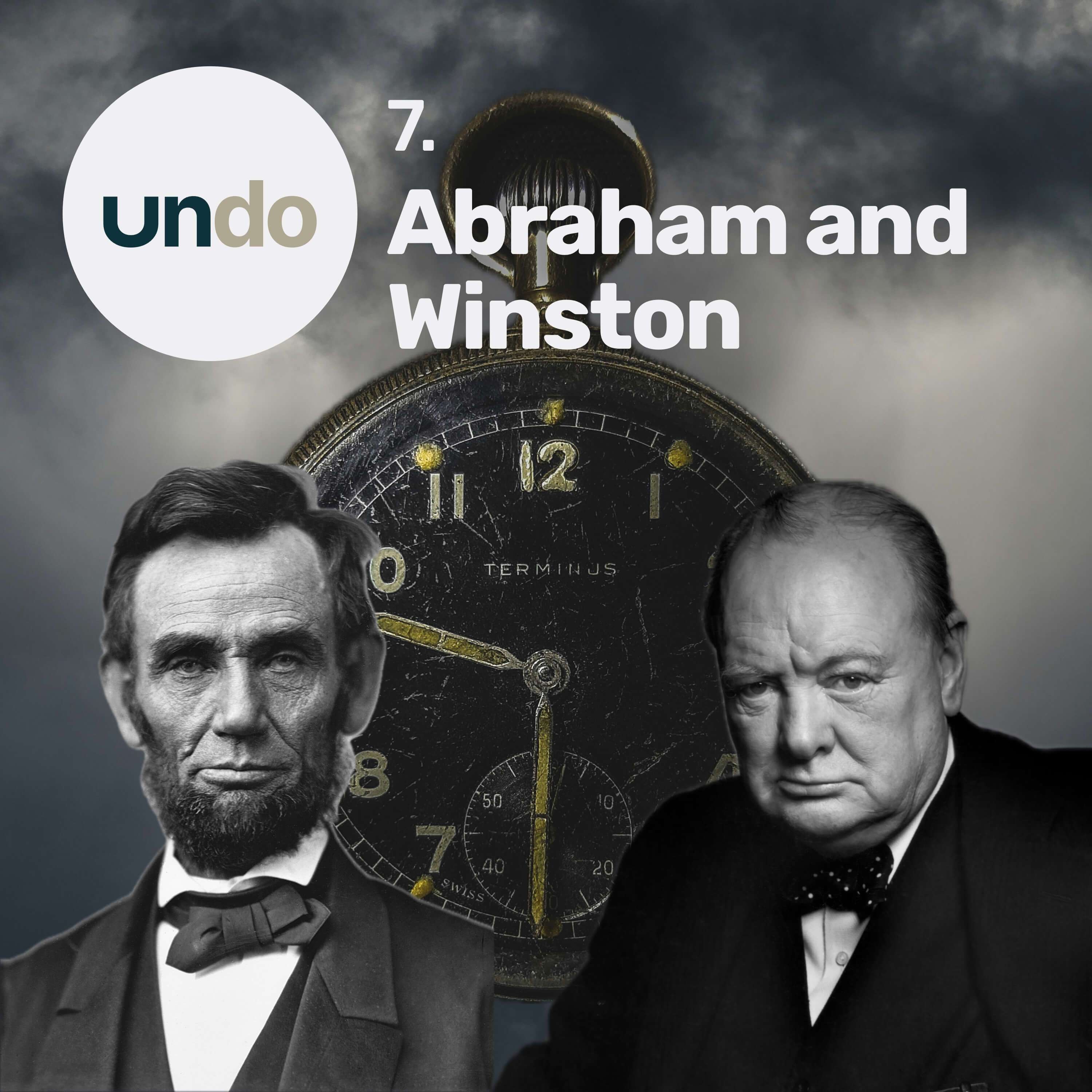
Undo – How history's outliers got stuff done
How to work when the sky’s caving in — Lincoln vs Churchill
00:27:20
Loading summary
Transcript20 lines
- [00:00]
Political Commentator
Instead of taxing our citizens to enrich other countries, we will tariff foreign countries to enrich our citizens.
- [00:08]
Mark Stedman
What if the truth is less that fact checking is censoring us?
- [00:11]
Critic
Donald Trump's administration is lying to you.
- [00:14]
Mark Stedman
But rather that being constantly surrounded by low quality information and news. Trump won. If you don't like it, leave is actually what is stopping us from sharing the truth.
- [00:24]
Historian
It is a fact that the body.
- [00:25]
Mark Stedman
Of water off the coast of Louisiana is called the Gulf of America.
- [00:29]
Critic
Well, he is a dick and I.
- [00:30]
Mark Stedman
Think he's also harming the the American public. Attention all employees. It has been decided that use of the phrase for fuck's sake is no longer an HR violation. When things look bleak, either in your head or out in the world, being productive is probably the furthest thing from your mind. We live in difficult times, no doubt, but two outliers 100 years apart fought oppression, propaganda and dehumanization, all while under their own personal dark clouds. This week, let's discover what two of history's greatest leaders can teach us about getting shit done while fending off black dogs and melancholy. My name is Mark Stedman, and this is Undo How History's Outliers Got Stuff Done. Listen, we're going to talk a bit about depression and maybe about the state of the world as it is now, but this is not about wallowing in grief or pointing fingers. You can get me drunk in a bar and I'll tell you all about my politics, but whatever side of the aisle you're on or whichever side of the Atlantic you call home, if you're a human being with empathy, you might be having days when you just don't feel so great. For Abraham Lincoln and Winston Churchill, two transatlantic leaders a century and an ocean apart, not feeling so great was something of an understatement. Lincoln suffered from clinical depression or what he called his melancholy, while Churchill had his black dog and was widely reported as having bipolar disorder. Now, we live in an age where nuance is as dead as those lads. So let me be clear when I say that I am not shying away from or hanging a lantern on any of their other personal or political aspects or what team they supported and whether that's the same team you support. Now, look in the cupboard of any outlier and out will fall a bunch of skeletons. So let's just take that as red and I can crank up this here time machine which will take us back 215 years and 51 weeks to February 1809. Abraham Lincoln is born in a log cabin in Kentucky to poor parents. At the age of seven, his parents moved to Indiana. He teaches himself and by the age of 25 is studying law in Illinois. Three years later, this is 1837, he's admitted to the Illinois bar. Nearly a decade later, he joins the House of Representatives, where he starts campaigning against slavery.
- [03:10]
Critic
I can't accomplish a God damn thing.
- [03:13]
Mark Stedman
Of any human meaning or worth until we cure ourselves of slavery and end this pestilential war. This amendment is that cure. He starts gaining notoriety in his race for the Senate and is elected President at the age of 51, going on to serve a second term, during which time he issues the Emancipation Proclamation, which frees Confederate slaves and delivers the Gettysburg Address, which is the famous four score and seven years ago speech. He oversees the surrender of Robert E. Lee and only five days later is assassinated by John Wilkes Booth. He dies the next morning. And in the December of that year, 1865, the 13th Amendment to the Constitution is passed, abolishing slavery throughout the entire United States.
- [04:08]
Critic
Abolishing slavery by constitutional provision settles the fate for all coming time not only of the millions now in bondage, but of unborn millions to come.
- [04:25]
Mark Stedman
Throughout his life, Lincoln suffered the kind of clinical depression that would nowadays have been a massive stick for the opposition to beat him with. It made him withdraw from people and gave him suicidal ideation.
- [04:38]
Critic
With Lincoln, we have a man who. Whose depression spurred him painfully to examine the core of his soul, whose hard work to stay alive helped him develop crucial skills and capacities even as his depression lingered hauntingly, and whose inimitable character took great strength from the piercing insights of depression, the creative responses to it, and a spirit of humble determination forged over decades of deep suffering and earnest longing.
- [05:14]
Mark Stedman
This comes from a fascinating article on the subject of Lincoln's depression. It brings up some pretty impactful images of the man slumped in a chair, his gangly arms flopping over his knees with that downwards and downcast expression you've probably seen in the poster for his 2012 biopic. It got worse following the death of his friend and possible romantic partner, Ann Rutledge, and it was serious enough that it would, by today's standards, be called clinical depression. But that's all just background, not only to the man's achievements, but to the way he approached work. We'll hop aboard that train of thought a little later, but for now, let's travel forwards a mere nine years, from Lincoln's death to Oxford. Future Winston Leonard Spencer Churchill is born into the wealthy Spencer family, who you may recognize from other such aristocrats as Diana, Princess of Wales, he's elected as a Conservative MP around the turn of the century and then defects to the Liberals four years later. He rises in status while championing prison reform and Social Security, but after a disastrous campaign in World War I, is demoted from First Lord of the Admiralty to Chancellor of the Duchy of Lancaster. Between 1929 and 1939, things get a little bit blurry. But in May 1940, he's promoted back to First Lord of the Admiralty, succeeds Neville Chamberlain and forms a Conservative government. Then there's a bunch of war stuff. Honestly, someone should really make a film about the Second World War, as there just doesn't seem to be enough. Anyway, the Tories are voted out in 1945 and he ends up on the other set of the Green Benches as Leader of the Opposition. Now, if you know anything about Churchill, you probably know at least some of his quotations. We will fight them on the beaches being one. My dear, you are ugly, but tomorrow I shall be sober and you will still be ugly. And my personal favourite, never stand up when you can sit down and never sit down when you can lie down. Back in the early 2000s, every geeky parody song released on the Interwebs was attributed to Weird Al Yankovic, which left him holding the bag for some pretty unsavoury stuff. Famous quotes are like that. Sometimes it just feels like it fits better to say that Churchill or Twain or whoever said a particular thing, especially if we can throw it up on Instagram with a sunset picture behind it. But Churchill was doubtless a witty man and a grumpy man. Now, some would argue that Churchill could never have achieved what he did if he had bipolar disorder. And I'm not about to refute the word of experts, but people are outliers for a reason.
- [08:10]
Political Commentator
Even though large Czechs of Europe and many old and famous states of have fallen or may fall into the grip of the Gestapo and all the odious apparatus of the Nazi rule. We shall not flag or fail. We shall go on to the end.
- [08:38]
Mark Stedman
Churchill painted and Lincoln wrote poetry. Being creative isn't an indicator of mental illness, but people with mental illness often find creative outlets. Now, I promised we'd get into some actual practical stuff and we're just about to do that. But I want to make the point that whether you think a certain way of feeling needs validating by a textbook or not, these two men had great work to do and were in their second innings in life. I don't want to put words into the mouths of historical figures, but I can't imagine they thought time was an infinite resource. So what did Lincoln and Churchill, these powerful heads of state facing seemingly immovable objects, do to keep their days from sliding into chaos? We're going to find out in just a sec. This podcast is supported directly by you. If you'd like to show your support for Undo and keep it free of ads, you can become a member of the Undo Book Club over at Undo fm. In return, you'll get extra bonus podcast content and every month I'll deliver an in depth review of a much lauded self help book so you can extract all the good stuff without the waffle. This month we're doing Slow Productivity by Cal Newport. Membership costs $5 a month and all the info you could ever need is at Undo FM Club. Okay, let's get back to it. So, Abraham Lincoln and Winston Churchill, two world leaders battling an ideology and their own brain chemistry. How did these mighty dudes make time their sidekick rather than their arch enemy? Let's begin with mornings. For Lincoln, the day started at around 7 in the morning. He'd be up and working before breakfast and might nip out to grab a newspaper. He often forgot to eat and his wife would sometimes invite people round for breakfast just so he'd get some food in him. Once again, if you know anything about Churchill, you probably know that much like myself, Winston wasn't big on skipping meals. He'd wake at the same time, take his breakfast in bed while reading the paper and delegating work to his secretaries. Lunch was a multi course affair for Winston, after which he'd retire to his study before taking a nap at 5. This has been described as Churchill's secret weapon. He believed that a 90 minute nap allowed him to do 36 hours work in just 24. Research suggests that shorter naps are good for alertness, but longer naps are where it's at if you want to improve your memory, because that's when your brain turns short term memories into into long term ones, like moving stuff from your downloads folder into your documents. If we don't get enough of that kind of restorative sleep, our brains take those downloads and just whack them straight in the recycle bin. Sleep didn't come nearly as easily to Lincoln. Poor Abe would get up at night, sometimes pacing around the White House or just lying there in bed not getting any shut eye. He'd try and get to bed between 10 and 11 so he could get his eight hours in, but it's not something he mastered. What Lincoln did master, however, was preparation the quote about the tree and the axe, you know, if I had four hours to chop down a tree, I'd spend the first two hours sharpening the axe. Well, there's no evidence he actually said that. And the first we know of it comes from 1944. But that's never stopped thought leaders liberally using it and attributing it back to Abe. That particular quote aside, preparation was crucial to the way Lincoln communicated.
- [12:29]
Historian
Lincoln had this roll top desk and he would scratch thoughts out for speeches and then put them in this desk. When the time came for the speech, he'd just pick these little thoughts out. Somehow he managed to get the Gettysburg Address from those scraps.
- [12:41]
Mark Stedman
Thank you, Doris Kearns Goodwin. Since we're in the mode of uncovering quotes, there's that lovely one about having written a longer letter because there wasn't enough time to write a shorter one. It's another quote that's got mangled and mucked about with over the years, but it's as true as any truism that truly was true. I'm currently into hour five of writing what'll probably end up being about a 12 minute monologue, and that's before I get into the shed and bang on at you for another eight minutes unscripted. Incidentally, if you want more behind the scenes stuff like that, undo FM Club is where to go. The point is that concision takes time and that's what Lincoln was good at. It's also what Churchill prized. According to productivity coach Dan Silvestri, Churchill insisted memos were limited to one typewritten page, so information could be digested and understood as quickly as possible, even if it took longer to write. Churchill might have been lazy in the sense that he only did the work that was absolutely necessary and did so as restfully as possible. But he was not work shy. Not only did he write more words than Charles Dickens and William Shakespeare combined, he also received a Nobel Prize in Literature in 1953. How do you achieve so much by only doing the necessary and putting your energy where it's most effective?
- [14:03]
Political Commentator
When his mind was occupied with any particular problem, it was relentlessly focused upon it and would not be turned aside.
- [14:10]
Mark Stedman
Those are the words of Cerean Jacob, who was the military assistant secretary in Churchill's War Cabinet and who'd go on to become Director General of the BBC. And of course, we see the same determination in Lincoln with his singular focus on abolishing slavery. We also see empathy in Lincoln. And while he had his melancholy, as he called it, he was regarded by Today's standards. As a stand up guy, he kept an open door policy, spending more time outside the White House during his presidency than within its walls, filling his days with meetings, which for him were his best source of information. I get the sense he was genuinely interested in people, but not from a scientific how do they tick perspective, but something more akin to a philanthropist. The more books you read on self help or self improvement, the more you read about the importance of relationships. And this was a key part in Lincoln's life. Of course, he's just about the most revered man in American history, so naturally biographical snippets are always going to paint him as a hero. But putting aside for a moment the question of whether he was nice, the point we need to care about here is that he cared about people. He got stuff done through a mixture of good nature and fierce integrity. And this is relevant to us because productivity is so much more than rigid systems and frameworks. It's about working with others, setting priorities and keeping commitments. If you were to characterize Lincoln as a people person, I don't think the same label would apply to Churchill. While he was witty and charismatic, I don't think one would describe him as being warm. And the story of this wartime PM is that of defiant leader rather than collaborator. Churchill was flawed in many respects and made big mistakes during his political and military careers. And it's long been said that he was a great wartime PM but not as effective in times of peace. And this, for me, is where these two men part company. I envy Winston's quick wit and his efficient brain. But in an interconnected world, it takes more than brilliance to be successful. I love systems, but I also love people like Churchill. I get irritated when those squishy meat sacks don't work the way they're supposed to. But if I'm going to save time by implementing the systems I'm exploring here, I'd much rather be like Lincoln, keep an open door and work with people so both of us win. Now, if we swing back around to depression or low mood, I'm left thinking about how we channel those feelings. The word depression has the same root as the word deep, and for me it speaks to a depth of feeling which both men had in spades. If you feel deeply, you can push that feeling inwards into yourself, or you can push it outwards into the world. Both Lincoln and Churchill took their darker energies and I think we're animated by them. Gloom can turn to grit. Once you have a good handle on your purpose, the thing you decide you're really, for that word purpose has been a bit overused over the last few years, but it's something we're going to come back to because it's actually really important. It's all well and good being productive, but unless you know what it's in service of, you're just going to be grinding your gears. So to wrap up, let me say this. When you fall over, you need a moment to grab your knee and go, ah. And then you get the hell back up again and keep on moving. If you're not ready to do that just yet, no worries, I'll sit here with you. But when you are ready to go on, I think these three things can help get eight hours of sleep or take a 90 minute nap where you can Believe me, I know it's harder than it sounds, but it's all really just a part of my second point, which is preparation. Preparation really is everything any self respecting tea drinker knows. You don't just show the tea bag to a cup of water. That's how you make hot water, not tea. You've got to let it steep. If you want to make a really good chili rather than a slightly spicy Bolognese, thyme is the key ingredient and not the herb. You get it. And lastly, what is this all in service of if not for other people? Do you want your best relationships to be formed when you're retired and you finally have enough time for people? If you're making art and you want it to resonate with people, is the story of the solitary painter or the isolated writer actually one we can use? Or might it just make our work more insular and disconnected from those around us? And if the early 21st century is teaching us anything, it's teaching us that we need to be seeing eye to eye more, not shutting ourselves away. I know it's tough right now, but while saving time is mostly about implementing good systems, and we'll get back to those next week, the thing we should be making time for is human connection, no matter how bonkers other people might seem right now. So go out into the world, my friend, do great things and hold your head up high. In the words of Mr. Churchill himself, if you are going through hell, keep going. Undo is written and produced by me, Mark Stedman, with research help from Perplexed and Voices from Elevenlabs. As always, when using a voice clone of a living person, I only ever use the words they themselves have written or said. You can take a much deeper dive into the lives of Lincoln and Churchill at Undo FM Mood, which is also where you can sign up to receive new episodes of Undo via email. If you'd like to stick around after this last brief message, you'll find me in the shed where I'll give you my own tuppence worth on depression and that pesky word purpose. Otherwise, feel free to alight here and we'll meet up again next week when we'll talk about checklists. This here is not a commercial message, but a thank you. The response to the first few episodes of Undo has been nothing short of amazing. So to anyone and everyone who's binged the back catalogue or shared them with a friend, you have my heartfelt thanks. If you like the show but aren't in a position to support it financially, just telling people about it is the best way to help it grow. And if you ever have any questions or feedback for an episode, hellodo, FM is where you can find me. Alrighty, let's get to the shed. You find me in the shed thinking about depression, as I promised. Yeah. I have had a sense for the last, I don't know, six months, maybe longer. In fact, probably, probably quite a bit longer of kind of seeing, feeling lost and feeling a little bit like that word purpose has been lacking in my life. Not in any great like, sense of what am I here in the world to do. Like not, not lofty and not self aggrandizing, but just what's it for? Like what, what is? And we know. Which I think is fairly common. I'm a man who's now knocking on 42. It's a good time to be thinking about the work that we're doing and going, is this leading anywhere? Yeah, I'm doing good work and I'm helping people, but like, you know, is it really the kind of work that only I could do? You know, could someone else be doing this? And if that's the case, what's the work that I really should be doing? And that's not uncommon at this kind of time in life. And with that can come that sense of. That there may be a grieving process for the life you think you're supposed to have. You know, that can, that can come with this stuff and then there's just the brain chemistry of it all. You know, I, I stopped taking vitamin D tablets a good few months ago because I was taking other tablets and I couldn't in my head fit both tablet takings at the same time. Yeah, I could, you know, quite easily and happily go back to taking vitamin D. I don't know how much that's made a difference really. But it is one of those things, you know, if you have SAD or you do find that your depression, if you have it is somewhat cyclical, then, you know, there may be an aspect, you know, a chemical aspect to it, but there's a lot more to it. Right? You know, there's, there's being out in the world. And one of the things that we learned from Lincoln is actually he was. He was physical. You know, he was out in the world. He was. He walked a lot. Exercise was a big part of his life. And, you know, eating wasn't necessarily something that he thought that much about, but at least getting up and getting out and moving and walking, walking the White House and I think thinking while walking was, was a big thing for him. It's also common in, in other leaders. You know, throughout history, Steve Jobs was a. Was a famous one for taking walking meetings with people. And there's science behind why walking side by side with the person, especially if you want to have a difficult conversation, is pretty useful because you're not faced with having to look them in the eye if you're going to have, you know, a tricky, a tricky chat. But, you know, physical activity is often among the first things we want to never have to do again if we're feeling depressed, because it just means getting up. But one of the things that I found, if you're feeling, especially if you're feeling overwhelmed, if you have one of those days where you're just. You're at your, you're filled up and you're at your capacity or bubbling over and you just, you can't make any more decisions. You're just at that sort of fatigue level. One of the things that I found helpful was just get up. Just, just, just your, you, your only thing that you have to do is, is stand up. Because then once you're stood up, it's like, okay, well, I'm up now I may as well go and empty that litter tray because it needs emptying. Okay, well, I've done that. Now I may as well go and go grab my bag and walk to the shop and, you know, get some shopping in or whatever. And I did find it worked. And all it was was just saying, okay, you're sat on the sofa, you don't know what to do. Just stand. Just, just get up. That's. That's your only to do list for, you know, to do item for the day. Just stand. And then once, you know, because it is that thing of, well, I'm Here now, and people have talked about that. We go into the gym. It's like just to make your goal to go to the gym, put on your gym gear, do all the stuff, and all you've got to do is get to the gym. Because you then find once you hear, you're like, well, I may as well do something, you know, even if it's five minutes, five minutes of exercise is still better than zero minutes of exercise. That would have been the alternative. And, you know, I like a few things. I probably preach that more than I practice it, but it's an idea that I would like to work a little bit better with. But anyway, those, those are sort of my, those sort of my thoughts. And listen, since you've sort of stuck around for a little bit longer, I will, I will tell you that I am planning to do a little bit more of this, a little bit more in depth, possibly also talking about the behind the scenes that goes into making this podcast, among other things, and my, my sort of personal productivity system as I'm developing it. And that's going to be part of the Undo Book Club. So if you want to check that out, Undo FM Club, you'll find all the details there. I thought, you know, since you've made it this far, you might be interested in a little more. And if not, no worries. But if you do want to hear a bit more about some of the things that I'm developing to help myself and help others, you know, not from the point of view of an expert, but from the point of view of someone who's just discovering these things and has a real interest in how they all fit together, then that's the place to go. Undo FM Club. And with that, I shall close the shed door and I will leave you to the rest of your week. Have a wonderful one. And thank you, thank you, thank you for your interest in Undo. It means a lot that, that you're listening, so thank you for your time. It's. I know how precious it is and I hope I've spent it well. Looking forward to chatting to you again next week when we're going to talk about checklists. So we'll get proper right back into the fundamental stuff. So I'll see you then. In the meantime, take care of yourself.