← Undo – How history's outliers got stuff done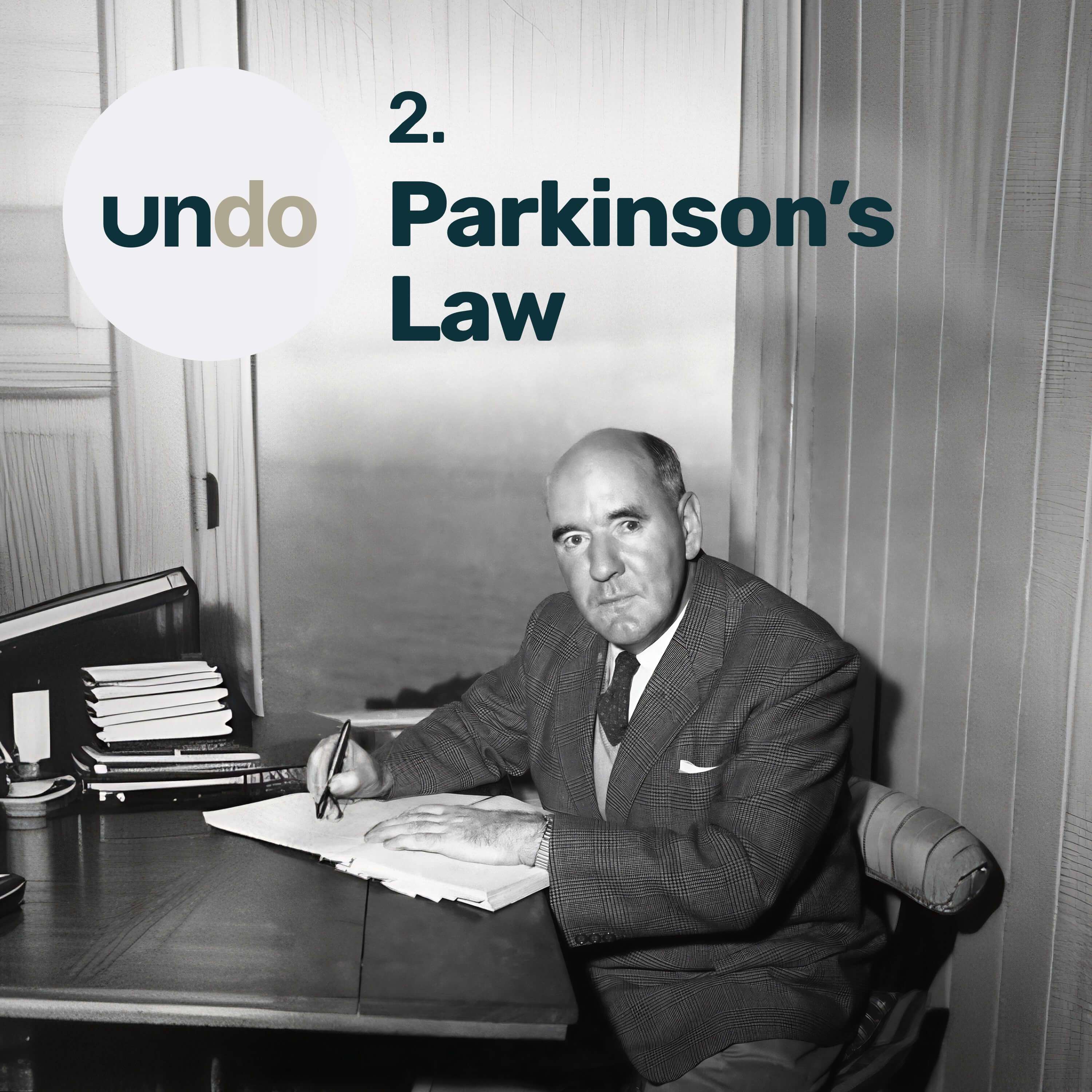
Undo – How history's outliers got stuff done
Work expands to fill the time available – Parkinson’s Law
00:14:42
Loading summary
Transcript3 lines
- [00:02]
Mark Stedman
Say you're starting a personalized cupcake business. You and your friend make the cakes and ship them out yourself. You film your mate icing the cupcakes and put the videos out on TikTok. Your channel goes viral, so you hire someone to do your social media. As demand increases, you hire a couple more bakers and a project manager. Then you need an office manager and before long an HR person, an accountant, someone to manage the website, a procurement specialist to find the best ingredients at the cheapest price. This is Parkinson's Law in action and it's the reason your cupcakes aren't as nice as they used to be. More to the point, it shows us why we can never do all the things, because there will always be more things that demand to be done. Especially if someone's livelihood depends on you being given more things to do. Thanks, capitalism. I'm Mark Stedman and this is Undo, where we look at productivity methods through the ages and try to separate the brilliant from the bullshit so you can build a system that works for you. Today, we're taking a look at a long held maxim of productivity. It's not a methodology or a hack, but a way of looking at how we spend our time and resources. The law is a law of nature. Of course, I didn't invent it, I discovered it. The law is that work expands to fill the time available for its completion. And it has a number of important corollaries, one of them being that in any administrative org, that's our boy C. Northcote Parkinson speaking to the BBC in 1979. And it's that line about work expanding that we're going to investigate today. Cyril Northcote Parkinson was born in 1909 in Barnard Castle on the borders of Yorkshire and Dan Durham in the uk. If the name Barnard Castle rings a bell, it's because during lockdown, it was the place one of the Prime Minister's advisors drove to in order, as he put it, to test his eyesight. Anyway, Parkinson spent his childhood in York and studied history at Cambridge. During the Second World War, he was a schoolmaster at the Royal Naval College in Dartmouth. In 1955, Parkinson wrote an essay for the Economist, which opened with that famous line about work expanding to fill the time available available. He'd go on to explain how this works in big bureaucracies and businesses, how managers hire more managers and give more work to the managers they hired. But at its core is a fundamental principle we experience as individuals every day. If we go back to the first beginnings of that cupcake business, Imagine you and your mate are selling personalized cupcakes door to door. You want to start local, so you cost up some flyers you can pass around. You give yourself an hour after work to write a quick bit of copy. For the flyers, you need to work quickly because it's got to go off to the printers in the morning. So you knock up some bullet points about how tasty they are, how they're made with natural organic ingredients, and that they're baked just a few doors down. Done. The flyer is ready to be printed and in a couple of days you're out there sliding them through people's letterboxes and leaving them under windscreen wipers. All in all, you drop 100 leaflets and you get 20 calls. But what if you gave yourself more time? What if the printers didn't need your design till Monday? That would give you the whole weekend to work on it. If your copy were more persuasive, maybe you could go from 20 calls to 35 or 40. So you spend the morning researching the copywriting techniques of innocent smoothies and the like. You walk to your favorite cafe so you can grab a nice coffee and be among other creative types. You map out all of your objectives on post IT notes and then transfer them to your laptop. You spend an hour or so writing, then run your text through ChatGPT and Claude and implement all the suggestions they give you. You watch an interview with Amy Porterfield on marketing and throw everything out and start again. By the end of the weekend, you've got the same number of words that say the same thing. But this time you. You know, you've really worked at it. You drop 100 leaflets and you get 20 calls. Well done. You just done Parkinson's yourself. This isn't just the trite observation about procrastination, by the way. Studies in the 60s and the 90s absolutely bear this out. In a study published in the Journal of Experimental Social Psychology, subjects were given a task to do that should have taken five minutes. The people running the test accidentally gave them 10 more minutes. And what they found was that the subjects worked longer on the task instead of taking the free time. And in a 1999 experiment published in the Psychonomic Bulletin and Review, subjects were given four sets of images to analyze. They were told the fourth set was cancelled just before they started, so they spent the rest of their time working on the third set instead of putting their hand up and saying done. These examples prove out my cupcake scenario as well. I don't know enough about baking to know if prove is a pun here, but you get the idea, right? We spend the weekend agonising over whether to use a comma after each bullet point when we could have sacked it off after the first hour and gone to the pub. So why does this happen? Some of it we can put down to good old procrastination. Jobs that feel daunting or have deadlines that are way off tend to lead to us suddenly and urgently needing to clean the guttering or rehang all the doors or learn to water ski. Or we end up preparing for ages, setting the scene and getting everything just so before it's time to stop.
- [05:53]
Unknown Speaker
It was terrible. I sat in the big hall and put my packet of Polos on the desk and my spare pencil and my support Gonk and my chewing gun and my extra pen and my extra Polos and my lucky Gonk and my pencil sharpener shaped like a cream cracker. Three more Gonks with a packet of Polos each and lead for my retractable pencil and my retractable pencil and spare lead for my retractable pencil and chewing gum and pencils and pens and more Gonks. And the guy said, stop writing, please.
- [06:26]
Mark Stedman
Deadlines help us sharpen our focus, making it easier for us to break them down into manageable chunks. Without that clarity, work can feel more nebulous and complicated, which for most of us is not satisfying stuff to grapple with. If you've lived away from home, you'll probably have experienced this. Your clothes can spend their whole happy lives spread out on the floor of your bedroom or draped over chairs. You've got put your clothes away on your to do list. But there's always something else that needs doing until your mum invites herself over for tea and it's like, right, that's it. All the clothes in the wardrobe dust every surface brush the cat lint roll of the boyfriend. There's nothing like a mother's judgment to light a fire under you. Of course, deadlines don't work for everyone. Douglas Adams famously said he loved the whooshing sound of a passing deadline, but he created the Pan Galactic Gargle Blaster and the Babel Fish, so he gets a pass. There's a related law in play here too, which draws a curve in the shape of a bell to map out how we can perform under stress. At the top of the bell is peak performance, which is due to just right amount of stress. On the left, the curve dips down because the job's too boring, while on the right, it dips down because the job's too stressful. Picking your clothes up from the floor is just not an interesting job, so there's no urgency. But contemplate the grief you'll get when your mum pops around. And that's just enough stress to make it interesting. We have Messrs. Yerkes and Dodson to thank for that little nugget. So this is all well and good and fine and lovely and good, but if you want to get the boring work done in less time so we can spend more of that time doing creative things, what can we actually do? Well, I'm glad you asked and I'm about to tell you, but first I need to briefly talk about something else. This podcast is supported directly by you. If you'd like to show your support for Undo and keep it free of ads, you can become a member of the Undo Book Club over at Undo FM Club. In return, you'll get extra bonus podcast content. And every month I'll deliver an in depth review of a much lauded self help book so you can extract all the good stuff without the waffle. This month we're doing Slow Productivity by Cal Newport. Membership costs $5 a month and all the info you could ever need is@ undo fm/club. Okay, let's get back to it. Okey doke. So we've got a decent understanding of Parkinson's Law under our belt. We know that work expands to fill the time available. So if we've got a bunch of metaphorical broccoli on our plate, how can we finish it quickly and efficiently so we can have some hypothetical cake? And speaking of cake, let's say you and your mate need to write and record a TikTok video for your cupcake bakery. You're planning on putting out a video every week. You could take the whole week and agonize over your hook, hone each transition and sharpen your call to action. Or you could give yourself just an hour, after which you have to upload what you have. If you're thinking that setting an artificial deadline won't work because you know there's more time, you're right. Sometimes this sense of urgency, even artificial, can help us get moving. But other times it can be helpful to find a buddy who can keep you on track. Maybe find someone who also needs to get something out without procrastinating over it. Hold yourselves mutually accountable, and you might be surprised how well that works. Similarly, you can set out a block of time in your calendar and allocate it to this task and this task alone. This is called time boxing and we'll investigate it in another episode. Another approach is to put the Eisenhower Matrix to use. We covered this all the way back in episode one last week and it can help us decide how much time we should reasonably give each task. Something else we're going to cover in more detail is the Pomodoro technique, which divides work time into 25 minute distraction free increments. The idea is you focus on the work for just 25 minutes, silencing any apps or devices that might go bing and pull you away, then take a five minute break. If we take our TikTok video as an example, we might think of that as two Pomodoro units or 50 minutes of total uninterrupted work time. We talked about procrastination earlier and one of the biggest reasons we find ourselves in that zone is because the work feels too nebulous and scary. Especially if that work involves putting ourselves out into the world, showing our faces or exposing our hearts. The trick here is to break the TikTok task down into smaller chunks. Number one outline the video number two write each story beat. Number three do a quick storyboard 4. Set up the equipment 5. Record the clips 6. Edit them together 7. Write a brief description 8 hit post of course, there are always going to be some jobs that just take a certain amount of time to complete. Poaching an egg, Toasting some bread. Hulk smashing an avocado. These are finite and predictable. There's a minimum amount of time it takes to research and write this podcast. I could spend a week on each episode and hone every word so sharp you could cut your finger on them. But it also takes time to read and understand the source material. So if you do creative work, you want it to be the best it can be. But if that work involves regular output, like posting to YouTube or writing a newsletter, there's only so much finesse you can add before at some point you have to call it done. MasterChef contestants don't finish cooking when they've made the perfect dish. They finish cooking when John Tyrode and his giant mouth declare time to be up. Seriously. By the way, have you ever watched him eat? That guy has an incredibly cavernous maw. Anyway, a good way to get a handle on how much time you should spend is is by tracking it. We'll talk about time tracking at some point soon too, but this is something that can help you get a good handle on where your time is going. If the last newsletter you made took an hour from soup to nuts, what would happen if you gave yourself just 20 minutes, stuck to a template, and wrote it more like a WhatsApp message than a piece of marketing. Now, I mentioned capitalism right at the start of this episode, and there's a knotty thing to wrestle with if you work for someone else. Just as work can expand to fill the time available, the more efficient you become as a worker, the more work you'll be given, even if that work is just to keep you at your desk. According to a survey in 2016, we spend less than 40% of our time doing the stuff we're actually meant to do. The rest we spend in our inboxes or writing status reports or going to meetings. We with Janet from Accounts Receivable. God damn it, Janet, no one's joining your pub quiz team. It's our duty then, as cogs in a featureless machine, to add just enough friction so we can do the work we're assigned without being punished for efficiency. All that energy we save by resting and avoiding busy work we can spend at home, working on relationships with people we love, or making something that'll outlast us. How can we do that? By setting tighter deadlines so we don't waste time on our own busy work, knowing when to say good enough is good enough, and breaking big, scary tasks into smaller, manageable ones. Remember, a life of creative pursuit is not the icing on the cake. It's the whole damn cake. Undo is written and produced by me, Mark Stedman, who is now preoccupied, occupied with cake. You can find links to more resources at Undo fm, which is also where you can sign up to receive new episodes directly in your inbox. Next week, it'll be time to pop this frog in your mouth.