Loading summary
Transcript70 lines
- [00:00]
A
At pjum, we actively manage risk today while targeting outperformance tomorrow. So no matter what investment risks concern you most. From geopolitics to inflation to liquidity, PGM brings disciplined risk management expertise that spans 30 market cycles. Our active approach finds opportunities and volatility, helping our clients to navigate risk and achieve their long term goals. PUM our investments shape tomorrow today.
- [00:36]
B
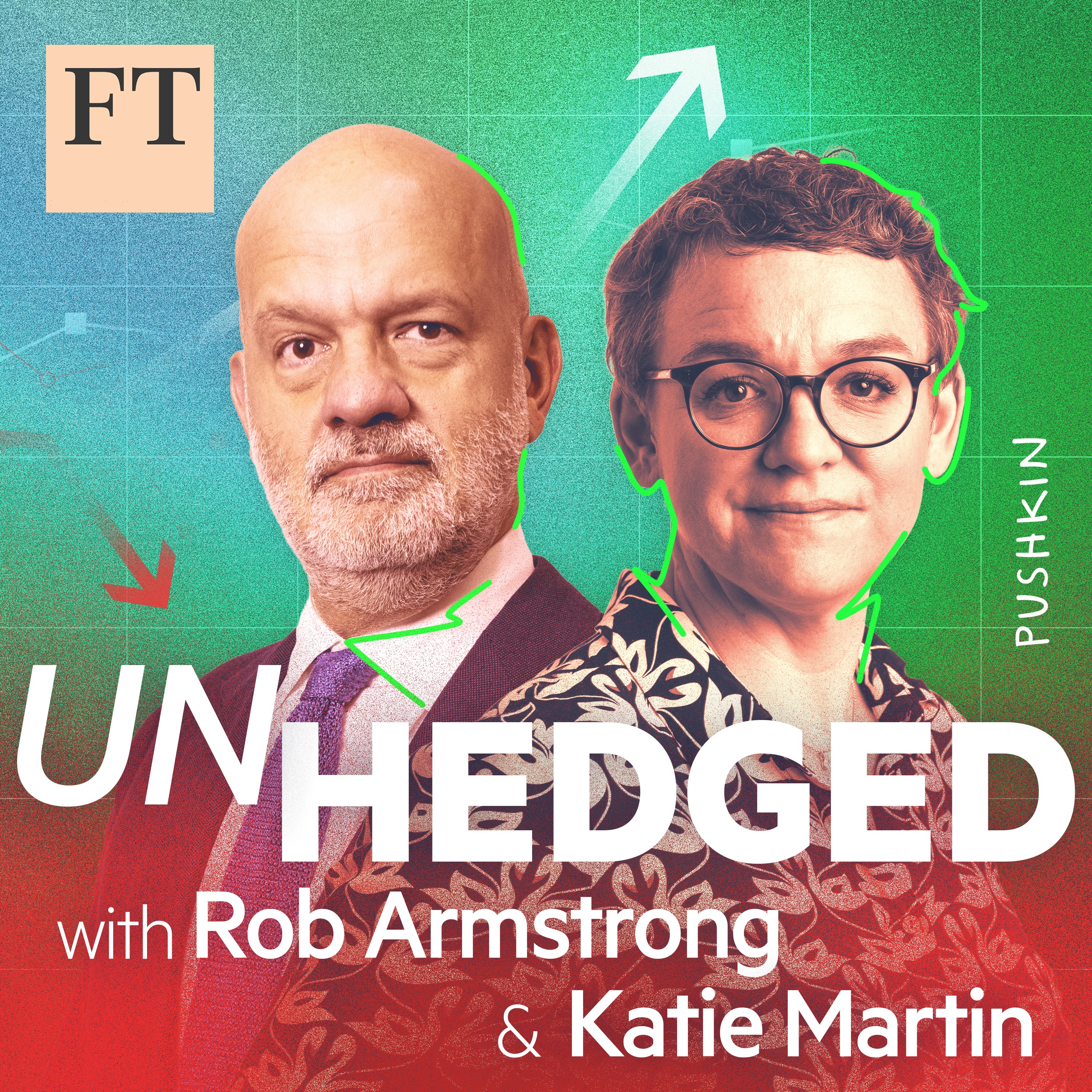
Pushkin over here at the Unhedged Podcast, we love getting questions from our listeners. Questions like why does Rob Armstrong look like Eddie Rama, the Prime Minister of Albania, rather than Cary Grant? And how do you make your own dishwasher tablets? But as we stumble, bleary eyed and frankly, rather beaten up into the end of 2025, we put out a bat signal asking you lot listening out there for questions about markets and finance that you'd like us to answer on the show. We had loads, thanks very much. Although hardly any. Maybe in fact none from women. Girls, come on now, don't be shy. I've made a career out of asking stupid questions and Rob certainly has. It's fine. Anyway, today on the show we're going to answer as many questions as we can. Sorry we can't get to them all. And we're going to try not to mess it up. This is Unhedged, the Markets and finance podcast from the Financial Times and Pushkin. I'm Katie Martin, a markets columnist at Festive FT Towers in London, pre recording this show so that by the time you listen to it, I'll be stuck into my third snowball of the day. Joining me down the line, all the way from the North Pole is my chief elf, Robert Armstrong, the largest of elves who is taking time out of fashioning small toys out of pieces of wood for all the good girls and boys at this busy time of year. Rob, tell me, are you a Christmas person or are you a humbug person?
- [02:01]
C
I am a Christmas person, although it takes me a long time to get into it.
- [02:09]
B
Uh huh.
- [02:09]
C
I've often said that when I am king, anyone who puts up a Christmas decoration before Thanksgiving will be summarily executed. I think Christmas should be a short, intense period rather than an endless cycle of tiresome decorations. So I get into it around Christmas Eve, but then I'm super into it for 48 hours and it's over. But I have a question for you, Katie. Is a snowball a kind of beverage? You just mentioned the snowball.
- [02:42]
B
I love a snowball. I was going to ask you whether you have snowballs. It's like it sounds disgusting. So you're gonna have to bear with me. It's like an eggnog, boozy eggnog drink to which you, you may, if you want to add more booze in the form of vodka. And then you top it up with lemonade, which makes it go all kind of fizzy and like a snowball. And you like squeeze some lime into the top of it. Delicious. So good.
- [03:06]
C
Never heard of it.
- [03:08]
B
Sufficiently sinful and sweet and boozy that you should consume them at Christmas. Only.
- [03:13]
C
Only, yes.
- [03:15]
B
So I was going to ask you snowball or Negroni, but I'm guessing you're going to say Negroni.
- [03:20]
C
I do like just an eggnog. I think eggnog's good. Any excuse to drink cream.
- [03:26]
B
What could possibly go wrong? So, okay, look, let's get stuck in because like I say, we did get like a heap of questions from listeners. Tom, he emailed and apologized for a stupid question. It's not actually a stupid question, Tom. He asked why do companies care about their share price? What difference does it make to a company if their share price is going up or down? Good question. Rob, what are you saying?
- [03:50]
C
A very good question and one without a simple answer. So, I mean, there are simple answers, but they're incomplete. And then you quickly get into the complicated answer. Simple Answer number one is the CEO's pay is often linked to it.
- [04:05]
B
Yes.
- [04:06]
C
Right. So the executives of the company get stock option grants or actual stock or whatever. And the idea is that this will align the interests of the people who run the company with the people who own the company. Solving the so called principal agent problem of corporate finance. This works sort of well, I guess. I think it's probably good overall that executives are paid this way. But the problem is even if you don't let the executive sell for say, five years after his or her stock grant, five years may not be the ideal planning period or decision horizon for a really good chief executive. So if the chief executive has a hard decision to make and the right thing to do is going to be one that might spook the shareholders, this will discourage them from doing it. So it's not, you don't get perfect management incentives out of this, but this is reason number one. This is how people get paid.
- [05:18]
B
But there's a bunch of other reasons. Right? You know, it's not just about, you know, what's in the interest of a clutch of CEOs, because who cares about those guys? There's not very many of them in the world. It's, it's easier for you as a company to borrow money cheap if you're able to demonstrate that you're worth a kajillion dollars, right? And if you, if you want to raise more equity, so issue more shares or whatever it is, then it's easier to do that if you can demonstrate a record to previous investors that look, this has worked out pretty well. So, you know, so let's have more equity, let's have more debt. So there is a kind of virtuous circle thing here as well, correct?
- [05:55]
C
Where it's a currency. If you have a high stock price, you have a valuable currency with which to do things. But again, the dark side of this is that the value of that currency is controlled by a bunch of wild eyed risk lemmings known as investors. And they can jerk that thing around fairly, unfairly or in between in the short term. And indeed this presents such a risk that there is an entire industry known as private equity which will get you into a situation as a company where you don't have to worry about the risk lemmings anymore. You've been taken off the market, you have one owner rather than a kajillion and you can do hard things that would be too hard to do in the context of publicly traded shares of your company. So again, it's a mixed bag.
- [06:57]
B
And also if you've got a very high share price and your company is worth a lot of money, at least, at least on paper, then you can go and gobble up other companies if you like. And it's harder for other companies to come along and buy you if you're very expensive as a listed entity on a stock market. So it's a good question, like why do you care? But there are a bunch of reasons why companies care, correct? So question number two from Paul. Should we be able to speculate on a broader range of commodities, for example, the price of a burrito? Now I'm going to say a burrito, not a commodity.
- [07:33]
C
Yes. No, that's a high value add product, the burrito.
- [07:39]
B
This I think is an interesting point, right? Like why can't we just bet in financial markets on anything? Why can't we bet on whether Rob Armstrong is going to be wearing a Santa outfit on Christmas Day? Why can't we bet on who's going to be the new chair of the Federal Reserve, yada yada.
- [07:59]
C
To an extent this is happening. This is what these prediction market companies are doing. It's happening for better or worse.
- [08:07]
B
Now, prediction markets, I think it is worth just like pausing on that for a little minute. They've gone kind of bananas in the States, haven't they? Because am I right in thinking you've only recently introduced sports betting?
- [08:21]
C
Only recently introduced sports betting. And I believe the reasons the laws around prediction markets generally have changed a little bit, although I need to double check that. But they're a big thing. I like them. I just want to say a word in favor of prediction markets, which is, especially with politics, we all love to shoot off at the mouth about how we understand politics and we know who's going to win, who's going to lose. Well, if you go over to your prediction market, Kalshee or whatever, you can put your money where your mouth is. And this is good because then you're like, oh, I thought that so and so was going to win six months ago and I bet 50 bucks on it. How was I so stupid back then? So, like, being able to bet on a lot of stuff allows you to kind of hold yourself accountable. I'm not saying you should put a fortune on these things, but I see the kind of intellectual functionality of these things.
- [09:17]
B
I don't. I completely disagree with you on this. I think it's really unhealthy. Right. So you mentioned Kalshi. So their co founder and chief execs called Tarek Mansource. He was talking the other day about how the platform could be used to, and I quote, financialize everything and create a tradable asset out of any difference in opinion. I'm saying, Rut Ro, this is bad. Okay? So one of the ways in which this is bad, okay, is a bunch of people have gone onto one of the prediction websites to bet on who would be nominated as the Time Person of the Year. You know, the Time magazine's Person of the Year. It's like a big kind of event every year, and a bunch of people had bet that it would be AI and actually what Time Magazine went for was a whole bunch of people who it described as AI architects. Now then the people who'd bet on AI are saying, okay, so we win.
- [10:16]
C
Yes.
- [10:17]
B
And the prediction platform that's taken a lot of their money on this bet is saying, no, you didn't.
- [10:23]
C
Yeah, you have to be very careful about specifying it. There's going to be conflicts and also there'll be gaming of the system. Right. It's, you know, people will be getting in there and making things happen that they bet on or inside. There will be insider trading and all of that stuff. Yeah, I hate sports betting. I should also note that I hate sports betting. Like sports betting on the individual app, I'll fearlessly predict that gets made illegal eventually again. Yeah, I just think it's horrible. You know, it's like, you know, it's, it's like carrying a little, it's like carrying a little liquor store in your pocket. It's like you can, you know what I mean? Like, it's, it's making a vice instantly available at all times with no restriction. This is not a good idea.
- [11:06]
B
But also, like you say, it's so easy to game it. So you can go on to Calsheet now and bet on who will Trump nominate as the chair of the Federal Reserve. Because as we all know, Jay Powell steps aside from that role in, in May next year, there's going to be a new chair. Now, if you happen to know who Trump is going to appoint as the Fed chair, then you can make a bet on that platform that's like not fair to the other people who are, who are playing now. Maybe you don't care about fairness and maybe I'm being too kind of prissy about this whole thing. You've got to like, you know, do.
- [11:38]
C
This stuff properly, I guess, to bring this answer around. We should also note that there are ways to bet on the price of a burrito. I mean, you can buy it, you know what the price of a burrito is today, and you can buy an inflation swap and speculate on how much inflation is going to drive the price of that burrito up.
- [12:02]
B
What people want is like, what people want is like a ha, ha ha, you know, isn't this funny? It's a bit like, you know, the cryptoization of everything and the meme stockification of everything tells you that you should be able to bet on burritos. I'm just saying, like, you know, in financial markets, that's why there's so much very tedious regulation, because there will be in the reg around if, if burritos were a regulated financial asset, there would be like a booklet like as, as thick as my hand that says what is a burrito? How do we define what a burrito is? How are we determining what the price is? If there are five different prices for burritos on my street, which one are we taking as the benchmark price and why? What happens if that price fails? And blah, blah, blah, boring, boring, boring. But the general public doesn't want boring, boring. Rules, rules, rules. It wants.
- [12:50]
C
I'm going to bet on a burrito. Yeah.
- [12:53]
B
So I just think that sort of lollification of, of financial markets, the financialization of everything for me bad, do not like. But you know, next reasonable people can disagree. Next question. We had a question from Jan who says effectively will ubs, the massive Swiss bank move to the us so it's, it's a Swiss bank. It's been a Swiss bank forever. It gobbled up Credit Suisse when Credit Suisse died. It basically is Switzerland and it's been talking about, oh maybe, maybe we should decamp because we don't like all these nasty regulations we've got in Switzerland. Maybe we should go to the us. We should. Glorious golden pasture where there are no rules for banks. We can do whatever we like. Like I think it's that whole thing.
- [13:42]
C
I mean it's saber rattling. Katie. Yeah, you know what I mean? And good. By the way, I think we've discussed on this show many times that there is a lot of work to be done on the structure of European financial regulation to make it simultaneously safe but more efficient and clear and less cumbersome than it is now.
- [14:07]
B
You say that you know how much eurozone bank stocks are up this year, like 60 or something ridiculous.
- [14:13]
C
Like it's been a, now they're treating it 0.6 times book or something.
- [14:18]
B
You're just jealous because you went in the trade and if you've been in it in as a dollar based investor.
- [14:26]
C
Anyway you, you made the point. It is Switzerland, right? It's not, you know, the Swiss are not going to let that happen. But it's good that the company is rattling the sabers and I hope that it makes Swiss and European officials snap to attention and say we have work to do here because they do.
- [14:46]
B
We have work to do here because we need to be crazy rule free lunatics like the Americans because what could possibly go wrong?
- [14:55]
C
They don't need to be rule free. The first thing you need, and we've discussed this on the show, is is for the rules to be very clearly trans European. Right. Not just the Eurozone, you know, I'm talking about across Europe in all of its manifestations, not the euro area, but like there has to be regulation across all European countries that makes financial services very transportable across borders.
- [15:25]
B
Yes.
- [15:25]
C
And they need to do that and it's a major block to prosperity and.
- [15:31]
B
They gotta do something about it with love. I see very little prospect that you can convince people to get this done, Rob. But you are not wrong that this is a big issue that needs addressing and maybe one day in our lifetimes it will be addressed.
- [15:43]
C
Yes.
- [15:44]
B
Here's a nice little question coming from Matthias. Matthias I'm afraid I don't know how to pronounce it, but you'll like this one. Why are shareholders so relaxed about the erosion of shareholder rights? So, for example, there was a story the other day about Exxon, the oil company, which has been effectively won a court order that enables it to limit shareholder activism, which is where investors effectively tell companies what to do. Why do you think investors don't seem to really care that they have less power anymore?
- [16:15]
C
Corporate governance is one of those things that people only worry about once. It has already gone terribly wrong.
- [16:25]
B
Yeah.
- [16:26]
C
So the classic example of this is the big Silicon Valley companies like Google, Meta. I'm trying to remember which ones have. Which have the control of the company and economic ownership of the company are separated by kooky multiple shareholder classes. And as long as the stock price is going up, people are like multiple shareholder classes. Who cares? Let's party, right? And then, you know, Mark Zuckerberg comes along and starts talking about the Metaverse all along, and everyone's like, whoa, whoa, whoa, whoa, who's running this here? I can't.
- [17:07]
B
We had that story the other day, didn't we, that Meta is cutting back 30% of its spending on the Metaverse. And I'm like, lads, I have an idea for the other 70%. Why are you spending any money at all on this nonsense?
- [17:25]
C
They renamed the company for this project, so they can't just shoot it in the head. Head. Which is what clearly ought to happen.
- [17:30]
B
Well, in the legs, because none of these people have legs in the Metaverse. They're all just like, disembodied floating computer people. Rubbish.
- [17:38]
C
But it's just one of those things. You only start worrying about governance when the trouble has already started. It's just a sad fact of human nature. And the lawsuits start, have. Then the recriminations have to start to fly before you assert your rights. Yeah, sorry.
- [17:58]
B
Yeah, yeah, sorry. Nobody cares. Right, final question in from Rick. Apart from the impacts to human lives in Venezuela, what are the implications for global markets? On the USA taking an increasingly active stance in attacking the Maduro regime.
- [18:14]
C
I'm going to let you start on that one, Katie. That's a hard one.
- [18:17]
B
I think in terms of the implications for global markets, my expectation is that there will be precisely zero if we. You know, one thing that we just keep learning over and over again is you can have, like, rockets flying into Israel and into Iran. You can have this grinding situation in. In Ukraine, you can have this appalling war that's playing out in Sudan. Markets don't care about this stuff. They need a really good reason to care about this stuff. And I can't see, see a macro reason why markets would care about an escalation of violence between the US and Venezuela. Can you?
- [18:57]
C
No, I can't. And the point you just made is especially true in the oil market because of fracking technology specifically and I guess a few other things. The sources of oil globally are much more diversified than they used to be. So it's less of a big deal if a Venezuela or an Iran or a. Whoever, one of the big traditional players shuts down. There's other sources. The, the market re. Equibul regains its balance is the term pretty quick.
- [19:32]
B
It reequibulates.
- [19:33]
C
We reequibulates the reequibulation of the oil market. So I know that is a word, I'm certain of it. So that, that's a big deal. But the question, I think an interesting philosophical question is is markets overall indifference to quite big geopolitical shakeups? Is that a good thing or a bad thing? Should we be glad about that? My instinct is that it's a good thing in as much as somebody can't hold the whole world hostage.
- [20:10]
B
Yeah.
- [20:11]
C
By doing something awful across a border. Or it's harder to do now.
- [20:16]
B
Right.
- [20:16]
C
But on the other hand, you might say it's easier for the world to ignore these things than it once was. You know, you had conflict, you know, 30 years ago, you had conflict in the Middle East. Everyone's thinking, well what about the oil? What does this all mean? We better get on the stick here and now everyone's like checking their watch and going on a prediction market and on the price of a burrito. Right. So. So I don't know, you know, the kind of. The fact that global markets are now so big and so well distributed that they can adjust to these things that could be good or bad in different ways.
- [20:55]
B
Yeah, you pick your poison on that. So look, you know, in summary, no one cares about anything and all we want to do is bet on burritos. It's a glorious Christmas message. We are going to be back on that profound note in just one sec with Longshaw.
- [21:23]
A
At pgm, we actively manage risk today while targeting outperformance tomorrow. So no matter what investment risks concern you most, from geopolitics to inflation to liquidity, PJUM brings disciplined risk management expertise that spans 30 market cycles. Our active approach finds opportunities and volatility, helping our clients to navigate risk and achieve their long term goals. Pgum our investments shape tomorrow today.
- [21:53]
B
Okie dokie. It is time for Long Short that part of the show where we go long a thing we love or short a thing we hate. Rob what you saying?
- [22:02]
C
I am short the informal infernal wickedness of the gift card where you give someone a certain amount of money to be spent on a little piece of plastic at a certain company. Which is all a nefarious trick because the companies know there's a good chance the card will be lost or not completely used, so they get free money. Or if you do spend it, you'll spend a little extra money because you can't get the transaction down to the penny on the stupid card. And it's all a nasty not Christmassy grinchy trick by corporate America. And I hate it.
- [22:46]
B
I totally agree with you. Gift cards are bad.
- [22:50]
C
Just give money. What the good uncle does is just puts money in an envelope and says here kid, you know the favorite uncle.
- [22:58]
B
Yes, I am Limit Long the story we had the other day from Josh Spiro in the FT on the bitcoin investor who wants to take over a bit of Saint Nevis.
- [23:08]
C
I read that too.
- [23:10]
B
Unbelievable enclave for like crypto people with its own court system. Yes, clear. So there's a lot of this about. And I am all in favor of tiresome tech libertarians and crypto maximalists being far away from me on a lawless island with like no health care, no police, few natural resources, and ideally some volcanoes or like GEO fault lines or whatever. And no military just for me for Christmas. Please go ahead and do it. Stop going on about it. Get yourselves out to these islands listeners. We are taking a break for Christmas Day. I think that's allowed. But we will be back next week. So. So from all of us on the Unhedged podcast, myself and Rob, the FT's audio team, Andrew pressing the buttons in London, and our friends at Pushkin who do all the production and editing to try and make us sound clever. Merry Christmas, Happy Hanukkah, Happy Holidays, Happy Festivus to the rest of us. Have a good one and we will be back in your ears next week. Unhedged is produced by Jake Harper and edited by Bryant Urstadt. Our executive producer is Jacob Goldstein. Topher forges is the FT's acting co head of Audio. Special thanks to Laura Clarke, Alistair Mackey, Greta Cohn and Natalie Sadler. FT Premium subscribers can get the Unhedged newsletter for free. A 30 day free trial is available to everyone else. Just go to ft.com unhedgedoffer I'm Katie Martin. Thanks for listening, Sam.