Loading summary
Transcript127 lines
- [00:00]
Jerry Insurance Advertiser
Tired of your car insurance rate going up? Even with a clean driving record, you're not alone. That's why there's Jerry, your proactive insurance assistant. Jerry compares rates side by side from over 50 top insurers and helps you switch with ease. Jerry even tracks market rates and alerts you when it's best to shop. No spam calls, no hidden fees. Drivers who save with Jerry could save over $1,300 a year. Switch with confidence. Download the Jerry app or visit Jerry AI Acast Today,
- [00:32]
Acast Podcast Promoter
Acast powers the world's best podcasts. Here's the show that we recommend.
- [00:39]
Knox
Do you like being educated on things that entertain but don't matter? Well, then you need to be listening to the Podcast with Knox and Jamie. Every Wednesday we put together an episode dedicated to delightful idiocy to give your brain a break from all the serious and important stuff.
- [00:52]
Jamie
Whether we're deep diving a classic movie, dissecting the true meanings behind the newest slang, or dunking on our own listeners for their bad takes or cringy stories, we always approach our topics with humor and just a little bit of side eye. And we end every episode with recommendations on all the best new movies, books, TV shows or music.
- [01:08]
Knox
To find out more, just search up the podcast with Knox and Jamie. Wherever you listen to podcasts and prepare to make Wednesday your new favorite day of the week.
- [01:18]
Acast Podcast Promoter
Acast helps creators launch, grow and monetize their podcasts everywhere. Acast.com Foreign.
- [01:32]
Freddie
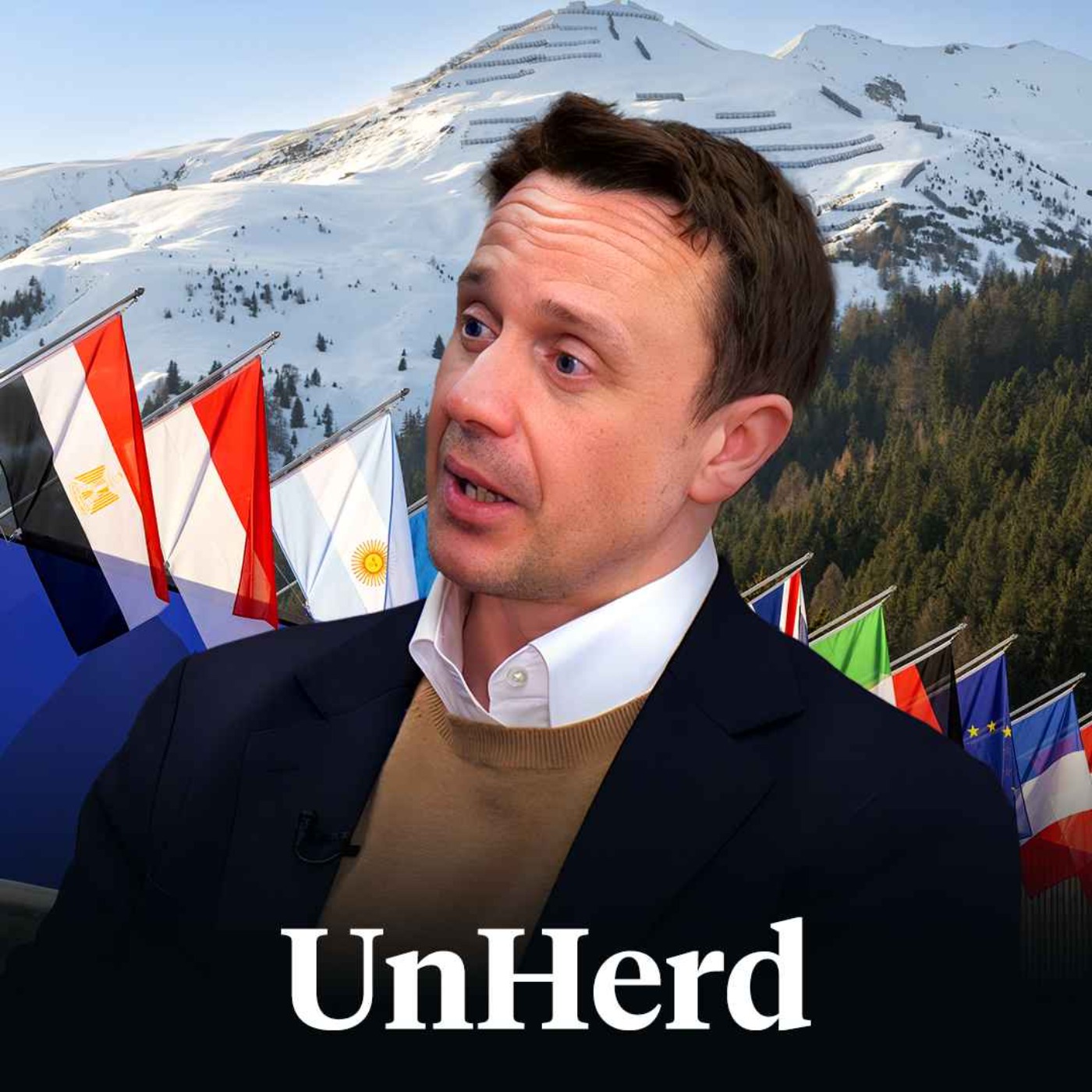
Hello and welcome back to Unherd. Right now at Davos, a ski resort in Switzerland, the elites from around the world have gathered. President Trump himself is there and it's fair to say the atmosphere is panic. The so called rules based international order has been decried as dead by many, many people, including Mark Carney, the head of Chatham House, says that the Western alliance is over. There is a huge amount of panic because suddenly with Greenland, with the attitude of the Trump administration to Europe, we suddenly don't know where we stand. What I wanted to do today is to speak not to a Twitter pundit who's going to give me easy answers, nor to some highly political blowhard on YouTube. I want to speak to someone who actually is inside government, knows how these things feel from the top table and can give me a little bit more of a sophisticated analysis. Professor John Bew is not only a historian who has written multiple best selling books, he is professor of History and Foreign Policy at King's College London and has been the chief Foreign Policy advisor to each of the last four Prime Ministers here in the uk, both Labour ones and Conservative ones. And what I've always admired about Professor John Bue is his realism. He is not interested in getting over excited about Trump derangement syndrome or some kind of political with a capital P concerns. He looks at the world how it used to be, how it is today, the tectonic plates and where real power lies. It's taken nearly a year to persuade him to come on our show. I'm delighted that he has agreed. Welcome to Unheard Jon.
- [03:16]
Professor John Bew
Thanks for hosting me Freddie. Happy to be here.
- [03:19]
Freddie
You're not in Davos I notice. I guess they would have been happy to have you there but you have resisted that temptation.
- [03:25]
Professor John Bew
Never been to Davos. Mark of pride.
- [03:27]
Freddie
You wear that as a badge of honor. Good. You probably will have seen a lot of the talks that have been happening over there and it's now a sort of competition who can state things in the most dramatic way. We had the head of Chatham House saying the Western alliance is over. Mark Carney in a much viewed and talked about speech was talking about the end of the rules based international order, a rupture, not a gradual transition. What's your big picture sense with everything that's happening in Greenland, with the tariffs, with the uncertainty about who our allies really are. Like how different is the world today than it was 10 years ago?
- [04:05]
Professor John Bew
So look, I'm academically trained as a historian and one thing historians should do is avoid the traps of presentism and hyperbole and offer a bit of perspective to the moment we're at. That having been said, every part of my antennae says that actually we're in a pretty radical moment or at least a moment of radical uncertainty. You mentioned some of these articulations of the way the world is now. I'm not sure I agree with the proposition that the Western alliance is over. I do agree with much of the proposition that the rules based international system is not a helpful way of looking at the world as it is. And Mark Carney's speech I thought was interesting.
- [04:48]
Freddie
Part of what Mark Carney was talking about, and a lot of historians have said this, was that the so called rules based international order was a bit of a chimera. It was phony in some way. It was a way of talking more than an actual way that the world was going governed. If that's true, what is it that's new now?
- [05:07]
Professor John Bew
Yeah, it's part, it's partly true. So look, I'm on the side of those who in recent years have grown a bit impatient around the fact that this concept is trotted out all the time almost like a secular religion. As soon as, by the way, it's turned into an acronym, things die. It was known as the arbus, sometimes in a Whitehall context. So at one level then I have a bit of impatience for that. Not because it's not been of great benefit to the UK to believe in that and to orient its foreign policy around that. And I really want to stress that, and I'll come back to that in a moment, but actually because it was a substitute for real serious thinking about what was happening in the world as well. And it sort of led us to a kind of comforting narrative. This is what we need to protect and preserve and led us away from a more competitive and serious edge and a focus on things like deterrence, be able to compete with others economically, technologically as well. So if you like, it's sort of both blunted or loosened our focus a little bit. So I've been on that side of it a bit. However, I don't fully subscribed to the idea. That's always been a myth, it's always been a chimera. It's always just been about US power. There's an element of truth to that. And of course the UK has benefited from the fact after 1945, but even more after 1989, the end of the Cold War, that its closest ally was the leading power in that 45 to 89 period in a Cold War context, but the unipolar power thereafter. And so therefore being having this relationship has been unique benefit to the UK and having a shared script among those western countries, but other countries buying into it has actually been of great benefit to the international system since 1945. So let's not throw the baby out with the bathwater. Like everything, like every national story and every international story, there's elements of myth and there's also elements of hypocrisy. People say, well, the rule, you didn't follow the rules and it applied to you. I'm completely comfortable with that. I don't rage against the hypocrisy. I think it's been as kind. He says if it's a myth, it's been a useful myth over this period of time. So don't fully buy into this idea. You sometimes hear it's all a big lie. And you hear it on the kind of realist right. And you hear it on the sort of anti imperial left. This is all a myth. I don't buy that. In fact, if you take those myths out of Politics. George Orwell talked about the importance of hypocrisy, a myth and things that people believe in. So it's been a powerful force and it's been something that has benefited the uk. Let me just lay that on the line.
- [07:33]
Freddie
I think is actually really important distinction which people don't make enough, that even if those ideals are deviated from the idea that sovereign states won't be invaded, that there are principles of international diplomacy that we take very seriously, even if they are, as you say, departed from in particular instances in a way that could be called hypocritical, the fact that they're there still materially changes the world, doesn't it? Because you, when you're as a country making your decisions about where to invest and what, you don't have to fear that you're going to be attacked day by day by people you thought were your allies, or that some kind of outrage is going to happen at any moment. There is some comfort that there is a framework to kind of operate in.
- [08:21]
Professor John Bew
Frameworks, norms, governing principles, ability to adapt a defense policy or a foreign policy around just some sort of basic core assumptions. So those are important things. And Edmund Burke would tell you that, or Niccolo Machiavelli would tell you that, you know, the great Whig writers of the 19th, early 20th century would tell you that as well. Those myths are important. Those stories are important. Sort of normative frameworks are important.
- [08:43]
Freddie
So why are we throwing them out?
- [08:46]
Professor John Bew
Because we've clung on to some elements of this story for far too long and we've actually forgotten the original founding reality of that story. So the first thing to say is this international order built in the Second World War is a combination not only of idealism and internationalism, but hard, horrible, great power realities and the peace. The creation of the United nations, for example, the creation of NATO reflect those great power realities. That's the core basis. The United nations is formed around a great power piece in 1945. We've partially forgotten that what was also crucial simultaneously, and the two should not be separated as a kind of hard reality over here and international piety over here, it was on the basis of that reality. People did believe in the system, they did enforce the system, they didn't expand the system. And here's the actual crucial point. It had legitimate legitimacy. And legitimacy works two ways. As what Henry Kissinger says about every world order, it has to have legitimacy. So there has to be legitimacy in the sense that nations want to feel that it's working for them. The system in the wrong. There's always been rebels or ragers against the system, but basically enough, enough nations, even not a perfect uniformity of satisfaction are bought into the system to a certain extent. That's the first thing that's got to happen. Particularly the great powers, there's got to be sensitive working for them. The US has always departed from bits of it. Iraq war in 2003 is a prime example of that. Without a UN second resolution, which of course the UK was party to as well. That's one element, legitimacy. The other end of legitimacy I think is quite important, which is as states buy into this system and the different aspects of the system, it has to have legitimacy in their own population. It has to have a sense of delivering for people in those countries. So there's a version of the system that sort of expanded after the end of the Cold War that not only had great power, arbitrage, management of peace, arms control, but had all these additive things around global trade, around free movement. That's very much associated with the Davos Connection. The rules, best order sort of grew, grew, grew, grew into lots of things, multilateral frameworks, climate change regulations and rules. And it's the legitimacy of that that's being challenged at two levels. One, at a nation state level where people say, this ain't working for us. If you're an American worker in Michigan, you think, you know what, this free trade thing, it ain't working for us. Right. You can see echoes of that in the UK as well. The UK has been very much Davos man, by the way, structurally, economically, thereafter, it's not working at that level. And at the nation state level, people are making calculations more and more that the system isn't working for us as well. At that point, the levels of hypocrisy or the myth or the departure from it becomes more of a pattern. It begins to break down as well. And we're living through that. That's a really challenging time for us. I say this with no relish. I just say we have to get real about the reality, have to understand what it was beforehand. Some myth, fine. Some power reality is fine. It was something that is historically contingent. Now we've got to adapt seriously to the new system. As I say with no relish, but a hard headed appreciation of reality.
- [11:41]
Freddie
Do you think it's right that it sort of happened in stages or steps? First there was those kind of blissful naive years in the 2000s where it was the World Trade Organization and China was going to become a liberal democracy and everyone was going to be singing Kumbaya in one single happy order. It feels like people have become wise to the naivety of that quite a long time ago. 2016 or before. What's new almost this weekend. What's new right now is that within the Western bloc there are now genuine ruptures. We got used to the idea that, okay, China maybe is a very serious opponent, we should be a bit more hard headed with them. We are looking at more blocks of power. But there was still a sense that the Western bloc was going to stick together. And what President Trump seems to be doing is actually directing most of his oppositional firepower at Europe. That's new.
- [12:36]
Professor John Bew
So it's extremely fraught in the broad Western alliance, the Atlantic world. Let me give you an historical example. In 1945 through about 1947, crucial period at the end of the Second World War, we have the foundation of United nations and then the series of agreements lead to the foundation of NATO. Massive period of change, both domestically in the UK but also in terms of the size structure of the empire, right? So India's gone, there's imperial window and you have to bring back a million troops from the Middle east and places like Suez, etc. Huge disruption. And this is sort of talked about as the kind of golden age of the rules based order United nations created. Foundations of NATO, robust position on the Soviet Union. It was hell in Anglo American relations on three indices at least. Number one, then lease is turned off, the tap is turned off at a moment's notice. Massive financial crisis in the uk, no forewarning, wartime ally sentimentality gone. Second, US ends nuclear sharing after we had shared our scientists in a joint project leading to the Manhattan Project over. You can't have the secrets for the bomb, okay, with your closest ally as well. The third is that America pulls the rug completely from Britain's Middle east policy, which is a vital source of energy, food source. It's where UK troops are actually, not unjustifiably in my view, over that period of time. So huge crisis in Anglo American relations. This is 45, this is 45 to 47, the core period, by the way of the sort of creation of the real space order, the peak of the special relationship. So let's put that in context then. Some people at various moments in time in the Kissinger era were furious at the Nixon approach.
- [14:11]
Freddie
Well, there's Suez in between, which Suez in between.
- [14:14]
Professor John Bew
Lots of difficult moments. So there have been very difficult moments. The path second observation is that if you actually read the US National Security Strategy, literally, which I'm not sure the extent to which I do. But let's take it seriously for a moment. Take it literally. It's full of Europe, actually. It's full of a sense of the importance of the Atlantic world, an affinity for Europe, a belief in the importance of Europe's future. It has a very specific political take on that, which is very, very uncomfortable for the current incumbent in governments, particularly in those key Western European countries. So it looks, if you're in France, that it's encouraging the front national, the AfD in Germany. That's how it's perceived to be. But this is a kind of nod to the importance of Europe in a sense that the United States believes in the civilizational importance of Europe. If you look at the US UK relationship until the last five days, actually, it's preserved itself remarkably well in a way that people didn't expect in this current period of time. It obviously has been of some value to President Trump as well. Right now, it feels extremely fraught, and I don't want to play down the significance of that. The Greenland issue feels like we are closer to the Rubicon, I think, than ever before. But you have President Trump riffing on how he believes in NATO, he saved NATO, et cetera, et cetera. So it's complicated, it's messy. I think it feels more fraught than at any stage, possibly since 1945. There's more oppositional politics, there's more of a sort of civilizational sense of tension. And then there's some material issues where it could be real, major crisis time, where the alarm bells are going off. So I'm not in any respects playing on the current mom. I'm actually playing it up. But I'm saying, well, let's really then focus and distinguish what can be preserved, what are the challenges, how we get out the other side of it.
- [15:58]
Freddie
I mean, you say that our prime minister, Keir Starmer, has had a good relationship with Donald Trump, at least until five days ago. That seems to be true. I mean, he's been showering him with gifts and invitations for state visits, and he's basically been sucking up to him in a way that many people found uncomfortable. And, you know, he had a trade deal to show for it, occasional sort of moments of apparent special treatment. But haven't we learned in the last week that that kind of approach has failed? You know, that whole initial response to Trump, too, where different countries were sort of competitively sucking up to him to try and get special treatment, it has not worked at all because it just makes everyone seem weak. And he plays them off against each other. There was no solidarity and no sense that there would be a stick or any kind of consequences.
- [16:51]
Professor John Bew
So Gavin Newsom, the potential Democrat presidential candidate, made this point at Davos. That was his argument. And he says Trump is a T Rex and you have to stand up to him. But I don't agree with your interpretation. I think the UK government approach, current government's approach, has actually been essentially the right one, under quite considerable political pressure. And it's probably the easier thing, I think, politically in some respects, to take a sort of robust line, but the sort of national interest comes first in that regard. It's not that dissimilar, by the way, the path that the German government has treaded on this issue. And to a certain extent, President Macron, who at one level can appear quite close to President Trump and another level will sort of break ranks a bit more quickly with the more cautious German and British positions. So it's not that unusual in that context. And that's important. Yes, it looks. Feels more uncomfortable in many respects, aspects of the US UK tech deal, which is a really quite impressive bit of work, by the way. It's sort of on ice for the moment, and there's tensions in that regard. Greenland is an area where you just have to lay out your guards and there's no sort of sense in which you can sort of wash this away or wish this was an issue. But there's really quite hard, significant, granular work to be done on issues like Ukraine, where the energy and focus cannot be on politically flouncing from one position to another. I can come to the sort of European alternative version of this in a moment. The hard yards are what happens in Paris, the negotiations with Jared Kushner and Steve Witkoff about potential security guarantees for Ukraine. The U.S. levels of support for Ukraine are still remarkably significant. U.S. troop presence importance in NATO is still really significant as well. There are five eyes. The Prime Minister talk about nuclear connections, those economic relationships. Let's also face facts with Europe, America, although it may be a tech bubble and it may have an element of fragility, and there's potential debt problems and overspend problems. Is it also a source of economic growth in the way that parts of Europe aren't as well? So you've got to, in government, have all these things running at the same time. I wouldn't sort of decry the death of one approach. I mean, a foreign policy is hard. Sometimes foreign policy involves not doing the popular thing. Sometimes foreign policy involves putting on your continence pants. Sometimes it involves drawing a red line
- [19:04]
Freddie
and saying we can't accept such a moment.
- [19:06]
Professor John Bew
I think again, the commons position on Greenland is the right one. That scenario whereby you can say the rules based order needs reformed or the things that don't work anymore.
- [19:14]
Freddie
What is the government's law position exactly?
- [19:17]
Professor John Bew
That a military annexation of Greenland is beyond the pale. And we have to say it is. That's right and proper because it's so disruptive to NATO.
- [19:25]
Freddie
But in reality you're a realist. We are not. We cannot fight the United States for Greenland.
- [19:34]
Professor John Bew
Yeah, but I don't think that's the proposition. I don't think that's the proposition. It is not without effect to say, look, this risks a major rupture rather than sort of throwing down the gauntlets saying we're going to fight the United States. I think the last time we had war plans to fight the United States, I think still in the early 1930s, they existed in a drawer somewhere in Waihou. Truth is that that's not a fight that anyone wants and it ain't gonna happen.
- [19:56]
Freddie
But so what options do we have? Let's talk about Greenland. He said he wants to get it, whatever that means. It is a sovereign part of the Danish kingdom. They are a NATO ally. What can we do? If he just says I'm going to take it, we don't have any options.
- [20:16]
Jerry Insurance Advertiser
You know what's wild? Most people are still overpaying for car insurance just because it's a pain to switch. That's why there's Jerry. Jerry's the only app that compares rates from over 50 insurance in minutes and helps you switch fast. With no spam calls or hidden fees, drivers who save with Jerry could save over $1,300 a year. Before you renew your car insurance policy, do yourself a favor. Download the Jerry app or head to Jerry AI Acast.
- [20:45]
Acast Podcast Promoter
ACAST powers the world's best podcasts. Here's a show that we recommend.
- [20:54]
Jameela Jamil
What if you laughed all through your commute? Or if you heard the funniest story while at the gym? Well, now you can. I'm Jameela Jamil and guests on my new podcast Wrong Turns share their most mortifying and hilarious disaster stories. I'm talking people like Mae Martin, Bob the Drag Queen, Katherine Ryan, Jake Johnson, Margaret Cho, Simon Pegg, Penn Badgley, and so many more. So listen wherever you get your publisher. Podcast Wrong Terms where dignity goes to die.
- [21:24]
Acast Podcast Promoter
ACAST helps creators launch, grow and monetize their podcasts everywhere. Acast.com
- [21:34]
Professor John Bew
it's striking watching quite carefully the various positions of people in around the administration, articulating what he means. And Scott Peasant at various points. US Treasury Secretary has been pretty robust on it in some respects. People look at Scott Besant for sort of the calmer version of things. So this is a serious proposition. The President feels quite determined about it clearly and is sort of doubling down on that as we currently sit here. So the right answer is not to sort of wave this away as he doesn't really mean this. It's like he takes seriously listen very carefully. Secondly, within existing arrangements for Greenland, I think it's right in right that essentially the high north in general is an area of growing security concern. U.S. obviously has an interest additional and related interest in critical minerals, resource, etc. But the Arctic is more contested and Greenland's an element of that as well. There's. How do you answer that question? And there's been sort of miniature attempts to do so with a setting of some European military personnel as well. So that requires really hard thinking as well. It requires a proper conversation.
- [22:34]
Freddie
But the Americans can have as many military bases and presence as they like in Greenland. That's already enshrined in the treaties.
- [22:40]
Professor John Bew
Exactly. So what's the problem exactly?
- [22:42]
Freddie
Well then secure Greenland. Would we be delighted.
- [22:45]
Professor John Bew
And that might be the way the conversation goes. So the American military have had those opportunities. I think it's probably fair to say that the Danes are saying they've not really been told by any U.S. official until the last few weeks or months that there was a big security concern over this. There are lots of options for enhanced US military presence basing all those different types of things. So in between, it's quite striking in the accounts of the Keir Starmer Donald Trump call. One of the more interesting elements of this was, as reported in Politico elsewhere, was the extent to which the Prime Minister is able to explain to the President that the presence that was there on the ground was designed to look at the security situation, offer reassurance to the United States, begin thinking about those issues because there'd been a misunderstanding apparently around the efforts and purpose of that. That's one of the bits of report eyes. Now this could be the sort of foggy detail, but foggy detail actually really matters in this conversation. You know, if I was a number
- [23:44]
Freddie
10 part of that little miniature tiny military kind of whatever it was, 17 people.
- [23:51]
Professor John Bew
One Brit.
- [23:52]
Freddie
One Brit. Obviously part of it was to draw a line and say to communicate to the Americans that, you know, we are taking this seriously and I Think, well,
- [24:06]
Professor John Bew
there's clearly a bit of explanatory work that needed to be done and that's still being done right now. So that's your first bit of business. Your hard reality diplomacy is that you know what we're trying to think here. The second is, okay, what sort of military presence is needed? What are the precise security concerns? Presumably, if you're a NATO alliance and you're the Danes in particular, this is all pretty new to you, this idea. This is a pretty big security concern. You haven't been hearing it from Washington or the US Ambassador until now, and it's coming like a blizzard at you. So, like compiling what that is in a meaningful sense, what it requires, et cetera, is the other element of it in a kind of good faith, possible way it may be. This is not anything to do with what's going on here. This is an assertion, a desire for imperial grandeur, return to a pre1945 world, where, by the way, it was very common for the US to buy, annex and acquire different territories. In fact, even Truman looked at this. This is why you have the 1951 treaty as well. But that is that pre1945 world. It is actually striking. Looking at the US National Security Strategy, the whole rationale and thinking is that there are historical precedents in their mind. There's a picture of McKinley and the portrait of McKinley in the white House last Trump presidency was Andrew Jackson at different points. So they have some sort of historical story. I'm not sure. It's always a historical story that fits neatly with historical record and there's challenges to it, but It's a very pre1945 story. It's quite striking. So you have the rest of the Western alliance very much focused on this 45 post 45 story and Carney decreeing the death of it. I'm saying you've got to understand the story properly and how you got to that point. And then the US with no apparent desire to use any of the language, sensibility, norms of that post 45 thing, the extent to which it's shorn it from itself. But just 18 months ago, I was working very close to the Biden administration, who would assert the importance of these things after the first Trump administration. So it's very disorientating for the key nodal point in the Western lands to just scrap the shared discourse and language, which is kind of Carney's. Carney's point is like useful myth. Maybe it was a myth we all Bought into it. We all followed the norms. This is very different. And so this is sort of pre1945 logic as well. So what I'm saying is it may be disingenuous, I'm assuming the Danes probably feel like that, to be talking about Greenland is suddenly having security concerns when you haven't raised them before. It may be. And I think there's probably a significant element of this, but I don't know what makes the president take that. There's a desire here to assert control.
- [26:34]
Freddie
He's a really magnate. Yeah, I think there's an element of the property.
- [26:38]
Professor John Bew
Yeah, I think there's an element of that as well. But, you know, you look at the Maduro move, right? So the Maduro move sort of eye captioning decisive US Use of US Military power and in a certain ambiguity about what comes next. So it says no master plan for Venezuela and no conception of what comes next. There seems to be a sort of clearer vision of what he wants for Greenland as well, in the midst. But then you run into these challenges. What does it do to the NATO alliance? People in Congress are following that very, very closely.
- [27:06]
Freddie
But the people in Congress haven't done anything much recently. No, I mean, do you predict that Republicans in Congress will start to resist some of this?
- [27:16]
Professor John Bew
I don't know. And I try and follow that debate quite closely. I'm struck that some people, I would presume to be more uncomfortable about it are less uncomfortable than I thought they would be. I do think a kind of full breach in the NATO alliance, including, actually, and here's where we have more influence than we might think. A complete fallout with the Brits leading to cancellation of a royal visit, utter despair from those who've been quieter and more constructive and trying to work with the flow of the Trump administration, that could happen. I think that's a reasonable answer.
- [27:52]
Freddie
King Charles is also King of Canada.
- [27:54]
Professor John Bew
Yes, exactly. Exactly. So it's quite hard for him to
- [27:57]
Freddie
do a royal visit to the United States at this point.
- [27:59]
Professor John Bew
Oh, completely. Right. So these are the issues. So does that have any effect? Does anyone give a damn in Congress? I suspect, yeah.
- [28:07]
Freddie
So what tools do we have if we want to show some kind of strength? A lot of people I think now are looking at the behavior of the Trump administration, thinking, okay, we tried the sucking up approach. Maybe that worked for a while. But clearly, you know, if you give a person like that just uninterrupted power, they will take more and more until they're stopped. If Carney and the Europeans are trying to find some strength, something that they can actually push back to the Americans with, that will be meaningful and will make Americans think again. What is it? What have we got?
- [28:47]
Professor John Bew
That's a really tough call. I can't remember who said it. I think it was Alex Younger, the former head of MI6, said the other day, the extent of the Western Alliance's dependence on the United States have been infantilizing to a certain extent. And I think that is the reality of the world. We are. I think you can run more than one horse at once here. So take Panama as a prime example. Last year, President Trump said he wanted to take over the Panama Canal, seize the Panama Canal, and Panama took an approach to that, which is to try and answer the concerns as articulated, try to get the bottom of the concerns in terms of Chinese investment, control of the Canal, work with bits of the US administration to try and avoid that scenario on a more quietist approach. Maduro, to use another extreme, was constantly poking the administration in the eye. I think it's probably impossible for him from his political context to do anything other with a kind of chavismo approach, but was saying, come get me, come get me in the midst of it. So there's two Latin American examples. This is a different category of things. I don't think you at this point give up talking or conversing. Although it's quite striking at Davos, Macron is actually not rushing to convene the meeting with Trump. So Macron's making a calculation that talking now doesn't work well.
- [30:03]
Freddie
He texted him, suggesting a meeting in Paris, which Trump just published the tax.
- [30:08]
Professor John Bew
I suspect most leaders, when they're texting, are pricing in the publication. There are.
- [30:13]
Freddie
That is a tiny and not very serious. But it's just yet another example of you can't trust anything. You know, any kind of way of talking between countries, including presidents texting each other, is now something you need to think twice about. Will he just put it on? You know, truth, social, all of those norms are now up for grabs.
- [30:32]
Professor John Bew
Yeah.
- [30:33]
Freddie
You can't rely on any of them. So it's very hard to know how to engage.
- [30:36]
Professor John Bew
It is, it's, it's, it's very discombobulating. So for the UK government to give an example to support your thesis, you know, you're dealing with the uncomfortable Cha Goss issue. You think you have found an agreement with the US government which basically endorsed the deal, and now President Trump blows up the Chagos deal the day after. Right. Which is completely discombobulated. So look, those type of actions, behaviors are very hard to orient around.
- [31:02]
Freddie
So if we need strength, I'm just going to go back to that question. If at some point whether it's now or it should have happened earlier as Newsom says, or whether it will have to happen in the future, it what have we got to meaningfully push back against the Americans and make them think again. Can we do a new kind of economic union with Canada and middle powers and say we will, you know any tariff on any of us is a tariff on all of us. Can we? You know, we are still the largest single market in the world in the European Union, we're still a big economic force.
- [31:35]
Professor John Bew
Well, we're not in the European Union.
- [31:37]
Freddie
In Europe, yeah.
- [31:38]
Professor John Bew
So the European Union has the so called trade bazooka. So there's plenty more the European Union can do to escalate those challenges run into how the European Union operates. So some member states will oppose that. It's a complicated conversation. Look at Meloni's position. Probably more important people tend to focus on Orban. Over here is a blockage. So Meloni trying to explain that the European position had been misunderstood, she sort of now presented as a bit of an interlocutor. You keep those channels open by the way. I say that always. Beware the flaunts to a comforting alternative then. People are sweating these retaliatory measures. Right? They're making it.
- [32:12]
Freddie
What would they be? Whether it's UK or EUBO has more
- [32:16]
Professor John Bew
economic wear in terms of squeezing US tech in terms and maybe at cost by the way, in terms of counter terrorists to sensitive state that will have effect sensitive states in the U.S. much like China did with regard to sort of key swing states in terms of focus to targeted sanctions. There's plenty that you can do as a trade bloc. It's them getting agreement to do that. They will still not wanting, will not be wanting to do that. And that's, that's the kind of reluctance. So that is a larger thing. There's elements to the extent to which the UK can join in those things or Canada can join in this way. So there's more on the table in the trades and it is primarily in the trade sense.
- [32:50]
Freddie
But is Donald Trump going to be frightened of threats by the European Union to impose to start some kind of trade war which he thinks ultimately he would win?
- [32:59]
Professor John Bew
Yes, I mean so look, there's a question of how many of these threats actually also are brought through. So give you another example. About 10 days ago Donald Trump said he was going to add tariffs to 25%. Anyone trading with Iran in a meaningful sense, that has massive implications for the US China relationship, where you've just come to some after tariff here, tariff here, ups and downs, some sort of loose accommodation ahead of the Trump Xi Jinping meeting of the later of the year. So nothing's actually happened in that space as well. He listened to Scott Besson yesterday, said, take a deep breath, don't retaliate. UK didn't retaliate first time, neither did Japan. Two critical US allies got a better deal on the other side. So people are doing recent lived experience as well. Do you reach for the bazooka as well? I mean, the honest answer is you prepare for all of these things and you prepare with greater alacrity and pace and commitment right now because as I said, it's closer to the Rubicon.
- [33:50]
Freddie
One example of retaliation working is what China did in response to those tariffs, where it sort of counter blocked crucial rare earths and things that the US needed and the US basically backed down. Obviously we UK or Europe don't have those kind of levers to pull to the same extent, but what levers do we have? I mean, are you of the view then it sounds like from what you're saying, that we need to continue basically ducking and weaving and trying to independently kind of finesse this and hope that he kind of comes to his senses. And you don't think some kind of solidarity and drawing a line is the right approach?
- [34:32]
Professor John Bew
I'd be running both those horses at the same time. I'd be having as many conversations as you possibly can with European counterparts about what trade sanctions looks like. Truth is, China's been preparing for that moment for at least a decade, arguably more, but more consciously in the last five years preparing exactly for that moment has serious significant leadership leverage on a range of these issues. Europe has less of that. But Europe has a lot of collective financial economic power. An example by way the EU not using that is over frozen Russian assets as a prime example. Sometimes hard to compile the different member states and orient them in a certain direction, particularly when there's hits to be taken and domestic political pressure outfolding from that. That's quite hard. That's Europe's strategic problem. Right. How does it live in this world of quite aggressive bull elephants when it has so many different brands consistencies to place? That's a recurrent problem for Europe. It's quite visible.
- [35:31]
Freddie
Is one solution or outcome from that some kind of reintegrated Europe? I mean, there's a kind of left Wing version of it, which is the sort of rejoin movement from the uk but it feels like with, you know, Maloney and then quite possibly Bardella and an increasingly right wing Europe. There could be a kind of right wing collective forming in the European Union which maybe the UK might want to be part of. Do you think that's possible?
- [35:57]
Jerry Insurance Advertiser
Are you noticing your car insurance rate creep up? Even without tickets or claims? You're not alone. That's why there's Jerry, your proactive insurance assistant. Jerry handles the legwork by comparing quotes side by side from over 50 top insurers so you can confidently hit buy. No spam calls, no hidden fees. Jerry even tracks rates and alerts you when it's best to shop. Drivers who save with Jerry could save over $1,300 a year. Don't settle for higher rates. Download the Jerry app or visit Jerry AI Acast today.
- [36:30]
VRBO Advertiser
Early birds always rise to the occasion for summer vacation planning because early gets you closer to the action. So don't be late. Book your next vacation early on VRBO and save over $120. Rise and shine. Average savings $141. Select homes only.
- [36:48]
Professor John Bew
Well, the current government want to be part of that. I mean, so here's an interesting thing. Let's say I asked my students this the other day. What's your approach now? What do you make your strategic bets? And they make a very good point. They say okay, we've made a bad bet on the US relationship. Brexit's too hard, we're going to pile in with the eu. And then I say what happens in three years time if there's a front national government in France, AfD government in Germany. Maloney looks like the most moderate leading politician reformer. Otherwise here and in the US is a democrat administration that wants to reform NATO apologizing profusely for offense caused in Greenland and is saying by the way, you guys got quite in debate with China. Now come here. There's decent odds on in each of those areas. Hard to see all of those things transpiring at once. There's good odds on something like that. So there's a question for you.
- [37:40]
Freddie
It's a very interesting idea. So in other words, you could have kind of center lefty Keir Starmer suddenly making nice and best friends with emollient democratic administration and sort of Europe being this kind of right wing bloc over the sea.
- [37:57]
Professor John Bew
Yeah. Which will have a, from a UK perspective a much less robust position on Russia. Look at the AFD positions. Look at the front national positions. So suddenly there's a complete change there. Italians have been good on the Russia portfolio, Meloni, but not with a great deal of comfort and a sense in which you need to do more as well. So I think the geopolitics of Europe is really fascinating. First of all, if there's a new Democrat administration, we're not going back to year zero. We're not going back. You know, I said the Bidens are sort of, you know, in any form. There's a, there's a. Some of. This is quite popular in the U.S. the sort of ridding of responsibilities and you guys get your act together. That, that historical phase is gossip. You can see something that might be more predictable, stable on the back of it. There's also just the human appetite. Exactly. The human appetite for turbulence. You can see it with Trump born actually. It's like this guy's a great change candidate. My God, this is exhausting. By the time Covid hits, etc. So there's an element of that. And then the geopolitics of Europe I think are really fascinating. I think that they're now major, major strategic questions as to the future shape of Europe, which by the way is one of the centuries old questions. There's the German question, there's the how. Europe is the most warlike continent by the way, in terms of causing historic disruption, being the source of two world wars, being the source of fascist ideology, planned economies, communist ideology. So it's a turbulent place at the best of times. Whether the EU is a peace project or NATO is the crucial. This is all now in flux. So that's the first thing to say, has a domestic component to it, has another component to it. What in Brussels is the long term approach to the largely friendly values aligned nuclear leading military in Europe? G7 par just to the north, really open question. EU and UK even under a very EU friendly Labour government struggled to find an agreement on shared defence procurement just a few months ago. Right. Just a few months ago.
- [39:48]
Freddie
So they're still so burnt from Brexit that they don't want to make.
- [39:51]
Professor John Bew
I think it's less burning now than. There's very hard and very tight circumstances to make these big leaps as well. And often they're forced by crisis as well. What does the future of European look like? The German and French versions are diverging as to what that looks like right now. Right. That's the kind of core reality. What does the Northern European grouping look like as well? What is the relationship with EU and NATO? So this is very much in flux. We should Spending way more time thinking about it in a meaningful way. What I'm kind of saying is there's no easy answer as the kind of. There's no, there's no sort of obvious Europe world that answers these problems now. And I mean, and even if you said, right, bang, we're going back in, it's a, you know, three, four year
- [40:33]
Freddie
negotiation, but could there not be a new kind of arrangement responding to the last few years that says that isn't the European Union?
- [40:41]
Professor John Bew
Yes.
- [40:42]
Freddie
And possibly includes Canada.
- [40:43]
Professor John Bew
Yes.
- [40:44]
Freddie
That is more of a we are collectively powerful, but individually not. And therefore both in the direction of China and in the direction of America, we're going to do some collectivization.
- [40:55]
Professor John Bew
Yeah, I mean there could be, but it's a hell of a heavy lift. Right. So Exhibit 1, EU and UK in this era and friendly governments can't come to an agreement over access to defence investment plans. Exhibit 2, as a part of that growing Franco German divergence among governments that actually should be relatively consonant and share a sort of similar image. Very different visions for the future of Europe. Right. Macron's paid with the EPC European Political Community as well. Option three. Actually Meloni, in some respect the most sort of stable force in a European context as well. But playing and quieting to maintain the transatlantic relationship and playing a more quietest approach with a different position on Ukraine as well. In the midst of it, UK customs market, single union, Single market, customs union. What does it, does it know what it wants strategically over a period of time? Does it have the domestic base to deliver that as well? So what I'm saying is that there's really quite difficult structural obstacles to sort of realizing something like that. But I think that's exactly the line of thinking we should be doing actually in a meaningful sense. So the current UK national government and national security strategy says a number of interesting things. One is ministers produce it. One is that the UK should focus on industrially advanced market economies or technologically advanced economies with no particular script about their value. So that would include the Gulf States, Singapore, et cetera, India, which is in some respects a tricky case as well. So it's got to focus its efforts on that as well. What does that really mean in material terms? That means trade deals, it means joint capability deals. It means a better coordination of supply chain semiconductors. That's actually quite a heavy lift again to get the material effect of that as well.
- [42:43]
Freddie
But you could do something around tariffs quite quickly though, couldn't you? I think, I think equivalent of a NATO article where you basically say a tariff on one of us is a tariff on all of us.
- [42:53]
Professor John Bew
Yeah.
- [42:54]
Freddie
And we will collectively respond in this way if we get what we consider to be rando unilateral tariffs from America.
- [43:01]
Professor John Bew
Yeah. And when those governments do that, they are going to be conscious and that's not far off. They're going to be consciously saying we're going to take a hell of a hit on inflation. Inflation on the markets, on domestic politics as well. So that's what they may have to face over this period of time, but that's going to be a tough thing. You can be really quite geopolitically creative about Europe as well in different ways. So one of the most interesting things is the UK has done is really hot house these Northern European relationships and they're quite striking for having a shared, many ways, a shared shape of economy, similar views around migration.
- [43:36]
Freddie
So which. What counts as Northern European.
- [43:38]
Professor John Bew
So the Joint expeditionary Force countries, the Nordic, Baltic, none of. They're all a bit of a patchwork quilt. But there's a.
- [43:44]
Freddie
Plus the Netherlands.
- [43:45]
Professor John Bew
Plus the Netherlands are in Jeff as well. Yeah. And then Poland.
- [43:48]
Freddie
So the old Hanseatic League.
- [43:49]
Professor John Bew
The old Hanseatic League coming back. But there's been a lot of, you know, you know, the.
- [43:53]
Freddie
I mean, I'll be very in favor of that as half Swedish, half British.
- [43:55]
Professor John Bew
Well, there you go. It suits you. You could be king.
- [43:57]
Freddie
There's no. There isn't much by way of big economies in that group, though.
- [44:03]
Professor John Bew
No, there's not.
- [44:03]
Freddie
It's just us.
- [44:04]
Professor John Bew
They're all quite dynamic economies.
- [44:06]
Freddie
Do you think that's one thing we should think about that we could actually be having a kind of splitting up of Europe, the Northern Europe countries, the Eastern European countries, which are evidently more and more different, and then the kind of Mediterranean and Western European countries.
- [44:20]
Professor John Bew
Well, I mean, I. I wouldn't carve it up. So it's with such a map image. So one of the most interesting bilateral relationship in Europe right now, and probably the most constructive is London. Berlin hasn't always been the case, been actually most fraught in Brexit period. That is a very interesting conversation. The Germans have heft, considerable heft for lots of reasons, less willingness to use it. And that is an interesting relationship. But how far can that develop without also bringing the concern over Brussels position? Brussels is uncomfortable with an E3 between Paris, Berlin and London because it seems to cut out Brussels as well in the EU commission. So there's these sort of different Poles I think you need as an act of a foreign policy in each of these areas, frankly, until such time as the restructuring happens. What I don't think that Britain can ever get away with certainly post Brexit saying, here is how the future of Europe needs to look. Look, here's the carve up, here's the rebalancing across the piece. We can't do that. That conversation has to be more organic. The problem with it being more organic is therefore it's slow, it's cumbersome, there's a million stakeholders and then. So how are you able to move the bemange as this sort of very clear, articulate, maybe fly by night, maybe gone tomorrow. Explosion of the use of force in the United States, Economic force, military force. How do you orient around that when your blmonge is so wobbly?
- [45:39]
Freddie
The sense I've got from the last hour is it's quite complicated and you prefer a more nuanced multi strategy approach. But I guess sitting outside of government and watching from afar, that's the whole problem with Europe. China and the US have a single leader, single policy, and they can make strong plays at a moment's notice. And Europe is this kind of endlessly complicated, much divided collective which can't really get its act together. What do we do about that? If we are going to represent our continent in this new world of bully powers, how do we fix it?
- [46:21]
Professor John Bew
Yeah, honestly, if we would have this conversation six months ago, I doubt that that would be the proposition you'd come to me with in Australians type of way, like you signed extremely European.
- [46:30]
Freddie
I'm not saying we should rejoin the eu. I'm just saying, you know, there needs to be some mechanism for European powers to stand up.
- [46:37]
Professor John Bew
No, it's fascinating and very interesting. So. And that is kind of the challenge. But what I'm kind of not arguing for is a milquetoast approach to this current moment. Okay, so I think we are close to break glass on a range of domestic and international issues. I've said the Rubicon is nearer than ever before. I think our own domestic political economy, if one is to open up a whole new channel of discussion as we, as we close, is something that is creaking and needs radical reform. By which means input output, from welfare to energy to defense investment, which is just the increase, which there was a genuine increase, has just been eaten away by inflation and nuclear. And that's the kind of core reality. And I've lived in number 10, I've been involved in various increases in defense spending. Three quite significant meaningful ones. I know how hard it is with all the other elements. The more I look at it now, the more I think the current. It just cannot go on. On the current levels. It's such the easiest thing to say externally, but I'm looking at this as a historian and otherwise there has to be more. So where does that money come from under current fiscal rules? What are we spending less on? Like we're not even close to, well, potentially. Or you look at energy, again, yes, or taxes, but again taxes. So these are really hard choices. Some of those need to be confronted in the first instance. And so I'm really up for the kind of radicalism in that moment as well. But I'm not saying sort of lie waiting for history to do whatever it's going to do to you in a kind of placid and plant way. I'm saying start on the nation state level and make those moves. I'd say I'd take a pretty high risk approach. We've actually been really quite bold on Ukraine policy. On other issues. We've been quite dynamic in certain areas of our foreign policy, like in Aukus and other areas, more high risk, more bold, actually trying to think about what that future foreign policy, national security presence looks like. So there's elements you pick up on as well. But I'm saying in the absence of a kind of single European cause to rally to and actually, you know, it is in our national interest that the Western alliance is not destroyed and is not over. That's absolutely core to our national interest. So I'm saying, given all that you run as many horses as you as you want and sometimes you're not going to have a saddle and sometimes going to be uncomfortable. You make the changes that you can within your own parents. You take bold measures where you possibly can. You avoid gestures and you avoid running from one house on fire and to another house on fire. You spend a lot more time on thinking about these and doing the things you need to do necessary. Even if we flick defence spending to 3% tomorrow, which would cause whatever in the markets or lead to whatever massive split in the Labor Party, how you spend it, how you domestically spend it. And you started with Davos. Let's finish on Davos, which I think. Let's talk about the UK condition and our single period, largest period of sustained economic growth, which by the way, both left and right bought into, was the kind of Davos consensus. We have de industrialized and I don't remember many people on the right crying about it at the time. We have offshore manufacturing. We are unsure where we Sit on the supply chain and not very well in the supply chain on things like our technological future, chips, etc. If you were to draw up the sort of residues of national power, the things that you would need to compete in this game, we've whittled away lots of these things. We can't switch that on overnight. Right.
- [50:04]
Freddie
But that's where you would start.
- [50:06]
Professor John Bew
In other words, you would start with
- [50:07]
Freddie
trying to get the national power restored.
- [50:11]
Professor John Bew
Yes. Do what you can in the context of what you can control, then beyond that, be present, ready for the risk, the need to deter the action. And I think we actually have a decent amount of sort of energy as a country and I'm not sort of so despairing about it. But you've got to start with that again. You started talking about chimeras and I say, but we're kind of last Davos man at the bar. Right. And then we look out, the lights are off, the roads back to the hotel room or icy. You know, our unhooking from Davos is actually uniquely, uniquely powerful. We're not doing a bad job of staying in the game, getting more serious about these defense and security issues. I wouldn't say we're done a, done a terrible job, but it's really quite hard. And you look around the decisions taken on energy 30, 40 years ago, on nuclear energy, now on the running down of the sort of broader nuclear enterprise, et cetera, these are not issues that a current government or a future government has to deal with and they're really quite big and structural. I don't think the world is coming back in that previous world. So the pace at which you can get match fit but as you do. So don't go from one, I'm not ready to burn down the Westerlands, just that or because it's all very upsetting and discombobulated and it actually is. I wake up feeling a bit uncomfortable about it. Right. As strange that geopolitics can have a psychological effect on you. But like what do you do? A lot of people, what do you do meaningfully? What do you do? Don't run from one. I say one, one sort of fantasy to another.
- [51:33]
Freddie
Do you think a bigger war is coming?
- [51:37]
Professor John Bew
I think it would be silly to say there's some inevitability about a bigger war. XYZ I think if you look at the historical record, what you can see is a number of potential very, very live and fraught contingencies in different parts of the world looking really quite tricky. So I think the middle east and Iran chapter has not. The last chapter of that particular period after the 12 day war that year is still open. And also the Middle east is fraught with other tensions. Let's say Syria may look a bit stable now, but there's issues there. There's a lot of tension by the way between the Gulf states at the moment as well. But that's Iran is the primary issue. I think if you look at Taiwan, South China Sea, Philippines, areas like that, there's a higher likelihood or eventuality of
- [52:26]
Freddie
more than 50 crisis.
- [52:28]
Professor John Bew
I wouldn't put a number on. I think it would be gauche. There's obviously Ukraine war of which eventual. Lots of different potential eventualities are there, including a potential Ukraine collapse. I'm not pricing that in right now. So add those things together plus a complete. And Greenland plus a relitigation of the fundamentals of the Western alliance right now, a complete negotiations. You put those things together and you go back to history and you say okay, right. There's a hell of a dry tinder. There's a hell of a overlapping tensions as well. But I say I constantly want to avoid a council of despair, right. So I don't think we should wait for the crisis before getting better at these things away from this war. So do I think a major war is coming? I think the likelihood of confrontation conflict is definitely increased and a really significant geopolitical, geoeconomic level. I'm not saying, I'm not going to go so far to say, as you know, war is coming.
- [53:18]
Freddie
Professor John Bue, thanks for your time.
- [53:20]
Professor John Bew
Thanks. Thank you.
- [53:22]
Freddie
That was Professor John Bew of King's College London, also a senior foreign policy advisor both to the current Prime Minister and the previous one and the one before that and the one before that. He is more than anyone else I can think of someone who knows what it's like in the room and knows how complicated these things are feel. And through all of that nuanced language that he gave us, I think we got a sense of no Freddie, no simple minded people who want to do some splashy resistance movement against Donald Trump, to kind of make a point and draw a line in the sand. That's not a good idea. He favours a much more nuanced and multi layered approach. But underlying it all is the fact that here in the UK we need to start reacquiring basic national power if we are going to compete in this scary new world. Thanks to John Bue and thanks to you. This was unherd.
- [54:25]
Professor John Bew
So good, so good, so good.
- [54:27]
Nordstrom Rack Advertiser
New markdowns up to 70% off are at Nordstrom Rack stores now. And that means so many new reasons to rack because I always find something amazing.
- [54:37]
Freddie
Just so many good brands because there's always something new.
- [54:41]
Nordstrom Rack Advertiser
Join the Nordy Club to unlock exclusive discounts. Shop new arrivals first and more. Plus, buy online and pick up at your favorite Rack store for free. Great brands, great prices. That's why you rack at vrbo.
- [54:56]
VRBO Care Guarantee Narrator
We understand that even the best of plans sometimes need a little support, so we planned for the plot twist. Every booking is automatically backed by our VRBO Care Guarantee, giving you confidence from the very start. Whenever you need help, it's ready before your stay, through the moments in between and after your trip. Because a great trip starts with peace of mind. And maybe a good playlist. But we've got the peace of mind part covered.
- [55:25]
Acast Podcast Promoter
ACAST powers the World's Best Podcasts Here's a show that we recommend.
- [55:33]
Knox
Do you like being educated on things that entertain but don't matter? Well, then you need to be listening to the Podcast with Knox and Jamie. Every Wednesday we put together an episode dedicated to delightful idiocy to give your brain a break from all the serious and important stuff.
- [55:45]
Jamie
Whether we're deep diving a classic movie, dissecting the true meanings behind the newest slang, or dunking on our own listeners for their bad takes or cringy stories, we always approach our topics with humor and just a little bit of side eye. And we end every episode with recommendations on all the best new movies, books, TV shows, or music.
- [56:01]
Knox
To find out more, just search up the Podcast with Knox and Jamie wherever you listen to podcasts and prepare to make Wednesday your new favorite day of the week.
- [56:12]
Acast Podcast Promoter
ACAST helps creators launch, grow, and monetize their podcasts everywhere. Acast.com.