← UnHerd with Freddie Sayers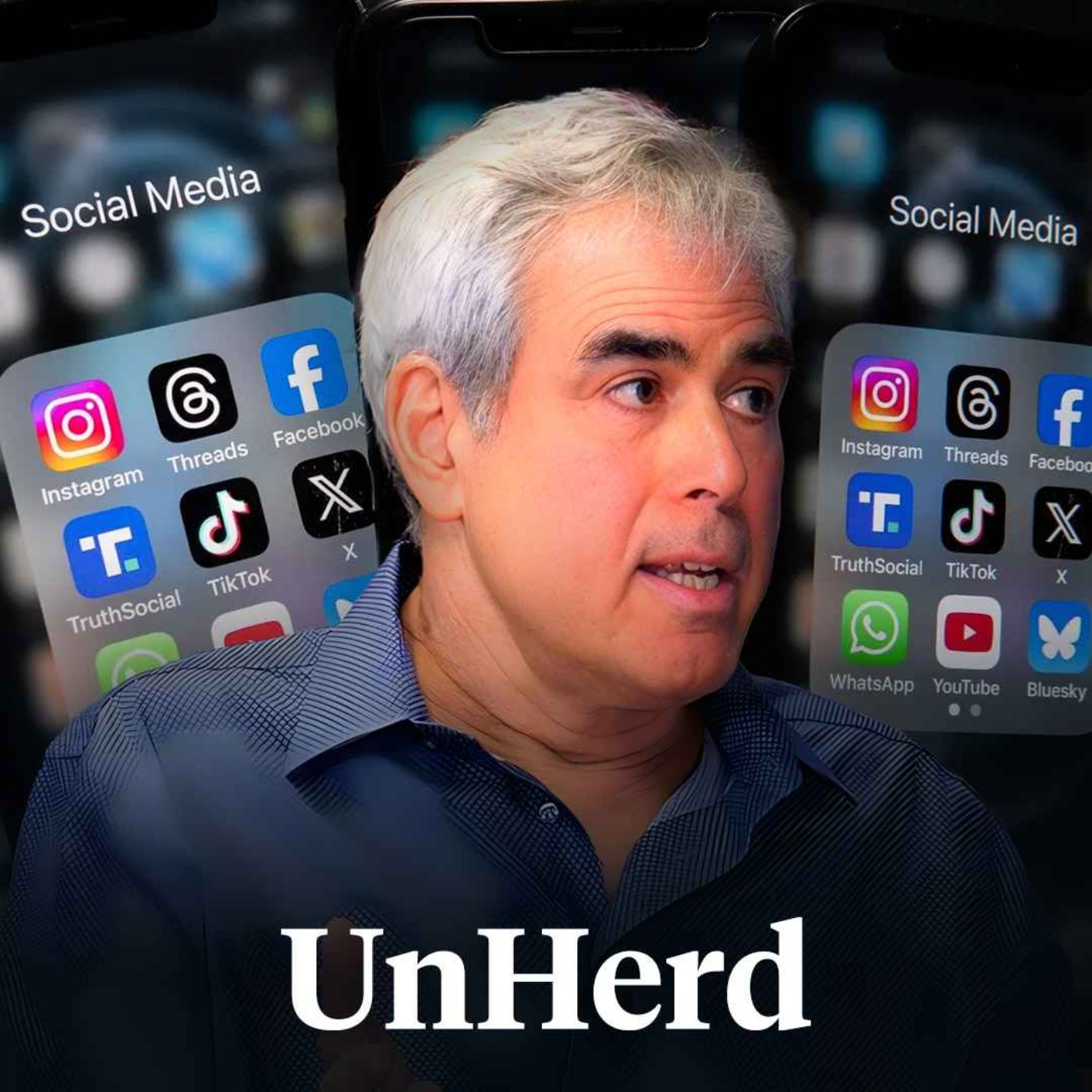
Loading summary
Transcript66 lines
- [00:00]
BetterHelp Ad Voice
A better help ad. Hold on one second. I just need to. What if you had a room where no one interrupts, no notifications, no expectations, just space to talk with. BetterHelp therapy happens in a space that's yours. Visit betterhelp.com randompodcast for 10% off your first month of online therapy.
- [00:31]
LifeLock Ad Voice
Lots of places can expose you to identity theft.
- [00:34]
Minouche Zumarodi
Oh, no.
- [00:36]
LifeLock Ad Voice
That's why LifeLock monitors hundreds of millions of data points a second for threats to your identity, which is way more than anyone can do on their own. If we find anything suspicious, like new loans or changes to your financial accounts, we alert you right away, all through text, phone, email or the LifeLock app. Get the alerts that could make all the difference. Save up to 30% your first year@lifelock.com podcast terms apply.
- [01:08]
Fred
Hello and welcome back to Unherd. One of the big political conundrums of the moment is what level of restrictions should be put on mobile phone social media usage for younger people, generally across the Western world. The Australians have banned social media for under 16. It's now talked about as a new policy here in the uk, but it's become one of those kind of political flashpoints because people are not sure how to balance concerns about young people accessing dangerous material, pornography, spending too much time doom scrolling late at night versus free speech issues, fears that somehow this could be the beginning of a kind of gating of the Internet. There's a whole load of arguments and actually what's been interesting is that people, especially on the political right, who you would expect to support this in protecting childhood family concerns, are actually the most vocal opponents of it. We want to dig into those arguments and fully understand it. And there is no human being better probably in the whole world to do that with than Professor Jonathan Haidt, who joins me in the studio today. He is professor of Ethical Leadership at the New York University Stone Stern School of Business. He is an expert in the psychology of morality and moral emotions. But in the last few years he's really been the global leader around this argument. His book the Anxious Generation has been a global bestseller and it really details the dangers of mobile phone and social media usage, particularly among younger people, and it's having a huge impact. Jonathan Haidt, welcome back to unherd.
- [02:47]
Jonathan Haidt
Thank you, Fred.
- [02:48]
Fred
It's great to be back and welcome back to the uk.
- [02:50]
Jonathan Haidt
I love coming here.
- [02:52]
Fred
So let's just start by addressing some of the arguments that people make in opposition, because I think most of our viewers and listeners by now will be familiar with the Concerns around social media usage, mobile phone usage among younger people. A lot of people, I think, particularly on the political right, are very anxious that the kinds of measures you've been talking about, which are now finally being adopted, I would say it's been an incredibly successful campaign, are opening a new danger, which is that freedom of speech and the free Internet is going to somehow be shuttered. In broad terms, what do you say back to those people?
- [03:32]
Jonathan Haidt
As a social psychologist who studies morality, one thing I've learned is that when there are a lot of people who believe something, they're almost always right about something. So you got to start to understand, you got to start by, like, what's motivating them. If we disagree, don't just start by, well, you're wrong on this and this. Like, okay, where are you coming from? All of this has been bipartisan almost everywhere. But the right has in general been a little faster, a little more supportive. Here it's different. Here in the UK, it's different. Why? Well, I think because here in the UK you've had governments for many years now that are arresting people in mass numbers for tweets. Here we are in the country that gave us our liberal principles, the country that gave us John Stuart Mill. Your government has laws that are cracking down on what people say on content, and that is, I think, really a bad thing. And so I think many people on the right, because they've been very much victims of that, many people starting from that distrust of regulation. So I want to acknowledge that that is a real risk. So the next thing to address is whenever people think about regulation, their mind jumps to, the government is going to judge speech and decide this passes, this does not. Now, that is a nightmare for free speech, and that's something that we almost never see in the US that is so clearly contrary to the First Amendment that we rarely have situations like that. And when they do happen, as like with the university speech codes, they can easily be knocked down. But you don't have that here. I mean, you don't have the First Amendment here. So the first thing to say is when regulations focus on the content of speech, that's a problem. Or there are going to be lots of problems. I think there's broad agreement csam child sexual abuse. So there are a few very limited areas where we think it's okay for the government to say, you cannot post things this, you cannot access this, but that has to be very, very rare. And unfortunately, what's happened in the uk, I believe, from just reading about the laws that you have on the books is because there are some laws that focus on content. You can't say something that will offend people in certain ways. You can't say things that will cause upset. I don't forget how it's phrased. That's what leads to all the problems. What I'm talking about are design based solutions. When you say, here are platform features that are causing the threats to children, do they have to always be getting notifications even at night? Is that a necessary feature? Do they have to be connected to anonymous strangers when they're 12? So there are design features that can be changed that would have a huge impact on child safety and that have generally no impact on free speech. That's where I want the UK to really focus. Design based, not content based.
- [06:11]
Fred
So the new announcement, even in the last few weeks, is that the Prime Minister, the current Prime Minister, we'll see if this measure survives the transition. But the current Prime Minister has said that he wants to bring in a ban on social media for under 16 year olds that includes Snapchat, TikTok, YouTube, Instagram X and Facebook. It's being described as Australia plus. So it's a little bit stronger than what they brought in in Australia. But already the reaction from many people on the political right has been the same, which is that it's somehow a stalking horse. Elon Musk, addressing it directly, says it's a wolf in sheep's clothing designed to bring in this new era of censorship. Lots of people we have engaged with and interviewed and spoken to over many years, Silky Kahlo, Glenn Greenwell, people who are liberals, who care about free speech, are also very anxious about this. I think the idea is that somehow you have to prove your adulthood by when you access the Internet, which is the beginning of a kind of registration process and the end of, of online anonymity. Are they wrong to have that concern?
- [07:18]
Jonathan Haidt
They're right to have the concern about a dystopic world in which you have to show papers to access the Internet. And I can see some countries doing that. So it's not that that risk isn't real, but what we're doing in the Western countries and certainly what Australia did, is nothing like that. It's not about accessing the Internet, it's about the moment of account creation. So kids in Australia, if they want to go to YouTube and search for videos and how should I kill myself? They can do that. Still, there is no restriction on access to content in Australia. It's the moment of account creation when you're signing a contract terms of service and the law at present says if you're seven years old but you say you're 13, you're in you can give away your data to the company they don't need your the company can take everything from you they don't need your parents consent, your parents won't even know. That's the status quo around the world right now. And what the Australia bill does is it says that moment of signing a contract the company has an obligation to verify that you are old enough to sign the contract. Otherwise all children are on social media from the time they're nowadays it's like 9 or 10 they get TikTok accounts. So this is not about show me your papers to access the Internet. This is about a moment we can all agree signing a contract's a big deal if you care about privacy. The moment you sign that contract you are giving away everything to a company that is going to exploit it, sell it, use it against you. The question is at that moment how do you feel about giving up one bit of information? The bit is yes or no over 16. Now some age verification methods and we'll get into this I hope device based verification methods. If your device knows how old you are, if Apple or Google operating system knows how old you are as they do when you for a lot of reasons, if they simply say back to the platform, yes, no at the moment of registration, there's no privacy risk and it's a one time check and remember it's a one time check done just before you give away the store, before you give away all your data for the rest of your life. So that's what the debate is on. It's not can I access, do I have to show a passport to access Wikipedia or any other site? It's when can I sign a contract?
- [09:30]
Fred
So device based age checks are surely the least effective though because many of these devices are shared between siblings, even between entire families. All of these platforms also have a normal browser way of accessing them. So you're just talking about you just need to get a laptop in a family home and start typing in the URL and bingo, you have access. If all there is is a device check, is that really going to make the difference?
- [09:58]
Jonathan Haidt
Right. Okay, so let's go through it. Let's suppose so the current situation is each kid has one or two devices. You have, you know, let's take the Apple environment so you know by the time you're 12 or 10 you probably have a laptop for school, an Apple laptop Let's say, and you have a phone or an iPad and your parents don't want you going to porn, they don't want you setting up an Instagram account. Right now, they're powerless. We, we cannot raise our kids the way we want. We cannot stop them from opening as many accounts as they want unless we keep them always away from the Internet. So that's why there is so much parental support on the right and the left. Because this isn't like, oh, parents should decide. In the world we live in, parents don't have the option of deciding. The companies have pulled our kids into a trap, surrounded them with technology that we can't monitor. No matter how hard we try, we can't really do a good job of it. So parents are crying out for help. So let's imagine the case where three things passed in the uk and let's hope that quickly the verification methods move towards device based rather than what's happened in Australia. Because they went first. Thank God for the Australians, they went first. Most of the platforms are using the Yoti. So you have a face scan. Okay, that's kind of creepy and it doesn't work that well, but it's okay as a first step, like it's just showing proof of concept.
- [11:14]
Fred
The Australians have used face scans as one of the main methods to verify aids.
- [11:19]
Jonathan Haidt
Well, just to be clear, the Australians don't tell the companies what to do. They just say, this is your job. And so the first round, most of the platforms, oh, now the Australia law specifically says platforms, it's your job, but you cannot only ask for a government id. You must provide a way to do it that does not involve an id. And so for now, most of the platforms are using Yoti or they're saying, you know, you can show a, I suppose you can show an ID or, or you can go out to this other platform, do a face scan to see if you're old enough and then come back with the signal, yes or no. Now the face scans, it's a little creepy and it's not that accurate. It's getting there. So that's the way things have started. And if that was the way it was going to stay, then, you know, it's not. I would not be as enthusiastic. But here's the really cool thing. The Australians have created a market for better age verification. And the tech industry is nothing if not innovative and quick to meet a market need. And once Australia announced that it was doing this, and once it was clear, dozens of countries are following, guess what? So many Companies now are competing to make better systems. Apple and Google have each, since Australia announced, come out with APIs that make it much easier for any platform to verify age. So it's getting much better. And if we move to device based verification as the main method. And so to come back to your question now, let's imagine I'm a parent, I've got a couple of kids, they each have one or two devices. I don't want them doing these things. So now I can set their device and I say, no, my kid is this old and he can't change it. I've set it up now when he uses that, if he goes to pornhub, it's going to send out a ping. Pornhub gets a single bit, yes or no. The answer is no, he can't use it. Now, as you said, he'll go to his older brother's device, he'll go to a friend's device. Yes, that's true. And you know what? That amount of friction would be a game changer right now. Every kid can check any site they want instantly while they're waiting for an elevator, while they're sitting on the school bus, while they're in class. They pull it out, they're on. They pull it out, they're on. It's the constant access that's really devastating their attention, their development. And so if we can introduce any friction, that would be so great. Just as we do when we say, you know what, you can't buy alcohol, you have to find an older brother to get it for you. That's friction. Of course kids get around it, but drinking ages do work to at least lower the usage.
- [13:46]
Fred
Just to argue the other side for a moment, should you really have conceded that device based is the only kind of defensible way to do this? Because for the reasons you say, like, there's no point doing it if it doesn't work. That's the other argument you really hear a lot, which is it's not going to work anyway. Kids are so smart, they're going to find ways around it. Not only borrowing their older brother's hand me down iPhone or whatever. Yeah, you know, there's VPNs, there will be kind of clever systems just as ingenious as the new age verification solutions. There will be bypassing age verification solutions. What's the argument against saying, well, if we're going to do it, let's do it in a draconian way that actually works?
- [14:28]
BetterHelp Ad Voice
Yeah.
- [14:29]
Jonathan Haidt
Okay, good. No, this is great. I want you to hit me with everything you got, I want you to go through every single argument. So now let's do the one. Oh, the kids will just get around it. So Australia, they took step one. They said, you platforms, you have to do this. And an amazing thing happened. All 10 platforms complied. Nobody sued. They all said, okay, we'll do it. That's great. Another amazing thing happened. The sky didn't fall. Hardly anyone was blocked from getting to their account. Hardly any adults were blocked. That's amazing. A third amazing thing happened. The usage of social media sites by Australian teens was went down 20 to 40%. There are different studies that measure different things. Do you know how hard it is to change teen behavior on a national level? It takes years to change drinking habits, smoking habits. And so the Australia bill right away caused a decrease. And a lot of people. There's a global story going around now. I'm sure it's promoted by Meta and others saying, oh, most kids are still on. I guess it didn't work. There's a narrative to developing. The Australian bill failed. This is step one. They're doing something really hard with technologies that are not so good right now. And they got a 20 to 40% reduction in social media use, it looks like. Now the Australian regulator goes to the platforms that have done the worst job and they say it wasn't good enough. You have to do better. Well, now there's new techniques from Apple and Google and everywhere else. They will do better. So it doesn't bother me that most kids in Australia still have access to social media. I should point out even if the law was perfectly enforced, every kid has access to social media. The Australia bill doesn't stop them from going to YouTube and looking up videos. You can have access to that. We're not trying to block access to information. It's account creation. When kids have an account, that's when the really bad stuff happens. That's when they can communicate with strange men. That's when the algorithm gets to know them. So yes, they're getting on it for now. And that will get better and better and better. Every country that follows Australia will be able to start at step two or three. Nobody else will have to take the step one that the Australians.
- [16:31]
BetterHelp Ad Voice
A better help ad. Hold on one second. I just need to. What if you had a room where no one interrupts, no notifications, no expectations, just space to talk with. BetterHelp therapy happens in a space that's yours. Visit betterhelp.com randompodcast for 10% off your first month of online therapy, you're great
- [17:02]
LifeLock Ad Voice
at protecting your data, but lots of places could still expose you to identity theft.
- [17:07]
BetterHelp Ad Voice
I thought it was safe.
- [17:08]
LifeLock Ad Voice
If that happens, LifeLock gives you a US based restoration agent who will stick by your side from start to finish. Phone calls, filing documentation, preparing insurance claims. Your agent handles it all. In fact, we're so confident restoration is guaranteed. Pour your money back. Isn't it nice to have someone like that on your side? Save up to 30% your first year@lifelock.com podcast terms apply.
- [17:34]
Fred
20 to 40% is still not that impressive if it's actually a government band. I mean, you could say you ban something and it only reduces by 20%. That doesn't sound like a huge success. Why not just take the hit on this question of anonymity and just require some kind of ID or actual logging in to prove who you are to access the open Internet? And then, yes, you've conceded that point and civil libertarians will be upset, but at least you actually get to age gate content.
- [18:06]
Jonathan Haidt
So you're asking the strategic question, would it have been better if the Australians came in really draconian? I think the answer is no, because first of all, you have to remember where the world was two years ago or a year and a half ago when they passed this legislation. People thought this was impossible to do. This is too bold. People will be upset, there'll be a riot, the kids will riot. It's going to be horrible. And in general, in a free country, governments should not be banning things that are popular that the people want, unless there's a damn good reason. If the legislators get too far out ahead of public opinion, there's going to be a revolt. And so the Australians went first. They probably assumed, as we all did two years ago, that this would be very hard to do, there'd be a lot of opposition. So they went in carefully. They did not go in draconian. They're exploring new territory. If they'd gone in draconian said, right, you just have to show us your passport, show us your driver's license, that's it. Like, that would have been really bad. That would have been like a papers, please social media. And so the Australians decided to go in soft, which is, let's just first ask them to do something. You platforms, you do something. And then gradually, with multiple rounds of measurement, and they've already sent the first round of letters to the ones that are doing badly. Multiple rounds. That made sense when they enacted this. But what's happened since? They enacted it on December. It went into force December 10th, there's been a global tipping point. A global tipping point because when the Australia law went into effect, there was a lot of news coverage and it was overwhelmingly positive and a lot of commentary on social media. And people were saying, look what the Australians are doing. Hey, why can't we do that? And everybody saw that. Everybody saw that the Australian law was a good thing. And this is why we've seen so many countries following in January, February and March. Like in those three months, the world tipped. Also in those three months, we had the trials in Los Angeles. Meta and Google were found guilty of designing for addiction. And the world saw the quotations from their staff, the quotations about how they were aiming for addiction. Grok put out the notify button. So there was global disgust at what this is doing to kids in January, February, March. So now there's enormous public support from the right and the left. Wherever you look, you find majorities of parents, often very large majorities of parents, say, yes, we want this. And so now whoever goes in next, they can start more draconian. They can say, no, I don't want governments to say, you have to use this method. But they can say, you have to reach this compliance bar or you'll get a large fine. The Australians had pretty small fines. As a strategic question, the answer is the Australians did the right thing by going in soft. But every other country can go in harder and harder as the technology improves and as the public support for it improves.
- [20:55]
Fred
So if you are a libertarian or civil liberties campaigner and you're watching this interview, you might be concerned by what you're saying, because it implies that there is a sort of gradually tightening noose. It's exactly what the conspiracists most fear, which is that they start gentle. And then, as John Haidt has just confessed, every year they're going to get tighter and tighter. So fast forward five, ten years down the line and the free Internet no longer exists.
- [21:22]
Jonathan Haidt
Okay, okay, what?
- [21:24]
Fred
Would you fight back on that?
- [21:26]
Jonathan Haidt
That's a reasonable thing to think, because governments sometimes work that way. What I'm talking about is not tightening the noose on kids or people or speech. What I'm talking about is holding the companies to a low standard at first, just to get started, and then raising the bar for the companies. You have to do better. And as the technology improves. And what does it mean to improve the technology? Improving means it's faster, more convenient. We don't want to inconvenience people when they're creating accounts, it becomes more accurate and it Becomes more privacy preserving. That's the progress we're seeing. And that's why I'm so excited about device based verification. Because device based verification poses zero privacy risk. Porn has been blocked in a few US states. And what pornhub does is they block access and they put up a thing and they say, sorry, we can't show you anything. And what we want is device based verification because we don't want children. We just want to know, are you old enough? That's all we want to know. And I actually think they're right, that that is the most privacy preserving thing. Nobody wants to show a driver's license to access pornography sites. There is a real risk that they would get hacked. But instead if pornhub just sends down a ping. Okay, this device. Yep. Okay, you're in.
- [22:40]
Fred
So, so just to be clear then the family laptop, or dad's laptop that is out lying there all evening, in your view, that should remain completely open so that the 11 year old go down at 7pm Open it, type in any URL they want.
- [22:57]
Jonathan Haidt
Yes.
- [22:58]
Fred
So you're only trying to target account based.
- [23:02]
Jonathan Haidt
Exactly.
- [23:03]
Fred
Addictive.
- [23:03]
Jonathan Haidt
That's right. I mean, if there was a perfect way that all adults could do what they wanted and all children were blocked from all pornography sites and it didn't violate, it didn't raise privacy, I'd say, yeah, let's go for that. That we're not going to get that there is no perfect way. If we could just get some friction, if we could just make it that the kid can't be on porn all the time. They can't be on porn overnight in their bedroom, they can't be on porn on the school bus, they can only be on porn when dad's away and, and they happen to know his password and they can get into his computer and they can watch porn, that's okay with me. I'm sorry. You know what? Okay if you use this clip. I'm not saying it's okay for kids to watch porn. What I'm saying is because we'll never get to perfect. I'm okay with a world like the world that I grew up in with porn and alcohol. It was hard to get and we sometimes got it. That would be so much better than what we have now. The most important thing we want to do here is help parents raise kids the way they want. And so if parents choose to put super high security on their computer, I mean, look, if you just don't tell your kids your password, they can't use it. I don't think I'd favor governments specifying exactly these high. You know, we're not talking about terrorism here where we've got to be 100% effective. We're talking about a reasonable set of obstacles to under 16s opening accounts and then getting sucked in. And, you know, childhood has largely become swiping through short videos. That's the main thing that kids do. This is horrible. This is horrible for the development. IQ is going down, test scores are going down, social skills are going down, attentional capacity is going down. So something has to be, we have to do this. We have to do this. The question is, how do we do it in the best way? How do we do it in a way that is privacy preserving? That doesn't make it easy for authority. Well, look, authoritarian states will do bad things, but we're talking about the democracies here. How can we do this in democracies? And for that I'm willing to make trade offs.
- [24:58]
Fred
Another argument that is often found against your movement is that sure, Jonathan Haidt has a point. Most people, as you say, agree that these are dangerous tools, dangerous ways for kids to be spending all of their time. However, the power should sit with the family, not with the government. And many conservative minded people who are basically sympathetic with what you're saying want solutions that are about empowering parents to better control what their kids see, rather than the word ban is a kind of anathema that will alienate them all. What do you say to those people? Why can't we find solutions that say here this is a better way for mum and dad to raise their kids in the way they want?
- [25:45]
Jonathan Haidt
You know, as an American, I mean, we Americans are generally more libertarian than you are in Europe. And you know, the idea of laws that tell parenthood you can't give your kid an iPhone like that seems weird. Although I've heard that from a number of British people.
- [25:59]
Fred
So in general, I'd say Britain is more libertarian than continental European.
- [26:03]
Jonathan Haidt
Yeah, that's right. I would agree with that too.
- [26:05]
Fred
Yeah.
- [26:05]
Jonathan Haidt
So if there was a way that parents could make these choices, and if most parents were being successful in that, then I'd want to follow that route because the great majority of parents don't want their kids on Instagram, they don't want their kids on TikTok, they don't want their kids on Pornhub. So if there was a way to do that that was effective, okay, then that could be a good alternative. Well, we're 15 or 20 years into the social media age. No one's found that way. You have two married parents who have PhDs understand tech, try really hard to restrict their kids digital environment to keep out the dangerous stuff. They have a lot of trouble. They usually fail in Silicon Valley where they know the most about this. A lot of them send their kids to schools with no technology. A lot of them keep their kids away from the technology because they know the parental controls don't work well. It's a cat and mouse game forever once you go that route. And we're talking about the most equipped families with two parents, lots of money, lots of time, they can't even do it. Most kids are not growing up in that environment. Most kids are growing up with a single parent or a working class home where there's not a lot in the way of resources. And mom just I've got to make dinner, here's the iPad. That's the way kids are growing up. So if you say oh, parental choice, you're condemning most kids to a life in which their parents just can't manage it. And they basically are at the mercy of all the companies. So yes, in theory, the more parental choice you give, the better. I fully agree with that. But why is it that large majorities of parents on the left and the right want the government to say age limit? Same thing with cigarettes. Do we think it should be parents choice whether. Well, okay, sure, if you want to give your kids a cigarette, you still can. But do we think it should be parents choice whether a kid can buy cigarettes in a store or do we think the store should age check? So parents need help and they want an age limit as on other dangerous products? If something is addictive, it's hypersexual, it shows horrific violence. We put age limits on social media, has all three of those properties.
- [28:17]
Fred
So the way to make the same case in kind of conservative language then I guess is this is a way to empower parents to parent in the way they would like. Yes, because it's just not realistic. Faced with all the pressures at school, the skill of the technology companies, the time available for them to do it without. So it's yes, it's a government intervention, but it's a way to help families bring out their kids better.
- [28:44]
Jonathan Haidt
Exactly. I think that's a good way to put it in more conservative language. I would add what I've observed, while it's totally bipartisan in multiple countries, what I've seen is that the conservatives like the social conservatives, not the sort of libertarian or business conservatives, but the social conservatives tend to be the Quickest to see the threat and to want age limits. Because I think social conservatives are the most sensitive to threats to the family, to the way the modern world, commercial incentives, porn, exploitation, sexualization of girls. Conservatives, I think they feel that threat to the family a little more and that's why they tend to be quicker to support this. So I would just add one element which is in addition to the list of features that you said in the presence of predatory companies, companies that have shown us over and over again. And we see it in all the leaks, we see it in the documents brought out by the, by the lawsuits. These companies are brilliant, they're rich. They've hired the best psychologists whose goal is to addict your child. That's what they're trying to do. And so do families want some help guarding their kids against predatory companies? Hell yes.
- [29:53]
Fred
In the minds of some famous social conservatives, this battle has played out in recent years and the more pro tech argument seems to have won. I think for example of the vice president, J.D. vance. This is someone whose whole political way of thinking is that predatory companies have hollowed out the middle class, the industrial base and also big tech has been incredibly damaging. That was part of his earliest way of thinking. In fact, in 2022 he gave an interview to a Catholic magazine where he called for a pornography ban, outright ban on pornography. Now, 2026, the same person is spending a lot of his time criticizing things like the Online Safety act and measures to control social media access as part of a stealth censorship program. What's your analysis of what's going on in that kind of political scenario? Because the same thing you can find over here with people like Nigel Farage who are also broadly in favor of things like restricting access to social media, but now have decided to oppose it for similar reasons. What's happening there?
- [31:01]
Jonathan Haidt
Yeah. So without commenting on why politicians change their minds and political calculations, I think what we're seeing here is the importance of really distinguishing things that protect children, especially by age access, and things that try to judge and control speech. Again, it's content based versus design based. So here's what I've seen happen. A really interesting thing happened, a really informative thing happened in the US around our one bill that almost made it. The US has never done anything. We created this monster. We unleashed it on the world. We said as long as you say you're 13, you're in. And we've never done anything since 1998 to help the one bill that almost made it through two years ago, Cosa, the kids online Safety Act. Let me just walk through how that happened because it answers your question. So it was modeled partially on the British age appropriate design code. It said, companies, if you're going to serve children, you have to do certain things. It didn't have an age limit. It just said you have to have age appropriate features. And it was opposed in Congress by the Republicans. Meta gives a huge amount of money to Congress. It passed the Senate 93 to 3. I think it was overwhelming bipartisan support in the Senate goes to the House. The tech industry really concentrates on the House. The objection is, well, this might violate free speech. Okay, so it gets stalled.
- [32:27]
BetterHelp Ad Voice
A better help ad. Hold on one second. I just need to. What if you had a room where no one interrupts, no notifications, no expectations, just space to talk with better help Therapy happens in a space that's yours. Visit betterhelp.com randompodcast for 10% off your first month of online therapy,
- [33:00]
Fred
it's worth saying companies like Meta are among the highest spending lobbyists in America.
- [33:06]
Jonathan Haidt
We know that, that they spend more Meta in particular. But the tech industry as a whole, including Google, they spend unbelievable amounts of money to help the Republicans win races. And of course they did it with the Democrats when the Democrats were in power. And so they have a huge amount of influence. But here's how it played out. So even though most House members were supportive, even though it passed through the first committee, it was never brought up for a vote. And the argument given by the House leadership was, oh, it has free speech concerns. Okay, so then what happened? Linda Yaccarino, the CEO of X, she got involved because, and I met her at a conference and she said, our business, we don't want to exploit kids. We don't need kids. Like, we're fine restricting it to over 16. She got involved to try to address, to put in more language to address the, the free speech concerns. Meaning like not about content. This is about kids in age. So she tweeted something strongly supportive of Cosa. And then Elon retweeted her, which we take to be a signal that Twitter, Elon, Linda, are supportive of, of protecting kids if you separate it from concerns about regulating speech. And then Donald Trump Jr also tweeted in favor of Cosa. And then of course, the first lady, Melania was very active in supporting the non consensual deep fake porn act. I forget what it was called, the take it down Act. So we have a lot of signs from the Trump administration that if we're talking about protecting kids, we're in but if you're going to pass a law that says like, oh, you can't say this or you can't say things that are offensive, then we're going to come down hard on you because we know what happens when you go down that road. So again, if you keep them separate, we want design based solutions that will make it safer for kids, that will allow countries and companies to age gate. That's what we want. We don't want speech regulation. If you separate them, then I think Vance's concerns are satisfied.
- [35:01]
Fred
Here's the strange thing, looking from outside America, that as you say, this monster, this genius creation of social media, used to love it, big tech, came from America, it has conquered the world. And now it is countries outside America that are finally trying to restrict it. Australia, European countries, now the UK and many countries around the world, as you say, within the US doesn't seem to be happening at all. What is the prospect inside America for your campaign to actually get somewhere?
- [35:32]
Jonathan Haidt
So when I wrote the book, that's the way I thought. I thought our Congress is broken, our politics is so easily corrupted by legal donations. I thought okay, how do we solve this problem when we don't have any support from Congress? And so I wrote the book focusing on norms, on four norms to roll back the phone based childhood. No smartphone before high school, no social media before 16 phone free schools and far more. Independence, free play, responsibility in the real world. Those were the four norms laid out in the anxious generation. And I thought we'll have to do this without government. But the two things I didn't fully realize are one, we have 50 states and those state governments mostly work and they jumped into action. The states have been amazing. More than 40 of our 50 states have, within a year and a half of the book coming out passed legislation for phone free schools. So our states jumped on this. A bunch of states raised the age that's held up in court. So it hasn't been implemented. But state governments have been amazingly active at trying to protect kids. And it's totally right left, there is no red blue difference. So American government, other than Congress, which is partly bald, other than Congress, we are getting a lot of action in the US and then the other thing I didn't fully appreciate was just how active the rest of the world would be, beginning with Australia. But as soon as Australia went into effect, more than a dozen countries, France being the first European country, Spain wants to do it. So Scandinavia, the Greek prime minister has been amazing. And then the third piece is while it looked like America Created this and we're letting it run and we don't care. There is a huge tech lash in the US now, especially around AI. Look, they fooled us once on social media, they took our kids, they've escaped responsibility. They've never been able to be sued until this year. They've behaved abominably towards their kids in social media. They did the same thing with ed tech, pushed it into the schools. It's damaging scores, it's damaging education. They tricked us on EdTech. And now people are pretty skeptical about AI in America. I think what I've seen is in the developing world, they're gung ho tech AI. Yes, technology is good. We want to catch up. We want it in the west where we were kind of overwhelmed with this much more negative and in America, especially negative about AI. So I think two years ago I was thinking the way you just did, but I think the whole world has changed in the last two years.
- [37:48]
Fred
It's also money though, isn't it? I mean, it's a huge growth engine for the American economy. These are huge American companies. And a lot of the lobbying, a lot of the diplomacy with the European Union is about American tech companies having access to these markets and these kind of restrictions reduce their business model.
- [38:10]
Jonathan Haidt
That's right.
- [38:12]
Fred
How can you solve that? I mean, there is no American administration that is going to want to clip the wings of the best thing in its economy.
- [38:20]
Jonathan Haidt
I don't think that's true. Two years ago, that's the way it seemed. Look, we were all techno optimists in the 1990s. The reason that American law said no one can sue these companies, you have complete freedom from liability. No one can sue you for what people post, which was interpreted broadly. The reason is because we thought that way back then. This is this new technology. It's amazing. And it was amazing when we all saw the Internet the first time. I mean it was incredible. And Congress basically said, let's not clip the wings, let it rip. Okay, that was 25 years ago. That was 30 years ago. Things are really different now. And now a lot of people are crying out for regulation. A lot of people feel oppressed by these companies. A lot of people see the damage. So there's not a lot of public support for these companies other than buying the stock, because that's been most of the growth in the stock market.
- [39:06]
Fred
So you think the mood is changing against them?
- [39:08]
Jonathan Haidt
Oh yeah, the mood is changing very fast against them. And especially because of AI. I think they really. The rollout of AI has been deeply Threatening to people as I think it should be. And it's not just the job apocalypse which is coming, it's many of there are threats.
- [39:21]
Fred
So you think American administration would take a hit on the economy in order to deliver this as you see it, safely?
- [39:29]
Jonathan Haidt
Well, it's not clear to me that it's a hit to the economy. If it clipped their earnings, okay, those growth stocks, they might grow a little slower. So okay, there would be some financial implication, but it's not that it would slow down the economy. It can't be good for the American economy to make our children stupider and stupider and sicker and sicker every year. That just can't be a long term growth story strategy for the US While China is able to say, oh no, our TikTok is healthy, kids don't get notification. I mean China is able to regulate. It can't be a growth strategy to say tech, do what you want to our kids, we don't care. Also in terms of how we get out of it, the companies are in many ways more powerful than countries. I think the best analogy is the British East India Company which basically was given a license to rampage, pillage, do what you want, start wars, kill people. That's essentially what our tech companies have been given. And the Trump administration has been pretty aggressive in threatening countries. If you do this, we're going to put tariffs on you. I don't think that's appropriate to do. I don't think that's historically been done to our friends, at least not to this degree. So I think whatever future administration, whether it's Republican or Democrat, I don't think they're going to be as aggressive in threatening countries who try to pass change child friendly legislation. Also, now that it's clear the whole world is unifying on this, it's a very different game than if it was one country trying to stand up to Meta. Like Australia tried to stand up on something about advertising, I forget, but I think Meta was able to sort of cut them off and say, oh yeah, you go against us, you're going to lose. But when it's most of the developed world countries standing up at the same time, it's a different game.
- [41:08]
Fred
Final question, John Haidt and I'm going to give you the microphone to end our conversation today. If you are talking to a somewhat conservatively minded person, imagine this person has been burnt over the last seven years. They've went through the COVID era, they were witnessed draconian curtailments to their liberty, all done under do goody language about protecting public health and the rest of it. They saw pretty much a conspiracy between government and social media to censor what should have been perfectly legitimate political speech. And they are deeply skeptical of people saying the word ban in connection with something that sounds virtuous in terms of helping people, they might agree with you, they might have kids that they're anxious or on the phones too much, but they're kind of done with people coming in saying we need to help you by banning this or restricting your freedom. What is your message to them?
- [42:11]
Jonathan Haidt
My message to them is what I've learned from 30 years of studying political psychology is that each side, the right and the left and libertarian. So in my book the Righteous Mind, I go through what each of them believe. Each of them are wise to certain threats to society or the family. And in a well functioning society, each one is voicing those concerns. And there's a mechanism for sort of balancing them or taking everyone's concerns into account. So conservatives and libertarians need to constantly be witnesses that whatever is proposed could be misused. You can't just trust government to do what it says. So they need to be the watchdogs. And so I would say to you conservatives, you are also the most sensitive to threats to the family. Even back in the 80s and 90s, it was conservatives who were saying, we can't just have these sexually explicit lyrics surrounding our kids. We can't just have porn everywhere and smutty shows. Conservatives are also like the canaries in the coal mine for the moral degradation of our children. And so I think conservatives are wise to that. Keep speaking up for that, that we can't be raising our children in a toilet and we can't be having our government decide what anyone can say. Keep voicing those concerns and that's how you end up with a really good policy in your country. This has to happen. We can't go. The status quo is just completely unworkable. The climate that kids are being raised in, it's not just degrading, it's not even good for free speech. Kids are afraid to speak on social, to speak honestly on social media. It makes them lie, it makes them present a false self. The status quo is horrible for everyone. It has to change and it's going to change. The question is, are we going to do it well in ways that are privacy preserving and that don't give government the right to judge who can say what, or are we going to do it badly? And so I think the UK is really ground zero for this debate. Because you do have a problem with government curtailing of speech, but you also the founders of liberalism, liberalism in the sense of individual liberty. So I'm really hopeful that it works out well in the uk and we need the Conservatives to be voicing their strong concerns, their right to be concerned. But I'm confident, given what I'm seeing and given the broad public support that we have to deal with this problem, I'm confident that we're going to get it right. Maybe not in every country at first, but let's see how things go and let's learn from each other. I think we can do this and I think we have to do this.
- [44:36]
Fred
Jonathan Haidt, thanks for your time today.
- [44:38]
Jonathan Haidt
Ready? My pleasure. Thanks for letting me talk to your audience.
- [44:41]
Minouche Zumarodi
Foreign.
- [44:50]
Jonathan Haidt
Powers the World's Best Podcasts. Here's a show that we recommend.
- [44:57]
Minouche Zumarodi
Go Touch Grass. You have probably heard this phrase, maybe you have even said it. But beneath the sort of light hearted nature of this meme is something very real and important. A growing sense that staying in touch with our humanity and being present in our bodies matters more than ever in today's digital world. My name is Minouche Zumarodi and I am taking over as host of TED Talks Daily this week to explore what technology is actually doing to your body and mind. In special interviews with scientists, doctors, parents, artists and more, we're going to dig into your physical and mental mental health on tech, how we think about our bodies differently now, how we relate to new innovations that are amazing but also a little scary and how we can live a healthier life in this high tech era. Tune in on TED Talks Daily. Wherever you listen to podcasts,
- [45:58]
Jonathan Haidt
ACAST helps creators launch, grow and monetize their podcasts everywhere. Acast.com.