Loading summary
Transcript70 lines
- [00:00]
A
The longer you stay alive, the longer you can enjoy Boost Mobile's unlimited plan with a price that never goes up. So here are some tips. Do not parallel park on a cliff if you want to enjoy an unlimited plan with a price that never goes up. Do not mistake a wasp nest for a pinata if you want to enjoy an unlimited plan with a price that never goes up. Do not microwave a hard boiled egg if you want to enjoy an unlimited plan with the price that never goes up. Stay alive and enjoy Unlimited Wireless for $25 a month forever. With Boost Mobile. After 30 gigs, customers may experience lower speeds. Customers will pay $25 a month as long as they remain active on the Boost Mobile Unlimited plan.
- [00:30]
B
Parle tu francais?
- [00:32]
A
Hablas espanol? Par l'? Italiano?
- [00:35]
C
If you've used Babbel, you would Babbel's conversation based technique teaches you useful words and phrases to get you speaking quickly about the things you actually talk about in the real world. With lessons handcrafted by over 200 language experts and voiced by real native speakers, Babbel is like having a private tutor in your pocket. Start speaking with Babbel today. Get up to 55% off your Babbel subscription right now at babbel.com acast spelled B A B B E L.com acast rules and restrictions may apply.
- [01:16]
B
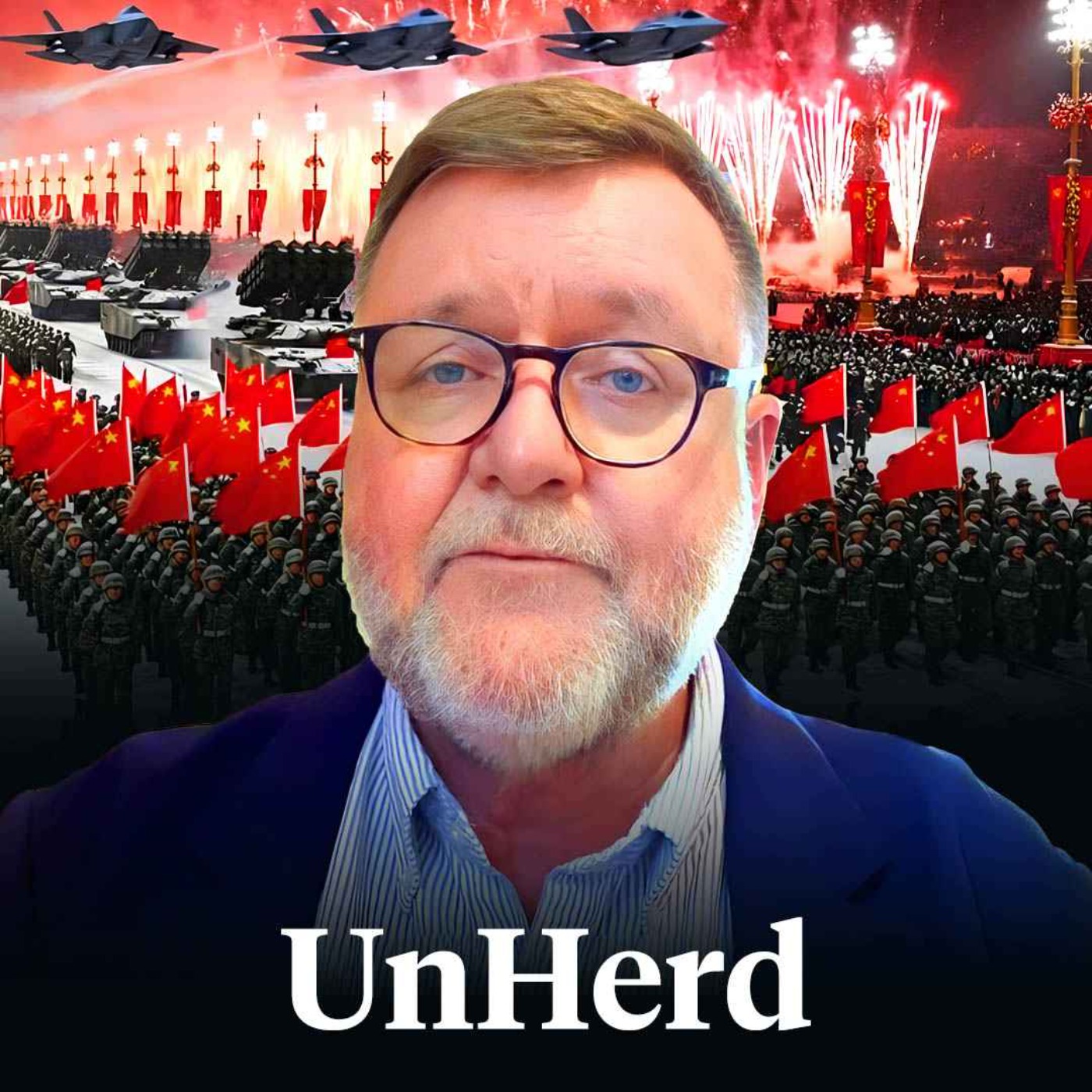
Are we sleepwalking into a new world war? It's obviously the biggest question, the most frightening question, perhaps the most important question that you could ask. And here at Unherd we are quite careful before putting in front of you people who claim imminent catastrophe because the stakes are so high. But this time we felt we couldn't ignore it. Because the person we're going to talk to today is called Professor Odd Arne Vestad. He is a historian. He is professor of History and Global affairs at Yale University and he is the author of one of the most definitive histories of the Cold War. He's co author of the Penguin History of the World, no less. And so when he comes out in his new book, the Coming Storm and says that he observes very specific and detailed analogies between what is happening today with the emerging great powers and what we saw over 100 years ago in the run up to the First World War, we felt it was really important to dig into it and see just how far those analogies can go. I'm delighted that he joins us now. Welcome to unho, Professor.
- [02:26]
A
Thank you. It's a great pleasure to be with you.
- [02:30]
B
So I guess let's just start with the Big thesis. What you're saying is that you see in the emerging geopolitical shifts that are happening now something very reminiscent compared to the years running up to 1914 and the catastrophe of the First World War.
- [02:48]
A
I should start by saying that this is a book that was written very much in irritation, which is a wonderful kind of tool to get you into book writing. And the irritation was primarily with the Cold War comparison or parallel or simile that's often used for our own time. And since I spent a reasonable amount of my own career looking at the Cold War from an historian's perspective, it's quite clear to me that whatever we are in at the moment is not a Cold War. It doesn't have any of the hallmarks of that great, great conflict. So I started looking for other possible.
- [03:21]
B
Sorry to interrupt, but let's just explain that because I've had Neil Ferguson on this show talking to me about Cold War ii.
- [03:29]
A
Sure.
- [03:29]
B
Why is he wrong? And why is the Cold War not the right frame?
- [03:33]
A
I think he's wrong for three main reasons. This is not a Cold War in terms of structure. It's multipolar rather than bipolar. China and the United States are perhaps the most significant poles within the system. But there are other great powers of significance. It reminds me much more of of the late 19th century than the Cold War. Secondly, different from the Cold War, the competition among these great powers now take place within the same economic system. The Soviet Union self isolated from the expanding market oriented system globally today everyone have accepted that system and want more for themselves within it. And then finally, this doesn't have the ideological divides that the Cold War was infamous folk. There are differences for sure between say China, Russia, India, the United States. But this is not a conflict or a set of conflicts that's driven by ideological zeal, very unlike what you found back then. So there are many more dissimilarities, but those are the key ones.
- [04:34]
B
First lesson is banked there, that when you hear people going around saying it's just the Cold War Part 2, be skeptical of that. What you found is another area of history that you think is more relevant, and you mentioned it there, which is the 19th century or the late 19th century and into the early 20th century. So what from a big picture do you think are the most close comparisons?
- [04:57]
A
Multiplarity, the sense that there are many great powers contending against each other, which of course doesn't mean that all of them have equal power, but they're able to act autonomously is a big, big similarity with the world Back then, the fact that you have a rising power back then Germany, now China, that's coming into its main position very quickly within what was then Europe and is today East Asia, the most significant parts of the world, is another similarity. The collapse of globalization. The 19th century globalization was very significant and led to higher degrees of economic and social interaction than we have seen at any point since then. But by the early 20th century it was starting to recede. A lot of people saying we're not really benefiting from this, especially within the establishment great powers in Europe, Britain, France, Russia. That collapse of globalization led to a strong emphasis on nationalism, a strong emphasis of populism. I think those are some of the main similarities that we see with what went on back then and the kind of situation that we have today.
- [06:18]
B
Well, let's take them in turn and really kind of dig into them. So the first is this idea that we are entering a multipolar world order, which is different.
- [06:26]
A
I think we're already in it. I don't think we're entering it. I think we are already in a full fledged multipolar order today.
- [06:32]
B
Why is that especially similar to the late 19th century or pre second world war? Could you not make the case that history is normally multipolar and the Cold War was the exceptional period?
- [06:42]
A
I think that's entirely true. I think the 20th century in many ways was an exception to this. The Cold War was indeed in many ways historically an aberration. It's very rare to find these kinds of bipolar systems, or at least bipolar systems that last for a while and do not end in cataclysmic war. Multipolarity is much more common. The last time I think we experienced, though in a full fledged form was in the early 20th century. The kind of multipolarity that existed in the interwar years was a very different kind because it came out of the disasters of the First World War. It was based on a set of hateful ideologies that were directly connected to the disasters that had gone before. So I think if you could call it a normal multipolar system, last time we saw that around was really in the late 19th century and early 20th century.
- [07:34]
B
And I suppose if we are looking for that comparison, there was a kind of self conscious competitiveness between those powers. At the time they were mainly European powers. It was Britain and France and the increasingly powerful Germany. They were scrambling for territory, expanding their empires and measuring them up, measuring themselves up against each other. Do you see that kind of atmosphere starting to happen now?
- [08:00]
A
Oh, for sure. I Mean, I think you see a lot of that. I think you see a lot of attempts by great powers to secure areas that they contend belong to them or are connected to them. Think about Russia's behavior with regard to Ukraine. Think about China's behavior with regard to East Asia. Think. Think about the most recent US national security strategy that emphasized the Americas, not just North America, but all of the Americas as an area in which the United States had a particular role to play. So I think we will see more of this in the years going forward. I think we'll see a lot of competition, obviously, if these powers can sustain it on a global scale, but even more significantly on a regional scale. And that's one of the similarities that you have to the world before 1914.
- [08:47]
B
And so within Europe, because they're often there are famous books and they've been adapted about those, even just the weeks running up to the First World War. And I just remember being struck by how interwoven those countries apparently still felt even though they were competitive. So in 1914, there was a sense that it possibly could never happen because there were aristocratic Germans walking around the streets of London. The ambassadors were all friends. The economy were quite finely woven together. And therefore there was some people, at least feeling like war could never happen right up until the day before it did.
- [09:27]
A
Three of the heads of state in the warring countries were cousins. The German Kaiser, the Russian Tsar, the British King, Kaiser Wilhelm grew up with a British mother speaking English at home. The oldest, favorite grandson of Queen Victoria. She quite literally died in his arms. And yet a few years later, these countries are at war with each other. So I think it's very important not to think that the kind of integration that we've seen over the past two generations takes away the real danger of war to some extent. It might actually increase it because of the intensity of competition within the same kind of economic system. And I think that's an interesting parallel to our own time. It's not lack of information, it's not individual crisis that leads to the kind of pressure and tension that we see today. It is the level of competition among the great powers.
- [10:23]
B
So, for example, the competition over semiconductors, processors, all of the components of the AI revolution is where one of the sharpest areas of competition at the moment. Taiwan is obviously kind of at the cutting edge of that. What would be the analogy? The nearest comparator in the kind of pre First World War period.
- [10:45]
A
So there are two aspects of this that I think are important. One is the increasing technological competition that you find in Both eras, in fact, I think that's one of the most interesting avenues for comparison that you have. The late 19th century went through this tremendous technological revolution. Telegraph, telephone, steamships, railroads, the first aircraft. This sense that things were changing very, very quickly in terms of technology. And that made people more afraid. It didn't make them more secure. And I see a lot of that happening with the AI revolution in our own time, with autonomous warfare of various kinds. It's a similar kind of fear that one would run out of time in terms of a crisis if a real world class crisis were to come along. And then in addition to that, of course, you have how much all of this is connected to East Asia. And Taiwan is the perfect example of that. So you have parts of this technological revolution centered on one area, one region, where Taiwan seems to me to have many of the hallmarks in pre1914 terms of Bosnia, Alsace Lorraine and Belgium rolled into one. It has the issues connected to nationalism or Bosnia. It has the territorial implications of the endless conflict over Alsace. It has the strategic implications of Belgium, which was the only country in Europe that Germany should not invade if it wanted to avoid an immediate conflict with Great Britain. And yet that is exactly what it did in terms of achieving an early victory. Many of these structural frameworks are. They're not identical, but they are frighteningly similar.
- [12:31]
B
So just to understand that last point, what you're saying is that these emerging great powers that are in kind of competition with each other in a multipolar system, it's not necessarily a direct conflict between the great powers that kicks it off. It can be these smaller, tangential areas you mentioned, Alsace Lorraine, which is a controversial area between France and Germany. Bosnia, which has its own particular history. And you're saying that places like Taiwan are the equivalent now, where they're kind of flashpoints that could get a conflict going.
- [13:05]
A
Very much so. I mean, great power war very rarely breaks out because of structural conflict among great powers. This is true for many different historical systems. It breaks out because of some kind of regional or even local conflict. That it then becomes very, very difficult to turn back. Particularly if there is the sense, as we have today and as we had back in 1914, that the established alliance systems, which were supposed to be a deterrent against that kind of war, may not be fully functional. So I think that's an added problem in our own time. Think about what is now happening to the US Commitment to NATO that I think are very, very dangerous because they add this general sense of opportunity that might be there Particularly in terms of the rising great powers and their challenge to the established system.
- [14:00]
B
Although could you not say that back in the 14 to 18 war those alliances did hold, people did feel that they had to honour their commitments.
- [14:09]
A
They did indeed. And that is the reason why the war lasted as long as it did and became such a complete and total disaster. But it was the advice that at least some people in Berlin were giving to the Kaiser in the summer of 1914, when things really started to go haywire because of a terrorist act, the murder in Sarajevo that no one expected. And when the Kaiser then returns from his annual sailing vacation in the Norwegian fjords, he's basically told that this time there is a Balkan crisis that will be really, really hard to, hard to unravel, very hard to deal with. And in that situation, I think the thinking in much of the German high command was that they were not certain even if the French Russian alliance was going to hold and certainly not what Britain was going to do in case there was a European war. That opens up opportunity. And that's very often the same people who were arguing that this might be the German maximum moment, that Germany wouldn't get a better chance again to set Europe right according to what they wanted to see achieved. And this is my worry with regard to China's position in East Asia at the moment, that there might be a point where people would be saying to Xi Jinping and to other Chinese leaders, if there is an acute crisis that comes around, nothing that China itself necessarily has produced, then this might be a better moment than later to achieve that unification that so many Chinese are looking forward to with.
- [15:52]
B
You've thrown us in there to the second of your big themes, which is the emerging power of China and the shaking, less confident hegemony of the United States. And in your book, the comparison is Britain, whose global empire was beginning to look a little bit shaky at the start of the 20th century. And Germany, you think is a little bit similar to China in that it hadn't been a nation even 50 years earlier. And although that's obviously very different to China, but it hadn't been thought of as a serious rival great power. And then it industrialized very, very fast and rapidly caught up with and overtook the other Western European countries. Talk to us about that comparison. Par le tu francais, hablas espanol?
- [16:40]
A
Par le italiano.
- [16:42]
C
If you've used Babel, you would. Babbel's conversation based technique teaches you useful words and phrases to get you speaking quickly about the things you actually talk about in the real world with lessons handcrafted by over 200 language experts and voiced by real native speakers. Babbel is like having a private tutor in your pocket. Start speaking with Babbel today. Get up to 55% off your Babbel subscription right now at babbel.com acast speaking spelled b a b b e l.com acast rules and restrictions may apply.
- [17:17]
B
This episode is brought to you by Progressive Insurance. Do you ever think about switching insurance companies to see if you could save some cash? Progressive makes it easy to see if you could save when you bundle your home and auto policies. Try it@progressive.com Progressive Casualty Insurance Company and affiliates. Potential savings will vary. Not available in all states.
- [17:37]
D
The to do list doesn't stop and neither does the pressure to keep up with it if you've been running on fumes. Grow Therapy makes it easier to find care that's covered by insurance and actually built around you. Whether it's your first time in therapy or your 50th. Grow makes it easier to find a therapist who fits you, not the other way around. You can search by what matters like insurance, specialty, identity or availability and get started in as little as two days. And if something comes up, you can Cancel up to 24 hours in advance at no cost. Grow helps you find therapy on your time. Whatever challenges you're facing. Grow Therapy is here to help. Grow accepts over 100 insurance plans. Sessions average about $21 with insurance and some pay as little as $0 depending on their plan. Visit growtherapy.com acast today to get started. That's growththerapy.com acast growtherapy.com acast availability and coverage vary by state and insurance plan.
- [18:39]
A
Unlock the savings at Boost Mobile and save up to $600 a year. I've been scouting these big carriers for a minute now and I've seen them pull the same play a thousand times. They promise you the world, then hit you with a price hike right when the game gets tight. But boost mobile, their $25 a month unlimited wireless plan is the most consistent player on the floor. No contracts and no price hikes. Unlock the Savings today@boostmobile.com Unlock based on average annual single line payment of AT&T Verizon and T Mobile customers compared to 12 months of the Boost Mobile unlimited wireless plan as of January20. For full offer details, visit Boost Mobile.com so I think both of those comparisons are very apt, though one has to be very careful with them because clearly there is no sense of identity and identical changes on the side of these two powers on each side. It's true that Britain, in terms of its overall position in the early 20th century, was a little bit like where the United States is now. Distinct rise in terms of domestic difficulties. Some people thought that Britain, mainly because of the Irish question, was on the brink of a civil war. In the era right before 1914, there was this overall sense that Britain was losing out in competition, especially with Germany. The Germans were stealing our jobs, that were stealing the British technology and making use of it for their own purposes. Lots of similarities to complaints that I hear almost daily in the United States now with regard to China, but also with regard to other countries. Meanwhile, on the Chinese side, of course you're right in saying that China has a long history as a country or as an empire. But when I first came to China in the late 1970s, China was a dirt poor, terrorized country. In the wake of the Cultural Revolution, no one expected China to take up the kind of position that it now holds in East Asia and worldwide. And that's the similarity with Germany. No one expected before the middle part of the 19th century that Germany, of all countries, disunited as it had been for a very long time, would grow to become the central power in Europe militarily and economically. And of course, these kinds of changes put a tremendous pressure on the system. It's very hard to accommodate newcomers of this kind, particularly when they grow in the central part of what is the global economic and strategic system of the time.
- [21:08]
B
A couple of questions there, because the impression I've always got, obviously neither of us were there, but in terms of what the mood would have been like in Britain in the years up to 1914, you think of it as the high point of Edwardian splendor and imperial confidence. One always reads that it was the First World War that really sort of shattered that. But what you're saying is you think those years were much more anxious and that there was industrial strife, there was anxiety about civil issues like women. Voting had already become a talking point and there was a little bit of the angst that we now see in the us.
- [21:46]
A
Yeah, I think there are many striking similarities with regard to that. There was this sense that Britain's position, which had been supreme in many ways in the 19th century, was no longer as supreme, that it was about challenges from others, that it was about challenges from within. It was a deeply divided country, not just politically, but also in social and economic terms, with very significant rise in economic inequality. And I think all of these things seem to me quite similar to what is happening in the United States today, especially because they were also accompanied by this dramatic rise in populism and nationalism that you found in Britain, but that you also found elsewhere in Europe. It wasn't just a British phenomenon. It was a phenomenon, I think, of an era that was going and without political leaders trying to make sure that we got a new kind of economic and strategic balance for Europe and for the world that could actually work.
- [22:52]
B
It was quite fun to read in your book that you've actually extended the analogy a little bit further. I'd like to explore that. So if in this, of course, imperfect comparison, Germany is similar to modern day China, Britain with its declining empire similar to modern day United States, who is France and who is Austro Hungary in this comparison?
- [23:13]
A
I say in the book that I wrote this text very much on the basis of having taught in the Grand Strategy program at Yale for the last five years. And the Grand Strategy program is set up to try to draw lessons from the past that we can make use of, however imperfect they might be for today's world. And of course, when you're dealing with students going through this kind of material, necessarily, the game will have to develop who is who, not just Germany and Britain in the pre1914 world, but also further afield. So it's very hard to draw immediate comparisons. The one that is most striking to me is actually Russia and Austria. Both of them are going through time periods of very significant decline. I mean, Russia today is not an advancing empire or an advancing great power. It is a seriously declining one, but still with great strength in some areas, as we know. And that's very similar to Austria back then. And remember, it was Austria that actually got that war in 1914, started through its own attack on Serbia. The other similarity in that respect has to do with alliances that we just talked about. So Germany was by far the most powerful country in Europe, but it happened to be allied to this decrepit empire right next door that had quarrels with all of its neighbors of various sorts. That reminds me of the relationship between China and Russia today to quite some extent.
- [24:48]
B
But China is partly allied with Russia, and Russia has quarrels, and Russia has
- [24:53]
A
this set of quarrels with others while being in serious decline at home and has a tendency to unleash conflicts that it cannot resolve on its own. Think about Ukraine, for instance. So this is one of the things I'm seriously worried about.
- [25:10]
B
Okay, so in this comparison then, Austro Hungary, which is a very long standing, shape shifting empire of multiple centuries, is slightly similar to Russia. And it's problematic, it's declining, and it's somehow enmeshed with this rising industrial superpower, which is Germany, China.
- [25:30]
A
That's correct. In a relationship with that great power, that rising great power that is in no way healthy for its own aspirations. So, I mean, there is this sense, as you often see in Russia today, that sense in Austria, that respectively, China, Germany back then is not just an alliance partner, it's also someone who is somehow out to dominate and control the other party, which could lead the other party to take action well beyond what they would believe would be in their alliance partners, strategic interest. So this is the difficulty, in a way, with these kinds of imbalances in power relations terms among great powers, particularly when there is an unexpected crisis that no one could foresee, that all of a sudden, sudden comes along and where people have to make the decisions very, very quickly.
- [26:26]
B
And I suppose in those early months of the First World War, Austria was almost getting permission from the Kaiser to start to retaliate for the assassination of Ferdinand. So, in a way, there is a comparison there with Ukraine that Russia is sort of asking from China how far it can go and China is turning a blind eye or tacitly supporting. Do you think that's straining it?
- [26:51]
A
It's not a complete comparison, but it is similar in many ways in terms of the more powerful alliance partner than ending up getting more than what they bargained for. There is another similarity, which is quite interesting, based on what we see now of historical documents that are starting to come out on Russian decision making for the war in Ukraine, that not only did they have to try to deal with a more powerful alliance partner, they also had to come up with a version of why they were launching these attacks that could be recognized as being at least not immediately against the interest of the more powerful partner. Apparently, what the Russians told the Chinese, what Putin told Xi Jinping right before the invasion of Ukraine, was that this would be a little bit like the Chinese attack on Vietnam in 1979. It would be a punishment for what Ukraine had done, not an attempt to take over the whole country by force. And the reason it was presented that way was that the idea in Moscow was that this would give the Chinese something to compare it to that resonated with their own past. Very similar in terms of how the Austrians were trying to sell their action against Serbia in Berlin.
- [28:11]
B
I mean, you've stumbled on what I think many people would think is one of the problems with this comparison, which is that the Kaiser and Germany at that point were Very enthusiastic about military action, whilst China, even though it has an increasingly powerful military, is very careful about how it deploys it. You don't get the sense from the Chinese government that they are very keen on invading people because they haven't yet. Doesn't the comparison break down there?
- [28:43]
A
So, so was Germany after the end of the Bismarckian era. Germany had achieved what they wanted to achieve when they got to the point of unification, according to the Bismarckian view of his own country and of the world, which in many ways is a little bit similar, I think, to what you find in China during the Deng Xiaoping era. It's after that that things start to go haywire. But even so, Germany had not been, except through sometimes using a very violent language, which you can also basically find on the Chinese side today, had been very, very careful with deploying its own troops, at least with regard to action in Europe, far more careful than what other countries had been during that same time period. So I don't think that makes it break down. I mean, I think an argument could be made that Germany was at least to some extent more militaristic in terms of its basic approach to international affairs than what China is today. But it is important, I think, to remind people that even though China hasn't taken military action against the neighbor for the last 40 years, it has also put a lot of emphasis on the buildup of its military capabilities. And the People's Liberation army still is, as you probably know, a branch of the Chinese Communist Party, not really an army for the whole Chinese state. A little bit like the German army before 1914, answered directly to the Kaiser and not through the democratic structures that had been set up in Germany. So not a complete identity in terms of buildup, but still some striking similarities.
- [30:24]
B
So here's where I thought it got really fun and we might strain the credulity or strain our audience's kind of imagination here, but in your account, France is rather like India today. Tell us about that, because I think most people, when they hear that, will scrunch their foreheads up and be confused.
- [30:43]
A
So I don't spend a lot of time in the book talking about similarities between France and India, but there are some striking ones. The emphasis on the relationship to the next door great power with which it's had very significant territorial disputes. China, yeah. France, of course, with Germany over Alsace Lorraine, and China with India in the high Himalayas, and of course the relationship with Pakistan, which is probably China's closest allies. So there are some similarities with regard to this. I mean, the preoccupation with that kind of relationship, irrespective of what else is happening in the world, strikes me as one similarity that you find between France back then and India today. It's less of an important signifier, less of an important comparison. But I do think that, you know, the main reminder that is there in terms of drawing that comparison in the first place is the significance of India in terms of today's international affairs, which is often disregarded. But I mean, to me there is absolutely no doubt that India's significance overall in terms of great power rivalries, it's only going to become much more visible over the next generation.
- [32:09]
B
Which leads to kind of the third theme that you teed up for us right at the start of this conversation, which which is more of a question of mood and tone and internal politics within these great powers. What you're observing is the hardening of the rhetoric around nationalism, suspicion of neighbors withdrawing from systems of international collaboration was also something that we saw in those very early decades of the 20th century. To tell us about that
- [32:42]
D
hey, this is Paige Desorbo from Giggly Squad, and today I want to talk to you about Boost Mobile. Quick question. Why are we letting our phone bills bully us? Here's a money Stop paying a carrier tax. When you bring your own phone and switch to boost mobile's $25 unlimited forever plan, you can unlock up to $600 in savings. That's real life money, not money trapped in a pricey phone bill. $600 is a trip, a shopping spree, or paying something off. Your money belongs in your life. You get unlimited data, talk and text for $25 a month with no contracts and no minimum line requirement. Your phone, your rules. Head to boost mobile.com to switch today and unlock the savings you actually deserve. After 30 gigabytes, customers may experience lower speed. Customers pay $25 per month while active on Boost Mobile Unlimited Plan savings claim, based on a January 2026 Boost Mobile survey comparing average annual payments of major carrier customers to 12 months on the Boost Mobile Unlimited plan. Visit boostmobile.com for details.
- [33:36]
B
Par le tu francais hablas espanol Parliamento?
- [33:40]
C
If you've used Babbel, you would Babbel's conversation based technique teaches you useful words and phrases to get you speaking quickly about the things you actually talk about in the real world. With lessons handcrafted by over 200 language experts and voiced by real native speakers, Babbel is like having a private tutor in your pocket. Start speaking with Babbel today. Get up to 55% off your Babbel subscription right now at babbel.com acast spelled B A B B E L.com acast rules and restrictions may apply.
- [34:17]
A
The general sense that you get when you look at today's world is in the United States, in China, in Russia, to some extent in Europe as well certainly in India, that other countries natural enemies, natural rivals of one's own country. That in a way this is at least to some extent a zero sum game. And I think that's where the rhetoric is so strikingly different from what it has been for much of the time period going back to the end of the Cold War, where almost all of these great powers emphasize different forms of cooperation, at least cooperation against threats that would be seen to be there on a global scale. Now that is no longer the case. What I'm fearful of with regard to that kind of rhetoric is not that it will lead to war in and by itself. What I'm fearful of is that if something happens that no one can control, the level of tension that is created by speaking about others in those kinds of terms could easily backfire, make it much, much harder to move out of that kind of conflict than what would have been the case if at least there had been some attempts at understanding the overall strategic positions and form of strategic thinking for others. Because one of the most frightening things going back to what we touched upon earlier with what happens in 1914, is that there was at least this sense that people back then, leaders back then, understood each other relatively well, in part because some of them were closely related. But it turns out when the crisis actually breaks, that that understanding is extremely superficial. There is almost no understanding of the biggest strategic motivations and aims and fears on the other side. That, I think is almost an exact parallel to the kind of world that we are living in today. So that's why we have to be exceptionally careful. I mean, the level of tension that we see in today's world is in many ways running much higher than what it was in the spring of 1914. That's, of course, then the real thing that we should be concerned about is if something that we cannot see at the moment actually were to happen, we are not able to roll it back.
- [36:32]
B
You can discover more of these kind of conversations with an unherd digital subscription. You get 12 weeks of unlimited digital access to unmissable articles from all of our writers such as Kathleen Stark, Glenn Larry Wolfgang Munshau, Yanis Varoufakis, and many more for just £12. As a subscriber. You can also watch exclusive weekly events here at the Unherd Club and read more in depth subscriber only Investigations and Deep dives. Not only that, we'll send you a free limited edition JG Fox Illustrated mug which features a punk protesting against offensive speech, which I hope you notice is ironically capturing our mission here at Unherd, which is to serve as a home for those still willing to speak their minds. Go to unherd.com podcast to claim this offer now. Tension? Yes. Anxiety? Yes. Nationalistic rhetoric coming from politicians? Yes. But do you really think that animosity runs deep like it did 100 or more years ago? I mean, Brits right down to even not very well educated Brits really felt the presence of Germany dun they didn't like them. As for the French, they definitely didn't like the Germans. Possibly even more so at that time it was a almost total animosity. And I just can't believe that Americans right now, they're playing their, you know, Nintendo Switch or they're watching TikTok, which by the way was until recently a Chinese company, and they don't care about China. I don't know that young American men and women even feel very much in either direction about China. So first, I guess two questions there. First of all, is the animosity actually real today enough to provoke a conflict? And secondly, would the young people actually turn up to fight in the same way that they did in the First World War?
- [38:28]
A
Those are very, very good questions, and I think they are among the most central ones. And I think what you indicated there is wrong on both counts. So in terms of perceptions, what we have, in terms of the ability to compare popular opinion in the era before the First World War with the era today, shows that in general, in all of the great powers, people have a much higher level of distrust of leaders and people in other great powers than what they had prior to 1914. More than two out of five Americans expect there to be a war between the United States and China within the next five years.
- [39:11]
B
But that's because people like you and me are constantly telling them it's going to happen. It's different to saying they feel a deep animosity towards Chinese people.
- [39:19]
A
That is the case. I don't think it's all coming through talking heads and experts or even Trumpian rhetoric. I think there is this fear that in the United States especially, that China and other rising great powers are eating our cake, that they are taking advantage of a United States that doesn't seem to be as powerful as before. Indeed, you could say that the Trump phenomenon can to some extent be explained by those kinds of attitudes. Meanwhile, in Russia, three quarters of Russians believe that the war in Ukraine is a civilizational struggle against the West. When I'm in China, talking to students, when I teach there, it seems to me that a very large number of these highly educated, sometimes American educated young Chinese expect there to be a war at some point soon between China and the United States. So I'm not sure that levels of animosity compared to the situation before 1914 actually hold up. Then the second one, will young people actually show up to fight? Well, that was exactly what a lot of people believed. Before 1914, there couldn't be a world war because no one would show up to fight. The unions would declare a general strike, the socialist parties would be the majority in Parliament and defeat any attempt at taking the country to war. And yet when war was declared, those were exactly the people who did show up to fight. So I think we have to be very careful with believing that we are so much better placed, especially on those two agendas, than what was the situation before 1914. Now, that's not saying that I predict the war, but I think the chances of something along those lines happening are certainly not held back by popular opinion.
- [41:05]
B
Final question for you, Professor. We haven't really mentioned Donald Trump in this conversation. I think many people feel like the kind of analysis you undertake, which is a sort of structural analysis, analysis looking at emerging great powers and their wants and needs, ignores this central new energy, which is the Donald Trump energy in which wars, how they start, how they end, seem to be now fast forwarded according to the whimsy of the president. And we all wake every morning to some new message, some new truth social that's happened. And suddenly, oh, it's not Venezuela anymore, it's Greenland. Oh, no, it's not Greenland anymore, it's Iran. And in two weeks time, who knows where the next absolute crisis will be. So that feels so different to the First World War, when there were these more serious statesmen, arguably, that were interested in things over the longer term. I mean, where's your account of the Trump phenomenon?
- [42:06]
A
I agree that Donald Trump is in many ways certainly what we've experienced over the last 80 years in the United States, a very different kind of policymaker, that's for sure. But obviously, if we look at earlier historical periods, there have been these people who have seemed to be willing to control caution to the wind. So of course, this was one of the main British gripes about the Kaiser was his unpredictability and his ability to say anything at any given moment, given what the whims of the day actually were. So it's true that I think we have to understand the structural background. But I also say in the book very clearly that it's not structure that leads to war, it is the decisions taken by individual leaders. And if the point is that someone like Donald Trump is more likely under pressure to move in the direction of being part of creating the kind of crisis that could lead to global war, I entirely agree with that. I just don't think that the Trump phenomenon is unique to our own time, that we can disregard this for earlier time period. There's always been in global history, people, leaders of great powers who have not fitted into the mold of what went before, not fitted into the mold that most people outside their own country would be happy to recognize as being central to a leader. But the point I think here is that we have to understand both of these aspects. We have to understand how leaders of the time, of our own time, think, but we also have to understand the structural conditions under which they act. And it's when these come together in the wrong kind of way that we get the kind of global disaster that we experienced 100 years ago.
- [43:54]
B
Taken all in. Do you think that some kind of larger global conflict is more than 50% likely in, let's say, the next 10 years?
- [44:04]
A
If we continue to go down the road that we are doing at the moment? I think it is more than 50% likely. I think if we are not able to, to find more stability than what we are experiencing at present, if we are not able to find some kind of ceasefire solution in ongoing wars on a global scale, if tensions between the great powers continue to rise the way that they are now, then I'm deeply fearful of what is going to happen. Not as a prediction. There is no necessity with regard to this, but with regard to the chances, and particularly with regard to the chances of things going wrong. If something that we are still not aware of could happen, could come along in international affairs, and that's why we need to think through the past. The past is only a tool for this. It's the analysis of our own day and age that really matters. But if the past can help us think about how quickly global affairs can move from a position of relative peace to a position of all out global war, then I think, you know, those warnings might be, might be well worth heeding. And that's very much the spirit in which I wrote this book.
- [45:17]
B
Professor Vestad, thank you so much for your time.
- [45:19]
A
It's been a great conversation. Thank you.
- [45:22]
B
That was Professor Odd Arne Vestad from Yale University talking about his book the Coming Storm. Obviously the main message we all want to share after that conversation is we hope he's wrong. Hope you found it interesting. Anyway, this was unheard. Par le tu francais hablas espanol par
- [45:48]
C
if you've used Babbel, you would Babbel's conversation based technique teaches you useful words and phrases to get you speaking quickly about the things you actually talk about in the real world. With lessons handcrafted by over 200 language experts and voiced by real native speakers, Babbel is like having a private tutor in your pocket. Start speaking with Babbel today. Get up to 55% off your Babel subscription right now at babbel.com acast spelled B-A B B E L.com acast rules and restrictions may apply.
- [46:23]
B
Insurance isn't one size fits all. That's why drivers have enjoyed Progressive's name your price tool for years now. With the name your price tool, you tell them what you want to pay and they'll show you options that fit your budget. So whether you're picking out your first policy or just looking for something that works better for you and your family, they make it easy to see your options. Visit progressive.com find a rate that works for you with the name your price tool Progressive Casualty Insurance Company and Affiliates Price and Coverage Match limited by state
- [46:51]
A
law the day begins at the Chase Sapphire Lounge by the club. At Boston Logan Airport, you get the clam chowder. In San Diego, it's Tostadas New York Espresso Martini. It's 10:00am why not? It's the quiet before your next flight, the shower that resets your day, the
- [47:06]
B
menu that lets you know where you are.
- [47:07]
A
This is access to over 1300 airport lounges and every Sapphire lounge by the club. And one card that gets you in Chase Sapphire Reserve now even more rewarding.
- [47:17]
B
Learn more@chase.com Sapphire Reserve cards issued by JP Morgan, Chase bank and a member FDIC subject to credit approval.