Loading summary
Transcript73 lines
- [00:00]
Freddie Sayers
Par le tu francais hablas espanol?
- [00:03]
Michael Knowles
Parl italiano?
- [00:04]
Babbel Advertiser
If you've used Babbel, you would Babbel's conversation based technique teaches you useful words and phrases to get you speaking quickly about the things you actually talk about in the real world. With lessons handcrafted by over 200 language experts and voiced by real native speakers, Babbel is like having a private tutor in your pocket. Start speaking with Babbel today. Get up to 55% off your Babbel subscription right now at babbel.com acast spelled B A B B E L.com acast rules and restrictions may apply.
- [00:39]
BetterHelp/Pura Advertiser
A better help ad hold on one second. I just need to. What if you had a room where no one interrupts? No notifications, no expectations, just space to talk with BetterHelp Therapy happens in a space that's yours. Visit betterhelp.com randompodcast for 10% off your first month of online therapy.
- [01:17]
Freddie Sayers
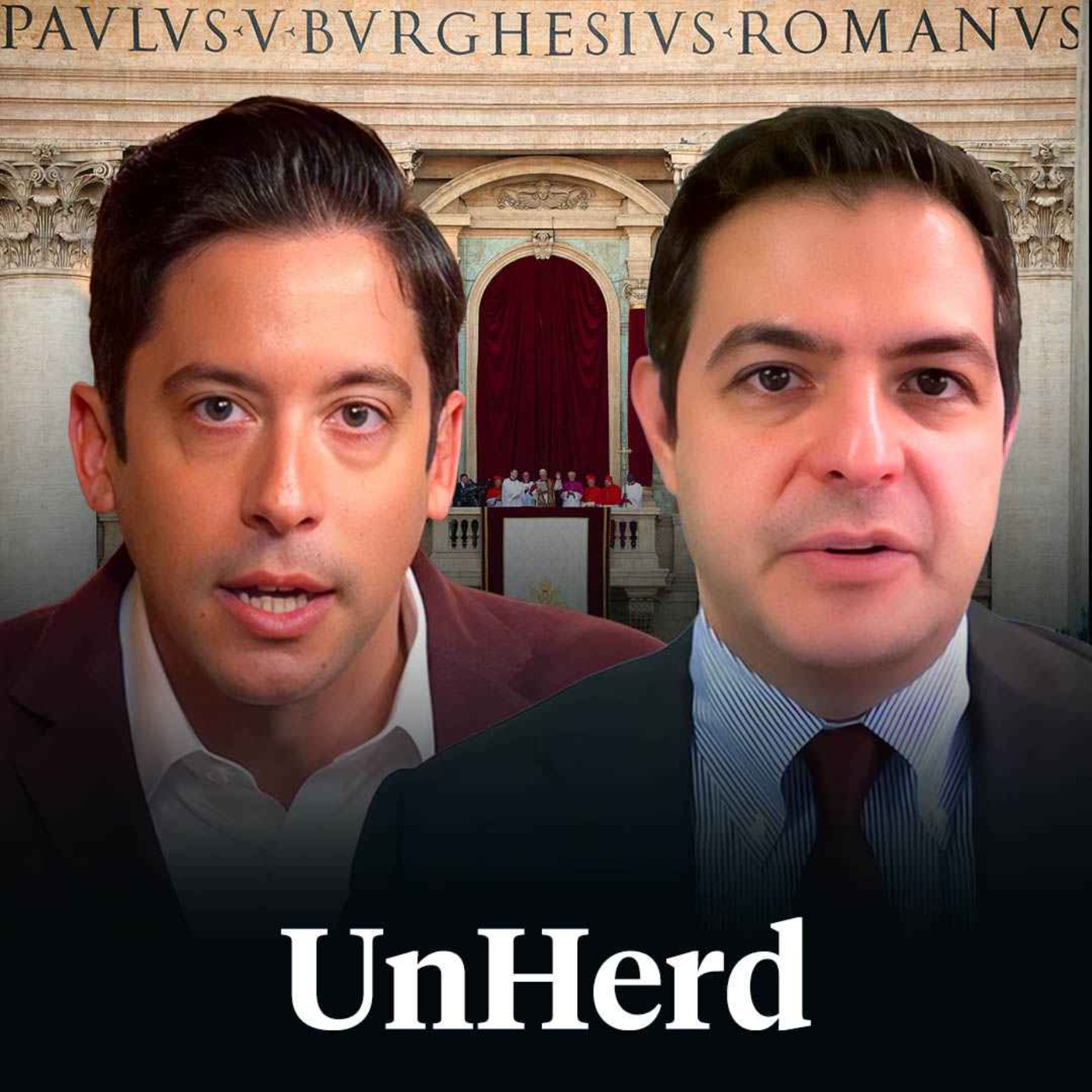
Hello and welcome back to UnHerd. In the last week, the pope, Pope Leo XIV, has published something called an encyclical that is one of these important periodical documents that popes produce to clarify the Catholic Church's teaching on the biggest questions of the day. They're not just like articles that you either read or don't read. For the millions of Catholics around the world, these constitute doctrine, so they matter a great deal. And the reason why this one last week called Magnifica Humanitas on the greatness of humanity or what's so Important is that it talked a lot about AI, a lot about technology, but also in the outskirts, quite a lot about politics. And when you consider the situation in the United States, where you have an ascendant Christian movement which is very much intermingled with the populist right and the Donald Trump phenomenon, it's kind of in opposition in large parts with Pope Leo. Some people think that Pope Leo was only elected to office to oppose Donald Trump. J.D. vance, perhaps the most senior Catholic populist, has expressed reservations about whether Pope Leo is getting too involved in politics and should stick more to matters of theology. What we want to do today is, first of all investigate what the pope actually said in this document, but with a particular focus on how it plays on the American right. We're going to have two guests today to see how they interpret it, and both of them are part of the populist right in the United States. So our first guest, Michael Knowles, is one of the more famous figures on that side of politics. His show at the Daily Wire the large online network founded by Ben Shapiro is one of the most popular in the US and he's considered someone pretty closely aligned generally with President Trump and that movement. He's been thinking and talking a lot about the Pope's encyclical, so I want to find out from him whether he sees division there or whether he has found a way to make it all cohere in his head. And second of all, we will be talking to Sohrab Armari, our very own US editor here at UnHerd, also a Catholic, also someone pretty closely associated with JD Vance, who is a close friend of his, but also the populist right more generally. So. So tune into both of those, and hopefully by the end of it, you'll have a sense not only of what the Pope's ideas are up to and which direction he's headed, but also the fissures and the movements inside the American right, which, frankly, could determine the whole future of the planet. Joining me now is Michael Knowles, who is one of the biggest figures on the American right. His show at the Daily Wire is incredibly popular, and we've been meaning to get him on for some time. He's been paying particular attention to the latest encyclical by Pope Leo xiv, and he's here to tell us what he thinks it means. Welcome to the show.
- [04:13]
Michael Knowles
Thank you for having me. Good to be with you.
- [04:15]
Freddie Sayers
So you took the trouble of actually reading this document by the Pontiff. Tell us what you think it meant.
- [04:22]
Michael Knowles
Yes, I felt it was important for me to actually read the document rather than just get an AI summary, given what the encyclical is all about. But I feel a particular connection to this Pope, not only because I'm a mackerel, snapping papist, but because I called the name during the papal conclave. I said, the name that I'm hoping for is Leo. And when they announced the new Pope, what we heard first in Latin was that he chose the name Pope Leo. And I said, this is great. Then they announced who the man was, and I had never heard of him. I knew absolutely nothing about him, but I knew that the choice of the name was. Was gonna be a signal about the pontificate, as he was drawing from Pope Leo xiii, who dealt especially with the issues of technology and industrialization of his age. And it was clear that Pope Leo XIV was going to do much the same thing. And actually, Pope Leo XIII had something to offer to both the left and the right. He offered critiques of industrial capitalism, but he was also staunchly anti Communist, anti socialist, and he's really the beginning of what we call Catholic social teaching. So Leo xiv, after a somewhat divisive pon Francis that appealed, I think, much more to the left than traditional and conservative people. Pope Leo xiv, likewise, I think, actually has something to say to all sorts of people on the political spectrum and on this issue in particular. The encyclical is ostensibly about AI that's what all the reporting says. But at a deeper level, it's really not. It's about humanity. We can see this from the title of the encyclical, Magnifica Humanitas. It's about how humans remain human in the age of AI. And so right off the top, we get some really interesting notes here. One, Pope Leo starts describing the development of Church doctrine. It gives you a whole history of the church, of the development of doctrine, a little history lesson on Vatican ii, but he uses interesting analogies. So he compares development of doctrine to a polyhedron. And you remember that Pope Leo is a math major. Actually. He's bringing in not just the kind of humanities and philosophy and theology background, but he's bringing in mathematics, which is crucial when we're talking about AI. And then right off the top, he gives you something crucial to remember, which is that artificial intelligence is artificial. It's not real. It's a simulacrum of intelligence. But they're different things. And a lot of people, including conservatives, including many Christians, seem to believe that the only difference between artificial intelligence and human intelligence is. Is artificial intelligence isn't there yet. You know, it hasn't become exactly the same as human intelligence yet. And what the Pope is telling us in the encyclical is that if that's your view, you fundamentally misunderstand what the intellect is.
- [07:08]
Freddie Sayers
It's funny, because we published here at Unherd an essay by Richard Dawkins just a few weeks ago where he said that he felt AI was now conscious. As far as he was concerned as an evolutionary biologist, it passed the Turing Tests, and he felt that it was impossible to distinguish from consciousness. He was then kind of piled on by a lot of religious people, as well as some secular people saying, no, no, you've got this all wrong. What would you say to him if he were here now? What is it about AI that is fundamentally different from consciousness as understood in this encyclical?
- [07:42]
Michael Knowles
Well, as one of the people who piled on Professor Dawkins after he made those comments, what I would point out is that his views make perfect sense from the standpoint of a materialist but the materialists fundamentally misunderstand human nature. So St. Thomas Aquinas makes this very clear in the Summa Theologiae which Pope Leo is drawing on in this encyclical, which is that the intellect is a function of the rational soul. So it's not merely a bodily process. The mind is not and cannot be the same thing as the brain. Obviously, there is interplay, there is overlap, just as the soul has interplay with the body, because the soul is the substantial form of the body. But we are not merely material beings. And so bringing us all the way back to Professor Dawkins point. What he is confusing is the very, very impressive data processing, computational power of a robot with what the intellect does, but they have different ends and they deal in different things.
- [08:41]
Freddie Sayers
I would say the Pope is really quite negative about AI. There are definitely passages of this encyclical where he talks about the possibilities for science, for biology, for curing diseases and so on. But the. The overall mood is one of fearfulness or anxiety, that AI is possibly a demonic or a very negative force that is inhuman and something we need to really be careful with. How does that sit, do you think, with many political conservatives embrace of AI and these kinds of new technologies? I mean, it runs through the Trump administration and I would say wider conservative thinking that, you know, these kinds of technologies are the future and we should be doubling down on them. Is there a tension there?
- [09:26]
Michael Knowles
Not as much of attention, obviously. Look, the Republican Party has had the backing of some people in Silicon Valley. Now, of course, there are others in Silicon Valley who have tried to destroy American conservatism. Mark Zuckerberg did his damnedest in the late 2000 teens and 2020, and now he's singing a different tune. But there are other people in Silicon Valley who have been more supportive of Republicans like Peter Thiel or Elon Musk. Nevertheless, Pope Leo is not a Luddite. Pope Leo is not inveighing against AI or technology as such. He makes that very clear in the encyclical. He says, look, technology is a tool. Really, what he's warning against is making technology more than just a tool, making an idol out of technology. And because the scriptures warn us about making dumb idols, lest we become like them, lest we misunderstand, because the AI does not actually have an intellect like a human being does. One of the reasons it doesn't have an intellect is because it doesn't have will. The AI is just programmed with the prejudices, with the ethical frameworks of its founders. And so we need to be aware of that, and we need to regulate that, in fact, and we need transparency. So we don't want to just implicitly imbibe all of the very dubious ethical presumptions of these people in Silicon Valley. That's a very important political lesson for us back here at home. Cause, look, I'm really happy to have the support of Elon Musk. Elon Musk is the only reason that we have anything resembling free speech on social media right now. He put his money where our mouths are. So I love that a lot of the political funding that Peter Thiel has been involved in. Peter Thiel, who has the distinction of also being an intellectual in addition to a tech billionaire. I think a lot of that has been really, really good. And Silicon Valley has done a lot of really, really bad things, too. And so we need to treat Silicon Valley as a tool politically. We don't want these people to be the oligarchs who are controlling political destiny of the United States or even the desires or conclusions of our own mind. We need to use them for what they're worth.
- [11:21]
Freddie Sayers
Because it does feel like a figure. Like Elon Musk, for example, is almost the object of this encyclical. I mean, there's passages about transhumanism, for example, the idea that we can perfect our own bodies using technology. I mean, Elon Musk is literally seeking to implant chips in our brains. It's quite hard to think of anyone more closely associated with that movement. He's also the owner of Grok AI, which is one of the biggest large language models. I mean, this could almost be a letter against Elon Musk, couldn't it? So how.
- [11:52]
Michael Knowles
No, I don't read it that way because, look, I'm as anti transhumanist as anybody there is. But we should be precise about what Elon's doing when he's talking about plugging our chips into our head. I mean, that can sound very dystopian. But the way that he has positioned that company, Neuralink, does not really contradict any Christian teaching, inasmuch as we may very well use technology, any kind of medical technology, to correct defects, to correct some of the problems, medical ailments. That is different in kind from using technology to transcend the limits of humanity, to become cyborgs or demigods or something like that. Now, maybe Elon has that in store as part two, but right now he's basically just trying to help people with Lou Gehrig's disease. And so those are totally different in kind and the Pope is warning against that. He draws the distinction in the encyclical. It's good to use technology to help improve human life, but we don't want to transform, transcend human life. To me, in many ways, the encyclical seems written more clearly against the people involved with Anthropic. And it's interesting because Pope Leo launched this encyclical with the founder of Anthropic. But Anthropic is interesting. Anthropic agrees with the Pope that AI can be kind of scary, and we need to be cautious here, and we don't want to just be utopians about it. Now, I think Anthropic is saying that in some ways because they're trying to market their product. So they're saying we've created this superhuman, godly AI technology. It's so scary, we need to put some caution around it. By the way, keep investing in our company. But nevertheless, they agree, at least in principle, that we need guardrails. However, there's a major disagreement between the anthropic view of ethics and the Christian view of ethics, because the anthropic guys embrace effective altruism, which has fallen out of favor because one of its chief proponents was Sam Bankman Fried, who's a fraudster. But effective altruism is a consequentialist, utilitarian view of ethics that is directly contrary to the Christian view of ethics, which does not believe that good ends or justify immoral means, does not merely view people as cogs in a machine, which traditionally comes much more from the perspective of virtue ethics. In many ways, I think Pope Leo was speaking directly to Anthropic, who he was sitting with and saying, hey, guys, you're on the right path about putting guardrails around this technology, but we want transparency into your ethical frameworks. We want to correct your ethical frameworks and make sure that what we're plugging into AI is morally correct.
- [14:22]
Freddie Sayers
Right. So you see a tension with some of the bigger technology companies, but less so with the conservative movement. There's another whole section to this encyclical. There is passages about AI. There's also discussion of this concept of subsidiarity, which really also came from that earlier encyclical that you mentioned at the start in the 1890s from Pope Leo XIII, a famous piece called Rerum Novarum, which a lot of people still talk about as the Catholic political sort of manifesto. In a way, it's a discussion of how religious ideas should be applied in the more real world. And Political realm, subsidiarity, at least as I understand it, you can correct me if you think this is wrong, is a general philosophy where decisions should be made at the lowest level where possible. So localism is good, smaller is better, and only escalate things up to some kind of great big organization if it's absolutely necessary. That is how I understood subsidiarity. But the way Pope Leo XIV talks about it feels very much more comfortable with larger global entities. Right. So he's talking about the need here. This is a quote. He talks for states and transnational institutions that are called to ensure fair rules and effective safeguards on the topic of AI, so that local communities, intermediary organizations, etcetera, Have a voice. But he's explicitly saying this problem is so big we need global forums and global organizations to sort it out. Which is really quite an opposite view to a lot of the more populist nationalist ideas, which is like, we're fed up with the World Health Organization. We're fed up with all these acronyms. Let's go back to the nation state. How do you square those two ideas?
- [16:13]
Michael Knowles
Well, I don't think there's certainly no contradiction between subsidiarity and recognizing that with the issue of AI, you need much larger institutions to deal with it. Because subsidiary, as you put it very well, says that issues must be dealt with at the lowest level that they can competently be dealt with. So we wanna leave a lot of room for families and local communities, for the individual, let's not forget for states. But certain issues really do rise up to the national level or even to the international level. So there's been a rise in the last 10 years on the American right in populism and in nationalism. There's no doubt about that. But, you know, nationalism looks at the nation. So this is elevating political issues to a higher level than, say, the Tea party movement of 15 years ago, which said, no, no, no, we just need to focus on states rights or local community rights. Issues like mass migration, for instance, cannot be left to the states or to the towns. They're not competent to deal with it. You really need the federal government to come in and do their job. Well, when it comes to something like AI, your city council is not going to be fixing any of the problems that come along with AI. And the Pope makes a really good point. When we're looking at these international organizations, we're not just talking about the WHO or the UN or the IMF or all these other litany of evil groups. What we're also talking about are the corporations here. And the Pope says, what's really scary is, is that you now have corporations that are really in private hands who are wielding massive power. Power to create culture, power to control our data and our information, power to help form our decisions. The Pope speaks about another aspect of Catholic social teaching which comes from Rerum Navarrum and draws on the deeper Catholic tradition, which is the universal destination of goods. The universal destination of goods, which corrects the errors certainly of communism, but even of unbridled laissez faire capitalism, which says that, look, private property is good. We have rights to private property. Pope John Paul II in Centezimus Annus, which was written on the 100th anniversary of Rerum Navarum, he says, the free market is the most efficient way to allocate resources in an economy. It's great, but really what we want is two cheers for capitalism, two cheers for private property. Because ultimately there is a universal destination of goods. You know, the sea, the land, the air. God made these things not just for the monopoly of an individual, but for all of us to use. So when we're talking about the universal destination of goods and we get to issues like data, like algorithms, like these handful of tech companies that are wielding immense political power, we need to recognize that something is very, very disordered. If all of these goods, which we don't even think of as goods, data, algorithms, information, if all of those goods are concentrated in just a few oligarchical hands, that is a completely unsustainable and immoral situation. And so when Pope calling for just.
- [19:04]
Freddie Sayers
Sorry to interrupt, Michael, but I never thought I'd say this, but Michael knows you're sounding kind of left wing here. I mean, what you're saying is that you agree with the Pope that things like data and algorithms that are now so powerful should be beyond private ownership and belong to some kind of common good. And therefore we need new transnational institutions beyond even the nation state to control or administer them. Am I hearing you correctly?
- [19:34]
Michael Knowles
Par le tu francais hablas espanol parl italiano?
- [19:39]
Babbel Advertiser
If you've used Babbel, you would. Babbel's conversation based technique teaches you useful words and phrases to get you speaking quickly about the things you actually talk about in the real world. With lessons handcrafted by over 200 language experts and voiced by real native speakers, Babbel is like having a private tutor in your pocket. Start speaking with Babbel today. Get up to 55% off your Babbel subscription right now at babbel.com acast spelled B-A B-B-E-L.com acast rules and restrictions may apply.
- [20:26]
Boost Mobile Advertiser
No pag es de bas porto servicio telefonico Cambiatia Bus mobile. Oy emps auror aprendebas en bus mobil punto comas lentas los clientes pagaram ventico dola salmes mi entras permanes can activos en el plan un limited the boost.
- [20:46]
Michael Knowles
Okay. Caller one wins courtside seats to tonight's game. What?
- [20:51]
Sohrab Amari
I won floor seats.
- [20:52]
Michael Knowles
You did? I've been calling for 13 months. Wait. Chris. Yes. I finally did it. What are you gonna wear? Men's Wearhouse. They've got today's looks for any occasion, and I need to look like a celebrity. Don't want to stick out. Exactly. They've got Chill Flex by Kenneth Cole, Joseph Abboud, and a tailor at every store for the perfect fit.
- [21:09]
Freddie Sayers
Congrats.
- [21:09]
Michael Knowles
You can stop calling now. Not a chance. Hit any look for every occasion at Men's Wearhouse. Love the way you look.
- [21:16]
BetterHelp/Pura Advertiser
Summer smells. Like summer road trips, ocean breezes, and long evenings under the stars. It's a feeling you want to hold on to restore your sense of place with pur new Summer fragrance collection, we've captured the magic of the season in clean, premium scents that transform your home into your favorite destination. Discover the art of scentscaping and bring the summer in. Visit pura.com to explore the collection.
- [21:43]
Michael Knowles
I'm not sounding left wing, though I see why you think I might be. What I'm sounding is Catholic and Catholicism. You know, the faith really confounds this neat left right political distinction. Because let's not forget the terms left and right originating the French Revolution, when the people who supported the church sat on the right of the national assembly and all the secularists and the atheists sat on the left. So it doesn't really map on all that neatly. But private property is good, and we have a right to private property. It's not merely that it's good. We actually do have a right to it. But private property is for something. Political communities are for something. And what they are for is for the common good. This isn't some radical leftist proposition. I mean, for goodness sakes, this is in the preamble to the US Constitution.
- [22:26]
Freddie Sayers
For example, does Elon Musk have the right to own the algorithms and the data of Xai, which encompass hundreds of millions of people around the world? Does Peter Thiel have the right to own as private property the data and algorithms that are found within Palantir, probably the company one would most closely associate with the kind of things you're talking about. Do they have that right?
- [22:49]
Michael Knowles
Almost. They almost have that right. In other words, they do have substantial rights to private property, and private property is substantially a good thing, but they are in service of the common good. And so really, maybe another way to frame that question from the other side is, does the state have a right or an interest in regulating massive corporations? Whether we're talking about Palantir or X, or to my mind, more Importantly, Google, Facebook, YouTube, just part of Google. Does the state have a right to regulate? Yes, absolutely. Of course it does, because these companies, one, in many ways function like public utilities, but two, are dealing in goods and services and information that really cannot be within the purview of a single individual. I mean, it's funny you mentioned the case of Palantir, because Palantir already works with the government in such a significant way that it is kind of hard to parse the distinction between private and public. But when the Pope is speaking about it from a higher perspective, what he's saying is even beyond the national level, I mean, these corporations are acting all over the world. They're dealing with a lot of information that is extremely valuable, can be extremely dangerous. And I go back really, in the old school American conservative tradition. I go back to Barry Goldwater in Conscience of a Conservative, who points out that we are not merely against monopolistic government, we're against monopolies of all kinds. It doesn't seem a great consolation to me if my rights are being stepped on by a private corporation rather than a government. You know, obviously a society is the interplay of lots of different forces. You have the family, you have the state, and you have the religious authority. Those are three kinds of perfect communities within society. There are mediating institutions, civil institutions, businesses, all the rest. But they make up an integral whole of a political community. So you can't neatly separate any of them out.
- [24:46]
Freddie Sayers
But would you support a transnational institution, this is the word from the Pope, to regulate AI well, we already have
- [24:57]
Michael Knowles
one, which is called the Catholic Church. And I'm only being half cheeky when I give that answer. Look, I'm not suggesting that the Pope should be looking through every line of code, but I'm really making more of a descriptive statement than a prescriptive statement. It is quite interesting that in our highly secular, rationalist, post Enlightenment age, everyone seems to be looking to what the Pope thinks about AI Isn't that so strange, at a time when we've been making fun of religion for decades and centuries, we all seem to really care what the Pope has to say about it. In part, I think this is because the Catholic Church is the only institution that has survived from antiquity into modernity in the west. And it's because the Pope has a kind of gravitas as the spiritual authority, and the spiritual authority is distinct from the temporal political power. This is a crucial distinction that gets kind of flattened out in modernity. But this has been something that the Church has been aware of since at least the 5th century, since at least the time that Pope Gelasius. I was complaining to Emperor Anastasius, the Byzantine emperor, there are different competencies for the spiritual authority and the political power, but they overlap because the Pope leads a flock that lives in the real world, and the temporal political power needs a moral justification. And so that these two things overlap, they interplay. One cannot do without the other, and they should be pointed in the same direction. So not only should we look to religious institutions to help guide us on ethical questions, but in fact, we just do. We just naturally do. The fact that a ton of libs are looking at the Pope on AI is the proof of it.
- [26:33]
Freddie Sayers
I guess I've got to get you to concede that there are occasionally tensions here, Michael. I feel I would have failed if I don't do that. For example, on the war in Iran, I mean, that was the most flagrant example where Pope Leo approached and spoke to reporters on an airplane in a way that I don't think popes have for decades, which was explicitly political. He was saying that voters in the United States should contact their congresspeople to oppose the Iran military activity, which has been a centerpiece of Trump's administration in recent months. I mean, if that's not a conflict between the Pope and Donald Trump, then I don't know what is.
- [27:11]
Michael Knowles
No, no, listen, you might be misunderstanding my point. Maybe I'm sounding too happy clappy about all of. There is always a tension between the spiritual authority and the temporal political power. In fact, that's what I'm referring to when I mention good old Pope Gelasius and Emperor Anastasius. They were in conflict with one another. There's always going to be a tension between those two things. Pope Leo's comments on the airplane recently, frankly, after 10 years of Pope Francis making political comments on airplanes, I find them to be actually rather moderate and polite. But, yes, Pope Leo, so, you know, curiously, he doesn't really call President Trump out By name. He said explicitly on the airplane he doesn't want to get into a debate with President Trump. In fact, I think the Pope is a registered Republican. This is one of the strange facts
- [27:58]
Freddie Sayers
about having an American Pope. I think that's a fact rather than a current fact. I very much doubt he's.
- [28:02]
Michael Knowles
Yeah, well, now he's the sovereign of a nation state. I don't know if he's voting in American elections, but it is funny. Pope Leo is the first Pope in history whose American political party allegiance we can know with certainty because he's registered in America. So we know that he's a Republican. Now, he seems to have had disagreements with Trump and the Vice President on things like immigration. He seems to be a little bit more left wing politically than, say, his brother, who is a hardcore MAGA guy who is apparently friends with President Trump. So, yeah, obviously there's maybe a little bit of a political tension.
- [28:35]
Freddie Sayers
And on Iran, did you feel that? I mean, that's a pretty much opposite direction, isn't it? He evidently thinks it is an evil, an unchristian act to attack Iran in the way that the United States is. I mean, you must feel something tugging at your heartstrings there. Is your religious leader right, or is the person who you follow politically right?
- [28:57]
Michael Knowles
No. Well, one of the great things about being Catholic is that we recognize that the Pope is only infallible when he isn't fallible. And so, you know, the Pope can make all sorts of prudential judgments about politics that we can disagree with. We want to take them seriously, but we can disagree with them. In fact, beyond what he said on the airplane, I think his more biting criticism of the war in Iran comes out in this encyclical, actually, because in the encyclical, Pope Leo refers to just war theory as outdated. That really raised my eyebrow. I'm still trying to think through this one. Because, of course, just war theory is a crucial part of the Catholic intellectual tradition. It actually predates the Church. We draw on Cicero and then obviously St. Augustine, St. Thomas Aquinas and many others.
- [29:41]
Freddie Sayers
I mean, my understanding of that was that he's anxious that the speed at which these kind of military decisions will now be made and the fact that some of them will be made autonomously by pieces of technology like self powered drones, algorithms and so on, may kind of take out that moment when you can decide as a human whether something is just or not, whether you think it passes the threshold. So. So that kind of future. I do understand the logic of that.
- [30:09]
Michael Knowles
No, he's totally right about that. I mean, you know, again, I think the encyclical is really, really quite good. Other than a few errant lines that raised my eyebrows, you know, references to migrants or what have you. When it's focused on what seems to be the thesis and subject of the encyclical, I thought it was really quite good. The reason that referring to just war theory is outdated raised my eyebrow. I certainly should hope that the Holy Father does not mean this in some absolute way, that, you know, Thomas Aquinas was wrong and St. Augustine's wrong. I don't think that's what he means. Pope Leo himself is an Augustinian. But the reason just war theory is crucial here to the tension between the Pope and the president on Iran is because after President Trump had some harsh things to say about the Pope and then I think others advised him that that's not the best tone to use for the Holy Father, Trump actually changed his tone. He was much more respectful. He said, pope Leo can say what he wants, he should say what he wants. But I can disagree with him. He seems like a great guy, yada, yada yada. When you really get down to the heart of the matter, what it seems to me is that if the Pope opposes the war in Iran, it seems he does, then the disagreement between Trump and the Pope on Iran actually is a sort of practical disagreement within just war theory. In other words, I also argued against the war in Iran, but I did so not on the grounds that it's always wrong to go to war or that the Iranian regime doesn't have it coming or something like that. It would be from within the criteria of proportionality. Are the goods to be achieved worth the losses to be incurred? And two, is there a reasonable probability of success, say, a reasonable probability of getting rid of the Iranian regime? I don't think that there is. That is not a disagreement over war in principle or even over the Iranian regime in principle. That's a practical disagreement over whether or not these goals and these criteria of just war theory can be achieved. And it is worth pointing out within that framing, the temporal power actually does have more of a competency to ascertain that than the spiritual authority. But I do think that the issue of the Iran war is much more complex than ideologues would have it. And I actually think the disagreement between the Pope and the President is less severe than, say, Twitter would make it seem.
- [32:16]
Freddie Sayers
But what's so fascinating, and this is where it gets so interesting, I think, is that the pope disagreeing with Iran doesn't make him left wing because there is a growing group on the American right which you have just said you are part of, that also doesn't like these kind of foreign adventures and is much more skeptical, much more restrainist or even isolationist. In fact, Sohrab Al Mari, our US Editor, who we're going to talk to in just a moment, is also definitely one of those people who is also a Catholic, also someone who considers himself a conservative, who is very skeptical about these kind of foreign adventures. So by taking that view, Pope Leo isn't necessarily being yet another kind of liberal, just Rowan Williams type who's kind of banging the same drum. He's almost appealing to a particular section of the American right which is ascendant. Do you think that's right? I mean, how do we understand that?
- [33:06]
Michael Knowles
Well, you've hit on it perfectly, which is, I think it is just preposterous to call Pope Leo a liberal. On the vast majority of political issues, the Pope is much more right wing than any American Republican politician. He doesn't just oppose transing the kids, he opposes transgenderism and so called same sex marriage and abortion and contraception. On migration, he actually has a relatively moderate view. He says nations can have borders. And on war, as you point out, there's no clear line exactly about what the conservative view would be. But I go back to a great political thinker from your side of the pond, Michael Oakshott, who points out that conservatism really is much more of a disposition. You know, he says to be conservative is to prefer the tried to the untried, the actual, to the possible present laughter to utopian bliss. And I think that really gets to the heart of it, you know, in Rationalism in Politics, Oakeshott defines ideology as the formalized abridgment of the supposed substratum of rational truth contained in the tradition, this delightfully extravagant but precise description of ideology. And he says the conservative is one who eschews ideology. You can have conservatives in America who disagree or anywhere who disagree on trade, on precise immigration policy, on war, various foreign affairs. Conservatism really is more to quote Roger Scruton about conserving, about a love of one's own reflexive notion that it's. It's easier to destroy than it is to build. And so on that front, I think very clearly Pope Leo is a conservative. Pope Francis for that matter was almost a conservative. I think any pope has to be.
- [34:46]
Freddie Sayers
Michael Knowles, I've got one final question for you. Who in your view, you've just given us a very eloquent definition of conservatism, calling on two Britons there, Michael Oakshaw and Roger Scruton, to back it up. By those definitions, who is more conservative, the Pope or Donald Trump?
- [35:02]
Michael Knowles
Well, I would say this is not a cop out, but I would say
- [35:06]
Freddie Sayers
you can't say they're both conservative in different ways, Michael.
- [35:09]
Michael Knowles
No, I'm not gonna say they're. No, no, I'm gonna say they're both conservative in the same way, but these have different expressions because they have different roles. And so much of Burkian, Kirkian, Oakshottian, Scrutonian conservatism is about recognizing one's role in society. Trump, if you took him to a dinner party, he would seem much less conservative than the Pope. There's no question about that. The Pope is mild, he's deeply spiritual. He's very traditional, of course, and Trump is brash and loud and obnoxious sometimes and all of that. But Trump's political character is best exemplified by that time that he hugged the American flag. He just started kissing the American flag. He doesn't have a firm ideology. He loves his country. He's a patriot. And within his competency, which is the temporal, messy, ugly, often undignified political order, the way to express that kind of a conservatism is sometimes to be a little tough and to break things, whereas within the competency of the Pope, the spiritual authority.
- [36:05]
Freddie Sayers
Got to interrupt. I'm sorry, I just have to. Because breaking things is like, surely the opposite of the Burkean Oakshottian conservative, where you're talking about respecting, as you just said, present laughter over future bliss. I mean, it's about respecting institutions, not smashing them down. I've never heard anyone make the case that. That Donald Trump is a Burkean or Oakshottian conservative in that sense.
- [36:32]
Michael Knowles
Oh, well, you've heard one of them now. In fact, I think that's the clearest form of his conservatism. Much more so than, I don't know, the kind of libertarian conservatism of a Hayek, much more so than the neo conservatism that we've seen in recent decades. Trump's is a dispositional conservatism. And all of those men that I've just cited in different ways have pointed out that conservatism cannot merely be petrifaction. Conservatism cannot merely be letting things alone. You know, and Chesterton made that great observation that it's the job of the liberals to go around messing things up and it's the job of conservatives to make sure they never get fixed. So Trump's really much deeper. Conservatism is recognizing that there are some problems. You gotta be a little tough. You gotta work them out, but it's for preserving something. This is why Trump is focused so much on America's 250th. This is why Trump is actually being criticized by some on the right for spending too much time cleaning up monuments. He just cleaned up the Columbus Monument at union Station, Washington, D.C. cleaning up cities, rebuilding beautiful architecture, focusing on the ballroom, even at the White House. Trump's is a conservatism that is very tangible, very practical, that is really invulnerable, I think, to ideology.
- [37:43]
Freddie Sayers
Not sure the new ballroom is especially conservative in its aesthetic, but I guess that's. That's a different controversy.
- [37:50]
Michael Knowles
It certainly is. I mean, it's not some brutalist monstrosity like Barack Obama's library in Chicago. You know, Trump had a whole executive order which was called the Make Federal Buildings Beautiful Again order, and it was calling for neoclassical architecture. Pretty conservative. But I guess the distinction, maybe to really make it pithy between the conservatism of a pope and the conservatism of a president would be the distinction of the conservatism of a monarch versus the conservatism of. Of a prime minister. The prime minister deals in the efficient, and the monarch deals in the dignified. And so they're gonna express themselves different ways. And you can have real tough guys. I mean, I think Nigel Farage would be a good example. Lady Thatcher would be a good example. Winston Churchill, for that matter. They could be pretty tough. They could break things. They could be innovative in some ways. All exemplars of conservatism at the level of practical politics. King Charles iii, in some ways, he seems like kind of like a lib in his environmentalism or what have you, but he's also a figure of deep, profound conserv. Traditionalist political philosophy. They just express themselves differently within their respective roles, and surely they would have to. I mean, that's a core tenet of conservatism itself.
- [38:57]
Freddie Sayers
Michael Knowles, you have done a very valiant job there, squaring what I thought was a circle. And our audience will have to decide as to whether the Pope's conservatism and Donald Trump's conservatism can, in fact, marry up and live happily side by side, as they appear to in your head. Michael Knowles, thank you so much.
- [39:17]
Michael Knowles
Yeah. Good to see you, sir. Thank you for having me. Par le tu francais hablas espanol Parli Italiano.
- [39:26]
Babbel Advertiser
If you've used Babbel, you would Babbel's conversation based technique teaches you useful words and phrases to get you speaking quickly about the things you actually talk about in the real world. With lessons handcrafted by over 200 language experts and voiced by real names native speakers, Babbel is like having a private tutor in your pocket. Start speaking with Babbel today. Get up to 55% off your Babbel subscription right now at babbel.com acast spelled B A B B E L.com acast rules and restrictions may apply.
- [40:01]
BetterHelp/Pura Advertiser
Summer smells like salt in the air and warm sand. Restore your sense of place with Pura's new summer fragrance collection. Discover transportive clean scents@pura.com commencement
- [40:16]
Freddie Sayers
that was Michael Knowles, who is a very popular figure on the political right. His show on the Daily Wire has millions of followers and he's also a Catholic. He is someone who was insisting to me that, yes, he is a devout follower of the Pope and also a pretty devout follower of Donald Trump, and he feels almost no conflict between them. He says they come occasionally in conflict, but he was the happiest camper I think we've ever interviewed on this kind of of topic. We're joined now by Sora Balmari, our US Editor, Unherd's US Editor, also a Catholic, also someone often considered part of or close to the populist right in the US do you share Michael Knowles, Happy, go lucky sense that yes, the Pope's there, Donald Trump's there. They have different realms. Occasionally they disagree, but mainly in his head, they are both conservatives in different ways and he just doesn't see such a big problem with it.
- [41:15]
Sohrab Amari
So I guess I'm the less happy, go lucky. I'm the sad go lucky voice here. But look, there are points of convergence between the two, I suppose. I know for real there are, but I think that tensions are real and someone has to try to synthesize the two. But otherwise I think it's incorrect to pretend like there aren't sharp divisions.
- [41:45]
Freddie Sayers
Tell us what you think they are then, because you've also written about, and read carefully the Pope's encyclical, and to you that prompted some really quite problematic philosophical distinctions with the Trump movement. What were they?
- [41:59]
Sohrab Amari
So, number one, I think it's the issue of how do we approach tech and technological capitalism. The Pope is not 100% against these things. In fact, there are lots of references in the encyclical to the potential benefits of AI. The Pope says that any sort of labor that is either repetitive, arduous or dangerous should be automated. And he welcomes that. His predecessor, Pope Francis, said something similar. Francis was still alive when the AI revolution was beginning. And he said something like, insofar as AI promises to improve agriculture, medicine, etc. Etc. We should welcome that. And he's so the Church is not Luddite, obviously, it's not anti tech. However, there is the issue of who gets to say what these AI platforms are like in their built in logic. Who has a say over the distribution of their benefits? How do we control for the potential for job losses? How do we mitigate or compensate workers who are thrown out of the labor market as a result of AI? And in those respects, it's not a libertarian view.
- [43:15]
Freddie Sayers
It's not a libertarian view, but it's not. It's not a Trumpian view either.
- [43:19]
Sohrab Amari
I mean, well, no, I'm saying Trump's view is libertarian. Right? I mean, on, on tech, he's very much resisted certain things. I was speaking to Steve Bannon yesterday and you know, he was describing what a struggle it's been to try to get the President and the White House to back various kinds of AI regulations. One is the issue of, for example, can states get to regulate AI? Can the individual 50 states? Normally conservatives are very pro federalism, but that issue became a sticking point with the White House, which tends toward listening to David Sachs himself, a kind of Silicon Valley venture capital who was in the administration. He had a kind of advisory role on tech issues and AI regulation, etc. Etc. This white House is very much let it rip so that the US can be at the forefront of AI and otherwise China will get ahead of us. So we need to just let the industry do whatever it wants. And that obviously is not the Pope's view.
- [44:16]
Freddie Sayers
And not only is he pro nation states getting involved in pretty heavy and careful regulation, or they are. He wants transnational institutions, that's a quote from the encyclical, to be more powerful because he thinks this is a global problem. And I was trying to quiz Michael Nelson, say, are you happy for transnational institutions to suddenly become more powerful? And he. Not sure he fully answered that, but that surely is a really big tension against a much more nationalistic and populist mood. Yeah.
- [44:46]
Sohrab Amari
So to understand that there's two things to note of, to see where the Pope's coming from. One is, and this is uncomfortable, it's very touchy, but it's a reality which is Catholicism as a whole. It's much more comfortable with empires. Why? Because it was born in one empire that was the Roman Empire. Christianity is not the religion of isolated desert places. So it's a religion that takes root in Greek cities that were essentially commercial hubs of their time. And it takes root within this, this Roman imperium that had laid down uniform laws everywhere, tried to and built roads connecting disparate nations and disparate geographies. And when the Church came out of the catacombs, you know, after the Constantinian conversion, and it no longer is a persecuted faith, it inherits the structures of the Roman Empire. So that the role of the Pope, for example, Pontifex Maximus, is a Roman role, it's a Roman imperial role now. It's given a kind of Christian telling afterward, but it's still that Roman administrative structure, the idea of a curia of cardinals who advise the Pope. Again, the curia court is a Roman structure. So the Church is just very comfortable with transnational, multi ethnic multinational structures. And the rise of nationalism, which isn't that long ago. It's 17th, 18th, 19th century, the church confronted that as a trauma. Right. And not just the kind of the English Reformation, obviously, but all sorts of other nationalisms that arose were a challenge to the church. That's one. And the second one is after World War II, Pope John XXIII wrote an encyclical that has magisterial status called Pacem in Terris Peace on Earth, which argues that if the goal of a political community is to secure the common good, and you have problems that are international in scope, like nuclear weapons or nowadays, you might say AI, then you need what he called, quote unquote, a world authority that is capable of securing the common good. Because it, you know, if a problem isn't, is too big for any individual nation state to tackle.
- [47:04]
Freddie Sayers
So he was referring then to the United nations at the time, presumably in
- [47:08]
Sohrab Amari
the 60s, and even still the current encyclical mention it praises the UN as a structure for dealing with these problems, which makes it sound very quaint. And someone at First Things writing in First Things called it a boomer document for that reason.
- [47:21]
Freddie Sayers
So those are two very central points attention then. I mean, the Pope is, if not anti tech tech, skeptical in a way that the Trump administration is not. And specifically, when you think of those leading lights, Elon Musk, Peter Thiel, David Sacks, et cetera, who are extremely influential inside the Trump movement, but are also absolutely the drivers, the engines behind the explosion of AI, that's a direct contradiction and this other one you talk about, which is the enthusiasm for transnational, larger than national institutions is another. So as a Catholic and as a partial populist, which way do you go on them?
- [48:03]
Sohrab Amari
I come down generally on the side of the Pope. I hope that there is a richer dialogue between the two than there has been. I think they have to have a dialogue with each other because obviously the Pope releasing this encyclical, it's having an effect on the debate. Everyone is clearly now having to engage with this 40,000 word document full of references to things that most people, including intellectuals today, for the most part don't bother with. Right. But he's forced a conversation. And so it's, it's, you know, obviously there's that famous quote from, from Stalin where he said, how many divisions does the Pope have? And of course the Pope had, has no divisions. But somehow this kind of moral example of the Church, it still has some power. And so there has to be, there has to be dialogue. It was interesting to me that one of the co founders of anthropomorph topic was at the signing and shook the Pope's hand. I hope there is more engagement. There is a strand of Silicon Valley, though represented by Peter Thiel, supposedly has said that the Pope is the Antichrist. Specifically, he just seems to think that any regulation is antichristic.
- [49:11]
Freddie Sayers
Final question for you. J.D. vance, the Vice President, is obviously the most senior Catholic in the administration. You know what's going on with him more than most. Do you think he shares Michael Knowles more kind of relaxed attitude or do you think there is a difficult push and pull inside his mind about whether he should go with the Pope or go with his boss, the President.
- [49:38]
Sohrab Amari
My gut feeling is that he's probably closer to Michael. First of all, he comes from the venture capital world. He was a mentee and once an employee of Peter Thiel. So there's that part of him where he feels that this technology has the potential to revolutionize how we do anything, everything, and push us to that next technological stage. But he does try to be a faithful Catholic. And in fact he has a memoir coming out about why he returned to Christianity and specifically chose to become a Catholic. The way I've begun to think of, of J.D. vance is not as someone who holds certain ideals more populist, pro worker, you know, tech this and that, who now, as a result of being in power is watching his ideals crash against the wall of reality, of political reality. I don't think that's quite right. I think he's someone who has two sets of ideals on lots of issues. He represents both sides of an issue. Now that to some people when we say, well, that means he's an opportunist or that means he is kind of confused about what he really believes, I don't think that's fair. I think on many important instances he really sees the logic in both sides of an issue. There is a logic to being worried about what this technology will do to jobs, to our minds, our capacity to remain human and maintain human cognition. But there's also the fact that, look, that's where technology is going and the US should be at the forefront of it and potentially our enemies are going to be at the forefront of it, and that's not a good thing. I think he holds both at the same time and he's trying to synthesize them. But I believe that if he does go into becoming president, which is I think very much still possible, then there will come points where we'll have to like, he will have to make a decision and he'll pick one or the other. And my gut tells me he will. He'll tend to pick the pro tech version, but maybe I'll be proved wrong.
- [51:39]
Freddie Sayers
There's a lot of mental acrobatics being talked about here. It sounds very hard work to be a devout Catholic and a prominent Trumpist at the same time, but evidently some people are for now successfully carrying it off. Final question Saurabh. This is something I also asked Michael. Who in your view is more truly conservative, the Pope or Donald Trump? The Pope. Nice clean answer, Saurabh. Thanks for joining us. Us.
- [52:03]
Sohrab Amari
Thanks Freddie.
- [52:04]
Freddie Sayers
Okay, we heard there from two of perhaps the most prominent Catholic populists in America and they come to very different conclusions on whether the Pope or Donald Trump is more conservative and whether they can be made to agree whether they can cohere in some kind of happy conservative way of thinking or whether this is fundamentally to movements, philosophies and human beings who, who are in tension and will eventually come into collision. Thanks to both of them. Thanks to you for joining. This was unherd.
- [52:42]
Boost Mobile Advertiser
The scouting reports end Unlock the savings at Boost Mobile get Unlimited Wireless for $25 a month forever and keep your phone. It's a veteran move. Unlock the savings@boostmobile.com Unlock $25 forever requires customers to remain active on Boost Mobile unlimited wireless plan. For full offer details, visit boost mobile.com.
- [53:02]
Babbel Advertiser
If you've used Babbel, you would Babbel's conversation based technique teaches you useful words and phrases to get you speaking quickly about the things you actually talk about in the real world. With lessons handcrafted by over 200 language experts and voiced by real native speakers, Babbel is like having a private tutorial in your pocket. Start speaking with Babbel today. Get up to 55% off your Babbel subscription right now at babbel.com acast spelled B-A B B E L.com acast rules and restrictions may apply.
- [53:37]
BetterHelp/Pura Advertiser
Summer smells like citrus in the sun. Turn your home into a daily getaway with Pura's new summer collection. Find your flow and fragrance and explore the scents@pura.com.