← UnHerd with Freddie Sayers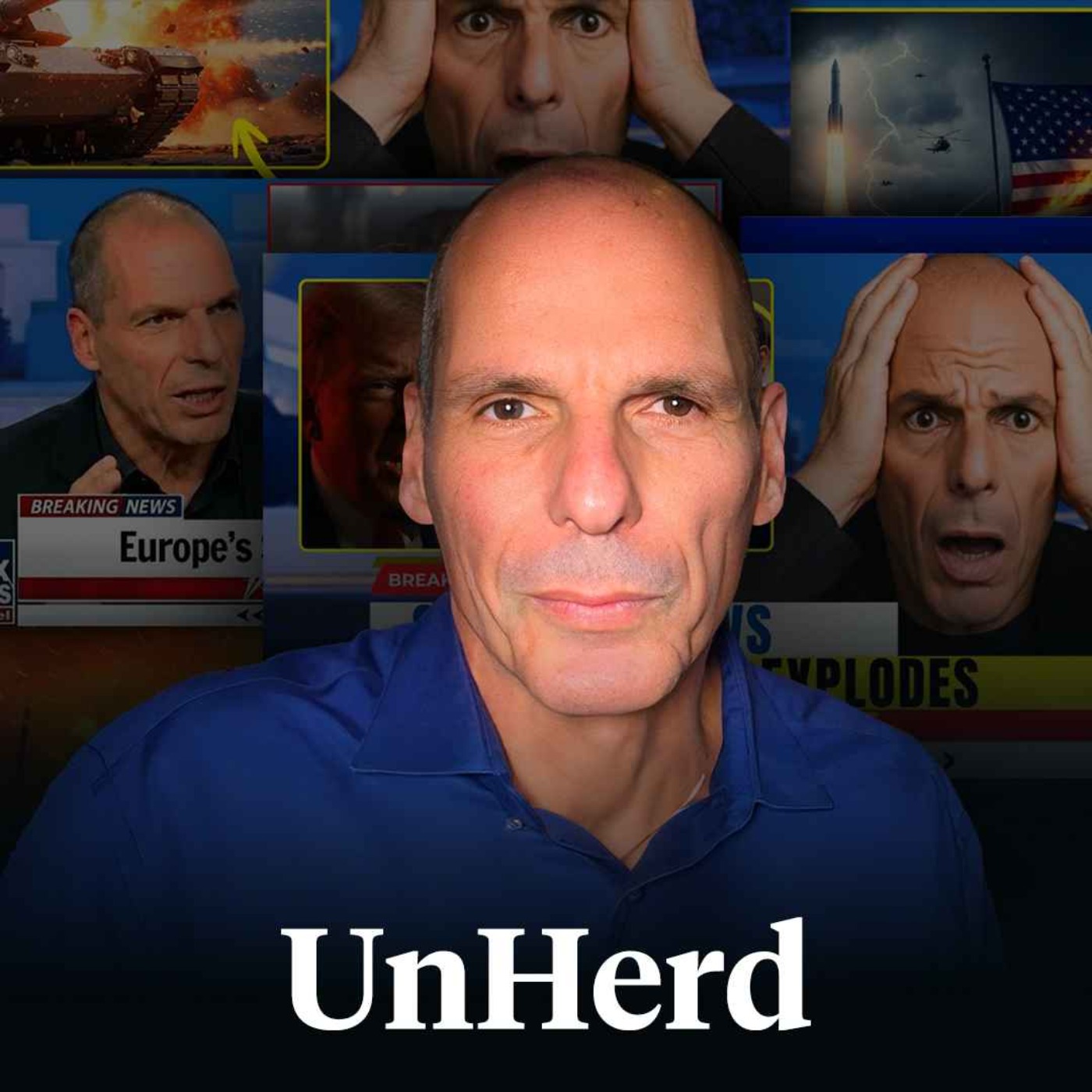
Loading summary
Transcript39 lines
- [00:00]
Progressive Insurance Announcer
This episode is brought to you by Progressive Insurance. Do you ever think about switching insurance companies to see if you could save some cash? Progressive makes it easy to see if you could save when you bundle your home and auto policies. Try it@progressive.com Progressive Casualty Insurance Company and affiliates. Potential savings will vary. Not available in all states.
- [00:21]
Native Deodorant Advertiser
Hey girl, what's happen? Is that your antiperspirant? Uh, yeah. Let me see that can. Aluminum butane. I cannot pronounce that. You have to switch to Native deodorant. Native's simple formula has only clean ingredients. It gives you effective 72 hour odor protection with no hydrocarbon propellant. Wow, this smells heavenly clean. Effective 72 hour odor protection isn't a myth. It's Native.
- [00:57]
Freddie Sayers
Hello and welcome back to Unherd. Happy Christmas. Or Happy New Year depending on when you are receiving this. The question today is how do you know that I am actually Freddie Sayers of Unherd, not an AI Deepfake broadcasting in my plummy British accent to you from an imaginary studio? Well, you maybe don't. And the reason we know that is that one particular person, an individual we know well, has been deep faked more than most. And there are videos of him popping up all over the Internet, purportedly talking about the state of the world and getting hundreds of thousands of views, but actually it's not him at all. I'm talking about Yanis Varoufakis, who as well as being former finance minister of Greece and one of the best known commentators on current affairs and economics, is also, I'm proud to say, the co host of our very own Iconoclasts podcast. Yanis joins down the line from Greece to tell me about this weird thing that is happening to him and what it might mean for all of us really very soon. Yiannis well, welcome back to Unherd.
- [01:59]
Yanis Varoufakis
Well, thank you, Freddy. Happy New Year to everyone.
- [02:04]
Charles Stanley Wealth Management Announcer
Before we start this episode, a brief word from our sponsor, Charles Stanley Wealth Management. The economic tumult of the past month has forced many people to take another look at their finances and whether their retirement plans are on track. This is where having an experienced wealth manager can make all the difference. Because it's not just trying to hit a number. It's about planning the life and lifestyle that you want to lead. Charles Stanley Wealth Management can help you chart your financial course, guiding you on when you can retire comfortably, as well as how best to pass on your wealth to the next generation. Unless you're planning to spend it all. Discover how partnering with a dedicated wealth manager can let you focus on what matters most. For more information, visit charles-stanley.co.uk today to schedule a free no obligation call to discuss your situation. And remember, investment involves risk.
- [02:50]
Freddie Sayers
So Yiannis, I think we got to just start by looking at a couple of these videos because if you're listening to this on the podcast, I will do my best to describe what they look like, but they are quite kind of mind boggling if we roll the first clip. Let's have a look.
- [03:03]
Yanis Varoufakis
The President of the United States, after deploying an aircraft carrier, killing 95 people, seizing tankers and declaring a blockade, called the leader he was trying to overthrow and got rejected. That phone call is the moment America lost the oil war. But here's what nobody understands. America wasn't fighting Venezuela, America was fighting China. And China already won. Let me show you how. I'm Yanis Varoufakis, former finance minister.
- [03:30]
Freddie Sayers
So I'm Yanis Varoufakis, former finance minister. Apparently you're not, you're an AI bot. But just looking at some of the comments underneath that, I can put some of them on the screen if you're watching, you know, hundreds of comments here, people really engaging with the content. Maduro learned well from Gaddafi, Chinese warships, Russian missiles. Scholars warned that weaponization of dollars was suicidal. I'm so glad that I've subscribed to this channel. I'm 71 years old and never thought that I'd be alive to see the decline of USA hegemony, etc, etc, so people have no idea that this is not real. Let's have a look at another one.
- [04:07]
Yanis Varoufakis
What's happening in KKE is not some isolated battlefield incident. It's the physical outcome of a broader geopolitical illusion that has haunted America and since the Cold War's end.
- [04:18]
Freddie Sayers
Jan's looking a little bit more Star Trek in that clip, but with the same powerful rhetoric and stop what you're doing and listen kind of formulation. That is what we've come to know and love and that it does capture quite well. Let's play one more.
- [04:32]
Yanis Varoufakis
I want to begin with a question that almost no one in Washington is asking out loud. What if Israel is no longer a source of regional stability, but the epicenter of the next systemic shock?
- [04:42]
Freddie Sayers
Once again it has that urgent, highly rhetorical feeling that some momentous event is imminent and happening, unfurling before our eyes. And Yiannis with his apparently authentic rhetoric, really making it come alive for the audience there. But turns out, Yiannis, real Yiannis, it wasn't you just before I come to you. I just want to show some of the thumbnails to those people who are watching on YouTube because it's kind of almost amusing if it wasn't so serious how these bots put together clicky thumbnails that people end up wanting to watch. So that most recent one is a channel called Yiannis Explained. And all of the thumbnails I'm looking at here have you with your head in your hands and your mouth wide open in shock. And it has a Fox News logo in the corner making it look like you went on Fox News Channel even though you didn't. And shocking news, massive missile attack. America lost, Japan, Zelenskyy's government collapses, Trump explodes, etc. I mean, it's kind of basic, but apparently it works. Another channel from one of those other clips we could look at very similar. May even be from the same author this time again, once again with Fox News logos in the corner. There's you looking in a suit, a little bit more kind of corporate on this channel. Global agreement collides with Israel. The US stands apart. Venezuela just made a move that shatters US power. Panic in Israel as Yemen strikes Tel Aviv. US help requested. 35,000 views. The fall of Odessa, Ukraine's collapse. 79,000 views. I mean, the numbers on some of these channels are just astonishing. And yeah, what does it make you think as the real flesh and blood version of Yanis Varoufakis looking at all of these synthesized versions of yourself?
- [06:39]
Hypnosio Advertiser
Hey, everyone, sorry to interrupt, but a very important message. Today's episode is sponsored by Hypnosio. Have you ever struggled with things like mindless snacking and emotional eating? You know, those moments where you're not actually hungry, but you're stressed or bored or just on autopilot? Most think they just need more willpower. But what I learned is the real issue is deeper. It's in the habits of your brain that they build over time. And that's what led us to Hypnosio. Hypnosio is a self hypnotherapy app designed to help you break unhealthy eating habits by rewiring your brain at the subconscious level. So instead of trying to force yourself to stick to a diet, Hypnosio helps you to understand why you're overeating in the first place and then helps you shift those patterns naturally. You can use it on your phone, tablet, or computer. And it's super simple. I've been using Hypnosio for a week, and let me tell you, I haven't even been tempted to eat my usual smorgasbord of ill advised random snacks. So what's to love? Well, Hypnosia reduces emotional eating, stops mindless snacking, retrains your brain for mindful eating and builds long term changes, not temporary fixes. And it fits easily into your daily routine. No drastic lifestyle changes needed. And get this, 94% of users maintain healthier eating habits compared to traditional diet programs. What makes Hypnosio different is that it works with your subconscious mind. It uses hypnotherapy techniques to help dissolve the mental and emotional blocks that can lead to overeating and stress cravings. It's convenient, flexible and way more affordable than in person therapy. It's amazing for busy professionals, parents, anyone tired of yo yo dieting, or just someone who wants to be healthier and more balanced relationship with food? Right now you can get two months for 16.50amonth, that's 50 off. Four months for 13.49amonth, that's another 50 off. And six months for 11amonth, that's a whopping 75 off and the very best value. So if you're ready to break old habits, stop emotional eating and feel more in control around food, check out Hypnosio using my link below and try one of their discounted plans. Use my link in the description box and pinned comment and grab 15% off your first subscription. Thank you again to Hypnosio for supporting today's video and thank you for watching for me.
- [08:54]
Yanis Varoufakis
It all started about a month ago, Freddie. I received a message, some WhatsApp message from a very esteemed colleague, a person whose opinion I value a lot. And he was congratulating me over a YouTube video of mine and he had a link in there and said this was spot on. Yannis, really very good analysis. It wasn't the one you showed just now. So I clicked on the link to remind myself of what it is that I had said which my colleague liked. And it was two minutes into the video that I realized it wasn't me. That's two minutes is an eternity when you have somebody saying things you never said but which you could have said. The reason why I caught onto this was because you see this blue shirt. Well, I was wearing it in that video, but that video was set in my office in Athens. Here I'm talking to you from my island home and this shirt has never left my island home. It was this juxtaposition of my blue shirt from one house to the other that alerted me to the fact that it wasn't me. And, you know, then of course, I started digging into it, and it turns out that the words that you just heard, I have never spoken. But alas, they are words that I could have spoken. The analysis is not far off mine. And there have been videos that I've watched of myself where I would articulate an argument in ways that I don't disagree with, that maybe I would have said it. But then, and this is the most insidious part, Freddy, and I'm sure you can understand it, I'm sure our audience can understand it. Then suddenly a sentence would be be inserted in my soliloquy that I would never have said. And that is where the defamatory part starts. That's when I blew my top and I started writing to Google and to Meta and Instagram and so on.
- [10:41]
Freddie Sayers
I mean, this is not an isolated incident. There are loads of them. You appear to be one of the most deep faked persons on YouTube. Let's just speculate why that might be for a moment. Obviously, you have a very distinctive accent and tone of voice and rhetorical style, which I suppose, you know, if an algorithm learns, it can fake it in a way that feels recognizable to people. Yeah, I guess you already have a big YouTube audience, so it's economically worthwhile to fake you because certain percentage of people are going to get duped by it. And in fact, some of them have got huge followings, like 150,000, multiple hundreds of thousands of people just engaging with it, thinking that it's you, but it's not.
- [11:24]
Yanis Varoufakis
There was another one which had more than a million over 12 hours. And, you know, my greatest worry deep down is that maybe my doppelganger self is more popular and indeed more cogent and eloquent than I am. But no, seriously, as you can imagine, I looked into quite a few of those channels, and what surprises me is the diversity of intent. So some of them were very clearly created by pro Russia forces and organizations they inserted. The insidious defamatory part was stuff that I would never have said in support of Vladimir Putin, for instance. Right. The unhealth community know that I'm highly critical of NATO, highly critical of the eu, but at the same time, I'm equally anti Putin. So that was very clear. What the intent there was was to present me as a pro Putin commentator, both to ingratiate themselves with the Russian regime and also to defame me amongst my own audience. But then there are other channels, Freddy, that I don't think they have bad intent. There is one that I noticed only yesterday which actually has a very nice disclaimer saying that this is not Yanis Orufaques. We have not asked for his permission. We are fans of his work. But as you can see from the screen, they try to make it clear that it's not me. The likeliness is not.
- [12:49]
Freddie Sayers
I mean, I'm sorry to interrupt, Yanis, but I think you're being much too generous there. I mean, I also saw that channel. It's a very, you know, not very prominent disclaimer, I would say, somewhere in the description of the channel. And clearly they're just cashing in on your brand. It's just as unacceptable to me maybe.
- [13:08]
Yanis Varoufakis
But which brings us to the whole monetization system that Big Tech has imposed upon an unsuspecting world. Because, you know, as you can imagine, the first thing I did when I came across these fake videos was to write to Google and to meta and to these people. It took days before I got a response. The response was, interestingly, of course, AI generated. Then I insisted on talking to a real person. I don't know whether they succeeded. Maybe they referred me to a more realistic version of AI who wrote a more human like letter. In the end, it took eight days, nine days after my first form that I fil and I submitted, illustrating and demonstrating and proving that these are deep fake versions of me. And they brought one channel down. And then within seconds, the same material reemerged in a different channel under a different name, but the same videos. And I realized within two weeks that this was a losing game, that they could recreate these videos hydra like, you know, those nasty would regrow on the body of Big Tech's cloud capital, as I call it, much faster than I could chop off those heads. So in the end, Freddie, I gave up.
- [14:31]
Freddie Sayers
Well, I think you should not give up. Because if Google has sufficiently sophisticated algorithms to detect within seconds if you're playing copyrighted songs or television material in your clips, which I know they do, because they immediately spot it and take those videos down. They can certainly spot if someone is re uploading a video that they have deemed to be inappropriate and they should be doing that, frankly, you'd think it would be pretty high up Google's priority list to deal with this for the reputation of their channel. But it's kind of striking to me that a corporation that is so happy to strike down videos when it's against their commercial interests or for, in my view, other kind of more censorious reasons, they happened to us during the COVID pandemic, for example, is being really quite lazy about getting rid of just overt deepfakes.
- [15:21]
Yanis Varoufakis
I don't think it's a question of laziness. I think it's a question of interest. They maximize their rents because they charge substantial sums for the advertising that is targeted using this captured attention of the audience and it is their business model to do this. It is not laziness. So there are two issues here. One is do I want to become bogged down in a two, three year long court case against these big tech companies? You know, I'm 65 now. I don't know how many more years I have of thinking and writing and commentating and so on. It's a question of time management for me. That's point number one. Point number two is that.
- [16:11]
Progressive Insurance Announcer
This episode is brought to you by Progressive Insurance. Do you ever think about switching insurance companies to see if you could save some cash? Progressive makes it easy to see if you could save when you bundle your home and auto policies. Try it@progressive.com Progressive Casualty Insurance Company and affiliates. Potential savings will vary. Not available in all states.
- [16:30]
AARP Announcer / Chris Duffy
Do you have a busy day ahead of you? AARP is here to help you feel your sharpest every day. Discover delicious food and simple habits proven to support your memory and mental well being. We have healthy meal plans and videos to give you inspiration for eating healthily. Support your brain health@aarp.org fuel your brain.
- [16:50]
Yanis Varoufakis
I'll be damned if I'm going to beg these people whom I call technofeedal Lords to give me back the ownership of my audiovisual identity. I wouldn't mind taking them to court if I had the resources and the time to spare. But I don't. And, and this is where I think you may enjoy this or not necessarily agree, but enjoy this. Fallback line that I have. In the end, there may be something progressive that's coming out of this very worrying situation and it is this. What is the logical limit of what I have experienced? Well, the logical limit is that we will never believe any video again. That nobody will believe that. What we are saying now is Freddy and Yanis having a discussion on some unheard podcast. Now, is this necessarily a bad thing? You see, the ancient Athenians held a very important principle to heart, even more so that they held the principle of democracy. And it was a principle of isigoria, which interestingly I put into the AI chatbots, you know, chatgpt and Anthropic and so on to see how they define the ancient Greek notion of isigoria, and they get it wrong. They define it as freedom of expression, the right to be heard at the assembly and all that. That's not what the ancient Athenians meant. What the ancient Athenians meant with isigoria is that each one of us has the right to have their views judged on their merits, independently of who you are, who has spoken these words, and independently even of your eloquence, your rhetorical flourish. Now, if we are at the limit, or we get to the limit at some point where nobody believes that anybody has said anything that has been claimed to have been said by them, then maybe we will develop the long lost art of judging what we hear in terms of the merits of the argument, not in terms of how much we like or dislike the person who said it or how eloquently this person has said it.
- [18:58]
Freddie Sayers
I think that's a good lining. It's a very imaginative and positive way of thinking about it. But really we need to be able to put our trust in particular people that is core to our kind of human relationship. Life would be too exhausting if every single sentence you had to sort of judge from first principles. It's just people say, I like Yanis, I trust him, and therefore I'm going to listen to what he has to say. So I, I think if we lose that, that's very serious. I mean, allow me just to be the negative Nelly. Even though we are at the positive moment of a new year, the bad outcome from all of this, rather than a kind of beautiful, sophisticated, skeptical audience assessing everything from first principles, would be that we go back to more like a kind of medieval or earlier situation where majorities of most populations are swimming in completely untrue beliefs and material because they don't have access to high quality information and they don't know what is true and what isn't and what to believe, all fast forwarded by the likes of YouTube and these AI bots and so on. And we go back to a world where access to good information is a luxury product and where any people who can afford to pay for it by buying subscriptions to reputable media outlets or whatever, are going to have any idea what's really going on in the world and most people are just going to be believing all sorts of hooey. Is that not a more likely outcome?
- [20:35]
Yanis Varoufakis
Of course it is. But it's the end of the year, the beginning of the new year. I decided to try to put a positive spin on what is a phenomenon that has given me sleepless nights. The reason why my Siguria argument in the end breaks down, as yours suggesting is that, well, we're not on the same, on an even playing field. It's not as if there is an Internet out there and we're all faced with the same impossibility of proving who we are and what it is that we said and what it is that we didn't say. The hoi polloi, the masses are in that situation. Clearly I experienced that. I'm experiencing it daily for a few months now. Whereas, you know, people like Elon Musk, Jeff Bezos, the. The ones who optimize the algorithms and who control what they show and what they don't show, well, they have a very well established identity. They can propagate their views without any possibility that they will be confused for others intentionally, strategically. Freddy, this is why you know that you interviewed me. Thank you for that. Some years ago I wrote a book entitled Technofeedalism. I feel, feel to take your thought further, that we live in a techno feudal era. This is something that I've been putting forward as a hypothesis, as a proposition for a number of years. This is the apotheosis. I mean it just proves that we are not even we new cloud serfs who are not even in control, in possession, having property rights over our audiovisual identity. This is techno feudalism gone berserk. Chatbots, AI that is integrated into these platforms can just totally wreck any possibility of a debate. And is this not yet again confirmation that the ideologues of both the extreme right and the extreme left, well for me, not leftist really. They are so good at protesting when their own free speech is violated. But they have no interest in free speech. They simply want to deplatform others. And that is something that should be at the top of our list of priorities to fight against.
- [22:50]
Freddie Sayers
Let me ask you one more philosophical question. Does it make you think again about the democratic principle?
- [23:01]
Progressive Insurance Announcer
This episode is brought to you by Progressive Insurance. Do you ever think about switching insurance companies to see if you could save some cash? Progressive makes it easy to see if you could save when you bundle your home and auto policies. Try it@progressive.com Progressive Casualty Insurance Company and affiliates. Potential savings will vary. Not available in all states.
- [23:21]
Native Deodorant Advertiser
Save over $200 when you book weekly stays with VRBO this winter. If you need to work, why not work from a chalet? If you haven't seen your college besties since, well, college you need a week to fully catch up in a snowy cabin. And if you have to Stay in a remote place with your in laws. You should save over $200 a week. That's the least we can do. So you might as well start digging out the long johns because saving over $200 on a week long snowcation rental is in the cards book now@vrbo.com.
- [23:54]
Freddie Sayers
How many people seem to be fooled by these things and how easy it appears to be to promote crappy fake content like this? I mean, the fact 800,000 people watched what should really have been quite an obviously AI made video and appeared to believe it and were debating about it in the comments. It's a bit depressing, isn't it, how how easily duped people are. I mean, you said yourself you were almost duped by your own video. So it's no slight on, you know, everybody else. It's just we are as a species and I guess very limited in our ability to separate real material from fake material.
- [24:35]
Yanis Varoufakis
Yes, on the one hand it's very depressing. On the other hand. However, I'm not one of those persons wearing rose tinted glasses believing that we have lived in the last four, five decades in something called democracy. Democracy is a great idea to aspire to, but we never had really democracy. Our western societies have always been oligarchies with periodic elections. Herding of public opinion has been part and parcel of these oligarchic societies. The whole notion of democracy that begins not in ancient Athens, but at least in the West. The Western tradition is the Magna Carta. It's later on the American Constitution. It was all an attempt to create social contracts that were binding the lords, the king's relationship with his lords. In the United States, if you read the federal papers, it's all about how to keep the demos out of democracy through various checks and balances supposedly that prevent democracy from ever taking place. But this is why I have such an emotional and ideological commitment to the idea of Isigoria, because that is for me the most important principle to uphold the idea that we should really care about the merit of the arguments of the other people. If we can imagine ways of subverting the power of big tech in order to bring us closer to an appreciation of arguments, their merits and their demerits, as opposed to being totally obsessed by the star system. You know, Freddie is saying that, Yanis is saying that, or you know, Taylor Swift, what are the actual merits of the case that people put forward? If we can get to that, we'll be far closer to reinstating demos within a kind of democratic dream.
- [26:31]
Freddie Sayers
Do you think any of that is possible. I'm looking for a optimistic note to conclude on here, but I'm not sure how that will go. If we're looking to try and build a resistance, let's put it this way, if we're looking to try and build a resistance against our techno feudal overlords, where do we begin? Are you one of the people who think we should sort of get offline, return to books? Where do we start?
- [26:57]
Yanis Varoufakis
Well, look, it's really very easy to be despondent and pessimistic. You know, all the empirical evidence is pointing to bad outcomes following the next few years. But I'm not. I'm making a political and a moral choice not to be despondent and not to be pessimistic in the same way that, you know, in a past that is not that far back, you know, the divine right of kings was taken for granted. Now we have the divine right of big tech to mess with our brains, to control our debate. Well, we change the divine right of kings, we can change that too. But you know, people ask me, how can you sound so sensible in certain moments and then proclaim yourself to be a lefty and a Marxist? Well, because you see, Freddie, I believe that in the end, I don't believe in regulation, I don't believe in estate regulating stuff. I believe in property rights. For me, what really matters is who owns what. I don't even care what the algorithms know about me. You know what I really care about? Who owns the bloody things. Who is the one responsible for optimizing them for particular objectives. So, for instance, we know that Facebook made a lot of money out of sowing anger and hatred amongst people writing for it, because this is how the site succeeds in keeping more eyeballs glued onto the screen and then targets, advertisements and so on. It's not that the algorithm wants people to be angry. The algorithm has been programmed by certain people appointed by, employed by the owners of the platform to make money in a particular way, given the property rights that they have. I believe in Digital Commons. I still have memories. I'm old enough, unlike you, to remember the Internet as a commons. We were writing programs and we were sharing them on the Internet and it was a genuine forum for dialogue and creativity. And today, anybody who is downloading a webpage or reading a webpage, you'll see at the top of your line, the URL HTTPs two dots, slash, slash. Yeah, that's a program. Somebody wrote this program in the 1970s and didn't get a penny for it. It was part of this gift exchange of creative people getting together to do stuff together. Now I'm not even against people making money out of it, but as a cooperative exercise, as a cooperative enterprise. Whereas with this privatization of what I call cloud capital and the weap of cloud capital in order to usurp our own property rights over even our audio visual visual identity, you know, that's for me, technofeatalism, that's what needs to be fought in the same way fidelism was fought.
- [29:48]
Freddie Sayers
Yanis the Real Yanis Varoufakis I assure you we may find that we see a version of this appearing in coming days, ever so slightly different. But in the meantime, thank you for your time today and Happy New Year.
- [30:00]
Yanis Varoufakis
Happy New Year to you too. Thank you Freddie.
- [30:03]
Freddie Sayers
That was the authentic real Yanis Varoufakis talking to Unherd about what it feels like to be one of the most deep faked persons on YouTube. He's everywhere, but only one in five of him is actually real. We got the real one there. The future that apparently we're already in is worrying to say the least. I thought Jannat was typically positive and philosophical about what must be quite a disconcerting experience. But for all of us, when we're coming into 2026, we really need to up our game and start being a lot more skeptical about what information we are trusting. Thanks to you. Happy New Year. This was Unherd.
- [30:51]
Progressive Insurance Announcer
This episode is brought to you by Progressive Insurance. Do you ever think about switching insurance companies to see if you could save some cash? Progressive makes it easy to see if you could save when you bundle your home and auto policies. Try it@progressive.com Progressive Casualty Insurance Company and affiliates. Potential savings will vary. Not available in all states.
- [31:12]
Freddie Sayers
ACAST powers the world's best podcasts. Here's a show that we recommend.
- [31:20]
AARP Announcer / Chris Duffy
We all have bad days and sometimes bad weeks and maybe even bad years. But the good news is we don't have to figure out life all alone. I'm comedian Chris Duffy, host of Ted's how to Be a Better Human Podcast and our show is about the little ways that you can improve your life. Actual practical tips that you can put into place that will make your day to day better. Whether it is setting boundaries at work or rethinking how you clean your house, each episode has conversations with experts who share tips on how to navigate life's ups downs. Find how to be a better human wherever you're listening to this.
- [31:55]
Freddie Sayers
ACAST helps creators launch, grow and monetize their podcasts everywhere. Acast.com.