← Unholy: Two Jews on the News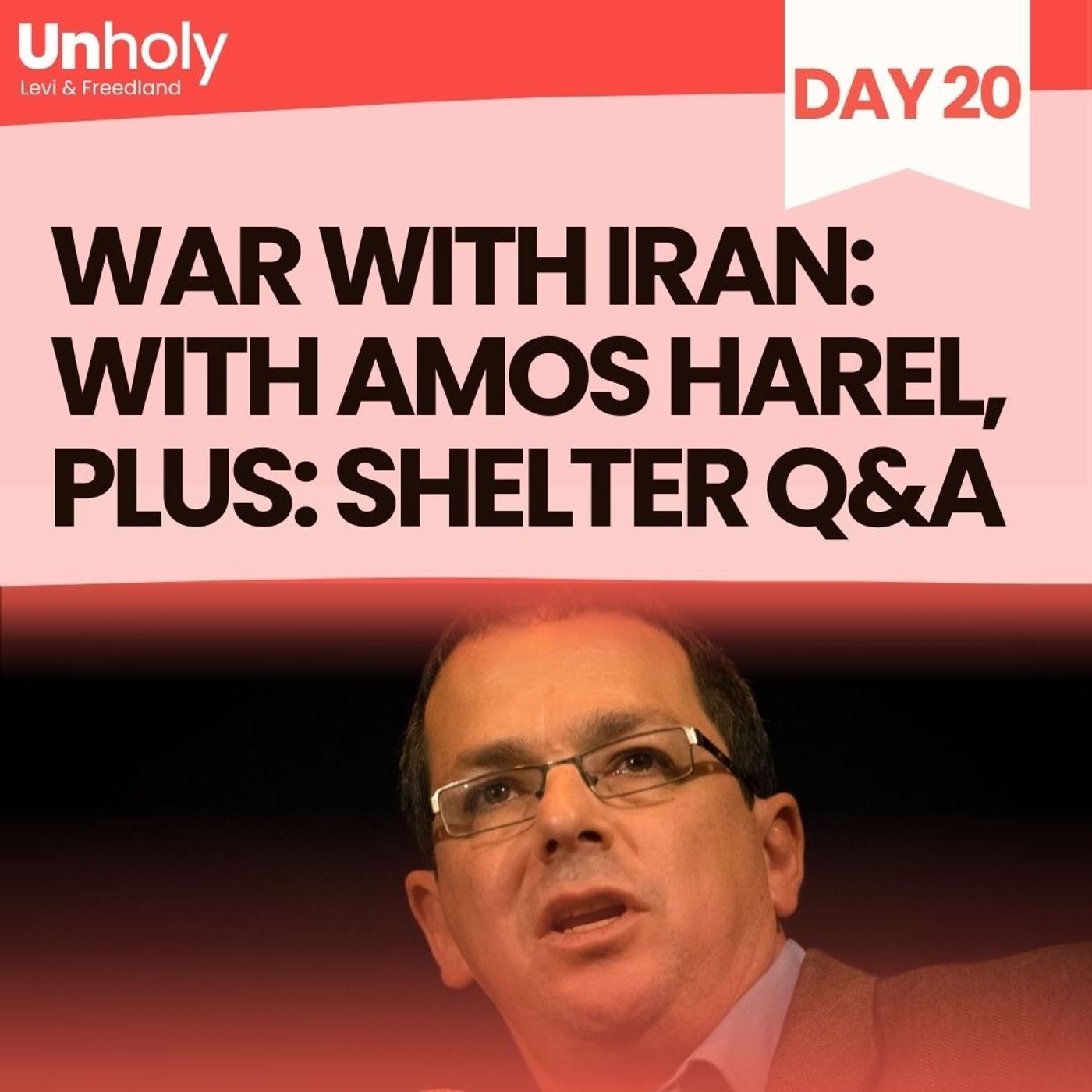
Unholy: Two Jews on the News
Day 20 of the Iran war - with Amos Harel. Plus: Shelter Q&A
01:16:39
Watch us on YouTube: https://youtu.be/HeoVvd294Ww Follow us on social media and join Patreon to get more of Unholy: https://unholy-podcast.lovable.app/ Day 20 of the US-Israeli war on Iran — and it's becoming a war of attrition. In the meantime, Europe refuses to lend its ships, daylight emerges between Trump and Netanyahu, and Joe Kent's antisemitic conspiracy theory gets the full debunking it deserves. Amos Harel, Haaretz's military affairs correspondent, joins Yonit and Jonathan for a deep dive. What does the assassination of Ali Larijani — Khamenei's right-hand man — actually achieve? Is the war drifting from plan A toward something no one planned at all? And why is Netanyahu now talking less about regime change and more about Israel as a "world superpower"? And we turn to you, our listeners, with your most pressing questions about anything between life and war.
Loading summary
Transcript84 lines
- [00:03]
Amos Harel
How does this end? I think by now it's a race between the energy crisis that we've just mentioned and what happens on the home front regarding rockets and missiles flying here, mostly from Iran, but some from Hezbollah and also being launched at the Gulf states. So it's a question right now of stamina. In a way, it's a very Israeli or Jewish version of a stiff upper lip with Israelis holding their ground and insisting on fighting. And again, and the goals of the campaign in order for this to end with an Israeli and American victory,
- [00:50]
Jonathan Friedland
The US Israeli war on Iran hits day 20. Is it going to plan? It's unholy. I'm Jonathan Friedland in London.
- [01:02]
Yanit Levi
And I'm Yanit Levi in Tel Aviv. Unholy. Two Jews on the news. This episode should come with a disclaimer like this episode is brought to you by one co host who slept two hours tonight. So I think since midnight on Wednesday and to this moment, we're about midday on Thursday, Israel time. So I think we've had seven sirens and I have had seven cups of coffee. So that's where we are, in case you're wondering, Jonathan.
- [01:29]
Jonathan Friedland
Yeah, I mean, and we, you know, our guest Amos Harel, whose voice you heard just there, the brilliant military affairs angler. He also, you know, throughout conversation is, was regularly noting that this is just the 21st day without, you know, not without a night's sleep before. And everyone who listening to this, who has people or knows people who or is actually in Israel will just know that this is really taking now, just very physical before you even get to the emotional and psychological stress, just the physical toll of interrupted nights. I mean, we've tried different ways, haven't we, to sort of convey to people what it might be like talking about having a newborn baby. Except as you brilliantly pointed out last week, that's actually a good thing. You also do have a baby. In this case. Just how that you know the toll that takes. And I do, you know, I come back to it again and again. At one point, people don't just go sort of out of their mind and just say whatever it takes, just when it translates into a kind of public sentiment. But maybe we're not at that point yet. I don't know.
- [02:32]
Yanit Levi
You tell me before I'll give you an honest answer. I just want to mention that we'll be answering your questions, listeners questions in a segment we're calling Shelter Q and A. And there are some very good questions. Our listeners are smart, smart people. I always like to be reminded of that, so there are some very good questions, hopefully at least mediocre answers coming later in the show. And now, to answer your question, we are exhausted. It has been, I think, for 20 days now, about two or three interruptions a night. That is, if you live in sort of the central part of Israel, if you live in the north, you're basically not leaving the bomb shelter, specifically since Hezbollah entered this war. And I don't know if we, it's necessary to explain this again, but it's not that you're awakened by a loud noise and then you go back to bed, right? I mean, it's this, this jarring sound of this preliminary alert emanating from your phone. Then you get up, most Israelis, either to a public shelter or to the shelter in your building, say hello to all of your neighbors, strangers in your pajamas and fluorescent lights, stay there for anything between 10 to 30 minutes and then go back upstairs again or go back into your home again. If this returns, you know, two or three times a night, then you're not sleeping properly. I mean, that is needless to say. Schools have been closed for three weeks now. So parents all around the country have turned into this 24, seven, you know, catering service, amusement center and education center. Next week, Pesach break begins at schools. No one will notice the difference because the schools will just continue to be closed. But at least, you know, to this point, about a quarter of a million flights have been canceled and Israeli Airlines, I think, will also cancel some of their flights. So there's not going to be a proper Pesach break. I can go on and on with my venting, Jonathan. Just stop me whenever you want.
- [04:12]
Jonathan Friedland
But that is no, I think you should go on and on. Seem like I think you should go on and on because we know this is a piece that's missing from the, the international understanding of the war. Obviously, media report casualties when they happen, whether that's in Iran, in Lebanon or in Israel. And there was an elderly couple who were killed by a strike this week in Ramadan. So they report that, but they don't report. And I completely understand why. Just that sort of night by night erosion of normality which you're describing. And I think it's very, you know, it's valuable for people to hear it. As I say, you know, there's my impulse, just like in the way that in the around the world people are talking about gas prices and at what point do American consumers say, right, you've got to stop this because I'm paying too much at the Pump. I'm also interested to know whether Israelis, and we do touch on this in our conversation with Amal Sorrel. You know, he mentions, invokes, the sort of British stiff upper lip and how that kind of stoicism. And we know that the Israelis really do have that. But at what point do they just say, look, whatever it was this was meant to achieve, now's the time to end it? Because I'm going out of my mind with sleep deprivation and with, as you say, the lack of education for children. This is like another COVID lockdown. I mean, just. Or is the patience almost infinite that Israelis will sort of wear this? They'll complain and because they're exhausted, but they won't actually say to their political leaders, you've got to find a way out.
- [05:45]
Yanit Levi
I kind of want to make another emotional point and then I'll try to answer your question, if that's okay. What I have been sort of running into a lot is people being very kind of judgmental or kind of criticizing themselves. You know, I don't know if it's a tendency of, you know, Jews in particular, parents perhaps, or, you know, that we go into self flagellation and self deprecation and kind of this overjudgmental tone. Right. I mean, and to me, I mean, we are all very tired. We're making mistakes, we're falling down, we're irritated for no reason. And that is just the way it is. And I think, you know, if I could say anything about dealing with anxiety, I don't know a lot about that. And as someone who's been in the news business, some would say that I, you know, we're often blamed for, you know, propagating anxiety. But I will say that I think the way to deal with it first and foremost is just to be very kind and compassionate to others and to ourselves. That is how I think we can kind of navigate it now. I think Israelis have a lot of patience, of course, and resilience. And remember, we're talking about it's day 20 of the war. Yeah. And then some, because we've been through this for two and a half years of an extremely difficult marathon, really. So obviously we're tough. And I think that every Israeli, if you would say to them, look, at the end of the day, the end of this will be a safer Middle east and a safer home for your children, they'd say, okay, I'll hold on. But if you say to them, look, what you're going to see is every six or eight months, another Round with Iran. And that could lead to, you know, a dispiriting feeling now. So I don't know if I'm answering your question, but it definitely is a challenging time for this nation again at the edge of an extremely challenging time that's been going on for two and a half years.
- [07:34]
Jonathan Friedland
Yeah, just say something about the cause. The word I wasn't expecting was your word about judgmental. You mean people are self critical?
- [07:40]
Amos Harel
Of what?
- [07:41]
Jonathan Friedland
Of their short fuse, of their temper, of everything.
- [07:44]
Yanit Levi
Like I have, you know, I've run into friends who forgot things and they would be like, oh, I'm such an idiot. I personally, you know, fell last week and I kind of hurt my hand and I was, you know, berating myself for. I'm such an idiot for falling. It's so weird. And at some point I, I kind of felt like people are so exhausted of trying to hold it all together. Right? I mean, you're supposed to be, you're exhausted, but you have to be alert. You, you're, you're fearful, but you have to keep up, keep up this brave face for everyone around you and particularly your children. It is difficult. There is a lot of, a lot sitting on the Israeli shoulder and I feel like a lot of us have been kind of turning it inward and that is why I kind of said, look, we have to be very, very forgiving because this is a really, this isn't normal, this is not a normal way to live. And it's definitely not a normal way to live as this is prolonged. And that is what. Maybe this comes just from my kind of sentiment and from the people around me, but I kind of feel like we should all be a little more patient, particularly towards ourselves.
- [08:46]
Jonathan Friedland
Very, very much so. No, that's very wise, I think. I think the normal point and the fear that this somehow, God forbid, becomes a new normal. Whereas you say every six to eight months you're back again, then in a way Iran becomes like a Gaza situation. That dread phrase, mowing the lawn, where every six months or so Israel puts Iran back militarily, pushes back with a bombing campaign, puts it back in its bo. If that's the future, if this regime holds on, that to me is very bleak. And then the linking it to the previous two and a half years has absolutely been in my mind through all of this, is that this isn't just on its own. There was a war last June, a 12 day war with Iran. But coming out of a period of two and a half years of just constantly being on a war footing and so we're talking really now about the country being in this frame of mind since October 2023, one way or the other, that is going to exhaust in the deep this sense, not just a night's sleep, but a kind of structural deep fatigue. And I just, I do wonder at one point that turns outward and becomes a kind of fury at this situation and translates into a sentiment, says there has to be another way. But I don't think we're at that point yet. And I understand what you're saying about how, you know, how things will develop in amongst all this. I mean, I do think, by the way, your point about with people, with young children, that is a whole other layer and level because of that thing of having to maintain a face and reassure. And my children are not so young anymore. But I have been putting myself, imagining myself into your shoes, for example, with three young children. That's a whole other layer. On top of all that, you also have to follow the news and transmit the news, broadcast the news to a country that is on edge. So, I mean, there is a lot to pick through and we do get into it with Amos RL but let's just talk a little bit about some of those developments this week.
- [10:48]
Yanit Levi
Indeed. And by the way, we're lucky to have screen time at all today because as I explained to you, at some point this week, we tried to record at 10am and I said to you, all of my children are sitting in front of all my screens having different zoom lessons, so we're not going to be able to record. So we have a limited time here, Jonathan. But to be more on the on the issue of the news, look, obviously another dramatic week, and we're at the end of week three, two major sort of developments happening in Iran. One is the assassination of the man who was essentially running the show after the assassination of Ali Khamenei. This is Ali Larry Jani, head of, you know, a key pillar in the regime and the head of Iran's National Security Council. And also, and I think importantly, the Basij chief, Reza Soleimani. Now, the besieged, you know, we keep talking about them. This is the kind of security force that is tasked with suppressing dissent. One of the Iranian experts used the term when I talked to him about the besieged. He said, these are the brown shirts, right? These are the kind of paramilitary trying to keep the dictatorship alive and quashing any kind of dissent. So the top brass has been taken out. By the way, interestingly enough, Israel is also attacking the headquarters of the besieged. In all Kinds of places, and according to reports, being helped by Iranian citizens that are kind of helping them target where the different locations of these are, because now they're more on the move. So that has been one issue, of course, the attack on the energy facilities. We'll go into that with Thomas Sar El. This war is continuing to be unpopular in the United States. I mean, it's interesting. I was looking at the kind of opinion polls on the first day or two of when this started. So the approval rating in the United States was 41%. The approval rating in Israel was 81%. That perhaps has something to do with the fact that the distance between Tehran and Tel Aviv is less than 1,000 miles and the distance between Tehran and New York is about 6,000 miles. So, you know, we can go into all of that. But of course, another big headline coming out of Washington is that the director of the United States National Contra Terrorism center quit essentially blaming Israel for dragging the entire United States into this war. So all this happened while, you know, while we were not sleeping. All this happened as well.
- [12:57]
Jonathan Friedland
Yeah, that's how the morning news could begin. While you were not sleeping. This is what's happened. I mean, the Larajani assassination, obviously significant. You know, on one level, these things are a great operational achievement. And it's fascinating the idea of Israel's extensive intelligence on the ground. It still knows where these people are. And the notion that they have obviously had for a long time help and intel from Iranians on the ground, that is important. You know, from me, from having done this for a long time, that I am a worrier. I have been worried by some of these developments because I think when it does finally come to conclude this thing, if there isn't regime change, and obviously that would be, you know, nobody would grieve the passing of this regime. But if that doesn't happen, there needs to be people there who have the standing to negotiate an end to this thing and just wiping out layer after layer of the leadership of this country. Obviously, Larry Gianni, a bad man, and all these people, the people in command of the Basij, the hated crack troops of this regime, you want to see those people gone? But I am one of somebody who remains worried about an anarchy scenario in Iran where you have nobody in charge, and it just begins to sort of break apart and unloose these sort of demons into the region, a kind of ISIS petri dish. That is one of the scenarios that worries me. So removing the intelligence chief, Larajani, one person after another. Yes. You know, it's sort of notches on the board that you think another achievement. But what comes after that? That's one of my worries about this.
- [14:50]
Yanit Levi
I think we should kind of look at the fact that these kinds of assassinations don't happen because someone presses a button. These are things that either there's an opportunity and some intel. Petraeus called the beginning of this war kind of a golden intel on Khamenei and the rest of his staff. So you have an opportunity and you either seize it or you don't. And I think that is what happened with the Lary Janie case. And there is a question of who do you talk to at the end of the day? Because I think we all realize that weakening the structure is very important. But how are you at the end of the day, for example, going to get the uranium out of there if not with an agreement? I mean, many people would agree that this, at the end of the day, the funnel is towards an agreement. And so you're right to ask who is the person at the end of the day? I think what happened here in this specific case was that the opportunity arose and that is what Israel took advantage of. And yes, this person who is such an important part of the structure and the more that kind of you erode the structure, at the end of the day, do you not achieve the objective, which is regime change?
- [15:55]
Jonathan Friedland
No, no, I get that and I remember absolutely Patrest, I think you talked about an exquisite intelligence and art. That was the thing I mean, which is amazing. And apparently that is the term of art they use. So I get that. But the concern I would have is where tactics lead you on strategy instead of the other way around. So in other words, we've got a chance, we've got an opening, do it. And then afterwards you think, well, actually now strategically we do eventually want an agreement because we think regime change might be preferred, but possibly improbable and therefore is it wise? So again, the concern I have is that the operational ingenuity of this is hard to doubt, but whether or not it is achieving what in the end will look like a long term solution. Like we say, we get into that a bit with Amos Harel. I wanted to pick up on your mention of Joe Kent, the director of the National Counterterrorism center who did resign, saying he could no longer support the war in Iran in good conscience. He said, just let me walk you through how I think this might have landed for sort of anti war types around the world. They would have thought, great, this is counterterrorism. Somebody was standing, has resigned. This is undermining the US war effort. He must be our guy. Oh wait, you then suddenly look and see who Joe Kent is, right? He is somebody from the far right of MAGA world. He's somebody steeped in conspiracy theory. He's a sort of on from the Tucker Carlson wing of the Republican right. And given that context, his resignation letter did not disappoint because he said there that one of his grounds was that this war had been the US had been pulled into it by Israel, that he blamed Israel for dragging the small, almost powerless American superpower into war. Mighty Israel had drawn it in there and there was precedent for this. This was a lie and is the same tactic, wrote Jokent, that the Israelis used to draw us into the disastrous Iraq war that cost our nation the lives of thousands of our best men and women. We cannot make this mistake again. Now, really important this. Cause this is one of these themes that comes up on the conspiratorial right. And it really needs debunking. And I'm glad to say it can be debunked really quite easily because this was around 20 years ago and luckily there is hard evidence telling us that is completely not the case. Just for the record. So we know this. Lawrence Wilkerson, who was chief of staff to Colin Powell, addressed this directly at the time and said throughout 2001 and 2002, senior Israeli officials were, on the contrary, warning against an attack on Iran. Quoting Wilkerson, Colin Powell's right hand, the Israelis were telling us Iraq is not the enemy, Iran is the enemy. Right. He described the warnings as pervasive. Prime Minister Ariel Sharon reportedly advised George W. Bush directly against occupying Iraq. I remember this well from the time because there were plenty of anti Israel, putting it mildly, types then who were saying it's Israel drawing us into the war. And I knew because I'd spoken to Israeli officials who once said to me very memorably, one Israeli official said, if we were to draw up a list of countries we would like the United States to hit in the Middle East, Iraq might be fifth, perhaps fourth, I don't know. First was Iran, by a long way, which is the backstory to where we are now. So it's an anti Semitic conspiracy theory. Joe Kent should be no kind of hero to the anti war movement. Instead he's just shod more light onto what is a growing corner of the American right which we have raised the alarm about on this podcast and we should continue to do so.
- [20:03]
Yanit Levi
Yeah, I mean, I'm really Glad that you went through all that. I will also add, you know, when he talks about pressure from Israel and its powerful American law view. Right. All of those undertones are not only anti Israel, they're a little bit more than that. And we can quote, I think Amos Hochstein, who definitely, I don't think we can call him a supporter of this move by Donald Trump, but he wrote on X, he wrote whether you support the war or oppose it, Joe Kent is a well known neo Nazi racist. No one should be taking anything he says seriously, even if you happen to agree with some elements. So I think we're in that regard for sure. I think that at the end of the day, the fact that the war is unpopular is not good news definitely from where I'm sitting here in Tel Aviv. And I think perhaps some effort should have been made to explain it better for the American public. There is a difference perhaps right to be said about are you saying imminent threat or a possibility, a golden possibility to take out a threat? These are different things. And perhaps some more work should have been done in that regard. But again, I think that we should think about a necessity to do this. And that I think is important.
- [21:10]
Jonathan Friedland
No, that's a very, very strong point that one of the consequences of failing to make the case for this war. And let's go back to the Iraq war in 2003. Remember, the case for that began on 9 11. There were people the next day who began making the case. And the invasion happens in March of 2003. If you think about the desert stories storm, the Invasion of Kuwait, August 1990. War doesn't start till January 91. In that time, Bush father and son make the case. They line up allies, they prepare the public. And when you fail to do that, through that opening you've. Through that opening comes all manner of wild conspiracy theories which in like water circling a drain always comes back to the same place to the Jews. And you know, I think these points that I and other sort of critics of this war have been making about Trump's failure to make a case, it isn't just a nice to have, it isn't just a sort of optional extra. You have to outline a strategy and war aims. Otherwise it will affect the way you fight the war and it will affect the way the war is seen. And we are seeing exactly that happening now. The door was left open to this kind of wild conspiracy thinking. So not helped incidentally, I suppose, by that narrative, by this latest statement of Donald Trump's regarding the attack on the South PAS gas field, in which he said, look, we didn't know about it, belied by the reporting and evidence that's coming out of Israel, where it says Israel and us absolutely coordinated. But there was one phrase in Donald Trump's social media post which unnerved me again, given the Joe Kent view of the world. It's when he says, we will hit back at Iran if they hit Qatar or any of our Gulf allies, whether we have the consent of Israel or not. He says. And I put my head in my hands when I saw that because I thought, well, now you're playing into that narrative that you, the president of the world's biggest superpower and the wielder of the mightiest arsenal that has ever been amassed in human history, somehow need the concept of Israel. What are you doing using this kind of language anyway? That was yet another bit of fuel that Donald Trump is throwing on this fire, I think.
- [23:33]
Yanit Levi
Yes. And I think I'm reading into some of what you're saying about preparing the ground for a war better. That kind of leads us into discussing what looks like a pretty big crisis opening up between Trump and NATO and Trump and Europe and just comes to serve as the. The point, I think, is that this is a bigger war than just Israel and Iran or the US And Iran. This has ramifications beyond the borders of the Middle east, what we're seeing right now.
- [24:03]
Jonathan Friedland
It really does. I mean, I was speaking, somebody, a scholar of these matters yesterday who said to me, some students were asking me, when could this turn into a world war? And he said, I think the question is rather is it already a world war where historians will look back and say it already is. And that's partly because what is the Iranians big weapon in this war? Their actual physical hardware, weaponry is being degraded and destroyed. But the huge weapon that this war has advertised to the world that they have is an economic chokehold in the form of the Strait of Hormuz through which so much of the world's oil comes, but a whole lot of other goods, too. Incidentally, that passageway or that channel and, and their power over it has been put up in lights by this war. That's their big deterrent. And that affects everybody, not just the immediate players. You have, obviously, the Gulf states drawn in, or maybe some people want to see them more drawn in. At the moment, they're acting only defensively. They're not hitting back at Iran. Maybe they don't have much firepower to do that. But the rest of the world and the Europeans are being affected by this most obviously surging oil prices, hitting 120 a barrel for oil that then drives up inflation and interest rates. And it's being felt all over the world. The direct manifestation of this, in a way, is Donald Trump saying to those European and other allies, lend me your ships so I can force open the Strait of Horn moves. And the answer came there none. I mean, the Europeans, Canadians, Australians are not in any hurry to lend a hand here. Even though they are themselves suffering from the blockage on the Strait, they are not lining up to offer any help. And so Donald Trump is forced to make these statements when he does his shtick of sort of pretending to be them. Oh, no, sir, he does this voice and he goes, you know, they're declining. No, sir, we don't want to get involved, he says, disparaging these Europeans, doing this voice. When he does the sir thing. That's always a tell. My point on that would be, what did you expect? You told them nothing. You prepared the ground? Not at all. And then you've just been insulting them now and also for the last year. Plus, he said about Keir Starmer, he's no Winston Churchill. We don't like people who join wars when they've already been won, is what he said two weeks ago or a week ago. Now suddenly he's saying, come on, where are your ships? Lend us your ships. And he should realize that these are all politicians, Macron or Carney or Starmer. Admiral, they have electorates and their electorates are in no mood to join a war that they think is turning into a quagmire. And they're not in a rush to join the side of a man who has just repeatedly insulted them. Just before this Oramo, Donald Trump had said that allies had been in the back behind the front line in Afghanistan and Iraq, massive insult to Denmark and Britain and other places where there'd been great loss of life among military personnel. So if you insult your allies, you can't expect them to help.
- [27:29]
Yanit Levi
Yes, of course. I don't know if you elegantly forgot that Pete Hegseth left it out that Pete Hegseth called allies like the U.K. what was it? Pearl clutching allies. Whereas Israel is a capable ally, by the way, is a capable ally just in the sense of what it is doing now side by side with the United States. But I would want to remind us of something that I'm quoting him for the second time this episode. Amos Hochstein, who was Biden's top advisor, said to us about Europe and how it is not standing up to Trump and how it should. That context was a few weeks ago after the Maduro issue. But I want us to hear it because I think it's relevant to our discussion.
- [28:08]
Jonathan Friedland
He's running the board because there is no board. Europe's pronouncements, after everything that he does on tariffs against them, Venezuela, whatever else he does is we are deeply concerned and we may even have a meeting about it. You look even at Greenland, he's threatening to invade Europe, essentially, and Europe has zero response. Nothing. Everything is about placating. They read him wrong every time, and then they repeat it the next time, and then they recognize that they read it wrong and they do it again.
- [28:42]
Yanit Levi
And I think this is part of what is happening, Jonathan, in the sense that I think he was right to say Europe is not standing up to Trump like it should or like leaders like Chirac or Thatcher, as you reminded him, would have done. And now they're standing up to him, which could be a little bit late, understandable from their perspective. Also indicative of how unpopular this war is. I'm saying sadly unpopular from an Israeli perspective. So they're just, you know, now they have the courage to stand up and say no, perhaps, as I said, too late. What, what I would say is this relationship, we don't know where it's heading. It has a lot to do with the war itself. If the war is successful and Europe didn't help, then that weakens the relationship even further. If it is a failure in Europe, that didn't help, it does weaken the relationship as well. And again, we are, you know, you and I both are creations of the post World War, Second World War order. And we tend to think that Europe and the United States should do good together in the world. And I don't. Just in that perspective, I think this is a worrying development. When the United States says, I need your help, and Europe is saying we're not going to help, that is not a good development in the good part of the world.
- [29:53]
Jonathan Friedland
I think I would go further. There are people who feel heartbroken by this, by this transit, the rupture in the transatlantic alliance, because they believe it has underpinned the post1945 world order, which, with flaws, of course, did ensure some degree of peace, prosperity and stability for 80 years. But I fear, and I take no pleasure in this, but I think responsibility does lie centrally with Donald Trump for taking an ax to this alliance repeatedly right from the beginning. That dressing down of Volodymyr Zelensky, Zelensky in the Oval Office, the constant siding with Vladimir Putin against Ukraine, never talking back to Putin, but the constant stream of insults. The national security strategy, which accuses Europe of civilizational erasure, which says the US Will now fund and support those political parties which are against the governments of Europe and which if populist nationalist movement movements which want to topple a lot of the sort of existing stability and order, whether it's the alternative for Deutschland in Germany and Le Pen in France and so on. So this has been coming for a long, long time. And it's extraordinary how patient in a way the Europeans have been until now in that they've been trying to make this work. And that's partly it's not because of some high minded principles. It's because they are still dependent on American hard power for their own security, but they are making plans for a different world. And you see Mark Carney, who's become in a way the unofficial leader of the free world minus the United States, who is traveling the world. You know, he was in Australia a couple of weeks ago making this case for the so called middle powers to get their act together without the United States even now talking about a kind of World bank for defense. So the world is changing, but a big part of why it's changing is Donald Trump in his own disdain and serial insult to previous allies.
- [31:56]
Yanit Levi
Yeah. And of course you mentioned the Canadian Prime Minister. I would say that perhaps what is interesting in what Amos was saying is that Europe should have stood up to Trump a lot earlier and that then perhaps we wouldn't see this crisis now. Now, in that regard, that's just me, you know, paraphrasing him. But I think at the end of the day, there are two sides to this story. And you're accurate in describing the Donald Trump side. I just don't know if again, if the Europeans perhaps should have done the exact opposite and stood up to him sooner, this would have been a different kind of world. I don't know. That's.
- [32:26]
Jonathan Friedland
No, that's really interesting. I mean, they have been so nervous of it because they are reliant on the American nuclear umbrella. They're reliant on American hard power. So they've been desperate to make, make this work. But like Mark Haney said, in a way it's because they've been clinging to an old order, not wanting to believe it had gone. And so they were constantly hoping that Donald Trump's better angels might pull him back towards the old model of a transatlantic alliance. Question is, are there any better angels? There don't seem to be many. So it was a sort of faint hope and a veil.
- [32:56]
Yanit Levi
Look, if his 10 rules of the deal and the first deal is always sign a prenup, then I think it's written. Right. You should have seen that coming. I'm just saying very much I agree
- [33:04]
Jonathan Friedland
with you on that.
- [33:05]
Yanit Levi
Yeah. So we but we want to stay focused on the Iranian issue and where this is heading on day 20th. And I think that, you know, we always turn to a very smart man to talk to us about where this is going and where this is from a military perspective.
- [33:24]
Jonathan Friedland
Amos Harel is the military affairs analyst for Haaretz. He is one of the most widely read and trusted commentators on defense matters in that part of the world and a friend of the podcast. Amos, very good to have you back with us on Unholy. I wanted to just start off first with this event of this week, which is the Israeli strike. It seems to be an Israeli strike on the South PAS gas field in Iran. Lots of theories as to what exactly this move was aimed for, including the idea that and you hear this coming out of the Gulf, somebody I spoke to in the UAE just wondered about this, whether the game plan here is to prompt Iran, provoke Iran into a response whereby they attack the energy installations of their Gulf neighbors, who then as a result would turn to Donald Trump and say, look, finish the job. We can't leave a sort of wounded Iran here lashing out at us, its neighbors. You have to finish this job and push out this regime. I don't know what you make of that. And just what your reading is, is of this whole situation, Donald Trump, of course, saying he did not know in advance of this attack that was coming on the gas field. But what do you make of it?
- [34:40]
Amos Harel
I'm not so sure about this explanation. The Middle east has a long tradition of believing in what is known in Arabic as muammar conspiracies, and especially those dark Jewish or Zionist conspiracies behind everything. I'm not sure that this is, in fact Netanyahu's plan, but it is interesting to note that this is the second time that Israel attacked a massive and important oil site in Iran within I think the last ten days or so. The first time was, you may recall, those attacks on the oil fields near Tehran with this very poisonous black smoke all over the place. And then American sources said later that Netanyahu was trying to create an image of chaos. Was he doing it again? Well, they coordinated to a point, and then Trump decided that this was too damaging for him also Qatari infrastructure was hurt in the oil field, in the gas field in Iran. It also reminds me of the attack in September in Qatar. You remember that, the Israeli attack. At that point, both sides were leaking, the two sides were leaking different versions of events. Were they coordinated or not? Did Netanyahu tell Trump in advance what he was about to do? My guess is that I think both in Washington and in Jerusalem, there is a sense that this campaign, which has been extremely successful on the operational level, is now beginning to lose its way when it comes to strategic gains. And because of that, the stakes are higher and there's more willingness to risk with the initiatives, with taking the initiative, with striking, but willing to risk more in order to get things done. And this is where I think the UAE version of events might be accurate. And since so much is at stake, you have different versions of events, you have contradicting theories of what is actually happening. But this is an energy war which could evolve into an even bigger international crisis. And this is where we are again, massive operational success. But it hasn't been translated to a decisive victory. And I'm not sure, I wouldn't even add the word yet. I think it's very, very hard to move from plan A to plan B or point A to point B. We're in a different terrain now.
- [37:11]
Yanit Levi
I mean, so you're saying essentially raising the stakes again, this attack on energy infrastructure. Of course, of course we saw this week the assassination of Lari Jani, Ali Khamenei's maybe right hand man, an important key pillar in the Iranian leadership and of course the head of the Basij and his deputy. I mean, we are at day 20. Do we know where this is heading? I mean, do the planners know where this is heading?
- [37:35]
Amos Harel
We should know the difference between operational level and strategic planning. And strategic planning is not a place where either Trump or Netanyahu tend to excel. Trump, we know he plays this by ear. He doesn't have patience for much details. He has certain principles that he's willing to act upon. And I think my personal view is that he was closer to the right understanding of events than Obama and Biden before him when it came to Iran. But when it comes to long term planning, what he has is mostly Witkoff and Kushner. And we know where that leaves us regarding Netanyahu. He has a long held belief that strategy is something that limits you as a leader, that you don't have to announce what your strategy is and that you need to improvise. But had he thought it through of course, he's been thinking of defeating the evil Iranian regime for 35 years. This is what he's been preaching for so long. And now he gets a chance, chance to do that. Does he know how to actually remove the regime, to topple it? I'm not sure. So I'm not exactly sure where we are right now. But I think we're approaching a stage in which all of those remarkable operational advantages, there's only so much you can do with them at one point or another. You have to decide what the goal of the larger scale war is, and it hasn't been decided yet. One more issue, I should add. I talked to one former Israeli general just a few minutes ago, and one thing he pointed out was that considering the Iranian decision regarding the Hormuz strait, Trump is in a tough place now. He can no longer do what he did in Iran June of last year, or what he did about the Houthis in Yemen, Yemen around February or March 25th. He can no longer declare victory and get out because this is becoming an international economic crisis. He can not just leave, declare victory and pull out of the region because there's such a mess being left behind. And in spite of the fact that the regime was hit so badly, those that remain, people like Mujtab Khamenei and others who are trying to control events from Tehran are now actually saying, since we've survived this, since at this moment we haven't been killed and the regime is yet in power, then this draw is actually a victory for us. And since we're here, we cannot make concessions right now. We need a better agreement later on. We have our own demands. The fact that we are alive is enough to present us as winners and to squeeze some concessions from Trump and company. Will it work out? I'm not sure. Maybe. Maybe the opposite is true and maybe Trump would just get angrier and apply more force and finally the regime would crumble. But right now we don't know exactly where we are, considering everything that's happening. And I would be wary of focusing too much on images or even statistics. Both sides would like to tell you right now that they're winning again. The western side, Israel and the United States has the upper hand. Life in Tehran is a thousand times more miserable than it is in Tel Aviv currently. But again, in my view, this does not promise us any clear and final victory, at least not yet.
- [40:59]
Jonathan Friedland
Just picking up your point about how it on strategy, and it's fascinating hearing you say that. Netanyahu in some ways does not Even aspire to a strategy. It's really interesting, but there is a divergence perhaps between the US and Israel on this. From Israel's point of view, if it does fall short of regime change, if the regime does survive, but it has a much reduced arsenal, is that you've described very well how that in some ways is a win for Tehran, but would it be a win for Netanyahu? Would he be quite able to live with. Yeah, the regime is still there, but they've got less hardware than they had before. That means this war was worth it.
- [41:39]
Amos Harel
He will have to change his public position about that. That and the whole PR campaign would have to be to work differently. And you have to remember that we're approaching elections. This is an election year. And there are similarities with the situation in Lebanon and Gaza as well. Was there a final decisive victory in Gaza? Yeah, we brought hell on Gaza. And most of the Hamas leadership is now dead, as should have happened after October 7th. But was Hamas actually defeated and destroyed completely, as he promised. So he's in a danger, I think, and I think that we can. I'm not smelling panic, but I think his last public statements, there's a lot hiding there. I think he's worried about the outcome. And our colleague Ronan Bergman just in, Yedio Dohonot just yesterday mentioned that while Netanyahu talked constantly a week or two weeks ago about regime change, he's now talking about Israel, the Israeli empire, about Israel being a great, almost a world superpower, and about how much our power and influence, our military power, military might are felt everywhere in the world. He's mentioning less the goal of regime change. I don't know yet where this is heading, but this is an interesting point to make. Now, having said all that, another important aspect of this whole affair is what the generals think. And speaking to some senior generals, I think three of the most senior generals in the Israeli military in the last week or so, what you see also is a slight change. I think they. I'm not sure that they were deep believers in this whole idea of regime change to begin with. But what we're talking about right now is, look, if we manage to erode their capabilities in such a significant way, and if we push back on the deadline for their possible nuclear power and so on, then maybe we're in a better place. And now would be the time for the public to work its magic. Once the Iranian people are encouraged by this, once the fighting is over, maybe the final step would be taken and the regime would collapse. But some of the Generals and some of the military experts in Israel are saying, saying, look, this was a bit far fetched to begin with. We couldn't go all the way and defeat a regime which is 1000 miles away. Not only defeat it, but replace it. In spite of everything that we've shown to be capable of. This is one step too far.
- [44:13]
Yanit Levi
It's so interesting. We spoke to you in June in what I think we should be already calling the first Iran war. And then you said, I can hold two thoughts in my head at the same time, that this was necessary. In fact, the chief of staff, you said it was a justified decision. But on the other hand, I have doubts about the person making this decision. I wonder, because this war is obviously now longer than the 12 Day War because it is highly criticized in the United States and in parts of Europe. Parts in the United States and in Europe. What is your thinking about it now, about the necessity generally of going to this operation now? What the information that Israel has when it decided that this would be the right time?
- [44:54]
Amos Harel
Well, in this case, the song remains the same. I feel probably the same about this. We now know more about Iranian intentions and Iranian capabilities than we knew in June at that time. I think at the end of the war. As far as I can remember, when I wrote about this, I didn't claim that this was a final victory. This is what the leaders said, but not some of the analysts. We had our doubts at the time. And it's very, very clear, A, that this regime is about annihilating Israel, that there was an actual plan to do that, and B, that they were recovering, that they were planning to do worse things to Israel and the region in the long run. I think it's rather simplistic to claim that there was an immediate threat from Iran on the United States. Maybe Israel was a more complicated case. But unlike some of the leaks from around Trump, I haven't seen any proof that this is actually happening now that they were about to strike or anything like that. They were smarter than that in the long run. We have a strategic problem with Iran that had to be dealt with. And it seemed like the Iranians were not going to show any kind of willingness to compromise or any kind of flexibility about a future agreement and getting. One of the failures of the previous war was about not reaching an agreement regarding the 440 kg of enriched uranium. And since this wasn't solved, and since this was raised again and the Iranians were refusing to solve it, I still felt that there was a justification for another war. I'm still worried about many aspects. The fact that we're killing so many of their leaders would mean at one point or another that they would try to retaliate. There will be Israeli politicians or generals or so on who would pay for this in the long run run. We're destroying their oil fields. Aren't we worried that some of our infrastructure could be hurt as well in the long run? These are difficult problems. And having said all that, I haven't. It's a personal view, but I haven't improved my personal opinion about Trump and Netanyahu and the way they conduct things and the way they talk to their different publics then I didn't change my mind from last June. I think the same is true right now. So, again, a justified war, in my view. But a lot of questions about the people calling the shots. And again, Netanyahu and Trump, no other do would have achieved that. And you can detest both of them. You can decide not to vote for both of them and still give them credit for actually taking action. But having said all that, that doesn't mean that they're operating in a moral way or that they're telling truth to the public or that they know what they're doing at this stage was extremely successful. For three weeks, we still have to hope that things would. That the world would sort this out. But we're stuck in sort of a mess right now. This is becoming a war of attrition. And in spite of those generals and politicians and analysts stating every day that we're about to achieve more victories, you know me, I'm a bit pessimistic about these issues. I think that we should remain doubtful about the outcome. I think it's much more complicated than the way it's presented to the Israeli or the American public.
- [48:12]
Jonathan Friedland
Yeah. And the question arises from what you've just said is how much, in a way, does the conduct of the war depend on the character of the people leading it? And I think we're seeing some of that playing out now. I just want to ask you about another front in this war, and that is Lebanon and Israel's continued targeting of. Of Hezbollah targets and the movement of over a million Lebanese getting out the way of what had been assumed to be an imminent Israeli offensive there. It's just emerged in the space of the last week that, as I understand it, the Israeli military or intelligence has decided that actually Hezbollah regrouped and rearmed at a much swifter rate than had previously been understood that they regrouped after the war. Of 2024, when everyone thought they were absolutely on their knees. First of all, what you make of that, and also, if that goes to a larger point relevant to Iran, which is these constant military efforts, they get short term gains. You see it with Hamas in Gaza, you see it with Hezbollah, Lebanon, you're seeing it now with the Iranian regime. But long term, these things regroup and return much, much quicker than you think. In other words, that the military solution has limited effectiveness when it comes to fighting these kinds of groups or state actors.
- [49:34]
Amos Harel
I'd start with your final conclusion. Things are complicated. Again, the tendency among analysts, especially in the media, is to simplify things and to make strong announcements that would explain to everybody exactly where we are are at a certain moment. But as journalists, we have to be aware of the spin. We always need to take a step back and worry about the fact that all of those spin doctors behind the scenes have a goal to achieve through us. Now, the reality of the matter is that in November 24, and I think we've talked about that in the past, there was a very significant military achievement. It doesn't mean that Hezbollah, the organization or the movement or the idea died with Nasrallah among the ruins of his bunker in Beirut. That was not the case. These guys, this is what they do. They haven't developed an interest in chess or in football since this is what they do for a living. They're getting money from Iran, a billion dollars a year in order to build weapons and use them against Israel. And they had retaliation on their minds, revenge on their minds. This is what they wanted to do. So there were significant capabilities before 24, they were smashed by the Israeli army. But since then, Hezbollah has been working again on improving things. And the military solution is not the only solution and is not a solution to all of the problems. But here is where I beg to differ. And this is, again, this is probably a very Israeli perspective. You stand where you sit and we sit where we sit. There are rockets flying around the place all the time. The tendency, especially after October 7, is that things should be dealt with swiftly and aggressively. If there's a threat from Hezbollah, then we need to deal with that. This is more or less the consensus. And you also have to think about the residents of the Upper Galilee, people living along the border who were told by the government that they could go back, that things have improved and that things would be safe right now. So the government is in a deadlock. There's a sort of a catch 22 here as well. And it needs to act and so do the generals, because they've promised, promised peace and calm and tranquility for a relative period of time at least. And this hasn't been. This isn't the way things have developed. So this is where we are. It's not as if the military solution is the only solution. Power should be used. But we have to understand the limits of this game, so to speak, and we have to understand that there's almost always another round, that Hezbollah would not disappear and neither would Iran. If there's a magical regime change in Iran, it will help the whole region and perhaps the whole international community. And yet, as I said, we're not there yet.
- [52:12]
Yanit Levi
You said, like, we stand where we sit. And where we sit, which is you and I in this conversation, there are rockets everywhere. So I know this perhaps is a. To ask you a date and time is complicated, but when does this, when does this end? I mean, first, if you can give me what, just give me when I'm okay. But you could say a few weeks or a few days. But you know what, how does this end? Because obviously the Hezbollah issue is complicating. Things matter things considerably for Netanyahu will be complicated to end again with an agreement, as you say, Trump might push the brakes in Iran, but that won't help because the Iranians won't stop. Like, how does this whole thing come to an end? And does it mean that in six months or eight months we're in this third war with Iran? Say something optimistic. This is what I'm asking.
- [52:57]
Amos Harel
First of all, it's good that you're helping me avoid your first question about the deadline. People have been saying two, four, six weeks. I don't know, am I? How does this end? I think by now it's a race between the energy crisis that we've just mentioned and what happens on the home front regarding rockets and missiles flying here, mostly from Iran, but some from Hezbollah and also being launched at the Gulf states. So it's a question right now of stamina in a way. I'm not promising blood, sweat and tears or anything like that, but I think that when we. Again, it's a very Israeli or Jewish version of a stiff upper lip, Jonathan, but it has to do with Israelis holding their ground and insisting on fighting and again, believing in the goals of the campaign in order for this to end with an Israeli and American victory. And again, the question mark here, of course, is Trump himself. How is he going to act? And as I quoted that former general earlier on, he cannot now easily disengage from the problem that he helped create. So the way to end this, I would assume, is still applying more pressure on the Iranians while holding to our guns regarding the attacks on the home front front and hoping that we don't suffer too many casualties, which would affect national morale. Because as you and I know very well, people are beginning to feel the outcome of this long military campaign going five, six, seven times a day to the bomb shelters is a big deal. It doesn't sound a big deal for Netanyahu, Trump, but for the people actually dealing with that, with small children, with dealing with education through zoom and so on, these are massive. These are massive issues. But I think we got to a point where it's becoming more of a complicated problem than some might have thought. In the past three weeks is a long time and there's no deadline in sight yet. I'm grateful that President Trump supports the Israeli caucus. And I think that we haven't talked enough about Israeli American military cooperation, which is amazing to watch. And yet I'm not sure that this is enough for a decisive victory yet. I'm ready for surprises there. If the Iranian people will suddenly decide to march towards the Basij camps, towards IRGC headquarters, whatever, that would be a great change. And I think that the regime would fall in the end any either way this would happen. But I'm not sure that this is entirely connected to where we are right now. And I think that maybe the limited, maybe more limited goals of the campaign should begin to be discussed.
- [55:59]
Jonathan Friedland
Before we let you go, Amos, I just want to ask you about one last incident, an episode that caught the mind of a lot of media coverage internationally. This is on the west bank where Israel, Israeli forces, Israeli police and undercover unit killed two young Palestinian brothers and their parents, according to the accounts, shooting all four in the head and face as the family returned from a shopping trip for Ramadan. The two boys, Muhammad, age 5, Othman, aged 7. He was blind and had special needs. You can see why this would have caused great outrage around the world. I think people know a little bit about these undercover units.
- [56:38]
Amos Harel
Units.
- [56:38]
Jonathan Friedland
They were dramatized in a very popular TV series, Fouda. People know a little bit about it, but what can you tell us about not necessarily this particular incident, but about the ongoing situation in the West Bank.
- [56:52]
Amos Harel
So we've discussed that. I think in previous conversations before the Iranian campaign escalated, the situation on the ground in the west bank is quite troubling for a long time. It began after October 7, a lot of incidents with all kinds of Palestinian terror cells and so on, but also an attempt by extreme settlers with the support of ministers in the government, specifically Beselyt, Smotrich more than anybody else, but also Benkvirne and sort of at least some kind of green light from Netanyahu as well, of taking control of more and more territories and pushing Bedouin communities out of certain areas in the West Bank. So this is one source of friction which is I think, the most important one, this incident. I would say that it's a different case. It adds to the tension going on for a long time, but it's a bit isolated. This happens every now and then, unfortunately, in the west bank. And you could see it happening as well for the Brits and Americans in Iraq and Afghanistan and so on. And I can tell you view right now that in spite of the discussions over an investigation and in spite of the fact that we know that the politics of this current government are different than the previous ones, we know the outcome. In the end, it will be one side's words against the other. And it would focus on one issue only, which would be did those policemen feel a risk to their lives when they decide to shoot? And as most people who are in such situations will tell you, it's a very, very personal issue. And no lawyer and no judge in Israel would step into their shoes and say, no, you needed to be okay, you needed to be more careful. And it turns out to be a terrible tragedy. But you shouldn't have been trigger happy, you shouldn't have acted in any way because not only because of the public situation in Israel and the public feelings about these issues after October 7th, but because it's a very, very difficult issue. So I would isolate that certain incident and say that's part of the price of the it's a terrible price, but it's part of the price of the ongoing Israeli Palestinian conflict. As long as there is friction in the west bank, you will see some of these mistakes made. And in most cases you will get after the usual Hezbollah fiasco, you will get the ministers and the generals backing the troops. So not a lot would come out of this. I would try and look at the more general perspective and say, hey, the situation is increasingly worrisome in the west bank because of settler violence, because of Palestinian attacks and so on, and things are tense right now and are affected by everything else. And B, I think there is a specific issue, perhaps not with this police unit, but with the fact that soldiers are coming back from Gaza and now serving in other places such as the west bank in Gaza under extreme circumstances, everybody was a suspect. You tended to shoot first and ask questions later and so on and that in some way was transformed into the west bank as well. So the army has an issue with that. And I have an issue with the chief of staff, Fayal Zamir, who in my view doesn't discuss these problems enough and doesn't have the emotional resources perhaps at this moment to deal with the troops conduct over these matters. So these are long term issues. There's a personal tragedy here which is terrible, but the long term issues remain and I don't see them being solved anytime soon.
- [60:38]
Yanit Levi
Amos Harel, we're so grateful for your time, Amos, and something tells me we'll be talking to you again, again very soon. So thank you so much for talking to us today.
- [60:46]
Amos Harel
Thanks for having me.
- [60:53]
Jonathan Friedland
Always very, very good to check in with Amos Haral. He follows and obviously understands deeply all the operational detail. He's across all of that, of course, but he does bring this nuanced perspective to the big picture, including the merits of the case, the differences in the case between the one that's being advanced in Washington and the one that's being advanced in Israel and how they are different and in a way one might be more sort of realistic than the other depending. So we come out enlightened as so often after our conversation with Amos. Now we're going to do something a bit different.
- [61:32]
Yanit Levi
We are. We wanted to hear questions from our listeners. This is a time of war, so we called it a shelter. Q AND A. Some of our listeners are indeed in between shelters and in between sirens and wanted to hear what is on your mind these days. So shall we start with I think two of our favorite interviewees? We can say that right?
- [61:53]
Jonathan Friedland
In another feature that we did in that lovely interim between wars, as it were, when we had, you know, listeners therapy when we invited lots of, of pairs of people in relationships who had felt the strain in their relationships. Listeners really did respond to Benjamin and Albert, two friends, close friends, school age friends in Copenhagen, in Denmark. So the unholy reach goes very, very far. Whose own friendship had become under strain. They talked about it very candidly over the issues about Israel and the Gaza war. And they came in with this, this really interesting question. Hi unholy, it's Benjamin and Albert. How much do you think the motive of freeing the Iranian people played a role in the US and Israeli decision to go to war? And do you think there might be other incentives at play like taking focus of the Epstein case? What are your thoughts about that?
- [62:49]
Yanit Levi
I mean, you know, it's so interesting to me. I think we talked about this an episode or two ago, that if Trump had actually attacked Iran on the night of January 8th or 9th, are very close to the sort of protests that erupted and then were so violently suppressed, this would not be a question. Right. No one would be questioning the rationale of this war. I think that it's pretty clear that Iran is a danger to the world, and this is a president who decided to do something about it. Remember, even the conversation we just had with Amosarail saying he thinks that Trump, you don't have to be a Trump supporter, but he understands or understood the intentions of the Iranians better than other American leaders. So I would say, I think that is still the reason I am less sort of a follower of these thinkings, that this would be a diversion. This is a huge decision to make for an American president. This is, in fact, the biggest war America has started since 2003. I think it's a decision made on the merits of it and not trying to sort of divert attention from something else.
- [63:50]
Jonathan Friedland
Yes. I mean, the. The nuance I would put on that is that only that. I think that's right. He saw it as a threat, but to the region, to the neighbors, to Israel, rather than it being specifically about liberating the people of Iran. And that's because of this thing of timing, I think. Well, multiple things. The timing, had it been January 8th, 9th, but also the rhetoric, regime change mentioned at the beginning, but then not really mentioned after that, whole lot of other stuff, new luring expectations. And it's about a nuclear deal. It's about ballistic weapons. If this was truly about liberating the Iranian people, it would have come earlier. January 8th, 9th. And also that's all you would be hearing. And instead you're hearing a whole range of shifting explanations. We have another question from Tammy.
- [64:38]
Yanit Levi
How can ordinary citizens contribute to the rebuilding and all of the healing that is going to need to happen in Israel over the next few years? And question number two is, how do we encourage more bridge building in the beautiful and inspiring way that you two are doing through your conversations? First of all, Tammy, thank you so much for this question. I apologize. By the way, Jonathan, there are a lot of noises of many children in the house. We're doing shelter. Q and A. I'm in the sort of very close to a shelter. That's where we are supposed to be at this time. So there's gonna be a lot of family noises in the background. I apologize.
- [65:14]
Jonathan Friedland
No apology Required, if anything actually does convey, look, this is the reality. Kids are at home, they're not at school. I think this is all part of conveying the reality of what's going on where you are. And I think no apology required ever.
- [65:25]
Yanit Levi
So thank you for that. So again, thanks to Tammy. I really appreciate the question. I think we're seeing again, as we always do in these challenging times, Israelis really coming together. And there is a piece that we aired on the news on Wednesday of the Rambam hospital, which is the biggest hospital in the north. It's in Haifa, all of it transforming to an underground hospital, indeed, three floors underground in the parking lot. That is where patients are being taken care of. And you see this again, these are extreme situations and extreme place to be. But people are helping, volunteers are coming there. Even artists are singing there, volunteering to sing beside the dialysis patients and the women who just gave birth and all of that. In this kind of environment, you see the differences are much smaller. Right. It's always like, you see the religious and the not religious and the Arabs and the Jews and everyone kind of working together and making it work. And I wish for this society that it knows how to do that, even when it's not such a challenging time. I think we have it in our bones and in our genes to do that. We really know how to do that.
- [66:37]
Jonathan Friedland
That is very heartening and particularly your mention there, the hospital very often when we were talking about building bridges, as Tammy mentioned in her question, it's in that health sector actually that the bridge between Israel's Arab minority, Palestinian citizens of Israel and the rest of the country is most apparent because people will know if you've been to those hospitals. It's not just the patients. Patients are Arab and Jewish side by side, but the medical staff, doctors, nurses are drawn from both sectors, both communities, and they just get on with the business of saving lives. That is something that's just, you know, embedded in the day to day Israeli reality. I've often thought if the country could be like, you know, Hadassah Hospital, we would be in a better place. So that's a good example. As for bridge building outside, well, look, it's what we've been doing and what we've been aiming to do on unholy for such a long time. And part of it is that if you're from the outside Israel, I think you said this last week, check in with people you know who are inside Israel. You know, often there are Jews outside Israel who are critical of Israel, call themselves Candid friends, sometimes they really emphasize the candid and forget about the friend bit. You know, if you want to be the candid friend, you've got to be both. So, yes, candor when you want to be critical and so on. But in a moment when Israelis are in great distress, their nights are interrupted, they're in fear, people are being killed from missiles out of the sky. It doesn't hurt to be a friend. And so I think always remember both halves of that equation if you're going to be the candid friend. We have a question from Lior.
- [68:14]
Yanit Levi
Hi, my name is Lior, longtime listener. First of all, I just wanted to say a quick thank you for continuing to put out episodes during this time. And a lot of them, it really helps to have something to listen to while in the shelter or during. During that anxious wait between the preliminary alert and the siren. And for my question, which I think a lot of Israelis are desperately looking for an answer to right now, what's your go to comfort binge at the moment?
- [68:40]
Jonathan Friedland
So the go to comfort binge right now, I'm very nervous of sort of saying this. I mean, you recommend. Well, okay, TV binge. You recommended Death by Lightning, which is terrific, and I really enjoyed that about James Garfield, who knew the first forgotten American president, it turns out brilliantly done, really well written and acted. I've also just concluded the first season of Drops of God, which is bizarrely about the world of wine, but a terrific drama. But no, the thing I'm hesitant about mentioning is the football because right now Arsenal are winning and therefore watching Arsenal win has been a sort of comfort thing. But I know that could change. There is a final coming up at the weekend, and I've tempted fate even by uttering these words. So that's an intermittent comfort binge. Anyway, I hardly need it. You're the one in the shelter, so what are you doing for your comfort?
- [69:31]
Yanit Levi
First of all, I'm glad you watched Death by Lightning. I thought it was excellent. And I'm trying to be like the intellectual and saying I'm rewatching Iclaudius, but no, I mean, let's be honest, these are tough times. So I have to confess, my binge watching has been. I'm hesitant love story, the whole Carolyn Bessette, John F. Kennedy, Jr. Yeah, I don't have anything to say for myself. That's it. That's what I'm, you know, is it a recommend?
- [69:57]
Jonathan Friedland
Is it on your recommendation list?
- [69:58]
Yanit Levi
I mean, it's. It's good playlist, good playlist and good Fashion stuff. I don't want to say more. I don't want to ruin. I don't want to spoil the story for you, Jonathan, if you don't know
- [70:06]
Jonathan Friedland
how it ends and you're worried about your image, your upmarket Shakespeare scholar image.
- [70:10]
Yanit Levi
Yes, this is what I'm worried about.
- [70:12]
Jonathan Friedland
Is it trashy treatment or is it.
- [70:14]
Yanit Levi
I mean, look, it's trash.
- [70:15]
Jonathan Friedland
It kind of should be.
- [70:16]
Yanit Levi
Okay. It's done very well. I'm waiting for the great explanation.
- [70:19]
Jonathan Friedland
I know I'm looking at you. You want me to.
- [70:21]
Yanit Levi
I do want you to tell the story.
- [70:23]
Jonathan Friedland
Yeah. Okay. Because you mentioned that you were watching this to me a while ago and. And we were looking around. Is there a sort of unholy link that would give us an excuse.
- [70:30]
Yanit Levi
We did.
- [70:30]
Jonathan Friedland
To talk about it, and I did.
- [70:32]
Yanit Levi
And Calvin Klein being Jewish is not enough, Jonathan.
- [70:34]
Jonathan Friedland
So, yes, because apparently he was the Shad Khan. He brought them together as matchmaker.
- [70:39]
Yanit Levi
And then I said, well, looksberg being Carolyn Kennedy's husband. So that's something. Something.
- [70:44]
Jonathan Friedland
Okay. Who's Jewish?
- [70:46]
Yanit Levi
I think so.
- [70:47]
Jonathan Friedland
Okay, so there's. We got some links here. And this is working. No, the thing I was going to mention, my tenuous, tenuous link to this story is that I did actually once shake the hand of John F. Kennedy, Jr. Because I was at the launch party of George magazine. You may remember that his foray International Life was the publication of a new magazine which was kind of. It was going to try to be sort of Vanity Fair of politics. So it was going to be, you know, Washington Life, but done in a glossy magazine way. You people will remember the saying that politics is showbiz for ugly people. And Washington really does bring that out. So the idea of a glossy glamour magazine about the people in Washington, you know, who, you know, God love them, but they're not fashion leaders or style gurus. But anyway, I was there at that launch party because I was a chorus correspondent in Washington at the time. And I was there and I did make sure to get a handshake with the. And he was, you know, tall and handsome just like you imagine.
- [71:48]
Yanit Levi
The only thing that you kind of find yourself thinking, and you remember him, you know, doing the whole Democratic convention speech in 1988, is how different politics or American politics, and particularly the Democratic Party politics, would have been had he indeed lived and stepped into politics, which is what she was kind of anointed to do. That was just my thinking. But the. This is me trying to salvage some sort of intellectual thinking from what I just confessed. So, yes, that was our shelter. Q and A.
- [72:15]
Jonathan Friedland
And thank you to our questioners and all of those who sent in questions. Sorry we didn't get to yours, but we will may have reason to do this again. So thank you for those. I think we are almost at the awards end of the episode where we should just honor tradition by. By doing that. Why don't we begin with a chutzpah award for those people who have been threatening an Israeli journalist, Emmanuel Fabian, who's a defense reporter for the Times of Israel. He's been on the receiving end of threatening messages from users of the this was all new to me, that this world even existed. The online prediction platform Polymarket, very, very naive. Well, I knew that online prediction platform exists, but the idea that they bet on this. One of his reports on a relatively minor missile strike near Jerusalem suddenly became the center of a whole battle over of a bet about the conflict. And one of the people who placed a bet wrote a message to him saying, after you make us lose $900,000, we will invest no less than that to finish you. Another threatened message said to him, you have 90 minutes left to update the lie. In other words, the claim was he, in his reporting of this incident, had gone against the outcome that these online bettors had wagered would happen and therefore lost their money. And they wanted him to change his story online so that they would have sufficient evidence to say they had won a bet about exactly when a missile would strike and so on. I mean, macabre and sort of sick that people are betting on these things. But the idea of threatening a journalist so that his account can match the wager that people have made so they can make money is taking it to a whole other level. So the chutzpah award to those people threatening Emmanuel Fabian of the Times of
- [74:14]
Yanit Levi
Israel, I think rightfully so. I would want to give the Mention Award this week to Dr. Orly Petel. She's a clinical neuropsychologist and founder of the Israel Healing Initiative. She wrote an open letter to the first lady of New York. This was after it was made public that she liked social media posts describing the October 7 attack on Israel as collective liberation and liked an Instagram post claiming the reports of mass rapes were a hoax. Now, this was before Mamdani was elected, but still she was a public figure. And what Orli goes into explaining, rather in great detail, and I think it's important to read the letter in full as well, what happened to the people who were even witnessing the sadism of October 7th and saying to her. If you are a person who is in the public eye, then you have to make the difference between sadism and brutality and liberation. It is not the same thing. And ever since this has been made public, she has not taken aback or retracted it or said anything. I think it is very important, important to say if someone is a public figure and can't make the distinction, it is important to call that out as she did in this heartbreaking letter. It is very hard to read, but I think it's important to read her open letter.
- [75:37]
Jonathan Friedland
And while we are handing out Mensch Awards, Rachel Goldberg Pollan, who people will know from this podcast, Whosan Hirsch was killed by Hamas having been held hostage in Gaza. Rachel Goldberg Pollan was named Woman of the Year by USA Today. And so we are. We mark that with her and we congratulate her on that.
- [76:02]
Yanit Levi
Yes. We should also mention that Rachel's book When We See youe Again, is coming out in April. She is such an inspiring figure that I think it would be important for everyone to read this book. We will say thank yous to Michal Poat, a huge thank you. Trying to edit all this between sirens and safe rooms and shelters. And we will meet, I assume, very soon.
- [76:24]
Jonathan Friedland
Jonathan, See you then. Yonit.