← Unholy: Two Jews on the News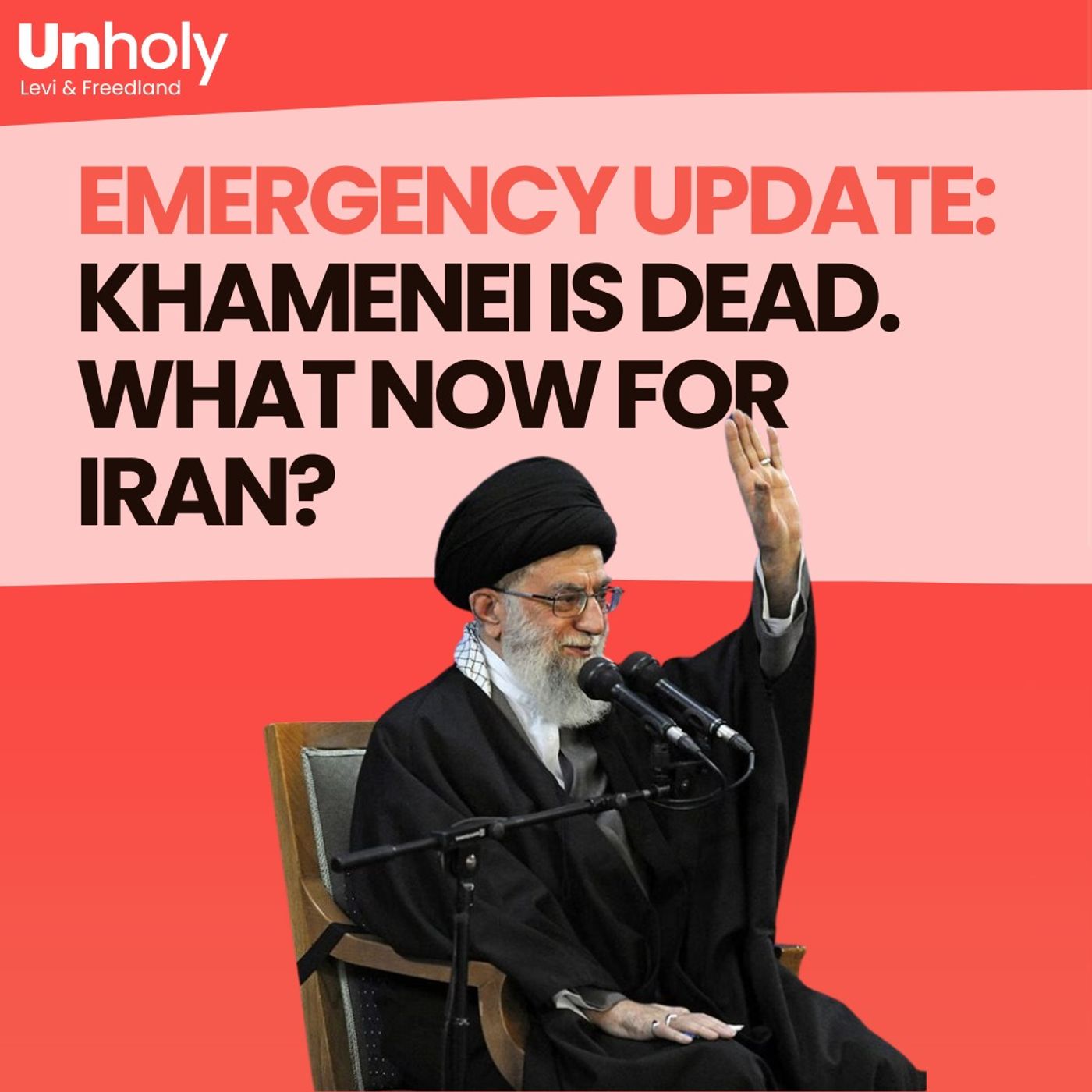
Unholy: Two Jews on the News
Emergency update: Khamenei Is Dead. What Now for Iran? - with Dr. Suzanne Maloney
00:16:29
As reports confirm that Ayatollah Ali Khamenei is dead, Yonit is joined by Dr. Suzanne Maloney for a searching conversation about what this moment means for Iran and the wider Middle East. They examine Khamenei’s worldview in the years leading up to his death, the ideological roots of the regime’s hostility toward the West, and the deep divisions within Iranian society. The discussion turns to the question now confronting Tehran — who can succeed a figure so central to the system — and to the profound uncertainty facing Iran as it enters a post-Khamenei era with no clear path forward. Chapters 00:00 The Legacy of Khamenei 02:54 Post-Khamenei Iran: What Lies Ahead? 05:42 The Future of the Islamic Republic 08:23 Regional Implications of Khamenei's Assassination 10:59 The Divided Iranian Society 13:58 Transitioning to a New Era
Loading summary
Transcript24 lines
- [00:00]
A
It's unholy. I'm Yonit Levi in Tel Aviv. 6pm here, 7:30pm in Tehran, 11am in Washington. It's Sunday, and it is the second day of operation Epic Fury. Israel and the United States strike the Iranian regime and crucially, take down Iran's supreme leader, Ayatollah Ali Khamenei, in an attempt to topple this regime that has most recently murdered its own citizens in the thousands. The mood here in Israel yesterday was of a country that saw the demise of its worst enemy. That is still true. But today, trepidation enters the equation, too. Rockets, sirens, and at least nine dead from an Iranian missile that hit the city of Beit Shemesh near Jerusalem. There are also reports from CENTCOM about three American soldiers killed in an Iranian attack. This is day two, and the focus is very much on the killing of the man who threatened to annihilate Israel for decades and chanted death to America and death to Israel. We wanted to talk to someone who has followed the ascension of Khamenei and his rule with an iron fist for decades. Dr. Suzanne Maloney returns to Unholy. She's one of America's foremost authorities on Iran. She is Vice President and Director of the Foreign Policy Program at the Brookings Institution, focusing on Iran. She's advised both Democratic and Republican administrations on Iran policy. And we always turn to her to understand where Iran is heading. Today, that question is perhaps more important than ever. Suzanne, thank you so much for talking to us again on Unholy.
- [01:23]
B
Great to be here with you. It's quite a day.
- [01:25]
A
It's quite a day. I feel like every time we talk, it's another dramatic peak in this story. Before we get into, you know, the significance of the decision to assassinate Khamenei, can we talk about who he was and what he meant for building the Islamic Republic of Iran?
- [01:43]
B
Sure. Khamenei is a critical figure in the post revolutionary history of Iran. He was a cleric who was radicalized in his youth and became part of the revolutionary movement, served time in prison, and then later assumed the role of President of Iran after several of his predecessors in that role lost their lives. Khamenei was not considered to be a particularly powerful or charismatic figure during his eight years in that office, which coincided with the Iran Iraq War. But that phase also did enable him to build really important relationships with the Revolutionary Guard and with the security establishment as a whole that we have seen play out throughout the later course of his career. He assumed office in 1989 after the death of Ayatollah Ruhollah Khomeini, who was, of course, the very charismatic, powerful cleric who was really the galvanizing force behind the revolution. And at the time of Khamenei's ascension, very few observers, including many in Iran, assumed that he would be able to kind of inhabit the role with the same force and efficacy that Khomeini himself did. In fact, what Khamenei did over his 37 years in office was build out the institutions of the office of the Supreme Leader in a way that really developed a stranglehold over the state apparatus itself. His very close relationship with the security bureaucracy contributed to a very hardline view of Iran's internal and external threats and opportunities. And he was a dominant figure whose loss is going to reverberate within Iran and across the region for many years to come.
- [03:25]
A
Of course, I want to get into that, the significance of that, of his assassination. I just wonder about one thing in this whole story. This is a man who saw the President of the United States building up an armada in the Middle East. He wanted a hard line approach in the negotiations. And for one minute, he didn't assume that they might be coming for him. I mean, at the end of it, he wasn't hiding. He wasn't, as we know, so far in a bunker. How do you explain that rationale? Is it wanting to die as a martyr? Is it thinking they're actually never going to dare die, try and attempt an assassination against me? What is in that?
- [04:01]
B
Well, it's hard to get into the head of Ayatollah Ali Khamenei, particularly after his death. But I think that this was a man who lived amidst violence and threats. He had suffered an assassination attempt that cost him the use of his hand. He knew he was in his final hours, and he was determined to see through the project of the theocracy in a way that I think made him less interested in his own survival than in the survival of the state itself. You're right. He had to know that he was under threat. He apparently spent most of the June war in a bunker, but opted not, in this case, to try to hide away. In fact, was holding what was said to be a regular meeting with many of his top advisors in the compound that had become the place in which he spent most of his time over the course of the past few years, as his health and age declined.
- [04:54]
A
Let's talk about the Iran that is post Khamenei we talked last time, and about the fact that even if he is taken out of the equation, that's not enough to topple the whole regime. And obviously this is a man who, according to reports, left meticulous kind of notes on how to continue even without him. So what happens now? Is it only up to the Iranian people?
- [05:18]
B
I wish it were up to the Iranian people. The future of the country should be in their hands. And that's obviously what President Trump was calling for in his own remarks yesterday. However, you know, the reality is that this is a very well entrenched regime. It is a very well armed regime. And Iranians on the street have limited capacity to simply go into the halls of government and seize the state. We know that a number of military commanders and other senior officials have lost their lives in the attacks, and probably more will die over the days to come. But there's a lot of redundancy built into this system. And the Islamic Republic has been planning for Khamenei's succession, really over the course of the full 37 years since he took office. There are plans in place. They had become more publicly discussed over the course of the past few years as Khamenei's health appeared to grow worse and his age obviously advanced. And so, you know, there is already a transitional council that is prescribed by the Iranian constitution that has been announced that will be the senior leadership of Iran for the foreseeable future. I would expect at some point a permanent successor to Khamenei will be named. Whether that is an individual or whether they try to sustain some kind of collective leadership, especially at a moment in crisis, I think will remain to be seen. You know, I don't think the Islamic Republic is going anywhere anytime soon. And we're going to be in a very unpredictable and probably violent period within and around Iran for the time period to come.
- [06:52]
A
So what is necessary, what is still necessary for it tofor this regime to begin to crumble?
- [06:58]
B
I think there would have to be a loss of confidence within the elite levels of the regime that they can somehow persist through this crisis. And we haven't seen that yet. There was a lot of watching for defections during the violence that erupted in January when Iranians took to the streets to demand regime change and security services slaughtered thousands of innocents. There were no defections at that point, and we haven't seen them yet. But of course, there are a lot of pragmatic people within the system. They're going to be looking for what may come on the day after and their own survival. And there may be those who are prepared to countenance some kind of compromise, if in fact they believe that that will enable the regime to survive. I wouldn't expect, however, any dramatic transformation in Iran's ideology. I wouldn't expect some kind of shift in the way they think about or talk about Israel, the United States. The attacks have probably hardened those philosophies within the system. And for the foreseeable future, I think we're going to be dealing with a very, very dangerous and probably unstable and unpredictable Iran.
- [08:05]
A
Ali Sistani, who's considered a Grand Ayatollah, one of the leading religious leaders of the Shia Muslims, he's in Iraq. He threatened a jihad if Khamenei is assassinated. How worried should we be of these kinds of responses coming from the Shia axis?
- [08:21]
B
Well, the dynamics within the Shia clergy are going to be very interesting. The idea of an Islamic Republic of velayat e Fahih, the ruling system of the Islamic Republic, was very controversial when it was first established. It persisted in part because of Khomeini's own influence around the clergy. But Sistani is a different pole. It's interesting the remarks that he, he's made, but we don't yet see, I think an uprising on the part of Shia militias at this stage. Hezbollah seems to be making a little bit more noise today, but was notably fairly placid in the immediate aftermath of Khamenei's death. And Iran is sacrificing a lot of its own influence by attacking its neighbors and going after infrastructure around the Gulf. They're going to be in a more isolated position in many respects, but it's reasonable to expect that there will be some follow on violence within Iran, but also outside Iran by those who are sympathetic to the regime if he had had his way.
- [09:20]
A
And Khamenei, of course, who for decades was saying death to Israel and death to America, it would be what to obtain, to put his hands on nuclear weapons, to develop an intercontinental ballistic missile that can reach the United States. I mean, he sacrificed so much, not only murdered his own people, but sacrifice so much of Iran's well being, of Iran's economic position in the world, all of that for this very radical ideology. That was his ideal. That is what he was working his whole life for.
- [09:49]
B
Khamenei was a true believer and he was a believer in the revolution as a universalist phenomenon. He also believed, I think, I'm sure, to his dying day, that Israel would fade from the map, which was part of the rhetoric of the Islamic Republic since its establishment. They thought that they were seeing that play out in the days and weeks and months after October 7th, obviously the tide has turned. It is Iran that is now very much on its back foot. It is Iran whose survival as a system is very much in question. But again, I think that makes the system more dangerous. I think we will have to watch to see how the new leadership of Iran takes the helm at a time of this level of unpredictability. The ideology is deeply, deeply ingrained. It's not performative. They believe what they say. They say it again and again and again, and there's no reason that we should doubt that it will continue. If this regime continues his hatred for
- [10:47]
A
the United States, is it slightly different from the hatred of Israel because the United States is the representative of the Western world? Israel is, as he sees it, right. The Jewish infidels that took over land in the Middle east, is it a kind of different hate, or does it come from the same place?
- [11:02]
B
I think it's a. It's probably a twin hate. They're slightly distinct, but very much intertwined in the minds of both the Khamenei and all those around him. This sense that the United States and Israel were the root of all evil in the world. And that really didn't begin with him, of course. It began with Khomeini himself. He came to the fore in 1963, inveighing against the monarchy and its reforms and blaming those reforms and changes to Iran's culture, its economy, and its politics on the United States and Israel. This has been an abiding hatred that has animated the Islamic Republic. I don't believe that it extends to the vast majority of Iranians, but it is a system that has been inculcating that kind of hate now for 47 years.
- [11:48]
A
When you look at the Iranian society, if we had to kind of try and gauge this in percentages, how many of them are happy today? How many are saddened beyond belief?
- [11:58]
B
I think it's impossible, especially at this distance and after many years since I've been able to set foot in Iran, to actually put accurate percentages on the breakdown. But there's clearly a constituency that the regime retains, both because of the benefits that they receive, but also because of the ideology that is steeped in the schools, in the culture. There is, you know, there are millions of Iranians who will come to the streets, and we've seen some of this over the course of the past 24 hours, to mourn Khamenei, to fear for the future of their own country and for their own livelihoods and prospects. But there are also millions of Iranians who are jubilant at the idea of Khamenei's death, the liberation of the country from what felt like an alien life force that had poisoned their own system and their nation against the rest of the world. This is not the future that so many young Iranians wanted and so many who remember the revolution and believed that they were fighting for democracy, that they were working for a better Iran, not an isolated, evil Iran. So, you know, that that's one of the challenges that any Iranian leader and any future trajectory for Iran is going to have to confront, that it will be a divided society for the foreseeable future and finding some force that could galvanize the country in a better direction and really bring along those people who actually believed in the Islamic Republic without ceding the forces of division and potentially internal instability. It's going to be really crucial. Right now, I don't know who that figure would be.
- [13:37]
A
You lead me so elegantly to the next question, which, of course, who can that person be? Is it indeed, you know, Reza Pahlavi, who is, let's say, his father, not exactly the greatest democrat, the last shah? Is he a person who can galvanize from, you know, sitting in Los Angeles, being in exile? Can he galvanize the Iranian society, or is this just kind of a pipe dream?
- [13:58]
B
I think Reza Pahlavi is a very decent human being who has devoted his own life to caring about Iran. But this is more than almost a half century since he has set foot in the country. He has not had the kind of governing or management experience that would lead one to believe that he's going to be well positioned to parachute into a society that has radically transformed, grown in ways one can't possibly even imagine since he left, and to try to impose some kind of new order. He does, of course, have a team. Some of those are recent emigres, dissidents, people who fought against the Islamic Republic and paid the price for it with prison time and exile. But again, the idea that we are in any way prepared to see, you know, an emigre force land in Iran and oversee the process of a really complex and probably brutal transition to a new system seems a bit of a stretch of the imagination.
- [14:57]
A
Although we should, I think, in a way, the way that we're sitting here talking about the end of the era of Khamenei is also already, I think, a stretch of the. Of the imagination. I mean, you know, from where I'm sitting in Tel Aviv, obviously no one mourning this man. I think in many other places in the world. We talked about it also in Iran itself. A man who has blood of Iranians on his hands and of Israelis and of Americans and Lebanese and Syrians and so many others is the world. I mean, obviously the world is a better place without him. But do we know where we're going from here?
- [15:23]
B
No. I think that's the million dollar question today. I mean, President Trump launched this operation and has achieved great success in terms of eliminating Khamenei and really eroding some of the capabilities of the Islamic Republic with respect to its ballistic missile program and its other military capabilities. But it seemed quite clear from his initial remarks and from the way the operation has unfolded and the plans that we are aware of that there really hasn't been any thinking about what US Role would be in some kind of a transition to a different future for Iran. President Trump left that to the Iranian people. I don't think that ordinary Iranians are going to be well positioned to affect that transition themselves. And so I think we're likely to see a sustained period of instability and uncertainty inside Iran. And I don't know if there's going to be a positive momentum forward to something that would produce a better regime.
- [16:20]
A
Dr. Suzanne Maloney, it's always such a pleasure to talk to you, even when the future is unclear. We're very clear on the fact that it's great to talk to you. Thank you so much.
- [16:28]
B
Thank you. Stay safe. Thank you.