← Unholy: Two Jews on the News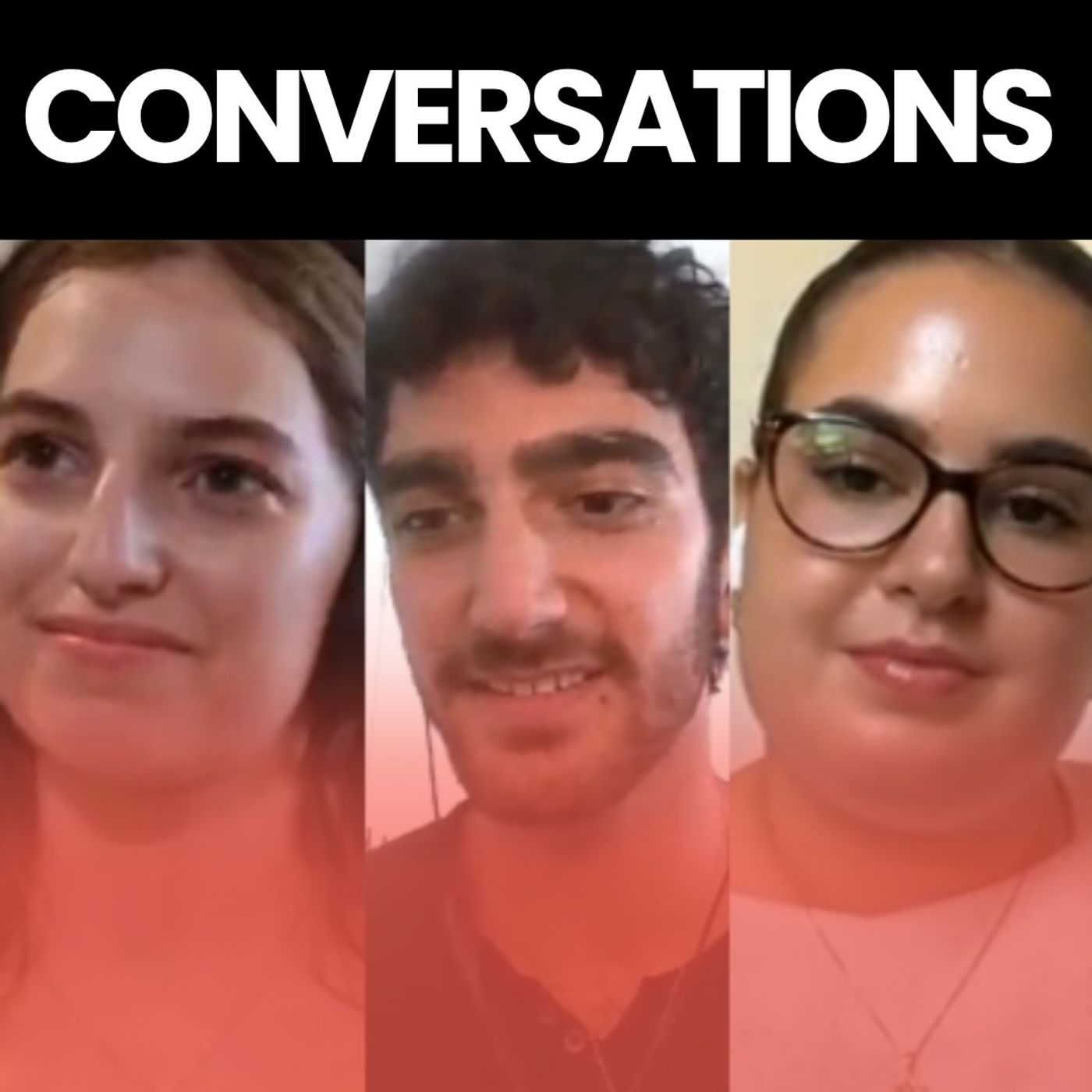
Unholy: Two Jews on the News
First Time Voters in Israel
00:43:43
This week, Yonit and Jonathan sit down with three first-time voters — Aviv, Yael and Dror — to talk about the topics that will shape these election - the judicial overhaul, whether Arab parties belong in a coalition, and the draft bill. October 7th moved each of them, but not the same way — one drifted toward the center, another sharply to the right. What they do agree on might be the most interesting part. Plus: what happens to a generation that has only ever known one prime minister. CHAPTERS: [00:00] Intro [00:21] Meet Aviv, Yael and Dror [03:29] Why Aviv says she might not stay [08:09] Yael on voting for the North [12:12] Dror's family, yeshiva, and the draft [17:05] How October 7th moved them in opposite directions [25:24] The fight over Arab parties in a coalition [30:41] The only prime minister they've ever known [34:57] Is there a generational vote? [37:35] Would they stay if they lose?
Loading summary
Transcript76 lines
- [00:03]
A
A lot of people my age sadly vote for Ben gvir, vote for Smotrich and I think it's a lot about their media presence. They do very well on TikTok, they do very well on Instagram and they really talk to the younger audience, which I see now Bennett is really working on bringing Jonathan Shalev and everything. I think there will be a lot of Ben GVIR and Smotrich voters and there will be a lot of Bennett voters.
- [00:43]
B
It's unholy. I'm Yonit Levy in Tel Aviv.
- [00:45]
C
And I'm Jonathan Friedland in London. For the latest of our unholy conversations, it's usually you and me, Yonit, with one guest. This week we're doing something a bit different. We're having three people join us for a conversation I think it's fair to say you and I have been sort of thinking about for a while because of. And now's the right moment because we now have a firm date for the election, 27th of October obviously. And well, we thought there's a whole group of demographic that are going to be play an important part in this coming election.
- [01:21]
B
Yes. What you will hear today is I think a fascinating conversation between three first time voters in Israel that is going to be a really large group in these crucial elections. 640,000 new voters which make up about 15 or 16 seats and 120 seat knisit. So they can definitely, you know, whatever they decide, they can definitely decide this election. There are a myriad of opinions like the rest of society. I think they mirror the rest of Israeli society. We will hear from three young Israelis, Yael and Aviv and Dror, who, whose range in voting goes, runs the gamut from the Likud on the right to the Democrats on the left and in the center as well. We have that conversation. You know Jonathan, I was thinking about how my generation was, was shaped by two main events. One of course is the assassination of Isaac Rabin in 1995 and also the terror attacks of the mid-90s. It's hard to explain, I think to the outside world, but when you're a 15 year old kid, you get on the bus to school and you don't know if you're going to get off that bus because that bus might explode. Then it shapes your worldview. These young Israelis have been shaped more than anything by October 7. And the leader of the country, which has been the leader for basically most of their lives, what does that do to them? What are their thoughts? What are their hopes for the future? What do they want whether they're considering when they're going into the ballot box who. I think it's important to notice who speaks to them in their media, in their language, you know, on TikTok etc. They talk about that as well. I think it's really important to listen to them.
- [03:01]
C
Yeah, I think it's absolutely, as you say, really so important. This generation formed by recent events, two of the three are about to go into the army to do military service in the shadow of October 7th and of course the war in Gaza that followed. So this isn't just abstract stuff that's been on the news. This is going to be there life from just a few days away. That obviously hangs over the conversation given how dominant the war in Gaza has been these last three years. And you know that very striking figure you said about how many suddenly this huge bulge of over 600,000 voters, that is a function of just an unusual thing, which is normally an Israeli election. It was only a year since the last one, you know, or months. And therefore the number of people who've just turned voting age is normally limited this time because the term ran its full course of four years. You have. That's a large group of people who haven't had, you know, they've, some of them could have been 14 when the last election was held, but they, so they're going to be crucial. They've had a lot to sort of experience and endure these last few years. And so it is, as we say, I think, a really illuminating conversation, but also one that will matter in the elections that are coming.
- [04:31]
B
Aviv, Yael Duo, we are so glad to have you all on Unholy. Thank you so much for joining us all.
- [04:37]
A
Thank you to you.
- [04:39]
B
Why don't we start by each of you introducing yourselves where you're from, your age and your name. So Aviv, let's start with you.
- [04:47]
D
I'm Aviv, I'm 21 for Naciona. I finished my service in the army 10 months ago. Right now I'm not doing anything in particular.
- [04:56]
A
I'm Yael, I'm 19 from Wasspina and I'm drafting to the army on Sunday.
- [05:03]
E
I'm Dror, I'm from Cologne and I'm also drafting soon to the army on Sunday.
- [05:08]
C
Wow. So both of you, two of our three are just days away from doing your military service, which means you're probably not thinking immediately about politics and the election. The big date for you is Sunday rather than 27 October, but nevertheless, it's the election we want to Talk about. And you, Aviv, Even though you're 21, this is actually your first time of voting because there hasn't been an election in nearly four years. So I mean, an opening question to all of you is, despite the fact you're going to have your minds on other things, inevitably, you know, a lot of people are saying this is a very important election. That lot is at stake. And I'm just interested to know whether, you know, for all three of you, it's your first, how important you. You consider this election, whoever wants to go first.
- [05:55]
A
This past year, both me and dro, we went on a gap year. So a lot of the topics we discussed and talked about was this. It's the upcoming election. It feels like we even talked about it way more than our drafting. We obviously, I think obviously that it's like this election is really super important. There's been some drastic changes, obviously over the past four years with the war and all the new laws they're trying to pass. So I think it really, really is important. Also, the people like young and they haven't voted yet start voting because our voices matter and they can really make a difference.
- [06:37]
E
For me, it isn't that of much point in day, I'll be honest, I'm not into that much politics. But like in the recent times, you hear about, you know, like the election in Democratim and all that stuff in the news and also what I see in my family and like people around me, that everyone is so much in it, like, if you don't vote, like, you cannot do that. You have to vote. One side said the Haredim is going to take over, one side said the Arabs are going to take over. So it's very much confusing. But like, it's so harsh, like everyone is in it.
- [07:09]
D
Aviv, I feel like if there won't be any change in the government in this election, like, I can see my future here. Really hard for me, what happened here in the past four years, I'm devastated. And when I'm thinking about the future of the country, I'm really hoping that in this election the young voters like us would take a big part of it, because I think it's really important.
- [07:34]
C
And Aviv, just unpack a little bit of what you mean about the last four years. Obviously, I know all of you know, but for people listening to this, what you mean in terms of what may have, what you think has changed or what it is that makes you think the election is so important that if it doesn't go one way or another, you yourself are Saying you don't see your future staying in Israel. So just explain that, say some more about that.
- [07:57]
D
We'll start with all the things that the Knesset passed, all the laws in her last couple of weeks, like as a woman, as a young woman, to see all those laws about separation in the academy and what happened in. And we can also go back to the reform, like weakening of the judicial overhaul. Then like October 7th and everything this government has done or actually didn't do. Like, I think they should take responsibility for the actions, for passing money to Hamas. Catherine, like all the horrible things that happened here, every time we hit a low, I'm saying, okay, that's the lowest we can go. And then we hit another low I
- [08:47]
B
want to go into. Because obviously we have different views in this conversation. And I can be the Israeli with the chutzpah here. I will say generally, and then correct me if I'm wrong, Aviv, you have decided basically, I think, to vote for the Democrats. Would it be true to say, Yael, if I kind of try and represent you where you are maybe thinking between, or kind of dilemma between Eisenkut and Bennett, and would it be true draw to say that you are considering to vote for the coalition as it stands, whatever party it is, or have you decided so, Doro, is that the way you would represent what you're thinking?
- [09:23]
E
No, because you call it the hafe hamishpatit. And for me it's like it's the other way to say it, which is the first thing that comes to mind that's important.
- [09:32]
B
So you wouldn't call it a judicial coup. You would say it's a judicial overhaul, like reforma mishpatit. Just to make clear on the terms that's important, okay?
- [09:41]
E
Because for me, when I saw all of the protests against it, I was like, why would you do that? Why would you block roads? Because I learned in Tel Aviv, my high school were in Tel Aviv. So every day I was using the bus to go there, and I was always stuck there. And I always see these 15 people standing on the road and protesting. And all that come to my mind is the people vote for that coalition. How can you come and say, no, it's not okay, and stop everyone life. And also for me, the past four years, it is hard. I also have, like, criticism to the government, of course, Like, I'm not, I don't know, b beast or like full on, you know, for the government. But I will not see it as like ruining the country at the end of the day. Like, they are here for the people, even though we think otherwise than them, they are, they are still represent like the majority of the people. That's, that's what I think.
- [10:41]
C
Yael, how do you respond hearing that? Because you're, you're not planning on voting for one of the parties currently in charge. You're thinking about something different. How do you respond just to what Draw said in particular about. Look, the. The government was only had a majority, it was elected in office and it's doing what it wanted to do. And why was that such a big deal?
- [11:01]
A
I think this government was chosen. I think a lot of people voted for it. If it's for Bibi that we see that people vote because that's what their parents voted, that's what they have been voting for years. And I think that it's time for a change because so much happened in these last four years and even before that with the judicial reform, which I think was necessary in some way, just not in the way that it was written. And I think I understand what Dror said because it really did stop people's lives. Like, like Drawer said he studied in Tel Aviv. There was always protest, there's always roadblocks and everything. I think there should be a change because we need something new, especially regarding to the war. And I live in the north. So like seeing whatever happens here and seeing how poorly the current government has dealt with it, it's heartbreaking. So I really think there needs to be a change.
- [12:03]
B
Could you tell us, all three of you, what is the thing, the main thing you're voting on when you're going to do this for the first time? This is such an important move for any person in a democracy. What is the one thing, even an image, a story, anything that goes through your head when you're going to go to the ballot box for the first time.
- [12:23]
A
So for me, the main thing I'm going to vote for and about is the situation in the north. I think in the beginning of the war, we didn't even think that this can take so long. And the more it procrastinated, the more it happened. We just see the effects of the government. No one coming to visit here, the news just not showing enough what's going on here. And there's just nothing being done. My friends were evacuated for almost three years. Some still didn't come back. A lot of people just figured out life is much more comfortable in the south. And I think it was so heartbreaking seeing businesses closed here and people's not going to school for two years. I didn't go to school for the majority of high school because of that. I studied in a school in Kibbutz Amir, which is right on the border. So that's going to be a main thing for me. And also I think as a person who drafting, it's just mind blowing how people can just get away with it when we need so many soldiers and we need.
- [13:33]
B
Draft bill, you mean?
- [13:34]
A
Yeah, yeah, the draft bill. We need so many soldiers. And it's heartbreaking seeing, like, soldiers fall every day and people just completely living like in a different state of mind is just. It's so weird to me. That's going to be a big thing.
- [13:50]
C
Yeah, yeah. El, can I. Can I just drill deeper into this? Because I think it's so interesting and people outside the country hear very little about the communities in the north and how they were under bombardment from Hezbollah rockets for such a long time. And obviously Israel then hit back at different points over the last two or three years. I was hearing some analysts of the election saying that it would, well, asking would it be better for Netanyahu and for the government if the war against Hezbollah was to resume and for the, for the fighting to begin again. Would that be a positive for people like you, voters in the north, or do voters in the north just are happier with the very temporary kind of ceasefire and quiet we have now? So, just from your perspective as a voter there, is it better if the war starts again, as it were, or better if it stays like it is?
- [14:42]
A
Right now, no war is good. I wouldn't want a war to start again. But at the same time, I feel like people are just putting a plaster on a band aid on such a big wound and people here completely lost their trust in the government, whether if they were voting for the government or whether they aren't. I think people here are just living in a state of mind that's like, well, no one's going to listen anyway. It's like they're not going to listen, they're not going to do anything and we need something we can't just stay. Hang on by a thread. And families wanting to go back to borderline kibbutzes, they don't want to send their kids to school on separate buses because that's what they've been doing, sending kids on separate buses in case there's a hit on the road and they just don't want to live this way anymore. Even now there's a ceasefire and they say that with codings, you don't really feel it, whether you Hear the booms or you're always afraid that something's gonna come back because there already have been times where like there was a ceasefire and then one day completely shut down booms again and school's cutting off. It's just, it's not a way of living. Like there's no consistent quiet. Like it just feels like it's gonna come back again even now that it's quiet. So it's definitely gonna affect the way people vote here in the North.
- [16:03]
B
I think I'm curious, Dror, about your family. If we're drilling down. I mean you have, if I'm not mistaken, there are parts of the family are religious. Some of them are even ultra Orthodox. Is there a conversation about what Yael mentioned? The draft bill, the fact that the exemption for the ultra Orthodox, the fact that you are going to enlist in just a few days. Can you help us kind of see your thinking into that?
- [16:30]
E
So I have seven siblings. My parents, they did aliyah for my rent. My mom when she was 18, my dad when he was 20, and then they're married here. My siblings, they are kind of like ultra, not ultra orthodox. I work with Khardalim.
- [16:45]
B
Can you like so national or national religious kind of.
- [16:50]
E
Yeah, exactly. So we do have conversation about that. I mean I have one, one brother who is like against Bibi and like my mom is like full on like in love with him, you know, like, you know, this type of moms and also my dad. So there are some mix up. But I think we all understand, especially on the topic of like the drafting, we all agree that it cannot continue like that. Even though me, myself, I don't understand like the importance of like learning Torah and like to study it and that we need to keep and that we cannot just toss it aside. Myself, I think it's such an important thing. But at the same time we all understand that we cannot just let it pass like that. So this is like a topic we all agree about.
- [17:36]
B
We have to make clear. You studied Yeshivat Barilan and you want to go into a combat unit and if I'm not mistaken, the home front rescue search and rescue unit. And you're the living embodiment that yes, you can study Torah and still go into the military and yet you think that this coalition doesn't need to be to pay the price for this bill. Or maybe you do.
- [18:01]
E
I do have criticism for the coalition, of course, in this specific topic that I absolutely not agreeing with the law and the favors that they are doing for the Haredim, of course Then I agree with that. But there are some parts of the coalition that I do like, resemble with that. They have my ideas. But the Haredim, it's like, I'm not that much of like a favor. Like, if you ask me what my dream coalition is, it's like the center, not the extreme, for both sides of the map.
- [18:32]
C
And just before we go to Aviv, because I know you want to get in, because obviously the coalition is a lot of different parties. Do you have a sense of which of those parties you would be likely to vote for? Obviously the main party is the party of the Prime Minister Netanyahu. That's the Likud Party. They have obviously driven through this bill that will exempt ultra orthodox young men from military service. Are you going to vote for them or are you going to vote for one of the other parties? What's your thinking at the moment? I know you haven't made a final decision, but where are you thinking?
- [19:05]
E
It's such a hard question because everybody asks about that, especially in, like, where I come from. So I will be honest. I'm confused such, because everybody says when, like, you need to wait a month before the election and then you know everything because things are happening like people are. Parties are combining, that kind of stuff. Right now I'm more leaning to daily code, of course, that I'm. I'm not agreeing with everything, but for me it's like picking from the least was. You know what I mean? Like, for me it's like everybody's like, not, not good. But you just pick the least from everything.
- [19:42]
B
That's interesting. We'll go back to that. I do want to hear from Aviv because at the end of the day, I think if I can say your generation has been kind of shaped by two major events. One, of course, is October 7th. The other is Covid. But I think less that will less dictate your decisions in the ballot box. But when we go to October 7, did something of Eve change for you in the political worldview? I mean, if someone, when you look at, for example, the Democrats are talking about more than any other party about the future in a Palestinian state, I mean, does that change for you over those three years after this horrendous attack against Israel and what happened after, how does that shape your view?
- [20:25]
D
First, I moved a little bit to the middle in my opinions. Like, I got more. I don't know. I didn't think about peace with the Palestinians. I didn't think about Palestinian state. It wasn't on my mind. I just wanted to bring the hostages home and finish the war. But then after I finished my service, I had a lot more time to see what's going on around me, to see what the Mitna Khalim are doing in the west bank, to see what our soldiers are doing in Lebanon and in Gaza, and also seeing the lives, the Israeli lives that are being lost there. And I'm thinking more and more about peace and Palestinian state. Also I think it's the Zionist thing to think because like I don't want to live in a country where Zionist, Israeli, Jew like me. Is that not the majority? I think it's the part like it's something we don't think about because if we'll be one state, then we, we will need to take all the Arabs, all the Palestinians living in the west bank and in Gaza and we'll have to give them like rights. They will have to vote. So I think it's also not good in this part. But I know they're doing horrible things. I know that there have been a rise in terror. Although I wasn't like in any war zone in my service. I served in a cushiony job service in Jaffa, but I saw a lot of terror attacks. I served in Galats in the army radio station. And it happened more than one time in my service, in my two years of service, that on my program that I produced there was a terror attack. And seeing it, seeing the people talking to the people who were there, it's horrible.
- [22:27]
C
But Yael, draw, do you want to perhaps come in here and talk about to pick up your needs question, what changed in your mind? Obviously everybody's lives changed, but in terms of how you're gonna might be voting, what impact the 7th of October had on how you see the politics? Yael, you're nodding.
- [22:48]
A
Yeah, yeah, I would love to answer that. I think like Aviv, I had a change, but kind of to the opposite side. I came from a very left wing family, left wing area, left wing school. It was just very obvious. I went to all the judicial reform protests like against it before that. And then when October 7th come, it kind of like made me realize how the importance. I always knew a Jewish state is important always, but it made me realize and it just showed me how important it is. And for me it like spiked up kind of like my Jewish pride, which I think is so important to like hold the Jewish people during that. So it definitely took me more right wing. And it made me also realize everything like Aviv talked in Judea and Samaria. For me, it made me realize the importance of Jewish settlements with all the complications that come with that. And there's a lot of complications, but it kind of made me see that side. And obviously during this year we were in the Mahina, the gap year. It also like for the first time, like I saw the other side because like growing up in a very like closed left wing bubble, I didn't hear a lot of stuff, like give an example. I didn't. We didn't study about Gush Katif at all and everything that happened there in my school. So hearing that for the first time being like, oh wait, maybe this kind of connects to me and everything.
- [24:20]
B
So you mean the settlements in Gaza and the disengagement From Gaza in 2005 in Israel withdrew and dismantled settlements just for.
- [24:27]
A
For the first time I studied about it. I went to Gush Katif Museum in Jerusalem and I think it just made me kind of like understand a lot more the importance of a Jewish state and the settlements in Judea and Samaria and Jewish sovereignty. So it definitely took me to think more to the right side and that's definitely going to affect how I vote. I just don't think there's someone right now in the right side of the map, in the coalition that really represents the values that I want to be like right wing values. I just don't think anyone represents them next to the liberal values. So that's kind of like a big tear and why I'm kind of finding my place in the middle, even though I'm not that happy about it. But that's kind of where I'm at right now.
- [25:19]
C
Given what you said about October 7, reminding you of the importance, for example, of settlements in what, what, you know, outside would be called the west bank. You called them Judea and Samaria. Why doesn't Netanyahu and Likud meet that need for you? Because they're very strong on settlements and they would say the things you've said about the importance of security and territory, that 2005 pulling out of Gaza was a mistake. I'm just wondering what's not. Not satisfying that from the existing part parties of the right.
- [25:54]
A
I think in the origins of the ideas of the Likud and what they present, it does. But seeing their actions through the war and seeing their actions, it doesn't work. It's not what they say they represent. There's also, I think, a lot of issues with the Likud without even before the war. And even if taken out, all the issues of the West Bank, I don't feel like they act on their values and what they say. I wish they would, like. I wish the lacud, like, acted on their original values, and I would totally vote for them, but they just don't. And I think there's a lot of issue, obviously, with the Prime Minister and his, like, private, like, all the, you know, investigations and stuff. So I think that's a big issue. And I also think that a coalition and a party, especially a main party, a prime minister that just sits in his place for so long is just never good. It is never, no matter who it would have been. And I think we just see it through the actions like nothing's being done. So that's why I prefer voting maybe for Bennett, who is also originally, we don't really know, but originally is also for these ideas, and I hope he would act for it.
- [27:13]
B
But you're still somewhere between Bennett and Eisenkut. Can you talk about that, where that meets you?
- [27:18]
A
I can, yeah. I think it's very hard to decide from all these people. I think also a bit from Lapid, even though I don't really consider voting for him, because they all kind of say the same stuff. Like, they say the same stuff. They come, like, if you see in the north, they come visit the same places. It's kind of hard to decide because they say the same stuff. So then, like, which one do I vote for? And I think I would definitely, obviously want them to sit together and with time, especially getting closer to the votings and to the elections, then I will understand a bit more. But it's just very hard because they both kind of say the same stuff, and I just don't know who to choose.
- [28:02]
C
So all three, all three of you are Jewish Israelis. One fifth of the electorate, around 20% of the electorate, will of course be the Palestinian or Arab citizens of Israel. I think all but one of the party leaders has said they will not sit with any of the Arab parties in a coalition. I think maybe Yair Golan, the leader of the Democrats that Aviv, you're backing, says something different, but the other leaders are pretty clear on that. How important to each of you? Maybe this starts with Drawer and Yael, but Aviva, it'd be very interesting to hear your view too. How important is that question to you that. That promise that there will not be Arab parties sitting in the coalition draw. We haven't heard from you for a while. Maybe this is one for you to start.
- [28:51]
E
For me, it's very important. Like, also, I don't. I don't want to say trust, because it's such a harsh word. But I think that the people that represent the Arab community in Israel are against this state and against Israel, and I cannot trust them. It's not about the 20%. It's about the people that represent the 20%. It's like the same thing I can say about the Haredim. So that's my opinion. And that's why I'm also not voting for the opposition, because I cannot trust the opposition. Because we saw what Bennett did with his, like when he created one, when he said with Mansoor Abats, with the Arabs, which he like went against everyone that voted for him, which is like part of my family, which is like all of my siblings are now calling him like a traitor. It's like he traded like everyone that voted for him. So for me, it's a very important issue. That's why I'm also not considering to vote for the opposition.
- [29:49]
B
Can I ask you, I mean, when you look at someone who's Mansoor Abbas who's slightly separated from the other Arab parties, perhaps he's saying all Arabs in Israel should do national service. He's saying Israel was born a Jewish state and will always be a Jewish state. In fact, it was Netanyahu who was the first person to try and build a coalition with Mansoor Abbas. The only person who stopped him was Bezale Smotrich. Even Ben GVIR kind of agreed to that. Why is not that not something that you would kind of consider in your opinion?
- [30:21]
E
I will be 100% honest. That's how you say I cannot trust him. If you want my honest opinion, especially after 7th October, especially everything that we've been through, the amount of times that we've tried to have peace, the amount of time that we tried to get into such any women and they always responded by killing and murdering. And I cannot imagine someone who sympathize with the Palestinians, which I know that Mansur Abbas is also like in favor of listing and everything, but he's also sympathizing with the Palestinian people, which.
- [31:04]
B
But I mean, he condemned this. And you're saying it's the politicians, not the people, not the Arab Israelis that you have something against, if I understand correctly.
- [31:13]
E
Yeah.
- [31:14]
B
Do any of you want to say your opinion on this? Yael or Raviv?
- [31:17]
A
Yeah, kind of agree and disagree with bro. I think for me, if you say either the Arabs or the Kharidis, I might say the Arabs, even though I'm not in favor of that. I think obviously it's important representation, but Kind of like what Dhul said. I don't feel like the presentation of them right now is the representation of them is worthy of being there. And I think you can build a government without the Arabs and still like work to migrate the racism against Arabs and to migrate the violence in the Arab, in the Arab communities. I don't think it should be an Arab party that takes care of that. I think it should be everyone's issue. And I think both Bibi can choose to do that and also Yer Golan and Bennett. And I think it should be on everyone's agenda, obviously, the, the violence and the racism and everything that goes on in that country. And it can be and it can happen without Arabs in the coalition. But I think the other issue is that, okay, if not the Arabs, then Haredis, but I'm not really for that happening. And I think the Haredis are much more extreme and they can do much more harm than our parties can do if they send the coalition. So it's a bit of an issue.
- [32:49]
C
Aviv, I think we haven't heard from you on this.
- [32:51]
D
I think my opinion is closer to Yael. I think it's very important that there will be some kind of Arab representation in our next government. The violence in the Arab society went like rogue. I heard stories about people about women who were pregnant and they were afraid to go to the hospital, to go out of their house to the hospital because the violence in their town was so bad. And it also started coming out outside of the Arab society and into the whole Israeli society. And also the racism is a really big problem.
- [33:31]
B
You are all, you're 19, Yael Endor, you're 21. Aviv Netanyahu has been the prime minister of Israel since 2009. Almost straight. There was a year and a half, even less of two other prime ministers, Bennett and Lapita. I think it's safe to say that you essentially don't know really of a reality of a different prime minister. Is it in that that you think about? I mean, Dor do you think, for instance, he has so much experience he should continue? Yeael, would you say enough is enough? Aviv I assume you'd say the same. I mean, this is a man who everyone in this country has an opinion about have. Is that part of your considerations? Let's start with you, Duo, and then move on.
- [34:14]
E
I think obviously it's a fact because we didn't see anyone else. But for me, it's like you said, it's like he have an experience. And again, I'm not saying that he's perfect. No one is perfect. You pick from the walls, the list. That's my agenda. So he's like, he did. He did some bad stuff. He did things that of course, I don't agree 100 with this person. And I think that it's also on us that we made him such of like, I don't know, like an impact in the Israeli politician is like, because of like people in their position like said that we are not gonna sit with Bibi. And that's how we got to situation where we have two half one side, we have the other side, which for me it's very unfortunate because why would you like decide to banned a whole, I don't know, a whole party because of one person and made it all around of him, which for me is very dumb because it's just like ruining it for everybody.
- [35:12]
B
Yeah. Lenoviev, you want to say something about Netanyahu?
- [35:15]
D
I think besides the person itself, besides Netanyahu as a person, no one should rule as long as he did.
- [35:22]
C
Yael, you were nodding at that.
- [35:25]
A
Yeah, I think 1. No one should rule that much. But I'm not totally against a coalition where Netanyahu is. I just don't think he should be prime Minister. I think. I don't know if I see kind of like a dream coalition. I was talking with Dror about it earlier. It's kind of like the center, which is like Bennett Eisenquote and Bibi and maybe Bibi as, I don't know, Minister of Security, minister of, I don't know, education. I think he can do good if he's at a different role. I think just as a ruling party. Overall, I think it's time to go. And I don't think it does any good. And I think that if he focuses maybe on a specific task, that could be a lot better. And someone else as a prime minister will obviously be very refreshing. And it would also be a good time to evaluate. Wait, is it actually better? Is it worse? Is it making any difference? So I think it's. It can be really interesting. I don't think it will happen because I don't think any of the center parties will say, we'll sit with Bibi, sadly. But I think I'm not totally against him being in a coalition, just definitely not as prime minister.
- [36:39]
C
In a way, you are all the Netanyahu generation for the reason Yonit said you've just grown up only knowing of this one prime minister, really. And I'm wondering whether you think there's a Since we've got you here, the three of you, whether you think you will vote, your generation will vote differently from the rest of the country, whether there is a generational aspect to this, is there an issue or maybe several issues that apply to all of younger, you know, all young voters like you, or are you actually just a mirror image of the rest of Israel and as divided as everyone else in Israel, Israel on the same lines of left and right and Bibi and not Bibi, or is there something that actually you as a generation want to say in this election and have in common?
- [37:27]
E
I think that our generation have in common is like. Because our generation is like the one who's like, served in the army throughout the war and like me and I also like joining the army, even like secular people, Tel Aviv, everywhere you go, it's like everyone says, like, about the drafting, about the Haredin. So I think that our generation is going to put a lot of pressure on it because our generation took the heat. Because if it's in reserve, if it's the regular serve that they are doing right now in Gaza and Lebanon and Syria, and they did a lot of days, and I think that that's a major thing that our generation is going to vote on.
- [38:06]
A
I can really agree with Draw. I think the whole thing about the army and the reserve service, and I think people, especially young voters, will definitely take that into consideration. But I think the way I see it, that since the war, people weren't extremely to the right and less people went extremely to the left. That's the way I see it. And I think a lot of people my age will. To me, it's sadly, vote for Ben gv, vote for Smotridge. And I think it's a lot of a lot about their media presence. They do very well on TikTok, they do very well on Instagram, and they really talk to the younger audience, which I see now Bennett is really working on bringing Yonatan Shalev and everything. So I think there will be a lot of Ben GVIR and Smotrich voters and there will be a lot of Bennett voters. But I think everybody agrees on the army issue.
- [39:01]
C
Perhaps as a concluding question, then, to all of you, and I think Aviv, you mentioned how high stakes this election is for you and whether you could be able to see your future there. Let's say the result goes the opposite way from the way you would like it to go, all three of you, that you're on the losing side on October 28th. If that happens, will you accept the result? And even, I suppose, to push the point Aviv made, will you stay in Israel even if the other side win this hugely important election?
- [39:36]
D
I'll accept the results no matter what it will be. Even if it will be the opposite of what I want it to be. In the near future, I'll stay because I want to learn in university. But after that, I'll think of another plan. I don't know. It's really hard for me imagining raising my kids in the direction the country is going to right now.
- [40:00]
E
Of course I will stay. It's not a question like, it's my country. I was born here. Like, I came here for a reason. I have nowhere else to go. Like, my parents ran away from Iran for a reason. I believe this, like, we have to stay, even though we don't agree, because if we come to this situation, we just lose everything. And even if you say, like, in a situation where the Arabs in the coalition, everything. I will stay because it's my country. It forever will be. I will raise my kids here. Bezrat Hashem, no matter what will happen.
- [40:32]
A
I really agree with Duo. I will always forever stay here. This is my home. Even if it goes the other way, I will stay and I will work and I will proudly serve in the army, and I will proudly encourage my future kids to obviously serve in the army. And I think that's our home. It's. This is where we're at. There's no changing that. And I can work on changing that, and I can protest and I can do all this stuff, but I think I was aspired to creating a better society within ourselves, whether it's working in public service and doing the changes in my community. And I will obviously accept the results because that's democracy, and that's how it works.
- [41:18]
B
There are 640,000 new voters this time. That is about 15 seats in the Knesset. Your voice is very, very important. Your vote is extremely important. And we're really, really happy and grateful that you shared your thoughts with us today. Aviva El Dro, thank you very much for coming on.
- [41:39]
E
Thank you.
- [41:47]
C
I think we got the full range of issues, not only preoccupying young voters, although there are definitely some of those. But I think pretty much everything that will be on the minds of Israeli voters in general. So you heard about the issue of security in the north from Yael. You know, she's a voter there in the north of the country. Obviously, the draft bill. These are people who are going to do their military service. Even those people like draft draw. Yael who are on the right. There's some resentment there that people or even religious people will have heard Draw peppers his conversation with Bizrat Hashem, you know, with God's will. He's a religious young man. He doesn't feel great about the fact that other religious young men are not going to do what he's about to do and to serve. There was reference there to Netanyahu's ongoing corruption trial, the role of Arab parties. You know, everything that's on the minds of Israeli voters will be on the minds of these younger voters. But there's other things, too, because they are younger and because they are being spoken to, as I think we heard, through different channels, through different mediums and in different language.
- [42:51]
B
Yes. And I think that's an important point, right? Who's the politician who gets it that they should speak in the register of these right talk on TikTok, et cetera. But to me, I have to say I am really impressed by these three young Israelis. They're smart, they're thoughtful, they think things through, they talk about politics. They have their considerations. They don't follow. It doesn't sound like they follow anyone blindly. And to me, it was really interesting from that aspect of our conversation. I'm really glad that we brought their kind of voices and thoughts through this podcast out into the world.
- [43:25]
C
So we are very grateful to all, all three of them. To Aviv to draw, to Yael. We will be back with a regular episode in the usual way at the end of the week. But otherwise, one more thank you, I think.
- [43:37]
B
Yes, indeed, a big thank you to Michal Porat, who made all of this happen this week. And as you said, we'll see each other soon.