← Unholy: Two Jews on the News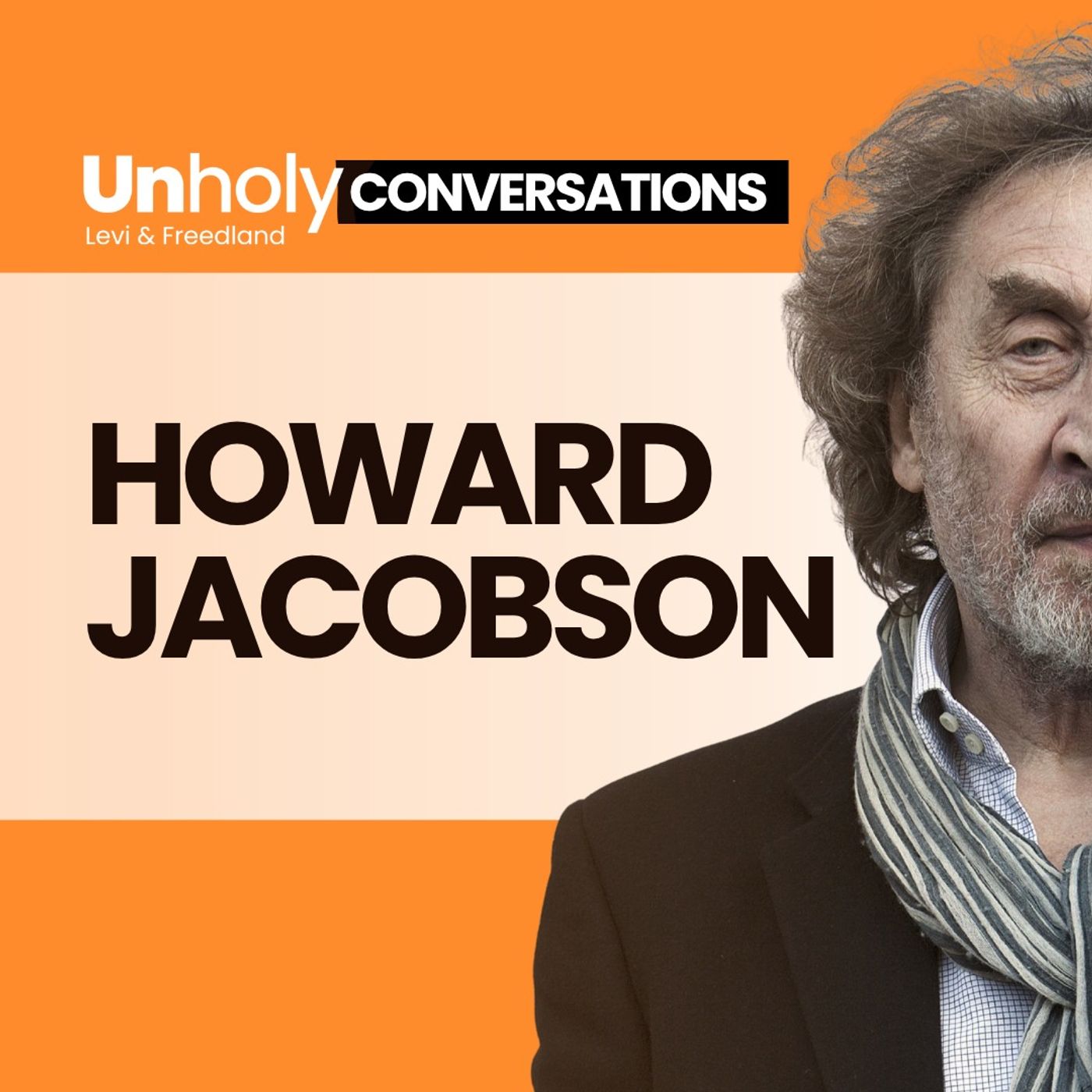
Unholy: Two Jews on the News
Howard Jacobson - Unholy Conversations
00:50:07
Howard Jacobson has screamed "liar" at the BBC, lost friends over a newspaper article, and started asking his wife whether it's still safe to live in London. Now he's written a novel about all of it. *Howl* is the story of Ferdinand Draxler — Jewish headmaster, reluctant marcher, man on the edge — who watches the world he believed in applaud the October 7th massacre and descends into a rage that may or may not be madness. Jacobson says he borrowed quite a lot from the last two years of his life. In this Unholy Conversations episode, Jacobson talks with Yonit and Jonathan about the ungovernable anger behind the novel, why he chose comedy as the only honest vehicle for it, the friends who wrote accusing him of celebrating Palestinian deaths, the Manchester synagogue where he was bar mitzvahed and which was attacked on Yom Kippur, and the question he can't shake: what would we have done in Berlin in 1932?
Loading summary
Transcript49 lines
- [00:03]
A
It's Unholy. I'm Jonathan Friedland in London and I'm
- [00:07]
B
Unique Levy in Tel Aviv. Unholy twojews on the news. This is our new thing, an extra episode every Tuesday which will be our Unholy Conversations.
- [00:18]
A
It's a whole thing Yonit. It's brand new. Very excited about this because we've so often had some brilliant, brilliant guests on the podcast and felt as if we would want to hear more and let the conversation run a little bit and now all have that chance with this dedicated Conversations episode every Tuesday. And I think it's fair to say we begin in style. Howard Jacobson is one of Britain's foremost novelists, essayists and and critics. He is a past winner of the Booker Prize for Literature. His new novel Howl is, to my mind, the first post October 7 novel. It tells the story of a head teacher of a London elementary school who is so perplexed by events after October 7th. At one point he ends up taking the children of the school out to erase anti Semitic graffiti, and we can hear a bit of that with the flavor of the book in this extract from the audiobook read by Paul Hertzberg. Remembering the innocent good times when sweet
- [01:32]
C
little unaffiliated Zoe, Charmian and I had joined an effort to remove rubbish from a scraggy bit of mudflat on the
- [01:40]
A
River Thames, I hit upon the idea of equipping my sad gang of petitioners
- [01:45]
C
with hooded overalls, paint brushes and small cans of agreeable grey and getting them
- [01:51]
A
to accompany me around the neighbourhood, in
- [01:54]
C
and out of the Common, painting over any sign, symbol, epigram or cartoon that
- [02:00]
A
intended to demean or distress us.
- [02:03]
C
Children love a task. Much as I didn't look like Snow White, my assistants resembled the Seven Dwarfs, and we sang Whistle while you work as we went about cleaning up the city. When hearts are high, the time will fly, so whistle while you work. To be certain they didn't paint over Haskem signs or some sub Banksy, but still priceless graffitist, they had to report to me anything about which they had serious doubts. Blood red hands had to go, of course, as did the inverted red triangle of Hamas resistance. Stars of David without any comment were problematic, but Simon said they were there to show terrorists which building to blow up.
- [02:45]
A
So those we painted over.
- [02:46]
C
What about Stars of David inside a swastika? Some thought we should just delete the swastika. Others argued that we shouldn't keep the remaining Star of David because it had been contaminated. I was with the others a Star of David inside a swastika was like a Jew who marched for Hamas. Damaged goods. After a show of hands, we slapped on the paint, leaving Emmanuel to worry whether it could ever be permissible, whatever the circumstances, for a Jew to do that to a star of David.
- [03:17]
A
Howe Jacobson. Welcome to Unholy. It is a terrific, provocative, funny, unsettling new novel. This book, in a way, it charts a descent into madness. I mean, is it your sense that Jews, people around you, you yourself, everyone, has somehow been driven a bit mad by the events since October 7, 2023?
- [03:41]
C
I worry about madness, that it was my idea to make my hero mad, and it was my idea to think that I was going mad. I'm not sure if it's the right word. I think I used the word to myself to soften what was, in fact, rage, a rage so ungovernable that I didn't know what else to call it. And when you are angry, every. When you wake up angry, you spend your day angry, and you go to bed angry, you might as well be mad. It is a kind of madness. It was A part of the madness, of course, is to go on doing the things that will keep you in that state. Such as? As I did, and as I imagine most Jews did in those many, many months following the mass, which in many, many ways feels like yesterday I went on watching television, although, you know, any sound person would have said, don't watch that. My wife put a. I can't remember where I put this in the novel, because the novel is not about me, nor is it about my wife. But you borrow what you can. Whether Ferdinand's wife, who's a good character, I think, actually covers the television with a sheet, I don't know. And I can't even now remember whether my wife did it. But she sort of did it metaphorically. She turned it. Stop watching it, do something else. Let's go for a walk. Let's go for a drink. That's not often something she says to me, let's go for a drink, get drunk. That's not anything. Rather than watch that. So I would turn the television on and then put on the radio. I knew how to. I could find it 24 hours a day. I could find the thing that made me enraged. And if that's not a kind of madness, I don't know what I couldn't do without it. And I don't think I've met any Jews who don't immediately recognize that condition. You needed to hear it, even though after a while you knew what you were going to hear. You certainly knew what you were going to get. If you turned on BBC News, you knew what you were going to get. You were going to get a story that would begin with the death of a child, which of course broke your heart. But that didn't mean it was all. That was always the best way to tell the story. But it was the way they wanted to tell the story. And that made me enraged. And I would scream at the television, liar, liar, liar. And when I first. And I was doing that everywhere. Liar, liar, radio liar, newspaper liar. When I first started to write this book, it wasn't a novel to begin with. I didn't know what it was to begin with. I just knew it had to be something. And I proposed to my agent, Johnny Geller, the idea that I would write a nonfiction book which would be called A History of the Jews in a Hundred Lies. I like to say that I gave up on that because I could only get to 99 lies. But in truth, I gave up on that because I didn't think that was what I wanted to do. I didn't think that would be the best vehicle for my talents, whatever they are. And neither did my agent, Johnny Geller, and neither did my publisher. They all felt, do the novel, do the novel. And then when you do the novel, other things are called for because you've written more nonfiction than I have, Jonathan. So you might be able to answer whether it's possible, whether it's easier to write nonfiction in a state of half madness than it is to write a novel. Maybe not. Maybe if you are. Maybe if you are so inflamed about that word fiction is better for you, except that it will be a very bad novel if you write it only in a state of rage. So that's when the challenge, and it's the challenge I like comes in, which is that you have to distance yourself from it, from the story. You have to distance yourself from the narrative of your feelings. So you have to find a hero who isn't like you and you have to help him do what was that? Henry James said he loved Turgenev because he broke the umbilical cord that bound him to the story and to everything he was writing about. And that's how it feels with me. And certainly that's how it felt with me. This time I had to break the umbilical cord. I had to not write about me being enraged all the time. Novelists are self lovers. It's a very solipsistic business. So you have to break the solipsism. And there are many ways of doing that, which comedy about which we might speak later is one. But that was the main thing. How to break, how to find the character who spoke a lot of the things I wanted him to speak. And therefore in some ways was like me, but not my mouthpiece, but was also somebody that I felt I had to go out of myself to find and create. And that's the moment when you know you've got a novel, otherwise you've got attract. The moment you know, the moment when you. The moment when you realize your characters, certainly your central characters, you must not just write about what they think, what their opinions are, but how they feel. And those are not quite the same things and what the consequences are of what they think to themselves and to their families. That's when you get a novel and not an essay. I happen to like writing essays. I'm rather fond of writing essays and it's a kind of besetting weakness. If left to my own devices and didn't have to worry about readers or a wife or an agent or anybody else, I would just begin it as a novel and then finish it as an op ed piece in which I explain to the world because I want. If I write a book on this subject, I want somewhere where I've got a hundred pages explaining the origins of Zionism and why most of the things that are said about Zionism don't get close to what it is. They're not just lies, they're partly lies, they're part. More and more I came to realize it's not just lies, it's ignorance. People actually don't know. They don't even know the dates. You just take on somebody who wants to argue about all this and you discover they don't know when it started or when it was. And if you invoke the name of George Eliot, as I like to do, and say Zionism had in its origins someone as humane and not as settler colonialist as George Eliot. They're astonished. How can you be astonished about that? It's the first thing that you know. Question one. Who was one of the first advocates of Zionism? George Eliot. When was that? 1818. And so you're off with. You're off. Here I go. You see, writing my essay about the origins.
- [10:21]
B
We are waiting for that essay, Howard. I do wonder though, because I want to quote Ferdi the Ferdinand, the protagonist, and he says he lost enough friends answering the question, could you be an anti Zionist without being an anti Semite. That connects to what you said. And he says Zionism was the only hope European Jews had of getting out of Eastern Europe alive. Whoever denies that is an anti Semite. I wonder if you personally going back to you have lost any friends over what you said after October 7th, what you felt, the rage you felt after October 7th.
- [10:52]
C
Yes, I have. I have Lost Friends was very locally directed to an article I wrote for the observer, which I suddenly started. I was astonished. I was at a march. Actually, I never go to a march. No, it wasn't a march. It was a kind a Jewish festival. I try to avoid gatherings at a time like that. But I went to one and a couple of people said, God, you're getting a bad press. And I said, what? No. And apparently a lot of people were writing about this piece, which. This was a piece I wrote about. How about what I've already mentioned the BBC coverage of the war and how it always began with the death of a child and how if one wasn't careful, this would beginning to look. It would be beginning to look like the narrative was being guided by the blood libel. The narrative which was not at all a denial that Palestinian children were dying and that it was an unbearable. It was unbearable to see it. But this was because people wanted to believe that I wanted that I was the blood libel incarnate. Only it wasn't a libel. There I was rejoicing in the death of Palestinian children and people said that to me and I didn't. People wrote that. Friends wrote that to me was. You always knew that what the email was going to be because it began, I write more in sorrow than in anger. So I tried to reply more in anger than in. More in anger than in sorrow. And yes, I mean, quite a few people parted company with me at that point. Nobody has so far parted company with me about the novel, which is much more important. But then maybe they've not had time to read it or they know better than to read it.
- [12:39]
A
I want to ask you something about specifically the novel, and I'm really hesitant because I know that it's fiction and you mustn't be held to account for it as if it were an essay or nonfiction or an, you know, essay and reporting. So I put that health warning there because I know it's not meant to be literal and it's a novel, but. And I also know that exaggeration is a great comic tool and weapon and you've used it from going back decades. But very early on you have a scene on the night of October 7, where people in London come out of their houses to dance in the streets, open bottles of Prosecco to sing, gas the Jews. That didn't happen in London like that. You have. If it did, people would have been.
- [13:26]
C
You can't know that for sure. You don't live where I live.
- [13:31]
A
Did that happen? Did you witness that?
- [13:32]
C
I'm not saying it did or it didn't, but, you know, in a novel, anything could have. But of course anything could happen. But if you felt it was implausible, that, I suppose, is a. Is a fair criticism.
- [13:43]
A
Well, it's just. What I was thinking was that so much happened, actually did happen, that was bad enough. The tearing down of the hostage posters. You write about that, and it's very, very powerful when you describe that. Partly, I think, because we saw it and we felt what your character feels, the tearing down of posters with children's faces on them, but they weren't. For example, we're going to hear an extract from the book soon, but in which the character covers up graffiti, including images of Jews as rats, labeled. Rats labeled as Jews. Again, if that had happened, I think people would have been as terrified and inflamed as Ferdie. But wasn't the reality, Wasn't the actuality bad enough? And is there a risk. I felt there's a risk that people will read this novel abroad and think, well, my God, in London they're popping Prosecco and depicting Jews as rats and graffiti. No wonder Howard Jacobson wrote this novel and et cetera.
- [14:40]
C
Well, when you read the first accounts of the reception of the massacre on campuses and things you do read about people celebrating. Yeah, they use a celebratory tone. I'd be very surprised if, amongst all those people who were. And I also read about dancing, that there was dancing in some places. And now I can't believe that when those academics, some of whom one knows and some of whom one can imagine, because we'd met these academics over the years, were doing their little dance of celebration. I can't believe a bottle of Prosecco didn't enter, or even, you know, Bollinger. So I don't feel I have to have seen it. And anyway, that particular scene is a sort of. It rather softens. I think the criticism of that scene could be, not that it makes things worse than they are, but it doesn't make things as bad as they are because they're let off. It was. That was a joke scene. I don't know where it came from, but I remember the moment of writing and being Very liberated. Cause I thought a note has now crept into this that helps break the umbilical cord not only between me and my characters, but between what I say happens in my novel and what actually happens outside of the novel. It could easily have. I'd put money with you that it did have. But the one thing that probably didn't happen, but that I needed to happen for my. For my peace of soul at that moment, was that when. When Ferdie goes out and asks them to be quiet, they do. Yeah. I mean, this struck me as for me, you know, one's own sense of humor is one's own. But it was a sublime joke that when Ferdi goes out and says, could you please lower your voices? One of them calls out and says, hey, this guy. This guy's wife is. Is not feeling well. He says, could we lower your voices? So then in quiet voices, they all said, cast the Jews. Once you've. Got. Once you've got a bunch of people being polite. I mean, I think it's a good joke because it makes a mockery of politeness and good nature. And it just reminds you of.
- [16:51]
A
And Englishness in a way, and Englishness.
- [16:53]
C
And it's sort of. Although I don't want to accept that it didn't happen and couldn't have happened, I also want to say that that shows you we're in a realm here of the not happening. But hold onto your seats. Cause we'll get onto something else. No one. I mean, it's not long after that that Ferdinand goes into the National Gallery and meets a parent of one of his pupils who's been gluing herself to a Rubens in the National Gallery that I know of. No one. It's Samson and Delilah and that's Gaza, and that I know of. No one did glue themselves to that. But, I mean, I think if they didn't, they missed a trick. They should have. It's partly my job as a novelist to kind of hint at things that people might have done better. So once you allow comedy in, you do run all the risks of exaggeration. But I think exaggeration is so important in so many ways. Cause it opens the box. It opens the possibility of absurdity. And they're. I mean, they're sweet. Those people who lower their voice and say, gas the Jews in quiet voices are sweet. It's a nice thing to do. But then think again about that and think, where are we? If one definition of sweetness is that people say, gas the Jews in a quiet voice, I mean, that Passes the madness back to them, doesn't it? It gets rid of mine anyway.
- [18:21]
B
Well, they're anti Semites, but at least they're polite. But I mean, there's. Look, from the Israeli point of view, this rage is of course understandable and I think for many Jews around the world, right? I mean, even before there was one plane in the sky, after October 7th, we were massacred and then blamed for being massacred. So everything that is rage in this book is so clear. And as Jonathan mentioned, of course, there's dark humor in it as well. I want to talk about Zoe, the character, the protagonist's daughter, who calls him a colonialist xio pig. And I wonder whether you hope that some of the people who were on the marches against Israel, pro Palestine marches, do you hope that they would read this book? Can it change hearts and minds to the extent that literature can?
- [19:09]
C
I wonder if literature can. I know whenever I've been asked to write a piece, what was the book that most changed you? I come up with something and I always feel I'm lying because I'm not sure that that's how I mean, obviously the reading of literature and the immersing yourself in literature, the committing yourself to art and the idea of art and the idea of art that art is art, takes you belong beyond your own mere self. It breaks that umbilical cord that makes everything just about you and it makes the kind of statements you make. It takes you into a world of discourse that is different from the world of discourse which I've inhabited as a journalist too. For all I believe that I think it'd be very hard to say any one book could change your mind, and I'd be very surprised if it'd be lovely if I thought it did change anybody's mind. The other thing is, in an age of non reading, in an age in which everybody is finding it more and more difficult to read, and lots of younger people barely read at all or read only that which they want to read. And that's what social media has trained us to do, to find out what we want to read. I did some reading, what I wanted to read. I read some articles in Fathom this morning and it was telling me everything I wanted to know. I was delighted to know, and that is the habit for all of us, that we read what we want to read. I can't imagine there'd be many marchers who would want to read this book or who wouldn't bail out after the first page, but I mean, if some did and some saw What I was agreed with me in some way that would be terrific. Though I think the only face to face criticism, so far apart from what's happening here, of course, that I've come across has been about Zoe. And it would make me. And it made me feel. It would make me feel. In answer to your question now, the Zoe's herself and the Zoe supporters would have difficulty. And that was, was I fair enough to Zoe, then I remind the person who says that to me, I'm not in the book, I'm not treating Zoe. But could you not have made Draxler, in that case, sweeter to his daughter? But then he would have been a different person. And I don't say anywhere that I think Draxler is a good idea as a dad. We see him rubbing her up the wrong. We see some of the ways in which his teasing, his Jewish fatherly teasing is going to exacerbate some of the things that she feels, make it easy to feel some of the things that she feels. But I think what some people have wanted me to do is to have more sympathetic sympathy for the marcher. And one should always own one's faults. I have no sympathy for marchers. I can't find it. I just don't know where to go for it because I don't know what the impulse to march is. I think the minute you go out there and you collect your rolled up flag from the umbrella stand, you know what you're going to say. You've made your mind up and I think you've stepped out from. You've. Yes, you've stepped. You've overstepped the boundaries of what I would call humanity. You want to express a certitude, you more or less always express it with violence and hate. You complain that people want to kill the cause that you believe while you were doing nothing but expressing murderous desire yourself. And I just can't find a kindness, I can't find any kindness towards a marcher. I own my fault.
- [22:45]
A
I mean, that's interesting because obviously there were counter marches during all this period where the Jewish community came out to march against the people you were describing, who of course said that they were only marching for a ceasefire, they had no hate in their hearts. But you didn't have any patience with, with the people who are marching on the other side, either, presumably?
- [23:03]
C
Well, I kind of went to. When I go on, I have sort of been. I won't admit that I've ever been on a march, but I go to marches, I observe the march as A kind of. This is. I mean, I wouldn't. I'd be very frightened of observing Zoe kind of march, but the Jewish marches I took a look at. I took a look at and walked in. If they were on the pavement, I walked on the road. And if they were on the road, I walked on the pavement. I was looking at them. And most of the time they just embarrassed me because they didn't do it well. And their posters weren't as good as the pro Palestinian posters. And also I left one thinking. I left one with my wife thinking, well, that didn't amount to very much, did it? Though I seem to remember the chief rabbi giving a rather stirring speech, as he's given many. And then I discovered afterwards that it expressed great intolerance towards people who didn't share the marchers view the things while also wanting to be on that march. And I thought, well, there you go. Even the people I want to like and agree with go bad. Because it's in the nature of a march to go bad.
- [24:08]
B
We are looking at two and a half years that were terrible for World Jury. And just in the last year, 20 Jews were murdered around the world, most of them on Bondi beach in Sydney. In fact, the attack at the Manchester synagogue on Yom Kippur happened in what was your. Your community.
- [24:25]
C
I was armaged there. That's how close I was to that.
- [24:30]
B
So can you share your feelings about that? And also, are you at all worried for your own safety? Did anyone ever tell you, Howard, maybe tone it down. Maybe tone down what you're writing, maybe tone down this book. Did you ever hear those kinds of things?
- [24:45]
C
The only time I've been told to tone down the Jewishness of my books was when a little bit crept into the first novel I ever wrote. And my father said it. And my father said, because my father brought us up in Jewish Manchester, where we felt no threats. There was a little bit of minor antisemitism at school, but nothing really. And my father's advice was always, stum, stay stum. Don't mention that you're Jewish. You'll never spot that we would. You'll never spot that we're yelling and screaming and gesticulating in the street and think those might be Jews. So we tried to staist them. And then suddenly I made references to Jews. And in fact, I made my first leading character a Jew, which astonished me, astonished my parents. Where the hell did that come from? The wonderful thing about if you're a writer and you're Jewish, the Jew will Out. It will come out. Whatever you do to stop it, it will out. It came out in Harold Pinter who denied Jewishness all his life. But all those silences. Every single. I'd go to the theater and listen to a Harold Pinter play and every time the audience heard a silence, I heard choo, choo, choo. It will always come out. So my father said, is that a good idea? I think my grandmother said it's washing our dirty linen in public. And it's not dirty linen actually. It's actually. So, no, no, I've not had it. No, I've not. But if you ask am I, do I wonder whether I should? And am I frightened? I have been sometimes, but no one has. I feel I've been looked at in a particular way. I felt that coming down the escalator in Selfridges the other day, having decided I would give myself a break and see if there was a suit that I fancied buying wasn't, by the way. And I came down the escalator and coming up the next door escalator were a couple of young men who looked as though they knew who I was and didn't approve. And it was just a little. Our eyeball. Our eyes met and I just. It could have been nothing, but I just thought that. And I've been. Occasionally I see that and worry about it and I don't. I wouldn't walk out at night in certain places. Don't ask me where, just I don't walk out at night much anyway, so I am distantly anxious. But beyond the day to day stuff, I'm more than distantly anxious because I don't know where it will go. And the fact that we've moved straight from Gaza to Lebanon doesn't make me feel we're gonna get arrest from this for a while.
- [27:20]
A
So one passage where your character says something I think is really interesting is what may be part of not all at all, but part of that rage. He says with every statistic from Gaza, the small part of me that had not yet been chast accepted guilt. But guilt is a pendulum. You can only go so far in one direction before you must swing back. The worse I felt, the more I resented those who made me feel that way. And I just want to. I'm curious how much your own anger in those two and a half, two years post October 7th included some guilt about what you were seeing the world's only Jewish country doing in Gaza and your resentment at those on the BBC and on the TV and on the radio, who were making you feel that way.
- [28:07]
C
I wouldn't have felt guilt. And if I thought guilt had crept in, I would have beaten it back. Once you start doing that, you get into that position of some of the Jewish defectors and deniers who talk about being ashamed. I don't think it's an English Jew's job to be ashamed of what Jews do in Israel. We're not going through all that. We're not having to deal with that. It is not a political reality for us. Shame has got nothing to do with it, just as prying has got. So if I were to suddenly feel a burst of exhilaration, cause something has gone well, or we've done it well, I would beat that back too. But I would worry that because however much one values the idea of complexity, somewhere or other, it's nice to have some simple lines of thought and to think, this is good. These are the good people. And I want them to do good things. Not because they're mine, but because they seem to me generally good people in a good cause. And when they don't, and when we feel there is a cruelty and there's a barbarism. And of course, I have felt that. I've seen cruelty that I wish wasn't there. Ferocity, really. Unimaginativeness. I had a conversation not long ago. It was Jewish Book Week here, Yonit, which is the great moment when all the Jewish writers get together and discover they have some readers and 500 Jews get together. And it's very nice. It's extremely nice. And David Grossman was over and we had a conversation and he was fantastic about. He was fantastically rich and complex about how it has to be understood by all parties that Jews feel that that's a country that belongs in some important ways to them. It's not just somewhere they've come in and conquered. That's just nonsense. It goes deep. And he was wonderfully vivid about what the. What the depth is, the love of the history of the play, the look of the place, the smell of the play. It was touching, but also, he said, but that still doesn't stop me from feeling that I wish that us, our side, couldn't just occasionally try something else. Maybe we just have to do what we do. But at the beginning, couldn't we try something else? Couldn't we even, you know, look those we consider our enemies in the face and say, look, you know. And we know everything you've tried that we've tried this. Yours doesn't work. Ours doesn't work, couldn't we just have another go and couldn't we have some madness? Of course. But of course, you've got to feel that something. He talked about imagination. And I've over the years thought, when I've been critical of Israeli actions, and mainly I haven't needed to be because everybody else is doing that for me, so I can be something else, leaving me space to be something else. But when I have been, the word imagination has cropped up for me. And I've thought, why is there not more imagination? Might be that imagination would get you nowhere, but there's something unimaginative about. Hit them, hit them, hit them, hit them. So I feel those things. Yes, yes. But if I felt guilt, I'd be very annoyed with myself because it's. I don't have the right. I mean, guilt implies a right. I don't have any right to feel guilt about what. Well, any other person does, really, but certainly not what they do. Over there.
- [31:29]
B
There's a chapter in the book titled When Will We Know It's Time to Leave. And I remember a satire program in this country. The sketch was this. A New York Jew leaves New York because of Mamdani. An Israeli Jew wants to leave Israel because of Israeli politics and the war. And they meet at Ben Gurion Airport, and each of them thinks the other is insane. And it made me think to myself, is it? Maybe it's a sad question, maybe I shouldn't ask it, but is there a place that is safe for us, that is the right place for us?
- [32:04]
C
What do you think of that on different days? I would give you a different answer today for a reason. I don't know, maybe that I've not read the papers or. Today I feel. Well, the world feels safe. Ish. There are other days when I. When those stories were coming through from Australia, which I felt deeply. I mean, it wasn't just that when the shul was attacked in Manchester, where I'd had my bar mitzvah, that I felt that I felt it in Australia too, because I've lived and worked in Australia. The first time I went to Australia, I remember writing to my mother within a few weeks saying, ma, it's fantastic here in all sorts of ways. This is great. This is great. Oh, and by the way, it's fantastic to be a Jew here. I sort of feel really safe here. And. And she wrote back and she said, darling, because, darling, I didn't know you ever didn't feel safe in England. And I would say, well, in Manchester. And I said, Well, I didn't know either, but until I came here, I didn't feel. I don't feel I've experienced this kind of easy goingness in relation to being Jewish. And it was easygoing. The Jews I met, and I met lots of them and I taught lots of them in Sydney and in Melbourne, they were in Blissland. It was really good place to be a Jew because you didn't feel you were there at the behest of or despite someone else. One has to leave the aboriginal question aside because everybody felt guilty about that, Jews and gentiles alike, but you didn't feel you weren't meant to be there. And now if you're Jewish, you do, and that's tragic. How many Australian Jews would pick up sticks and go and go to Israel? I don't know how many Jews here, One often hears stories about, they're all going, they're all going. I know one or two Jews who have a flat in Tel Aviv who are spending a bit more time in it, but that's not quite the same as a mass exodus. I don't know if there is one, but my wife and I often have the conversation and we have had it in the course of the last two years when things have felt very frightening. And I live in central London, so I can hear the marches every weekend, every weekend. The march, the march and the rage of the march and the murderousness of the march. And if they're not saying, gas the Jews, I hear them saying, I hear, I know what they're saying. And they're saying, gas the Jews. And we have said, is it safe to be here? Yes, I think so. We both thought so. But what would we have done in Berlin in 1929 or 1932 or 1935? Lots of people were smart enough to get out. Many people thought it would be all right. And many people would have thought, had to have even asked the question, even in the mid-30s, was mad, mad. We live here, we got. We got our kids go to school here, we have a life here. I have a profession here, I'm a doctor, I'm a professor. Why would we leave? So the why would we leave? Is a vexed question and we have sometimes got the answer wrong.
- [35:16]
A
I have to say I thought about you a lot when Bondi beach happened, Howard, because a conversation Jonit and I had on the podcast then was that this was a hugely significant event, partly just psychologically, because the fantasy that had lived in so many diaspora dues was that was one place that was completely untouched by the demons of European persecution of Jews. And that was Australia. And now even that place had been in our minds, in our imagination, had been taken away. And I thought of you and your writings about Australia. Because I know of your connection there. I wanted to say something perhaps about Britain and about England. Because you've written that in a way, it's not just British Jews who might feel a sense of being endangered. And that comes out very strongly in how. But the Britain itself, England itself. Actually, I think you use the word England. It's people like me who use the word Britain. But you speak of England. That something of England is itself in danger or if. Or maybe has already gone. Can you just say something about that?
- [36:17]
C
I wrote a piece quite recently. I wrote it for the Telegraph. Cause they asked for it. About that feeling that rereading one's novel when it's just come out and how you feel. And how realizing what I hadn't realized while I was writing the novel. That I was partly writing about England. About how the sights and sounds of England were changing. About how the things that I'd always loved to do in London and feel that London was, you know, my city. I could walk from home to the St. James's park and then walk across Trafalgar Square and go to the National Gallery. And just love that sense of what London was like. And some days you could in the last couple of years. But certainly at weekends, which is normally when you're free to do this. You couldn't. You couldn't because the sounds upset you and the appearance of things upset you. And this was greeted by. I got lots of mail about that piece by non Jewish friends, and not just friends. And I was stopped in the street to talk about it. A lot of English people felt this way. And it hadn't. I don't think they even knew they'd felt this way. And it hadn't occurred to them. It had anything to do really with. It hadn't occurred to them that by saying that they were allying with the Jews or not allying with the Jews, but that London is a site of. I felt sorry really for non Jewish Londoners having to have this. Whatever side you were on, let's say you're not on a side, let's say you are absolutely fair about it all. But having this war between two alien parties, alien to London in their city, in their. Why do they have. Why do they have to have that? And I wonder whether those. Whether the sight of that and the sight of London as a place where People just don't just march, but shout and carry banners of hate and then deny the hate has upset people. I have been stopped. I hate it when writers say they've been stopped in the street. But I have been stopped in the street more when I wrote some of these articles than the novel, because the novel takes longer to permeate. You write an article, it's there in the world in a second. You know, Jonathan, the number of non Jewish English people who have said, I agree with you, I agree with you. I don't like. I don't like what's going on. It's not only they don't just share your politics. I don't like the assumption that the English just feel like this about that, or sometimes they would even want to correct. You're wrong to think that the whole world is against you. That one. And I like that one. I want to be wrong. You're wrong to think that. You're wrong. If you think that the English have bought a particular line in this, they haven't. Sometimes they put their arms around me and they say, I love a Jewish boy. I worry about that sometimes, particularly if they get my name pronounced, my name wrong. But other, I just feel it's a desire for solidarity. I can't remember how this question led to this rambling answer. Does it matter?
- [39:29]
A
It doesn't. Not one bit.
- [39:33]
C
And I've now I've run out of answer. If you remind me of the question, I'll pick up the threads of the answer.
- [39:39]
A
No, no, you completely answered it. Your need. I think it's your question.
- [39:45]
B
Perhaps this is a naive question, because reading this book and you go through this process really of thinking, you know, how did we get here, right? How Israel commemorated Yom Hashua just on Tuesday, 81 years since. Since World War II ended. How did Jews and the world reach this point where in Ferdi's words, instead of never again, they hang out a sign that says please repeat. So I'm not going to ask you how he got here, but is there any way to get out of it somehow to make things better? That's why I said it was a naive question.
- [40:22]
C
We said after. It was said after the Holocaust, when the great phrase was never again. And it was then asked, well, what will ensure never again? And we said, education. What fools we were, because we did not know how teach. I was an academic once, and I'm very sentimental about the academy and the idea of the academy. I'm a Levisite, I'm a Matthew Arnoldite. I'm A Cardinal Newmanite. The university is the. Is the great place to free the human mind. The university is the place where people are taught individuality of mind, independence of mind, and how to think. And I don't think there can be any denying now that what we've seen in the last few years is that on many campuses, students have been taught not how to think, but what to think. And the minute you're taught what to think, you're not at a university, you're at something else. You decide what it is to call it. So I can't say education education, but I can say knowledge, and I can say knowledge independently earned and won through reading and thinking. I can say that we should all know more about the history of this part of the world, whose battles we've got so embroiled in. I do think not only that, more people who abuse Israel and Zionism should just know what the hell they're talking about, even approximately what Zionism is, what Zionism, or at least what Zionism was, because history is very important. If you feel that Zionism now is not what Zionism was intended to be, and there's a very fair argument for that, then you should feel, if you knew what Zionism was intended to be, you should feel it in your heart. It should strike you as terribly disappointing, tragic even, that such a fine and noble idea, and it was a fine and noble idea in practice originally, has let itself down. To which the answer might be, well, every fine and noble idea lets itself down. Well, all right, if that's the way things goes, that's the way things go. But when you get the likes of, oh, let's not name names, but when you get people saying Zionism, Zionism is racism, the sheer ignorance of that. I wouldn't say that Zionism has become racism, but it has for some people. That's perfectly clear. But that doesn't mean that that's at the heart, that's endemic to Zionism, because it seems to me a little bit of history, even a little bit of history will teach you that that was not the case. A little bit about who were these people who came over not with tanks, but with plowshares, with their utopian dreams, many of which were not only to do with settling in a and wanting to learn how to farm and becoming friends with the Palestinians, but about changing the nature of Judaism itself. Because Zionism was partly a movement to liberate the Jews from what they'd. From a kind of torpor, a religious torpor, that they'd fallen into, in the countries beyond the Pale where so many of Jewish intellectuals in Russia and places like that writing at the end of the 19th century would say, what kind of life is this? They're living in these villages. They don't work the land, they don't have a job. They just sit at home reading the Torah again and again and. And they've become slaves to their own ritual. Zionism was going to free us from that. And it has. It has. Look at what's been. Look at what's been achieved by Israel. Look at the revival of Hebrew as a language. Look at the arts. Look at the, look at shtetl on television. Anything, you know, you could forgive. Anything that's created shtetl, Is that okay? I say shtetl, you say steedel, whatever. But it's a wonderful thing. Anyone who wants to march and say anything about Zionism or Israel should first of all know what it is. And that goes to the Jews too, because I don't know how many Jewish kids now know what it is. Know what that country that they are. So if it's the country you're attacking or it's the country you're defending, either way, know what you're talking about. Just that know what you're talking about. And then some. Some other things. We cannot allow those lies, of which I was going to write about 100 but could only find 99. We cannot allow those lies to be normalized. So when a person says on radio, and so, and so, and so, and so was responsible for the. For the genocide, the genocide, don't allow that phrase, the genocide, particularly with that definitive article which is so insidious, the genocide. And what you have to say is there actually is no genocide. If you've got an hour to spend, I will describe to you what a genocide is and this isn't it. If you're talking about cruelty, if you're talking about heartbreak, if you're talking about lack of imagination, yes, but those things do not themselves a genocide met. Correct it. Every time it's said. Correct it. Correct it. Don't let anybody get away with saying something which is untrue. Why does a television announcer or a radio presenter allow those things to be said? Is it laziness or are they sympathetic to the speaker's lies or what? But I think that. So it is education again, after all. It is, after all, education, but not on the campus. The campus has done itself in. I mean, don't go near Oxford and don't go near Harvard. I'm even sympathetic To Trump's attempt to. Whatever he wants to do to Harvard, do it. Do it. I've got a lot of friends that are teaching in Harvard, but I haven't heard their voices in the last couple of years. Why not? So I say that learning in the best sense of learning. Learn what the hell is going on before you dare to have an opinion. Opinions killing us.
- [46:17]
A
Howard, I want to close with the subject on which you are a master. You wrote recently. Comedy for us is consolation, comprehension, the compact we make with unending tragedy. As I said, you are a maestro of the comic form. Explain how this will those three things. Consolation, comprehension, the compact we make with unending tragedy, how those operate for Jews.
- [46:41]
C
It's not so much that I am the master, though it's nice of you to say that, but Jews are the master. Jews are the greatest Jewish writers in the last couple of hundred years, apart from James Joyce. And he really wanted. So wanted to be a Jew that he was a Jew. And maybe Martin Amis the same. If they're any good, if they have a comic gift, they know they should be Jews. Really, they should be Jews. And really they are. I mean, who has anybody written a better comic character than Leopold Bloom? But he took an Irish. It took an Irishman who recognized in the Jews something akin to do it. I think Jews do it because they are not light. We are not light. We are not light hearted. We are not light of foot. We are not spiritually light. We are a very heavy, ponderous intellectual, learned people who have partly, you know, made enemies because we have got so many edicts, so many commandments, so many strictures and restrictions. Restrictions as to how we should live. We take life so seriously. We are so unlike the classical world. We don't have light. But. But miraculously that's what makes us such good comedians. Because nothing is more funny than comedy that's. That finds its way, that finds an absurdity or a chink of light, a crack, a crack in everything. The old Leonard, the lovely Leonard, we do that. We make comedy out of that which. Which can't possibly be comedy. We think so. It's a wonderful. We perform a wonderful intellectual acrobatics with it, the English comedy. And God knows I'm an admirer of George Eliot and Dickens particularly. Dickens very nearly became Jewish at the end. Jane Austen didn't, but Dickens very nearly became Jewish. But it's. And as those books darkened and our mutual friend could have been very easily mutual. Mutual it was nearly called. Only I know that. I think it's that. And I think it's that we know that because comedy comes at a cost and it's got to be found. And we know that we must do it in such a way as not to make light of our experience, but to go on honoring the weight and darkness of our experience. And that it is, in that sense, a completely intellectual activity. I think every Jewish who becomes an intellectual in the act of telling a joke or making a joke, even the most philistine Jews, and we've met a few. There are a few here and there telling jokes. And the speed with which they get a joke, the understanding with which they make a jerk makes them. They become philosophers. And I think that's how. I think it's something like that. But you don't want to hear anymore because it also has. Comedy can also be very tedious when talked about. Somebody who wants to talk about it.
- [49:34]
B
Howard Jacobson, always a huge pleasure and a privilege to talk to you. Thank you so much for taking the time to talk to us today.
- [49:43]
C
My pleasure entirely. Thank you for giving me that time.
- [49:51]
B
That was our conversation with the great Howard Jacobson. We will continue to have these conversations, Unholy Conversations on Tuesdays, a regular episode, just as it was before drops on Friday. We'll say a big thank you to Michal Poat and I'll see you soon, Jonathan.
- [50:06]
A
See you then, Yonit.