← Unholy: Two Jews on the News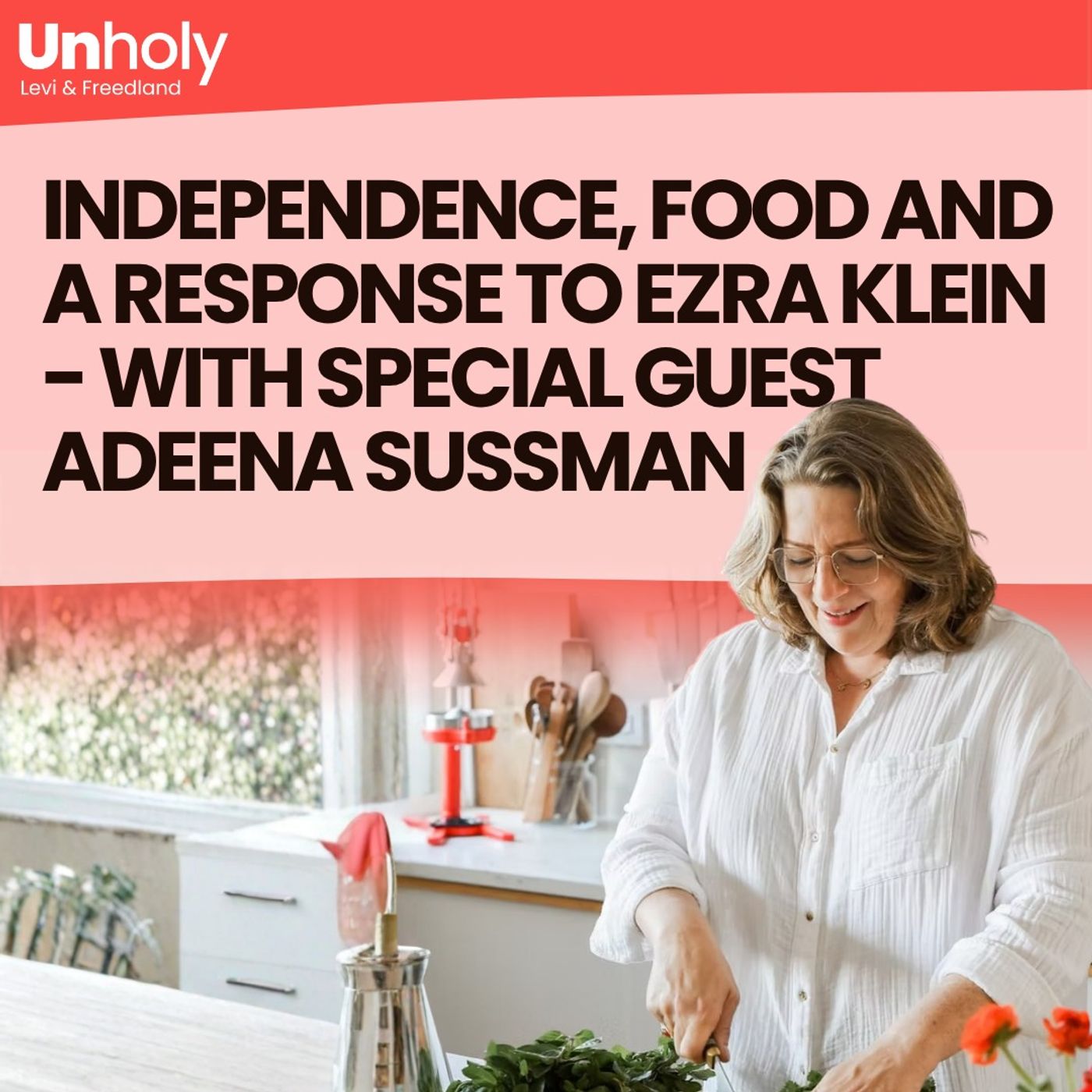
Unholy: Two Jews on the News
Independence, food and a response to Ezra Klein - with special guest Adeena Sussman
01:22:32
Watch us on YouTube: https://youtu.be/1RBYWVXGom0 Follow Unholy and learn more about the pod: https://unholy-podcast.lovable.app/ Join our Patreon community to get access to bonus episodes, discounts on merch and more: https://bit.ly/UnholyPatreon Listen to Aner Shapira z"l and Yehudit Ravitz: https://www.youtube.com/watch?v=y1XbaGln45Q Pre-order "Zariz" by Adeena Sussman: https://www.adeenasussman.com/zariz Israel's 78th Independence Day arrives in the shadow of a three-year war — and a nation more divided than ever. As US-Iran talks stall and the Lebanon ceasefire holds by a thread, Yonit and Jonathan take stock of where Israel stands: from the parallel ceremonies splitting the country, to Rahm Emanuel's seismic break from past support for Israeli military aid, to Ezra Klein's "one state reality" argument — and why Yonit thinks it misses half the picture. Then: a joyful detour. Adeena Sussman, author of the forthcoming Zariz: 100 Easy, Breezy, Tel Aviv-y Recipes, joins to t...
Loading summary
Transcript80 lines
- [00:03]
Adina Sussman
Every pot of Sabbath stew is an announcement that we aren't going away. Shabbat itself is kind of like a national holiday that 80% of the country celebrates on a weekly basis. And it revolves around food. So it's constantly providing the sort of impetus to keep moving forward, which is what I feel like Jewish people do. And food has a lot to do with that. It is a way that Jewish people continue to demonstrate and implement continuity in our.
- [00:45]
Yonit Levy
It's Unholy. I'm Yanit Levy in Tel Aviv.
- [00:47]
Jonathan Friedland
And I'm Jonathan Friedland in London. Unholy Two Jews on the news. The voice you heard there belongs to Adina Sussman, chef extraordinaire, author of multiple acclaimed cookbooks, bursting with enthusiasm for her new one. And it's a wonderful, delightful conversation which we will be bringing you. And it's going to be a lovely conversation.
- [01:09]
Yonit Levy
And there will be some culinary confessions from Mr. Friedland. I'd stick with this conversation. We talk about culture and history and food. And of course, this is also the third Independence Day during a war. We are awaiting news of renewal of talks between the US And Iran. So there's a lot of news going on. Spoiler alert. The name's Ezra Klein and perhaps Ram Emanuel will be said later in our show. Also wanted to tell our listeners that there will be important news from the Unholy desk, which means more Unholy.
- [01:39]
Jonathan Friedland
There is something we've been aiming for for a while. People tell us they really do enjoy it when we have guests on the show. They also really like, you know, hearing you and me. Go figure. But what we're gonna do is bring you, yes, the usual regular episode. Every Friday it'll be Yonit and me talking about the news of the week. But on Tuesdays you will have the Unholy Con bringing you interviews with thinkers, writers, journalists, experts, specialists, people in the news, people out of the news, bringing those to you every week. And so two episodes of Unholy. This is not a some deal where you've got to be a subscriber, although we encourage that as well. There are bonus episodes for subscribers. This is for you as regular Unholy listeners. Make Tuesday and Friday now your regular Unholy days. I want to hear all about the rituals people develop because until now we know your need that we have become part of people's Friday ritual. People tell us, they listen to us when they're doing the washing up, when they're cooking Friday night dinner, maybe picking up challahs in the morning, whatever it is. Unholy conversations every Tuesday. Weave that into your routine and your timetable. So we will be there in your feed at least twice a week. More obviously, if the news comes and if you are a subscriber and we cherish you, there are bonus episodes for you as well.
- [03:02]
Yonit Levy
On top of all that, you summed it up nicely. So that was our news for our listeners. We like to listen to our listeners. They're smart people and they wanted more unholy. So here we are.
- [03:12]
Jonathan Friedland
Or maybe we should say actually what the very first one is gonna be, because on Tuesday coming up, you can hear Booker Prize winning award winning novelist Howard Jacobson talking about Howl, his new acclaimed and really fiercely interesting book. I've called it the first post October 7th novel. So that will be a really interesting unholy convers coming to you on Tuesday.
- [03:38]
Yonit Levy
Indeed. Now we want to talk about what happened this week. So, as we know, Israel celebrated Independence Day on Wednesday, actually from Tuesday night. We talk about this every year, how the whole country has to transition from solemn Remembrance Morning Day into Independence Day festivities. Israelis not only are used to this transition, they're actually proud of it in a way. Right? To say we know what the price of we paid for defending our country, the price we paid for independence is, and we want to carry that weight as we enter Independence Day. It happens on an hour on national television that has been actually extended to almost two hours. The ceremony, the torching, the lighting of the torches ceremony. It happens at the burial ground of Theodor Herzl in Jerusalem. Actually physically turning from one side of Mount Herzl, which is the military cemetery, to the other side where the festivities begin on Tuesday night. Usually this. You know, first of all, this has been going on for decades, this torch lighting ceremony, ever since the 50s. It's kind of an archaic but charming ceremony, I'm sure, Jonathan, you know, you saw it more than once. You have these lighting the torches and all of the Israelis from all walks of life joining in in this and the procession and soldiers marching, creating different shapes on the kind of the festivities area. But I think in recent years of, since this is the third Independence Day during a war, things have slightly changed for how this ceremony is to begin with. We should probably point out that the protocol says that the person who officiates the ceremony is the Chairman of the Knesset, the Speaker of the House, because it had to be this sort of ceremony that everyone could join, like the broadest consensus possible. Let's say that in recent years the Prime Minister has taken on a more prominent role in These festivities, sending his own speech. This year, there were people who were actually marking how many times the camera cut to Netanyahu during the ceremonies. If you're curious, Jonathan, it was 41. And of course, during these three years, there have been these parallel ceremonies because of what happened after October 7th, and many people saying, you know, this government doesn't represent me anymore. So there have been these parallel ceremonies, including one on Independence Day this year in Tel Aviv in what was called Hostage Square. It was called the Liberal Democratic ceremony. That happened at the same time that this state ceremony was happening.
- [06:15]
Jonathan Friedland
Yeah. And there was controversy, I think it's not the first time controversy over some of the people taking part in that ritual torch lighting. You know, that you say normally the tradition is to bring along people from all walks of life. And this year, one of those chosen alongside a scientist and a chef and a doctor, was this very controversial figure, a rabbi who has become Notor for his. You know, he does military reserve duty with an armored bulldozer, made videos in which he says, we will flatten you and destroy you in Gaza. Avraham Zarabeev, he was a choice. And I think that was one factor in propelling quite a lot of people to think, you know what, this year I'd rather go in with that alternative ceremony rather than this one that feels more and more political and not just in the way you described, with the increasing role of the prime minister, rather than trying to keep it consensual. And this choice of Zarbiv was, it seems to me, part of that. I mean, how would you. And there's a reason why I'm going to ask this. How would you describe the mood at these 78th anniversary celebrations and festivities if you had to, in a nutshell, capture the mood of Israelis this Independence Day? Because I'm about to contrast it with an earlier one. But I want to hear how you would capture this one.
- [07:36]
Yonit Levy
Look, I mean, I think it very much is a nation divided, and perhaps the story of the two different ceremonies tells that story. I think we will get into more example of that division in a few minutes, but I think the mood is different than it was in recent years. We should just point out maybe one quote from the prime minister that he said over and over in the day between Memorial Day and Independence Day, he said, I promise, and I brought back all of the hostages, which is an interesting thing to say, indeed, true, when you put that fact and detach it from context. But if you add context, and I think many of the hostage families did comment that not Only were there 46 hostages who were taken into Gaza alive and brought back dead, including Hirsch Goldberg, Poland. We heard his mother in a very heartbreaking interview two days ago on our podcast. But the fact that they were kidnapped in the first place is something that one should notice. And it is very hard to take credit for the second half without taking responsibility for the first half. So I think many people who are not the government supporters felt that this year. The backdrop, of course, is being three years of feeling the same kind of mood.
- [08:56]
Jonathan Friedland
So the reason why I wanted you to sort of capture, in a nutshell, the mood in 2026 is be or for this 78th anniversary is because I came across going through a whole lot of bot boxes. I've mentioned before that my late father, Michael Freeman, left behind a whole lot of papers and of documents and was a notorious hoarder, and he kept everything, including huge numbers of back numbers of Time magazine. So just this week, there we are, because some people will be watching this on YouTube. There is Israel at 25. You can see Time magazine from April 1973. The main story on the front, not Israel, not Israel. Watergate breaks wide open and there's a picture of Richard Nixon on the front, but Israel at 25. You turn inside and you know, it's a famously a sort of color news magazine. So there's photographs of Russian immigrants arriving at Lod airport and a picture of a beautiful young woman, an aged Moroccan Jew with his smiling Sabra granddaughter. To be honest, images like this would look like Hasbara now. They would look like propaganda. You would just wouldn't really see them. A lovely, charming photograph of a young sort of Haredi boy and an ar. An Arab man as. And the caption, you know, Jews and Arabs mingling together and so on. But the paragraph I thought was interesting here, when you turn inside, it's talking about the anniversary celebrations. The Israelis have never been known for understatement, and the grandeur of the anniversary will accurately reflect the country's prevailing mood. Although it has plenty of unresolved social and political tensions, Israel today exists in a state of euphoria. And why not? Militarily, it has never been stronger economically. It has never been more prosperous. Statistically, its achievement in the past 25 years are virtually unparalleled in history. And there's an American news magazine there. It is celebrating this anniversary. Just when people think about media coverage now and what the Mood is in 50, what, 53 short years, how much has changed. And as I say, it felt somehow sort of apt that just yesterday, going through whole lots of boxes of stuff, that's what I came across. So obviously the mood has changed, you know, partly also just in terms of Diaspora. I remember the Independence Day of 1973. I was six years old. I had as a gift from my parents a blue and yellow T shirt. That was Israel at 25. This was for Diospreju's unambivalent. There was no complication about it. Six Day War was six years earlier, the year I was born. And it was just Israel was a cause of pride and celebration, as I say, no ambivalence at all. And Yom Ha' atz Mud was just a day of festivities uncomplicatedly every year for those Diaspora Jewish communities, you know, 50 years ago. Now it's a site of debate and contest and argument and division internally, meaning Jewish families arguing. We've talked about this a lot over the sort of dinner table and externally with, you know, Jews in Diaspora being asked to account for and explain, where exactly do they stand with Israel? Are they responsible for it or do they justify it, do they defend it, et cetera, et cetera, et cetera. It's just such a contrast. And, you know, we all know that we all live with it all the time. But just coming across that little relic of an earlier era brought it into quite sharp focus for me this week.
- [12:37]
Yonit Levy
I want to say something about that if I can. First of all, you know, gold star to Michael Friedland for keeping that magazine in mint condition. We should say mint condition.
- [12:47]
Jonathan Friedland
You could see.
- [12:47]
Yonit Levy
Very impressive, very impressive. And even a gold star to you for organizing the room in a way that you could find the magazine. I do want to say something about this. For some reason, my mind took me these couple of days, 10 years back, not 53 years back, and I remembered a quote from the 10th president of the state of Israel, Reuven Rivlin, and something he said on Memorial Day almost 10 years ago. He said, I'll say it in Hebrew first. This means our independence is holy and it's hard, he said. And I think that line could stretch to Israel as a whole. It's holy and it's difficult and it's complicated and loud and it's also beautiful and it's also spellbinding, and there's nothing like this country on earth. And you're right to know that things are very difficult. In fact, I would go as far as saying that our generation is dealing with the most difficult period in Israel's history since the founding generation of Israel. I Don't think that should leave us with a feeling of despondency. I think I'm throwing us to a conversation I had with my son a few weeks ago. The poor boy asked me who my favorite American president is. That lecture lasted while, but he was sweet enough to ask a second question after 45 minutes. And the question was, what makes a person great? And I said, it's two things. I think it's obviously their characteristics, but it's also when reality tests that person, when reality sets this test for them, and they need to rise to the occasion, they need to withstand this test. And again, I would extend this to. To a country. We are into a generation. We are, again, in a very, very difficult point in our history. All of the problems that we know that exists on the security level, on the external level, and also, I think, the more dangerous ones internally, the divide inside Israeli society, we need to rise to the occasion. We need to be that generation that knows that needs to figure out after 78 years where this country is heading. That doesn't mean that it isn't a responsibility and a burden, but it does mean that it's also an opportunity.
- [15:11]
Jonathan Friedland
I mean, that's a beautiful line of Reuven Rivlin's, and he was a very unusual and interesting president. That's a beautiful line that captures a huge amount. I think people, listeners, will be struck by you saying that about this being the most difficult period, given what is known about Israel's history. How hard the different periods, you know, big Yom Kippur war, The founding in 48, the early years of when the country was really poor and sort of
- [15:37]
Yonit Levy
struggling since the founding date generation. I do. I do completely agree that the 1948 and the war of Independence and all of that, very difficult. I think, in the history of the state of Israel, the last three years are incredibly difficult.
- [15:50]
Jonathan Friedland
Yeah. So that's very striking. Part of that, obviously, is this sense that the wars of the past were short and sharp, but they were short. You could see the end soon after the beginning. And then they were followed by a diplomatic redrawing of maps and of treaties and new alignments and new alliances, most famously Yom Kippur, followed not long afterwards by the peace treaty with Egypt. The sense now of a state of almost permanent confrontation, war, where there's a pause, there's a ceasefire, but since October 7, the country's been at war more than it has not been. And that. Which brings me to where we are with Iran. I mean, and the current state of play, obviously, we've seen Donald Trump and what he's doing with Iran and saying the ceasefire actually is now going to hold as long as it takes to get a proper offer and negotiated settlement. Right. Iran seems to see that as Donald Trump blinking and backing down. He wants Lebanon and Israel's confrontation with Hezbollah to be folded into that. There is a kind of uneasy truce. Just how, how are people where you are seeing that? Is it seen as being something that's going to hold, that people can begin to make plans, or does it feel like it's just a pause for breath right now? Yeah.
- [17:07]
Yonit Levy
I don't know if anything in these past three years taught us is not to make plans. Right. I know that Americans are very focused on saving the date. We don't save dates here. We don't know what is, what tomorrow brings. I think the feeling is of this kind of waiting, anxious waiting, or at least, you know, being focused on this because we don't know, as you said, we're Donald Trump extending the ceasefire. Are negotiations going to blow up? Are we looking at another kind of round in this? What we, I think can say is that it doesn't seem like the United States or Iran have an appetite to return to a full blown war. We also know that the sort of threat of a full blown war was already on the table. I heard an expert on the Iranian nuclear program of Nervilan talk on the radio today and he said something very interesting. He said, look, at the end of the day, it's the uranium, enriched uranium, that could solve this. Right. If Iran agrees for that to be taken out in return for a lot of economic relief, then every side of the story can say, look, we have victory here. But it is an important thing to notice.
- [18:20]
Jonathan Friedland
It's sort of telling that with all this confrontation going on and just people being killed in different countries in the region all the time, that somehow it's actually not the killing of a person that cuts through in terms of capturing global attention, but actually the destruction of an inanimate object, a statue, statue of Jesus that was in footage that I think will have been seen or photos that would have been seen that really captured the global interest. And it was of an IDF soldier in a Christian village in southern Lebanon taking a sledgehammer to a statue of Jesus and to the face of Jesus. As I say, in a way, we should always think that the killing of a human being should, should capture global attention more. But this did. And, you know, Prime Minister Netanyahu moved very quickly to say this was wrong and to say that the people involved would be disciplined quicker, a lot of people notice than will be said when it's human lives are involved. But it was as if he understood that this could become very quickly a symbol on multiple fronts, one of them being the increasing disenchantment. And we've talked about it here on the podcast of America's Christians, particularly younger American Christians with Israel who have been arguing. And Oliver Conroy was on the podcast explaining that there's a younger generation who think it's some kind of boomer tick for older Christians to be pro Israel. They see no reason to. This will. Will go straight to that. And of course, it taps into deep anti Semitic tropes about Jews as the killers of Jesus. So it's an incredibly potent symbol. But it also suggests that wouldn't have come from nowhere, that somewhere down the line that soldier thought that was okay. And okay enough that he would get his friend to film him doing it suggests a degree of sort of brutalization. There's a lot going on there in that image. I mean, you know, I'm, I'm, as you can hear, I haven't sort of formulated it all, but obviously I want to know what you think and how Israelis reacted to it.
- [20:33]
Yonit Levy
Well, we're pretty appalled by it for the reasons that you stated. I mean, we should say the IDF was very quick to set up an inquiry and to regret, express deep regret over the incident, replace the statue. We should also say and punish both soldiers, both the person who photographed it and the person who did it. I mean, it's terrible on all fronts. Right? It's religiously terrible. It's a PR disaster, all of it. And the last thing that Israel needed in this case. I think the perspective is, of course, that there are tens of thousands and at some point, hundreds of thousands of soldiers fighting a war on multiple fronts. I'm not saying in any way that this should be excused. I'm just saying this is one incident.
- [21:18]
Jonathan Friedland
Yeah, I think it's one of those ones that could live on, actually, a lot when people have forgotten sort of death toll and so on. I think this image could be one of those things that appears in posters and propaganda and on demonstrations for many years to come. That's one of my. Just a postscript to what we were saying about the ceasefire and so on in Lebanon. The wording of Donald Trump's announcement that when he said that there was a ceasefire and included Lebanon, and he said that, you know, Israel attacks on. On Lebanese targets in Lebanon will stop, the way he put it was to say they were prohibited from hitting out. And I just thought that was an amazingly interesting word to use here. Is Israel be bombing Lebanon any longer? They are capital letters prohibited from doing so by the usa. Enough is enough. This was on Truth Social, on his social media platform. Just in terms of the politics of this, of Benjamin Netanyahu's, you know, sovereignty matters to countries. It particularly matters to sort of nationalist parties of the right. And to say to have it said out loud that the country is not sovereign, it is subject to the decisions of another country. Quite something for Netanyahu to swallow.
- [22:41]
Yonit Levy
I think some would comment that this post came right as Shabbat began, so that many of Netanyahu's supporters didn't see it. I'm not entirely sure it's coincidence, perhaps, that was trying to assist Netanyahu in when you opposed it. Reality on the ground is that Hezbollah is still attacking and Israel is still responding. Very, very in a sort of lower volume than we, but still happening. There are talks continuing today in Washington, today on Thursday in Washington between the representatives of Israel and Lebanon. The question still remaining whether the government in Lebanon can put some sort of pressure on Hezbollah, which is, you know, does not mince words when threatening the Lebanese leadership. So this is where we are at this point. Again, similar to the Iranian front. We don't know where this is heading. We do feel like the American president does not have an appetite anymore. These kinds of skirmishes or these kinds of conflict, whether it be Iran or Lebanon. I would just make an extra note on. We talked about how Israeli society is divided. This is Thursday. In the morning, there was really heartbreaking scenes. Jonathan. I don't think we can call it any other way. At the footsteps of the Supreme Court in Jerusalem, families, bereaved families who are demanding a commission of inquiry into the events of October 7th. We should say this coalition has done everything in its power to prevent that kind of commission to be set up, petitioned the Supreme Court. And what happened was that families that support this government came as well, and there was an argument between them. The families who are pro government were essentially saying that it was the fault of the court, that the court had tied the hands of the soldiers. This is echoing a lot of claims made by the right in Israel that the high court is restraining the IDF and thus enabling terrorists to enter the country. I'm saying this because I think it's very important to see again, as we are in our 78th Independence Day, I think it's important to see just how deep the divide is it's not just an argument on where do we go from here or where is this country heading. It's an argument on how we got here in the first place, how October 7th happened. The difference between if you're a Netanyahu supporter, you will say, wait, it's all the military's fault. Not only is it the military's fault, it's the fault of the reservists who were objecting Netanyahu's judicial overhaul and threatening not to come to military service. That is what Sinwar saw when he decided to attack Israel. And of course, if you're on the other side of the Israeli map, you're gonna say, wait a minute, it was Netanyahu who started all this with his judicial overhaul. So that is where we are. And it is a worrying, worrying divide, definitely. As we are now six months before the scheduled election. So we're in an election year. This is only going to, sadly, this is only going to. To get worse.
- [25:48]
Jonathan Friedland
Yeah. I think of your point earlier about this being such a hard period in the history. Part of it is this degree of polarization where in a way it's becoming hard for there's not even a kind of shared body of facts that everyone can agree with and then differ on the interpretation or the opinion. You're getting to the thing where people just seeing the events themselves, you know, completely differently. My mention of Trump earlier makes me think that we might look to how things are playing in the U.S. we talked last week about Alyssa Slotkin, the senator from Michigan, how she was one of 40 Democrats who voted against a military aid package for Israel. Hugely significant vote if Slotkin was a big deal. The shift from one of the big names of the Democratic Party that we'll come on, come on to in a second is a massive deal. And I'm talking about Rahm Emanuel, former guest on this podcast, a advisor to Bill Clinton to Barack Obama, congressman, mayor of Chicago, a former ambassador to Tokyo. He's really done the whole lot, a very big career, has aspirations for the highest office to be president, perhaps even in 2028. Here is how Rahm Emanuel described his relationship with Israel just over a year ago when he came on Unholy.
- [27:24]
Adina Sussman
I mean, I grew up in American politics where my first name is Rahm. I think there's the only other person I knew was the doctor that saved my life, Rami Yogev, as my full name is Rahm Israel Emanuel. Even if you wanted to hide, not really easy, okay. And so but I've made my way through American politics.
- [27:39]
Jonathan Friedland
I mean, you know, it's a metaphor where people say my middle name is security or my middle name is Trump Trust. His literal middle name is Israel. Right. So he is absolutely the solid core of the pro Israel wing of the Democratic Party. It would be like Joe Biden or someone. It's somebody from the Israel, overtly proud to use the word Zionist wing of the Democratic Party. Here's what, what he said when he went on Bill Maher. He said, no more U.S. military aid, financial assistance from the taxpayers for Israel. You're a country like all other allies of ours, Japan, South Korea, the Brits, the Germans. You're going to pay full price. You can buy what you want, but you have to abide by the laws. That should be it. No more U.S. taxpayer support here. The days of taxpayer subsidizing Israel are over. No more financial aid. It's a big moment.
- [28:36]
Yonit Levy
Look, first of all, all you're right to say it is a big moment. Just in parentheses. Perhaps this is important, right? I mean, Israel is not a charity case. It's the sort of research and development center for much of this weaponry. And I think that should probably be mentioned. It should also be mentioned that the US Weapons industry gets much of this money. But that's not what the facts are not important here. What is important is who is saying it. And it looks like, like the most prominent Democrats who want a future perhaps leading the party have to cleanse themselves of any kind of Israel association. That is what is very concerning in this move by Ambassador Emmanuel. And I think that more and more you see these, you hear these voices from the Democratic Party. You're right to point out Senator Slotkin, definitely not anti Israel voting in that vote. There are more and more voices of the moderate Democratic Party talking this way. I should also mention an interview given by Almas Hochstein, also a former adviser to President Biden, also an interviewee on this podcast. So what Hochstein said was Prime Minister Netanyahu sacrificed Israel's interests in the United States. And there is that kind of hue in what some of the Democrats are saying, which is to say if Netanyahu is not the prime minister, perhaps this whole thing could be restored, started. That's not his words. I'm just saying that that is the subtext of what some of these Democrats are saying. By the way, if you're looking for any solace on the other side of the political map in the United States, then we should mention Steve Bannon's quote from last week saying that Israel is a sideshow to a sideshow, which I have to say that as an Israeli, first I was insulted, and then I said to myself, perhaps that's better than anything else. Let's just be a sideshow. Perhaps we shouldn't talk about us that much, much forget we exist for a while and let us, you know, be here in peace. But that, you know, we're not gonna hear great things from that side of the aisle either. Sadly, we should say no.
- [30:42]
Jonathan Friedland
We've been talking about that, and with what's going on there, Tucker Carlson and so on, I think in a way you're right to be relieved if you want to be out of Steve Bannon's sights. It's a good thing. It's a good thing. No, I, I very glad you mentioned Amos Hochstein, because I heard him and thought, look, it was the case I was making last week on the podcast, I think, which is that this is, you know, the old Cold War diplomats talked about who, like, lost China, who lost Vietnam and so on, who lost America, that political question. I think Hochstein diagnosed it very well and said that it was, you know, before then. The special relationship with the United States, he said, was the most important asset Israel had. And it was because it was bipartisan for so many decades. He said he's destroyed that because he's decided to become not just part of the Republican Party, but he's decided to become just an appendage of Donald Trump. And, and he says, every Democrat now sees if you want to be for Trump, great, but we, the Democrats, are anti Trump. And then de facto he says, this is his words, we are against you. And he then goes on to say, I think Democrats should be aligning with Israel, not with Netanyahu. So in other words, people like that, from Israel's point of view, are not a lost cause. They're saying they still feel and I'm sure Rahm Emanuel would say, say if we played back the tape of him On Unholy in February 2025, he would say, yeah, I still believe all those things. It's still my middle name. But I don't want to give any sucker to this version of Israel, Netanyahu's Israel. I think that is where the fault line is. I think it's interesting that people like Hoste and he didn't have to say Democrats should be aligning with Israel. But I think the unpopular position inside the Democrats, there are exceptions, John Fetterman and so on, but the unpopular position is to be seen be in any way with this government, this iteration of what Israel is, there are very few takers around the world for that now. You know, one less, one fewer. Since the departure of Viktor Orban, there are very few takers for that. But for Israel itself, I think Hochstein is saying there's some hope there. If Israel gets off the Netanyahu path, the Ben GVIR path, the Smotrich path, Democrats will be able to be on that side, but they can't be on it when it is a sort of extension of the Trump project. And I think that was, you know, sort of just as a matter of pure politics and strategy. I think that was Netanyahu's big mistake. Because in a partisan system, if you tie yourself to one party accepting John Boehner's invitation to speak to Congress while Obama is at the other end of Pennsylvania Avenue, you're going to make yourself the target of the other party. That's how bipartisan politics works. And Rabin and others understood, never make Israel a partisan issue because then you'll be on the wrong side of one half of the country. You want to be bipartisan.
- [33:31]
Yonit Levy
Well, I think that we can have an analysis of his mistakes after his premiership. But since he is the longest standing Israeli prime Minister, and since 2009, almost consecutively, apart from a year and a half almost, that Naftali Ben and Yair Lapid were prime ministers, I think from the political internal perspective up to this point, he wouldn't agree that he made a mistake. In any case, this is part of a conversation I think that we were planning to have this week. And it all connects to an episode that created quite a response, I think, for many, many people around the world. An episode of a podcast, Ezra Klein's podcast in the New York Times, an episode called Reckoning with Israel's One State Reality. I have a lot to say about that, but I'm waiting for you first.
- [34:17]
Jonathan Friedland
It absolutely got a lot of attention. A lot of people listening to the Ezra Klein show has a very big reach. He covers and talks about Israel a lot. He's come on this podcast and, you know, he's a very, very smart, deeply read guy. And he decided to bring in a couple of experts to talk about the situation on the west bank, particularly, they talked about Gaza as well. The argument, I think he, the podcast was trying to make is, look, people talk about two state solution as an ideal, but right now, as an act, as a matter of sort of jurisdictional reality, Israel governs, governs the people, in effect, between the Jordan river and the Mediterranean Sea there are you then you just. There is one controlling authority there has been since 1967. And you need to reckon with that rather than putting it out of your mind. And it went through the various dimensions of it that Israeli Jews and West Bank Palestinians really are all subject to Israeli jurisdiction, but Israeli Jews are subject in the civil authorities, civil courts, Palestinians unions under military courts. He talked about the settlers, how they, they used to be sort of policed and regulated extremist settlers by the idf. And settler violence was something that happened, but it would happen in the dead of night. Trying to be doing it away from the IDF now said this, said the contributors, the daylight attacks happen in broad daylight. I mean just the other day a 13 year old old child was killed under Israeli settler gunfire and so on, that this happens. And now the IDF stand by according to the contributors in the podcast. And they sometimes do nothing and even in some cases help. So this was the sort of broad argument of it and it was trying to say that, you know this maybe one day there'll be two states and maybe one day there'll be one state as a sort of legal constraint, political construct. But right now, as a matter of just fact, there is a one state reality in governing Israel and Israel proper and the west bank and the half of Gaza where the IDF are present. So that was broadly the argument. And I know you have a lot to say about it.
- [36:42]
Yonit Levy
I have a lot to say because you heard some of it during the week, heard and read my messages. Look, I would actually start in reaction to this by quoting a poll for my channel, channel 12, which was conducted on Friday and asked a question for the first time that wasn't asked ever in this format. The question was who do you think needs to be the next Prime Minister? There are only two answers, Netanyahu or not Netanyahu. I'm saying it was never asked this way before because usually when you ask in polls of the compatibility to be prime minister, you ask Netanyahu versus Lapid, Netanyahu versus Bennett, Netanyahu versus Eisenhower. No, no. Here there was only two options, Netanyahu or anyone but Netanyahu. 36% of Israelis people asked in the polls said Netanyahu, 56% said Netanyahu. By the way, 8% said they don't know. I'm not sure what they're still waiting for, but they haven't made up their mind. And when you look at the popularity of this coalition, then just do the math, right? The coalition currently has 68 seats, but in the polls it has around 50, 51, maybe 52 out of the 120 seats of the Knesset. That's about a 40% support in this coalition. This is the picture in Israel. What I'm saying is, because I feel like these kinds of conversations ignore Israeli sentiment which opposes this government, which opposes Ben GVIR and Smotrich and their ideas, and to act like Zionism today is Ben Smotrich is a deep mistake. By the way, we should just make note that this conversation that we're quoting had no Israel Israelis on it. There wasn't an Israeli on this conversation. And when you think of the people who for three years, more than three years, week in, week out, come rain or come shine, were protesting this government, first they were protesting the judicial overhaul, then they were protesting the fact that they want the hostages back and they want to end the war in Gaza for three and a half years in between trying to survive financially because a lot of businesses were, of course, crashed because of the war being so long and just trying to survive the fact they were missing missiles from Gaza, Lebanon, Yemen and Iran. And then these are the people you should be talking to when you think of what the future of Israel is and not, I think, extreme positions. I'll make one note, if I may, Jonathan, which if we're talking about facts, there's another fact to say. The fact is that in 2006, Ewud Olmert was elected with a landslide majority. And he did something quite strange in Israel of today. He set out his plan. He said before the elections, I am going for something called the realignment plan. It will be the continuation of the disengagement from Gaza, dismantling settlements in the west bank, moving settlers back into the Green Line, etc. Israelis voted for this. They voted for him. And when you ask what happened in those 20 years between Ewud Olmert and Ben Gvir, the far, far right politician, being so prominent in the government, that question, question has to be asked also from the Palestinian side and not just from the Israeli side. I can go on. Should I go on?
- [39:50]
Jonathan Friedland
No. I mean, I could hear it all week, I'm sure. But the one pushback I think people who listen to this might come back with is to the poll. Absolutely right. And you're right to emphasize it that the majority are not with this government and they're not supportive of this Prime Minister. But is there objective objection to the, as it were, one state reality that Ezra Klein was describing in which the Green Line of 1967 has become blurred to the point of erased. It's not visible in day to day life. In other words, some of those opposition parties, whether it's Gaddy Eisenhower or whoever it is, they're not saying, you know, elect me and I will end the occupation. Certainly not saying that. But they're also not even saying, you know, what Olmet did say. And I think it's brilliant you point that out and that Olmo 20 years ago could win a mandate on that platform. And we should also mention come incredibly close to securing a peace agreement with Abu Mazen for the Palestinians by which the Palestinians would have been in charge of the overwhelming bulk, I mean 90% plus plus plus of the west bank and with land swaps to compensate for the rest and so on. Right. To remember all of that. But now in 2023, can we read into those that majority of voters and political parties that are not with Netanyahu are. Those are people who are against this one state reality, who would want to change it. I'm just not sure that matches what the politicians who are anti Bibi are offering or even talking about to the rest of the country.
- [41:30]
Yonit Levy
In other words, those Israelis I described who are protesting for three years, you're saying why aren't you also protesting, protesting for peace or why aren't you also protesting for a Palestinian state? In a way that is the subtext of what you're asking.
- [41:44]
Jonathan Friedland
No, because I think they've got their hat. No, because they've got their hands full and they've got enough to deal with day to day life. But in terms of the judicial coup and after October 7th, but I'm telling you just in terms of their opinion, I'm not saying why are they not on the streets? I get that. As a matter of understanding the politics of it, I get that. I'm just saying in terms of what they're. Can we read into those opinion poll numbers that they are disaffected with with the strategic path Israel is on, which is to be very opposed to a Palestinian state, which is the only way we're going to break out of this one state reality. I'm not sure there's a majority for that there. And in fact, it's your point that you made the other day brilliantly in the context of Hungary, which is the man most polls suggest is likely to be the next prime minister. Naftali Bennett more or less agrees with the broad thrust of the Netanyahu position. It's just he will do it more honestly, cleanly and without the excesses. But he's implacably opposed to dividing the territory and he would preside over the current one state reality. I think we can hope maybe that would change. But I would love to believe that what you're saying is in a way what the gloss I would want to put on it. But I'm not sure I can make that leap.
- [42:55]
Yonit Levy
I want to answer with something else that was said in this podcast that we're talking about. Professor Shibli Telhami was saying something that I found, found exactly the point of what happens with facts if you don't give the full context. He said, back in the mid-90s, during the Oslo years, you had a situation. If you're living in Ramallah, living in Nablus and Jenin, you actually felt a state emerging around you. And then he said, fast forward 10 years after the second intifada. This is not true anymore. You have a big security walls, a de facto new border and a range of checkpoints. If someone doesn't know what the second intifada is, he doesn't understand the story that was just told him. The second intifada is when Hamas and other Palestinian terrorist organizations decided to move blow up peace negotiations, not for the first time and sadly not for the last time. And more than a thousand Israelis were murdered in suicide attacks by these organizations in buses, in cafes and in other places until Israel decided this wasn't a coincidence to indeed set up checkpoints and a wall to prevent terror from entering Israel. This happened again and again for decades. And this culminated in the worst massacre against Jews since the Holocaust and of course since the establishment of the state of Israel. And so when you ask yourself, wait a minute, what does the moderate Israeli think? Well, the moderate Israeli saw people being murdered and saw sadly, people in Gaza beating up to pulp the hostages that were brought in and heard the testimonies of the hostages. So they are rightfully concerned about what could happen in a case of a Palestinian state. They will be much more worried about this. I think that if one, if someone realizes that and can promise even the middle of the road Israeli, what kind of security and that this can never happen again. If there is a kind of a Palestinian entity in eastern part of Israel, not only in the southern part, that would change the conversation. I don't see a politician doing it at this stage. It is too close to October 7th to have this kind of conversation.
- [44:51]
Jonathan Friedland
Yeah, I think you've explained very well why I was trying to say, which is that the Israeli public just isn't in that place yet. And for. And though. And You've explained the reasons why they are. And after the experience of, you know, the second intifada 24ish years ago and October 7, you can again, as a matter of analysis, you can absolutely understand why. And in a way, that's why it isn't just about their feelings about Netanyahu, it is about the actual situation that's there. So we do at least have an Israeli in this conversation on this podcast. And so we make sure, let's, let's
- [45:31]
Yonit Levy
give another gold star to someone, a prominent journalist from around the world who actually does engage with an Israeli journalist every week, even though sometimes it isn't fun for him.
- [45:42]
Jonathan Friedland
No, it's always, always enlightening and worthwhile.
- [45:47]
Yonit Levy
Use the word fun. I dare you. I double dare you.
- [45:52]
Jonathan Friedland
You know how much fun I have doing this podcast week in, week out. Talking of fun, we should get to our guest, I think, because this is not just fun, it's joy. We have a treat for you right now.
- [46:11]
Yonit Levy
Adina Sussman is a cookbook author, a food writer. Her new cookbook, Saree's 100 Easy Breezy Tel Avivi Recipes, will be released on April 28. Her last cookbook, short Shabbat Recipes and Rituals From My Table to Yours, released in September 2023, was an instant New York Times bestseller. Adina, welcome to Unholy.
- [46:30]
Adina Sussman
So good to be here. Thank you guys for having me. I'm honored and so excited and so are we.
- [46:35]
Yonit Levy
And there's so much to talk about, I think, before anything else, actually. And we'll get into your new cookbook, which is called Zariz, but it's Zariz, as you will say it, 100 easy breezy tel Avivi recipes. And we want to talk about, about that. When I went through it yesterday and I thought to myself that a cookbook is in a way, a kind of snapshot of a certain moment in time, certain moment in a country's time, in the writer's time. The fact that this book is really written during a very long war, how does it change you, your writing and the book itself?
- [47:10]
Adina Sussman
It's a very astute observation, Yonit. I really, you know, cookbooks have become like memoirs or novels. They have a narrative arc and they really capture a moment in time. And this was the book that I came back from my book tour for my last book to find myself a month into the October 7th war with Hamas. And, you know, my brain and my body were taxed and I still needed to cook and I still needed to work. And I realized that What I needed for myself was simple cooking for complicated times. And, you know, I generally really try and go with my gut about that. If this is what I need, then this is what my audience is going to need. And I. I really just dove in. And this book, more than I say any of the other books that I wrote, was both a professional journey and also a therapeutic journey. It was the way that I continued to do that I think that I love the most during a very hard time. And I still needed for myself, I needed to feed my family and friends. I needed to work. I needed the sensory experiences of cooking that sustained me. The sizzling, the aromas, the process, the chop, stopping, everything. But I needed to do it in a way that was gonna create more calm in my life and just help me function. And so I streamlined everything down to the studs, to the bare essentials. I tried not to sacrifice flavor or depth of flavor or layers of flavor, as chefs like to call it, but to do it in a way where every ingredient and every cooking implement and every technique had maximum impact. And it kind of became a bit of an object lesson in life. I mean, really, I think we all, after October 7th, like, every. The essentials of our emotions, of our actions, like, became more meaningful and in full relief. And I think that just, you know, evinced itself in my kitchen and my cooking as well. So that's the book I wrote, but I also wanted it to be full of joy. It's bright, it's colorful. I mean, I happen to have a copy right here, coincidentally, so the COVID is just. It's sunny. My books, you know, I say they have, like, the secret ingredient in my cookbooks is the natural Israeli sunlight. Everything is shot without flashes in my house. And I wanted it to bring joy and appeal to people and remind people that cooking can really be a balm, you know, in any time, and that we don't need to stop cooking. We can just maybe cook a little bit differently. So that's the book that I wrote. And of course, because my audience is English speaking, I had to come up with another Hebrew word that Americans and other Anglophones could pronounce. And somehow zarize is what I came up with.
- [49:53]
Jonathan Friedland
Oh, it's a very good name. It's fascinating hearing you talk about the process, because people are used to the, you know, notion of comfort food, and that usually refers to the food itself and the eating of it and the. The sensation. But in a way, what you're saying is the process of cooking can be balm, which is a Lovely word. But just because of you mentioned it, your audience is English speaking. People will hear from your accent, although they know from your neat. People can have your accent and actually be native born Israelis. But in your case, your journey to Israel is a particular one. Just tell us about how you came to be a cook, in a way, an Israeli cook and just what that's like, coming to this cuisine, as it were, an outsider.
- [50:34]
Adina Sussman
I always like to say I'm a bit of an insider outsider in this culinary culture. I was fortunate enough to be writing about Israeli food and wine for the best, better part of, you know, 15, almost 20 years before I moved here. And I spent a gap year here after high school. I lived here for five years after college, which is when I kind of discovered the beauties of seasonal cooking and market cooking. I lived in Jerusalem near the Machine Yehuda Market. And I remember my first fresh falafel that I ever had as opposed to, you know, in the 1970s in California, falafel was made from a Telma packet where you rehydrated a powder and fried it. Hummus was in a can and the lemon juice was citric acid. And these were the exotic foods of the 1970s in the Israelites.
- [51:18]
Jonathan Friedland
Yeah, don't knock it, don't knock it, Adina.
- [51:21]
Adina Sussman
I'm not. I still have those nostalgic feelings for those foods. And you know, I think every cuisine and everyone's meal has to meet them where they're at. And that was my mother's way of show, introducing this cuisine into our lives. But when I got to Israel and had the real thing and I drank so much carrot juice during that first month in Israel when I was nine that my fingernails turned over orange like a beta carotene overload, you know, and I, it never left me. And on my, in my gap year and in my five years in Israel, I really, really came to connect very intimately with the food here and also the way that the food interacted with Jewish life in Israel. You know, in the United States, when you go to the farmer's market and ask when a pomegranate is at its peak, they're going to say late September. And here they're going to say Rosh Hashanah. And I realized that there was this really special connection between our food calend and our Jewish calendar and other religious calendars as well. Muslims have their same exact version of the same thing when green almonds or satire is blooming and all of that. And then as my culinary career sort of took off And I was writing about Israeli food and wine and started writing cookbooks. I met my husband Jay on a blind date about 12 years ago in New York. He was there for work. He works for the Society for the Protection of Nature in Israel. And a mutual friend set us up on a blind date and we connected right away. And I decided to pull up and move to Tel Aviv. And we, you know, laid down our roots right next to the Carmel market. And all of a sudden I was not just writing about something as a visitor, but I was in situ. I sort of became a translator between, of. Of Israeli food for Western audiences, explaining to them about the roots of all the ingredients and, and how the culture is so diverse and how so many of the things come from both local influences, Palestinian, Arab and Jewish, and also the multitude of immigrant groups that come here and just how that all blended together to create something that I think
- [53:24]
Yonit Levy
is extremely special, those immigrant groups. And by the way, you're of course representative of one of those immigrant groups. And when you look at the sort of recipes that you have, right? I mean, I love the Floppy Yossi, which is a sloppy joe, an Israeli version of the sloppy joe, for example. Or like you do love your Trina, everything, including the chewy Trina Blondies, all
- [53:44]
Adina Sussman
of that, it rhymes, it rhymes with my name. So I mean Trina Adina. Like it was meant to be. It was meant to be.
- [53:50]
Yonit Levy
It's also perfect, I agree. But I wonder if there is such a thing at the end of the day that is Israeli food or is everything, because it's an immigrant society, is everything going to be a bit of a, a mix?
- [54:03]
Adina Sussman
First, first of all, we have to remember that Israel is an 80 year old country, right? This is, you know, this is a nascent place and its cuisine is still developing. American food, for instance, I would say in the last 20 years, like a language, a lexicon has coalesced around what new American food is maybe the last 30, 40 years. And I think the same thing is still happening here. You know, it used to be that the mark of a great chef in Israel was someone who could cook amazing food from other places. It showed that you were international, you were well traveled. When people in Israel had had less dispensable income and were less continental, you know, if you could cook a good coq au vin or, you know, a wonderful Italian pasta or something from somewhere else, it showed that you were sophisticated. But about 20, 25 years ago, as Israel opened up, we became a wealthier country. The Internet people started traveling and I Think really what happened was a lot of young chefs went to work in Michelin star restaurants around the world. And I think they thought they would come home and bring back, you know, the secrets of French cooking, the secrets of Italian cooking. But what was happening around the world was that chefs were starting to celebrate local ingredients and what was right under their noses. And a light bulb went off that, you know, wait a minute, we have some of the best produce in the world. We have incredible olive oils, we have incredible cheeses. Our wine scene is really developing. And we have the advantage of these many, many influences from both local and around the world. And Israelis are a little bit less precious about fusion. They're willing to, it's sort of a startup nation as sort of expressed through food. They're willing to take things, throw it against the wall and see what sticks. And I think the same was true of food. And they came back to Israel, these chefs, and they started implementing all of the technical wizardry that they learned abroad, but also infusing it with their own local and family traditions. And I think there are so many stories like that. Like all things, it's a complex issue, and I think it's a fascinating one that I really enjoy exploring through my work and in my kitchen.
- [56:07]
Jonathan Friedland
I mean, just one aspect of that complexity, and this is a less pleasant side of it. But I know that you're very active on social media. You have hundreds of thousands of followers on Instagram. One thing I have noticed is that Israeli cooks, Israeli chefs, can get quite a hard time on social media on exactly the lines you've just been talking about, about the influences, because there are people out there who will say Israel has no real cuisine of its own. It's actually been. And this is, you see this been. Been this accusation. It's stolen Palestinian cuisine. So when you mention salaf or hummus, that's not Israeli, that's Palestinian. And I see chefs and cooks and food writers get this response online. I'm interested to know, first of all, if you get some of that yourself, and then. And also, I don't know whether you bother replying, but just in, in, in principle, what you say to that argument, that some of the things that are iconically Israeli, including those Telma Falafel balls that I remember that they were actually somebody else's cuisine, what's your answer to it?
- [57:04]
Adina Sussman
Yes, I do get, let's just say, feedback online. I would say with every passing year, both my skin has thickened about it. And also, I think some people are genuinely curious about It. And first of all, if someone approaches me with curiosity and respect, I will engage in any conversation. But I would say that most cuisines are diasporic and wandering in nature, and there are very few cuisines that are pure and distilled in their own dropper. Like, you know, the same is true of Palestinian cuisine, to be honest, which is a cuisine just like Israeli cuisine is. And many Palestinian dishes come from other. From other places where Palestinians lived or gathered. Egypt, Syria, Lebanon. Similarly to Israeli food, I would say that people don't challenge an American person when they make pizza to always say that it's Italian. It's become part of what is served in America, and there is an assumption that it's Italian. However, I would also say that I think we can do our part to diffuse this tension by just acknowledging the provenance of a dish. You know, if something clearly has, you know, Palestinian roots or roots in the Arab world. I have. And no one really has any issues declaring that, you know, maqluba, A lot of Israeli chefs make it now. It's a flipped dish where the meat starts on the bottom of the pot and turns into the top. And, you know, if I. As long as I say that this has Palestinian roots, then I feel like I have, you know, permission to adapt it with respect for the original. And that is true of how I approach all cuisines, Whether they're cuisines that have their roots here or whether it's in Asia cuisine or something European or South American or wherever it is, it just sort of makes sense and also lends depth and also a story to the dish. You know, I always say, if we're gonna spend all of our time on the top level arguing about where hummus came from, we're never gonna get deeper to talk about what's on underneath the plate. Who made this dish? Why is this dish emotionally resonant for you? Tell me a story about how it impacted your life. Tell me the twist that your mother and grandmother made on it that they passed along to you and what do to this to make it your own while celebrating its roots. And that, to me, is what I think really informs the evolution of cuisine all over the world. And here as well.
- [59:28]
Yonit Levy
It's interesting. In Shabbat, your cookbook, you write a lot about that, of course, that tradition of Shabbat and cooking with your family. You talk about your father and mother, and I remember that part where you say, in Palo Alto, California, kosher food wasn't as easy to find as it is today. Some meat was frozen in your freezer for a very long time, and each time you had kind of defrosted. And I think about that. I mean, it's not only the Israeli conversation here. This is a Jewish conversation going on. Absolutely. To the extent that we can still quote Woody Allen on that line, that every Jewish holiday is, they tried to kill us, they failed, let's eat. But there is something in that connection of food to Jewish tradition. But also, I don't want to say defiance, that's a big word. But also the. To say, we're here and we're still eating and we're still cooking and we're still doing all that. I mean, where is the sort of Jewish web of connection in what you do?
- [60:26]
Adina Sussman
It's true. Every. Every pot of Sabbath stew is an announcement that we aren't going away. I absolutely agree. And also the fact that, you know, the life. The Jewish life cycle, you know, once one holiday is over, we're always looking to the next, whether it's the next Shabbat. I mean, Shabbat itself is kind of like a national holiday that of the country celebrates on a weekly basis, and it revolves around food. So it's constantly providing the sort of impetus to keep moving forward, which is what I feel like Jewish people do. And food has a lot to do with that. You're always thinking about, where's your next meal coming from, where's your next family gathering from, who are you hosting for a holiday, and also what are you going to be serving that is going to enhance that holiday. And for me, that's very exciting and tantalizing and, you know, stimulating on every level. And I do think that also, yes, it is a way that Jewish people continue to demonstrate and implement continuity in our lives, for sure. And, you know, food for a lot of Jewish people for whom religious ritual is not tantamount to their experience, like, the food is what really keeps them connected. And so, you know, I think we have to meet people where they're at. And if my long cooked Sabbath stew is gonna cause someone pause to think about their family history or where that came from, or maybe remember, have a memory of their own grandmother's kugel or something they had somewhere in the world, that's great, too. But also it has to be great food.
- [62:00]
Jonathan Friedland
You mentioned religious ritual, and the food writer, Jay Rayner, who is himself Jewish and is the restaurant critic for the Financial Times Times, he says that, you know, Jewish cooking faces one big impediment in his view, particularly kosher cooking. And that is so many, so much good Cooking requires, requires, he writes, the mixing of milk and meat, but in sauces with meat and so on. And he thinks that Jewish cooking begins with, or kosher cooking begins with this big, whatever the opposite of a head start is. You know, it's a disadvantage. What, what do you see say to, to that?
- [62:37]
Adina Sussman
First of all, I love Jay Rayner and love his take on things. I would, I would argue first of all that you know, all vegetarians have, have a culinary limitations on their food. Does that mean there can be no good vegetarian food or no good vegan food? I, I disagree. I actually think also when I was coming up in the culinary world, like chefs were less interested in making substitutions or adaptations. And the younger generation of chefs is really interested in accommodating their diners and also and experimenting with dishes and figuring out ways to make great things using things that meet people's culinary preferences. And I think that kashrut kosher laws for some people are their day to day life, but it is also a preference. And there as we know, there are many a Jewish who are super happy to keep a kosher home and eat the Kung Pao shrimp on the porch. So, you know, and I respect those Jews as much as the ones who keep kosher all the time. But what I would say to Jay is that, have you ever had, you know, a 24 hour cooked hamin with roots in Jerusalem that has beautiful medjool dates melting into very tender meat with beautiful, beautiful, beautiful perfectly cooked barley that lends creaminess to the pot and there and then that adds in beautiful local things like hard boiled eggs which are more a Sephardic tradition and you know, and beans and onions and you know, and it becomes like this is our Jewish cassoulet. So you know, I think that, you know, when you go to a great restaurant and the food is amazing, you know, salt, butter and cream and oil are easy ways to make food taste delicious. And I think that yes, sometimes wouldn't it be fun if you kept strictly kosher to just pour half a pint of double cream into a dish. But like that's not an option for a kosher cook. You know, I want to say that my books are 100% kosher. In my personal life, I'm more flexible about my ritual observance and my kashrut. But I want my books to be the, I want every single Jewish cook to be able to cook my food, including my Orthodox family. And that really informs my work and I view it as sort of a big tent approach to cooking. So I understand where he's coming from, but I also feel like modern Israeli cuisine is a place where people can take those liberties, but you're not gonna even find a completely non kosher new generation chef, like putting shrimp into a Sabbath stew. Like, people understand that these are not just Jewish traditions. These are culinary traditions that we need to honor and carry on and document for, you know, into, into the future. So that's how I would answer that.
- [65:23]
Yonit Levy
I'm digging a little into the American Israeli divide here because it seems to me that, I mean, you know, we're very different cultures. Even in the sense of your home
- [65:35]
Adina Sussman
and what are you talking about?
- [65:37]
Yonit Levy
You were sitting, you were talking about even the Shabbat, you know, tradition, which of course is a Jewish tradition. But you see your family every week. Right. And even in the sense of your house in Tel Aviv being this primarily place where people just, you know, call you and half an hour later you're having dinner. Whereas in, you know, in the US you save the date a month and a half in advance. To say nothing of the fact that Tel Aviv can deal with restaurants semi open while there are rockets, missiles from Iran. But if there's rain in this city, of course everything shuts down because the city collapses. I mean, there are all so many idiosyncrasies in this, in this country. And just if you could talk a little bit about that kind of American Israeli divide, which you really are a kind of, I don't wanna say spokesperson too, but really represent it.
- [66:21]
Adina Sussman
Yeah, I mean, you know, I always used to joke that in New York spontaneity was scheduled a month in advance in your Outlook calendar. You know, you know, the idea of just, you know, popping in for a meal to someone's house. I mean, Jonathan, I don't know, I can't speak for the uk, but I feel like it's a similar. There are invitations and acceptance of invitations and a time of arrival and everything's finished and the kitchen is spick and span and clean and polished and, you know, I like, you know, that I'm
- [66:49]
Jonathan Friedland
not so sure of the rest. Definitely.
- [66:51]
Adina Sussman
Yeah. So, you know, I love that here it could be Thursday night and we haven't made a plan for Shabbat dinner, but then 24 hours later we'll have 12 people at our table. You know, I think there's a social contract of going with the flow here. Lise Rome. And I think it informs how people
- [67:11]
Yonit Levy
just gave you another word for the next, next cookbook. I'm just saying.
- [67:13]
Adina Sussman
Exactly. I think it informs how people gather and how people entertain and host. And I think that there is a lot of home based entertaining here because of Shabbat as the cornerstone of our entertaining experience. And people are used to the noisiness and the messiness and people coming and going and family members being around and. And I like to bring my friends into my home and make them feel like family. So, yes, I've adapted the Israeli model. I would say as a 20 year New Yorker, it took me a little while to get used to just how spontaneous Israelis can be. But now that I've gone to the other side, I think I'm more Israeli than American in that respect. I definitely keep a tight calendar, but I also like to leave room for spontaneity in my life and in my cooking and in my entertaining, for sure. And I also, you know, my food is a real, a real expression of the two identities, like you said. I have the Tahina Blondies, which are one of my most popular dishes from Sababa. It's a peanut butter type brownie, but it uses taena instead. And, you know, it has cardamom in it and cracked black pepper. But it also just kind of tastes like if you close your eyes, you sort of could pick yourself having a bar like this after school with a glass of milk. But then I really root it in the terroir of Israel and in the shook and of the spices that I like to use. And those are the kind of dishes that I think really express my dual personality. And, you know, my books are really the way that I can deepen that Venn diagram of my Jewish identity, my Israeli identity and my cooking identity. And you know, Sababa was the story of my immigration to Israel and my getting settled. And Shabbat was the deeper dive into, into that sort of center point where all those things mixed. And it also became a meditation on my own childhood, my own upbringing. My mother passed away a long time ago and was a huge influence in my cooking, along with one of my grandmothers who loved to cook and one of them who hated to. Both of them were equally influential. I loved that one of my grandmas hated to cook, actually. It was like she was kind of a rebel in her own way. And, you know, that Mens and then Zariz was the book I needed to write and that I really feel like people are looking for simpler ways to cook right now. So. Yeah, and all of the books have dishes like you said, like the sloppy Yosi, which is my, my take on a sloppy joe, which is An American saucy meat in a bun, which I really attach a lot of Israeli spices and flavors to and stuff into a pita. Like, it's very adina. It's a very adina coated recipe. And there are many like that that for sure.
- [70:02]
Jonathan Friedland
No, I mean the, the idea of food being this way where identities can merge and meld, it absolutely comes through the identity sort of mixture that I had in mind particularly was something very much part of Israel's story over these last nearly 80 years, which is the combining of Ashkenazi and Sephardi or Mizrahi that, that was, that wasn't for. In. In terms of Jewish Israel that was in for many decades, the big sort of ethnic divide. You know, is it even out of date now to speak about those as if they were two separate cuisines or have they merged to such an extent or just, just talk about that.
- [70:39]
Adina Sussman
I think an interesting distinction in Israel, you know, when. Is when Israelis talk about ohel yehudi, Jewish food, they're often talking about what I like to call Ashkenormative dishes like matzo ball soup, chopped liver, jellied cabbage foot. Oh heavens. But all of those things that you get in a very few restaurants or that someone's Ashkenazi gefilte fish that to Jews in Israel, whether they're Mizrachi, Sephardic or Ashkenazi, that's Jewish food. Israeli food is the stuff we've been talking about. And you know, I think what happened, you know, the story of Israel, modern Israel, was a story where, you know, half the country felt discriminated against because they were darker or because they were newer or because they came from a different place. But around the 70s and early 80s, that really started, started to change. And Mizrahi culture is the ascendant culture in Israel. Culinarily popular culture, music, you know, and that's now the hottest, coolest culture. Of course, hamburgers, sushi, Asian food are super popular here as well. And I think that's, you know, something that there was an interesting article in the New York Times last year about how it used to be if you went to Copenhagen, you only want. Wanted to eat Nordic food, you know, or food from that region. And now when you go to Copenhagen, you also might want to have the best, eat the best taco in Copenhagen because there's an amazing taco restaurant from a Mexican immigrant. And the same is true here. There are all kinds of foods that have blended together. But I would say there still is a distinction between Ashkenazi and Mizrahi food. And now the culture that is sort of coming back are people sort of bagel and smoked meat. And the things that are more associated with Ashkenazi cuisine that kind of laid dormant for a long time and never had their sort of culinary comeuppance are now having that. And every culture kind of goes through that. There's an amazing young Ethiopian Israeli chef in Israel named Elazar Tamano and he has a really groundbreaking Ethiopian Israeli restaurant that's Pan African. Touches on his Ethiopian traditions and the food, most importantly, the. The food is just riotously delicious. You know, it's not, it's not only intellectual food and it's not only delicious food. It's a combination. It arouses all the senses and is incredibly delicious. And every cuisine in Israel has that moment. And you know, I'm waiting. The next one that I'm waiting to have that moment is Russian cuisine. You know, we had over a million Russian immigrants come in in the late 80s, early 90s, and they still to a large extent, food wise, live sort of separately from the rest of Israel. And it's going to take some young chef who now considers himself as Israeli, as Russian to sort of mine his own traditions and combine it with something modern and create something that's going to introduce and reintroduce this cuisine into the local scene. And I'm telling you, it's going to happen.
- [73:34]
Jonathan Friedland
The whole conversation has left me completely salivating with hunger. I mean, so many delicious dishes. So the book is Zariz and tell us exactly where people can get it. It's outright now, Adina.
- [73:46]
Adina Sussman
It comes out April 28th. It's available in the United States, wherever books are sold around the world through different distributors. And just Google it, it should come up. I want to thank you guys for having me and I cannot wait to see you both here at my table.
- [74:04]
Jonathan Friedland
That's a date.
- [74:05]
Yonit Levy
Adina Seisman. Thanks. So,
- [74:12]
Jonathan Friedland
Well, the appetite is properly whetted. But before we can start raiding the fridge, we have some awards to hand out.
- [74:21]
Yonit Levy
I think we can hand them out while raiding the fridge.
- [74:23]
Jonathan Friedland
Oh, I like that.
- [74:24]
Yonit Levy
That's okay.
- [74:24]
Jonathan Friedland
That's a whole format right there. I could really get into that. So it's such a crowded feel. I mean, within the chutzpah. There was the French court that ruled this week that the nanny who had tried to poison Jewish children was not in fact anti Semitic, even though the fact they were Jewish, it seems, was part of the crime. It's just a head spinner. A chutzpah nominee, I think, for the leader of the Green Party here. His name is Zach Polanski. Relevantly, two things. The Green Party is surging in Britain. It's doing very well, draining votes on the left. A white from the labor government here, which is in big trouble. And that Zach Polanski is, as the name might suggest, Jewish and grew up in the Manchester Jewish community in what he says was a very Zionist household. Relevant for what? Perhaps for comes, which is. He said that he was interviewed by an Israeli paper and was asked about this spate of recent arson attacks on Jewish buildings, attempts to burn down synagogues and Jewish charity buildings. And there have been so many in recent days. And he was asked about those and said there is a perception of unsafety, or whether it's actual unsafety. That was the way he put it. It's really important that we do everything to make sure people are physically safe. But as if there was a question mark whether the problem was a perception of unsafety. It's really hard to imagine how you could describe it that way, considering that have been frequent. I mean, people have lost count of how many attempts there have been now attempted firebombings of Jewish buildings. How is that a perception rather than actual unsafety? And I think it goes to a larger, let's be generous, kind of blindness on that part of the left, the kind of anti Zionist left which the Green Party has become the vehicle of here, which is a sort of, let's call it a slowness to simply empathize with Britain's Jewish community. Many of those voices who regularly go on social media and elsewhere, celebrities and offer opinions, often stridently, on the issues of the day, have had nothing to say about this. These two three weeks of repeated and regular attempts to burn down Jewish buildings. And it's just very natural, noticeable that people, and this goes beyond Britain, but people who are absolutely, and they've got every right to do it, but very vocal in denouncing Israel and denouncing the war on Gaza. The likes of Javier Bardem or Mark Ruffalo or actors Steve Coogan and Tilda Swinton or the sports, former sportsman and TV sports presenter Gary Lineker. These are all people who were very, very, very quick to. To denounce Israel. Some of them doing it days after October 7th. They have, they have been. And we did a little AI powered check here at Unholy to make sure. And our findings were that so far those people I've mentioned and other celebrities have said nothing about this attack on jiu. Several of Those performers are British. This attack is happening to a British community, and yet stony silence from them. Now, it's possible that our AI search was faulty, and if I've missed something, then I will be ready to apologize and stand corrected. But so far, it seems as if those people have not said anything. Now, I think they should, as a matter of morality, but also, you would think, if only as a matter of optics, they would think, look, I criticize Israel at the time, people maybe were pushed back, and I knee. I. I insist, insisted as a celebrity on saying, I absolutely have no truck with antisemitism. And this is purely opposition to Israel. What better way of demonstrating the sincerity of that than by speaking out when Jews in Britain are under what feels like deadly attack? And the fact they say nothing means that it's very hard for them in future, I think, to say, to insist on. On their credentials as opponents of antisemitism, because the moment to take a stand is right now, and they're not taking a stand. And the leader of Britain's Conservative Party put it quite well the other day when she said, if it was black churches that were being attempted to be burnt down, it would be a national emergency. And I think it would be. And yet those voices that do speak out at moments of national or global emergency have been strangely silent during this period, which, as you can obviously imagine, has been, you know, terrifying for British Jews. So I note and observe that silence. It goes beyond the Zach Palancey questioning whether it's just a perception of unsafety, but he can perhaps be the bearer of this point with a chutzpah nomination.
- [79:31]
Yonit Levy
So it's not a perception of echoing silence. It actually is echoing silence. And sadly, you're not wrong. You're actually right to point out this glaring blind spot. Blind spotted for generous, of course, Mensch Award. Should we.
- [79:48]
Jonathan Friedland
Oh, I think we should.
- [79:50]
Yonit Levy
The recipients of the Mensch Award, two people, one of them, sadly not with us, but I think that we should remember his name and talk about him. It is Aner Shapira. If that name rings a bell, it is because we spoke about him with Rachel Goldberg, Poland. Indeed. Anil was Hirsch's best friend, and they were together at the Nova Festival. They both ran to this roadside shelter when the rockets started falling. That roadside shelter was full of young festival goers from the Nova seeking shelter there. What happened was the terrorists attacked that shelter in Reim, and. And Haner, being really one of the heroes of October 7, kept throwing out the grenades that the terrorists were throwing in. He did that for as long as he could until he was killed. And then the terrorists raided the shelter. They killed and kidnapped the people who were there. Of course, one of the people kidnapped was Hirsch himself, and also Alon Ohel and or Levi Eli Yako. And these people did return alive, contrary to Hirsch, but were held for time, a long, long time. In Gaza. Aner was also a musician and he recorded songs. And this week, in honor of his life and his sacrifice, a beloved, beloved Israeli musician who we both admire, Yuditravitz recorded a song, essentially a duet with him posthumously. It's a beautiful song and it helps him, I think, to perhaps to live on in this, in the memory of the collective memory of this society. So that is our are, I think, deserved. I don't know if to call it a word doesn't cheapen it. But the story that I wanted to tell at the end of this episode that was full with Memorial Day stories and with Independence Day conversations, but we are reaching the end of our conversation, reminding everyone that the next unholy episode will be dropping on Tuesday. A conversation with Howard Jacobson. A big thank you to Michal Porat and I will see you soon, Jonathan.
- [81:55]
Jonathan Friedland
I'll see you then, Yonit. And we're gonna play out with that. So.