← Unholy: Two Jews on the News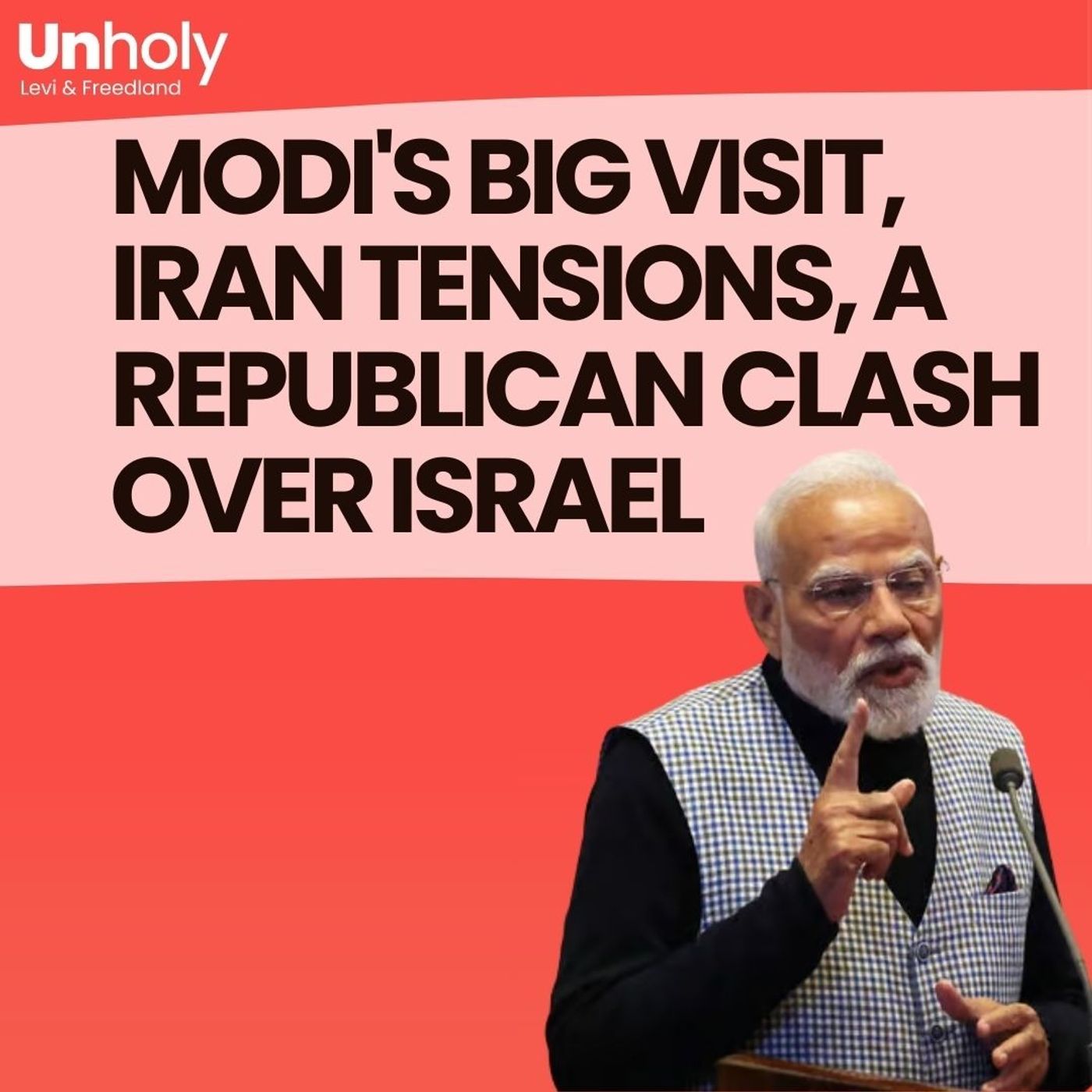
Unholy: Two Jews on the News
Modi's Big Visit, Iran Tensions and a Republican Clash over Israel - with Matti Friedman and Alon Ushpiz
00:44:59
As the US–Iran talks in Geneva keep the region on edge, Yonit is joined by journalist Matti Friedman, to make sense of Israel’s uneasy calm — daily life continuing under the knowledge that everything could change in minutes. They reflect on Purim anxiety, old antisemitic tropes resurfacing, and Narendra Modi’s unusually warm visit to Israel, set against Knesset infighting. They also dive deep into the evolving India–Israel relationship with former ambassador Alon Ushpiz: affection, technology, security interests, and how much (or little) Islam really drives the alignment. Plus: the backlash to Hugh Laurie’s mourning of Tehran producer Dana Eden, a Chutzpah award for Tucker Carlson and Mike Huckabee, and a Mensch salute to Israel’s women’s hockey team.
Loading summary
Transcript74 lines
- [00:03]
A
It was kind of a snapshot of discourse circa 2026. It's a time when our deepest thoughts and issues affecting humanity are being adjudicated in 280 character tweets, and people's random comments are being seized upon as proof of their innate evil. And it's unfortunately just a staple of the way people have come to communicate in the age of social media.
- [00:38]
B
It's unholy. I'm Unique Levy in Tel Aviv. Jonathan Friedland is in Australia, New Zealand. I won't lie to you. I thought it could be nice for a few days having the virtual house all to myself and I could crank up Taylor Swift. But now it's gotten a bit lonely and I needed someone to talk to. So Matty Friedman, journalist, acclaimed author, dear friend, is joining me this week. Hi, Mati.
- [00:58]
A
Hi, Onit.
- [00:58]
B
This is true friendship. I called you up, I said I needed help. You came. I mean, I think in a year from now, it's going to be my AI agent calling your AI agent. But for now, we're both here for real. And Mati is, of course, the voice you heard at the top of the show. We're going to be talking about Iran, we're going to be talking India and Hugh Laurie. It's going to be very interesting. I always wanted to talk about Indiana Unholy. So this is going to be a good opportunity. And, and what do you feel? What is the mood? I mean, I kind of feel like everyone is on edge, kind of still waiting for Donald Trump's decision.
- [01:32]
A
I think Israelis are in a really strange headspace right now. I mean, we're kind of planning our weekend as if everything is normal and, you know, kids are in school and the country feels more or less like it usually feels. And yet we know that within five minutes we could all be in our safe rooms for the next month. It's a moment of. I think it's an intensely confusing moment, which you could miss if you're an external observer, because, honestly, honestly, the country looks basically normal. But I think people under. Are under some serious mental strain.
- [02:01]
B
It is so strange because first of all, this kind of heightened sense of alertness has been going on for a pretty long time. It's about a month and a half since January 11th when Trump said to the Iranian people, help is on the way. And of course, we as Israelis immediately translated that to mean Trump is going to attack Iran, Iran is going to attack Israel. So everyone is, since then, kind of in a. In a holding pattern. And when you think of, you know, purim is next week. And usually the sort of concern here in this country is, oh, kids are gonna wear their costumes and it's gonna rain now. It's like kids are gonna wear their costume. Is it gonna, you know, rain ballistic missiles on them? It's very strange. I had a friend of mine telling me this this week that her daughter asked her if, if there's gonna be another siren vacation soon in Purim. And just to pause on that for a moment and explain what that means. Right. You know, during these kind of very strenuous two years, tense times and there were moments where I think particularly the parents to small children, Right. Need to sugarcoat it for them and what is going on. So the good side is you're not going to school, but there is a war going on. So that kind of translated for this family, for that term, you know, a siren vacation. It's not really worse. Sure.
- [03:09]
A
My 9 year old is also lobbying for the war because for him it means that he doesn't have to go to school and he can hang out with his family at home, you know, indefinitely. And I sometimes, you know, I think that it's just terrible to grow up that way. And I, on better days, I try to convince myself that that's a success as a parent, that he experienced the last two and a half years and particularly the, the rounds of Iranian ballistic missiles as something generally positive, meaning that we managed to buffer him to such an extent that he can convince himself that actually this is something that in his own nine year old eyes is actually better than the alternative, which is having to wake up.
- [03:48]
B
Normality.
- [03:48]
A
Yeah, go to, go to class.
- [03:50]
B
I mean, well, I did mention Purim, this favorite holiday in this household for sure, but I, I got myself kind of thinking the 2,500 years and yet again we're embroiled with the Persian Empire. I mean, how do we keep doing that? I don't know. But to be serious, I mean, when we think of this week, again, we are here, we're talking on Thursday. Thursday seems to be that moment where there's yet another crucial meeting between the Foreign Minister of Iran and the top advisers of President Trump, Kushner and Witkoff and to see if there is any way to arrive at a deal. What is new this week is of course the President of the United States and his state, State of the Union speech, speaking for 107 minutes. So not a Gettysburg Address style speech, rather longer, out of that three minutes were dedicated to Iran. But importantly, I think for the first time it sounded like The President was trying to prepare the American public for at least the reasoning behind this kind of attack. If it does happen, it's still an if.
- [04:48]
A
This speech was better than the Gettysburg Address. It was the greatest speech of all time delivered by the greatest president of all time. Of course, no one even remembers the Gettysburg Address anymore. But I wanted to go back to something you said at the beginning, which is interesting, that Purim. Every year at Purim, there's something with Iran, and people point out that it's just an amazing thing that we're still having these problems with the Persian Empire. And I go back to the Book of Esther, and there are passages in the Book of Esther that seem drawn from current events, but it actually doesn't relate to Israel's conflict with this current iteration of the Persian Empire, which is the Islamic Republic in Iran. It's. It's more about this state or the situation or the plight of Jews in big parts of the Diaspora. So there's this passage in Esther where Haman, who's the evil vizier, he's the villain in the story, he says to the king, he says in Hebrew, he says. He says, there's a certain people. This is Haman talking to the king. He's plotting against the Jews. And he says, there's a certain people dispersed among the peoples in all the provinces of your kingdom who keep themselves separate. Their customs or laws are different from those of all other people, and they do not obey the king's laws. And that seems drawn from Twitter. I mean, it seems drawn from the deranged TV programs of Tucker Carlson. I mean, we're literally hearing that frequency right now, this idea that there are people who seem like everyone else and they live in your country and they have the same rights as everyone else, but they keep themselves separate. They answer to a different set of laws. They're involved in some kind of conspiracy against the majority. So that's not the problem we face with Iran. This is a problem that I think increasingly faces a Jew living in New York or in Paris or in London.
- [06:49]
B
It just means that 2,500 years have passed, but we're still dealing with the same kind of insidious thoughts. And we have a land, right? We have a state, but it's still that. It's still that kind of incitement against the Jewish people. Let's just remind the story of Purim is that the good guys won, right?
- [07:09]
A
So that's in a very politically incorrect and gory way that puts Game of Thrones to shame.
- [07:17]
B
I knew you'd remind us of that. I knew I could trust you. Moving forward hundreds of years as we sit here now, I do think that the kind of one of the more interesting notes on where we are right now with the sort of that triangle of Tehran, Jerusalem and Washington is that if we have that perspective of a month and a half, it looks like what what happened in the beginning is that Donald Trump was quite gung ho about some sort of attack. And we know and this has been published, there are certain countries, including Israel, that tried to convince him to press the brakes. The logic then of the Israeli prime minister was to say, let's, you know, perhaps a bigger operation is needed. And if a bigger operation against Iran and particularly the Iranian regime is needed, then we, Israel, need to be better prepared. And what happened now after a month and a half is the tables have turned and Israel thinks it is pretty well prepared. But now it looks a little bit like Trump has gotten cold feet. We still don't know what the president will decide, but just logic and the two things that are pulling in different directions. And again, all of us remember how in Covid, suddenly everyone became this expert for pandemics and viruses, right? Oh, it's the rna, you know, and everyone is here in this country has become this expert on F22 planes. And I know more about the USS Gerald Ford than I ever wanted to. But the point is that a lot
- [08:35]
A
of Gerald Ford is getting a lot of attention. I'd like to get a lot of attention.
- [08:39]
B
Did you also think about why does this president get the best, best aircraft carrier?
- [08:44]
A
I think it's the biggest chip because I've been tracking the USS Delbert D. Black. That's the one to really keep an eye on. And of course, there's also the USS Michael Murphy and the Frank E. Peterson Jr. Another destroyer, which is those who really know those are the ships they're looking at. So everyone is a geopolitical and military expert and everyone knows exactly what's going on and when this thing is going to, to happen.
- [09:09]
B
And me, you pull in both directions. One side you say, you can't pile up this kind of armada and not use it. On the other side you say, well, if someone wants to use it, right, he would have done it by now. So it really is the situation. Again, as we sit here on Thursday, we have no idea, as you said, in five minutes we might be in a safe room. Actually, Narendra Modi is here, so I would imagine that wouldn't happen while he's here. But just in the sense of it can happen very, very soon or not happen at all. So we are really in the same place. The Groundhog Day. On the one hand, we're still playing out the story of someone being against the Jewish people and also playing out the story of we don't know what's going to happen with Iran. I like this segue because it's geographically. It's neat as well because you have to go through Iran to get to India. So we went through Iran and we want to talk about India, which doesn't happen a lot on this show. So I'm pretty happy about that.
- [09:58]
A
If I were to India, I would probably. I would go around Iran.
- [10:02]
B
Yeah, see, now we're just being petty.
- [10:04]
A
Personal choice.
- [10:05]
B
At the moment, I'm just being petty. But when there's peace with Iran, you could go through Iran to get to India.
- [10:10]
A
That would be wonderful. I'm waiting for that time.
- [10:12]
B
So we want to talk about the historic visit of Narendra Modi, the Indian Prime Minister here in Israel. Just to say this was before we get to the ceremony and celebration and how warm this visit is, the Israeli Knesset not having its greatest moment when he came.
- [10:30]
A
So our internal political divisions are this all consuming national sport and even an incredibly important diplomatic moment for Israel, and one that was truly moving, was swallowed up by infighting about issues that might seem to external observers of Israel to be quite small, but to people here seem quite big. The speaker of the Knesset refused to invite the Chief justice of the Supreme Court to Modi's speech as required by protocol as part of this endless fight between this governing coalition and the court system in Israel. And as a result, the opposition said they would be boycotting at least part of the ceremony at which Modi would be greeted at the Knesset. They ended up walking out of a few speeches and coming back for Modi's speech. But it was an unfortunate demonstration that even at a moment when we should all be happy that the leader of one of the world's biggest democracy, India, is here and saying incredibly warm things about Israel, we should be able to overcome our petty divisions, and yet we are unable to do so. And it's a real. It's a. It's a symptom of the very dark moment we're at internally as we kind of emerge from this war, at least I hope and look ahead toward an election on which a lot is riding.
- [11:48]
B
Yeah, so that was definitely the Israeli Parliament airing its early laundry outside. But let us talk about the importance and the celebratory mood that Prime Minister Narendra Modi brought with him, we should say the Israeli Indian relationship, perhaps sometimes in the sort of public discussion is marginalized and doesn't feel like the most important geopolitical or strategic relationship. But actually, first of all, it is and can be very important. And maybe this is a place we can look at with some sort of optimism.
- [12:23]
A
We can try it if you want to just put a bit of humor in it. We can say that when Israelis think about India, I think generally what they think about is their post army backpacking trip. And when we think about Israel, India, economic relations, I tend to think about the amount of drugs that Israelis buy and go up. But the story is of course, much deeper and much older and much more important. And unlike so many of the topics that we end up discussing here, there's a real possibility for, for something big to change for the better.
- [12:53]
B
So let's hear the conversation we did with one of Israel's ambassadors to India. Alon Ushpis is an Israeli diplomat. He was the Israeli Ambassador to India between 2011-2014 and served as the Director General of the Foreign Ministry from 2020 to 2023. Ambassador, thank you for talking to us today.
- [13:16]
C
It's my pleasure. Thanks for having me.
- [13:18]
B
We heard a very warm, supportive speech from Narendra Modi in the Knesset. He said, I'm Israel Chai. He says his country stands with Israel now and in the future. What kind of. When I think of that, I think this is a kind of speech that Israel really hasn't heard from its traditional Western allies in a very long time. What is the significance of his coming here now, or to be put this kind of bluntly in Israeli. What's in it for him?
- [13:45]
C
Well, to begin with, it's not typical Western style speech because India is not a typical Western, obviously not a typical Western state. Modi obviously is not a typical Western politician. I think in the case of the Indian Prime Minister, this really starts from two things. I would even say free. I think there is an emotional affection. I think he simply likes us. It's a rare commodity nowadays, but it was also a rare commodity in India during most of the years of our diplomatic relations. We had quite a rich relationship with India, but I have to admit that most of the years it was under the table, very quiet and behind closed doors and curtains. He basically took, I think, a strategic decision to put all the things we had between us into light and upgrade them. The second point is that I think, and this came up very prominently from the very first minutes of my first meeting with him in Gujarat. He strongly believes in economic development for all Indians through technology. And in this case I think he finds Israel as a strong strategic partner and this goes way beyond one or two fields. It's like a philosophy and a strategic perception. And the last thing is that I think he truly and strongly believes in personal relationship. And in the Israeli case it's very outstanding because Prime Minister Modi had a couple of rough years before he came to Prime Minister and there were very few countries that not only appreciated him but hugged him in the warmest way possible. Israel was one of the few and I know for sure that he remembers it very vividly now. What's in it for him? I would say economic development for technology, security and defense, agriculture and water and the new front lines of technology. I'm speaking mainly about deep tech, quantum AI, cyber, maybe even space. I hope so very much. And on top of this, I think he sees his security regional arena in a very realistic way and sees Israel as a partner.
- [16:35]
A
Alon going a bit further back in history, Ben Gurion loved Gandhi and he had a picture of Gandhi in his bedroom. As far as I know there was no picture of Herzl in Ben Gurion's bedroom. There was only a picture of Gandhi. And he had a great admiration for Nehru, he had a great admiration for the great Indian statesman Nehru. And Ben Gurion was convinced that these two stories had a lot in common. These are two kind of post colonial entities. India achieves independence in 47 and we do in 1948 and were both rooted in ancient cultures but becoming secular democracies and emerging into the, into the modern age. And he wrote letters to Nehru and his love was almost completely unreciprocated. So India kind of grudgingly acknowledges that Israel exists but incredibly doesn't establish full diplomatic relations with Israel until 1992. So there's this kind of disappointed unrequited love. Unrequited love, exactly. That was the term that I was looking for from, from Ben Gurion toward India. So how do we go from that to the incredibly warm speech that we heard in the Knesset this week?
- [17:47]
C
It's a great question and probably quite a complicated answer. Let me start by saying that one of the most mind boggling papers I've ever seen is the exchange of letters between Ben Gurion and Nehru. I think it's from, if I'm not mistaken, it's 51, but I might be wrong with a year or two. And what's mind boggling about the specific letters I'm speaking about is that Nero asks for aid in food, which is a big thing in India. It's, I mean, in brackets, you, if you are the leader of a country, it has to provide food for, let's say, 1.46 billion people. That's a very heavy burden. It's really, it's something that sits on you quite dramatically. And in his response to Nehru, Ben Gurion writes that we are a small country and obviously we cannot provide grains and staples and other food products like this, but we have the technology and the training and we will be more than happy to cooperate with India in this field of agriculture. And I think it's said it's mind boggling because these letters are from the beginning of the 50s and let's say about 40 years afterwards, the Israeli apparatus, embassies, ministries, together with the Indian system. And the Indian system is a very shallow title to what it really represents. That's a real system. It's hundreds of thousands of people took these letters and translated it into reality. Now, how did we mind the gap between these letters and let's say, the 90s? I think there is, there is an emotional foundation for what's going on between Indians and Israelis. It's not a coincidence that tens of thousands of Israelis go every year to India. It shows something very deep. And it's not a coincidence that in most cases, these Indians receive these Israelis with open arms and very warm hearts. I think that at the center of this, there is this a, the feeling that both Indians and Israelis tend vis a vis something that is very occasionally very big and threatening. There is, and I think that's very prominent, there is, I think, a strong, very strong common denominator of a hunger to survive. Israelis as a nation and Indians as individuals to survive and prosper. And it is something that is shared by the billionaires living in the penthouses in the side scrappers in Bombay and the people who sell tea in the train station. Obviously defense and tourism, it's a big thing that occupies the minds and hearts of both nations. Last but not least, Indians are very, very practical people. And even in the days in which we were behind the curtain, there was a very solid recognition in India that there are things that we can do together. And for their reasons, they will not put it on up front on the stage, but they will do, or used to do very good business with us. So the combination of, I would say, some kind of an emotional attachment, a very strong hunger to survive and prosper, terrorism and threats, other threats, and the ability to do stuff together.
- [21:36]
A
There's a word that's missing here and I'm just going to suggest what it is and you can tell me I'm wrong. Is the word Islam is the dark matter kind of floating around this discussion of what's bringing Indians and Israelis increasingly together? Is it or isn't it Islam?
- [21:50]
C
There is part of it, but I've been doing India for, let's say something like 15 years, and I worked through different Israeli governments and through different Indian governments. Yes, there are segments in India and also in Israel that see this as a major phenomenon. But if that was the only major phenomenon or if that was the main shifting, I think relations or the DNA of relations would have changed when government shift. And may I remind you that during most of the modern India history, government was Congress government, Congress party government. And. And you can say a lot of things, but one of the things you cannot say is that they were the congress governments were anti Islam. I won't deny the fact that when you walk into certain rooms in different big cities in, in India, you might hear these things, but I don't think it's the one. The number one chieftain. I think the number one chieftain is the hunger to survive and prosper mainly through technology.
- [22:57]
B
Yeah, there's something common in our DNA. But I have to ask, since Mati did say Islam, I mean, we have to mention that Modi himself has a Hindu nationalist agenda. Part of his base definitely are blunt with anti Islam Hughes. In the past, he was shunned from the United States. He didn't receive a visa for a decade. He was denied because of severe violations of religious freedoms, his warm hug to Israel and vis a vis the Muslim community in this country. We should say that's 204 million Muslims. Does he come to Israel in spite of that community or to spite that community?
- [23:33]
C
No, I don't think he comes to spite that community. And actually, one can look at it from a wider perspective and for example, dive into his very prosperous relations with the uae, Saudi Arabia and many other Gulf countries. I really think that he comes here because of affection, his long memory of a long friendship that you've also alluded to and the fact that he believes that he can do a lot of good things together with us for the good of Indians. I don't think it's about Zionism. This is about two countries very different from each other in some aspects that got to the conclusion that we can do some really nice stuff together and we have a record. So it's not. It's not something that we have to prove now. We have a record, by the way, as we speak. I think a couple of minutes ago, the Prime Minister of India and Israel gave their speeches and signed, I think it's something like 15 papers, official papers, agreements and memorandum of understandings in different fields. And that's exactly a continuation of what I've said. These things are very practical.
- [24:51]
A
I found myself very moved by his speech. I thought it was perhaps in this moment of isolation when we're not used to hearing major world leaders in our own parliament saying, we're with you now, we'll be with you in the future. Am Israel Chai. I mean, it meant something to me and I think it meant something to a lot of Israelis beyond all of the political, political divisions which were on display in the Knesset literally as Modi was speaking. And he spoke about shared culture. He spoke about the Jews of Kuching, and he spoke about the Jews, the Bene Israel Jews. And he spoke about the famous Indian Jewish general JFR Jacobs, who's an incredible figure and he got name checked in the speech. And I want to ask you as
- [25:30]
C
someone I had the privilege of sitting with General Jacob many times. Oh, wow.
- [25:34]
A
He died.
- [25:36]
C
I know very few. He passed away a couple of years ago. But when I was in Basel, he was still very much live and kicking king, a very strong man. What was amazing about General Jacob is that now, through my 30 years of service in the Israeli Foreign Ministry, I met a lot of very interesting people, including Israelis. But I don't think I've ever met a man, a general, that through his own military action, established a state, Bangladesh. And that's something. It puts you on a different pedestal in the annals of international relations.
- [26:16]
A
Just for listeners who might not be familiar with the story, one of the great Indian military heroes, this is in the early 1970s. The general who ends up creating Bangladesh was a Jew. It's a wild story, and I recommend diving into it. But I wanted to ask you just about your own time in India, just spending time in what is certainly one of the most fascinating countries in the world. When you spoke to Indians on the street or when you met people outside of the diplomatic core and outside of the circles of intellectuals that you obviously interact with as an ambassador. What do people think about Israel? How did they see Israel? Have they even heard of Israel?
- [26:48]
C
Let me first say something. When you look at these relationships, I don't think it's less than America because you are speaking about a very small country and the other countries, as I said, 1.4, 6 billion people.
- [27:01]
A
It's like that joke that says why, why is the India Israel relationship so powerful? Because together we're more than a billion.
- [27:07]
C
I was, I was always wondering when Israelis told this joke whether the Indians really laugh or they are just polite. I think most Indians, I would say, like us. Some of them love us, some of them think that this relationship will bring about something which is very good for, for their daily life. In our best moments in India, it's very cold blooded realism. What I'm going to say now, but our best moments in India is that when we are very powerful, very successful, whenever we will be perceived like slightly less powerful and successful, then it is when the Israeli ambassador really has to start sweating and, and working the corridors of them.
- [28:01]
B
Let's be very optimistic and think this relationship just, you know, gets stronger and better and warmer. Could you then organize the kind of axis this, what should we call it, an Asian axis for us like on the one side, Israel and India on the other side, what would you put there? Turkey, Qatar, maybe China? I mean how can we look at that kind of balance?
- [28:25]
C
First of all, I think your axis like, or semi regional like perspective is an indispensable one because of the simple fact that we need it. We need to go beyond our boundaries and we need to go beyond our, I would even say classic old fashioned priorities in foreign policy and economy. And the Indians definitely need it. Now there is one additional actor that a needs it. And even if they, even if not all of them think they need it, I think they look at it in a, in a very positive way and that's the Americans. But going back to the set of priorities, it's, I think it's very obvious that the economically and security line, I'm putting now the US aside because that's the eternal most stable, most stable strategic partner. But if, if you look at the rest of the globe, I think it's very obvious that we have to start looking slightly more to the east. I would say some of the Sunni countries in the Middle east, definitely the Gulf and then to Asia. Asia is I think India, Japan, Singapore, Korea and some countries in Southeast Asia, like for example the Philippines and China. And if we take this perspective even without referring to, I would say to four countries like Qatar and Turkey and this can easily be upgraded in the next, or downgraded, it depends on your perspective or escalated in the next five years. Even without that, I think it's very clear that we have to look at the, and this region Gulf to the east that we have not. That was not on the same level as the US and Europe in the last 20 years.
- [30:22]
B
I mean, that's fascinating. Again, if we're optimistic about this, we
- [30:26]
C
have to do things proactively in order to be able to materialize this in the current political environment. I think that this will take some time.
- [30:38]
B
Ambassador Alon Ushpis, you made us smarter. We really thank you for this conversation today.
- [30:44]
C
That's the best compliment I've ever got. Thank you. My mother will be proud.
- [30:48]
B
Please do tell her. Thank you so much.
- [30:51]
C
Thank you.
- [30:56]
B
That was fascinating. There was a Jewish Indian general who created Bangladesh. This is what I'm taking with me for, for the weekend. This is an amazing story.
- [31:06]
A
There are many amazing stories in the very kind of deepened, twisting basements of the, the Israel, India story. Another one, by the way, is that one of the people who drafted the Pakistani constitution was a Jew who converted to Islam. There's no, there's no end to these stories. So I guess we'll have to do it on a different episode of Dedicate
- [31:31]
B
another episode to this. We are arriving at our awards here. Ma on the show soon. Soon we'll talk. We will dole out our chutzpah award of the week and our mensch award. I want to talk about another story and I'm deliberately not putting it into any category. I just wanted to talk about this with you. I wondered what you thought. And the story is the Hugh Laurie story. To anyone not familiar. Let's kind of remind our listeners it started with a tragedy. It's the death of Dana Eddin, one of the producers of Tehran. By all accounts, a very talented, special woman, a MOT of three. She died in Greece on 17 February. And Hugh Laurie posted this on X. He wrote Dana Edin, who co created and produced Tehran, the series Tehran, died on Sunday seemingly by her own hand. It's a terrible thing. She was brilliant and funny and an exceptional leader. Love and condolences to all who knew her. What happened after this very beautiful note by Hugh Laurie is that he was hit by a barrage of hate because I assume some people's heart is so dark that they think you can't mourn a friend if that friend comes from the wrong nationality. In their eyes, of course, she was an Israeli. Three days later, Hugh Laurie tweets this. He says, nothing I have ever said or done could lead a sane person to believe I am a Zionist. However, if someone exalts in the death of a friend of mine, yes, I will block them. If you wouldn't do the same in my position. You can f off too. End quote. Now then he was hit, of course, by a barrage from the other side. Why must you distance yourself so strongly from the ideas that Jews have right to self determination. I. I want to hear your thoughts on this because I have to say, look, I was insulted by the second tweet, right? I mean, I kind of feel like us Israelis, we have this definitely in the past two or three years. We're back to our manufacturer settings, like the default setting needs to be on insults. I didn't like reading it, but I kind of asked myself, does everyone have to be a Zionist? We have to kind of sit with a. A chalkboard and kind of say, did you say you're a Zionist today? I don't know. I think the bar is a little lower than that. We hope people will think that Israel needs to exist and that people know who the bad guys are. October 7th were. But to demand everyone become a Zionist makes you very busy with things that are not necessarily helpful. This is my opinion. Perhaps I'm wrong, but what did you make of all of this, Mati?
- [33:56]
A
It was kind of a snapshot of discourse circa 2026, which is. It's a time when our deepest thoughts and issues affecting humanity are being adjudicated in 280 character tweets, and people's random comments are being seized upon as proof of their innate evil. And it's unfortunately just a staple of the way people have come to communicate in the age of social media. What I thought when I saw that tweet, which of course begins with a beautiful tribute to a friend who was by all accounts an amazing and talented producer who died while shooting a new season of Tehran that ends up being this kerfuffle about Zionism. Because he wants to make sure everyone understands that he's mourning his friend. But he's not a Zionist. Now, to me, Zionist is just means my right to have a home. Like French people have a right to have a home, and Polish people have a right to have a home. And having someone say, you don't deserve that, it hurts. Now, it's almost. I'm certain that that is not what he meant. Not everyone was measuring that.
- [35:06]
B
It doesn't sound like that's what he meant, but just the kind of indication of how society looks at that term, which is sad, but right.
- [35:12]
A
The word Zionism has become radioactive. I mean, there was a poll that came out a few weeks ago, and I'm not remembering the numbers exactly, but it was a poll of American Jews. And they found that more than two thirds of American Jews say Israel is very important to them, but only around one third refer to themselves at the moment as Zionists. And my guess is that the term Zionism has been rendered so negative that even people who are sympathetic to Israel don't want to be associated with it. The word Zionism means that the Jews should have a country. I think it's very difficult to look at the history of the 20th century and maybe all of the centuries that have elapsed in the last two millennia and reach a different conclusion. So what used to be quite an accepted idea 20 or 30 years ago or in the years that have followed the Second World War has become something, you know, very, very thorny. And, you know, there's this famous resolution that's passed in the mid-70s that declares the United nations that Zionism is racism, that Zionism is a form of racism. And. And this idea is still kicking around. In fact, it's maybe more prevalent at the moment than it has been at any time since the moment when that resolution was passed. And you can kind of see that floating in the air around this unfortunate series of tweets by an actor and why we're all looking to celebrities to help us understand our geopolitical allegiances. It's probably the wrong place to look, you think?
- [36:38]
B
I just, you know, first of all, what. What worries me is that people will stop talking at all or, you know, not want to even mention Israel just because they're afraid of any sort of, you know, backlash. This is pretty insane. He just wanted to write about his friend who died, and he was sad about it. He wanted to, you know, pay tribute to her. So this created this situation, which you can't really say anything. You're going to be hit from one side or hit from the other side. And, yeah, to me, it just sounded very, very sad. I must admit that I to hear your thoughts because I feared that my judgments would be blurred by the fact that I grew up watching a bit of Fry and Laurie on BBC prime long before the whole world discovered him on Dr. House on House, which is a wonderful series. So I didn't know if my vision was blurred because of that, but I see that we're kind of in agreement, so I feel better about myself. So let's move to the very clear chutzpah Award nominees this week. Joint recipients. I would suggest an interview that tucked Tucker Carlson, who can get the chutzpah word every week, really did, with Ambassador Mike Huckabee. He did it in Israel. He did it in the Ben Gurion. By the way, we have talked about Ben Gurion a lot. But now, I mean, the airport, he didn't want to. He didn't go into actual Israel. He was doing this interview in, in the airport. And at the end of it, both of them had to clarify their statements, thus proving the adage by Ariel Sharon, no one ever regretted not giving an interview. So Tucker Carlson had to apologize for saying that President Herzog was on Jeffrey Epstein's island, when in fact, he was not. Ambassador Huckabee said in an interview that Israel has a biblical or divine right to control the land from the Nile to the Euphrates. He had to walk that back. But that was an interview that both of them had to explain after. To me, I think what was interesting there were the fault lines, minds of the Republican Party very, very clear on the Israeli issue. Pretty scary when you think about particularly Tucker Carlson's opinions, but just that kind of. To look at the Republican Party 2026 and what they think, the very different views on, on Israel and the support of Israel.
- [38:50]
A
What you were saying in our, in our previous discussion about tweets from Hugh Laurie, it's. It's almost impossible to have a sane discussion about Israel and Israel's real dilemmas. And when I was forced to watch highlights from that interview.
- [39:03]
B
Forced? Because I forced you. Is that what you're. You're hiding in that, saying the word forced?
- [39:07]
A
Let's just say I was forced and not attribute that to any particular person who may or may not be on this call right now. I, you know, it's, it's. What's really striking is that the conversation is an American conversation. So these two guys are discussing Israel or seemingly discussing Israel, which is the country where we both live. It has nothing to do with Israel. So talk about. Carlson is coming at this with these very conspiratorial ideas about Jews not really being the Jews. And they say they're this, but we should give them a DNA test to make sure that they really are. And Mike Huckabee is coming at this from a very theological direction. I mean, he's a pastor. He's a really nice guy, but he's a pastor. It's kind of strange to find him in a diplomatic role because there is a real tension between the role of a communal or congregational religious leader and the role of a diplomat. So he's trying to explain why he thinks the Jews have a right to Israel. And he says basically, God gave it to The Jews. And what he means by it is essentially most of the Middle east, from the Nile to the Euphrates, which is one of the arrangements cited in the Bible. Of course, the actual area of Jewish control changes dramatically over the centuries. But then they have this deranged discussion about it, and it has absolutely nothing to do with the modern state of Israel in 2026, which has a real long over the long list of problems that we need to deal with. And so much of the discussion is just. It's ideology, it's theology, it's rage that has nothing to do with us, but is being directed at us. And I think that there is a line that links the kind of insane discourse around those Hugh Laurie tweets to the insane discourse around this interview and indeed to the insanity of this interview, which illustrates a real problem that I. I've had often, as someone who writes about Israel in English for audiences abroad, which is that it's very, very difficult to describe the actual country of Israel, which is a very, very small place. 10 million people live here. It's 1/100th of 1% of the world's surface. And we have, you know, the usual package of human problems. We have bad governance, we have corruption, we have racism. And we need to figure out our own problems just like everyone else. And it's much harder to address those problems when everyone is speaking in these cosmic terms.
- [41:25]
B
It's definitely a conversation that's not. They're not talking with us. They're either talking about us or at us. It's a very Christian conversation. And when you think about earthly figures. Right. I mean, the fact that Carlson is talking about Netanyahu and his, you know, hold over Trump and why did he meet him seven times? You know, this is, again, a. A very important part of the Republican Party that doesn't like the relationship and doesn't like the fact that it looks to them like Netanyahu is at this point in time pulling Trump into a war with Iran. And that is a voice that he is listening. That's a voice in his ear. And I think it's really important. And when we think of, you know, the bipartisan relationship and the future, and a lot of, I think many years Israelis were worried about what was going on in the Democratic Party. This is really worrying when you look at it, particularly Tucker Carlson's views, I think think we perhaps should land on the Mench Award, which is always a good place to. To end our conversation at.
- [42:26]
A
Absolutely.
- [42:27]
B
And I'm looking at you because you have to bring Some sort of sprinkle of optimism here.
- [42:31]
A
Well, being. Being Canadian and I, I feel like I've been asked to step into the shoes of an Englishman because a Canadian is kind of as close to an Englishman that you could find. We're kind of off, off brand Englishmen.
- [42:43]
B
Please don't tell our secrets to our listeners.
- [42:46]
A
I will bring some of my own national heritage here. And I would like to nominate the Israeli women's hockey team, which is a very impressive group of women who should be getting more attention than they have been getting. They did really well last year at the World Championships. They came in second place in their category, which is admittedly not the top category, and yet they're playing against really good teams. And Israel's women's team came in second place in the World Championship last year and is about to leave. I believe it's tomorrow go to this year's World Championships in Estonia where they have a shot, or at least feel they have a real shot at taking first place and then advancing into a higher category of competition. So in a week where there was a lot of discussion of hockey because of the Olympics and there was a tremendous game between Canada and the United States, which was won by the Americans, I think we should nominate Israel's women's hockey team for the mentor. All of them. I don't know if a woman can be a mensch, just technically in terms of Yiddish.
- [43:49]
B
He made a teddy bear a mensch once. And of course, a woman can be a mensch or a menchette. Is that what you prefer?
- [43:54]
A
What I'm saying is that the word might not be mensch. I'm just not sure. I don't. I don't know the edition. We should probably find out next time.
- [44:00]
B
I'll write down the criticism. Mati. I did, and I love the fact that the. The Canadian picked a hockey team for the cliche. The beauty of the cliche in the Canadian picking the hockey team as a story. I think it's perfect.
- [44:12]
A
So whether, whether you are menches or not menches, we wish you the best of luck in. In Estonia. Kick ass.
- [44:19]
B
Exactly. We are keeping our fingers and our toes crossed and we will say a very big thank you to our mensch of the week, Mati Friedman, for stepping up and co hosting this episode of Unholy with Me. Mati, thank you so much. And a huge thank you to Michal Porat, as usual. By the way, we have a bonus episode up for subscribers in which Matti and I talk about the divide between Mizrahi Jews and Ashkenazi Jews, a very important line in the Israeli society and I think a key to deciphering the society as a whole. But we will say our thank yous for now. And Stacey, thanks so much for having me.