← Unholy: Two Jews on the News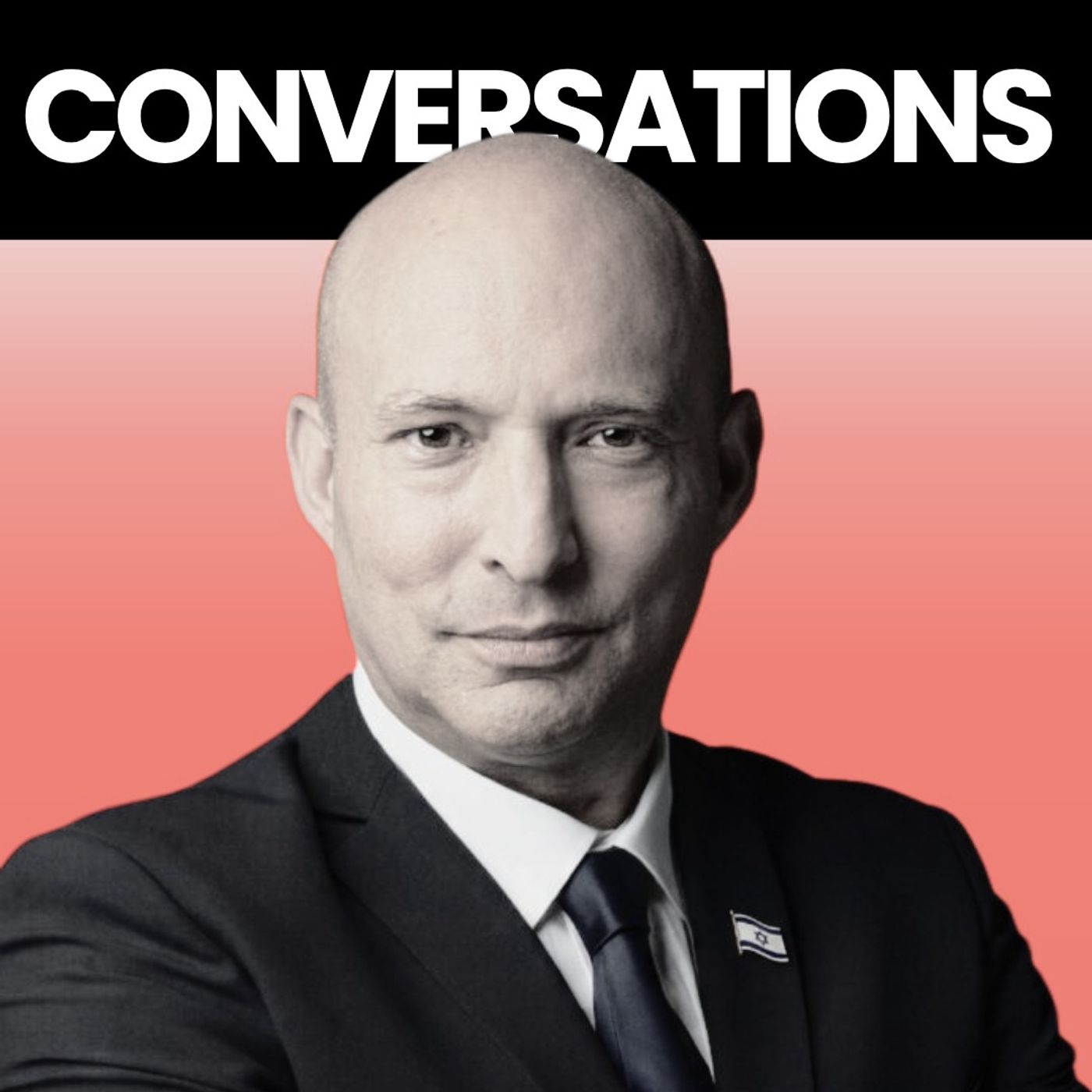
Unholy: Two Jews on the News
Naftali Bennett
00:54:58
Israel just learned that the US and Iran have agreed to a deconfliction cell with Lebanon — and Israel wasn't in the room. As the dust settles on a war whose outcome is, at best, ambiguous, Yonit and Jonathan sit down with former Prime Minister Naftali Bennett, who wants his old job back. Bennett doesn't hold back: on why he believes this government dragged out a war Israel was never built to fight, on the "infinite power of propaganda" keeping Netanyahu afloat three years after October 7th, and on whether he can trust Trump — or JD Vance — to look out for Israel's interests when Israel isn't at the table. He also lays out, in detail, what he'd do differently on the Haredi draft, the judiciary, the Palestinians, and Ben Gvir and Smotrich — and admits the polls aren't moving the way he hoped.
Loading summary
Transcript56 lines
- [00:06]
Naftali Bennett
I think Israelis don't realize the full extent of our international position. It's looking really bad, almost wall to wall. And in America, we've totally lost the Democrats. The younger generation of Republicans are moving away from us. So, yes, we deeply appreciate President Trump, but we can't build Israel's entire future on the fact that there's a president who really likes us.
- [00:47]
Jonathan Friedland
It's unholy. I'm Jonathan Friedland in London.
- [00:51]
Yonit Levy
And I'm Unit Levy in Tel Aviv. Thrilled that Jonathan Friedland is back in London.
- [00:55]
Jonathan Friedland
Yes, I am. I'm back here. The vacation effect is already fading.
- [01:00]
Yonit Levy
Can I just ask, because I'm sure our listeners would wonder, I mean, you're right back from vacation. British prime minister quits. Coincidence?
- [01:09]
Jonathan Friedland
I don't think so. I knew you were going to say no. I managed to time this quite well. I feel quite journalistically, I feel quite sort of satisfied not to have missed this event. I was in position, ready for it. We knew it was coming. We're going to talk about it, I think quite a lot probably in our Thursday episode that drops on Friday, late Thursday, if you're in the US because it is obviously a huge story here. Maybe one of the things we can talk about is whether it matters outside Britain at all. I think in a way he was a victim of dynamics and processes that are at play across the democratic world. So I think that's perhaps of interest. But yes. So I'm tanned, rested and ready. And he now has the chance to get a good long rest. He waits for a successor to come in. But lots to say about K. Starmoo, I think.
- [02:06]
Yonit Levy
Indeed. And as you said, that will wait for our Thursday episode. In the meantime, someone who is a former prime minister and looking to be the next prime minister of Israel. And we sat for an in depth conversation with him.
- [02:20]
Jonathan Friedland
Yeah, this represents a bit of a departure for us. I mean, longtime listeners will have noticed that we don't often have politicians on the podcast. And we did have sort of an unspoken rule that no serving officials from organizations or politicians would be on, partly because, you know, you get to speak to a lot of them for your day job. And we wanted to do something different with Unholy. But Naftali Bennett comes in sort of under the wire because he is not at the moment a serving politician in the sense he's not in the Knesset and he's not a minister or he's not in the formal opposition. But he is obviously a declared candidate. But I think elections are looming. We don't know exactly when they're going to be. They're very likely in October. And one of the things we're going to try to do, I think on the podcast is hear a range of views from those people who are jockeying for position in the coming elections, whether the party leaders or senior figures in the various parties. That's something we've been wanting to do. So in a way, this conversation will get that ball rolling.
- [03:23]
Yonit Levy
Former prime minister of Israel and the man who hopes to hold that title again, leader of the Together Party in the coming elections, Naftali Bennett. Thank you very much for talking to us today on Unholy.
- [03:33]
Naftali Bennett
Great to be here. Yonit, Jonathan and all the audience.
- [03:37]
Yonit Levy
I want to begin with Iran. The memorandum of understanding already signed between Iran and the U.S. now we learn Tehran and Washington agree to set up a de confliction cell with Lebanon to resolve disputes. Israel is not privy to any of these discussions or deliberations. Would you agree with the former head of military intelligence, Tamil Hyman, who said about this agreement signed, if we had known it would end like this, he said it would have been better not to start this war at
- [04:05]
Naftali Bennett
Look, I would focus on two main items because it's a bit too early to tell, but there's things that we can do. The first is the Iran nuclear deal itself. And the second is the linkage with Lebanon and Hezbollah in terms of the Iran deal itself. Assuming America retains the leverage. It has considerable leverage. Yeah, it's opened the Straits of Hormuz. But the secondary sanctions, to the best of my knowledge, are in place and they are very, very tough sanctions that are hurting Iran. I believe America still holds tremendous leverage for the ultimate deal, and that's good news. But we need to ensure that we achieve the goals of the deal, primarily dismantling the nuclear program. And I believe that the United States currently views this MOU as a placeholder. So it's less about the details written in the MOU right now. It allows that negotiation that in itself is not a catastrophe. The second item is that we cannot afford any linkage between Iran and Hezbollah. We're fighting a war, a defensive war against Hezbollah. We can't have Iran play games with us and the world every time something happens in Lebanon. So that's something that we in Israel have to insist on. I think it's a bit too early to tell. I think we have to focus on keeping the leverage and not relieving those very, very devastating sanctions until we achieve the objectives of the deal.
- [05:55]
Jonathan Friedland
I think what most people looking at this Wall think is that Iran, if anything right now looks certainly not weaker, possibly even in a stronger position than it was at the start. It's got this economic super, you know, massive weapon of mass disruption in the form of the Straits of Hormuz and so on. And therefore they look to leaders to have foresight and to say, to repeat your needs question, given where we are, would you have seen that coming and therefore avoided this war? And if the answer to that is no, you would have gone into it. What would you have done sitting in the Prime Minister's chair to ensure a better outcome than the outcome that has happened, which has made by just a first blush Iran stronger and Israel in a worse position than it went in?
- [06:41]
Naftali Bennett
I would do everything different. You can isolate a moment in time. You have to take the broad view of things. First of all, I would not run a protracted, long dragged on war on all fronts. This is going on forever. This has never been Israel's strategy. Israel's strategy from our inception, because we're a small country, because we don't have a huge population, is to have short, intensive, strong and decisive wars. This new startup of just dragging on the war forever is wrong. And that is not something I would entertain. Secondly, the whole activity, the whole demeanor of this government is one that is massively destroying. And I'm talking about our own government destroying Israel's international standing. It's never been worse. For the first time in history, American public views Israel net negative in terms of favorability. This has never happened since our inception. Israel was always on the good side. And look, if you pay international public price for doing what you have to do, I support that because first and foremost we have to defend ourselves. But we are paying a huge price for infantile, stupid activities of ministers in our government. The latest is just from two or three days ago when Minister Ben GVIR tweeted some really stupid tweet brought Israel zero benefit, but presented Israel as if we support genocide. Obviously there's no genocide going on in Lebanon, there's a war going on. So my point is that we have a limited bucket of credit. If you waste that bucket of credit on stupidities, on domestic politics, then by the time you actually need the credit for the real things, you're out of credit. So I would do basically everything differently. One final thing is to fight a war you need soldiers. One of the reasons this is being dragged on so long is we're missing 20,000 soldiers. We don't have enough soldiers. You have to capture a certain position and then we Leave it. And then we have to recapture it time and again just because we don't have enough soldiers. But we could have enough soldiers. If the government drafted out of the 100,000 young ultra orthodox haredim, if it even drafted just 20,000, 20% of them, it would take five months to train them. We could have done this three years ago, but for political reasons, we're not doing it. So bottom line is the government's doing everything wrong on every dimension and that's how we got to where we are.
- [09:53]
Yonit Levy
We're going to get to the draft bill a little later on. In conversation, what I'm wondering is, you're saying I would not prolong these wars unnecessarily. Do you think that Netanyahu did that for political reasons on all fronts?
- [10:04]
Naftali Bennett
I can't get into his mind and I don't want to, by the way, I don't know. I do know that this has gone on forever and ever and it exhausts our economy, it exhausts our reservists. There's a whole generation of Israelis, 25 to 35 years old, that at the main years of building their careers, they're stuck. I'm not talking about the fact that they can die and unfortunately a lot of boys have died lately. But just everything's on hold in Israel and the public opinion can absorb a short, intensive war and move on. But the fact that day in, day out for three years, Israel's the headlines of the world. And we can talk about the world being unfair and anti Semitic and there is truth to that. But that's a fact. That's a constraint. That's reality. So the war is being dragged on. This is not how Israel ever conducted wars. It's wrong to do it this way. And it plays to our weaknesses instead of our strengths.
- [11:21]
Jonathan Friedland
The other big shift that people have obviously observed particularly visible with this memorandum of understanding is this gap opening up between Washington and the government of Israel and these decisions being taken that are either against Israel's direct interests or without Israel's input even. Do you, as a would be returning prime minister, feel that you can say you would trust Donald Trump to have Israel's best interests in mind when doing these negotiations with Iran when Israel is outside the room?
- [12:02]
Naftali Bennett
First of all, Donald Trump has been an amazing president to Israel from the outset. And when I look at Donald Trump, I don't start counting now. I look at his entire record of recognizing Jerusalem as our capital, moving the embassy, killing Soleimani. I was in the room in the Mossad, sitting next to the CIA liaison when we killed them, when they killed them, using our intelligence, attacking Iran and giving us our back. So first of all, the people of Israel owe huge gratitude to President Trump. Secondly, under no circumstances can Israel allow its fate to be determined when it's not at the table. We're an independent country, so it's not a good thing. And I would add the third point. President Trump is the President of the United States of America and he holds American national interests at the center, rightfully so. Now, by and large, in many, many cases, the interests align, but not always so. For example, Iran from an Israeli perspective is an existential threat. From an American perspective, it's a strategic threat. It's not existential. And America has many other considerations. So we have to ensure that our interests are taken care of. And the situation where we're not in the room is bad. It's wrong.
- [13:32]
Yonit Levy
Do you trust J.D. vance, the Vice president, to have Israel's best interests in mind when he is negotiating this deal? He said this week, trump is your only friend in the world.
- [13:41]
Naftali Bennett
He said to Israel, I think that's a testament to how bad our international position is. That is a reality when you hear Israel. I've not met J.D. vance. Clearly he also focuses on America's interest and certainly in general, I'd say there's a wind, a very strong wind in America of reminiscent, a bit of Pre World War II isolationism and America First. I'm not complaining about it. That's a reality. We have to act within this reality. I would say this Israel, if it wants to sustain long term future, a strong future, we have to look at the world. We can't just be focused inward. And there's a very interesting phenomenon. Israelis, while we view ourselves, you know, I grew up in high tech, et cetera, we view ourselves very connected to the world. I think at this point in time, I think Israelis don't realize the full extent of our international position. We are, it's looking really bad, almost wall to wall. And in America we've totally lost Democrats. The younger generation of Republicans are moving away from us. Generally, the younger generation tends to be more anti Israel or less favorable of Israel. This is not a good situation. So yes, we deeply appreciate President Trump, but even he will at some point end his term. We can't build Israel's entire future on the fact that there's a president who really likes us. We have to have a much more robust and sustainable strategy, which means we have to change everything. My plan if I become prime minister is to create a Israeli renaissance which starts domestically and it grows regionally and internationally. We're going to have to tell a whole new story of Israel. It's not going to be easy to fix the damage here. It's not going to be easy. It might take a generation, but we have to start doing it. And we can do it. We have to get in the field and fight the war of hearts and minds and not only the physical battle.
- [16:18]
Jonathan Friedland
I want to ask you about exactly that. But just before we leave the question about the Trump administration. It was reported by Channel 12, in fact, by political correspondent there definitely el that officials in the Trump administration are opening up channels, unofficial channels, to talk to you because you could be the replacement for Benjamin Netanyahu. Can you confirm that, whether you are talking, whether through back channels or intermediaries to the Trump White House?
- [16:49]
Naftali Bennett
Well, naturally, I'll never talk about what I'm doing or not doing in international or diplomatic channels. Obviously, across the board, regionally and internationally, I am doing everything possible to strengthen the foundations of Israel's diplomatic stance. So generally speaking, I will meet and talk to anyone who can influence Israel's interests.
- [17:20]
Jonathan Friedland
So we notice you're not denying that. So let's go to this international point which you made. Now, you've said a couple of times, even in this conversation that the remarks of the Ben Gvirs, and I think you imply the Smotriches of this world have done great damage to Israel's reputation. But I'm sure you know it's not just that. It's not only that. So plenty of observers around the world are assuming and hoping, I think it's fair to say that for a change, that if you were to win, there will be a change in your country. But they're not really sure what you would do differently. We understand you won't have Ben GVIR and Smotrich there saying things, crazy things on social media. Okay, we get that. But in terms of Israel's relations with its neighbors, the fundamental relationship, including with the Palestinians, they're not sure what you would do differently, apart from personal style from Prime Minister Netanyahu. So for people listening to this who think, I hope Bennett wins, I hope he becomes the new prime minister, but I'm not sure what he does differently. What's going to be the change?
- [18:27]
Naftali Bennett
Well, the whole atmosphere would be one of optimism and progress, you know, just doing good for everyone. I would envision my first month meeting everyone, meeting President Sisi, King Abdallah, Sheikh Mohammed bin Zayed and anyone in the region. None of those meetings took place since the start of this government. And I would set out a positive vision for Israel, for Israel and our immediate neighbors. Israel in the region, Israel in the world. Now I do want to set expectations. I'm tough and hawkish on Israel, so I don't want anyone to have the wrong impression. I would support a Palestinian state or steps towards that, because I don't. And I think that would be national suicide. But my point is that the big picture matters because, you know, I'm not a hidden person. Everyone saw me under magnifying glasses when I was prime minister and I stood on our national interests, yet at the same time dramatically progressed our regional position. We, you know, I think we broke a world record in signing a free trade agreement. The time it took, usually it takes like seven, eight years. I did it, we did it. Sheikh Mohammed bin Zayed and myself, we did it in weeks. And we opened up relations and strengthened with Egypt, with Jordan, real tangible things, and with the Palestinians as well. My stance vis a vis the Palestinians is the following. While I do not support land concessions in the Palestinian state, I don't view it as binary because I also oppose a two state. I oppose a two state solution, but I also oppose one state solution. I think both are a disaster. And I don't view the world as binary. Either it's two state or one state. I think that there's sort of a spectrum where you can change reality on ground in very tangible and meaningful ways without hurting Israel's security. And that's what I did. Let me tell you a story. When I became prime minister, I called in the guy who runs the cogat, Rahsaan Elian. I called him in. I know the guy from. For the past 32 years, we served together in officers course. And I said, listen, here's the deal. I'm not going to make concessions and I won't take risks on our security given those two constraints. I want you to come in, in a month from now with everything we can do to improve our relations with the Palestinians and to improve the Palestinian quality of life, economy, etc. And he did. He came in three weeks later and it was sort of an a la carte. He presented about 24 different options. I approved, I believe 11 or 12 of them. And we made lives much better.
- [21:48]
Yonit Levy
Kogat is the coordination of governmental activities in the territories, basically the arm that coordinates the Palestinian Authority and Israel and the idf. But you know, you're saying all this and obviously everyone in the world is trying to figure out the differences between you and Benjamin Netanyahu on this, I just want to make sure this will never. From your stance and you joined hands with someone, Yair Lapid, who thinks that the ultimate solution is, is a Palestinian state. So what you're essentially saying is for the next couple of years, this is not on the table if I am prime minister.
- [22:21]
Naftali Bennett
That's correct. And I also want to say, Yonit, that an overwhelming majority of Israelis, including Israelis, some that in the past supported a Palestinian state, they oppose it. And it's not because we're just a bunch of a herd, unintelligent group of people. What Israelis saw in the most physical and visceral way was we understood where our enemies stand. I will say something that is unpleasant, but I have to say it. I believe that if you that today, rough. More than half of the Palestinians in Judea and Samaria in the PA would want to destroy Israel, I think even more, and I have a bunch of data points to support it. 70% of Palestinians support. October 7, the only free elections that have ever been held in the pa. There was a absolute majority for Hamas in Gaza. There was not one case of a righteous gentile, not one Gazan said, hey, hey, don't, don't rape these women, don't murder them. So we have an objective problem where we are surrounded by people that right now, I'm not saying what will happen in 30 years or in a generation. Right now they want to kill us. That's the reality. We can't just evade it anymore. And no one in Israel will. So instead of bashing our heads into something that no Israeli, you know, even, even Eisenhut and Yair Golan, they're not even talking anymore about a Palestinian state. So this is not the right approach. The right approach is to make things better. I would suggest this if on a scale of 1 to 10 right now, the Palestinians in the, in the PA, let's say their, their quality of life, let's just call it a 4 out of 10. If in 4 years we can make it a 7 out of 10, 8 out of 10, are we better off? Yes. So let's do what we can instead of focusing on what we can't.
- [24:38]
Jonathan Friedland
I mean, you know, we could litigate this for a long, long time. I do notice that former Likud Minister Dan Meridor saying just recently that, you know, the choice is very, very stark, that either if there is no separation between Israeli Jews and Palestinians, there will either be no Jewish majority, or it will be an apartheid state. That is the end of Zionism is how he framed it so that that stubborn choice. I see your point about how unpopular the notion now of any kind of statehood for Palestinians is. But there's a Likud figure saying to you that the reality is just staring Israel in the face no matter how few takers there are for this solution, something fundamental has to be done.
- [25:25]
Naftali Bennett
He's saying I am aware of his position. I disagree and I want to emphasize I am not suggesting to apply Israeli sovereignty on the pa. There's two, two and a half million Palestinians there. I don't want them to be part of our nation, part of our state. They have their own land, their own control of that land. I don't want to govern them. They should have basically almost everything meaning they do their own taxes, their own government, their own parliament, their own police, their own sewage water, electricity, etc. But it stops short of a Palestinian state in two elements. One is the obvious one which is demilitarized but the second is they don't have full sovereignty primarily on the borders because if they did, they would be able to open their gates to roughly 7 to 10 million descendants of 1948 Palestinian refugees and we would see a huge influx from Syria, from Lebanon, from God knows where into the PA and that would totally change the demography between the Jordan and the sea. And that's something I can't accept.
- [26:48]
Yonit Levy
So we're agreeing that in spite of notwithstanding Likud's earnest efforts to turn you into leftist, you are not leftist. I think we can make that point. But I do want to ask about the Arabs inside Israel and Mansoor Abbas now you made history with your short lived government. You were the first to have an Arab party, the United Arab List ram inside your coalition. This time around you're saying I'm not doing that. By the way, longtime followers would also note that before the elections that you did do that, you prom. You made the same promise. But what I'm trying to ask is look, Mansoor Abbas is.
- [27:21]
Naftali Bennett
Thank you Yoni, thank you. I appreciate for reminding me I'm being
- [27:24]
Yonit Levy
the annoying Israeli in the conversation. Jonathan can't be the annoying Israeli in the conversation. So there's only. It's just up to me to hold that rule. So I want to ask this. Mansoor Abbas said he's for national service for Arab Israelis. He said quote israel is born a Jewish state and will remain a Jewish state. What more does he have to do for you to say, you know what, this actually makes sense. Why don't I honestly tell My voters that if this is an option, I might take it. Why not?
- [27:51]
Naftali Bennett
I don't focus on the race of the person or his color of skin. I don't care about that. I set a bunch of principles. The next government has to rely on Zionist parties only. We something we didn't talk about, what the next government needs to do. The next government needs to rebuild Israel from. It's basically Israel 2.0 huge movements of pushing through a constitution, of drafting and bringing the Haradium into society. Some of the biggest moves. And at the same time we still are in war with, I don't know, seven fronts or two fronts or whatever. As someone who was Prime Minister, I'm telling you this cannot be achieved if we lean on non Zionist parties. I'm talking about any non Zionist parties,
- [28:50]
Yonit Levy
Jewish, ultra Orthodox either, who don't define themselves as Zionists.
- [28:53]
Naftali Bennett
That's correct.
- [28:54]
Yonit Levy
So not Mansourbas, not the ultra orthodox. I still am a little fuzzy on the math here, but I would want to ask you, since we are in this conversation and you did join hands with Lapid at the end of April. At the time, both of you together were 28 in the polls. Now this joined party is 19 seats in the polls and Gadi Eisenkut is edging ahead from you with 21 seats. If that will become an option as elections are looming closer, would you move aside to let him lead the bloc if he will emerge as the person who can win Netanyahu?
- [29:29]
Naftali Bennett
My sole goal is to fix Israel to ensure that we have the next transformational government doing reforms at the magnitude of Ben Gurion reforms, basically finishing the incomplete job in terms of bringing Haredim in and pushing through a constitution, et cetera. I will do anything in my power for that to happen, regardless of my particular position. I believe by far I'm most suited to do this because we're talking about incredibly complicated and bold reforms. You can say a lot of good and bad things about me. Wherever I am, I do big reforms, whether it's as education minister in math or prime minister dealing with the economy or with crime, which we reversed, which was going up and went down until my government fell and we handed it over to this clown. But I think that I'm best suited. Ultimately, the Israeli public will decide I will do anything in my power to make the change, regardless of my particular position.
- [30:47]
Jonathan Friedland
So let's talk about change and reform again. People outside the country have these assumptions that there will be a big change if you were to be at the helm. We've talked about the international or relation, the regional shifts that might come about. But the other one that has been a really signature feature of this current government until October 7, it was what was defining it around the world world was its overhaul of the judiciary. It made people fear that there was an erosion of democratic institutions in Israel. And a lot of people think, well, as long as Netanyahu is not there, that will go. And yet we look at your own record and you actually were an advocate of what became known as judicial reform. I think your slogan in an earlier campaign in 2019 was that you would take care of Hamas and your number two would take care of the Israeli Supreme Court, as if it was somehow an analogous threat. I'm not seeing a principal disagreement between you and this judicial change that so angered people around the world, including Jewish diaspora communities around the world. Once again, very different style, you're a different person. But I'm seeing that both domestically and regionally the big differences might not be there specifically on judicial reform. Would you continue? Would you pick up where this government left off?
- [32:10]
Naftali Bennett
Absolutely not. What I would do is actually something that in the past I didn't think is necessary and now I'm vehemently a supporter of it. I would push through a constitution. I would immediately, literally the first day of my term, I would push through a eight year limit for Prime Minister's term limit. Also something that I didn't think was necessary in the past. And it's not trivial at all in a parliamentary system. Yet I believe it's the right thing. We should learn a bit from George Washington, from Cincinnatus, from Gideon Gidon, the judge. All three of them understood that what people need is not a king and not a monarch. But we need people that are greater than their leader. I would also push through a full blown constitution that would include two elements to it. One is rules of the game. Set the rules. How you legislate a law, how the Supreme Court, under what circumstances can it cancel a law, how you legislate constitutional law, or what we we call it in Israel, a basic law. But the second block would be the values. And I would base it on Israel's Declaration of Independence. It's a remarkable text that encompasses our values. And so the constitution would also include that it wouldn't be just the narrow one. So that's where I stand on this.
- [33:47]
Yonit Levy
Talk about Ben Gurion, Smotrich, we should mention you and Smotrich once part took part in the same party that you led. You're saying they both won't be part of Your coalition, if you set it up, could you say why?
- [34:01]
Naftali Bennett
No, what I'm saying is there are principles. If Smotrich decides that he supports the constitution I'm talking about, he supports an inquiry, a national inquiry for the catastrophe of October 7th. He supports all the reforms I'm talking about, well, he no longer will be Smotrich. But I don't want to. I talk about principles and here's, I guess, something that'll help explain me, because I'm still Bennett the. But I'll tell you what has changed. I've not changed my beliefs. What has dramatically changed is the weight of what is most important. The single most important thing for Israel now is to stay together is unity. Unity is a big word, but unity, yeah. I believe that by far this is our biggest threat. I believe that year of 2023, prior to October 7th, what happened effectively is that because of this horrible government that we have it, it tore ourselves apart, it weakened our immune system. We became weaker and weaker. Sinwar and our enemies waited for us to be at our lowest moment and bam, they attacked. So Israel cannot afford this. And I guess my main message here is that it sounds. People love talking about international standing, but domestic strength of Israel will determine everything. And if we're strong internally, if we're strong economically, technologically, if we have a strong high tech that doesn't leave Israel because the government is basically pushing it out of Israel, then we'll also be able to deal internationally. I envision an Israeli renaissance now, given those principles, you can derive my positions. So many things that I believe in, I'll set aside for many years, because while they might be important, they're less important than unity and compromise.
- [36:23]
Jonathan Friedland
Just. You've mentioned the need for a written constitution, the democratic erosion that is happening in the country. I just want to know how. Get a sense of how deep your fears are for that. I mean, it has been mentioned that come the election, it might not be obvious or guaranteed that the current prime minister will accept the voter's verdict and leave office. That would have been unimaginable in the democratic world before. But after January 6, 2021, people now ask that question. Do you think it's possible Israel may confront the situation that the United states confronted in January 2021 with a leader who has been rejected by the voters but won't leave office?
- [37:08]
Naftali Bennett
Well, many, many red lines have been passed. Things that were inconceivable in the past have happened. For example, people thugs invading a military base and then the police. Doesn't come strange arrests, etc. I would hope that this doesn't happen. We need a strong and overwhelming victory. I very much look at the Hungarian precedent in many ways what I think they did well In Hungary, after 16 years of defeats, the liberal opposition had the brains to put a right wing leader, but a good right wing leader to lead the government. Because not unlike Israel, Israelis want to change, desperately want to change, including people who voted Likud, desperately. Everyone sees the corruption, everyone is frustrated by the horrible evasion laws. Everyone has seen the disaster. But at the same time, they don't want to hand the country over to someone who's perceived the center left. They don't trust that. And I hope to come to the Israeli people providing both of those as a seasoned as prime minister, Defense minister, minister of economy. And that is basically the strategy that I'm leading.
- [38:44]
Yonit Levy
But in that strategy, and I'm just wondering, I mean, the fact that you decided to run with Yair Lapid, which again was an important message of unity, but if the goal was to bring off or to peel off voters from the right, that is not what is happening right now. As we see the numbers in the polls, are you worried about that? Do you think that might have been a mistake to run with him?
- [39:03]
Naftali Bennett
I'm a big believer in this move and we'll measure it in the long term, meaning the elections themselves. Look, everyone talks about unity. We decided to take action and do unity unite, which is much tougher. Now, Lapid and I don't harbor the exact same political views. That's no secret. But that's the point. That's precisely the point. I'm leading the joint party. Lapid fully accepts that we are. I very much admire and appreciate Lapid's character. He's a real fighter. He's been fighting, you know, as head of opposition the toughest years in Israel's history. And he's a mensch. And yes, we are demonstrating to the Israeli public how people who think differently can work together. And that's exactly the sort of government that we want. I believe this is not the last step that we're going to take towards the elections, of consolidating.
- [40:08]
Jonathan Friedland
I mean, when the move happened, we said on the podcast, I said on the podcast, my expectation was that it would diminish your credentials as you personally as a figure of the right, that right wing voters would move away from you once you'd done that deal with Lapid. If you reject that analysis, what's your own explanation for that fall in the polling numbers that Yonit set out well,
- [40:32]
Naftali Bennett
first of all, I'll let you know that the Israeli public still perceives me as right wing. This is something that we check all the time. And right wing on the international scene on security, defense and diplomacy, while liberal, very liberal. So that's not changed. Look, it's a campaign. There's going to be ups and downs. I've seen everything. I don't know how many campaigns I've done in my life. I think almost eight or nine if you count the primaries. The elections unfortunately are still far away. We've got enough time and I'm fairly confident that our block is going to win and we're going to come out a very strong party.
- [41:22]
Yonit Levy
I want to ask about the fact that, you know, when you look at Israel and once, and we should say you came on the political scene 2013, you were the person, you know, poking Netanyahu from the right. And now you are seriously considered by many people, even in the center, even in the center left, as their big hope to topple Netanyahu. What happened? Did you change or did Israel change?
- [41:48]
Naftali Bennett
First of all, my goal is not Netanyahu. My goal is to fix Israel. I'll tell you something dramatic has changed. Externally, I sort of always like supporting underdogs. Fifteen years ago, and certainly during the disengagement and during Oslo, the right wing was the underdog of Israel. It was a whole different scene. Media was overwhelmingly center and center left. Very, very few right wing people. There wasn't Amit Segal or other influential folks. And same was most of the Israeli society. Now it's reversed the liberal camp. Right now they are the underdog, the right wing. I don't call them right wing because I don't know what they are. The current government, I don't think it's right wing. I think it's just a crazy fanatic and stupid. But whatever we call them, they. They're running Israel. They control everything. And it's the. The folks in high tech in Herzliya, in Tel Aviv, they are the underdog. Let me tell you a story of what a certain moment in time that was one of the drivers of me to even consider coming back. This happened before October 7th. I was visiting the Technion and I went to the nanotechnology center there and was a young professor, let's call her Aya, about 35 years old, that ran that nanotechnology center. She was amazing and energetic and brilliant. And you know, all the beauty of the story of Israel, as we were coming out and taking off Those white clothes that you put on. I asked her, you know, what's your take on the reform? It was probably about May or June of 23. Suddenly she started crying and she said, I'm going to tell you something I'm ashamed of. Don't tell the president of the technion yet. He was about 20 meters from us, we're moving, we're leaving Israel. And I said what? And she said, they broke me. I don't see a future for my kids in Israel. When I look at the democracy, I don't see a few. I love Israel, I'm Zionist, I served as an officer in the military, etc. I was shocked. And she obviously reflects what hundreds and hundreds of thousands of doctors and high tech and academia. We can't afford to lose them. And I tell my friends in the right wing, fine, I mean yeah, there's a majority of right wing, but don't be schmucks. It's one thing to implement gradually your opinions and values but they didn't come to do that. They came to do something totally different. They came to destroy, to revenge. They attack day in every morning. They measure themselves by how much they can piss off Ayah and our friends in the high tech. Is that what you want? Do you really want an Israel without people that are liberal, that are centered, that are left? I, I want even as some and this has never changed me, I was always right wing on but I want in Israel a vibrant debate between secular and religious because I don't believe that everything I, I think is 100% right. I want that debate, we need it. And ultimately the balance of that debate brings us to the right equilibrium. I think this is horrible. That's why I'm all in now for protecting this reserve if you will. We need them. We're going to. You want to be a second and third rate country with no good surgeons and no good high tech and it would be horrible from all elements. So from my perspective, my main guiding star is calming things down, fixing Israel from within. Even if it means that I don't affect my beliefs or my entire long term goals in the next eight years. I will be a very happy person if eight years from now after being prime minister, I go home and we have a functioning strong Israel even if things have not changed dramatically on the Palestinian issue.
- [46:24]
Jonathan Friedland
This may be our last question, but because you mentioned October 7th there, I have to ask, given the depth and horror of that attack that happened on Benjamin Netanyahu's watch, how is this even a contest? How is it that three years later you're in a fight to replace him as prime minister, that he's actually in the polls, still a plausible viable candidate? What does it say about the opposition in Israel that this is even a question three years on after such a disaster for the country?
- [47:02]
Naftali Bennett
That's a great question. What I've learned, first as Prime Minister and then as a citizen just observing this. The power of propaganda is infinite. And I had coined the term as prime minister, a term which I called the poison machine, which uses. Utilizes the potent elements of social media, which didn't exist in the past in a very effective way with one message pounding day in, day out and creating a virtual reality. For example, there was a reality that I renovated my home, my personal home in Ranana, for 50 million shekel at the expense of the taxpayer. That sort of became a fact. Obviously, it's a full line, not one shekel of renovation. And one of the things that they've managed to push through is that this is all the fault of the Shin Bet and the idf. And even worse, that there was internal betrayal somewhere in. And lots of people believe these lies now. Was it a failure of IDF and Shin Bet? Oh, yeah. But it was also a failure of a policy of 14 years of building a Hamas monster on our borders and feeding it $30 million a month of Qatari money and containing this and procrastinating. I think Netanyahu's policy for many years on all areas, domestic and international, was kicking the can down the road, and it blew up and exploded. It's difficult. But I'm telling you that while there's some population that is captivated in these lies, there's a much bigger population, primarily, by the way, Likud voters, that are secular and traditional, that they are very disappointed from the government. They don't want to vote Likud again, but they want to see a viable alternative that won't sell Israel from their perspective. And that's where I hope to come in. And especially, you know, my big sail point is hope is hope. You know, we can change it. I firmly believe that in a very short time frame, we can begin the biggest turnaround in Israel's history and make Israel look much, much better internally and internationally.
- [49:53]
Yonit Levy
Former Prime Minister Naftali Bennett, head of the Together Party, thank you very much for talking to us today.
- [49:58]
Naftali Bennett
Thank you, Yonit. Thank you, Jonathan. This was great. You take care.
- [50:06]
Jonathan Friedland
Really interesting to hear from him. And I think the those two things that really interest me, the domestic thing, I think, is as you know, you asked him about this, about this decline in the numbers since he's teamed up with Yellapid, and it was really clear even before you'd asked it, in a way that he is having to respond to that because he is really trying to set out his credentials as a figure of the right. And that's a need I don't think he would have necessarily had as sharply until he'd merged parties with Lapid. And it's just a quite interesting psychological thing. Everyone knew he was going to work with Lapid, Everyone knew they'd go into coalition together. But being the same party, it's changed the sort of vibe and kind of brand of Naftali Bennett. And he's trying, I think, quite, you know, frenetically to row back from that and to remind people, yeah, no, I really am of the right and that's why he gave us this quite trenchant answers on Palestinian statehood and so on. But I just wonder if it's a bit too late. You know, we're in an era, you know, we'll. We'll talk about it more on the end of the week about the Keir Starmer and his fate. But the politics of vibes and the vibes change, if you are, but, you know, tied together with someone who is just sort of iconically a figure of the cultural liberal left in Israel, which Lapid is. And so I think we were part of that. You could hear him trying to, through us, re shore up his credentials as a hawk.
- [51:35]
Yonit Levy
Yeah, I mean, what Naftali sought to do, Naftali Bennett tried to do with that merger with Lapid was to basically say, I want all arguments over the question of who will lead the anti Bibi bloc. What it did was quite the opposite because the minute they joined hands, the numbers of the two parties combined started to drop and Eisenkot's numbers dropped, started to rise. And now there indeed, two months after this happened, is a looming question who should lead the anti Bibi bloc. I found it fascinating that to your questions about whether or not the Trump administration had reached out to him, he did not deny that as a sort of back channel, I mean, testing the waters to talk to other leaders that aren't Netanyahu. Very interesting in his case, obviously an ideologue from the right. But he said a few times in this interview, I am putting my agenda aside because the only thing I that matters now is uniting Israel. That, of course also corresponds with his joining hands with Lapid. And of course to say, we look, we Israelis have a Problem with the way the world sees us. We cannot, he said, put all our eggs in the fact that the President likes us or not. We have to build bridges in other places. I think the names he calls Ben gvir, sm, all of them ideologues from the right, far right more than him, but. But still his big tent of the Israeli right, what he calls them, what he calls this government, I think it's pretty clear that he will do everything in his power to replace this government. And as we sit now at the end of June, we don't know if he will succeed, but he is a very interesting figure in Israeli politics and I think that was a fascinating conversation to have with him.
- [53:08]
Jonathan Friedland
I agree. And just one last thought. You asked him about the Mansar Abbas, the figure from this very conservative Islamist party, which unusually did sit alongside Naftali Bennett and in the previous government that he headed for that brief period, he said, you know, you reminded him that while he's promising now not to sit with him, he'd made the same promise last time and did it anyway. Curiously, you know, I'm not his target voter, but that's a strength in my book because it means that I take with a grain of salt all his avowals of these stubborn, unbending, hawkish right of center positions. I know he says them, but I just think maybe I'm back to vibes again, that he is somebody who once in the job, once in that chair, will shift and bend and adapt. And, you know, I think it was famously Ariel Sharon who said that once you're in this chair, you see things differently from here. And I think he, you know, we. The reason why a lot of people, internationally, diplomats and others will welcome his arrival if it happens. Big if, big if would be that they would think, yeah, forget the rhetoric, forget the officially public stated positions. This guy will be pragmatic, which they once believed actually of Netanyahu, but do no longer. They see him as a stubborn ideological figure now unbending. And I think there's a different feeling, perception about Bennett and actually also Gerdy Eisenkot. So despite the fact that he was saying all that to us, I think you rightly reminded him, yeah, we changed the record. We've heard that record before and we know you changed to my mind, as I say, that's a strength rather than a weakness.
- [54:47]
Yonit Levy
So that was our conversation with Naftali Bennett. We'll say a big thank you to Michal Porat and you and I shall meet later this week, Jonathan, we shall see you then. See?