← Unholy: Two Jews on the News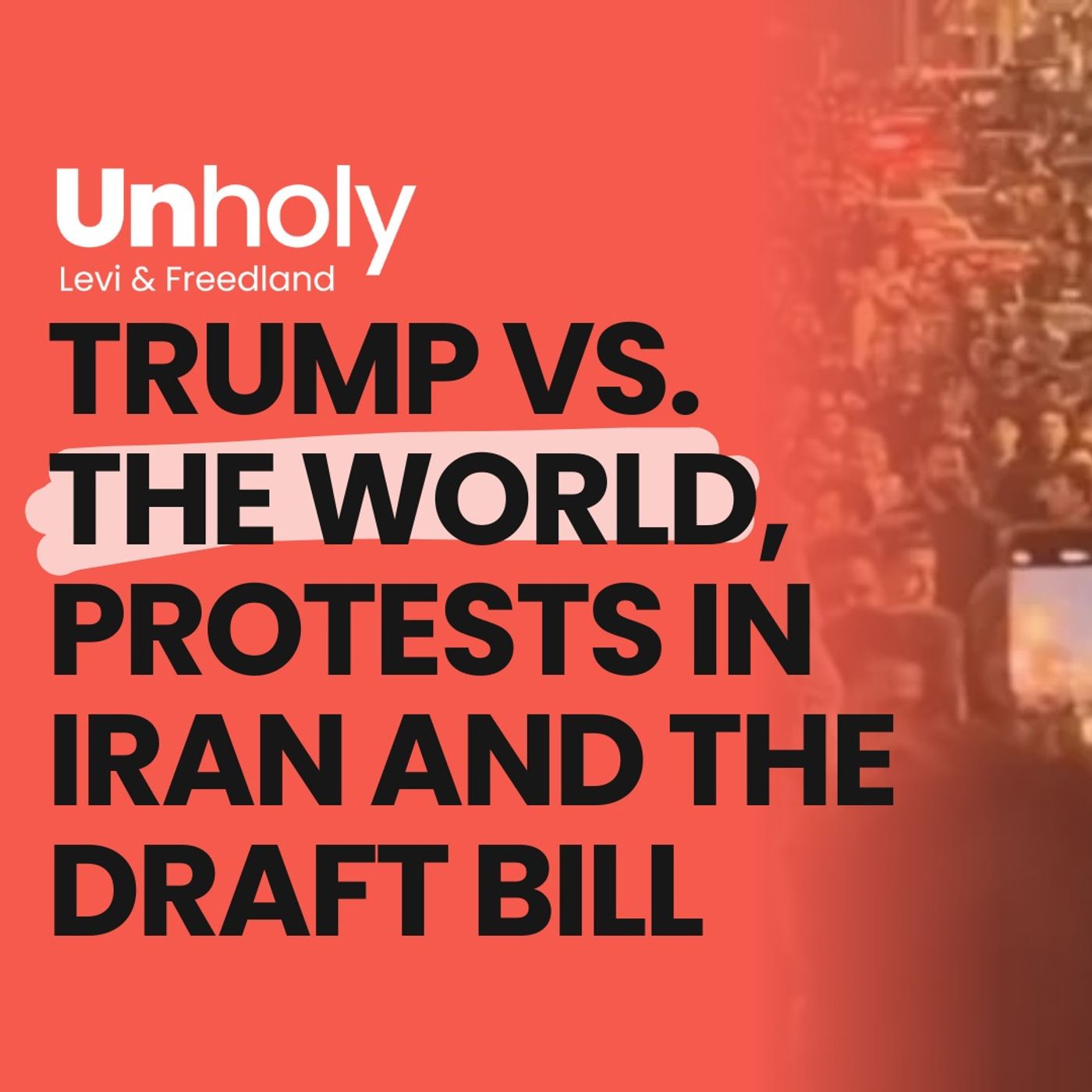
Unholy: Two Jews on the News
Trump vs. the world, Protests in Iran and the Draft bill - with Amos Hochstein
01:08:25
Loading summary
Transcript87 lines
- [00:00]
A
He's running the board because there is no board. Europe's pronouncements after everything that he does on tariffs against them, Venezuela, whatever else he does is we are deeply concerned and we may even have a meeting about it. You look even at Greenland, he's threatening to invade Europe, essentially. And Europe has zero response. Nothing. Everything is about placating. They read him wrong every time and then they repeat it the next time and then they recognize that they read it wrong and they do it again.
- [00:44]
B
It's unholy. I'm Jonathan Friedland in London.
- [00:47]
C
And I'm Yanit Levy in Tel Aviv.
- [00:49]
B
And it's unholy. Two Jews on the news. That voice you heard belongs to Amos Hochstein from former special envoy of the Biden administration. Man who brokered a ceasefire in Lebanon. Ideal person to talk to for our rapidly, dizzyingly changing world, which we're obviously going to get into from Venezuela to Greenland, almost close to our two Nords on the fjords idea about a Danish version of Unholy, for which we still wait.
- [01:17]
C
We waited, waiting for someone to pick that up. Please, please, we just gave you an idea for free. Please pick it up.
- [01:23]
B
We did, but I am told something like that is in the works. But you know, we, we, we wait patiently for that. Meanwhile, I mean, I don't know how big we are in Denmark, but I had a very uncanny feeling that somebody was listening to us because just this week I was, you know, always like to be very ahead of the curve. I was at a play called Christmas Day. It should have obviously been there before December 25th, but I. It's just finishing its run in London's Almedia Theatre. The interesting thing about it, it's a Jewish family having a dinner on a Christmas, on Christmas Day. Part of the theme, the argument, the banter across the table is, is this Christmas dinner or isn't it? It can't be because we're Jewish, etc, but by the new playwright or up and coming playwright, Sam Grabiner. Interesting play. I mean, you know, one of those ones. I'd love you to see it. We could talk about it. It may come back. But the, the uncanny feeling was just. Our listeners will have heard our Christmas special. A lot of that angst about Jews and Christma poured into this play. The origin of it, how you deal with it. Do you celebrate it? Don't you? The business about Chinese food, is that just an American New York thing? How that custom came about. It felt as if somehow, you know, we had been heard and I, I felt heard. After our Christmas special and that play, lots of discussion as well, relevantly about how a family is strained by the events of the last two years. And I was thinking as I was watching it, paging Orno Guralnick, couples therapy extraordinaire host and think who of course is joining us for a very special Unholy coming up.
- [03:00]
C
Indeed, we have our own couples therapy here on Unholy. Because of that, those strained relationships over the past two years, we're going to have two different couples, two friends and a couple to talk to Ona and to talk to us about that. That will be coming up in the next couple of weeks. So will the fact that we are sitting celebrating five years next week for Unholy, a lot of talk about that next week. I think there are a few other things to talk about that happen in the world, although I can't, I have to say that you dangling this great new play in front of my face is making me, first of all, you know, just envious and then saying, oh, but the play might come back. Thanks, Jonathan.
- [03:38]
B
Yeah, no, it's the worst thing you can do. It's the worst thing you can do is mention a play whose run ends on Thursday, January 8, to mention. It's like when people tell you about great show and it's sold out. So I know I get marked down. But last time I have to tell you, in the audience there as we were going in was the mother of Mark Rosenblatt, who wrote Giant, you know, which we talked about so much on the podcast, that play which is heading to Broadway, proud Jewish mother going in. I couldn't help but feel she was going in to eye up the competition because here is another you young Jewish British playwright, and she was sort of checking out his work, but she also waited till the very end of the run. But no, I mean, interesting play. I would say a lot to talk about from it, but it will, you know, it will have another day, I'm sure. Meanwhile, is no, you know, real life drama, perhaps. I was going to say real life drama. Exactly.
- [04:35]
C
I mean, did I steal a punchline? Did I do that again? I mean, I just want to say.
- [04:39]
B
That got there better.
- [04:41]
C
The amazing thing about President Trump, you know, flying over, sending his military to a different country, taking the leader and deposing him, all of that. My only question, my serious question really here is why do that on a Friday, just after we recorded our, our predictions for 2026? I mean, didn't you feel like a little bit of a fool? Like, who could have Taken that pile of predictions and, you know, the first act of defenestration for 2026, throw them all out the window and say, okay, so it's a new world now. Great.
- [05:08]
B
I know, it wasn't helpful.
- [05:10]
C
It wasn't helpful.
- [05:11]
B
Although I seem to remember saying in there, after 10 years ago, 2016, journalists should never, ever make any predictions ever again.
- [05:19]
C
Okay, we're canceling our predictions episode. We really did, and Donald Trump was the one who taught us that lesson. We should say, I mean, I'm curious to hear your thoughts about that. I don't think we talked since, at least not a lot. And just that thinking, the first thing that came to mind, hearing that rather lengthy press conference, was to say, it's amazing that suddenly we're saying the quiet part out loud, right? Usually when things like this happen, not many similar examples in, I think, the history even of the United States, but it's usually there's a pretense, right? There's like, okay, we were going, because there's weapons of mass destruction and this is a decay. And here it's like, okay, but it's about the oil, which, you know, Trump is fabulous. He says Venezuela stole it from the U.S. but still, it's very. It's very blunt, isn't it?
- [06:07]
B
No, it is one of those sort of fabulously Trumpian moments, because during the Iraq war invasion, 2003, it became a kind of leftist catechism to keep saying it's about the oil. It's all about the oil. And Trump administration officials, Blair administration officials in London would all say, no, that's just a conspiracy theory. You've read too much Noam Chomsky. No, it's really about nation building or regional. And then the American president says, we're going to be running Venezuela, by the way. No euphemism. Who's going to run it? We are. Next sentence, the oil. We're going to change the infrastructure. We want the oil. It's a great big deposit. It is amazing how he sort of breaks through. It is like some sort of semiotic performance art. He breaks through all the, you know, previous charade, lip service, whatever, and speaks as America's most severe critics have spoken about America for 50, 60 years. He then articulates that he's like a sort of their nightmare come true. And he speaks so directly about, and.
- [07:14]
C
Indeed a presence who he himself, by the way, in his inauguration said, right, I'm going to be. There's going to be peace and no war and no regime change. Like what? That's not even a year old. What happened to that?
- [07:24]
B
Forget his inauguration. His New year's resolution for 2026 was to be the president of peace. That's actually what he said was his intention for this year. I thought the on the point about nation building and the usual things politicians or presidents say. I thought one social media poster put it brilliantly saying just as word came out about the kidnapping of Maduro, said, I don't feel I've even been lied to enough yet. You know, like, where's the lying that normally precedes something like this? This feels weirdly discombobulating. I want three months of lying before we have. But there wasn't even the pretense of the charade of seeking UN authorization or anything like it. Straight in. The other thing about it is it really doesn't fit even the sort of darkest versions of us in previous interventionism, which is you knock off one old regime and there's regime change you impose and you admit they're not even doing that.
- [08:26]
C
They've kept Iraq being the example for that. Right, right.
- [08:29]
B
I mean, where you want, you know, you get rid of Saddam, but you get rid of the whole Saddamist, Baathist.
- [08:36]
C
Infrastructure for the good of the people, among other things.
- [08:40]
B
So you say that's what you will. That's the rhetorical position here. They're keeping this hated regime utterly in place with the exception of the person at the top. He dismissed, didn't he, the Nobel Prize winner, saying that, you know, who is seen as the, you know, legitimate sort of leader of opposition in that country, saying, no, no one respects her. Instead, I felt between the lines he was saying, we've cut a deal with the vice president there. They're going to give us the oil. That's all we care about. People of Venezuela, you're going to still live under the boot heel, but you're going to live under the boot heel of, to coin an old phrase or to repeat an old phrase, our son of a bitch rather than someone else's son of a bitch. And, you know, it's.
- [09:27]
C
I don't endorse this kind of language, by the way. I hope our listeners know that, that I'm not.
- [09:31]
B
Who was it who said he's our son of a bitch? It's some American figure from the 50s. I'm going to look that up while we're, while we're talking. So, yeah, it's discombobulating because it's not even the usual regime change, the lies, it's not even the old playbook yeah.
- [09:45]
C
And it does beg the question, what world are we heading into in 2026? I remember you all know Harari in our London event, the Unholy live, talking about the sort of we live now in a world in which strong countries don't respect boundaries anymore. I think he meant Putin and Russia and Ukraine. And now we're talking about something else. But we will, I think, talk about this more at length with our guest with Amos Hochstein. I could just tell you that from the Israeli perspective, and this is, I think we should connect two stories this week. One is, of course, the Venezuela story. The other is the Iranian protests. So first of all, we should say Maduro had very chummy ties both with Iran and with Hezbollah. No one in Israel is shedding a tear. That this, we should say a terrible man is basically been deposed. But it's also interesting that, that Trump was kind of using this and threatening the Iranian regime, saying if you keep hurting your own people and trying to clamp down on the protest, hurt you, essentially, that that's a message that I think many in Israel felt is a risk will play a restraining force when it comes to what is happening in Iran. So those two stories kind of were connected in the Israeli psyche this week and not only in the Israeli Sanki. By the way, I saw a few of the Trump administration officials walking around make Iran great again baseball caps. You always know they're serious when there's merchandise involved. So that is connected not only here.
- [11:04]
B
Yeah. But I looked, by the way, it was Franklin, no less than Franklin D. Roosevelt, who said of a Nicaraguan dictator, somoza may be a son of a bitch, but he's our son of a bitch. Supposedly said that in 1939. So when we use colorful language, we have good historical antecedents for it.
- [11:23]
C
I will allow it this time.
- [11:24]
B
I. I wouldn't get it through, through the language police unless there was that kind of imprimatur on it, that kind of provenance. So y. The Iran connection is there. It is a bit undermined by this, the way it's dictator change rather than regime change, because if we've now seen the precedent really is. Look, as long as you do what we want you to do, you can stay in place. It suggests that, you know, if Khamenei were to go, but replaced by someone else more pliant to the United States, but with the same, you know, Islamist rule, rule in Iran, maybe in this new world we're in, maybe Trump would say, fine, as long as you're doing business with us, we're okay. And bad news for the people of Iran. I suppose that would include a change in policy towards Israel in that situation. It just means that the old playbook is not quite fitting for this new situation. He sees it all in very, very different ways. I suppose the thing to say is that if that is right, that is very bad news for the people of Iran who have been engaged in the best part of two weeks of protests. The streets really in escalating and intensifying, involving huge courage from them to take to the streets in very big numbers. This is definitely the biggest outpouring of popular dissent since there were demonstrations in 2022 triggered by women refusing their head covering the hijab or the compulsory hijab. This time they are out there. I don't know whether they feel they've got, you know what, they can look to Washington because as I say, the events of the last week suggest Washington will cut a even with the most horrible regime if it suits their purposes as long as the figurehead is gone. But maybe we, maybe that's an over interpretation of what we've seen in Venezuela.
- [13:14]
C
I mean the Iranian experts that I was listening to and talked in our studio this, this week, one of them is Benny Sabati who lived in Iran I think until he was a teenager and in fact during the 12 Day War. We had an interesting episode with him on this podcast. He's saying the interesting thing is first of all that you have the sort of merchants in the bazaars, in the markets, they are joining in. That's very interesting. The fact that you have in the more devout religious cities where the, the revolution started, you have protests. That's also very interesting. It's still not on the scale that will topple a regime, but the longer it lasts, that is the thing to look for a longer kind of lasting protest. We have to say the Israeli intelligence is saying that they don't think that at this current state this is something that could toppl the regime.
- [14:06]
B
And the other, Is it wrong to point out that Israeli intelligence hasn't got a flawless track record of force?
- [14:14]
C
Of course, no.
- [14:15]
B
Of course the action is important to.
- [14:17]
C
Point out for sure. I think also, you know, so does the American intelligence doesn't have a flawless record when it comes to nine, 11 or even the Western intelligence services when it comes to the Iron Curtain. But for sure you can't. That is not something to bet all your money on. Definitely. And the question that kind of again from the Israeli perspective that was raised this week is whether or not an Iranian regime with. With its back to the wall would want to attack Israel just to, you know, deflect the fire from them or the other way around. Would Israel think this would be a good moment to attack the Iranian regime? I don't think, again, to the extent we shouldn't be making predictions this early in this crazy year, I would say I don't think either regime would want to do that right now. Each for their own separate reasons.
- [15:03]
B
Yeah, I think it would be potentially a dumb thing to do by Israel because the one thing that would unite the people of Iran and enable the regime to circle the wagons would be the uniting against a common threat.
- [15:14]
C
Or that's why Israel wouldn't be interested in doing that now.
- [15:17]
B
You would think so. I think that would be the calculation. Just in terms of your point about. It's so interesting about merchants in bazaars. The other data point I picked up and I thought was fascinating was there are reports of some reluctance in the units of the security forces to put down the protests, to crack down hard. There have been reports of, in a few cases, I don't know whether it's outright refusal, but some signs of dissent there. That is the thing obviously to watch when you're looking at any kind of oppressive regime is do they keep the armed forces on side? And there are some, perhaps just some small signs of cracks there. So that is obviously something we'll watch. And as we've said, we'll take that up again with our guest.
- [16:05]
C
I think we should talk about what has been going on inside Israel, and I think we are now officially in election year, so there are election vibes and maybe we should just pause on what happened this week. We are still talking and will, I think, continuously talk about the draft bill, the attempt by this coalition to exempt officially the ultra Orthodox from military service. The bill itself, of course, if you would read it at face value, actually talks about, you know, thousands of Haredim that should enlist and sanctions if they don't. But all of it is so diluted that the result of this bill would be that actually most of them would not be, would be exempt and continue to receive budgets from the state. So, of course, this is enraging many in Israeli society, in fact, many in Yao's own base. What is happening inside the Haredi community, inside the ultra Orthodox politics is fascinating because on the one hand you have the majority, which means SH Party and part of United Torah Judaism that are saying to Netanyahu very clearly, if you don't pass this bill, we are not giving you the budget. And remember, Jonathan, I kind of bang the hammer on this a lot. I know. But by the end of March 2026, if Netanyahu does not pass the budget, then Knesset dissolves in their elections earlier than are slotted in June. So that is the main threat. What is happening with the more extreme parts of the ultra Orthodox community is they're actually saying the opposite. What they're saying, I think Yair Etinger explained this for us in a recent episode. What they're saying is, no, the mere fact that there are sanctions in this bill if people don't enlist is enough of a reason for us to actually oppose the bill. And so the more extreme factions, part of United Torah Judaism and a lot of people from the Khalidi community who are have been protesting in the streets this week, by the way. Some of the protests became tragically turned into a violent incident in which a bus driver rammed into the protesters. He says he was attacked by them first, but in any case he rounded to the pro protesters and a 14 year old boy was killed. But these protests are heating up and this will become probably a staple of what, how this community is reacting as the election year progresses. So this is really a question whether, whether Netanyahu, yes or no. Succeeds in passing this bill. The main opposition, Netanyahu, Naftali Bennett, once the man who, you know, walked beside him is the person who keeps, keeps hitting the hammer on this and saying, you know, this, I will give you the plan for the people who did serve in the military. I will give them extra budgets. That is the plan he set out this week. So that is basically what has been happening in Israeli politics. We should also add that on the side of the anti Bibi camp on the left, and particularly Yair Golan and the Labor Party, they're called the Democrats. Now two of the leaders of the protest movement against the judicial coup have joined Yair Gol party. Officially that party still has open primaries, so it remains to be seen how high they will be in this party. But it just shows you that how that kind of grassroots movement is now coming into mainstream Israeli politics. I think that will be a very interesting thing to watch.
- [19:13]
B
Yeah, I agree about all of that. It is. We're in that phony war period, the pre election period and all of these different forces are beginning to coalesce and align. And I remain alert to and fascinated by the fact that the draft issue, unlike so many other issues, splits the right. There are so many issues which break down on very simple. I was about to say simple nothing in Israel. Not the usual left, right partisan lines, but pro Bibi, anti Bibi. This is something where Bibi world itself, Netanyahu world, the right, Likud, they're all split different directions about whether the ultra orthodox should be compelled like every other Israeli 18 year old, to serve in the military. And that is the kind of Achilles heel for the right. And if he plays that issue wrongly, it could cost him votes. I don't think people are holding their breath necessarily for what would happen after an election because there are some very canny politicians in those ultra orthodox parties and they are usually end up on the right side of a deal. But why will in this period it's a very, very divisive vignette. I don't think many people will be that surprised by the idea that the leaders of those anti judicial coup protests align themselves with Labour and the Democrats. But there was a time the Labour Party was so ailing that people thought that they are not even the vessel for oppositional politics. People are going to find something new. It's a tribute to Yahya Golan that he is making himself the flag around which the oppositional forces are rallying. It was one reason why among my predictions was that he will be a player in 2026's elections. We should talk about the wider world, which has of course riveted our attention this week. The world seems to be changing before our very eyes, even just in this first week of the year, which is why we wanted to speak to someone who doesn't just observe it with great expertise, but has absolutely been in those rooms as a diplomat, as a negotiator in various world capitals, sitting with various guys. Government really knows the region we're so interested in and the right choice. For our interview this week.
- [21:28]
C
Amos Hochstein was senior advisor to President Biden and special envoy in the Obama White House. His expertise runs the gamut from energy resources to Middle east negotiating. Among his many achievements, he is the man who brokered the Israeli Lebanese ceasefire more than a year ago. We'll be talking about that as well. Today he's managing partner at TWG Global. Amos, thank you so much for being on Unholy again.
- [21:49]
A
It's great to be back and it's.
- [21:51]
C
Really great to have you again. I mean, I don't even know where to start at this beginning of this crazy beginning to 2026. But let's try and ask the big question to open up our conversation. Venezuela, Greenland, other countries sort of on President Trump's board is the 1945 Post World Order now dead and buried. Are we walking into a completely different world?
- [22:14]
A
We're definitely walking into a different world or we've already walked into a different world. I'm not so quick to pronounce things to be dead and buried. And I also don't think that there is something to kill and bury. In other words, the post1945 world was topsy turvy during the last 80 years. We ended the war to end old wars and immediately went to the Korean War which ended a few three years later, and we went to the Vietnam War. The United States did replace the government in Panama essentially by force. There were plenty of wars in the Middle east. So we had a major war inside Europe in the late 80s and into the 1990s as the breakup of Yugoslavia turned into a war with concentration camps and killing fields and mass killings. So there's been conflict inside that period of post1945. So I don't know that I want to say that it's the liberal world order is over, but we're marching in a direction that we've never marched before. Precedents are being set and the question is what of them becomes the norm and what becomes one offs? And I don't know the answer to that question. I don't think anybody can know the answer to that question yet.
- [23:39]
B
I mean, in a way the examples you've given show that the, you know, the notion of sort of international norms were kind of honoured in the breach more than in the compliance. There's all these examples, but at least it was there as a sort of aspiration that you had international institutions, international diplomacy. You know, Yonit and I were saying just before that before, if an American president did something like this, there would be at least there'll be some lying beforehand to prepare public opinion. Now people, you know, the President just says we're going in, we're going to run it and we're doing it for the oil, you know, and so maybe that isn't as big a loss, but among the casualties could be. And again, we know about all the exceptions, but would be something like international law. And that now feels like a dead letter. I know you don't like pronouncing things dead, but the notion that there would be law that is broken now it seems as if we're in a world where really powerful countries can really do whatever they can get away with. The only restraint on an American president would be if he hasn't got the firepower to do it. And just because of the point of view of this podcast and where we're coming from, what we're interested in. I'm just wondering whether, first of all, you think that is emerging a world without even an aspiration for international law? And if so, is that a world that Israel should welcome? Or are there dangers for Israel in a world where you no longer have even the aspiration for international law and restraints?
- [25:08]
A
It's hard for me to answer that question because I'm not sure that I agree with the premise on international law. I think international law was a concept that was favored and pursued post World War II by a relatively small number of countries, implemented by an even smaller set of countries. The main powers of the world did not accept the notion of extraterritorial international law. Never did. The United States has never been a partner to the icj, to the icc. When it went to the Senate, it never got ratified. So the great powers, the United States, Russia, China, India, never really saw this as a concept that applied to them. It applied more to rogue states, a mechanism by which to try rogue states. And so the idea post World War II, of the Nuremberg trials becoming the norm never really took hold. And I think that you can see that with the outcry around the accusations or the indictments against the prime minister of Israel that was rejected strongly by the United States. And I can tell you, as someone who was deeply involved in it, deeply opposed by most of the heads of state in Europe. So I don't know. I think norms are being broken for short. But I think there's something else that's happening, and I want to pick up on something that you said. What is that stops the United States, a president, from doing anything they want? It's not the lack of firepower. It's political opposition, number one, at home and political opposition abroad. And I think these are very two important points that are happening right now. This president controls Washington like few presidents have, but that may only be true for another nine months or so. There will be an election in the midterms where, if you believe the trends, the history and the polling and so on and the numbers, the math is against him holding the House of Representatives. He'll probably keep the Senate overnight. That is a massive change of power, an ability to do things, because having the House is not just a pesky House of Representatives. It has a lot of power to it. Number two is opposition abroad and here. I know that I'm saying something a bit offensive, but there are no world leaders at the moment. Of the countries that believed in the norms that you're referring to, there are no leaders, or almost none. Almost every single leader in Europe is upside down in the polls, is underwater in the polls. Macron and Starmer and Mertz and so on are all between very unpopular to historically unpopular in their own countries, with the exception of Italy, who is significantly more popular and more powerful and stronger. But I don't know that she opposes a lot of the things that Donald Trump is doing. And so there is no leadership around the world. So in previous eras, you would have had a strong French president or British prime minister or chancellor who would have stood up in the heyday of Merkel or of Chirac or of, you know, Thatcher, Thatcher, there would have been. You would have had to deal with that as an American president. He's running the board because there is no board. Europe's pronouncements, after everything that he does on tariffs against them, Venezuela, whatever else he does is we are deeply concerned and we may even have a meeting about it. So the position. You'll talk about Greenland in a minute. You look even at Greenland, he's threatening to invade Europe, essentially, and Europe has zero response. Nothing. Everything is about placating. They read him wrong every time, and then they repeat it the next time, and then they recognize that they read it wrong and they do it again. So I think that's more. As far as the Israel question, that's a deeper question. I think Israel has to decide what it wants to do before you can say, is it good for Israel. Israelis have to make a decision what kind of country they want to be. I don't think they've made that decision. Do they want to switch to a Hungarian Orbanist democracy, or do they want to be its old traditional democracy? I don't know the answer. And when you have an answer to that question, then you can answer if it's good for Israel or not.
- [29:34]
C
I think we'll discuss Israel a little bit later. But, I mean, we started with the big questions. Let's now kind of focus on the Venezuela question and the fact that, as Jonathan mentioned, there's not even a, a lot of lying. It's just like we were there for the oil. Someone who knows this infrastructure very well. First of all, is it that simple to just go in, get the oil, make the money, and that whole issue of, wait a minute, but what happens if there are riots? What happens if the riots next to the oil. Do we have any idea what the plan is here?
- [30:04]
A
So it's an interesting circumstance. In Venezuela, I think Trump always finds the smart way of when he wants to do these expansionism, Jonathan, that you talked about before, he does it in places where it makes it very difficult to oppose the underlying. Because the EU and the United States under Biden did not recognize Maduro's election, we said he stole it. And we recognize the opposition as the true leaders. And in fact, the leader that we said won the election was hosted by the President of the United States in the Oval Office as the president, the rightful president of Venezuela. So he takes out a illegitimate president of Venezuela. Then he says, I'm here really for the oil. I'm going to run the country. And so I think that's where the missed opportunity was for Trump because he could have announced that day there'll be elections in 90 days. There will be, or the Anaca Rena Machado's party will take over. And then how do you criticize? Do you really criticize it or not? Instead he said, look, I'm here for the oil. And he doubled down and said, the difference between Iraq in 2001 too is that Bush didn't keep the oil. I'm going to keep the oil. Now, is it so simple? Absolutely not. So what you're seeing happen from the day that they took Maduro, that first press conference is the shifting sands of what the oil deal is going to even be. One it was, we're just going to take the oil. The oil company's going to go there. Well, then they back channeled and said, oh shit, we can't really do that because nobody's going to finance, you know, $50 billion. So he said, well, he went out and said to NBC, we're going to subsidize them. Well, that felt like a lead balloon in Maga. There's nothing that spells America first like taxpayers subsidizing multi billion dollar oil companies to build infrastructure in a foreign country. So they walked away from that. Then they said, big pronouncement. We're going to bring 30 to 50 million dollars on truth social million barrels to the United States. Huge victory. Now you do the math of 30 million barrels at the low end times $42, that's about a billion dollars. Then you have to, minus shipping costs and insurance and all that stuff, suddenly it's less than a billion dollars. And for those of us in our generation, the Austin Powers movie when he says the ransom will be $1 million, right, that's what it felt like to me, 30 to 50 million sounds like a lot of barrels, but it's a billion bucks, maybe two at the high end. So they shifted it again. And now what they're saying, as of last night, they change and say, you know what? You're right. American companies are probably not gonna go in all that fast. They're very conservative and they're very cautious.
- [32:40]
B
When Trump says, in effect, we've achieved what Joe Biden merely talked about, you know, he too didn't recognize Maduro, he too said Maduro was a bad guy. But I've actually gone and done something about it. Everything you've just said out now, now, are those the things you did think about in advance and did talk about? And therefore, that's why actually there was no equivalent raid or operational action taken by the administration you served because you saw around these corners and saw the problems.
- [33:07]
A
We definitely did not seriously contemplate a US Invasion and an extraction of Maduro. But we did have intensive talks because he's right and we did fail. We had direct talks with the Venezuelans for the first time in many years. We remember that in 2022, I had negotiated with Chevron to give them their license back to go back into Venezuela in return for one releasing 11American prisoners. And in return for certain conditions on the elections, which the elections ultimately did happen. As a result, he didn't abide by them. And that was part of the breakdown of what we. But we were willing to. We had negotiated his exit, his ouster in more normal, traditional, where he gives up power, goes to another country, and we all go about our business and Venezuela sort of survives. But no, he's right. We didn't do enough about it. And I will say he is one of the things that he's broken in many places around the world is the idea that sometimes we become, because we're so concerned for the norms that we talked about before, we become prisoners of the norms. We become prisoners of the idea that we can't do something just because we haven't done it. And I've taken note of that. And I think that when there's a Democratic president, we do have to change course. And we've also gotten to Democrats, went so far away from the Bill Clinton era of strong is wrong is better than right and weak. Now, Trump has taken that to the extreme, and I don't think that's wise. But I've always agreed with Bill Clinton that when you are a superpower, if you want to remain a superpower, you have to sometimes demonstrate power. And I think that Democrats followed Europe in the abdication of power, where strong is wrong. It's not strong and wrong, but strong is wrong always. And the decline of Europe economically, politically, militarily is not because of any budget. It's because of a mindset. And parts of the Democratic Party have adopted that. And I think that became a dangerous thing. Again, I think Trump went to the far extreme that is destroying our credibility and the diminishing returns there are dangerous for the United States.
- [35:50]
C
It's very interesting when you're talking about the soul searching among Democrats that you think should happen. I wonder when we are talking about, as you say, Trump taking it to the extreme. I mean we were hearing the pointing at Mexico and at Colombia and at Greenland to come next out of all that, what do you think is the sort of next step that he might make?
- [36:12]
A
Hard for me to see. Mexico is not Venezuela. Sheinbaum was elected in a Democratic election and exceeded her poll numbers and has come out of the shadow of Amlodipine, her predecessor and mentor. And before that she was the mayor. And also that's on our border. You mess that up and suddenly I don't care how many troops you have on the border, you're going to start seeing a migration crisis on the border with Mexico. I don't think he's going to touch that. I think Cuba is probably the next domino to fall, not necessarily because of an invasion but because Venezuela was truly a lifeline for Cuba. The economy is crumbling, has been crumbling. It may happen on its own with some help. So something that's teetering and you give it a little push and it falls.
- [37:01]
B
Well, so I was just going to say because of these alliances, it takes us back to the country that in the region that we focus on so much on this podcast we're particularly interested in in terms of Venezuela and that is Iran that they had a relate obviously a very close relationship. The removal of Maduro, how do you think that that affects the calculus in Tehran? Does it mean that they themselves feel threatened? Do they think this is a precedent that could come to hurt them? Yoni mentioned earlier in the podcast the sighting of these, I think they were black and white hats but MAGA style caps say make Iran great again as if Iran is next. What is the sort of knock on effect of this for the regime there there which is obviously being shaken by these protests that we're also talking about.
- [37:50]
A
There's been too much talk about Iran has lost Venezuela. Venezuela didn't do much for Iran. Iran did more for Venezuela than the other way around. Specifically on enabling some of their sanctions busting activities and so on. It was a good base of operations for Hezbollah and for Iranian agents for the Western Hemisphere. And I think that's an operational loss, but probably not one that is all that critical for what in the list of things that Khamenei probably wakes up every morning and talks about, I think the Western Hemisphere operations is not high. I don't buy into this is such a huge deal. I think psychologically and strategically, if the United States president is proving that time and again that he is not the Trump of the first term that was anti interventionist and that he's now not only pro interventionist, but he's kind of liking it and he's gotten a taste for it, and everything that's happening for him domestically sucks. Right. He ran on affordability, and affordability is getting worse. He ran on food prices and food prices didn't. Not only did not go down, they went up. Electricity prices have gone up, housing prices are going up, et cetera. And dealing with that has been a nightmare. He has not been able to deliver on almost anything domestically. Right. The healthcare was a disaster. And remember those, those premiums are going up only starting now. They expire December 31st. It'll take six months, but it gets worse every month. And so foreign policy and intervention suddenly becomes more fun. So for Iran, it's like, wait a minute, if he's willing to do that, does that extend to all the way? Venezuela is very close to home, so easier to do. Iran's far, but it's closer to home because he's got Israel to do whatever he wants. And Israel's chomping at the bit. So anytime he gives a green light, they'll attack anything right now in Israel. Right? They'll attack any country, any place, anywhere. That's what they. They're also in the same position. The domestic sucks and the military adventurism is working. So double down on what works. So I think the Iranians are thinking about that. I'm also in a different place than where a lot of people are on protests. I don't think they're that serious. I think the Israelis are purposefully, from a propaganda perspective, they're sort of making them bigger than they are. If you look at the statistics and compare them to the Hijab women freedom protests a few years ago, a couple years ago, they are significantly smaller. They're not as broad in the society. And you know, I think somebody mentioned, I think it was actually an Israeli, the INS was pointing out that I think on Friday or Saturday during one of the Biggest protests. Days of the protest there was a massive big soccer match that was happening in Tehran and there were 10 times more people at the soccer stadium than they were on the streets combined across the country. Also you look at the Iranian response, they have responded with police and some extra forces, but not their. It's not been the full bore. So I don't know that these protests are all that impressive at the moment. I think they're worried for sure. And we know, I think Israel made a decision to strike Iran again long before Venezuela and I think they got a provisional green light from the administration long before Venezuela. So I don't think those are related, but I think they'll be more concern in Tehran about America's intentions. Post Venezuela.
- [41:24]
C
I was interested in the Iranian protests. I think a clip just resurfaced of President Obama on Pod Save America a few years ago saying he regretted not giving the protests during his time in office. It was the green revolution, more of a support he said. It was a debate in the White House. And you do see President Trump at least saying if this regime hurts, hurts their own people, I will be there for them. Is that helpful in any way? I mean does that have some sort of restraint play, a restraining force on this regime?
- [41:57]
A
Look, I don't disagree that Obama administration, it was a missed opportunity. I think also the mindset of the world was very different during that time because it was pre Arab Spring and nobody believed that anything was possible. So I think that there was a, a failure of imagination was part of it as well. Look, during the freedom protests, the women's protest two years ago, we decided to learn from that lesson. And President Biden in the State of the Union at the UN General assembly repeatedly talked about the protests and support. There's always a tricky fine line of back channels conversations with people that are talking to the protest leaders who say support us but not too much. This has to be an Iranian protest. The minute this becomes a Trump protest, an American protest, an Israel protest, we lost. And I think this would be hard for Israelis to accept. But anti regime Iranians are not necessarily pro normalization with Israel. Okay? There are plenty of Iranians who hate the regime deeply and fully hate Israel for especially this is especially true post Gaza. And so when you come in and say these protesters we are the prime minister of Israel is putting out things of saying I support you. That hurts the protests. Most of those protesters said please don't help me, I'll manage my own affairs. I think the kind of help that we need is more Providing Starlink for free when the regime shuts down the Internet, providing them the kind of support and creating political pressure. Not I'm going to come and bomb the country, but rather a rallying cry. I would prefer that President Trump says, I'm going to call a special meeting of the G7 to discuss the protests in Iran and what should we do about it. And a blockade. Should we do a blockade of Iran? I'm going to call Erdogan and say, you were always very concerned for the killing of the Syrian people by the Syrian regime. You should be concerned about this, too. I'm going to call on Muslim leaders to condemn the Iranian regime for the killings. And so these are the kinds of things that I would try to put the pressure say I'm going to bomb you, I don't think is what helps it to point.
- [44:26]
B
Continuing our little tour, Dorisan, which we're doing with you. We have to. I'm bound to, because of your role in brokering the ceasefire in Lebanon and particularly the dimension of the conflict between Hezbollah and Israel. Just to ask you about the business of that, of those of. I mean, there's obviously specific questions about Lebanon. Perhaps we'll come to those. But I'm just interested to know how you're assessing the progress on the deal. Deal that the Biden administration, outgoing, had a role in. And then the Trump administration incoming, and then obviously it renewed again in October for Gaza, that ceasefire deal. And there were two phases. The first one went off pretty well in terms of hostages returned. There is obviously one deceased hostage. The remains of that person are still awaited. But there is this second phase, which is in a way the really big substantive issues. Hang on that the disarmament of Hamas is part of it, but so is some kind of roadmap for a Palestinian state. You're one of the few people who's been in these rooms, do you think that is for the birds? It's not going to happen. It's a sort of, you know, it's waiting for Godot. Or do you see that there is activity from the people who have to make this happen, to make it happen? Is it, you know, do you see it materializing or is it going to be one of those things that was notional and phase two didn't really exist except to get phase one through.
- [45:48]
A
So phase two didn't exist. When phase one was announced. It was, we will have phase two, but nobody knew. It was never discussed. You had the 20 point plan, which had enough in it for everyone to hang on to, to hang their hat on. So it's very different. Difficult to get to an agreement when both parties believe that the status quo is better for them than going to phase two. Hamas and Israel are united in their interests at the moment on this question. Happen. Hamas sees its most important goal at the moment is survival. Completing the retakeover of the part of Gaza that they're in. And to be in a place where they control the territory, the people, and live to fight another day knowing that that day is not today and it's not tomorrow, but it's at some point in the future for Israel. They want to be in a place where they control half of Gaza, right? 53% or whatever it is of the territory, freedom of operation to strike and act in the other part of Gaza at will whenever they want. They have essentially a buffer zone between the Jewish Israeli towns and Gaza. That's good enough for now. The minute you go to phase two, all kinds of complications happen. One for Hamas, are they out of power or not? Unclear. Do they have to disarm? Unclear. Are they in exile? The leadership? Unclear. Foreign forces suddenly mucking about. And I'll start from that because on the Israeli side, same exact thing. Foreign soldiers mucking about. Jesus, now we have another unifil. And who wants that if you're Israelis? I keep telling Israelis, stop trying to get your friends to send soldiers to Gaza. That's the best way for you to become not friends. Mistakes will happen. Some 18 year old will shoot one of them, disrespect them, etc. So they don't want foreign soldiers there. They don't want to have to withdraw. Part of phase two is they're supposed to withdraw and the end of that process, they're supposed to say something about a Palestinian state which Israel does not want to, if it was willing to give, to give up on that point and announce support for a process, to launch a process for a Palestinian state, we'd have normalization with Saudi Arabia. They're not going to do it for Hamas.
- [48:14]
C
I mean, at the end of the day, one thing should be said, which is that your administration was hard at work trying to get to the end of the war in Gaza and at the end ultimately failed.
- [48:26]
A
I disagree.
- [48:27]
C
And I wonder what?
- [48:28]
A
I disagree. I fully disagree.
- [48:29]
C
You didn't fail.
- [48:30]
A
No.
- [48:32]
C
Okay, then please do disagree. The end of the war.
- [48:37]
A
We did. We brought about the end of the war in three phases. Hold on. Phase one was the women and the. And by the way, many more. The vast majority of the hostages were released by, during The Biden administration, all the women and all the older men, a ceasefire for 42 days that held on day 14. Israel and Hamas had agreed that they will begin the phase two negotiations and forced. And we had. And by the way, almost the entire phase two was already negotiated. Israel on day 14 during the Trump administration announced publicly that day, if you remember, a big headline where the prime minister ordered his delegation not to leave the country and not to go. And so we did bring about the end of the war in three phases. The Israelis decided to walk away from it, and the Trump administration said that it was okay for them to walk away from it. And the Israelis promised them, if you allow us to put a blockade on Hamas on Gaza, it will work and they will get better terms. It both worked and didn't work. Right? It worked in the sense that it got better terms, but it didn't work in the sense that that was the final nail in the coffin of Israel's reputation around the world. And eventually, in October, they ended up with a deal. So.
- [49:53]
C
But we were no longer an option dotted line. And October 13th is the end as the return of the rest of the living hostages, the beginning of the return of the dead hostages, and Netanyahu agreeing to this, which he didn't before. So I'm wondering, what is the leverage that Trump has that Biden didn't have? Doesn't that beg that question?
- [50:11]
A
Again, we did get to the. He did agree to the deal in the three phases. Right. If you look back at the deal in January, Netanyahu agreed to it. Netanyahu has agreed to a lot of things that he later doesn't agree to.
- [50:25]
B
So you're saying that Netanyahu agreed to the deal in January of 2025, only then to walk away from that same deal a matter of weeks later?
- [50:36]
A
Yeah, because he allowed the 42 days to expire without negotiating phase two. And by the way, it's the same now, guys. He did phase one, and now he's in a ceasefire, but he hasn't agreed to go to phase two yet. Right. And he's saying Hamas doesn't want to disarm. And there are all these other things. Now, Trump also changes the terms of the agreement whenever he want at will. And I think that he finds it's easier to deal with the Israelis than it is with Hamas, which I fully agree and support, but we haven't ended anything. Still have 2.2 million people who now live in what used in 47% of the territory that they lived in before, which is a Recipe. We're just waiting for the next round. We all know that, right? If you don't have a solution, you're just waiting for the next round. It's not like the Palestinians living in Gaza are saying, what I want is to live in peace with Israel right now. What they want is quiet. They want is homes. That they want is some kind of normalcy. But their life is more miserable today than it's ever been. And Israelis will say rightfully so, you picked this fight. You did October 7th. We didn't start this fight. But it doesn't matter if you don't get to phase two, if you don't get to phase three, if you don't get to a point where there's some kind of resolution, that then all you're doing is reigniting the powder keg. And it's not at a boiling point now, but it will be eventually. Instead, the west bank is getting to the boiling point. And so I see it as the same way. Only one party announced the October deal as a peace agreement. The Israelis didn't, Hamas didn't, Egypt didn't. Only the United States said, it's a peace agreement. It's not a peace agreement. It's a temporary cessation of hostilities.
- [52:22]
B
You said before that Israel has to make a decision about what kind of country it wants to be. And I think it just relates there to what you were saying about the. The conflict in Gaza that, you know, you may want to think it's an end to conflict. It isn't. It's just a pause as we wait for the next round. What do you think that if you had to describe somebody who's been so closely involved with this to Israelis, what you think the choice before them is in the elections that are coming in 2026, what the kind of two paths that are available to them, including regionally and diplomatically. Given the tables you've sat at, what would you say to them is on offer? What is the choice they face?
- [53:03]
A
I listen to Bennett when he comes to the States and talks. He's not offering anything different regionally. On the contrary, to some degree, he tries to be even. I'll be even stronger and tougher, and I'll be just as militarist. So I see no change offered by any of the major candidates. The change is personality. The world hates us because of Bibi. We're going to have a different face. We're going to have a different voice. We'll be more. But I don't see Bennett talking about, I am going to agree to a pathway to a Palestinian state. If you don't have that, there's no normalization of Saudi Arabia and there's no reintegration into the world community anywhere. And I think that for Israelis, what they don't understand, what's masking this, the Trump presence is masking the massive deterioration in their place in the world because America is such a big supporter of Israel. The difference between Trump and Biden, who both were accused of supporting Israel above and beyond their own political bases and beyond their allies, is that when Biden supported Israel, Biden had a lot of support in Europe, had a lot of support around the world. And so we browbeat the Europeans behind the scenes on how to deal with, on some of the Israel issues when they try to do all kinds of things at the UN And Europe and so on. Biden was able to cajole. When Trump does it, I think the Europeans, the recognition of the Palestinian state by France and the UK and so on, while it was silly theater, it was an expression of, during a world of tariffs and threats by Trump. I can't fight him on that, but on this, he can't tell me what to do. And so I'm going to do something. What's my outlet?
- [55:01]
B
It.
- [55:01]
A
I'm going to go after Israel. They wanted to do that multiple times during the Biden administration, and we sort of walked them through. Why that wasn't wise. So once Trump leaves the scene, look what's happening to Israel. On the right, Israelis keep. I hear them, they tell me this all the time. The far left. The far left, the progressive left, and they're not wrong. The far left is maniacally anti Israel, Israel. They're talking about the genocide today, just as they did in the height of the war, as though there's no ceasefire. But the far right is not any different. And that margin, that marginal part of the Republican Party of the right, is growing very fast. It's not just Tucker Carlson and Candace Owens. It's Matt Gaetz and it's Steve Bannon, and it's Megyn Kelly now who's gotten into the fight. And she had to make a choice that she did not want to make between Ben Shapiro and Tucker Carlson, two friends. And she refused to make the choice and sort of said, kind of like, I'm with both. And then a few weeks ago, she was no longer able to do that. And when she, when the chips were down, she chose Tucker. And now she's in online fights with who? With Ben Shapiro, with Levine and so on with the Jews. So Israelis don't understand how bad things are on the far right. And I'll give you an example that is very material. The next time there is a military support for Israel budget in a year and two years from now, the left's going to say they're using bombs to kill children. The right is going to split in three. One side's going to say, I'm neocon, I support Israel, give them the weapons. The other part is going to say the churches and the religious, they're killing babies. And then the third part, the MAGA is going to say, wait a minute, Bibi came out and said he vanquished all his enemies. Why are we giving him billions of dollars? Screw that, spend it here at home. And this idea of striking Iran again now feeds into that right wing narrative. You struck Iran in June. You came out and said you ended the Iranians like it is. That's why that was the justification you did. It's a one and done. But six months later you got to do round two. That means it didn't work. That means it didn't work. And that means you want to mow the lawn every six months. We're not in for that. So I think Israelis the choice in this election, and I agree with Israelis, there's a lot of that has to do with Bibi's never going to repair his reputation around the world. And so maybe a different face makes it a lot easier and pleasant and so on. But we've gone down to the fundamentals. If you're saying, I'm not even willing to discuss a Palestinian state and settler violence doesn't come to an end, we don't want to talk to you.
- [58:01]
C
I think there's a difference between what people would say, particularly Bennett feels he can say before an election and after. But I don't want to let you off and I know we promise to be shorter, but I do want to ask one thing, which is Lebanon and you talked a lot about where we are with Iran and where Israel is internally. Are we seeing, Are we about to see? Is it inevitable to see another round between Israel and Hezbollah?
- [58:27]
A
Bottom line, no, it's not inevitable. Will it happen? Quite likely. I think Israel needs to understand that it has the absolute best combination of president and prime minister that Lebanon has had in generations since the invasion of the Syrians in the 1970s and the civil war. These are people who are publicly saying, I want to have a normal non. I don't want to recognize Israel, no normalization, but a normal relationship. We can Be neighbors who don't like each other but still live in peace with each other other. Or instead of using the word peace, in no conflict with each other, they're publicly saying that just like The Gaza deal, November 27 was the ceasefire and Israel implement. Both sides implemented the ceasefire with a lot of pressure from me and from the US military and so on for two months. And Israel withdrew more than anybody expected and so on. On the day I left office, Israel stopped implementing. The reason there are five points. If the inauguration was January 10th, they would be eight points. So it's not anything special about the five, it's just what was left. So Israel didn't implement it. And eventually Hezbollah also stopped implementing. The Lebanese government is, I think, a good government, but a weak one when it comes to its tools to implement. I think here what Israel should be saying, instead of let me bomb them, they should be going to the United States and saying, you need to spend more money, time, resources and people and Lebanon should not be an afterthought for you. And you need to grab the laugh, train it as you've done in many countries, and make it into the kind of force the Lebanese, sorry, LAF is the Lebanese Armed Forces, you're right. And train them and do it with them and use the south as that implementation example. That is what should happen. And by the way, this is a place where the United States can go to the uk, France and Italy in particular those three and say, forget unifil, we want troops of yours to join the LAF in patrolling the south. And I think they would do it and build bases. And the last thing they need to do, not the last, but immediately in the ceasefire. The last paragraph says as soon as you have the ceasefire, start negotiations between Israel and Lebanon on a permanent land boundary. I did the maritime boundary, I negotiated most of the land boundary. 85% of that is done agreed to by both parties. How to redo the boundary? There are some tough. Two tough points that have to be addressed. If you get that Lebanon is able to then say to Hezbollah, there's no more resistance, guys, because they will announce officially, we have no more claims against Israel. Israel will announce we have no claims against Lebanon. You have a non aggression pact. You can build towards normalization over three to five years, but you will have a non aggression pact between the two. Israel has more support today among the Lebanese people than Hezbollah does. Another war will likely change that. I agree with Israel that this is the moment to disarm and Lebanon has to do it. They're right. To say this is B.S. we want more. The tool that Israel has decided all tools are gone except for one one airstrikes. It's the only tool that we now have and be damned, all other tools. And I disagree with that.
- [62:18]
B
Amos Hochstein, thank you so much for that. As we said, we did a sort of global tour there, but huge insight and the benefit of your experience for speaking to us on Holy, thank you very, very much indeed.
- [62:32]
A
It's always fun to be with you guys. Thank you.
- [62:39]
C
It was fascinating to listen to Thomas. I, I was particularly interested in that kind of, first of all, the soul searching among, among Democrats, which I find very interesting. Right. We was talking about, of course, he said, right, Trump taking it to the extreme, but also that we as Democrats, he said we should think about, you know, that strong isn't wrong, that strong actually has a value, that acting with more, you know, I guess I don't want to say aggressiveness, but sort of more power in the world actually is important. And I found that very, very interesting what he said about, you know, we can go on and on what he said about Israel, but obviously also what he said about Europe. Right. I mean, that Trump is playing the whole board because no one's on the board but him, basically. I thought that was very, very interesting as well.
- [63:22]
B
And in a way, it was the same point about Democrats and Europeans. They have become fearful of demonstrating power. And he said there is no leadership and went through Starmer Macron and his point about them all suffering domestically. But in a way, he was making a sort of bigger picture, longer term point that there has become a kind of, for all the good talk of norms and post 45 world order, that restraint has come to a point where, you know, if other people, bad actors perhaps in the world are flexing their muscle and showing their power, then, you know, others, including the west, need to do that. And yeah, we, I think we have seen where that can lead if it's taken too far. But yeah, no, it was an interesting counterweight. It did make me wonder who he would, you know, among the Democrats who he believes echoes that message. I found my own mind going back to the conversation we had with Rahm Emanuel on the podcast. I mean, somebody who wants to, I think, be in the mix for 2028, I think he would talk the same language about, you know, harking back to the Clinton administration, the view that occasionally you do have to demonstrate your power. And so I, you know, I wondered who Amos Hochstein's money would be on for 2028. But a fascinating conversation. I think it is awards time for us.
- [64:41]
C
It really is. What would you want to start with?
- [64:43]
B
Well, I thought we should hand out our chutzpah nominee to actually somebody who's a player. The story that you were setting out for us just before earlier, namely the whole Rao convulsing Israel itself, but certainly the Haredi world, the ultra Orthodox world, about the draft, Rabbi Menachem Zvi Berlin, head of Yeshivat Rav Chaim Ozer. So the head of a yeshiva religious academy was speaking in very animated terms, terms to supporters saying about the state of Israel, not the particular government. The state of Israel. We have no business with them. They are our enemies. They are no better than Hitler, may his name be erased. They want to uproot us from the world now. You know, I think longtime listeners will know I am particularly intolerant of trivializing comparisons of this or that to Adolf Hitler. They are particularly disgusting, I think, when you compare Jews and Israel. You know, we've persuaded much of the world that if you do in posters and placards, an equation of the swastika and the star of David, it's anti Semitic. That rule applies to all comers. And it includes Rabbi Menachem TZVI Berlin, a man of great age who should know better people. The state of Israel, who's asking all Israelis to wear the uniform equally to protect the country, should not be and are not to be compared with Adolf Hitler. And this was said at an event, by the way, that was quite mainstream. It's affiliated with one of the ultra Orthodox parties, the Degel Hazorah Party. So this week's nominee is Rabbi Menachem Zvi Berlin.
- [66:27]
C
You know what's nice about this week's award? That we have a rabbi for chutzpah and a rabbi for Mensch. I quite like that. It's neat. An order for the universe, kind of. So my mention of nominee would be Rabbi Mendel Mintz, who this is a story from Baltimore. And he raised two and a half million dollars for a Jewish children's library. And the reason he did that was to honor his late wife. She was a beloved educator in Baltimore. Her name was Miriam Mintz. She died in 2024. And he decided he wanted to do something grand to carry her name. He didn't have that kind of money, so he launched a crowdfunding campaign for this. And he managed to garner that kind of money from the people who this story spoke to them. And indeed he managed to raise that money and will build a Jewish Children's Library. I think that's a really nice story. It contradicts your story in the sense of, as I said, a rabbi versus rabbi. But I think this is and both.
- [67:22]
B
Actually and both from the ultra Orthodox world as well. So Rabbi Mintz is himself a Haredi rabbi and Nivu, which worth looking at the pictures of the institution built in the name of his wife's Miriam. It looks really inviting and a place clearly for children and for their learning. So a worthy winner in our mensch category. And I think it's only time for our thank yous.
- [67:46]
C
We will say a big thank you to Michal porat next week, January 15, 2026, exactly to the day. Five years since unhappy Holy started. We'll discuss a little bit about that in our.
- [68:02]
A
We will.
- [68:02]
B
There'll be lot to talk about in our podcast.
- [68:03]
C
There's still a week to implode, Jonathan. You got a week to blow the whole thing up before we celebrate. Five years. Take that into consideration. Start working.
- [68:11]
B
Yeah, there's lots of time. I will see you then. And we will see all of you then for our Podversary special. Bye bye for now.