← Unholy: Two Jews on the News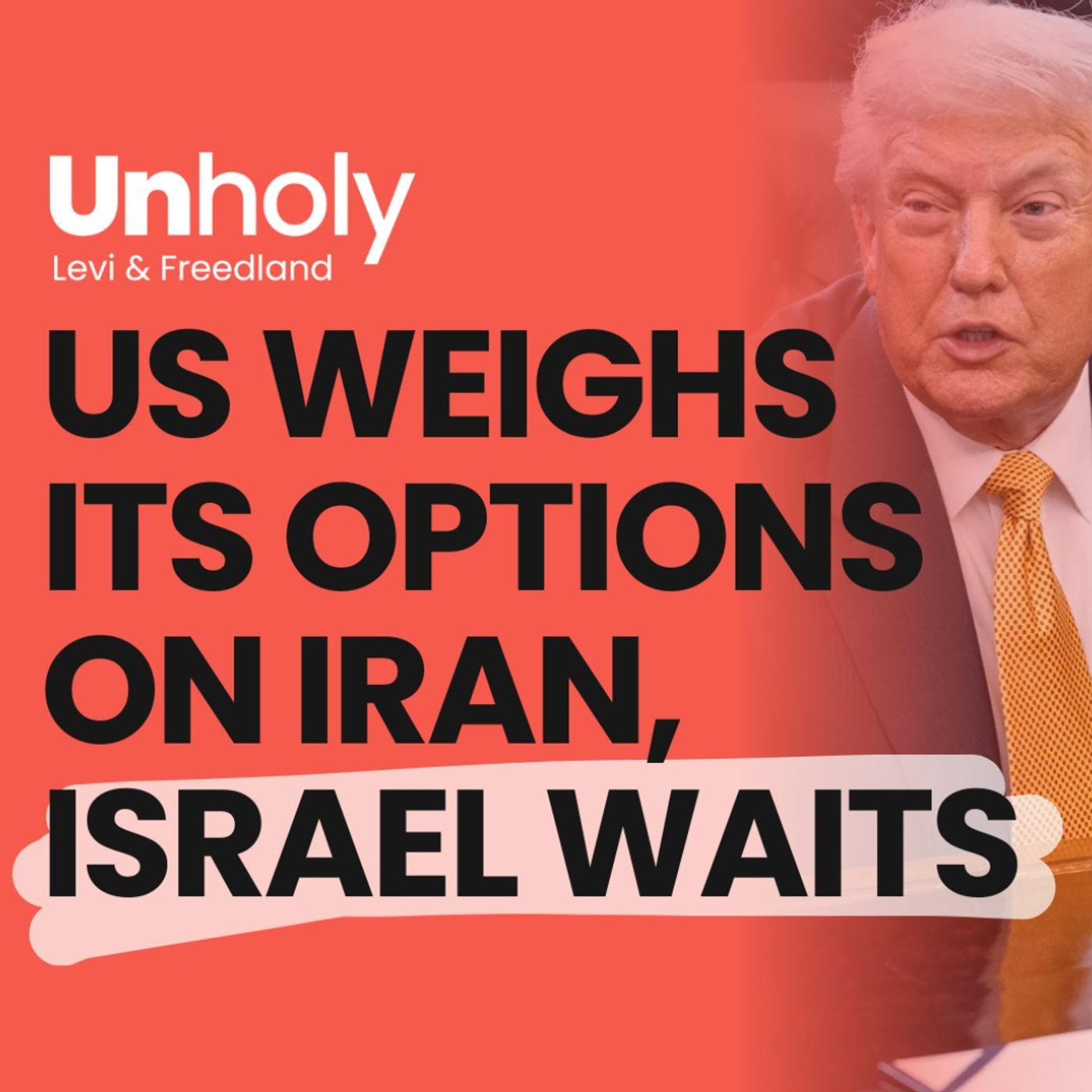
Unholy: Two Jews on the News
US weighs its options on Iran, Israel waits - with Suzanne Maloney
01:06:40
We have a new bonus episode out! find it in your feed, or here: https://bit.ly/49pirZ1 Watch us on YouTube: https://youtu.be/ICs1pgQgCbY For more Unholy content, social media, etc: https://linktr.ee/unholypod Iran is burning, the world is watching – and, as ever, everyone is waiting to see what Donald Trump does next. As mass protests face a ferocious crackdown that may already rank among the bloodiest in the region’s modern history, Yonit and Jonathan speak to scholar of Iran Dr. Suzanne Maloney about the possibility of an eventual regime change in Tehran, Washington’s options and Israel’s concerns. In the UK, a police chief is urged to quit as the truth emerges of his ban on Maccabi Tel Aviv fans, there’s a Mensch award for sporting excellence - and in the midst of it all, Unholy turns five.
Loading summary
Transcript80 lines
- [00:00]
Dr. Suzanne Maloney
I think what this moment should be for the United States and for the rest of the world is a wake up call that this regime is extremely dangerous to its own people and to the region, and that it should be intolerable that the regime itself continues. We can see that Iranians want something different. There are many tools that the United States and its partners can use to try to help prepare for some kind of a transition, to build support for opposition within Iran and to really isolate and apply pressure in every possible way on this regime. Foreign.
- [00:42]
Yonit Levy
It's Unholy. I'm Yanit Levy in Tel Aviv.
- [00:44]
Jonathan Friedland
And I'm Jonathan Friedland in London.
- [00:47]
Yonit Levy
And this week we will be talking to Dr. Suzanne Maloney, an expert on Iran, on what is happening inside and where this is all heading. It's also five years ago today, exactly, that Unholy aired its very first episode. We will also be talking about this later in the show. But we do recognize there are more important things going on in the world right now.
- [01:06]
Jonathan Friedland
There are so many, lots of them to talk about. So we will just park the celebration and sort of poppers and a bottle of bubbly and we will delay that while we talk about what has been a really intense week in the region and in particular in Iran. And just shocking numbers. I think that's the thing that has been so, you know, hard about this last week or so is that we knew, of course, the Iranians would crack down, the regime would crack down extremely hard on these protests, this eruption of mass protests on the streets. But the crackdown and, you know, reports of it are obviously always limited because it's very, very hard to operate and to cover that. But we're hearing reports of at least, I mean, the regime itself has admitted to thousands killed, mowed, gunned down, mowed down. But some talking about, you know, five figures, maybe more than 10,000, maybe even up to 20,000. We don't know. Reports of just morgues overflowing with bodies gunned down by their own people, by their own regime. So this is obviously a huge event. And yet somehow, because we aren't seeing, you know, hour by hour, minute by minute, pictures, photographs, footage, I'm not sure it's sort of cut through or penetrated the sort of global mind quite as much much as it should do, it is a really huge development.
- [02:34]
Yonit Levy
First of all, I mean, the numbers, as you say, are heartbreaking. The Iranian opposition station reporting 12,000 being killed. This is a regime killing its own people in cruelty that I think even all that we know about this regime has Surprised many. And we'll hear Dr. Suzanne Maloney later in the show actually saying that that is very surprising in this moment. Of course, the fact that they kind of cut Iran ayatollahs, they cut Iran off the Internet from the rest of the world means they can do this large scale massacre in the world. Can't do a lot. Yes, we can. I think in parentheses also mention that whereas Free Palestine is very, very popular, it doesn't seem like the hashtag Free Iran is. And you would expect more people to step up and say that this is terribly, terribly morally wrong. I should tell you that we are again, at this point, point, the world is again at this point where basically we're just waiting for Donald Trump. Right. And his decision, whatever it may be, to respond to this. He said he would. As we talk now on a Thursday afternoon, Israel time and London time, I mean, there are signs in both directions, right. On the one hand you have the USS Abraham Lincoln carrier redirected to the Middle East. You have non essential personnel in American bases in the Middle east evacuating. You have on the other hand, these news from Al Jazeera coming out saying Trump actually told the Iranians he's not gonna attack and saying yesterday that he knows that the executions have been canceled and he's happy about that. That could be a deception. We don't know where we're heading. There are so many questions. Mainly what is the American President about to do and how Iran will respond. Of course, in that is also the question what does that mean for Israelis? Let's say the mood here was quite on edge in the last couple of days.
- [04:25]
Jonathan Friedland
Yeah. I mean, I know that just from speaking with you and speaking with other people in Israel, that sense of anxiety that if the US Hits Iran, Iran hits Israel, that it's sort of the Great Satan, little Satan thing, they will always hit the target. That's more immediate. We're so used to this now, this pattern of waiting for Donald Trump, this notion of as a matter of strategy, being unpredictable. He's definitely doing that because he does say things that point in both directions. We're angry, we're getting less angry. And the idea of it being a feint, a sort of strategic play, that is very plausible. He was, he did similar things in the Venezuela case just a week or 10 days ago where there was some signaling that actually they were talking and so on and then action happened. So you just have no way of reading it. I was just going to linger just one last time on the, on the numbers because There are words that are, or place names really, that are steep, you know, seared into the memory in the Middle East. And in terms of numbers dead, what's happened in the last week maybe exceeds those. And the places I'm thinking of are Halabjah, the chemical attack in 1988 as the last stage of the Iran Iraq war, or the Hama massacre in Syria in 1982. This last week is in that order. Thousands and thousands killed. And so we're going to inevitably talk about reaction, responses, but this is just a very, very blood soaked for the people of Iran who were brave enough to come on the streets and protest against their own government.
- [06:07]
Yonit Levy
And the thing that seems very interesting again, Stalin, Trump threatened the Iranian regime, stop killing your people. They did the opposite. They actually doubled down on killing their people in an attempt to quite literally kill this protest. And to say to Trump, there's no protest, look, you don't have to intervene, cuz it's not gonna help. I don't know as we sit here on a Thursday afternoon if that worked for them or not, but if it did, it's a very worrying thing again from the Israeli perspective, just to sort of, kind of explain the mood we're in. So what might happen again if Trump does do something or attack or begin this attack, then what will happen in Israel will be that the home front command will raise alertness, meaning telling the Israelis, you need to be as close as possible to a safe room, not enter it, but just be as close as possible. That hasn't happened yet, but the feeling is like, you know how in weather sometimes like 40 degrees Celsius her a night, but it feels like 20, so it feels like it already has. And just to give you this indicative moment, we on the evening news in Israel aired the whole speech that Trump gave in Michigan, which was a, an economic speech, but it happened on the same day that he said, we are, you know, we're on our way, help is on the way to the Iranian people. So Israelis were listening very, very intently to every word he said. And his whole speech was aired on, on Israeli television. Let's say you only said 40 seconds about Iran in that speech, but Israelis got to know his state of mind on everything from Jerome Powell to transgenders.
- [07:38]
Jonathan Friedland
All of that was, I was gonna say, if you take a whole Trump speech live, you're gonna get every tangent about swimming teams and about his favorite TV show.
- [07:46]
Yonit Levy
Your friend here had to explain the context of all that. So that was like, you know, trying to look at modern art and explain what's going on there.
- [07:53]
Jonathan Friedland
So, yeah, no, it's very very, it's very difficult.
- [07:56]
Yonit Levy
What we do want is to bring you a conversation with one of the leading Iran experts world to try and figure out what this means for Iran itself and how close we are to the end of the regime. We will talk about other things in this show, but now I think we should focus on that.
- [08:11]
Jonathan Friedland
Yeah, lots coming up after this interview, we'll be talking about several very bruising episodes that have happened in the Jewish diaspora in different points of the globe, including Britain, Australia, all kinds of places. All of that following this week's interview. Doctor Suzanne Maloney is one of America's foremost authorities on Iran, as well as someone who's been with us on Unholy before. She's the vice president and director of the Foreign Policy Program at the Brookings institution in Washington, D.C. where she focuses on Iran, on the Persian Gulf, on energy. She's advised both Democratic and Republican administrations on Iran. And Suzanne, welcome back to Unholy. We're watching these events and I'm sure you know you that you are doing so particularly keenly with one question I think everyone has in mind, which is variations of is this the end of the regime? Are we witnessing the unraveling of the Iran regime which has been in place since the revolution?
- [09:16]
Dr. Suzanne Maloney
Thanks very much, Jonathan. I'm really glad to be back on Unholy. I'm very sad about the events that have brought us to this day. But I would say in answer to your question, it's a bit of a yes or no. I think we are seeing the unraveling of the regime, which is why they were prepared to use such intense and immense violence in repressing the protests that have erupted across the country. But I don't think that we are yet seeing the end of the regime. Quite unfortunately, that was almost predetermined because these protests erupted much in the way that we've seen unrest in Iran over the course of particularly the past eight years, the turn of 2017 into 2018. We saw similar protests again in 2019. There was, of course, the Women Life freedom Movement in 2022. But in most cases, what we're not seeing, and I think that's what's proven true here, is a real organization behind them, a political movement that can actually sustain a confrontation with the regime and that actually has a strategy for trying to persuade some within the regime to defect to create some kind of a transition process. We don't see any evidence that that exists, with the exception of the role of Reza Pahlavi, which we back to. But I think that without that, unfortunately, street demonstrations, as widespread and vociferous as they were, are never going to be enough to take down this regime. It's simply too well entrenched.
- [10:52]
Yonit Levy
You used the word were. And I wonder, now that we're in day 19, do we think that the protests are dying down from what you're gathering, is that what it looks like?
- [11:04]
Dr. Suzanne Maloney
It does appear to be receding in terms of the level, number and intensity of protests around the country. But I would say it's been very hard to gauge what actually is happening on the ground, especially since one week ago when the Iranian government essentially switched off the Internet, switched off connectivity, and plunged Iran into, effectively an information blackout. So there have still been videos and reports coming out from the ground over the course of that time, but they are selective. Most people are not able to contact Western reporters. There's very few sort of media outlets that have any presence on the ground. And so we simply don't know. But certainly the number of videos that have been circulating really since about Tuesday of this week have been declining significantly. And it does appear that, for the most part, the protests have been silenced as a result of the absolutely massive of violence that the regime was prepared to use.
- [12:10]
Jonathan Friedland
Does that mean then that the protests of early 2026 will simply have to take their place alongside previous eruptions, most notably, I think, 2009, as one of these mass expressions of popular discontent that comes and then goes, because ultimately it cannot succeed in its aim?
- [12:32]
Dr. Suzanne Maloney
I hope not. I hope that because of what we know has happened within Iran over the course of the past, that this is a trigger for the rest of the world to take a different approach to this regime. In 2009, as we know, even in the weeks after the massive protests over what was very genuinely understood to be a rigged election in Iran, the Obama administration was reaching out to the Iranians, trying to revive a dialogue and, in fact, intensify a dialogue around the nuclear issue. We can litigate whether that was the right or wrong thing to do. But I think it's quite clear that given how many people we believe have been killed and wounded in the suppression of these protests, it should be completely intolerable for any civilized country to continue to do business as usual with Iran. We're waiting to see what happens, particularly from the Europeans and others. Several states, including the British, did close their embassies, I think, out of a concern for the safety of their personnel and also out of some sense that there may be. And I think that's still possible, some kind of a kinetic action by the Trump administration. But I would hope that when you have the German chancellor declaring this to be the end of the regime, that they don't simply revert back to business as usual.
- [13:58]
Yonit Levy
So let's talk about those options, if we can, coming from the American president in particular. It's been 19 days. The Trump administration, Trump specifically has been threatening the Iranian regime. You know, as we sit here on Thursday afternoon, Israel time, Thursday morning, Washington time, it looks like the president, or perhaps someone is making it look like the president has got, you know, cold feet. There are now these news coming out of Al Jazeera saying that Trump told the Iranians he's not going to attack. So just your kind of thinking on where this is heading and in that very large range of what the American president can decide on, you know, the more extreme move being even taking down Khamenei, and the less extreme saying, let's black out all of the IRGC computers in Tehran. Where does this look like? I mean, where do you put your chips if you need to?
- [14:50]
Dr. Suzanne Maloney
Well, I think the fact that it's so unpredictable and so difficult to determine what this administration may be doing is one of the unique features of the Trump administration. Every U.S. or every government around the world is going to use, to some extent an effort to try to cloak what it may be planning rather than signal it very publicly. But this administration is so unpredictable and has, in fact, taken steps that prior administrations in the United States were unwilling to take, particularly the June war and the decision to bomb Fordow and really end Iran's enrichment program, at least for the foreseeable future. Also the assassination of Qasem Soleimani. So I don't think that we can presume that the Trump administration is doing nothing simply because they appear to have stood down, at least in terms of what appeared to be some very active planning in the early days of this crisis. So we know that there was a bit of deception used with the Iranians back in June to create the false impression that nothing was afoot. And of course there was. But I do worry about the posture of the United States, particularly the role of the president and his use of social media. We all watched the protest and want to provide support rhetoric historically from our own perches. But when the American president uses social media to promise that the United States is locked and loaded and that we will rescue the protesters, I think he has put American credibility on the line. And if we don't act in some way, we will have not just let down the people on the streets. I think we will have created a kind of Obama red line situation with respect to Syria, where it appears that the United States is either unwilling or incapable of making good on commitments that the American president has articulated publicly. That would be a terrible outcome. And so while I don't actually believe that there are good kinetic options for changing the state of play in the short term in Iran, I think the temptation, both for moral and strategic reasons, to enact some kind of a punitive strike on Iran must be fairly strong within the administration.
- [17:10]
Jonathan Friedland
And what would be? Because obviously there's a whole question about means, but what would be the, the ends, the goal of such a kinetic action? And, and in a way, I asked that because until recently, it would be obvious that if you take action, you want to, you know, regime change would, would be the one obvious goal. But after what we saw in Venezuela, where there was something less than regime change, there was dictator change, you know, getting rid of one person at the top, but keeping the regime in place, it means we've now got to think that, you know, for a variety of options. So what would actually be the goal? Before we get into the actual how of it, what would be the goal from Donald Trump's point of view of any action he might want to take?
- [17:49]
Dr. Suzanne Maloney
Trump has been pretty consistent throughout his political career that he doesn't want to see boots on the ground in the Middle east, that he doesn't want to see the United States once again bogged down in long term occupation or military activity, particularly in this part of the world. So I think he's likely to stay consistent with that. In this case, I am fairly skeptical about the possibility of a Venezuela option. There is, you know, this is a long standing and very coherent regime. We saw during the protests, even the reformists, even those who've been critical, who at times have been openly critical of their own government, they did not come out on the streets, they did not align themselves with protesters. So I think if you take out Khamenei, if you take out the senior echelon of Revolutionary Guards leadership, as Israel did back in June, this regime will simply replace itself. There are candidates already in waiting to take on the role of supreme leader. And unless some post Khamenei, post January 2026 Government in Iran is prepared to renounce all of the postures, particularly the anti American and anti Israeli posture, that have been so central to the Islamic Republic's ideology and its foreign policy, I don't think that we end up in a better. So you may take some kind of military action which is morally satisfying in eliminating Ayatollah Khamenei, but it doesn't actually produce a different outcome. Trump is prepared to live with that in Venezuela. I'm not sure that anyone in the region is prepared to live with an Iran which has been hit hard by the United States, is likely to respond militarily with retaliation, and still retains the same commitment to try to eradicate the state of Israel and to be antagonistic toward American interests in the region.
- [19:42]
Yonit Levy
I wanted to restrain myself from asking this question, but I will anyway. If you were advising the president now and you're saying, on the one hand there has to be some sort of price to pay for how violent this has been, how violent this regime has been towards its own people, on the other hand, anything you do with Iran has ramifications much beyond the Iranian border, what would you say? What does the president need to do?
- [20:05]
Dr. Suzanne Maloney
I think what this moment should be for the United States and for the rest of the world is a wake up call that this regime is extremely, extremely dangerous to its own people and to the region, and that it should be intolerable that the regime itself continues. We can see that Iranians want something different. We know that there's a talented and educated and incredibly supportive diaspora community around the world. And there are many tools that the United States and its partners can use to try to help prepare for some kind of a transition, to build support for opposition within Iran and to really isolate and put apply pressure in every possible way on this regime. I think cyber attacks on the capacity, the command and control of the Revolutionary Guard and the security forces that support them in street repression would be absolutely valuable. But I don't know that simply taking out the leadership actually brings us to where we want to be. This is a long term effort. I don't think it's a one and done kind of operation that President Trump pursued in Venezuela because this regime is so deeply entrenched and it's not going to be an overnight solution, but if we commit to the work of trying to ensure that this regime cannot stand and that we commit to be prepared for the next time Iranians come to the streets to respond in a way that's actually effective rather than just beating our chests, then I think that there is at least a better prospect that we'll be in a better position over time with respect to this situation.
- [21:47]
Jonathan Friedland
And you think that better prospect is possible even without the boots on the ground option that we know the President does not like.
- [21:56]
Dr. Suzanne Maloney
Yeah. I think the key is to try to find defections from the security forces. I was shocked. Personally. I think many of us have had our assumptions challenged over the course of the past few weeks. I never imagined that Iranians would fire on their own people at the level and intensity that we believe to be the case over the course, particularly of the past week. So I think that it's going to be absolutely critical to try to splinter the military and the security intelligence apparatus as a whole, and that is going to take time. We know, of course, that there are countries that have had considerable success on the ground in Iran. I'm not sure that the United States is one of them in recent years. But that would, to me, be an absolutely essential element of trying to ensure that we are, in fact, advancing a better outcome for Iranians, rather than just living up to what the President may have promised on social media.
- [22:55]
Jonathan Friedland
You mentioned earlier that the goal of any outside intervention should be to splinter the security forces. So there are breakaways and defections. What action could. Outside actors, I suppose, mainly the U.S. what could they do to make that more likely?
- [23:09]
Dr. Suzanne Maloney
Genuinely, I mean, I think. But I think that's absolutely critical because especially if you're gonna rely on, you know, the. The readiness of people to come to the streets, you have to be able to create a posture in which there's going to be some doubt sown within the security forces about their survivability unless they walk away. And that was a key element of the revolution in Iran. The fact that the military effectively, at a certain point, said they wouldn't engage in further repression and then aligned themselves in the final days of the regime with the revolution itself. You know, that's a very different context, but this, to me, was the most horrific aspect of what has happened. The fact that you saw so many people willing to engage in such horrific violence to preserve a regime which is absolutely unacceptable.
- [24:02]
Yonit Levy
But hasn't that happened before? Or this time? It was just so cruel because it has happened before that protests were stifled with violence.
- [24:11]
Dr. Suzanne Maloney
Yes, but I mean, look, in 2009, they mainly clubbed people. There were some, you know, we know Nada Agha Sultan died on the streets before the eyes of the world. She was shot. But it was not the kind of, you know, sort of automatic weaponry. It was not the Revolutionary Guard. It was the security forces, for the most part, in prior protests. We do know in 2019 when they closed the Internet. At that time, there are Credible reports of 1,500 people that were killed over the course of the following week, which is why I think everyone understood as soon as they announced they were disconnecting the country from the international Internet, they have a domestic Internet that that was going to be. That was a very, very bad sign. And they have not, of course, restored full connectivity at this time. So, again, what we know is still very much subject to what people can find ways to get out via episodic access to Starlink.
- [25:12]
Yonit Levy
The nation here has been kind of on edge, waiting not only for what the President might do, but what might be the Iranian response specifically towards Israel. I wonder if the logic should be that at this point in time, the Ayatollahs wouldn't want to invite an Israeli involvement in this whole thing. Meaning even if Trump does attack whatever he does in Iran, that doesn't necessarily mean that the response will be be targeting Israel.
- [25:40]
Dr. Suzanne Maloney
You know, I think given this, the ferocity of the response that we've seen on the streets, I don't think we can rule anything out with respect to how the Iranians would respond to a strike by the US in response to the situation on the ground. And what I'm concerned about is simply that they obviously see this as existential. That's why they were prepared to mow people down with military grade ammunition and weaponry simply for going out and shouting for a different government. I think that they will not be as calculated in their response to an American military strike as they were in June, as they were in the prior rounds of exchanges between Israel and Iran. So they will see this as sort of absolutely essential to maintaining their own credibility and to effectively their own lives. I mean, they know that when this regime goes down, none of them survive. So they're going to do everything they possibly can to ensure that they try to deter further action. And I would be concerned that they would in fact, escalate significantly rather than engage in what, at least with respect to the American military base in Doha was a more symbolic attack. We know that their efficacy, their capacity with respect to Israel, you know, they're significantly outmatched. But all they have to do is get lucky once or twice and cause civilian casualties at a higher toll than they've been able to do in the past. And I think they'd be prepared to take that risk if they think the regime itself is in danger, which is absolutely the case.
- [27:16]
Jonathan Friedland
And from their own point of view, their logic in doing that in hitting at Israel would be what? That the Iranian people will close ranks and rally behind their government if it's a fight with Israel, is That the thinking that they would have.
- [27:31]
Dr. Suzanne Maloney
No, I don't think they have any hope of rallying and I imagine they know they have no hope of rallying the Iranian people. They would, of course, and have tried to portray the protests as having been directed from outside. So they can, you know, an attack on Israel would be a further justification, further corroboration from their perspective. I don't think they're going to attack without precipitation. I think it would be a way to respond to the United States, some kind of an attack by the United States that is an attempt to deter, an attempt to persuade the Saudis, the Qataris and others to jump in and try to engage in more intense diplomacy. You know, we know that in fact during the height of the violence over the course of the past week, there was outreach, presumably through the Omanis from the Iranians to offer some kind of a new nuclear negotiation. They may believe that this president is so interested in deal making that they can in fact dangle some potential concessions. I don't think they're prepared to give up their nuclear program. I think that's also existential for them. But you know, we can, I would imagine that there are going to be a variety of avenues that the Iranians use to try to regain the advantage and to try to ensure that the administration doesn't take overwhelming action which could I think be quite dramatic for them.
- [28:57]
Yonit Levy
We are more than six months after those 12 days in June. Obviously there has been a lot of talk about the sort of damage to the ballistic missile program, damage done to the nuclear enrichment facilities. A lot of talk from politicians. You're a professional. Can you tell us where Iran is now in that regard after that war?
- [29:20]
Dr. Suzanne Maloney
I think the biggest concern from everyone here in Washington, and I believe that's also echoed in Israel, is about the effort that they're making to rebuild the ballistic missile program. Because that is, I think what they see is their near term deterrent, their ability to hit hard, potentially unilaterally or in response to any kind of attack. So that is, I think, the most urgent concern. I remain convinced over time that they're going to find a way to resume enrichment. And I think that will then once again put us in a dangerous situation without inspectors on the ground. So I think that both of those, you know, the state of play, Iran is heavily weakened in terms of both its sort of air defense, its ballistic missile program and its nuclear program, as well as its proxy network. But it's still quite a dangerous actor. And in some respects, I think the fact that it was weakened on the ground is what persuaded Iranians that this might be a new moment, this might be a different moment for them. And it is part of the overall delegitimization of the regime from within, that they really have very few ways to try to counter in the short term.
- [30:34]
Jonathan Friedland
So just picking up on exactly that, this moment of weakness, isn't it as possible as some new kinetic response from the Trump administration that it goes actually the other, other way? And thinks, and I think you nodded to this by talking about Trump as being a deal maker. His kind of real estate brain would think, this guy's on the floor now, now's the time to screw out a good deal from him on the very things Yoni mentioned on the nuclear capability program, on ballistic missiles. And so actually, what emerges from this is a handshake, as it were, with a weakened. And I wonder if a lot of the rhetoric that you again referred to about we're ready to go locked and loaded, Trump being Trump, he would walk away from those commitments and instead actually seal a deal at a moment of maximum vulnerability.
- [31:24]
Dr. Suzanne Maloney
I think that's a real possibility. It apparently was being discussed whether the administration should take up this offer from the Iranians. And the president's most recent remarks have said that he's not interested in doing so, but we know he can turn on a dialogue time. And this is something that the Iranians have always used the opportunity to engage diplomatically, which they typically withhold. We have no formal diplomatic relations. And over the course of the past 47 years, it's been Iran that's been unwilling to negotiate for most of that time, rather than the United States, which has almost always been prepared to engage in direct diplomacy. So I think if they put an attractive enough offer on the table, it's entirely possible that the administration will be tempted. They may think they can do some kind of a Venezuela arrangement where they do a deal, they persuade Khamenei to step aside, or, you know, there's some kind of symbolic leadership change. But I think unless the regime can actually renounce its own core principles of anti Israeli and anti Americanism and its own hostility to its own people, I don't see how this regime survives. I don't see how anyone who is complicit in the brutality that took place over the course of the past week can have any legitimacy with the Iranian people. And that really does mean that we need to plan for something that looks very different. Even if there may be people in Washington, there may be people elsewhere who are looking for A less holistic transition, simply because it does seem like a Herculean effort, even at this moment, to imagine an entirely different regime in Iran.
- [33:01]
Yonit Levy
So let's try and use imagination and say, let's see that what we think or imagine that what we're seeing is really the beginning of the end of this regime. It will take time. It will take people on the ground. It will take, particularly the Iranian people coming out in full force. It might take years. Is there a leader anywhere of the opposition that might take the role? Is it the obvious son of the Shah, or is there someone else that's waiting sort of behind the scenes?
- [33:31]
Dr. Suzanne Maloney
I hope there is a leader. I'm not sure I see someone who is well positioned and can actually drive a movement forward. Reza Pahlavi has a constituency in Iran. Some of that is, I think, just symbolic in the sense that many Iranians, especially this generation, don't remember the monarchy, but certainly know that life was very different then. Iran was a respected country in the world. It had a booming economy, and it had a very liberal orientation, for the most part, at home. And that is something that they all aspire to. Better economy, prosperity, trade, engagement with the world. And that makes Reza Pahlavi attractive. He's also been the beneficiary of a fairly assiduous effort to expand his profile through a satellite television station, which is very, very much pro Pahlav. I think there's also, you know, he has some genuine affinity and appeal to Iranians. There's nostalgia for the monarchy, but I do think that what we've seen over the past several weeks does not suggest that he's well positioned to be a leader of any movement. He didn't seem to understand that as he called for Iranians to go to the streets, that there was no real likelihood that that was going to lead to the end of the regime itself. And he put put individual Iranians in incredible danger. And he's called on the administration to engage in military strikes. I understand that, but that, too, there's no short term, easy fix to this regime. It's going to take a lot of time. So I think Reza Pahlavi has an important role to Play. But after 47 years outside the country, the idea that he could do what Ayatollah Khomeini did, which was to come back from exile and seize control of a tumultuous situation and actually build a government that could last, seems a little bit hard to imagine. I think there's a role for someone like Reza Pahlavi in terms of Mobilizing the diaspora, unifying the diaspora if possible, creating the funds and the capacities that will support a genuine opposition movement within Iran. But I would assume that some leader is going to have to come out of a domestic context in Iran to be sustainable and legitimate over time.
- [35:57]
Jonathan Friedland
And do you see any signs of that? Are there any figures on the inside or almost by definition, if someone had emerged, they would have been removed and eliminated.
- [36:08]
Dr. Suzanne Maloney
I don't see any figures, but you know, if there were a movement, they wouldn't probably be advertising themselves to those of us outside. There are, you know, plenty of organizations in Iran. Most of them have some semi governmental role, whether it's just student groups or labor unions. They were all sort of co opted by the government. But we know that those are the types of activities that do produce leadership and help individuals begin to rise to the fore. I think there's a lot about Iran that we're not able to access. We see an immense amount of imagery from outside, but we don't really have a texture for what's happening behind the scenes. So I'm hopeful, but I would say there's no one person at this stage.
- [36:54]
Jonathan Friedland
No. I suppose what I was looking for is whether there's a sort of Gorbachev type figure, in other words, someone from within the ruling elite who has marked themselves out even very subtly as reform minded and ready to break from some of the shibboleths of the regime.
- [37:09]
Dr. Suzanne Maloney
Iran has a whole movement of those people, but they all stayed silent over the course of the past few weeks. The original reformists, some of them are of course under house arrest or many parliamentarians and newspaper editors who've been forced to leave the country. So again, I think there is a kind of recent exile diaspora that can be quite useful here and quite effective. We will have to see. I don't think we've seen anyone who appears prepared to defect from the regime with real leadership potential. But that may still be coming, that may still be playing out behind the scenes, be watching various people. But I think, I think the challenge is anyone who is perceived to be complicit or perceived to have not opposed what has happened on the ground, I would think is going to have a very difficult time persuading those who risked everything and suffered such incredible losses to rally behind them if they come out after. If someone like former President Rouhani were to try to position himself, I wouldn't put it past him. I just have trouble imagining how that would play with, with families who've lost loved ones as a result of their willingness to actually go to the streets and demand an end to the regime.
- [38:26]
Yonit Levy
Dr. Suzanne Maloney, you made us smarter as usual. Thank you so much for talking to us.
- [38:31]
Dr. Suzanne Maloney
Thank you.
- [38:38]
Yonit Levy
Always great to talk to. Dr. Suzanne Maloney, let's talk about the announcement that came out while the whole world is kind of looking at Iran and watching Washington and wait, waiting to see where all this is heading. And what we heard was Steve Witkoff, the President's close advisor, has a very thick portfolio on many things in the world, including Iran. But he was talking about Gaza in this case and saying that the part two of the deal, the deal between Israel and Hamas is moving forward. It means that the disarmament of Hamas needs to happen. It means that Israel needs to withdraw from what it is, what is called the yellow line. Right now, Israel, Israel has a presence in about 53% of the Gaza Strip. It means that Ran Gvili, who is the last deceased hostage that is still held by Hamas, will be brought back to his family. It also means that there will be some sort of governing body in Gaza and a military presence, an international military presence also. I have to say I'm still not clear on the details. It does seem, Jonathan, to me more like something that is being said because you have to balance out the sort of war drums relating to Iran and put out this declaration. But I still don't see how all of this moves forward. And as an Israeli, I'm still not clear specifically on how this disarmament of Hamas is going to happen as we speak. Now, tragically, the situation is that Hamas is still the strongest, strongest entity in the Gaza Strip. Not only that it's building, rebuilding itself militarily, but also holding the civic administration. This is not how we hoped it would look more than two years after October 7th.
- [40:20]
Jonathan Friedland
Absolutely right. If Hamas is getting more entrenched by the day, in, in day to day control of life in Gaza, all accounts suggest that, and absolutely that's its sort of security grip and hope. Other words, there's both the police force and the sort of governing authority on the ground, it seems to me, is reconsolidated. That was always bound to happen if there wasn't action immediately. As soon as October, when Donald Trump was taking his sort of victory lap in the Knesset, in Jerusalem and then in Sharm El Sheikh, there were people saying then, this is in about now. This vacuum cannot be allowed to last even hours before humble Hamas step back into it. If you want this to be changed, you have to get in there now. And there was no sign of that. And there had to be a sign of gripping the new situation, otherwise of course, Hamas would assert itself once more. And that's exactly what's happened. And you listen now, you watch, you know, archive footage of six months, nine months a year ago of Netanyahu talking about the eradication of Hamas, the destruction of Hamas. They'll be gone, of course. Could the. Of course Gaza can never go back to being run by Hamas. It already has. It's. We're absolutely at that point. I think this is one of these things. All of this. This is show, don't tell. So we needed not Witkoff to get up and say, we're doing phase two. You would know that was true if you were seeing it. If there were the beginnings of the process of, you know, de Hammas Ification of Gaza, Hamas step receding, new technocratic governance coming in the assembly of this international force that's meant to take its place, that would be happening practically. And as I've said repeatedly on here, I always believe and have been told that the disarmament piece of that comes after the other pieces. It becomes possible and doable. Once you do have these beginnings of change in governance, the beginnings of an international presence, so on. It cannot be. These things are so often about sequencing. This was the big lesson in Northern Ireland. The sequence is such that the disarmament becomes logically entailed by everything that's gone before. Decommissioning or demilitarization rather. I just don't see this. I see this as telling, not showing. That's a pessimistic outlook. I'd love to be proved wrong. The Trump people are nothing if not unpredictable. Maybe they've done something that we don't know. But as it stands, it just looks like a statement to me. It looks like, like words rather than deeds. Meanwhile, the events of this last two year period, what happened after October 7, continued to reverberate across the world and certainly across the Jewish world. And just one episode of that that is worth updating on, because we did talk about it on the podcast when it happened, and that was this very controversial football fixture between, between Israeli club Maccabi Tel Aviv and Aston Villa, a English football club in the West Midlands. In Birmingham, the game caused huge controversy because the police decided that they would, in effect, ban visiting supporters from Maccabi. They said the supporters, the Israeli club couldn't happen. There were fears, they said, over security. And the fears that they had in mind were that Maccabi fans would run riot or be aggressive, bring trouble with them. That was the official word that came from the police, there was huge outcry about that. There was then an investigation into this decision by the police. And just this week the findings of that investigation have emerged and they are pretty shocking. The statement that was made by the British Home Secretary, the equivalent of the Interior Minister here, cast huge doubt on everything the police had said about their reasoning for their decision. Decision. A big part of it was the claim that Maccabi Tel Aviv fans had behaved badly when they had played in Amsterdam against the club Ajax. And the British West Midlands police claimed that Dutch police had told them that, you know, Maccabi fans had brought trouble there. Well, here's what the Home Secretary, Shabana Mahmoud said. Claims, including those about the number of police officers deployed, the links between fans and the Israel Defense Forces, the targeting in Muslim communities, the tearing down of Palestinian flags and attacks on police officers and taxi drivers were all either exaggerated or simply untrue. The Dutch police, it turns out, had said when it was claimed that they had been the source for this information that led to the banning that we didn't know. We never said that. That's not how it was at all. And as if to distill the. The poor decision making, poor judgment or worse from the West Midlands police, their Chief constable, the man in charge, was forced to admit that one piece of evidence he had cited, which was alleged misbehavior misconduct by Maccabi Tel Aviv fans in a game played against another English football club, West Ham. He had to admit that that was erroneous. Why? Because there had never been a game with West Ham. It never happened and they believed there had been, had been because of AI. They had relied in writing their advice on, to explain their decision on the Microsoft product Copilot. And the AI had hallucinated a bogus fictitious game between Maccabi Tel Aviv and West Ham. And that was one of the reasons why Maccabi Tel Aviv fans were kept out of the country. This is such an upending of what should be the logic of, of policing. Of course, what you should do is protect a minority who are in facing potential danger. And it now seems it was they, Maccabi Tel Aviv fans who faced danger from hostile members of the public in Birmingham. And instead they were punished. They were the ones punished. The Home Secretary here, Shabana Mahmood, who is herself a Muslim, by the way, has called for the head of the police there to, to, in effect she's called from, to resign. She said she no longer has confidence in him. It's not up to her to fire him. But this whole episode has brought great discredit on those police. And it means many of those people who said at the time that Maccabi fans were being unfairly punished. And I'm afraid I didn't completely give the full weight to those complaints that I perhaps should have done because I didn't think the police would make up evidence and I didn't think the police would rely on AI hallucinations. Those people got this wrong. So a really sorry episode from start to finish.
- [46:59]
Yonit Levy
Yeah, I agree. And I think it's scandalous. I think that the fact that they portrayed, essentially portrayed in Hebrew. Right. The expression is lashon Hara. You really just scandalously. And smearing the fans of Maccabi, some of it with fake, fake, complete fake stories. And then not taking the risk and not. Not understanding that the actual risk is to them and that you need to protect them and not. And the other. The opposite was done. I mean, I think it's. It's a scandalous thing. I'm glad at least that the truth has come out on this. There's another story that you wanted to relate to, though.
- [47:35]
Jonathan Friedland
Yeah, just. Again, just showing you how this. The reverberations ripple all around the world. So the Adelaide Writers Festival, which is a big thing in Australia, due to go ahead in the end of February, beginning of March, Full disclosure, I was due to be a speaker there myself. That has now been cancelled. And it followed the dis. Invitation of a Palestinian Australian speaker. The organizers of the festival said that it was no longer culturally sensitive to have this Palestinian Australia Australian speaker come in the aftermath of the terrible atrocity, the massacre at Bondi Beach. The Jewish community had called for this speaker to be disinvited from the festival. The festival board did disinvite her against the wishes of the festival director. And then hundred dozens, dozens and I think eventually over a hundred speakers planned speakers at the festival pulled out the saying this was a violation of free speech. The Palestinian Australian speaker herself had said that in previous comments prior to her invitation that in her view, Zionists did not have the right to quote Cultural Safety. That phrase took on a very obvious, a very particular meaning after Bondi Beach. And so the organizers felt she did not. It was not conducive for her to be there at the festival. But in claiming that her free speech had been violated, dozens and dozens pulled out. And in the end the whole festival's been cancelled.
- [49:19]
Yonit Levy
Yeah, I actually think that sounds terrible even if you don't take into account what happened on Bondi beach, what she said. But yes, I, you know, that just sounds terrible. Even after October 7th and even before.
- [49:30]
Jonathan Friedland
Yeah, no, I agree. This week is like all week, since the very first one, actually. For five years we hand out some awards. Crowded field yet again in chutzpah. I'm just going to offer one. People have read tons about this, but just it's a big international one. Elon Musk, I think he's been nominated a few times. This product, I mean really, how do we dignify it with the word product. Grok, his AI software. You can ask it for any of thing until it seems very recently. You could give Grok an image, a photograph and say manipulate this in the following way and if it was a woman you could ask and if it was anyone to digitally undress that photograph and then all kinds of variations could be made to put that person, the image of that person, into a sexually compromising position. People have done this and Grok will happily comply with requests to depict women that way, children that way. The, the. I first came across this, I wasn't aware of this until I saw somebody had shown that in order to taunt a Jewish woman on social media, somebody hostile to her. Of course, Anonymous had asked Rock, a Jewish woman, to depict this woman in a bikini and then ask the bikini, ask Rock to make the, the backdrop the gates of Auschwitz saying arbeit macht frei and then to make the bikini in the notorious blue and white stripes of the Auschwitz uniform. And Grok of course complied and X showed that image and it was widely available to anyone who wants to see it and no amount of complaining would do anything about it. That is what this technology has done. There's now pressure the British government, other government governments have been saying, demanding that this feature be disabled. And finally Musk has said it will be, but who knows? He's made promises before, but until now he was saying they're trying to curb free speech. As if this pornographic, misogynistic, child abusing tool counts as free of expression. It's repellent and disgusting and Elon Musk deserves to be called out for it.
- [51:46]
Yonit Levy
I will add one more story. I'll do it carefully. It has to do with our competitors on channel 14. One of their correspondents named Tamil Murad was writing a tweet he said, we published on the main edition of Channel 14 foreign elements are arming the protesters in Iran with live weapons. And this is the reason for the hundreds of dead among the regime's people. And the last line of the tweet being anyone is free to guess who we're talking about. What happened after this was that the Iranians themselves, foreign minister, minister first, and then the rest are using this to prove that Israel is behind the protests in Iran, thus giving them reason not only to stifle the protests themselves, but also perhaps later to attack Israel. This is a, I don't even know if to put it under chutzpah and not just kind of oyve silly thing to do kind of title, but this is kind of, I think an attempt to say, say look how great Israel is or how Israel managed to infiltrate even to this point to rally the troops around Israel. When you're actually creating this kind of damage, we should say, and just to make very, very clear, Israel is not organizing the protests against the Iranian regime. Just to make that clear. Should we move to Mensch?
- [53:05]
Jonathan Friedland
Why don't we. Yes, let's do that.
- [53:07]
Yonit Levy
This will go under. It's the title. This is very surprising that we haven't made a Mensch thus far. But Denny Afdia I think deserves our Mensch award this week, perhaps also last week, quietly turning into one of NBA's most compelling stories this season. Leading the Portland Trailblazers with all star level production, career high impact both ends of the floor. There's something very sweet about him. Not only is he great, but also, you know, when he talks he always, he never says I, he always says we. He really is a team player in every, you know, form. He's already the most successful Israeli in the NBA. He might be the first Israeli to play in an NBA all star game. He has been battling an injury. We hope all, you know, we, we wish him the best but I think he's a great, great story and he deserves mention war this week.
- [53:53]
Jonathan Friedland
Yeah and I was just going to say a collective men award perhaps in this week to the people who have taken to the streets in Iran and who have paid obviously an extra extremely high price. We talked about it obviously earlier on in the podcast but a mention of them as well and we will celebrate and raise our champagne filled glasses to each other because it's been five years, Yonit.
- [54:17]
Yonit Levy
Five years. Yes, five years exactly. January 15, 2021, the very first episode of Unholy, which was called a vaccination. We were talking about Israel being trailblazers in vaccine Covid vaccines. We're talking about a president, new president in Washington, Joe Biden about to swear be sworn in. We're talking on the cusp of an Israeli election. We didn't know it then but that would actually in his eyes for sure usurp netanyahu and bring Naftali Bennett as a prime minister to Israel. It was a different time. I think the only comparison is because we're yet again looking forward to an Israeli election. We should say this. Perhaps that Unholy was born. On a Sunny June day, 2020, I was driving to work. I commute. The law in this land is that news has to air from Jerusalem. So I commute from Tel Aviv to Jerusalem. I listen to a lot of podcasts, and one day I was thinking there should be a cool podcast about Israel and the Jewish world in the Middle East. And by the time I arrived at work, I'd not only convinced myself of my great idea, but also that I can do it. And I called my friend Leor Friedman, who lives in London, and I said, what do you think? And he said, I think it's brilliant, and let me tell you who I think he should do it with. And there were three seconds of silence and he said, jonathan Friedland. And then we said. I said to him, great name, but will he say yes? We called you up. Yeah, of course, being very Israeli, we pretended we had been talking about this idea for. For weeks. And we have. The whole thing, the whole everything was well thought out. And surprisingly, I should say for a very. Not only you, not only me, but only also you, a chronic overthinker, you said yes, quite quickly, actually.
- [56:06]
Jonathan Friedland
It's true. I was walking on Hampstead Heath and I remember going in and out of signal. So I think probably the bit where you said, let's do a podcast was the bit where the signal glitched. And I said, yeah, yeah, whatever, sure. No, I thought that the idea was a brilliant idea in a way, and podcasting was in its infancy, and the idea of two people speaking once a week, checking in about a subject of kind of mutual interest, obsession, commitment, seemed to me a very good idea. I think I've mentioned before, the model in my mind was a podcast about Arsenal Football Club that I listen to every week. And I thought this would be like. That it will be two people who. And the thing, the joy of that podcast, the Arsenal, Arsenal on is that they both support Arsenal, right? So everything, every else, everything else they talk about is set against the backdrop of having that thing in common. And I think in a weird way, that's what it's like with us, that we may disagree about this or that nuance, but we basically support the same team ultimately, and we want the Jewish people to thrive and flourish. And so the peculiar thing about the podcast medium is that it's made that the conversation that happens between two people who share ultimately definitely the same goals, rather than the old style crossfire, you know, from the left, from the right, for and against, black, white. It's made that thing very, very enticing. So that's what I thought we would do. I did not know we would be going into what has been a very turbulent period for the Jewish people. People, I think, might be surprised here that we've been doing this five years. So many people joined us after October 7th. They think it was our creation then. In fact, we now realize as we mark this anniversary, we were together on this podcast more time before October 7th, I think, than after. Just. I think it's about the halfway mark. And so we've been doing this a long time. And I think, you know, your notion, you lior that phone call, you know, you were onto something.
- [57:59]
Yonit Levy
It definitely is a different time. Before and after. Before it was. It was important, and it felt like it was kind of two cousins calling each other and saying, hey, what was happening on your side? And I think the minute, even before October 7, the judicial overhaul started, it became very serious. And obviously after October 7, when we dived into some of the, I can't avoid saying kish kiss of a lot of things, and the conversation became more difficult, but in a way real about real problems. And even between you and me, I think that became a very, very intense thing. But a very important, I hope, moment, I think. I guess I feel like asking, maybe it's a risky question. I feel like asking if there's ever a moment where you're like, I don't want to do this anymore. Crazy, silly lady. Go away. For sure.
- [58:54]
Jonathan Friedland
Well, I was going to say for sure because in that period, everybody, I think surely in that post 10-7-period had moments where they just wanted a sort of go stay in bed and pull the duvet over their head and make the world go away kind of thing. There were so many people who didn't want to go to Friday night dinner with their family. They thought, I just can't do this anymore. Didn't want to go to argue with their colleagues in the university common room or whatever it was because it was so tiring and so difficult and so painful that period. And so I think it would have not been, you know, it would have been strange if we hadn't had moments where we just thought, I can't take this anymore. Because. Because this process was forcing us to do what a lot of people did actually actively avoid, which was to stare at what was a really painful unfolding reality and to really go deep into it. And we, unlike most people, we never got a week off. So there were people all the time I would come across who would say to me, I'm just, I can't do it anymore. I'm going to unplug from the news or I'm not going to phone my brother this week because it would just be another row, you know, so there were moments like that, but that's all it was. It was never a serious plan to, to, to do anything because I knew that what we were doing was, you know, really valuable and important and it had to be faced, you know, and that the, you know, there's a desire often to run away from what's difficult, but you don't do it. And I think this is why it's what people tell, tell me they appreciate that the conversation you and I have is no matter. Even when we have disagreed really strongly as we did in that period, we stuck to it and we stuck with it. Which reminds me of something I was going to say before about why the idea always leapt out to me as a good one. The absence. This I think maybe is what came to you when you were in that car in the traffic jam. There was no other channel anywhere in the Jewish world for Israelis and Jews to talk, Diaspora Jews to talk to other incredible as that seems there wasn't a single forum really. There was definitely a lot of one way traffic. There were people, you know, who would read, you know, some of the Israeli newspapers online in English. So that's a one way channel from Israel to the Diaspora or there are Diaspora Jewish leaders who go on these missions to Jerusalem, exactly what you're satirizing. And they meet Israeli politicians, but Israelis don't come to, you know, the Diaspora particularly and want to hear what Diaspora Jewish life is like. So, so the idea of a two way dialogue between Diaspora and Israel even before October 7th struck me as a really good idea. After October 7th, I think it became kind of essential and I think that is why many people turn to us. Because it was the one place where instead of talking about each other, we were talking to each other. And of course that was going to be difficult. It wouldn't have been real if it wasn't. But I think it was valuable. So I'm bound to turn to the same question back to, to you, what about you? Did you ever have a moment thinking, my word, what have we done here? Let me walk away.
- [61:50]
Yonit Levy
So I'm going to answer that. But before I do. I'm just going to say 95% of the time, I'm having fun doing this. Fun in the nerd definition of the word fun, which means intellectually stimulated. I'm having a lot of fun. Those moments when it is difficult is really part of. I love that question because it's part of what we're doing in the sense of how do you have a conversation when the conversation itself is difficult? How do you talk when talking is a problem? And we've been through that a lot. And I think that the answer to that is kind of two things. One is keep talking however hard it is. This is very counterintuitive to the way I was raised, but still, this is the conclusion from doing this podcast. Just keep talking. And the other important thing to say is remember who you're talking to and what they're going through and why you chose them to talk to and why that choice is important. So, you know, going back to that conversation with Lior 19th of June 2020, every time I get very angry, I ask myself, would I prefer it if he had said a different name after three seconds? And the answer always is no. So, you know, as long as that is the situation, I think it's okay.
- [63:17]
Jonathan Friedland
You're saying you're very angry with me sometimes, but that is, that is, that is the Jewish response occasionally.
- [63:24]
Yonit Levy
But I think that's like.
- [63:25]
Jonathan Friedland
You didn't like what was wrong with the red tie, right? What was wrong with the red tie?
- [63:29]
Yonit Levy
That is exactly what I was saying. Jonathan, way to highlight the, the, the headline. I.
- [63:35]
Jonathan Friedland
But no, I was going to say too, while we're just doing this, and we'll only do this once now and we'll won't do it again for another five years. But equally, I mean, even when we have really been at the, you know, moments of great strain and you have asked me actually sometimes, oh, even in a joke, oh, I bet you wish you'd never taken that phone call in June 2020. I never really. I, I never have. Apart from in the mobile moments of absolute, you know, pain, I've never sort of thought that's true. On the contrary, I've thought, I'm really glad that you, you know, you, there were many other people you could have phoned, but I'm glad you phoned me. And I think we, it's, you know, there couldn't have been a better co. Conspirator for us to be on this journey with. For me to be on this journey with. So I think it's, it's all worked out very well. And you should have more drives and traffic jams more often because who knows what will come about.
- [64:25]
Yonit Levy
I just want to one request if so, which is I'm tired of that story that says the crazy Israeli lady. I was walking at Hampstead Heath. The crazy Israeli lady calls me up and says, what about a podcast? We're changing that story. The story will be that Jonathan's walking alone, alone Hampstead Heath. He's wondering about his life and he's asking himself, he's saying to himself, self, I've written dozens of books and I've written thousands of columns. What is the meaning of. Of all this? And then an angel, an angel dressed as a TV anchor woman, as angels often are, called you up and, you know, changed your life. So that is the story I'm telling from now on, if you're okay with that.
- [65:04]
Jonathan Friedland
Yeah, I think we'll have to.
- [65:07]
Yonit Levy
We'll.
- [65:07]
Jonathan Friedland
We'll run that through the fact checking machinery of unholy. It's a nice account and in a way it's not a million miles away.
- [65:13]
Yonit Levy
From a million miles away. But I will give you final scoop on what Leol said after he said the name Jonathan Friedland, why he thought it would be perfect, which I never told you. And this is.
- [65:21]
Jonathan Friedland
You have never told me this.
- [65:22]
Yonit Levy
The deep intellectual thinking on why you would be perfect to do this podcast with me. He said, it's perfect. He's outside, you're inside. He's a man, you're a woman, he's English, you sound American. It's perfect. That was analysis.
- [65:40]
Jonathan Friedland
No bad.
- [65:40]
Yonit Levy
We're done. We're done. Mish. Producer. Producer's like, stop talking about yourself. We've done enough. It's been enough.
- [65:46]
Jonathan Friedland
We have done. We only have one last piece of business to transact this week, which is do our thank yous by popular demand. Yonit, it's gonna be you thanking our producer because I know that everyone loves to hear you pronounce her name.
- [66:02]
Yonit Levy
A big thank you to Michal Porat. We hope you're not running away for we have at least five, five years to do this, you know, left. So please. And to our listeners, I think a very big thank you for being with us and we will meet again next week.
- [66:17]
Jonathan Friedland
Yeah, we didn't ask them if they ever felt like packing it in. If you have, do not give in to that impulse.
- [66:23]
Yonit Levy
Please don't. Please don't.
- [66:25]
Jonathan Friedland
Do not. We love you being there and thank you for being there. This with us every step of the way. These last five years. We will see you next week.