← Unholy: Two Jews on the News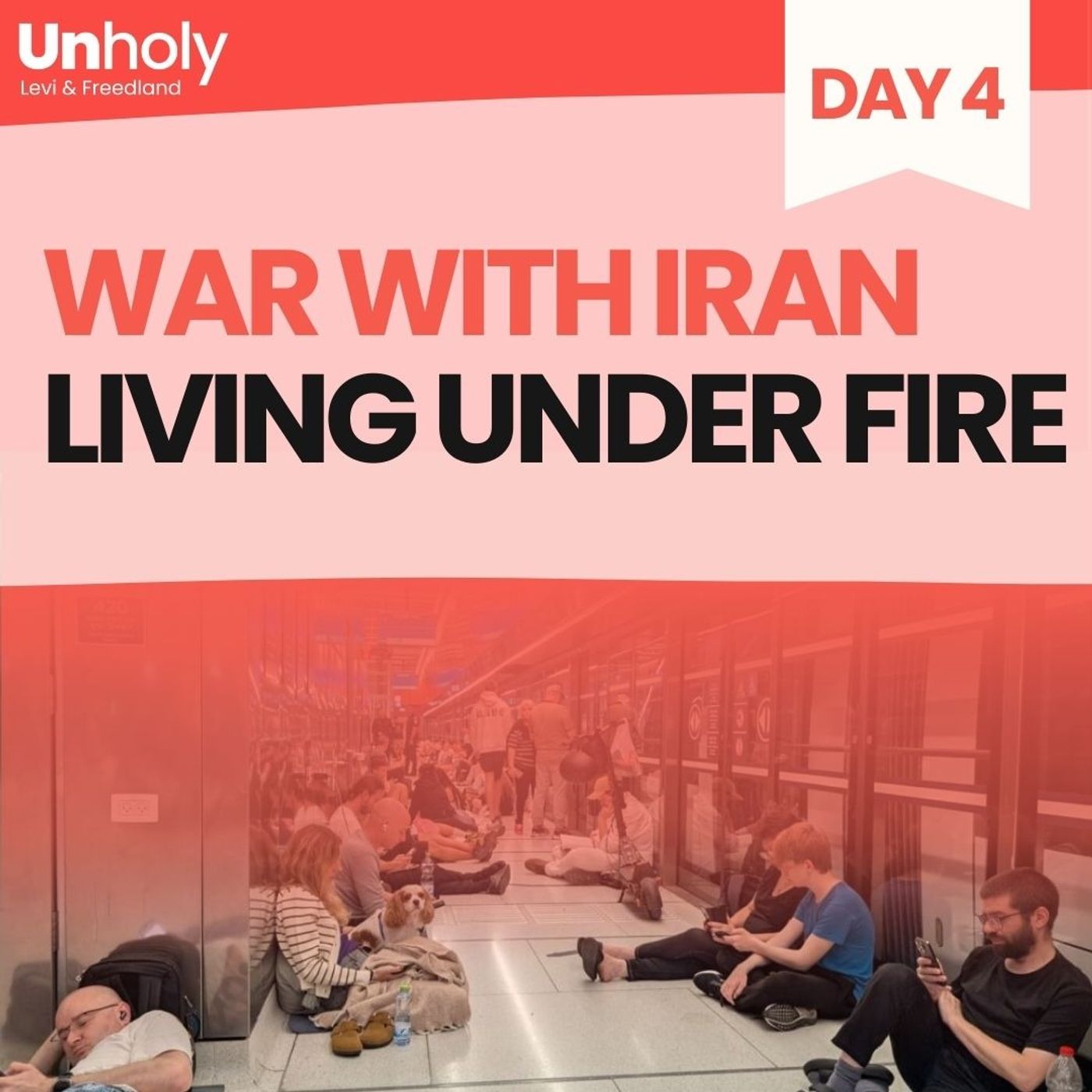
Unholy: Two Jews on the News
War with Iran - Day 4 - Living Under Fire
00:24:10
Day 4 of the Israel–Iran war: What does life look like inside Israel right now? Yonit and Jonathan reconnect for the first time since the beginning of the war with Iran. What does war feel like minute-by-minute? What does it mean when sirens sound every hour and a half — day and night? What happens to a society when workplaces close, schools shut, airports empty, and families move between safe rooms and bomb shelters as routine?Yonit describes the exhausting rhythm of preliminary alerts, the psychological strain of constant disruption, and the quiet resilience of Israeli civilians navigating a conflict that feels both immediate and existential. They discuss: ▶︎ The difference between June’s confrontation and this new phase ▶︎ The strategy behind Iran’s high-frequency missile fire ▶︎ The role of deterrence — and whether this is the beginning of the end for the Iranian regime ▶︎ The balance between exhaustion and resolve inside Israel ▶︎ And ultimately: who decides when thi...
Loading summary
Transcript33 lines
- [00:00]
A
Yan, it's unholy. I'm Yanit Levy in Tel Aviv.
- [00:03]
B
And I'm Jonathan Friedland, usually in London, currently in Australia.
- [00:09]
A
Jonathan, it's good to hear you and see you from very far away. We haven't been together on the podcast for a while. We're now in day four of what we should start calling I think, the second Iran war. The first was in June. We will try to bring you our dear listeners updates daily. We had a fascinating episode that you did with Almas R el, sort of setting the stage on what the strike was. The U. S Israeli strike that started on Saturday. Then a conversation with Suzanne Maloney about where Iran is heading and the significance of the assassination of Ali Khamenei, the Supreme Leader. What we wanted to do today is, I think, mainly talk to you, Jonathan, about where we are, how we live now, what it feels like to be an Israeli in the past four days.
- [00:58]
B
Yes, I mean, I thought what I was going to say was I think there will be plenty of time in the coming days, maybe longer to get through all the analytical questions and obviously those are piling up about why, when, how, etc. But I thought that in our first conversation of the two of us together directly since this started, it would just be really useful for me, but I think for people around the world as well to hear from you what it's been like to be absolutely in the middle of this and just the day to day encounters. And it just struck a moment by moment experience of this rather. And it just struck me that we'd arranged to speak, I think, think 25 minutes or half an hour ago we couldn't because the text message arrived from you saying the sirens have started again. And I just walk us through what it's currently like. There you are in Tel Aviv, just minute by minute, hour by hour, especially during the night, just what that is, what's happening, how it's playing out.
- [01:54]
A
So we should say it's 3:30pm in Israel and where you are, it's almost 1:00am in Melbourne, 8:30 in Washington. I mean, look, obviously this started eight and 10 minutes on Saturday morning. It took Iran two hours to retaliate. And ever since, this is war, which means everything's closed. Workplace is closed, school closed, airport shut down, no one in or out, only emergency services working. Essential workplaces are open, streets are eerily empty and none of us have really any sort of control over our schedule or our lives. I mean we did experience this in June. I think the main difference is that this time the salvos are kind of limited in size, but they happen in a frequency that is much more intense. So just to give you, for instance, in the first 60 hours, there were 36 alerts in Tel Aviv. That means siren every hour and a half on average, day and night. So as you mentioned, we were trying to plan this recording and we kind of left you, I left you this message saying, I can't talk now because we have to be in the safe room for half an hour and try to imagine for a minute what that means, right? I mean, if you are a Tel Avivan who has a bomb shelter under their building, so every hour and a half you have to walk the, whatever, four flights of stairs, four floors that it is to walk down and then walk back up and an hour and a half later do the same thing, stay there for about half an hour, maybe longer, and then walk up again. If you are 80 years old, if you are eight months pregnant, if you're a family with small children, I mean, just consider that there are more than 30% of Israelis who don't have either a bomb shelter or a safe room nearby. They need to basically live in either underground railway stations or underground parking lots because the frequency this time is really more intense. Last time in June, June, there were about two or three salvos a day, barrages a day, but they were. And they had like 20 or 30 missiles trying to overwhelm the Israeli aerial defense system. This is different. It's not challenging the aerial defense system, but it definitely is challenging the citizens. And it is an exhausting experience, Jonathan. I mean, that I can tell you for sure.
- [04:03]
B
And, and just you mentioned the people who are reliant on the.
- [04:06]
A
I'm talking quite fast for someone very tired, by the way. I'm just mentioning that.
- [04:10]
B
No, I mean, no, there is zero judgment here.
- [04:13]
A
Perhaps talking, perhaps to make it before the next siren. Yes.
- [04:16]
B
Yeah. About the public, people reliant on public shelters. And of course, people will be aware of the nine Israelis who were killed in Bet Shemesh. They were in a synagogue, public, a shelter that was there as part of the synagogue. That's again, because of what you explained, which is they won't have had the private, as it were, or shelter, you know, shelter within their own homes. They were reliant on that. Just on the thing you've explained to us about the difference in frequency. To what extent do you think, because you're saying it's having a real effect on the nerves. Of course it would. Of the Israeli public. Does anybody think that's a lie. It actually is a deliberate strategy that there's a tactic here, or is it just a function of what hardware the Iranians have left to them now, in contrast with June last year?
- [05:01]
A
Actually, I think it's both, and that's a very good question. One is that the Iranians have mathematically less missiles that they had in June, about half of their arsenal. That's still leaves them with thousands of missiles. Right. But they are. If they are planning for a longer war, then what would make sense is to, you know, do this really in these limited kind of barrages, but have them in a frequency that they, I think, understand, kind of shake up Israeli, they try. Israelis, they try. And of course, launch them all across Israel. It's not only Tel Aviv, we're giving that example because I'm here, but obviously everywhere. Jerusalem, northern part of Israel, the southern part of Israel. Everything is targeted. And I think it's. It's exactly both trying to say we don't have maybe enough missiles like we had in June. So we're trying to do this economically and send only two or three rockets. But we realize that even two or three rockets every hour, hour and a half is going to disrupt the lives of Israelis in a way that is very difficult to sustain. We should say the Israeli home front. I mean, the Israeli civilians, unbelievably resilient. We can hold onto this for a long time. It isn't fun to be quite, you know, understating the point and just talk
- [06:13]
B
us through what this means at night. Partly because of the time difference between us at the moment, nine hours between us, that's obviously had an impact. But just what does it mean in terms of interrupted nights, Children sleep. Just give us a sense of that.
- [06:32]
A
So I have to enter in this equation and into this answer what is called the preliminary alert. Ever since the Israeli home front command obviously very part of the military and very experienced in protecting Israeli civilians. This is a country, you know, under threat since its inception, essentially. But what is the sort of new feature that has begun to, that has been implemented since the war in June is what is called a preliminary alert. This means, by the way, the technology is unbelievably sophisticated because it means that the Israelis can detect the missile being launched from Iran. It can focus on the trajectory and know enough to say to an Israeli in a certain area in Israel, in about 10 minutes, you might hear a siren in your area. Make sure you are as close as you can be to a safe room. Now, why is this important? Because the Sound that this preliminary alert makes from your phone, from every single Israeli's phone, is a very grating, loud sound. And it is obviously its intent is to wake you up if you're asleep, to get your attention, if you're not paying attention. And that is the sound you have been hearing. I'm trying to discuss this with friends because I knew we were going to have this conversation. How do you explain this sound to someone who hasn't heard it? And the only way I'm not trying to sound facetious, but it sounds like the music that would accompany Darth Vader and his entrance to the Death Star. It is the most disharmonious morning chord you could ever listen to. Extremely loud, repetitive. So to wake you up in the middle of the night, and that could happen five or six times with the statistics that I gave you, and then you have to walk to the safe room or the shelter, the nearest by place you can be protected, and wait for the siren. That is what nights have been like. Enter any, you know, equation into the equation, whatever you want. Children, elderly. I mean, take that into consideration. That is basically what our nights have been like since Saturday.
- [08:30]
B
And you said, and it's absolutely, obviously true that Israelis are very experienced with this. They have become resilient to it. But at what point, and maybe it's already happening, do you get that sense, which would be, again, completely natural, where people say, okay, when is this going to stop? Enough already. Because this was, you know, is a war of choice in the sense. It wasn't sort of that Israel came under attack first. There was a political decision made. As I said, we'll have plenty of time in other episodes to talk about the politics of that, Trump and Netanyahu, et cetera, but just on the level of ordinary people, because it is so disruptive. When does that translate, if it does, into impatience?
- [09:16]
A
You know, it's interesting, I was thinking to myself yesterday how perhaps a Jewish thing it is, that for weeks we were sitting here saying, you know, when will this start already? And now it's like, when will this end already? Obviously, on the human level, on the most basic level, yes, this is disrupting our lives to the extent that I think we feel like it would be nice if it would be over. I think that the Israelis are not exactly the people that you need to explain the threat from Iran. I mean, even if you would ask on normal days a question, you know, on the necessity of this or the timing of this, I think that the. It's very clear that the Islamic Republic of Iran has been threatening Israel and continuing to threaten Israel. And after October 7th, nobody here really, I think deeply is asking the question whether or not Iran was planning to annihilate Israel if it could. So the fact that there was an opportunity presented means that, that I think there are less Israelis asking the question. And I think if we zoom out for a moment, just in the sense of we are two and a half years after the biggest massacre that we experienced, the most horrendous day in Israeli history, and the terrible, most terrible day of Jewish history since the Holocaust, every single one of the commanders or the leaders who dreamt of this, who planned this, who executed this, and who celebrated this were, Are dead. And in that regard, just on that level, before I get to what the responses can be, and, you know, the Shiites around the world and, and, and the question of the necessity, just on that regard, I think it is something to, to keep in mind, not that it is the first thing that comes to mind when you're running with your kids to the Safe room at 3:30am But I think in this region and this tough neighborhood, it is something to kind of think of at this moment.
- [11:10]
B
So you're saying that even however much the strain, the stress, the exhaustion this is inducing, the country sees this as an action directed at those people who were ultimately behind October 7th in the sense of Iran as patron of Hamas. And therefore, there is a great deal of patience being extended to the government for however long this takes, because in the public mind, it's connected with that traumatic event.
- [11:39]
A
Yes, but you're talking, or perhaps I was answering about the past. I think it's also important to talk about the future in the sense that this would not, will not go away. Now, obviously, since we're not naive, I don't think that the Iranian regime will crumble tomorrow. But if this is another stone in toppling what is an evil regime that no doubt had, if it could, the intent to erase Israel off the map. I'm not even, you know, getting to what the plans were for the United States that I think it is okay to, you know, bear up for, for a while. Obviously, this, this country is very divided, and obviously, you know, there, there are questions about the fact that in September, the prime minister said that an existential threat has been removed. The existential threat of nuclear Iran, he said then, and the existential threat of missiles. So it could be that a question can be asked about the hyperbole of saying that the existential threat has been removed. By the way, he didn't if I recall correctly, say the nuclear facilities were obliterated like the President of the United States did. So I think a case can be made that is saying, you know, Iran still was trying to acquire and to create this nuclear threat. It was definitely moving forward with the ballistic missile program no matter what, and it needed to be stopped. If we Learned something from October 7th, was that when your enemies speak clearly about their intentions, you should clearly listen. So that is what I think I can say at this time, with about an hour and a half of sleep in a collective three days.
- [13:19]
B
I mean, it's a very important. I was just thinking about on your point there. It's quite true that the president talked about obliterated, that he had obliterated the nuclear threat, and five minutes later, he's back saying, we better eliminate this nuclear threat, and that's why we're doing this operation. Netanyahu's words in June was to declare, quote, a historic victory which will stand for generations.
- [13:42]
A
Generations?
- [13:43]
B
He said. Yes. I mean, generations.
- [13:46]
A
It's quite a short generation. You want to say eight months? Yes.
- [13:49]
B
Yeah. I mean, eight months time. You have to go back to it. It just means that the language was, I think, hyperbolic back in June, because he could have said this is a first phase of a process that's going to take time, but he didn't say that. Partly, I think he's got caught up in the sort of. This is a separate point. But about Trump, inflation has happened with language. Everything is the unprecedented, historic like never before. Trump says that about the most minor things in American domestic politics. And so it's become the coinage. And I think Netanyahu often rhetorically tries to keep up with that, but it just means that, I don't know whether Israeli public opinion was, you'll tell me, was pressure prepared to go back into this so quickly that in June, it was going to last for generations. And here we are in February, late February, beginning of March. We're back again.
- [14:43]
A
Well, it would definitely be difficult to. If this is the future, right. If we. What we saw in recent years were these ongoing skirmishes with Hamas every year, every couple of months. And now it's going to be an ongoing skirmish with Iran. That is something that will be very difficult to sustain every eight months. If, on the other hand, what we're seeing, and I hope it's what we're seeing, the beginning of the end of this evil regime, then it is something I think that the Israelis are willing to pay the price of now. I mean, when you think of we had Amos Hochstein on the podcast a few weeks ago, and remember, he said to us, you know, Democrats for a long time have been thinking that strong is wrong, strong is not necessarily wrong. And if you think back to the fact that North Korea now has nuclear weapons and the United States threatened North Korea and tried to prevent it, but never attacked North Korea. Now, I'm not saying that trying to attack North Korea was the right thing, but this is a different kind of move. This is a choice to say preemptively, I will attack with all of my might. Right. This is a huge operation, and it took down the leader of Iran. That is something to think about and to talk about. But if you're saying this is what I'm trying to do to prevent them from ever getting weapons that are going to destroy me, because that's what they said they were going to do again, Israel, you can also mention that they said they would do the same to the United States. So it's an, it's an argument. But I think right now, Israelis are very, you know, to be honest, I think tired and trying to survive from day to day. And this, this question will return and will definitely return. If what we're going to see is in six months, the same thing, I think then the questions would be more prominent.
- [16:24]
B
Like I say, and like we said at the beginning, I think there'll be plenty of time for all those sort of analytical geopolitical calculations and conversations, including on unholy in future days and weeks. We're focusing today very much just on the mood and where you are in Israel. Related to that. We've talked about the disruption, the inconvenience, the lack of sleep, the exhaustion, the word that you haven't used much, and I wonder how much it's there, even in the light of Betzemish, is fear. Yes, it's a terrible disruption. And your mention of the elderly and children, that alone can inflict huge psychological stress. But to what extent is there the feeling that now that this Iranian fusillade could actually lead to mass casualties in Israel? And I'm asking that partly because it seems to me from a very long distance that the fear is less now than it was in June last year? Partly because in June last year, it was a sort of unknown quantity. How powerful really was Iran? And in a way, they revealed themselves to be to pack less of a punch than had been feared. They were able to inflict less damage than people imagined. So now do people imagine that Iran is sort of using up its capacity has not really been able to inflict much pain. Or every time that siren goes off to people, are they filled with mortal dread of what Iran might do?
- [17:57]
A
I mean, first time, first of all, I'm sure you experienced sirens in Israel. I mean, this is a country that's been under threat for decades. That, just that feeling, it's always frightening, right? I mean, that kind of sound that goes up and down and it's, it's, it's, it's a visceral feeling. But I think, I'm not sure about the fact that there's not fear this time. I think that Iran is not, the regime is not desperate enough to have used all of its arsenal, by the way, it's using a lot of its arsenal on the Gulf states, right. We've seen the attack on Qatar and on the UAE and Saudis. That is also a dispersed attack which takes some of its arsenal away as well. I don't think they've used the, the worst that they have yet. There are a lot of, you know, missiles that have not been in this at this moment, perhaps because the regime is not yet desperate. And there is fear that is different from other incidents where it was Hamas or Hezbollah or the Houthis in Yemen, I think here because of how heavy the bombs are. And you see, and you mentioned Beit Shemish. Not all of them, but some of the people killed were in a bomb shelter. But there was a direct hit from a missile. And, and it's a direct hit. So you do have that somewhere in the back of your mind. But you know me enough to know that that's compartmentalized in a drawer somewhere, because I'm not, I can't personally let that fear creep in, not on a family level, not on a personal level, not on a professional level. You know, if you're the anchor of the evening news, then you're not going to be afraid. You're going to be. I think it's important to say this is our fight now and we're in it together. So, yes, you didn't hear the word fear. I think it's not coincidental. That is the feeling now. And I really don't, I don't know. As we sit here again, Day four. This will last four or five weeks, as the president said yesterday, or will it last two or three days, as he said to Barack Ravid on Saturday? It's very hard to know. I think there's a lot of pressure on him from many directions, whether it be the Gulf states or his own party or his own country. This can be a long story. So the key here is to kind of brace ourselves and know that this is how we live now.
- [20:14]
B
Just before we close, then on that point about the timing and how long is this going to last? And you made this very telling point that before it was, when's it going to start? And now the question is, when's it going to finish? I think in a way, you've implied an answer there, which is for the answer to that question, people are looking to the words of Donald Trump. To what extent are Israelis look into the words of their own Prime Minister Netanyahu for Cluz? Or is it just understood that the person who will make the decision on when this ends is not the head of the government of Israel, but this is entirely in Washington. The person who will blow the whistle to say it's over will be Donald Trump. And if Donald Trump does not blow that whistle, this will just keep going. Or is there agency? To what extent is there agency? How much agency does the prime minister of Israel have in when this thing wraps up?
- [21:06]
A
Well, first of all, we should say the prime minister of Israel gave an interview for the first time since this started, and he gave it in English to Sean Hannity on Fox News just to make that point. There is no press opportunity and there's no interview in Hebrew to a nation at war. And to answer your question more directly, I would say that I think that generally speaking, Israelis look to the president of the United States and realize that when he decides it's over, it will be over in the same way, much in the manner that it was in June when he essentially turned back Israeli fighter jets because he decided it is over and sort of. And also in the same way that he decided the war in Gaza is over. So I think that they're looking to him, trying to decipher between his many different comments about timing, but they think that he will be the one to decide when this is over.
- [21:58]
B
Yeah, and I think in that context, you want to be looking at the markets and the oil price and the tv. If there are images that are discombobulating and unpopular to American TV audiences, a terrible killing somehow in Iran that captures the world's imagination, something that we can't imagine or predict. We know from past experience, that's when Donald Trump says enough, it won't be
- [22:23]
A
the Israeli public saying enough, by the way, just to make that point. I mean, however, we were talking about how difficult this is. I mean, I was just remembering as we talked that there are 100,000 Israelis abroad and they're trying kind of clawing their way, desperately trying to get home to a country at war. It shows you something about what kind of country this is. And the terminology about getting those Israelis back home into a war zone is rescue flights. Right. The only country in the world that would call it that way. So it's not going to be us who are going to say, enough, we can't do it anymore. It's going to be, as you said, a lot of the elements that you just stated.
- [22:59]
B
Yeah. And the polling, by the way, in the United States, not hugely supportive of this. And if there were images on of top TV that made Americans turn against this or American loss of life, and there has been some American military personnel, it's already happened, plying, you know, American aircraft downed in a friendly fire attack by the Kuwaitis, you know, anything like that, you just, you've got to keep an eye on that. We're going to keep an eye on that also. All the many analytical questions about how this came about, whether the arguments, the justifications that have been marshaled and how it plays out, how it ends in coming episodes as we can, you know, assemble between us, given the, you know, interruptions of sirens and time differences.
- [23:46]
A
We got to 25 minutes with no interruption of a siren. That's something we did.
- [23:50]
B
We did. So listen. It's a cliche to say stay safe, but do stay safe. And you and I, and somehow unholy and all those listening, we will talk again, so speak soon.
- [24:02]
A
We'll just say a big thank you to Michal Poat, also under, also under a barrage trying to get this episode out and we'll talk soon.