← Unholy: Two Jews on the News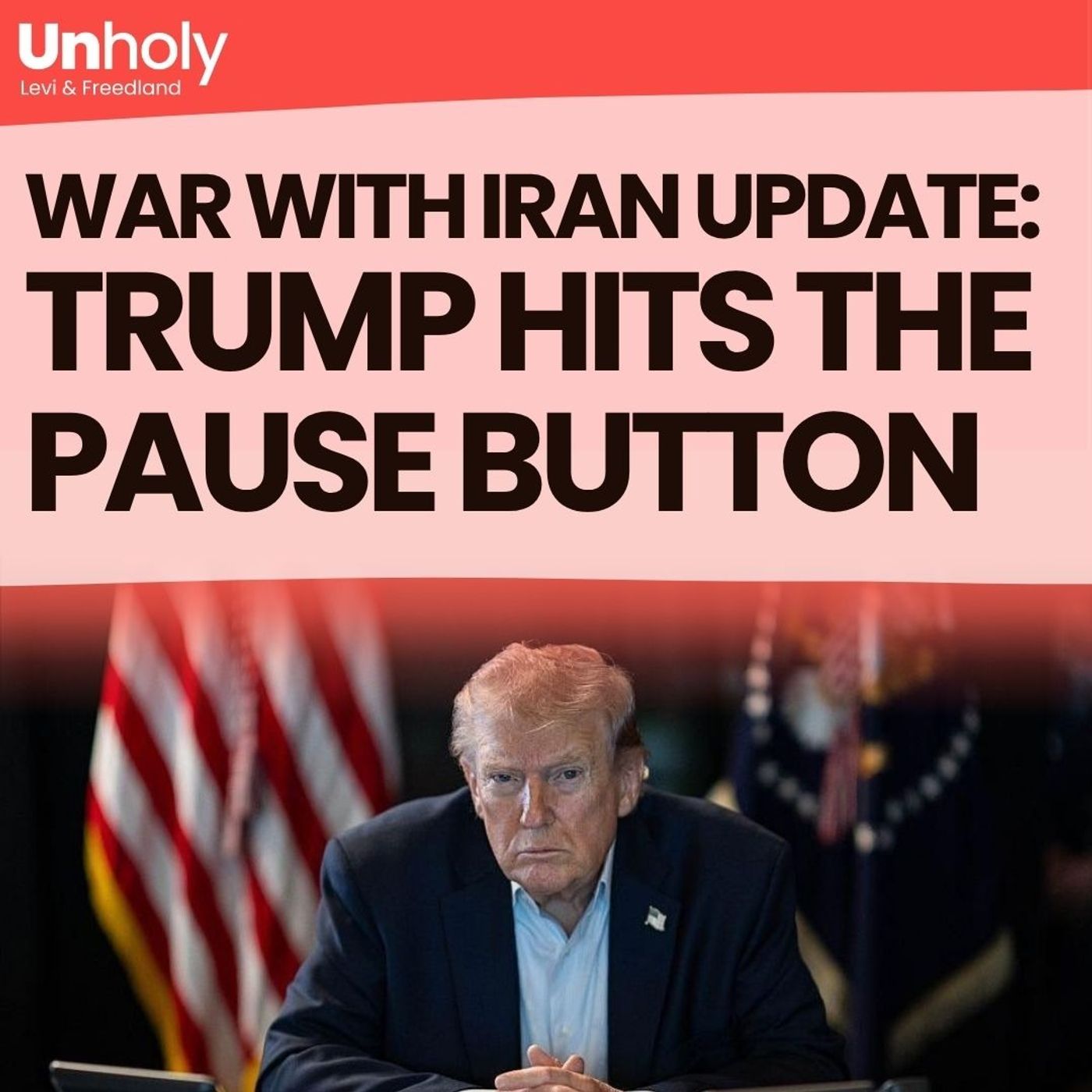
Unholy: Two Jews on the News
War with Iran Update: Trump Hits the Pause Button
00:21:02
Watch us on Youtube: https://youtu.be/dhvM7lnkO88 Follow us on social media and get more Unholy content: https://unholy-podcast.lovable.app/ This morning, Donald Trump posted something that might — or might not — mean the US-Israeli war on Iran is coming to an end. A five-day pause on strikes. Secret talks via Pakistan and Turkey. Kushner and Witkoff on the American side. A shadowy Iranian speaker being cast as the pragmatist the US has been searching for. This is a special emergency episode of Unholy, recorded on 23 March 2026, as events were still unfolding. Jonathan and Yonit break down the two scenarios — deal or larger war — and why Trump's exit ramp looks nothing like Netanyahu's. They also turn to the daily wave of antisemitic attacks across Europe and North America since this war began, including last night's arson on four Hatzalah ambulances in Golders Green, London. Chapters 00:00 Introduction to the Update Episode 01:02 Trump's Social Media Post and Its Implic...
Loading summary
Transcript16 lines
- [00:00]
A
This is an update episode of Unholy. I'm Jonathan Friedland in London.
- [00:05]
B
And I'm Yanit Levi in Tel Aviv.
- [00:07]
A
And we're here because of a social media post from U.S. president Donald Trump just in the last few hours, which taken at face value, would mean at the very least a pause in the war. US Israeli war on Iran, or perhaps the beginning of the end, or as Winston Churchill said, the end of the beginning. And this is. These are the words that Donald Trump posted on Truth Social. I am pleased to report that the United States and the country of Iran have had over the last two days very good and productive conversations regarding a complete and total resolution of our hostilities in the Middle East. Based on the tenor and tone of these depth, detailed, constructive conversations, which will continue throughout the week, I have instructed the Department of War to postpone any and all military strikes against Iranian power plants and energy infrastructure for a five day period, subject to the success of the ongoing meetings and discussions. Thank you for your attention to this matter, which is how he always signs off these posts. I mean, my instant reaction was, okay, well, let's see what happens. And I realized as I thought that that is such a change. Normally if an American president said these words, you'd think, right, that's it, it's the end of the war. My own sort of instincts have been worn down by the fact that he sometimes says, we're about to do this. 20 minutes later, we're going to do the opposite of this. There was a promise there will be no attacks on energy installations in Iran. Then it was we're 48 hours from. So I was sceptical. But yonit, there have been more. There's been more information coming out in the subsequent hours that does suggest there is more to this than just a social media post.
- [01:46]
B
Indeed. So we're talking. It's almost 6pm Israel time, 4pm London time and approaching noon Washington time. A few hours after this post by the President, we know now a few more things. First of all, just to take a step back, Trump did give Iran 48 hours an ultimatum to open Hormuz Strait or he said US will obliterate its power plants. So this post came, I would say, about 12 hours before that ultimatum was about to end. Timing is, of course, important now. What we now know is that there has been a mediating effort made, particularly by Pakistan and Turkey, to try and get Iran and the United States to actually negotiate physically. There have been talks, we now know, and those talks involved Kushner and Witkoff of course, from the US Side, Trump's trusted advisors from the Iranian side. It's very interesting that Trump himself would not name names in this statement that he gave about an hour ago, right about to aboard a plane. He said, I'm not going to name names because they might be killed. But more information is coming out from other sources talking particularly about, first of all, Alakchi, the foreign minister, who has been in these discussions earlier, before the war started, between with Kushner and Wyckoff, and of course, another name that I think we will return to Muhammad Bakr Kalibaf, the speaker of the parliament. So those are the two people. Now, why is all of this important, Jonathan? Now, we don't know that we're actually going to a deal, right. That the war will be over. But we do know that the president pressed pause. He's pressing pause for five days. He says the United States will not attack energy facilities. We'll talk about what Israel will or will not be doing in those five days and that they are giving negotiations a chance. I would still say at this time that we are talking now on a Monday evening here in Israel. We are still looking at two scenarios. One of them is that indeed we are seeing the beginning of the end of the war that will end with the deal, or this is buying time for remember, there are thousands of Marines on their way to Iran, buying time, also talking on a Monday, very early in the morning before the markets open and perhaps trying to deploy the military for an even bigger operation in Iran. So it's either, I mean, it's kind of black and white here. There's either an option for a bigger war or, or for actually a deal.
- [04:11]
A
Yeah. That last reading, by the way, that you put in, is the same reading that was advanced by the Iranian state news agencies who said there are no talks. First of all, they denied there were any talks. And then they said, and this is just a move by Donald Trump to lower energy prices and to give buy him time militarily. That's suggesting that they were aware of their own sort of power of leverage with the global rise in energy prices and suggesting, see, we've got Donald Trump where he wants him, where we want him. He's desperate to get the energy price down and to buy himself some time. So skepticism coming from official Iranian sources, but as you say, other reporting, indeed quoting Israeli sources, saying this has been the channel through Pakistan and Turkey and that the figure of the Iranian speaker is the figure. This, by the way, was always the, you know, take it at face value this is what the Americans hoped. Remember we had General David Petraeus on the podcast just about 10 days ago saying that he thought it was that they had hoped for Delsey Rodriguez. And actually they've got Kim Jong Un. The idea that somebody, Delsey Rodriguez being the vice president of Venezuela, who emerged as somebody who the US could do business with, that had been the American, perhaps also Israeli, hope there'd be somebody there who would emerge. Now there's going to be this question about whether the speaker is that person, the pragmatic figure who decides, look, it's better to cut a deal. The official Iranian view is this is just a tactic. And from their point of view, you can see why they would be extremely wary of talks of any kind, because there have twice been talks that were ongoing with the Americans, only to be interrupted by military action from the Americans June of 2025, again, late February of this year. So you can see why they would be thinking, is this another tactic by Donald Trump to say there's talks just while he prepares to punch them harder? But the world' oil markets and stock markets reacted ecstatically to this news, thinking they are so desperate for an end to this that immediately the oil price came down, stock prices went up, gilts, the price it costs for governments to borrow went down. Just shows you how much the world economy is desperate for good news. On this. I have to say I am very, very cautious here just because this is another whim. Donald Trump governs on whims. The deadline that was 12 hours away, that was one whim. This is another whim. Who knows?
- [06:47]
B
Yeah. So I would, first of all, wouldn't be totally impressed by the Iranians lying about anything, including if there are talks or aren't. So just to put that in some sort of perspective, I think it's also important to talk about the fact that it was this week that the Iranian regime and someone is still calling the shots there. Right. There are still decisions being made very clearly, including the fact that if infrastructure is targeted in Iran, that infrastructure is targeted in Israel. Someone is making those decisions, including the decision to fire a missile to Diego Garcia, which is a base that is very. Makes Europe much more in this sort of eye of an Iranian threat. Right. Just to make that clear as well. I don't think Iran is leaving this story if it is indeed reaching an end. I think Iran has made very clear its kind of threat it can have on the world. So that is important to remember as well. But I think you're really, you're very accurate in in putting that Venezuela story back on the table, by the way, Trump himself saying it in his remarks only a moment ago, he said, we're dealing with people. One of them might be what we're looking for. Look at Venezuela. He says that's working pretty well. From the beginning, we said that is what he would have wanted. This sort of model in which you don't have an actual regime change, but a change in the regime. There's someone you can talk to in the same kind of a regime. But. But indeed, is this the Dulce Rodriguez quote, unquote, that Trump was looking for? That's a question, by the way, Trump is also laying down a lot of what he says that the parties have already reached. We don't know if that is, is entirely true, but he said he was asked by reporters, will there be no enrichment whatsoever? Iran agreed to that. He said, yes, that he was asked by reporters, how are we going to get the enriched uranium? He said, well, if we have a deal, we're going to get down and take it ourselves. Again, we don't know, but this is already kind of stated by the President of the United States. If this is the deal that we have arrived at, that is a question. We don't know the answer to that. But it does seem like, at least for the most part, if Trump, if the President of the United States gets this, then it is something he can say, look, we have arrived at a deal and of course he will sell the greatest deal of all time. I think we should also talk about the Israeli aspect in this whole story, but we'll do that in a moment.
- [08:58]
A
Yeah. So just to be clear, I wasn't calling Galibouff the speaker a pragmatist. I don't know. I've got no idea. I mean, there will be people with doctoral levels of Tehran Kremlinology who can tell us that I'm not one of them. My point was that was what the Americans had been looking for. They want someone who they can cast as a pragmatist. If this is that person, who knows. Again, I agree, obviously you don't want to be credulous about statements from Iran. You wouldn't believe anything they say. But the, the fact that they were. Their official statement said there had been regional initiatives aimed at reducing tensions. I thought was an interesting admission that there is some kind of back channel. But they were obviously keen to, if only to address their own hardliners and not seem themselves credulous. They were keen to stress their skepticism about this being a ruse and you can see why they would say that because there will be people there within the Iranian apparatus who will be deeply skeptical of any move. And I have to say that, you know, the thing that made me wonder and pause and of course we wouldn't expect anything different from Donald Trump. There was no caution built into this statement. He said, we are talking about a complete and total resolution of our hostilities in the Middle East. It wasn't sort of the talk of a, of a pause or an armistice. That's why people are suddenly wondering, has he resolved the nuclear issue, etc. I find that very, very unlikely and very hard to believe that that huge issue could be resolved. And the fact that he was forced to sort of ad answer about the uranium and say we'll go in there and get it ourselves tells me they're nowhere near. The sign that it was more serious was the presence of, or the mention of Witkoff and Kushner. I think that if it had been mentioned, some sort of low level official or a real diplomat rather than a realtor, in a funny way, you'd have thought it's less serious because when Donald Trump is serious is when he deploys the son in law and the best, the golfing buddy. So that I thought is a sign, okay, this has more meaning. But, and I know you wanted to get onto this, I think it really is interesting that he will be regarding this as good enough. A change in the regime. And there daylight emerges between the U.S. position and the Israeli position, because the Israel position more or less from the start has been we want this regime gone. We regard its mere existence as a threat to Israel, given the history of what this regime has done, given the proxies and so on. And here is Donald Trump suggesting Delsey Rodriguez is fine for us. Same regime, different face. We'll live with that. It's just an interesting question to me is, does Netanyahu have to just take that and say, okay, it's a degraded Iranian regime is better than what we had to start with? Or does this divergence lead to even a situation where one side is no longer fighting and the other is. I don't think that's likely, but I think daylight is emerging between the two.
- [11:55]
B
Yeah, I mean, I don't think it's likely that Israel would continue if Donald Trump says we're done. We saw that happen in June and that was, you know, really physically turning back Israeli planes. I don't see that happening. I think it is very interesting. I don't think that this statement surprised Benjamin Netanyahu the coordination is pretty tight. But it, it was interesting that the chief of staff of the IDF spoke two days ago and talked about the fact that we are in midway. Right. That might take another three weeks. It is, it is true that Israel, the intelligence echelon in Israel was thinking about that, that Trump is close to it, particularly when the ultimatum was, was set that Trump might be close to, to saying something similar. So it wasn't a surprise for Israel. I think the crucial question in the next couple of days is what are we going to see? Are we, first of all, we have been seeing since Trump, since this morning, we have been seeing rounds of attacks of the Israeli air force. It has been a few hours of quiet on the front of missile launches over Israel. But I wouldn't think that that would be a quiet couple of days. I think we're still going to see this sort of skirmish between the two countries. You're talking about daylight, and I think rightfully so. I mean, Trump himself was saying only today, yes, the Israelis will be happy, there will be peace, all of that. Again, Israel is closer to Iran. It's much more worried about the Iranian. And we have seen the capabilities, definitely what Iran wants to achieve and standing strong and tough on their goals. So I think that Israel is quite kind of wary of where this deal is going. Yes, for sure.
- [13:30]
A
Yeah. And look, I think with some reason, I mean, we had our conversation with Amos Harel the other day when he was talking about the justification for the war. From Israel's point of view, there's a strong case that this country, Iran, this regime, is and has for years posed a threat to Israel and its security, either directly through its own arsenal, saw that in June, or through its proxies. It is much harder for Donald Trump to make this case to the American public that it has posed an imminent threat to the U.S. i mean, that was the word he used, right? The start, imminent threat, as if the Americans were going to come on much harder. We know from the polling that Americans do not buy and have not bought that argument. It is, according to pollsters, the most unpopular start of a war, of any war in polling history. So they're not persuaded there was some immediate threat. Therefore, he doesn't need to come away with the same sort of clarity of military sort of cancellation that Netanyahu needs. I mean, Trump does not need to say, well, look, guys, that dagger that was previously pointed at our throat has gone because people didn't believe there was an Iranian dagger at the American throat. That's now A different position. So whether Israelis will say, this is yet another case where you have, like you did with Hamas, said, we will not rest until we've eradicated the enemy. And then guess what? The war stops before the enemy is eradicated. I'd be very interested to know how that plays with domestic opinion. Maybe it will be completely outweighed by sheer relief that the torments of the last three, four weeks are drawn to a close. Maybe that will be decisive.
- [15:09]
B
I am curious about something which is does the fact that the missile was shot so close or closer to Europe change anything in European public opinion about this war? Or that has completely been kind of under the rug?
- [15:22]
A
No. The strike on Diego Garcia. Look, Diego Garcia is a long way away. It's true that it is from Europe. I mean, it's true that it showed that the Iranian reach is much further, that they can get into a 2,3000 kilometer range and that's a different ball game. But I mean, there were these warnings from El Zamir that now Paris, Berlin, Rome are within reach. I think people did see that as a sort of political move to try and shore up support among these allied countries. I don't think many people think London is going to be hit by an Iranian missile launched from Tehran. I don't think many people think that. What they do think, and we may come on to talk about this, is the terror threat that Iran can and very clearly I think has unleashed across the countries of the world. That's real enough. And we say that because barely a day has gone by actually since this war started where there has not been an attack on very specifically a Jewish target. In the last two, three weeks we've seen synagogues, Jewish schools targeted from Toronto in Canada to Liege in Belgium, Amsterdam, Rotterdam, Michigan, an attempt on Temple Israel in a suburb of Detroit in Michigan, and then just overnight here in London, the most well known Jewish neighborhood in the whole country. Actually in Britain, Golders Green, famously a Jewish neighborhood. In the dead of night, four ambulances of the Hatzola Service, which is a not for profit charitable service for strong links with the ultra Orthodox Jewish community, which runs volunteer ambulances both for Jewish and non Jewish patients. Four ambulances were targeted in a serious arson attack in which cylinders of gas exploded, caused a spectacular explosion and fire which actually then windows were broken in nearby blocks of flats. A very visual, visible, concrete attack on a Jewish charity which joins a long line of those attacks. There has been a claim of responsibility by an Iranian aligned group in London, the Metropolitan Police saying it's being investigated as terror attack, the prime minister calling it a horrific anti Semitic attack. And the government moving very quickly here to say it will immediately do more to secure the Jewish community. Community. It's going to replace those four ambulances. But and I thought this was important, government minister, health minister saying higher walls and better, tougher security is not enough. We need to tackle the causes of this and to deal with this threat. And I think that's something the Jewish community here have been saying for a long time, but it adds absolutely to the fear. Whether that leads people to think, well, therefore, we must hit Iran even harder because they're the patrons of these attacks, or whether a lot of ordinary voters will think, well, therefore, let's make this war stop so these horrible attacks don't happen. That's a perennial debate. I don't know which way in terms of public opinion that will go. But right now it's added very much to the sense of fear and of a community that really is under attack.
- [18:33]
B
We will obviously talk about this, address this further in our regular episode on Friday. In the meantime, I would urge our listeners to read a brilliant column by one Jonathan Friedland about antisemitism in the Guardian because I think it points to the fact that somehow Jews always find themselves the only minority that has to pay some sort of price for the actions of decisions made by a government that is hundreds, thousands or even more miles away. No one is targeting Iranian students on campuses in the United States. No one is targeting Russian students on campuses in the United States. And I hate these comparisons because I do not think that my country is in any way similar to Iran or Russia. But even in those cases, you don't see the minority suffering from, from the connection to their country. Like Jews suffer from a connection to Israel. I know.
- [19:25]
A
Or if you do. No, no, no. I mean, I'm, I'm, I'm very grateful what you say about the column and we will get into this more on Friday. But I was going to say, and if you do ever see attacks on that minority progressive opinion is very, very clear very quickly that that is a completely unforgivable connection to make. You know, there were mosques that were attacked in the aftermath of 9 11, for example, but opinion from George W. Bush on the right, all the, the far left all knew that that's completely unforgivable and heinous. When there are attacks on Jewish site, suddenly you find all kinds of people getting very tongue tied saying, well, you've got to factory in that, you know, the Israel is behaving really very bad. They lose suddenly the clarity which I think the world did have a quarter century ago after 9 11, that whatever else goes on, this is not to be visited upon Muslim communities around the world. And that clarity seems to me, you know, has suddenly become very foggy when it becomes to Jews in Israel. But we, I, you know, we will get unfortunately, this is not away there is a mood of tremendous fear and anger, all of those things here in London. But I know this fear is going on all over the world. Those attacks, like I mentioned, you know, when it's happening from North America through to Europe through to here, this has been a real pattern and it's happened more or less every day since the start of March. So we will talk about this further in our regular episode.
- [20:44]
B
We will indeed. We hope we gave some answers as to what is going on and not just more further questions. But we will be following the story, of course, and coming back if other updates will be needed. And we will see each other on Friday. We'll say a big thank yous to Michal Porat.
- [21:00]
A
Yeah, and see you then, Yoni.
- [21:01]
B
See you.