← UNMARKED: A True Crime Podcast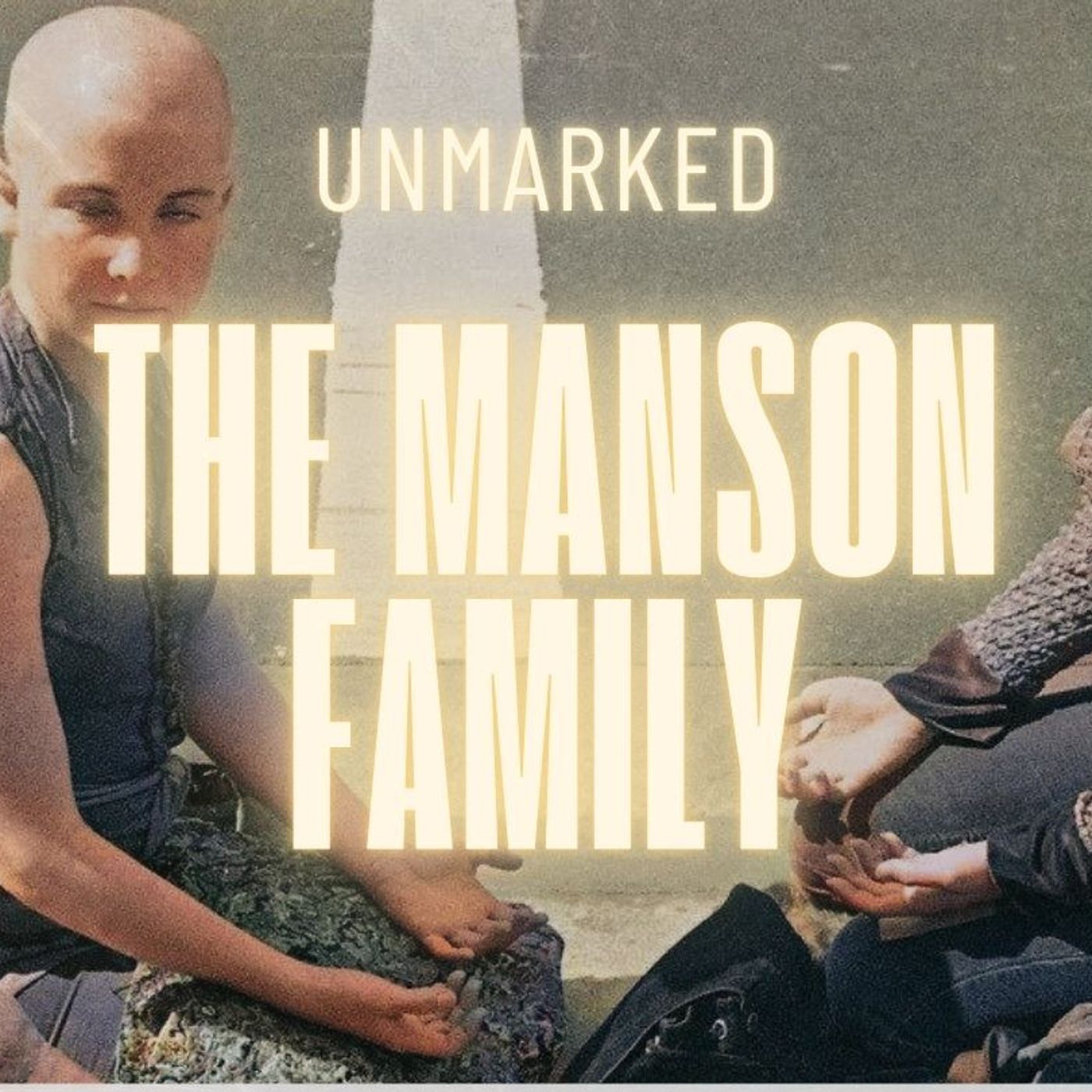
UNMARKED: A True Crime Podcast
14: The Manson Family: Finding the Followers of Charles Manson
00:44:30
Loading summary
Transcript169 lines
- [00:00]
A
Hey, it's Howie Mandel and I am inviting you to witness history as me and my Howie do it Gaming team take on Gilly the King and Wallow $267 million gaming in an epic global gaming league video game showdown. Four rounds, multiple games, one winner, plus a halftime performance by multi platinum artist Travy McCoy. Watch all the action and see who wins and advances to the championship match against Neo right now@globalgamingleague.com that's globalgamingleague.com everybody games. The bleacher Report app is your destination for sports right now. The NBA is heating up, March Madness is here, and MLB is almost back. Every day there's a new headline, a new highlight, a new moment you've got to see for yourself. That's why I stay locked in with the Bleacher Report app. For me, it's about staying connected to my sports. I can follow the teams I care about, get real time, scores, breaking news and highlights all in one place. Download the Bleacher Report app today so you never miss a moment.
- [01:02]
B
I've spent the last decade tracking down the Manson family. That search has taken me across America to undisclosed locations, uneasy meetings, long drives to nowhere towns.
- [01:15]
C
Be careful with this, with this phone call and don't use it to cause any more persecution to my friends, family.
- [01:26]
B
I've had conversations with people who still lower their voices when Charles Manson's name comes up.
- [01:32]
D
I lived with him for almost a month.
- [01:35]
B
The Manson family came together in 1969, a loose collection of drifters, true believers, runaways and lost kids orbiting a man who promised them meaning. Within two years, man, they would commit the most infamous murders in the history of Los Angeles. The killing of Sharon Tate, a pregnant movie star, and eight others. Crimes so brutal they rewired the American psyche and effectively closed the door on the 60s.
- [02:04]
E
You know, people told each other their deepest, darkest secrets and thoughts because they were giving up their egos.
- [02:11]
D
Nobody says, like, should we be doing this or is Charlie right? No question. Unquestionable.
- [02:18]
E
They went and they did what they did.
- [02:20]
B
But that's not the question that keeps pulling me back. The murders have been dissected, the trial televised, the mythology monetized. The questions that still linger are simpler and more unsettling.
- [02:33]
F
To understand what this whole episode is about, you have to talk to Charles Manson.
- [02:41]
B
Today, we track down the surviving members of the Manson family. We'll hear from them directly and unpack how a loose commune became one of the most infamous cults in American history.
- [02:53]
F
Every few months, they'll make another documentary and take their money to the bank. And Charlie just sits there suffering it
- [03:00]
B
for all of us. I'm James Buddy Day. This is unmarked.
- [03:07]
C
You have a prepaid call from Charles.
- [03:13]
B
When I interviewed Charles Manson throughout the final year of his life, I had no idea those conversations would become the foundation of a decade of work.
- [03:22]
C
I've lived quite a life in the underworld.
- [03:26]
B
At the time, they were just calls. Long, erratic, sometimes lucid, sometimes circular conversations, all with a man who'd spent nearly 50 years shaping his own mythology from behind prison walls. You find a lot of people are afraid of you.
- [03:43]
C
Well, yeah, I would imagine so.
- [03:47]
B
After his death, I went back back to the firsthand witnesses, and that research is collected in my book, Charles the Last Words. And it's a lot. Because the Manson story isn't just infamous, it's layered. It's contested, and in many ways it's still misunderstood.
- [04:08]
C
The truth is, they never told the truth about me. No one ever told on me. They were.
- [04:17]
B
So today I'm building on that research because if we really want to understand what happened, how a drifter with a guitar convinced young people to kill, we have to shift lenses. We have to look at the people who said yes, the followers, the young women and men who became the Manson Family. Now, most reports reduce the Manson Family to a single reductive cult. It's a convenient label. It keeps things tidy. But what we're really talking about is a group of roughly 20 people, mostly young women, who came together in 1967 at the height of the counterculture. They were runaways, drifters, idealists, some barely out of high school, others 13 or 14. And they didn't begin as killers. They became violent in the summer of 1969. After two years together, we were all in one family. That word, family, it's doing a lot of work here. Because what they built wasn't a formal organization. There were no membership cards, no doctrine carved in stone. It was bound together by loyalty, first to each other and ultimately to Manson. Where the story begins is still a matter of dispute. The standard version places the origin of the Manson family in haight Ashbury in 1967, and it's characterized as a deliberate attempt by Charles Manson to form a cult centered entirely around himself. At trial, lead prosecutor Vincent Bugliosi described it this the family was nothing more than a closely knit band of vagabond robots who were slavishly obedient to one man and one man only. Their master, their leader, their God, Charles Manson. Within his domain, his Authority and power were unlimited. He was the doctoral maharaja, if you will, of a tribe of boot licking slaves who are only too happy to do his bidding for him. End quote. It's a powerful image. It's also a prosecutor's argument.
- [06:40]
C
It's not true on the level that it was presented to you.
- [06:44]
B
I would argue the family begins months before Haight Ashbury in the spring of 1967 in Venice Beach. And the person who sets it in motion isn't Manson. It's a teenager named Lynette Fromm.
- [06:58]
G
We did not have sex orgies and drug orgies or cult meetings.
- [07:05]
B
That's Fromm, often called Squeaky, speaking in 1975 during a psychological evaluation. When I spoke to Manson near the end of his life, he wasn't allowed to communicate with Squeaky, who he called Red, not just because of her hair, but because he used a color system to categorize the women closest to him. Red, blue, green, silver. Through people still in his orbit. I was eventually connected to Lynette. We spoke for hours by phone, and in 2017, we arranged to meet at a studio in a small town near her residence. I won't disclose where, but the terms of her parole restrict her travel. By then, Squeaky had already lived several lives. In 1975, she would attempt to assassinate President Gerald ford by pressing a.45 caliber pistol toward his head in Sacramento. She said it was about the redwoods. Prosecutors saw something else. So you're in your apartment and you see Ford, and you're like, okay, so if I can get his attention or do something, I can get my friends back in a corner.
- [08:17]
G
Initially, I was gonna talk to him about the redwoods. I thought, well, maybe I'll bring a gun. And then I said to myself, are
- [08:30]
B
you gonna shoot him?
- [08:32]
G
And I said, I'm gonna go see what's necessary.
- [08:39]
B
She received a life sentence, escaped briefly in 1987, and was eventually paroled in 2009. But in 1967, she isn't squeaky yet. Lynette Fromme is just a lonely teenager in Venice beach, disconnected from her family and searching. After meeting Manson, she accompanies him to an apartment where they connect with another young woman, Patricia Krenwinkel. Krenwinkel is also adrift. Her parents divorced when she was 15. She moved from school to school. She was using marijuana, then Benzedrine at the time. And soon Manson, Krenwinkel, and Fromm are roaming around Southern California together.
- [09:25]
G
We did a lot of traveling around. They did a lot of meeting people. We found dozens of young People out in the streets or some of them were taking care of themselves, fine. Others of them were being abused. And it was my feeling to offer these people a place to stay.
- [09:50]
B
From Venice, they head north to Haight Ashbury. There they're joined by Mary Bruner and Susan Atkins.
- [09:57]
D
I lived with him for almost a month.
- [09:59]
B
That's the voice of Phil Kaufman. He first met Manson in Terminal Island Prison before finding the manson family in 1960. Eight years later, we found him in Tennessee and flew him back to California to sit with us in Venice Beach. And when he describes what he saw, it's not hypnosis, it's not supernatural control. It's something simpler.
- [10:23]
D
They were looking for love, and Charlie was, you know, selling it wholesale. You know, come home and be, you know, you'll get loved. Yeah, we'll love you to death.
- [10:32]
B
This insight is significant because when you speak with former members, it becomes clear they were drawn to Manson for different reasons. For Lynette Fromme, he was a guru. For Patricia Krenwinkel, a father figure. Manson has the ability to be what each person needs. That's what really creates the family. And soon, Squeaky Manson, Kren Krenwinkel. They're joined by two more, Mary Bruner and Susan Atkins. Mary Bruner is a disillusioned clerk at the university library. She sees Manson as a lover. And for Susan Atkins, Manson represents something she's long been denied, stability. It's a common story for all the women. When Susan Atkins was 14, her mother died of cancer. The medical bills bankrupted the family, and Susan was essentially abandoned by her father. Later, she would go on to participate in the murders actively and stand trial alongside Charles Manson and the others. And it was Susan who first blew the case wide open.
- [11:43]
D
Susan Atkins blew. Blew the whole cover off of everything ragging up. That was her. I mean, that was very much her. Charlie would have been better killing her, and he probably would have gotten away with it a little bit longer now.
- [11:58]
B
I was never able to speak with Susan. She died of brain cancer on September 24, 20 2009. In her later years, she rejected Manson and wrote her own book, the Myth of Helter Skelter, pushing back against the prosecution's narrative of her motivations. But back in 1967, none of this has happened yet. Fromm, Krenwinkel, Bruner, Atkins, Manson, they aren't a cult at this point. They're barely a commune.
- [12:28]
C
What most people don't understand is that it wasn't Charlie's so much. Charlie's Charisma that attracted of more women. It was once he had two women together. The women attracted the women.
- [12:41]
B
That's the voice of Bobby Beausoleil. He remains incarcerated in California for his role in the violence despite receiving parole recommendations multiple times. I first connected with Bobby through another journalist and have spoken to him for years.
- [12:58]
C
Women like a community of women and that was the attraction in that group. And then, you know, having a patriarch there is helpful, you know.
- [13:10]
B
Within roughly 10 months, the group has swelled to about 15 people. They're now a family, but it's a small f and they squat in abandoned houses, most notably one they call the Spiral Staircase House in Topanga Canyon and a second called the Gresham Street House in Canoga Park.
- [13:30]
G
Young people would come to our house and say, can I stay here? And would say, you can stay here, but you know, you're gonna have to be quiet. You're gonna have to respect the place. And if you just want attention from your parents and if you're going to take drugs, then you can't be here.
- [13:53]
B
Among the newcomers is 17 year old Barbara Hoyt.
- [13:57]
E
My dad and I didn't get along very well and same with my older brother. They ended up running away. My dad was pretty mean to us.
- [14:06]
B
Barbara passed away in 2017. I met her years earlier in Idaho where she had built a quiet life after retiring from a decorated nursing career. She had rejected Manson, testified for the state and became an advocate for the victims.
- [14:23]
E
I was walking up Santa Susana Road and then two girls came by and they took me to the Gresham street house where they were living.
- [14:34]
B
Do you remember who the girls were?
- [14:36]
E
Stephanie Schramm, and she was the daughter of Angela Lansbury and.
- [14:44]
D
Oh, Deirdre.
- [14:45]
E
Deirdre, yeah.
- [14:46]
B
Stephanie Schramm, another of many peripheral members of the group. She first met Manson at 17 in Big Sur. Afterward, she drove back to Los Angeles with him in an old bakery truck he briefly drove, a vehicle later immortalized in Quentin Tarantino's Once Upon a Time in Hollywood. Schramm has said little publicly. I've never been able to get much on the record about her. Those I've spoken to remember her as not involved in the violence.
- [15:17]
D
The other one was oh, God, Murder.
- [15:21]
E
She wrote that TV series.
- [15:24]
B
Oh, Deidre.
- [15:25]
D
Deidre Lansbury, yeah. We used to pick her up at school and she'd go out with her credit card and buy us things.
- [15:34]
B
Deirdre Lansbury was indeed the daughter of Angela Lansbury. How long she remained around the group is still debated, but a 20, 24 social media post revived an old claim that Angela Lansbury moved her family to Ireland to distance her daughter from the scene. Whether that's precisely true or not, the point is the circle was expanding.
- [15:59]
E
Squeaky taught me how to drive. She was very friendly. And we went and climbed a tree and sat in it and talked about the hypocrisies of life and things like that.
- [16:10]
B
It doesn't sound like a cult. It sounds like teenagers. But here's where something shifts. The group becomes increasingly socially isolated. Now, isolation doesn't always feel like isolation from the inside. In fact, it often feels like belonging. When you pull away from the outside world and replace it with constant reinforcement from a small circle, you create an echo chamber.
- [16:38]
E
They made me feel very welcome, unaccepted.
- [16:44]
B
Inside the group, people are sharing their deepest secrets. Trauma, shame, fear. Under the guise of shedding ego.
- [16:53]
E
You know, people told each other their deepest, darkest secrets and thoughts because they were giving up their egos. It was like a Zen thing or something anyway. And I had never heard the word culture. I never heard that, so. And I didn't hear it there either. It was from tv.
- [17:15]
B
I can relate to this because Manson often spoke about shedding ego, learning to sit with the mind.
- [17:22]
C
You don't spend 30 years in prison and not learn a lot. You learn the mind, learn the day, learn how to get up and live for the day.
- [17:39]
B
At first, it comes across as a benign message of mindfulness. But in the context of the family, it encourages the women to confess vulnerabilities. They feel seen bonded, and now they're invested. Another member of the family, Catherine Sherry, better known as Gypsy, she once told me, quote, you didn't think you were being told what to do.
- [18:05]
D
One thing about Charlie, Charlie was very manipulative. He make you think that you had thought of something. And they say, hey, yeah, Squeaky just said that we should do this. So, you know, like, he kind of directed mind traffic.
- [18:17]
B
That phrase, directed mind traffic, that's so perfect. Manson didn't bark orders. He reframed thoughts.
- [18:25]
E
I remember him telling a girl to do something, some little trivial thing, and she said, I can't. And he said, you can. And he said, well, you can't, can't. And he had her repeat after him, I can't, can't, and I can, can. And it kept going like that. And so she decided, well, instead of I can't, I can. So whatever it was, she decided she could, and she did.
- [18:56]
B
The shift is visible. The family begins to shed their old identities. Their names change. Lynette Fromm becomes Squeaky. Patricia Krenwinkel becomes Katie. Susan Atkins becomes Sadie.
- [19:09]
D
There was a guy in prison with us who was a forger. And I met Charlie and this forger, and he was making all the phony driver's license for the girls.
- [19:21]
B
Changing her names isn't cosmetic. It's assimilation. It signals rebirth inside the group.
- [19:27]
D
Susan Atkins changed her name to City Glutz. You know, very unromantic name.
- [19:32]
B
By the spring of 1969, the group's isolation intensifies when they move to Spahn Ranch, a rundown former movie ranch in the hills above Chatsworth. Once used for westerns, now little more than collapsing sets, dusty trails, and abandoned buildings.
- [19:51]
F
When I went to the ranch, I felt it was just the most mellow place I'd ever been. And there was no ambitions. People were just living their lives.
- [20:09]
B
That's the voice of Gray Wolf, another family member who found the group in 1969 and remained loyal to Manson until his death. I was introduced to him by Charles Manson himself.
- [20:21]
C
You realize that you are for you. I am for me, and Gray Wolf is for Gray Wolf. You understand that?
- [20:33]
F
People say, well, how come he was so attracted to people? Well, he was, quote, married to the truth. He. That's the way he lives his life. He's. He's not into ear business, and he's not necessarily ready for you to get into his.
- [20:50]
B
In 1969, most of the group lives scattered across the ranch's dilapidated buildings, except for Squeaky, who is tasked with caring for the ranch's elderly, nearly blind owner, George Spahn.
- [21:04]
E
I guess Charlie told Squeaky to, you know, take care of George so that they could stay at the ranch, and she did. I think he wanted George to wheel the ranch to Squeaky. That's what I think.
- [21:20]
B
It's just weeks before the family undergoes its most extreme transformation, before paranoia hardens and becomes violence. But for now, the days are mundane.
- [21:31]
E
We went on garbage runs. You know, we went and we get fresh stuff out of the garbage behind stores. Those were fun. And you get in there and shuffle through the produce and all that stuff. And sometimes they'd throw out, you know, bins of candy. Everybody loved candy. They call them zuzus. We'd sing after dinner. We pass around a joint or two.
- [22:00]
D
Money wasn't, you know, money wasn't even involved in anything. You didn't have to earn a living yet. Carol's going out and getting him food. He was having sex, you know, playing his music. You know, life was good for him.
- [22:13]
B
By now, others have joined. There's Nancy Pittman. She takes the name Brenda. Entering Manson's inner circle after being introduced through Deirdre Lansbury. I managed to track down Nancy through publicly available property records. I won't say where she lives. She has renounced her past. She told me she had, quote, drunk the Kool aid and survived. There's also Diane Lake, just 14, raised by hedonistic parents who encouraged her to live at the ranch with Manson. I've met Diane several times, most notably when we appeared together on the Today show in 1969. She's known as Snake. But there's also Catherine Gillies, also 14, a runaway before she passed away in 2018. I spoke with her at length.
- [23:07]
C
He wasn't a cult to begin with. And besides that, there were tons of them. Communes, cults, whatever they want to call them. It just didn't. You know what I mean? That's just a way to put something in a box.
- [23:19]
B
But people could leave, right?
- [23:22]
C
Yeah. Yeah, you could do anything you wanted.
- [23:27]
B
Then there are the women affiliated with Bobby Bosole, including Leslie Van Houten, who eventually lands at Spahn Ranch as well.
- [23:35]
C
Leslie went on her own. I did meet. Meet these girls before they got involved with the family, but I hate really calling it that because that's not what it was called.
- [23:47]
B
Yeah, the group.
- [23:48]
C
Yeah, the group. The commune, you know, the Charlie's people.
- [23:51]
A
Hey, it's Howie Mandel and I am inviting you to witness history as me and my Howie do it gaming team take on Gilly The King Wallow 267's million dollars gaming in an epic global gaming league video game showdown. Four rounds, multiple games, one winner, plus a halftime performance by multi platinum artist Travy McCoy. Watch all the action and see who wins and advances to the championship match. And against Neo right now@globalgamingleague.com that's globalgamingleague.com everybody games.
- [24:22]
H
When you manage procurement for multiple facilities, every order matters. But when it's for a hospital system, they matter even more. Grainger gets it and knows there's no time for managing multiple suppliers and no room for shipping delays. That's why Grainger offers millions of products in fast, dependable delivery so you can keep your facility safe, safe and running smoothly. Call 1-800-GRAINGER click granger.com or just stop by Granger for the ones who get it done.
- [24:52]
B
And of course there's Charles Tex Watson, who met Manson through his loose connection to the Beach Boys.
- [24:59]
E
Tex was a very happy go lucky guy, not a Care in the world. He would do a lot of work on dune buggies and. And I guess they were stealing dune buggies at the time. And as time went on, I know they were stealing dune buggies. And he would modify them.
- [25:19]
B
Tex and Manson form something like a subunit inside the group. According to multiple people I've spoken with. Tex responds to the group's social isolation much differently, becoming less attached to the women and more attached to Charles Manson himself.
- [25:37]
C
That relationship was so strange because it creeped me out. I didn't like it. That's one of the reasons I didn't live at the ranch.
- [25:45]
B
In a 1971 psychiatric evaluation, Tex often describes the women as, quote, Manson's girls, displaying the fact that he views himself as separate from the family of Manson. He says, quote, for the first time in my life, I. I felt like somebody. This entire document is a fascinating read, and I'll post it on our research platform. Unmarked case files.
- [26:09]
C
There were certain things I didn't like, and the way he had kind of worked on text to destroy his ego, you know, to annihilate his ego so that he was, you know, just someone that Charlie could use to serve whatever purpose that he might have for him to serve. And for what purpose, no one knew at that time.
- [26:40]
B
It's just, you know, it was in July 1969. This relationship dynamic becomes the catalyst. Manson and Tex become involved in the shooting of a drug dealer named Bernard Crow, who they believe is connected to the Black Panther Party. Few inside the group understand the full details.
- [27:00]
E
I did not know anything about Bernard Crow until the trial when the district attorney told me about him.
- [27:10]
B
And this is the tipping point, because inside the ranch, the mood changes, the isolation peaks, and this is where the cult truly forms. Because now there's an enemy. When a group defines itself against an external threat, real or imagined, cohesion tightens. It becomes reactive.
- [27:29]
E
I heard the Black Panthers were coming, and then Charlie was recruiting the straight Satan, Sue Danny and to be guards and. But he was very worried about the Black Panthers attacking the ranch. I didn't know why.
- [27:48]
B
What did he say?
- [27:51]
D
That the Black Panthers have been a tackle ranch.
- [27:54]
B
Remember, all they have is each other. Another member of the group I've spent time with is named Sandra Goode, who Manson referred to by the color blue. She once told me the ranch didn't have newspapers, books, or even clocks, making the family completely reliant on each other for information. This, again, is Katherine Gillies.
- [28:18]
C
And what was happening is Bernard Crow was sending his people to the ranch and threatening us I mean, we were up all night, like, in different positions to make sure, because they were going to burn down the pile, kill the girls. You know what I mean?
- [28:30]
B
That's what Charlie was the day she's talking about. It doesn't matter who they are, what they believe, whether they truly are coming. It's all irrelevant. What matters is this. The group believes they are under threat.
- [28:45]
E
It did switch. It got so intense, so fearful.
- [28:59]
D
Makes me.
- [28:59]
E
Makes me nervous just to talk about it.
- [29:02]
B
Researchers don't define a cult by what people believe. They define it by how power works in the. Inside the group. It's something the group evolves into. And for the family, the evolution is almost complete.
- [29:17]
D
That transition from. From love and peace.
- [29:20]
E
And.
- [29:21]
D
And, you know, even though he. Even though he was manipulative, they. They weren't violent. But then all of a sudden, I mean, not just violence.
- [29:30]
E
I mean, it was just.
- [29:31]
D
It was just. Just terrible. Terrible.
- [29:34]
B
The group is no longer a loose commune. It becomes recognizable as what history will call the Manson family.
- [29:42]
C
Peace, love, and all that.
- [29:44]
B
This is the voice of Sherry Cooper, who was just 14 at the time.
- [29:48]
C
It was like, you know, like a commune type thing.
- [29:52]
D
Yeah.
- [29:53]
C
And then he just started, you know, going crazy. He wasn't crazy, you know, for the first. I was there 16 months, and then he just, you know, talking about cops and blah, blah, you know, kill the world and, you know, things like that.
- [30:23]
B
I spoke with Sherry several times by phone. After locating her through public records. We've since lost touch, but in 1969, she's at the ranch caring for the horses. Did people believe? That's why I was wondering, when he was saying stuff like that, did you believe him or were you just like, oh, Charlie's being crazy?
- [30:43]
C
No, I believed him because he was getting, you know, he just changed, you know. Yeah, it just changed. You know, at first it was just, you know, hippies, free love, blah, blah.
- [31:03]
E
We were armed. And one time we were at the back house and we were hiding because the police were coming down. And we had field phones from the front of the ranch to the back of the ranch. And we all went out in the. Out in the trees and had rifles aimed at this poor policeman who had no idea, and he just left. And, you know, ugh,
- [31:28]
B
that could have been way worse.
- [31:29]
E
Oh, my God.
- [31:31]
B
On July 27, 1969, Bobby Beausoleil, Mary Bruner, and Susan Atkins kill an acquaintance named Gary Hinman. Bobby is arrested days later, found in Hinman's vehicle.
- [31:46]
E
I had heard about it, and I heard he Got arrested for murder. And I thought that was funny because, you know that the police just made it up.
- [31:57]
B
That reaction is critical. When the outside world accuses one of your own and you reflexively reject it, the bond deepens. A week later, on August 8, 1969, members of the Manson family carry out a home invasion on Cielo Drive.
- [32:15]
E
After the dinner in the back house, and I remember Charlie and Tex talking off in a corner, and it was like there was black around them, and that was. I had no idea what they were talking about, but I think they were talking about the murders, and it was just, like, evil around them.
- [32:37]
B
Barbara's account of that night is fragmented and that fragmentation matters. Most people at the ranch don't fully understand what's actually happening. They have different pieces of information, different assumptions, different incentives. This, again, is Grey wolf.
- [32:54]
F
To understand what this whole episode is about, you have to talk to Charlie Manson and everybody that's been involved in one way or another. You know, we just get our personal takes on it and do what we do in a personal way.
- [33:14]
E
I went to the back of the ranch and I got clothes for. Charlie had told me to take all the young ones, and myself included, to the Wikiup. And I had never been to the WikiUp, so I guess they knew where it was. But then Sadie called from a field phone and asked me for three sets of dark clothes. And so I went up there with the three sets of dark clothes, and Charlie asked me pretty angrily what was I doing there, when, you know, he told me to do something else. And I told him Sadie had asked me for three sets of dark clothes. And he told me they already left. So Charlie told me, go back, and I did.
- [34:00]
B
On August 8, 1969, five people are murdered. Sharon Tate, Jay Sebring, Abigail Folger, Wojciech Frykowski, and Stephen Parent.
- [34:11]
D
I mean, he says, all right, go out and do this. And then you're all in the car together going, okay, we're gonna do it. Nobody says, like, should we be doing this, or is Charlie right? You know, no question. Unquestionable. They went and they did what they did.
- [34:26]
B
When they return, the horror begins to circulate. In whispers, I heard Sadie say,
- [34:35]
E
and Sharon Tate was so beautiful. And she was. And Charlie would have loved her. Told Charlie he would have loved her. And she was the last to die because she had to watch the others die first. Really got my attention. She described how. Abigail Folger had run from the house and Katie had caught up with her and was stabbing her. And Yelled for Tex for help because Tex was out on the lawn killing Wojczak Mikowski. And. That text ran over and basically gutted her, stabbed her in the stomach.
- [35:31]
D
So I knew text was
- [35:35]
B
the next day is subdued because now everyone is holding two realities in their hands at the same time. On one side, garbage runs, singing after dinner, passing a joint around the fire. On the other, five people dead in a house in Los Angeles. That kind of contradiction doesn't resolve easily. It creates cognitive dissonance. The psychological strain that happens when your self image and your actions just don't line up. It's truly difficult to understand. But when I ask Sand Sandra Good how they understood it at the time, she didn't hesitate. The family saw themselves as soldiers in a time of war. If you believe you're in a war, especially a war that feels existential, then the ordinary moral rules they bend. Civilians become enemies. Fear becomes proof that you're right. Violence becomes your strategy. For the Manson family, they're not killers, they're combatants.
- [36:36]
E
Sadie came in and told Northern me to switch channels to the news and I did and told me to call Tex in. They put on the news and the first story was about the, the Tate murders. And they laughed.
- [36:53]
B
On August 10, 1969, they strike again. The home invasion on Waverly Drive in Las Felix. Killing Lino LaBianca and Rosemary LaBianca.
- [37:04]
D
It was a place that they knew they'd been to Harold's house, which is
- [37:08]
B
right next door in 1969. Harold True is a friend and former roommate of Phil Kaufman.
- [37:15]
D
I took the, the family up to, to his house and next to the little Bianca's house and they had a. We had a little get together party and what have you. And that's where they came back. That's when the night they went there. I had a feeling that they were looking for me because that's, you know, that's the last time they saw me. That's where I was actually living.
- [37:36]
B
On August 10, 1969, that familiarity becomes lethal. Late that night, Lino LaBianca and Rosemary LaBianca are confronted inside their own home by Manson and Tex. They're then murdered by Texas Krenwinkel and Leslie Van Houten.
- [37:55]
E
The next night I didn't see them leave. But the next day after that, Leslie was. Had a bunch of coins on the bed at the back house and I guess they belonged to Mrs. LaBianca.
- [38:11]
B
This time the crime carries a different texture. The violence is not impulsive, it's methodical. The scene is more arranged they're trying to communicate something larger than the act itself. If the previous night was chaos, this feels like escalation. And in the aftermath of the murders, the Manson family flees to Death Valley.
- [38:33]
E
It was up there in the desert that I found out about the murders.
- [38:38]
B
Geography matters in cult dynamics. The further you get from civilization, from neighbors, police, media, or skeptical friends, the more reality becomes internal. Information narrows, and the leader's voice fills that silence.
- [38:54]
E
When I overheard about the Tate murders, Sadie was bragging about them to Ruth Morehouse, and she was telling her basically about the murders of the females, the women. And that's when I connected that they had done it.
- [39:15]
B
It's in Death Valley that the arrests finally come. In October of 1969, law enforcement raids Barker Ranch, initially on stolen vehicle charges. At first, the connection to the Tate LaBianca murders is not fully understood. The arrest is procedural. But by November and December of 1969, as investigators connect an unprovoked jailhouse confession by Susan Atkins to the evidence in Los Angeles, everything changes. On December 1, 1969, Charles Manson is formally charged in the Tate murders. And that's when the media machine ignites. This is when the name the Manson Family, it hardens. Not a loose commune, not a drifting group of runaways. The Manson Family, capital F. The headlines, the courtroom theatrics, the shaved heads, the carved foreheads, all of it crystallizes the image. What had evolved slowly over two years is suddenly packaged, labeled, and it's broadcast to the world. In a strange way, the Manson Family is fully born only once it's exposed. But something else happens at the same time. Without Manson physically present, the structure that depends so heavily on him begins to destabilize.
- [40:44]
D
When Charlie was not in jail, everybody knew what to do because Charlie knew what to do. So they knew what to do. But as soon as Charlie went to jail, it became fragmented.
- [40:54]
B
That's the paradox. When Charles Manson is physically present, the group coheres around him. When he's removed, it fractures.
- [41:03]
D
I was summoned to the trial, but I was never called. And I could see Charlie wave at me, you know, from behind a glass door next to the judge's bench there. You talk to Charlie about the murders, and he talks about the trees and water and, you know, the earth. I said, well, Charlie, he's just murdered. You know these people. Yeah, but what about the earth? You know this. You know, this one here, look, they don't match. That's it. You never. You're not. You're asking one question and he's answering another.
- [41:34]
B
During the trial, Barbara Hoyt turns state witness. But before she can testify, she accepts an offer from the Manson family to reconsider in Hawaii with another member named Ruth Morehouse.
- [41:46]
E
Squeaky and Gypsy, they talked me into going to Hawaii. And Ruth and I went to Hawaii. And we stayed in the Hilton on the top floor and went out. We were there about a week. We went to the airport, and she got a hamburger. She disappeared. She told me to pay for it. She disappeared, came back, gave me the hamburger. Go ahead and eat the hamburger. I ate the hamburger, and she told me, just go back to Waikiki and lie on the beach. And that's what I was gonna do.
- [42:27]
B
Before Ruth leaves, Barbara, she makes a seemingly offhanded comment. She says, quote, can you imagine if there were 10 tabs of acid on there?
- [42:36]
E
I was starting to feel a little hungry, and I got on the bus and I was just going higher and higher and higher. And I kept hearing in my head, just imagine if there were 10 tabs of acid on that. And I got really high. And all of a sudden I realized there were 10 tabs of acid on there. I was wandering down the streets of Honolulu. This is downtown Honolulu. And apparently I stumbled onto Red Cross Building. And as it happened, a social worker went up the stairs. I had a respiratory arrest, and I think they were about to code me. But when I regained consciousness, it's like I died and got thrown back. My mom came the next morning, and I jumped up and I. And I told my mom they tried to murder me.
- [43:35]
B
The event is the last straw for Barbara, who testifies for the prosecution and rejects her involvement with the Manson family altogether. But not everybody follows suit. It takes years before women like Patricia Krenwinkel, Susan Atkins and Leslie Van Houten publicly distance themselves from Manson. That delay is not unusual. When someone joins a cult, they don't just adopt ideas. They restructure their entire identity around the group. Names change, moral frameworks change. And when the leader is removed, members aren't just losing a person. They're losing the architecture of who they are. For some, distance eventually comes time. Therapy, aging, exposure to alternative viewpoints. These slowly reintroduce that autonomy. But for others, it never does. Lynette Fromm, Sandra Goode, Cappy Graywolf, others. They're no longer living at the ranch. But in other ways, they're still there.
- [44:40]
F
Every few months, they'll make another documentary and take their money to the bank. And Charlie just sits there suffering it for all of us.
- [44:48]
B
This follows a recognizable pattern. When a Cult collapses. Structurally, the belief can survive. Relationally, the leader becomes symbolic, mythic, a cause rather than a commander.
- [45:01]
F
I saw Charlie and they just could. Oh, no. All that love and beauty that you saw there. Actually, it was a trick. He was evil the whole time. He was just trying to get in those little girls that he had and he was controlling those women. He controlled him. How did he control him? What do you mean he controlled? He hypnotized him. Is hypnotism like maybe a media that repeats the same lie over and over and over and over and over and over and runs the bank with the millions of dollars?
- [45:29]
B
In the end, what we call the Manson family wasn't just a group of people. It was a system of belief, loyalty and fear that reshaped lives long after the name Charles Manson became infamous.
- [45:42]
F
Charlie hadn't made any money off this. The DA made a lot of money. DA made a lot of money. Like millions and millions and millions. We could talk about that all night.
- [45:55]
B
If you've stayed with this episode, you know this case is more complicated than the headlines. The full primary source research is now available in the new edition of my book, Charles Manson the Last Words. This episode of Unmarked was produced by John Nadeau and edited by Dave Alderson. Our additional producer is Jesse Demarais. If you're looking for the documents or extended calls or ad free versions of these episodes, they're all available inside Unmarked case files. Link in the description.
- [46:31]
H
When you manage procurement for multiple facilities, every order matters. But when it's for a hospital system, they matter even more. Grainger gets it and knows there's no time for managing multiple suppliers and no room for shipping delays. That's why Grainger offers millions of products in fast, dependable delivery so you can keep your facility stocked, safe and running smoothly. Call 1-800-GRAINGER Click grainger.com or just stop by Grainger for the ones who get it done.
- [47:01]
B
Ryan Reynolds here from Mint Mobile. I don't know if you knew this, but anyone can get the same Premium Wireless for $15 a month plan that I've been enjoying. It's not just for celebrities. So do like I did and have one of your assistant's assistants switch you to Mint Mobile today. I'm told it's super easy to do.
- [47:17]
H
@mintmobile.com Switch upfront payment of $45 for 3 month plan equivalent to $15 per month Required intro rate first 3 months only, then full price plan options available, taxes and fees extra. See full terms@mintmobile.com when you manage procurement for multiple facilities. Every order matters, but when it's for a hospital system, they matter even more. Grainger gets it and knows there's no time for managing multiple suppliers and no room for shipping delays. That's why Grainger offers millions of products in fast, dependable delivery so you can keep your facility stocked, safe and running smoothly. Call 1-800-GRAINGER Click grainger.com or just stop by Grainger for the ones who get it done.