← UNMARKED: A True Crime Podcast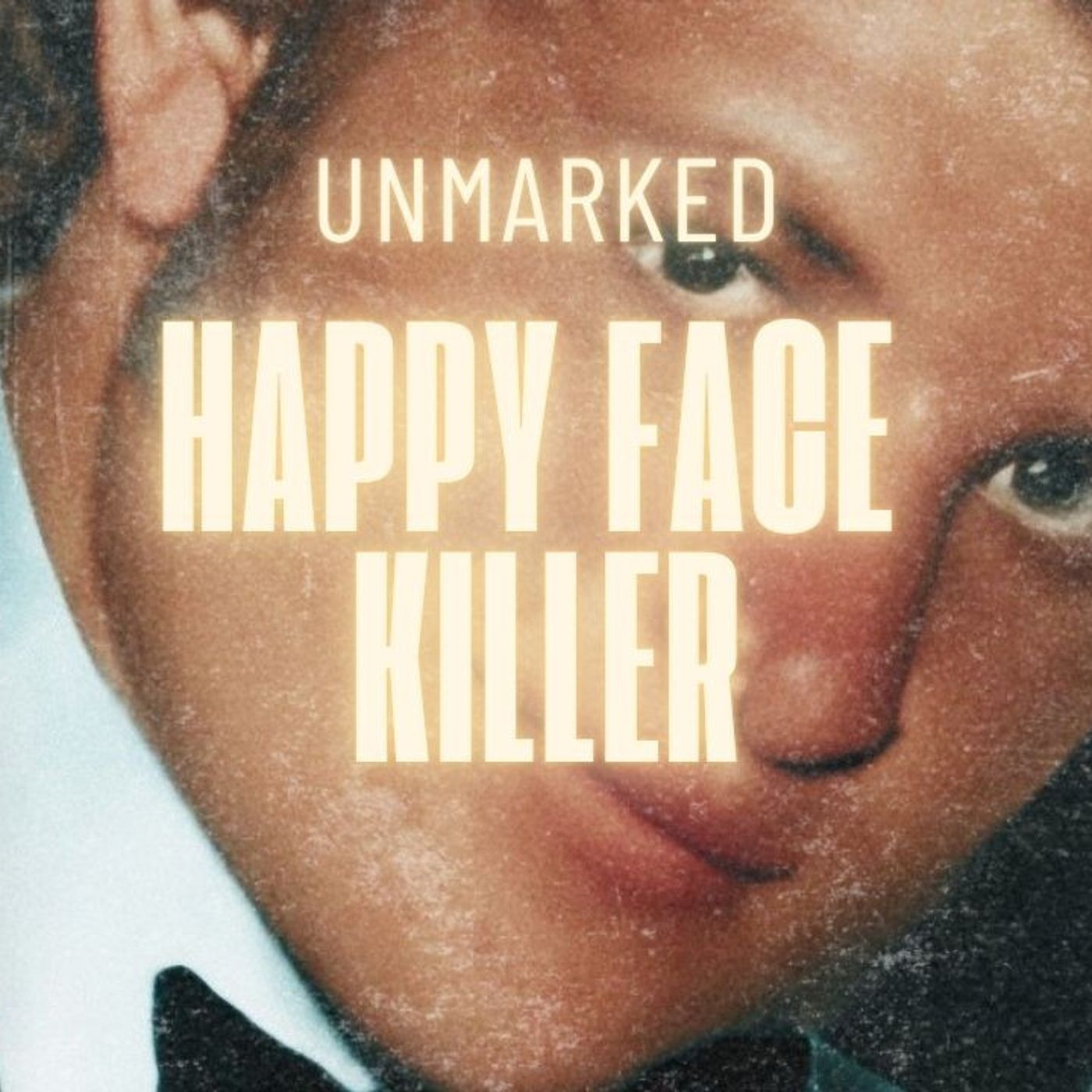
UNMARKED: A True Crime Podcast
22: The Happy Face Killer: Psychopathy, Control, and Confession
00:46:33
Loading summary
Transcript123 lines
- [00:00]
Commercial Narrator
With Vrbal's last minute deals, you can save over $50 on your spring getaway. So whether it's a mountain escape with friends, a family week at the beach or sightseeing in a new city, there's still time to get great discounts. Book your next day now. Average savings $72 select homes only.
- [00:31]
DISH has been connecting communities like yours for the last 45 years, providing the TV you love at a price you can trust. Watch live sports news and the latest movies, plus your favorite streaming apps, all in one place. Switch to Dish today and lock in the lowest price in satellite TV, starting at $89.99 a month with our two year price guarantee. Call 888-@dish or visit dish.com today.
- [01:02]
M. William Phelps
He was sitting directly in front of me, a foot away. And he's a huge guy, 6, 6, 6 5, 300 pounds. And his knees were, you know, up to my chest and his hands were on his knees. And I'll never forget, I said to myself, I said, those hands strangled eight women.
- [01:25]
James Buddy Day
I spend a lot of time studying psychopathy. These are people so fixated on themselves that they're blind to everything else. Not just empathy, but consequence, restraint, reality.
- [01:39]
M. William Phelps
I asked him, I said, could you kill me? And he said, if I had to, I could, but I have no reason to. And then I said, so you had a reason to kill these women? And he said, yeah, of course.
- [01:56]
James Buddy Day
There are few offenders who open that door the way Keith Hunter Jesperson does. I've gone through police files, interviews, court transcripts, deep research, and very rarely, very rarely, does a killer give you this kind of access. Not just to what happened, but why,
- [02:17]
M. William Phelps
once he's called Happy Face Killer, he embodies it, he takes it on. I got a nickname now. I'm one of those guys now.
- [02:27]
James Buddy Day
Between 1990 and 1995, Keith Jesperson moved across five states as a long haul trucker. After his arrest, he confessed to the murders of eight women.
- [02:40]
News Reporter
He's known as the Happy Face Killer because he sent the media details of his homicides and and would always end it with a smiley face.
- [02:48]
James Buddy Day
Jesperson wants to be known. He inserts himself into narratives. He writes, he talks, he explains. He's one of the only offenders I've come across who actively participates in research about himself. And in doing that, he's exposed how his mind actually works.
- [03:10]
M. William Phelps
Why'd you kill her?
- [03:11]
Keith Hunter Jesperson
I was just pissed off because there wasn't any parking spots in the rest area when I came in and I was tired and hadn't slept for probably 30 hours. I was just irritable.
- [03:20]
James Buddy Day
So today you're not just hearing an account of what Jesperson did. You're exploring how he thinks. Because this kind of violence doesn't come out of nowhere. It follows a pattern. One we've seen before and one that still exists in more people than we're comfortable admitting.
- [03:40]
M. William Phelps
I realized that I had an opportunity to ask a serial killer anything and he was willing to answer me.
- [03:48]
James Buddy Day
I'm James Buddy Day. This is unmarked. A relationship with a psychopath doesn't stay contained. It doesn't matter who you are. A journalist, an author, a researcher, a. Or someone who doesn't realize what they're dealing with until it's already underway. I've seen this up close. I've talked to people who've lived it. And the pattern, it's always the same. They don't let go. Because these personalities, what they're always chasing, it isn't connection.
- [04:25]
M. William Phelps
Psychopaths in general, especially serial killers who are psychopaths, they crave stimulation. They need to be stimulated all the time.
- [04:40]
James Buddy Day
That's M. William Phelps. Author, Investigator. Someone who spent decades inside these cases. He's written more than 27 books and hosts shows like Crossing the Line and Paper Ghosts. And out of everything he's worked on, there's one case that. That didn't just stay on the page, it followed him home. Keith Hunter Jesperson.
- [05:05]
M. William Phelps
Over 100 hours. I spoke to him over 100 hours. And you know, in the closet in my office here, I have over 9,000 pages of letters that we exchanged. I have hundreds of letters from him I haven't even opened yet.
- [05:22]
James Buddy Day
Before we go any deeper, let me catch you up. At one point, Keith Hunter Jesperson claimed he had as many as 160 victims. Don't believe it. What we can actually confirm is eight. Eight women across California, Florida, Nebraska, Oregon, Washington and Wyoming. All over a five year period ending in 1995. But. But what makes Jesperson's case different is that he has this insatiable need to be understood.
- [05:57]
M. William Phelps
I mean, he would send me three, four, five letters a week. Each of them 20 notebook pages on both sides. You know, so I couldn't keep up with it. But yeah, and I went out to visit him many times.
- [06:11]
James Buddy Day
There's a term for that. It's called hypergraphia. An overwhelming compulsion to write. Jesperson's isn't just a need for attention, it's something else. He documents everything constantly, obsessively, because in his mind it matters more than anything else. He believes people will care and that needs to be recorded. This is how someone like Jesperson navigates the world.
- [06:40]
M. William Phelps
Empathy, love, caring about somebody, sympathizing with somebody. They don't even feel any of that stuff and really they have no idea why. You know, it's just, it's not in them.
- [06:54]
James Buddy Day
You've probably heard the term sociopath, which is different from psychopath. Sociopathy is a diagnosis. Clinically, it's tied to criteria outlined in manuals like the DSM 5TR. It relies heavily on observed behavior and, and that's not really what we're talking about here. We're talking about something much broader. Psychopathy, a fundamental structure of the mind that's been debated for decades, going back at least to a book called the Mask of sanity in 1941. But even now, there isn't a single clean definition. In the 80s and 90s, researcher Robert Hare developed what's called the Psychopathy Checklist. It's a tool used by clinicians to assess offenders. But even that is being re examined because it confounds who someone is with, what they've done. Something I spoke about with M. William Phelps, that's such an interesting paradox with these men in that they are grandiose like you said, and they want the spot spotlight on them. Yet at the same time they will lie about everything. They deceive constantly and they don't recognize that their psychopathy blinds them from what really happened, what really is going on.
- [08:26]
M. William Phelps
I mean, that's the gist of it, right? That is really at the core of this. Right. You know, because they are psychopaths, that psychopathy doesn't allow them to see it.
- [08:43]
James Buddy Day
So for today, here's the simplest way to think about it. Psychopathy comes down to three traits that build on each other. Grandiosity, someone who sees themselves as the center of everything. From that you get the second trait, callousness. What happens to other people doesn't really register. And when you're both grandiose and callous, it's an easy step to the third impulsivity. Whatever they feel in the moment, they act on it. Put those together and you get a very specific way of seeing the world. Narrow, self centered, like everything is being filtered through a keyhole, where you're always the center and other people, they don't fully register. And that brings us back to Keith Hunter Jesperson, because he doesn't just fit this pattern, he leans into it, wears it openly in fact. And to understand how a mind like this comes together, you have to go all the way back to the beginning. A quick pause Step Stay with me. This episode is sponsored by BetterHelp and I'm really happy to have them here because on this show we talk a lot about psychology, the environments people grow up in, the experiences that shape them, and the way those things can follow all of us into adulthood. And since May is Mental Health Awareness Month, it feels like the right time to say this plainly. Whatever you're going through, you don't have to go through it alone. I know from experience how easy it is to keep pushing things down. Or just telling yourself, I'll deal with that later. Or convince yourself that you should be able to figure everything out on your own. But who are we kidding? Life does not work that way. Some days feel good, other days feel overwhelming. And when something is keeping you up at night, having someone to support you, it can make all the difference. And that's what I appreciate about BetterHelp. They make it easy to take that first step. You start with a short questionnaire that helps you identify your needs and preferences. And BetterHelp does the initial matching work for you so you can focus on your therapy goals. I've gone through the process, very straightforward and with more than 12 years of experience and an industry leading match fulfillment rate, they typically get it right the first time. But if you're not happy with your match, you can switch to a different therapist at any time with tailored recommendations. You don't have to be on this journey alone. Find support and have someone with you in therapy. Sign up and get 10% off@betterhelp.com unmarked. That's better. H-E-L-P.com unmarked and now back to the record. Keith Hunter Jesperson is Canadian born. He's from Chilliwack, British Columbia, a few hours from Seattle, born in 1955, four siblings. And according to the material we have, the signs of who he will become show up early.
- [12:01]
M. William Phelps
I delved into his childhood with him a lot. In fact, I asked him once, I said, listen, I need a timeline of your life. He sent me three of those fifth grade type notebooks, marble notebooks with the marble black and white cover. Three of them. Full 600 pages. And he started in the 1800s in Denmark, where the Jesperson family originated from. In those books he mentioned his mother in 600 pages one time and then he blames his father for everything that
- [12:39]
James Buddy Day
stands out to me. 600 pages and his mother appears once. Contemporary reports describe his father, Les Jesperson, as overbearing, alcoholic over the years, Keith has made claims like he was charged room and board while his siblings paid nothing. But we have to be careful here because what you're seeing is a version of events centered entirely on Keith Jesperson, where fantastic extremes become part of his origin story.
- [13:13]
M. William Phelps
Jesperson also told me the story once that he was with his dad one day, and they're driving on a back road up in British Columbia, and he's young, 15, 16, whatever, and the dad is drunk, and the dad hits somebody who's walking and kills the guy. And he says, my dad just dragged that guy, threw him in the woods, and we took off. And nobody knew the difference. He said that taught me that you could get away with murder. Now do I believe that story? It's hard for me to believe that story. You know, that seems like a Jesperson drama that he created for himself.
- [13:57]
James Buddy Day
You know, that story is familiar. I've heard versions of it before. Other offenders, like Hayden Clark, they've created similar memories, moments in their childhood where everything clicked, where they learned they could get away with it. And in Jesperson's case, just like Hayden Clarke, there's no evidence any of this ever happened. But it shows you something about how his mind works. Not just what he experienced, but how he rewrites it instead. By all accounts, Jesperson has early predictors of irritability, poor emotional control, a tendency to take whatever's happening around him and turn it inward.
- [14:45]
M. William Phelps
According to Jesperson, whatever he did was never good enough for the dad. He had no control over his life. Living under his father's thumb, zero control. He was told what to do, he did it. If he didn't do it, there was a price to pay. Whether he was blamed for something, he didn't get what he wanted, or his father hit him with the belt or whatever it was, he paid a price, and he had no control over his life.
- [15:14]
James Buddy Day
There are also reports of early warning signs, like animal cruelty, fire setting, bedwetting, what's called the McDonald triad. But that theory, it doesn't hold up the way people think it does. The McDonald triad was proposed in the 1960s based on small, poorly controlled samples, and later research has not supported it as a reliable predictor of violence. The problem is it confuses symptoms with cause, like treating a fever as the disease instead of a sign that something else is wrong. So when Jesperson points to memories of these behaviors, it's worth asking whether he's describing something real or trying to fit himself into a story that already exists. Because what we actually see is something more grounded. Keith Jesperson is an isolated adolescent struggling to understand why social cues don't land, why connection does not come naturally.
- [16:23]
M. William Phelps
His nickname was Igor. He was a big kid, kind of clumsy. Nobody liked him. His brothers picked on him. He got picked on in school, etc. Etc. And then his father picked on him.
- [16:40]
James Buddy Day
Before Keith attends high school, the family moves from British Columbia to the United States, settling in Selah, Washington, just outside of Yakima, a small town where Jesperson doesn't blend in, he stands out.
- [16:58]
M. William Phelps
His father used him as a scapegoat for the mistakes his father made. So for an example, his father was kind of a contractor. One day his father put the backhoe through somebody's house, knocked the wall down. He went inside and blamed it on little Keith, things like that.
- [17:18]
James Buddy Day
And that brings us to the moment Jesperson often points to as a turning point, high school. By this point, his size and his social isolation are working against him. He's not just an outcast. Jesperson has made claims that he was sexually assaulted during this period. But after years of conversations and research, M. William Phelps describes something different.
- [17:48]
M. William Phelps
What happened to him in high school. What he tells me is, is his brother and his brother's friends. One day he was walking down the hall and they tackled him. They took his pants off and everybody came around and laughed at him.
- [18:05]
James Buddy Day
In his own writings, Jesperson reframes this moment. He turns it into something violent, more defining. This is where you start to see the pattern clearly. Experience distorted into narrative, narrative reinforcing identity. And once that loop begins, the seeds of fantasy are sown.
- [18:32]
M. William Phelps
I did enough research with this guy. I've read his writings. I know, I've seen his drawings. He's an excellent painter. He sent me dozens of paintings I have stored away in the closet that I'll never look at. And his fantasy is a woman in the position of he is in total control of that person.
- [18:56]
James Buddy Day
It's at this time that Jesperson reports developing the fantasies that will drive him in later life. And these fantasies are the result of a vacuum, real world deficits that we know Jesperson has. You see, Jesperson himself participated in a study. It began in 2015 and was published in 2022 in the journal of Personality Assessment. It's titled Performance and Neuropsychological Functioning in the Case of a Serial Killer. And what that research demonstrates is that Jesperson has difficulty identifying emotional states in other people, particularly negative emotions. And this is more pronounced in his interactions with women. What that means is that his psychopathy prevents him from accurately reading people. So his mind, it fills in the gaps. And when you're getting it wrong but you believe you're right, the only way to make sense is to take control.
- [20:07]
M. William Phelps
He needs to have total control over this person. That's his fantasy. And that is really a fantasy for a lot of these guys, total control.
- [20:17]
James Buddy Day
As this fantasy develops, Jesperson describes a lifelong fixation on becoming a serial killer. Now, whether that's true or something he's rationalized after the fact is debatable. Something that came up in my conversation with M. William Phelps. He is a modern era serial killer in that he grew up reading about other serial killers. And you know, he seems to be so enamored by his own fame, he participates in research studies about himself. Is it just this insatiable need for attention he has today?
- [20:54]
M. William Phelps
As we sit and talk, he and the Long island serial killer Rex Ewerman are exchanging letters. So Jesperson inputs himself into that situation because he knows the Long island serial killer is a much bigger story than his story ever was. So he wants to be part of it. So that. So that's what he's about.
- [21:17]
James Buddy Day
That correspondence says a lot. Jesperson has a need to insert himself into bigger stories, bigger names, because he needs to matter.
- [21:27]
M. William Phelps
Jesperson loves to think he's the smartest guy in the room and he thinks he can explain anything that has to do with killing, serial killing, etc. So for him, it's all about being the smartest guy in the room and being the spotlight of the room, having the spotlight on him all the time.
- [21:55]
James Buddy Day
By 1975, Jesperson is 20 years old, but he's still on the outside. Socially awkward, rejected, struggling to connect to people in meaningful ways. And in that context, marriage offers something simple, a defined role, a relationship he doesn't have to navigate. In the same way, that year he marries his teenage girlfriend, Rose Hawk. They have three children, and on the surface it looks stable, but that stability is thin.
- [22:30]
M. William Phelps
You know, he was more focused on getting sex out of Rose or dominating Rose, his wife. And he was always gone, he was always on the road, he was always out on the road. So he really wasn't much of a father at all.
- [22:50]
James Buddy Day
By the late 70s, Jesperson is working as a long haul truck driver, eventually being hired by the company Systems Transport out of Cheney, Washington, a job that keeps him on the road for days at a time with little oversight.
- [23:06]
M. William Phelps
He was getting sex workers, paying for sex Picking up women. Most serial killers have an addiction to something. You know, most of them are alcohol or drugs. They're, you know, they're addicts. And Jesperson, I couldn't find it for the longest time. What was it? Well, it's a combination for him, gambling and sex.
- [23:28]
James Buddy Day
Gambling, sex, two things built around risk and control. And they map directly onto the traits we've been talking about, about impulsivity. Chasing the moment, the rush. At this time, he's acting without thinking about what comes next and callousness, because the consequences don't really land. Not on him and not on the people around him. And despite all of it, even with the infidelity, the lying, the constant losses, his marriage lasts 414 years.
- [24:03]
M. William Phelps
With his kids, I mean, his kids he would pick. After the divorce, he would pick them up, bring them to a hotel, get him pizza, let him swim in a pool, bring him back home. At home, he was no father at all.
- [24:16]
Commercial Narrator
If you work in university maintenance, Grainger considers you an MVP because your playbook ensures your arena is always ready for tip off. And Grainger is your trusted partner, offering the products you need all in one place, from H Vac and plumbing supplies to lighting and more and. And all delivered with plenty of time left on the clock. So your team always gets the win. Call 1-800-GRAINGER visit grainger.com or just stop by Grainger for the ones who get it done.
- [24:46]
When you manage procurement for multiple facilities, every order matters. But when it's for a hospital system, they matter even more. Grainger gets it and knows there's no time for managing multiple suppliers and no room for shift shipping delays. That's why Grainger offers millions of products in fast, dependable delivery so you can keep your facility stocked, safe and running smoothly. Call 1-800-GRAINGER click granger.com or just stop by Grainger for the ones who get it done.
- [25:16]
James Buddy Day
By the late 80s, Jesperson is living alone in East Portland. He's in a rundown one level home, so sleeping on a mattress on the floor, he spends most of his time driving truck. When he's home, he walks to a nearby tavern. And by 1990, Portland is coming out of a pretty rough decade. The timber industry has collapsed. Working class jobs are disappearing across Oregon. So what you get is a split city, a revitalizing downtown core, and an expanding, underdeveloped East Portland where homelessness is growing and visible. And it's this environment in which Jesperson first crosses the line.
- [26:08]
M. William Phelps
The way he presents this is, you know, I'm out. My girlfriend. I just realized my girlfriend, whose house I'm living in, took off with another trucker. So I went out to the bar, and there's Tanya Bennett.
- [26:27]
James Buddy Day
Tanya Bennett, the woman Jesperson meets at a local tavern on January 21, 1990. She's developmentally delayed and struggling with homelessness. Throughout her life, she's been involuntarily committed to hospitals due to ongoing mental health issues that she never overcomes. She is what we mean when we describe someone who is vulnerable.
- [26:54]
M. William Phelps
Jesperson tells me, let's go back to my place. And then when we get there and she pisses me off, she says something that flips him out, according to him. But I don't believe any of that. I don't believe any of that.
- [27:09]
James Buddy Day
Jesperson's account of his crimes are filtered through his psychopathy. Remember, he struggles to recognize cues in other people, so he projects them instead, and that results in a distorted version of what actually happened.
- [27:25]
M. William Phelps
The other thing about him is with his victims is he always blames them. It's their fault. If they didn't do this, if they didn't do that, if they didn't say this to me, I wouldn't have done this to them.
- [27:41]
James Buddy Day
This is where his psychopathic traits come together. Grandiosity. He places himself at the center of this interaction. Callousness. What happens to his victim doesn't fully register. And impulsivity. Whatever he feels in the moment, he acts on.
- [27:58]
M. William Phelps
He went out that night. He chose her. He brought her back to his place, and he killed her.
- [28:06]
James Buddy Day
Jesperson is back on the road the next day. Bennett's body is discovered days later on a switchback in the Columbia River Gorge, about a mile and a half from a historic Oregon landmark called the Vista House on Crown Point. The autopsy lists her cause of death as strangulation. And in the weeks that follow, something happens that Jesperson could never have anticipated. A mentally ill woman named Laverne Pavlanak implicates herself and her boyfriend, John Sovsnoski, in the murder, giving a detailed confession using information pulled from local media. She will later say she did this to escape an abusive relationship.
- [28:54]
M. William Phelps
Not only did he get away with that murder, but two other people went to prison for that murder.
- [29:00]
James Buddy Day
Pavlonak and Sosnoski are arrested on March 5, 1990. Both are convicted on February 8, 1991, and they serve five years before being exonerated by Keith Jesperson after his arrest. But in 1990, the media reports infuriate Jesperson because his grandiosity demands that he be recognized. And when someone else is blamed, even if it protects him, it becomes intolerable. This is Jesperson speaking to Phelps in a video call from 2017 ranting about the case.
- [29:40]
Keith Hunter Jesperson
She basically saw the law as a way to get rid of her abusive boyfriend that was on parole or probation. And every time a new crime came up, she'd call him and say, John did this crime. You got to get him away from it. You got to put him in prison.
- [29:55]
James Buddy Day
This goes on for a while. And it's telling because Jesperson is projecting. He's not reacting to the injustice. Remember, he doesn't experience the suffering of others in the same way. Instead, he's outraged that his actions aren't being seen.
- [30:14]
Keith Hunter Jesperson
I need someone to research this case for the fact that the public needs to know what the prosecution and the police officers did to convict two innocent people and put them in prison. That's the real story here, not. Not the fact I'm a murderer. The fact is that how they put these poor people in prison.
- [30:35]
James Buddy Day
Three months later, on April 13, 1990, Jesperson kidnaps Dawn Slagel, a 21 year old mother of three, from a shopping center parking lot in Mount Shasta, California, near the i5 corridor. He attempts to assault and murder her, but she escapes and finds police. They charge Jesperson with sexual assault and when he fails to appear in court, a felony warrant is issued. He's later arrested in Iowa at a weight check station after his name is run through the National Crime Information center database, revealing the outstanding warrant. However, the charge is inexplicably reduced to a misdemeanor and the cost of extradition is deemed not worth it. So Jesperson is released months later. This oversight has a real world cost. Jesperson picks up a woman, a victim, whose identity he he never learns.
- [31:43]
M. William Phelps
There's still one victim that's not identified and that is Claudia in California.
- [31:48]
James Buddy Day
According to contemporaneous reports from law enforcement, the woman is believed to have been hitchhiking towards the Los Angeles area and caught a ride with a truck driver the morning of her death. Investigators believe she was traveling from the Las Vegas or Barstow region along I15. What we know is that Jesperson murders her in his truck and leaves her body along Highway 95 near Blyth, where it's found on August 30, 1992. At the time, the investigation is minimal.
- [32:25]
M. William Phelps
I spent two years working with Florida authorities and the medical examiner's office down there trying to get enough isotope analysis from her bones in order to put into the familial genealogy, forensic genealogy, and finally we ran out of funds. We couldn't do it.
- [32:46]
James Buddy Day
In fact, this victim remains unidentified, even though in recent years genealogists have identified her biological father, who is now deceased. We know he was from Cameron County, Texas, but traveled extensively across the country. Several half sick siblings have also been identified, but none share the same maternal line. And so they were unaware of the victim and cannot assist in identifying her. This is Jesperson speaking about the case with Phelps.
- [33:19]
Keith Hunter Jesperson
The way I look at it is that I was open with the police when they first came at me with this Florida case. And I wanted to settle all my cases to get them out of the way. Now high I already told them all the information they needed to settle the case.
- [33:34]
James Buddy Day
This conversation is revealing because Jesperson is explaining his true motivation for wanting this victim identified.
- [33:43]
Keith Hunter Jesperson
By helping them and by getting like yourself and maybe some other people involved in actually is a feather in my cap.
- [33:53]
James Buddy Day
Oh, okay, so you're doing it for your own motivation.
- [33:58]
Keith Hunter Jesperson
It works all the way across the board.
- [34:01]
James Buddy Day
Jesperson opens more windows into his psychopathy, Even something like victim identification. What should be about giving someone their name back becomes self serving. But back in 1990, Jesperson passes through Turlock, California, meeting a woman he claims is a sex worker who enters his truck. Truck at a truck stop. While he's asleep, he says he murders her and leaves the body in Livingston, California, near another truck stop called the Blueberry Hill Cafe. This is Jesperson attempting to recall the details of this victim.
- [34:42]
Keith Hunter Jesperson
She was a blonde or something like that. It was dark, but I'm assuming she was probably a strawberry blonde, Hair down about her shoulder length and petite.
- [34:55]
James Buddy Day
Now we have to dig into this one. Jesperson never learns his victim's true name. But after his arrest and confession, the Merced County Sheriff's Department identifies this victim as Cynthia Lynn Rose, whose body was discovered behind the Blueberry Hill Cafe near the base of a tree. Tree in a fetal position. But the autopsy report tells a different story. According to the medical examiner, Cynthia Lynn Rose died from a drug overdose. The autopsy notes that injuries to her head, including a broken jaw, were not responsible for her death and more importantly, do not match Jesperson's account.
- [35:40]
M. William Phelps
He. He says he didn't kill her, but they found her there where he said he dumped the body. They found this girl, Rose.
- [35:50]
James Buddy Day
According to Phelps's research, when Jesperson confessed in 1995, investigators connected him to an existing report of a deceased woman found near that location.
- [36:02]
Keith Hunter Jesperson
The woman that they tried to say is mine was Cynthia Lynn Rose. And they showed me pictures of that, of her when I was going down to Riverside. And I said, well, I don't know who that is.
- [36:16]
M. William Phelps
He tells him, I buried a woman at Blueberry Hill Cafe. Just so happens, bang, they find her. Must be his victim. And then when he saw her picture, he said, yeah, that's not the girl I killed.
- [36:28]
James Buddy Day
To Phelps and others, Jesperson maintains that the victim he murdered in the fall of 1992 was remains buried where he
- [36:37]
Keith Hunter Jesperson
left her, the one near the rest area. I took the tunic behind a Blueberry Hill Cafe in the parking lot. I still believe that if she didn't get up and walk away that she's still there.
- [36:49]
M. William Phelps
It's a parking lot now. It's been paved over. The Blueberry Hill Cafe, that's where he dumped her. And he dumped her in an area where the trucks turned around and there was like a three foot rut where all the trucks turned around. He put her in there and put dirt over her. She's still there. I'm convinced of that.
- [37:09]
James Buddy Day
But local investigators have closed the case for now. And that's hard to sit with because these victims are people who are overlooked in life and even in death, they're still waiting to be seen. Case in point, November 1992.
- [37:28]
News Reporter
Foreign.
- [37:32]
James Buddy Day
Jesperson murders Lori Ann Hentland, a sex worker he meets in Salem, Oregon, who he claims tried to overcharge him, leading to an argument that results in her death.
- [37:45]
M. William Phelps
This is just his excuse, his kind of psychotic reasoning. But his reasoning was always they had burned, burned him or they had burned somebody else and they deserved and they needed to die.
- [38:01]
James Buddy Day
Pentland's body is found in November of 1992 behind a store in Salem, Oregon. The medical examiner determines she's been strangled, but it doesn't raise an alarm. Once again, the investigation is minimal. And we see this again in Jesperson's next victim in June of 1993, who won't be identified until 2022. Patricia Patsy Skipple, a native of Colton, Oregon and a mother of two who disappeared from her Oregon home in the middle of the night after an argument with her husband. On June 3, 1993, another truck driver finds her body where Jesperson has left it while along California State Route 152 in the Gilroy area about 80 miles south of San Francisco. Her disappearance and her remains are never connected by authorities until Jesperson tells them
- [39:05]
M. William Phelps
Years later, in defense of law enforcement, especially in this case, he's leaving bodies all over the country. So number one at the top time, you know, between 1990, 1995, it's kind of hard to connect these at all.
- [39:22]
James Buddy Day
But that becomes the problem because by not connecting them, not only does this vulnerable population continue to be overlooked, but Jesperson himself fixates on the fact that he isn't being seen.
- [39:37]
Keith Hunter Jesperson
About two weeks later, I write a letter to the Oregon newspaper, which falls on a desk. And in that letter there's the very top of the page with one little smiley face. Now, I don't really remember doing it, I just, it's just one of those,
- [39:52]
M. William Phelps
it's like an afterthought Jesperson would always tell me. He would say, look, all I did was send a letter to the newspaper and I doodled a happy face on the bottom of it, on the top of it, just as a doodle. I didn't do it to become the Happy Face Killer, but that's what they called me when they saw that happy face.
- [40:16]
James Buddy Day
But Jesperson's actions suggest otherwise. His need to be recognized is evident in the fact that he scrawls a confession of sorts on a truck stop bathroom wall, indicating police have arrested the wrong people.
- [40:31]
M. William Phelps
Once he's called Happy Face Killer, he embodies it. He takes it on. I got a nickname now. I'm one of those guys. Now. I'm not just some trucker out there killing women. I'm the Happy Face Killer. So he embodies that kind of Hollywood image of who he becomes.
- [40:50]
Keith Hunter Jesperson
When I was confessing in these letters, I wasn't telling the absolute truth because if I was, they'd all break it all down and come after me with the absolute truth. I figured I'd tell him little lies here and there.
- [41:07]
James Buddy Day
Back In August of 1994, Jesperson picks up a 24 year old sex worker named Susan at a truck stop in Tampa. He drives with her towards the Florida Panhandle where he murders her and leaves her body near the Holt exit on Interstate 10.
- [41:25]
M. William Phelps
She was from the upper Midwest. I, everybody thought she was from down south because he dumped her in Tampa, but she just happened to be down in Florida when he picked her up.
- [41:34]
James Buddy Day
Her remains are not found for more than a year. On September 14, 1994, her skeletal remains are discovered by a road crew. She isn't identified until 2023, when DNA is used to locate her next of kin, confirming her as Suzanne Schellenberg.
- [41:57]
News Reporter
Got some great exciting news that We've been able to solve a homicide that's 30 years in the making. The last unidentified victim of the notorious Happy Face Killer has now been identified. She is no longer a Jane Doe. I want to reiterate how proud I am from these investigative team that we have, not just.
- [42:16]
James Buddy Day
That's Okaloosa County Sheriff Eric Aiden in 2023. And I want to pause on this moment because you see press conferences like this all the time. And to be clear, this work matters. The investigators, the genealogists, the people who stay on these cases for years, that work is real.
- [42:39]
News Reporter
We've really had a good reputation here at the sheriff's office for solving cold cases. We've solved over a dozen that I know of in the last 10 years.
- [42:46]
James Buddy Day
But in cases like this, involving victims who were vulnerable, overlooked in life, there's something else that needs to be said. It took 30 years to get this right. That's not cause for celebration. That's a moment for humility, to understand what was missed and to make sure that it isn't missed again. And that can be seen in Jesperson's seventh victim, Angela Cebriz.
- [43:15]
M. William Phelps
He tells me he picks up this woman in his truck and he's driving her, you know, she says, I'm going across country and I'm going to this guy's house. I'm pregnant with somebody else's baby, and I'm going to tell this guy that it's his baby. And Jesperson said to me, I couldn't let her do that. That's wrong. I said, but killing her is right. Maybe eight years later, into the business relationship we had, he writes me a letter, and he says, I lied. That was a lie. She never told me that.
- [43:50]
James Buddy Day
Her body is found in September of 1995 in Wyoming. the time, few people even realize that she's missing. No one is really connecting many of these victims to the Happy Face Killer. And if Jesperson doesn't murder a woman who can be directly tied to him, there's no reason to believe he will stop.
- [44:13]
M. William Phelps
He picks up Julia Winningham in his truck and he goes into the house and he talks to her mother. So right there, she knows the last person with Julia is Jesperson.
- [44:24]
James Buddy Day
On March 10, 1995, in Washougal, Washington, Jesperson strangles Julia Ann Winningham, 41, of Camas, Washington, a woman he is easily connected to socially.
- [44:39]
M. William Phelps
When they lock onto Jesperson, they think that he only killed Julia Winningham, his ex girlfriend. Right. And that's basically how he gets caught. He can't handle himself, and he ends up killing somebody he knew.
- [44:57]
James Buddy Day
Jesperson is arrested on March 30, 1995, for the murder of Julie Winningham. He's questioned by police and released because at that point, they have little to hold him on, and he simply refuses to talk. But in the days that follow, Jesperson becomes convinced that his arrest is inevitable. He turns himself in, confessing to a detective on voicemail, as well as writing a confession to his brother. He hopes that cooperation will result in leniency. But once he's in custody, something else happens.
- [45:39]
M. William Phelps
They have no idea that he's killed all these women until he tells them.
- [45:44]
Keith Hunter Jesperson
My biggest defense is a great offense, and that is to push my guild down the road to say, okay, I did this. Now let's settle this. Let's move on. If you want to give me life sentence to it, fine.
- [45:56]
James Buddy Day
Once in custody, Jesperson won't stop talking, confessing, inserting himself into cases across multiple states. Some are accurate, others exaggerated. Many later recanted.
- [46:10]
Keith Hunter Jesperson
I've never hidden behind a lawyer in my life. I listen to what lawyer have to say, I follow. You know, I pay attention to what they have to say, and I know what's going on. But my case study, as you know, has been just to resolve the whole thing and just move on.
- [46:28]
James Buddy Day
In November of 1995, Jesperson pleads guilty to the murder of Julie Winningham in Washington State. He's sentenced to life in prison without the possibility of parole. In the years that follow, he's convicted of additional murders across multiple jurisdictions. Addictions, including Oregon and California, receiving multiple life sentences. And despite periods of claiming many more victims, investigators have never been able to substantiate any.
- [47:00]
M. William Phelps
I did tons and tons of research for years trying to see if there are more bodies with him, and there just aren't. They're just not there. Because I know that if there were, he would admit to it. He would definitely take credit for it.
- [47:18]
James Buddy Day
And that may be the clearest window into Keith Jesperson's psychology. Because even here at the end, the pattern holds. Not just the violence, but the need to be seen, to be known, to control the narrative. The same traits we've been tracking from the beginning. Grandiosity, callousness, impulsivity, working together. And there's a growing body of research that is trying to map this out. For decades, researchers have been trying to understand what's happening inside the brains of these violent offenders. Brain scan studies led by psychologist Adrian Raine have shown consistent patterns, reduced activity in alien areas tied to impulse control, decision making and emotional regulation. Physical differences in how the brain processes fear, empathy and consequence.
- [48:14]
M. William Phelps
Adrian Raine he did and he continues to do scans on psychopaths. Brain scans. In fact, Jesperson has donated his brain to me to give to Adrian Rain.
- [48:27]
James Buddy Day
When he does, it's not an excuse, but another piece of the puzzle.
- [48:33]
M. William Phelps
There's a missing hole in the psychopath, and that's the area of the brain where empathy, love, caring about somebody, sympathizing with somebody would be.
- [48:45]
James Buddy Day
These brain scans give us another way to look at Jesperson's mind. But even by agreeing to donate his brain to research when he dies, we have to remember this is not Jesperson wanting to be studied. It's a serial killer who wants to matter even in death. Before we wrap, we covered a ton of research in this episode, and if you're like me, who love spending their Sunday nights with a glass of wine reading in depth psychology research, I will post what I can for you on Unmarked Case Files, our research portal where you can examine the evidence for yourself and for books this week. If you want to go deeper, M. William Phelps book Dangerous Ground. My Friendship with a Serial Killer is his definitive account of his time with the Happy Face Killer, and it's a great read. And if you're looking for a great true crime, read my book Charles Manson the Last Word Words is available on Kindle and Amazon and Kindle Unlimited, and it recounts my decade of research into the Charles Manson case and finally, my grimdark fantasy novel, A Plague of Steel, which is the first in a planned series that I'm going to be writing for the next several years. It's now available in paperback on Amazon, but you can also read it on Kindle and Kindle Unlimited. As always, Unmarked is produced by John Nadeau and edited by Dave Alderson. Our additional producer is Jesse demarais. Until next week, this is Unmarked.
- [50:29]
Commercial Narrator
If you work in university maintenance, Grainger considers you an MVP because your playbook ensures your arena is always ready for tip off. And Grainger is your trusted partner, offering the products you need all in one place, from H Vac and plumbing supplies to lighting and more. And all delivered with plenty of time left on the clock so your team always gets the win. Call 1-800-GRAINGER visit grainger.com or just stop by Granger for the ones who get it done.