← UNMARKED: A True Crime Podcast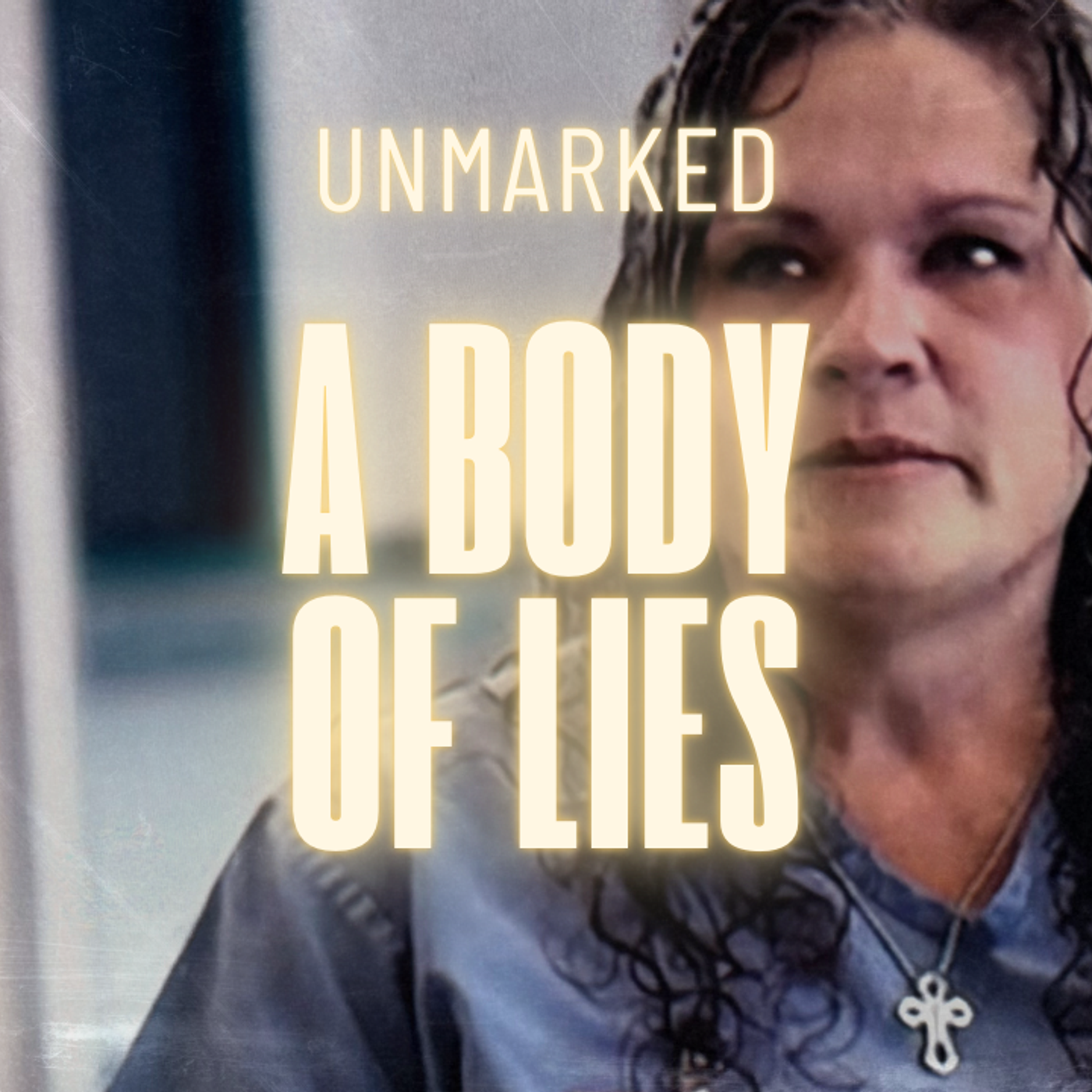
Loading summary
Transcript93 lines
- [00:01]
A
With VRBoCare, help is always ready before, during and after your stay. We've planned for the plot twists, so support is always available because a great trip starts with peace of mind. You know what? It sucks to be bored. But when I get on my phone and play real casino games on spinquest.com, the time flies by. That two hour wait at the DMV seems like 10 minutes. Play your favorite spots live blackjack, live preps with a live dealer. New players $30 coin packs are on sale for 10 bucks. Play spinquest.com and you'll never be bored again. Spinquest is a free to play social casino void where prohibited. Visit spinquest.com for more details. I remember standing just inside the main gate of the largest women's prison in the United States. It's deep in the heart of Florida. A guard hands me this little box. It looks like an oversized pager with a little button in the middle. And he clips it to my belt. And his instructions are blunt. If someone tries to kill you, press this button.
- [01:11]
B
Prison is inhumane. I will have to say, I never knew we treated humans like this at all. I really didn't believe we treated humans like this.
- [01:21]
A
That's the woman I'm there to interview, Doris Dee Dee Moore. She's serving life in prison with no possibility of parole.
- [01:30]
B
A lot of these people could be. We could save taxpayer money and could be in houses on ankle bracelets and stuff and actually work instead of taxpayers paying.
- [01:40]
A
Dee Dee Moore is not one of those people. This is a woman who once staged her own kidnapping, who committed fraud on a staggering scale. Convicted of first degree murder, I'm there to sit across from her face to face and hear her story. Not that she's honest. She isn't. In fact, Dee Dee Moore is almost incapable of telling the truth.
- [02:03]
C
You think I've done this? You think I took a gun and shot somebody? Dee Dee, look at the bright side. If you can convince me, you can convince anybody.
- [02:10]
A
The lies are where her story really lives. And it's through those lies that you will come to understand Dede Moore.
- [02:18]
B
Do I deserve a life in prison? To die for killing a man I didn't have nothing to do with? Absolutely not.
- [02:26]
A
I'm James Buddy Day. This is unmarked. When I sit across from Dini Moore, she's wearing prison blues. We're in a cavernous cafeteria that echoes with chairs scraping against the cement. There's a guard beside me, close enough to touch. Dee Dee smiles, chatty, eager. And immediately she begins talking about her innocence.
- [02:53]
B
You've got to be crazy if you think that I did this. The evidence shows that. The DNA shows that I've been corresponding
- [03:01]
A
with Dee Dee for a while now. In fact, I have her letters right here. Despite being written from a prison cell, it's printed on Doris Moore custom stationery. Most of the letter is her complaining about her TV appearances. It reads in part, People could not believe 2020 did not show my side of the story. I've got letters from all around the world. Snap. Did a little better.
- [03:25]
B
You've got somebody like 2020 going, oh, you could make this paper up. Have you lost your mind? You oughta seen what they cut and cropped out.
- [03:33]
A
To be clear, Dee Dee Moore is undeniably guilty for the murder of Abraham Shakespeare, a Florida man who won a $30 million lottery prize in 2006 and vanished in 2009. His body was eventually found buried under a concrete slab in Dee Dee's backyard. Two gunshot wounds to the chest from a.38 Special. Despite her complaints, she hasn't been misrepresented in the press. She is, by every definition, a violent, pathological liars.
- [04:07]
B
I had one lady write me and say something happened in the jury room.
- [04:11]
A
There's no point debating her as a true crime filmmaker. I've had years of practice talking to pathological liars. People like Dee Dee live in a sort of blurred boundary between truth and invention. Sitting across from her, as far as I can tell, she believes every word she's saying. So instead of arguing, I want to understand. How did she become capable of all this? Where are you from?
- [04:37]
B
Plant City, Florida.
- [04:40]
A
Dee Dee is born Doris Donegan. She's from Hillsborough county, population 100,000. High poverty. And like most people, her childhood shapes her. According to her mother, a certified nursing assistant, Dee Dee was a gleeful kid, a Brownie, Girl Scout, elementary school cheerleader. But Dee Dee was always embarrassed by what the family didn't have. The cars, the clothes, the money. So when she turns 19, she escapes the only way she can. She gets married. Her husband is James Darrell Moore, a man her own age. And at first, life is quiet. In 1995, they have a son, Robert. And in 2000, they buy their first house. And this is where things start to get strange. Dee Dee's first major scam is to fake her own kidnapping. It begins on June 14, 2001, when the bank attempts to repossess Dee Dee's $50,000 black Lincoln Navigator. Six days later, the Navigator is stashed inside a garage in Pasco County, Florida. Dee Dee promises the garage owner 500 bucks to store it and warns him that it might be involved in an insurance scam. Next, an accomplice drives her to a secluded area, ties her up and leaves her in a ditch. A passerby finds her, but Dee Dee tells deputies two Mexican men kidnapped her from a post office, tied her wrists and ankles, threatened to burn her alive in her own car. They stole her jewelry. They dumped her by the roadside. It's these kind of outrageous stories that Dee Dee will become known for. Two weeks later, on June 26, the Pasco county garage owner recognizes Dee Dee on the news and calls police. Dede's story quickly unravels. Under questioning, she pleads no contest to filing a false report and receives a year of probation.
- [06:50]
C
I don't care if you're. If my sister, my sister, somebody killed her. I would not go file a false report and say I've talked to her if I didn't. That is my sister. I'd rather be dead myself.
- [07:04]
A
That's Dee Dee speaking to a pair of detectives. Years later, after watching hours of interrogation and even sitting across from Dee Dee, I've noticed something. She can cry on command. Not real tears. It's the performance of emotion. And her tells are obvious once you know what to listen for.
- [07:25]
B
The judge keeps telling me, stop crying. Like I'm supposed to be emotionalist and supposed to be like this in trial.
- [07:31]
A
First, she ramps up fast. Her voice cracks, her breathing stutters.
- [07:36]
B
I'm supposed to just sit there emotionless and you're gonna yell at me and tell me that you're gonna put me in the back room for crying, for being human.
- [07:46]
A
It looks emotional, but it's not felt. It's performed.
- [07:50]
B
It was wrong and they allowed him to do it because. And it was wrong. But I tell my lawyers the whole time.
- [08:02]
A
Back in 2001, after Dee Dee is convicted for faking her own kidnapping, she. She files for bankruptcy and divorce. This is Dee Dee speaking to investigators years later, offering her version of events from that time.
- [08:15]
C
We divorced because I helped every lowlife, every person. I never would say no to anybody. I helped everybody. I took in stragglers. I helped everybody I could. I would pay other people's car payments when they couldn't pay them. Well, I don't think that's the basis for your divorce. And that's neither here nor there because we had a long, extensive conversation with James.
- [08:38]
A
Between 2001 and 2008, Dede's schemes get much more complicated. She learns how to use companies, credit and bank accounts Car payments disappear, payroll goes missing. It's that sort of thing. And by 2008, her financial trail is a mess of credit card debt, broken leases, prepaid phone schemes, and fraud investigations.
- [09:03]
B
I was wanting to do something different in my life, go a different avenue, and I already had a successful business at that time, and I wanted to do something in book writing. And so I have that on documentation through a bank account, which I'm going to give you.
- [09:17]
A
She did, in fact, mail me her bank statements, but they're poor photocopies of bank statements misaligned and smudged, and they tell a different story. Her statements begin shortly after her bankruptcy, and they show extravagant charges. Golf courses, two trips to Las Vegas, staying at the Luxor and Bellagio. Not the footprint of a successful entrepreneur, more like someone living beyond their means with other people's money. In 2008, Dede attends a small business conference in Kissimmee, Florida, where she meets a real estate broker named Barbara Jackson. It's Barbara who tells Dee Dee about a client of hers, a quiet man from Lakeland, Florida, who won $30 million in the lottery two years earlier. In Dee Dee's version of events, she intends to write a book. And Barbara Jackson suggests that Abraham's story would make an ideal subject.
- [10:13]
B
Barbara had suggested he would be an interesting subject because of his scenario and what happened to him and everything. So we got to talking at the government conference.
- [10:25]
A
It doesn't take long for Barbara to arrange an introduction, having no idea she's just handed a lifelong con artist her newest. Mark Abraham Shakespeare lives in Lakeland, which is a small city between Tampa and Orlando. People who know him describe him as soft spoken, kind and overwhelmed by his sudden wealth. When I ask Dee Dee to describe him, she struggles. She falls back on the same adjective over and over and over.
- [10:55]
B
He's very street smart, very street smart. He very good and very street smart.
- [11:02]
A
This is something pathological liars do when they're trying to hide something. They get stuck on a phrase because they can't improvise beyond their own script. Psychologists call it a verbal anchor, a memorized line meant to shape the narrative. And then she does something else that pathological liars do. She slips in a small detail meant to skew the victim's reputation.
- [11:25]
B
I don't know if you look up his, you'll have to look up his record. But I know he was charged with invading a house at one time by gunpoint. So he had very good street smarts.
- [11:37]
A
This is textbook minimization. If Abraham Shakespeare is a street Smart criminal. Then Dede couldn't have taken advantage of him. But here's what really happened. After winning the lottery, he opts for a lump sum, about 12.7 million. After taxes, a co worker sues him over the winning ticket. But Abraham wins the lawsuit in 2007. He buys a $100,000 BMW that same year and a Ford 500 on July 9. He also purchases a 1.1 million dollar home in a gated community. By all accounts, when Didi meets Abraham, he's struggling. He's worn down by friends, family, and acquaintances constantly asking for money. We talked to many people in Lakeland who knew Abraham, and they all confirmed the same thing. Abraham would often lend out money on handshakes. No interest, no plan for repayment.
- [12:35]
B
He had loan documents for it. He only gave a couple people money, but most of it was loaned out so they could pay him back in increments. He loaned out mortgages, and he loaned out loans and, like, loaned out car money and loaned out house mortgages, and they were supposed to pay him back on these debts. At first, I felt sorry for him. I knew that feeling. I knew that way of. It's hard to say no because you want to try to help save everybody, and you can't save everybody or you'll have nothing left.
- [13:08]
A
When Dee Dee is interviewed by investigators years later, she tells them that she offered to help Abraham by recouping the money he'd lent out.
- [13:16]
B
That he was having all these problems.
- [13:18]
C
He had a problem doing all his collections because no one would pay him back. Once he gave them money, they wouldn't give him any. They would say, get the F off my property. Threaten him and everything. So he was having a problem with doing that. So he had asked me about doing his collections for him.
- [13:33]
A
But Dee Dee has since changed her story. Instead of recouping the money, he wanted to cash out and disappear from all the pressure.
- [13:41]
B
What happened was Abraham wanted me to cash out his money. Okay? Abraham cashes out his money, and he wants to bury it. Okay? I don't want it buried on one of my properties. But he begs me and begs me, and I'm like. And he keeps asking me. And so finally he says, I'll pay you $300,000. Well, I look at myself, I gotta be stupid. Not. I meant you gotta be really stupid. Okay, $300,000. Sure. What's it gonna hurt?
- [14:08]
A
This becomes her entire defense. Abraham wanted to disappear. He trusted her to hide his money. She thought she was just burying cash, not a body. So here's the timeline, and it's remarkable. Dee Dee meets Abraham in October of 2008. Seven months later, he's murdered. In that short window, she gains control of virtually everything he owns. His one million dollar home goes to Moore's company, followed by two Moore properties. He cashes out $3.5 million in receivables for just $185,000. That goes to Dee Dee as well. Moore assumes multiple mortgages. She buys a Lincoln mks, trades it for a BMW and puts the title in her boyfriend's name. And she registers a new company, Abraham Shakespeare llc. Dee Dee Moore is named as director. This pattern continues for three more months, until April of 2009. At that point, according to Dede, she takes all the money that Abraham has asked her to cash out and buries it under a concrete slab.
- [15:20]
B
I admit to that. I feel bad. I made a mistake. I let them bury money on one of my properties. I didn't think nothing was wrong in it. I didn't think of the consequences. That was my stupidity. But do I deserve a life in prison? To die for killing a man I didn't have nothing to do with? Absolutely not.
- [15:42]
A
No money was ever buried on Dede Moore's property. Abraham Shakespeare's body was. Dee Dee can't lie about digging up her yard. Too many witnesses, too much evidence. So she's invented this story about buried cash.
- [15:58]
B
So we bury the money April 6th. We ended up burying it there. So it's on camera, and we bury it out back. April 13th. I put concrete just over the edge of the money.
- [16:13]
A
What's interesting is that buried money is an evolution from the original excuse she gave investigators after her arrest. This is Dee Dee in the original investigation, telling detectives that she dug the hole to bury concrete.
- [16:28]
C
We were burying some concrete. We had buried concrete out there on the property before. If you look up front of that, in front of that building, there's concrete buried. There's concrete buried right in front of the brown building to the left.
- [16:45]
A
Sitting across from Dee Dee, I notice another telling. She starts using her hands, pointing in the air, gesturing downwards, drawing maps, trying to fill that space between us. Then she grabs whatever piece of paper is in front of her and begins demonstrating. She slides it around, taps it. She recreates imaginary trenches, timelines and movement. This is not evidence. It's more theater. Pathological liars often try to anchor their stories in a physical space. And Dee Dee needs these props to make her fantasy feel real for both me and for herself. The more elaborate the lie, the more she performs with her hands. Tyler redick here from 2311 Racing, Victory Lane. Yeah, it's even better with Chumba by my side. Race to Chumbacasino.com, let's Chumba. No purchase necessary. VTW Group void where prohibited by law. CTNCs 21 plus sponsored by Chumba Casino. I'm here with Spinquest where you can play and win from the comfort of your own home with hundreds of slot games and all of the table games you love with real cash prizes. Right now, $30 coin packs are on sale for $10. For new users, it's all@spinquest.com that's S P I N Q Q U-S-T.com Spin Quest is a free to play social casino. Void where prohibited. Visit spinquest.com for more details. Back in April of 2009, Dede brings in her ex husband James Moore and asks him to dig a large pit behind her house. He rents equipment, he digs the hole, he leaves and a couple hours later, Dee Dee calls him back to fill it in. The true reason for the pit is to hide the body of Abraham Shakespeare. Investigators later determine Abraham Shakespeare was shot on April 6, 2009, the week before the pit was dug. His murder takes place at a different property also owned by Dee Dee Moore. Blood evidence is detected in the master bedroom. Cadaver dogs alert in the bedroom and the bathroom. And the Florida Department of Law enforcement later recover two.38 rounds from Abraham's body. Unsurprisingly, Dee Dee disputes all the physical evidence.
- [19:11]
B
Everybody out there knows Abraham did not die April 6. Abraham got a DNA test done April 28, proving he was not under the concrete when it was poured.
- [19:22]
A
When I'm with her, she hands me this low quality photocopy of a DNA test that that she supposedly ordered a month after Abraham died. She insists that this proves Abraham was somehow alive, but she ignores the obvious. His body was recovered from beneath the concrete slab she says she poured. But she has an explanation for that too. And it just shows how elaborate her fantasy world has become.
- [19:50]
B
There's a trench dug underneath this concrete so far out they didn't see how far the trench was dug, proving they trenched up under the concrete, trenched the dirt out the money out, and then
- [20:04]
A
put his body in secret underground tunnels. Post mortem DNA tests. This is where Dee Dee Moore lives now, where every contradiction has a fantastical escape hatch. But here's what we know. On November 9, 2009, six months after he was shot in Dede's home and buried at Another of her properties, Abraham Shakespeare, is finally reported missing by a friend, and the Hillsborough county sheriff's office opens an investigation. A month later, December 9, 2009, Abraham's mother receives a phone call from someone pretending to be her son. It's a crude attempt to make it seem like Abraham is still alive. But deputies trace that number, and it comes back to a man they can't immediately find. That man is named Greg Smith. For several days, investigators try to locate him. They're looking for the person behind the fake call, someone who, by definition, has information about Abraham's disappearance. And then they get lucky. During surveillance, detectives spot the same man, Greg Smith, and he's meeting with Dee Dee Moore. This is detective David Wallace from Dee Dee's 2009 interrogation, explaining what happens next.
- [21:31]
C
I pull Greg over, and I say, greg, guess what? You got a choice here, son. You got two things. You can either jump on board with me or. Or you can go right down the river with somebody else. And guess what Greg said. I'm on board with you, Mr. Wallace.
- [21:44]
A
At this point, everything spills out. Greg admits that he made the fake call to Abraham's mother, that he made another fake call to police in Miami, and it was Dede who paid him to do it.
- [21:57]
C
You had Greg Smith call the phone and talk to his mother and say he was Abraham Shakespeare. You had Greg Smith do this? Okay. Oh, don't tell the police, mama, because they're just out looking for me. You orchestrated everything.
- [22:13]
A
When I asked Dee Dee about this, her explanation is suspicious, to say the least. She claims that Greg Smith lured the police to himself to implicate Dee Dee.
- [22:25]
B
He wanted the cell phone to track the police to him because he wanted to be on the police. Ends up the side of it so that he could put the police in my direction.
- [22:34]
A
By early 2009, investigators are recording every interaction between Dee Dee Moore and Greg Smith. And it doesn't take long before Dee Dee pushes things even further. She asks Greg if he knows anyone who might be willing to take the fall for Abraham's murder. And Greg plays along. He introduces her to an undercover officer posing as someone desperate enough to confess to a killing that he didn't commit. And right away, Dede makes an offer. $10,000 up front, with another $40,000 in installments if Greg will falsely confess to Abraham Shakespeare's murder.
- [23:15]
B
If you listen to the recordings, there's 20 hours of recordings that show my innocence. He's the one that suggests that I say, why do I have to do that?
- [23:22]
A
What Dede Isn't saying is that Greg Smith was not the only person she tried to pin this on. Not even close. Investigators would later learn that she'd been shopping around for a fall guy. At one point, she even approached her own father, asking him to confess to Abraham's murder on her behalf. That's the part she leaves out. It shows how far she's willing to go, not just to avoid accountability, but to rewrite reality itself. Four days later, on January 25, 2010, Moore hands the informant a Smith Wesson.38 special with an attached laser. At the time, she says, it's the murder weapon.
- [24:04]
B
You can't manipulate the system and make something up and say this person killed them when they didn't, when the gun doesn't match, when the DNA doesn't match, when all the circumstantial evidence, when the crime itself doesn't match.
- [24:21]
A
In fact, it's Dee Dee herself who connects all the evidence and hands it over to authorities. She takes Greg Smith out to her Plant City home. She stands on the concrete slab and she tells him, Abraham Shakespeare is buried underneath. When I'm with her, she actually reads the police report to me herself, as if it helps her case somehow.
- [24:43]
B
It says that Greg Smith says Moore told him that she was in possession of the gun. She further told him where Shakespeare was buried on the property and she needed to have the body moved. Okay, right there. That's what he says. But if you look right here, when you listen to the tape recordings, if you examine the transcript of the meeting moments later, Moore says nothing of the kind. Never mentions having a weapon, nor Shakespeare was shot, nor she knew where Shakespeare was buried. Then in 2012's deposition, Smith says that she did. He clearly got that information from Greg Smith. So you cannot sit there and manipulate something when you've got it all on tape. Everything is tape recorded.
- [25:33]
A
What Dee Dee leaves out is that authorities were listening in when all of this took place. They saw her hand over the gun. They saw a hand drawn map with the location of the body. Dee Dee also had supplies with her gloves, bleach, a metal tub for the remains, and kerosene.
- [25:52]
B
I don't buy kerosene because that body's not going to be burnt if it's found, because I think that's disgusting and sick. I'm not going to buy kerosene. But guess what? In discovery, it says there was kerosene there or gas, but it never was. Yeah, but I gave him the illusion because I wanted to know if the money was there. I didn't really believe the body was there.
- [26:18]
A
More bad answers. More contradictions in reality. She shows them the exact location of Abraham's body. But according to her, it's a coincidence or an illusion or a trench was dug, or there's a DNA test. Her story changes by the minute. It's now 2010, and it doesn't take long for the sheriff's office to find what they've been looking for. On January 28, Abraham Shakespeare's body is recovered exactly where Dee Dee said it was. Dee Dee is arrested and taken into custody, and it begins a marathon interrogation that lasts for days.
- [26:58]
C
Abraham Shakespeare gets killed. Not only does he get killed, he gets killed at your office. He gets killed with your gun. He gets buried on your property. And you pour a slab within a week later right over where he's at. Why? Why would I have him killed? Why would I have him killed?
- [27:16]
B
Why would I have somebody come there and kill him?
- [27:18]
C
Dee Dee, Why? Hang on a second, Deedee, okay? You know as well as I do Abraham Shakespeare was killed the night of August of April 6th. Okay? Is that right or wrong? Is that right? Let's just start off on just these little baby steps.
- [27:33]
B
Look at.
- [27:34]
C
I told you. You need to go and wait until they give you time of death and check that on.
- [27:39]
A
Time of death, April detectives use the strategy of telling Dee Dee that they know what happened. They act exasperated and they tell her it's over.
- [27:48]
C
You were telling him the same silly ass stories you were telling us. We've done it all on tape, Diddy. Your stories have all fallen off. You can't come up with a new one. The only story that's gonna last now is the truth. James Moore did dig that. That thing, okay? I know he did, all right? James Moore knows he did. Okay? I just spent the afternoon with James Moore, okay? I just left with James Moore, all right? We know what happened. I'm supposed to hold onto it till he comes back. He's supposed to be getting money when he wants, and he did. He got money when he wants. Hang on a minute. He's not coming back because we just dug him out of your property. You knew that.
- [28:32]
A
This is a poor strategy with Dee Dee. Pathological liars don't break under pressure. They inflate. And that's exactly what happens if you
- [28:41]
B
had nothing to do with his murder or. Why do you keep lying? I had a reason to lie. They were going to kill my son. My son put him on my doorstep.
- [28:51]
A
This is her most recent excuse. It's the one she tells Me in person. She had to lie because unnamed people were trying to kill her. Trying to kill her son. In criminal psychology, they call this the victim stance or the victimhood inversion. When evidence is overwhelming, the offender attempts to reframe themselves as the true victim. So why were you making all this stuff up?
- [29:18]
B
Because I couldn't tell them the truth because they wouldn't protect my son.
- [29:22]
A
Her son was never in danger except from her. When all else failed, she tried to blame him for the murder. He's only 14 years old at the time. But detectives don't bite because he's not the only person she accuses. She cycles through suspects the same way she cycles through stories.
- [29:41]
C
They lied to me. Ronald and them lied to me. The drug dealer lied to me. I don't care if you think I did it. Stop for a second, okay?
- [29:51]
A
She blames a drug dealer. She blames her ex husband, she blames her cousin. And later, she even blames her own attorney. Completely different killers, all mutually exclusive, all impossible. When Dee Dee Moore is cornered, her lies don't shrink. They multiply.
- [30:09]
C
Okay, well, then why don't you just arrest me if you think I did it? Dee Dee, stop. And an innocent person's gonna go to jail. Dee Dee, stop for a minute.
- [30:18]
A
Dee Dee Moore is still at Lowell Correctional Institution in Ocala, Florida. She maintains her innocence to this day. She continues to write letters. She continues to blame everyone but herself. And she continues to rewrite the truth until even she seems unsure where the lies end and the fantasy begins. But no matter what Dee Dee says, the facts don't change. Abraham Shakespeare trusted the wrong person. And in seven months, Dede stripped him of his money, his home, his identity, and finally, his life. She buried him in her own backyard and spent the next year manufacturing a fiction so elaborate, she can still recite it without hesitation. Listening to her now, it's easy to forget what happened. But that's her gift. And her curse.
- [31:11]
B
I passed a lie detector test.
- [31:13]
A
Pathological liars tell the story they need to hear.
- [31:17]
B
This is what people do. They hear what they want to hear.
- [31:21]
A
At one point during our conversation, Dede summed herself up in a way only she can. A sentence that collapses in on itself, circles back, contradicts, and somehow tries to stand as proof of innocence. For me, this sums up Dede Moore.
- [31:40]
B
I lied. I told you I was lying. Why did they lie? They had no reason to lie. I lied profusely. I kept telling you I was lying. I didn't lie that I was lying. I didn't lie that I was lying. Think about it.
- [31:58]
A
If you go to our social channels, YouTube, TikTok, Facebook and Instagram, you'll see additional content about this episode, more phone calls, insights and interviews, and we'll be posting daily from from the last decade of our true crime reporting. This season on Unmarked, you'll hear exclusive audio and interviews, calls and content, including the last interview with Charles Manson. We're opening our archives one case at a time. Subscribe to Unmarked so you don't miss what we reveal next. This episode of Unmarked is produced by John Nadeau, edited by Dave Alderson, and our additional producers are Jesse DeMarais and Steve McClellan. What's up baby? It's Bretzky and I'm here to tell you that spinquest.com is giving out free sweeps coins. All you gotta do is purchase a ten dollar coin pack and guess what? They're gonna give you the coins from a thirty dollar coin pack that lets you play all your favorite games like Blackjack, Wanted, Dead or Wild. And we're talking real cash prizes, baby. Spinquest.com Spinquest is a free to play social casino void where prohibited. Visit spendquest.com for more details. Safeway and Albertsons have made saving easier than ever with great savings on family favorites this week at Safeway and Albertsons. USDA Choice Beef, boneless, tri tip, whole or flank and style ribs bone in are $6.99 per pound member price and asparagus are $1.99 per pound member price plus 16 ounce strawberries. Six ounce raspberries or blackberries are $1.97 each limit three member price with digital coup coupon. Hurry in. These deals won't last. Visit safewayoralbertsons.com for more deals and ways to save.
- [33:37]
B
When you manage procurement for multiple facilities,
- [33:39]
A
every order matters, but when it's for a hospital system, they matter even more.
- [33:44]
B
Grainger gets it and knows there's no time for managing multiple suppliers and no room for shipping delays. That's why Grainger offers millions of products
- [33:52]
A
in fast, dependable delivery so you can keep your facility stocked, safe and running smoothly.
- [33:58]
B
Call 1-800-GRAINGER click granger.com or just stop by Grainger for the ones who get it done.