Loading summary
Transcript144 lines
- [00:00]
A
Hi, it's Alana, a producer at Unsettled. I know you haven't seen us on your feed lately, so thanks for sticking with us. We've been hard at work on the episode you're about to hear, which originally aired on the BBC World Service in collaboration with Sundance Institute. This short audio documentary follows producer Max Friedman as he spends the day in Rishash, a small herding community in the west bank, with a shepherd named Mohammed.
- [00:30]
B
Thank God we had good rain the last few nights. The rain is the source of our life. It's how the grass grows, what the sheep eat, everything we need.
- [00:41]
C
I'm sitting on a brush covered hillside with two Israeli activists and a Bedouin shepherd named Muhammad.
- [00:46]
D
Give a hand.
- [00:47]
C
Who is Max Mohammed? Mohammed is in his early 30s, same as me. He's short and stocky, with a warm smile, wearing ripped jeans and a dark red cap.
- [00:57]
B
Max Hafim in America.
- [01:04]
C
That's Aviv Tatarski, an Israeli activist who's my translator for the day. I've been producing stories about Israel and Palestine for a couple of years now, but today is my first time reporting on the ground. I'm in a remote place called Rashash, where Mohammed lives with about 80 members of his extended family. As we drink from tiny glasses of hot sweet tea brewed with sage, Mohammad keeps an eye on the sheep and goats grazing below.
- [01:36]
B
Usually we take the flock out at 8, 8, 15, come back at 2. You wander with the flock, the woman milk the sheep and turn it into cheese. You sell it. That's our routine. This is very good land for grazing. You will see everything's green, but we prevent it from coming here. Since the settlers arrived and started limiting us. There are big areas we cannot go here. We go only if the activists are with us.
- [02:11]
C
Aviv, my translator, is part of a network of activists who visit places like Rashesh all over the occupied west bank to accompany Palestinians as they do some of their most basic daily activities. Herding, farming, walking to school. Someone like Aviv is here in Roshash. At least a couple times a week, Mohammed gets a phone call.
- [02:35]
B
There is a settler coming on an atv. Now we started to work.
- [02:42]
C
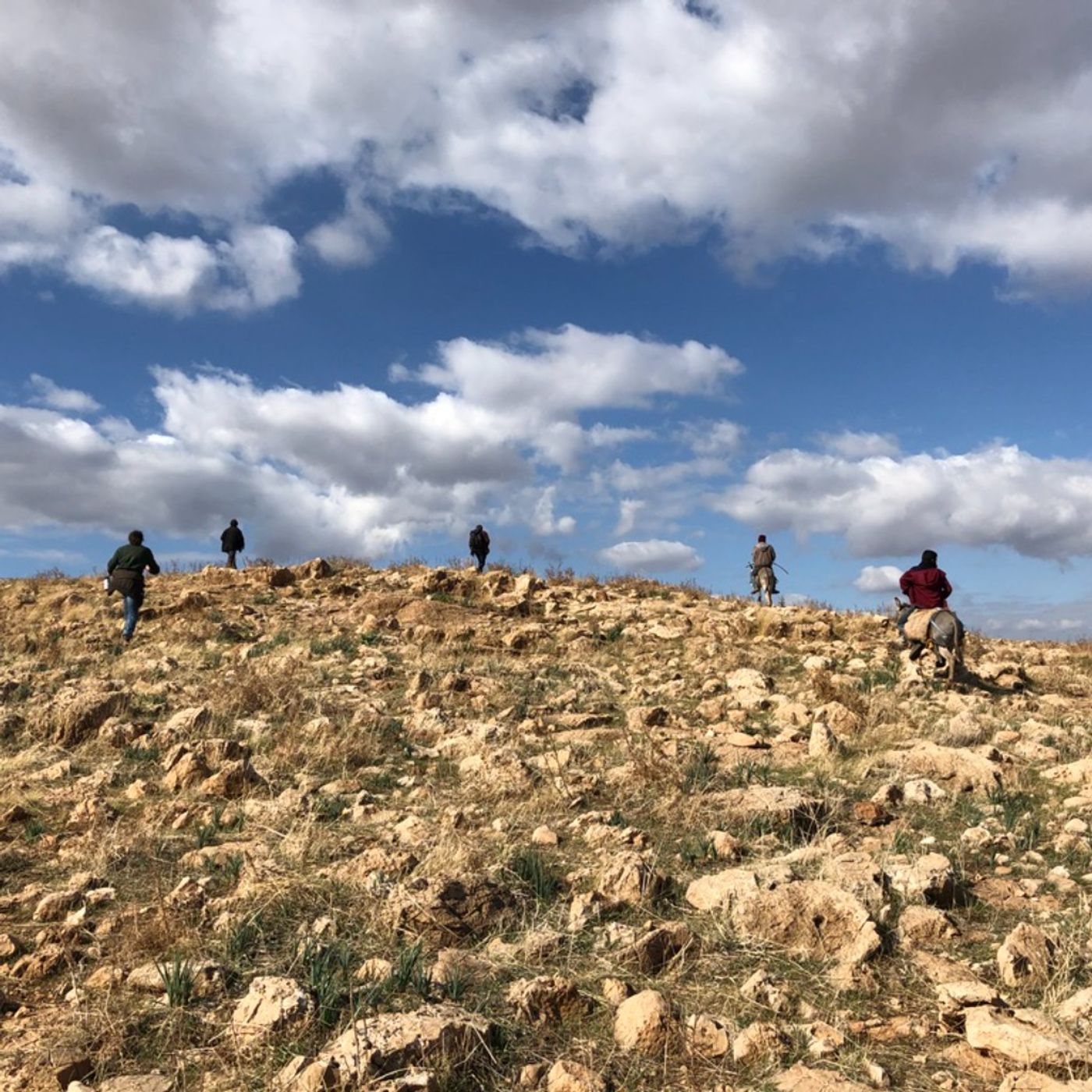
So we're following Mohammed and his nephew down the mountain. The nephew is riding on a donkey. Mohammed is leaving. Then there's a dog and then there's a Vivani. When we get down to the valley, Muhammad and his nephews try to herd the flock up a rocky hill before this all terrain vehicle shows up. Most of these sheep and goats are pregnant. If they get scared or stressed, they can Miscarry. I hear the motor before I see the atv. It's like a small tractor. It comes roaring through this valley and then swerves off to the left towards the flock. Without a word, Aviv runs towards the ATV and stands directly in its way. Aviv is not a big guy, but he grabs the front of the ATV with one hand. The ATV lurches forward, pushing Aviv with it. It looks to me like the driver is ready to plow right through Aviv to get to the sheet. I've got my microphone out and I'm trying not to shake, but my heart is racing. After pushing and pushing and pushing Aviv with the atv. Finally, the driver gives up, reverses and drives off. For now, Aviv and I walk to catch up with the herd. How are you feeling? I'm good. What to do? Did you feel like he was trying to run you down?
- [04:01]
B
You know he was. He was going over me. But I keep on thinking they're not insane enough to really run me over.
- [04:11]
C
Not long after, we get to the top of a rocky ridge, the settler is back, this time on foot. Let's call him Baruch. He's tall, maybe in his late 30s, with a thick red beard, wearing a plaid shirt and muddy white pants. Baruch walks right past Mohammed without even looking at him. Instead, he makes a beeline for Aviv and confronts him.
- [04:30]
E
So why are you still here?
- [04:32]
B
Why are you here?
- [04:33]
E
Because I'm in my land.
- [04:35]
B
It's your land. You own it.
- [04:36]
C
You own it.
- [04:38]
B
But do you own it? What's the difference between me and.
- [04:41]
E
You are disturbing me. I'm not disturbing you.
- [04:43]
B
I'm not disturbing you how you came here? I didn't see you at all.
- [04:47]
E
My flocks are up here and they eat here. And you came in with the Palestinians to do problems.
- [04:54]
B
But I don't understand what problem I did.
- [04:58]
C
I have so many questions for this guy. What are you doing here? What makes you think this land is yours? But then he turns to me. I guess he can tell that I'm not from here.
- [05:08]
E
You also are tourists from where you are toured.
- [05:10]
C
You are not under interrogation.
- [05:13]
E
That he'll tell to the police this.
- [05:16]
C
Is not an empty threat. At this point, the Israelis are all calling the police on each other. The activists reporting the settler. The settler reporting the activists. Eventually, Baruch walks away, and for a second I think it might be over. But Mohammed knows better.
- [05:31]
B
He's going to come with a horse and boombox. I have to lead the herd out.
- [05:38]
C
Suddenly, a teenager comes riding in on a white horse, blasting electronic dance music from Little speaker. The horse gallops towards the flock. The activists chase after the horse. I chase after the activists. And every time the horse gets too close to the flock, Muhammad's dogs jump in and start barking furiously. And then from out of nowhere, I see Baruch again on his atv. So then there's, like, the horse on one side of the flock and the ATV on the other, boxing in the activists and the sheep and the shepherds and the dogs, slowly but surely pushing them all further and further east. This goes on for about 20 minutes. Finally, the kid gets off his horse, takes our picture, and then he and Baruch ride off. It's over.
- [06:26]
B
I'm tired and angry. If I was any more tired, I couldn't get angry.
- [06:33]
C
At this point, we're so far off course that the sheep and goats will have used up all the energy they got from grazing just to get back home.
- [06:41]
B
In the past, because they came to harass us in a smaller area, we could go there and go back home quite easily. Now we have a long, tough way to go.
- [06:52]
C
The land directly to the west of here is an Israeli military base. The land to the east has been designated by Israel as a nature reserve. So if Muhammad's flock gets pushed too far out, there's no place left for.
- [07:04]
E
Them.
- [07:06]
B
Where you first saw them today. They haven't come to this area until last week. They are expanding.
- [07:17]
C
That night, I call my co producer Alana back in New York to tell her what I saw in Rashash.
- [07:22]
F
And this is the thing that happens.
- [07:24]
C
To them basically every day. We're part of a team that makes a podcast called Unsettled, which is meant to open up the conversation in the Jewish community about Israel's occupation of the Palestinian territories. One of the most amazing details of this day is that the outpost that has been giving these guys trouble for the last two years is called, in Hebrew, Angels of Peace.
- [07:45]
A
Angels of Peace. Is it Malache Ashalom? Like Shalom Aleichem?
- [07:50]
B
Yes.
- [07:55]
A
Like, will you ever hear that the same again? I don't think I will.
- [07:59]
C
Malache hashalom is a phrase that Elana and I both know from a prayer called Shalom Aleichem, one that Jews sing every Friday night to welcome in the Sabbath. I grew up in a pretty mainstream American Jewish community. Support for Israel was central to Jewish life. The Jewish state was supposed to make me feel safe and proud. There was an Israeli flag in the sanctuary next to the American flag. We learned Israeli dances in school. There was a charity box in every classroom that sent our pennies to Israel. For planting trees. That same community taught values like justice and tolerance with no acknowledgment of how Palestinians like Mohammed live under Israeli occupation.
- [08:41]
B
What you see is how we live. We have been here for 30 years. It was a good life here and we could go get all we need from the sheep. But since two years when the settlers arrived, everything's changed. Maybe they want us to sell the sheep and get out of here.
- [08:58]
C
The west bank has been under Israeli military occupation since 1967.
- [09:03]
F
At that point, Israel captured the west bank from Jordan in the Six Day War and essentially has had it ever since.
- [09:10]
C
This is Daniel Gordas, an American born Israeli writer and one of the founders of Shalem College in Jerusalem.
- [09:16]
F
Following 1967, there already began a debate inside Israel as to what Israel should do with these newly captured territories.
- [09:24]
G
If they took the land in the aftermath of the 67 war, they would have had to take all the Palestinians on that land.
- [09:31]
C
Nora Erakat is a Palestinian American human rights attorney and the author of justice for Law and the Question of Palestine. She says Israel didn't annex the west bank because they didn't want to naturalize the Palestinians who lived there.
- [09:44]
G
Because if they actually absorbed the Palestinians at the time, it would have disrupted a Jewish demographic majority.
- [09:51]
F
If you don't care that Israel remains a Jewish country, then the right thing to do is to give the Palestinians citizenship. And then we'll just have one large country between the Jordan river and the Mediterranean Sea and Jews will relatively quickly become a minority in that country. We and the whole point of creating Israel was to have a Jewish state.
- [10:08]
C
So instead the west bank has long been envisioned as the site of a future Palestinian state. But so far, Israeli and Palestinian leaders haven't come to a workable peace deal. And in the meantime, Israeli settlers have been moving in. Today, nearly half a million Jewish Israelis live in the west bank, most of them in settlements established with the Israeli government's full support.
- [10:29]
G
And that corresponds directly with the confiscation of Palestinian lands and the removal of the removal of Palestinian peoples and the increasing policing and militarized oppression of Palestinians who become now unwanted bodies.
- [10:46]
C
So why do so many Israelis move to this disputed territory?
- [10:50]
F
Some of them move out of religious belief that that's part of the land that God gave to Abraham. And therefore they're fulfilling a kind of Jewish destiny by living there. Others move there out of Zionist passion because they believe that the way the Jewish state was fashioned was by building new communities in areas which were either purchased in the old days or captured in Defensive wars that Israel did not want, and other people move because of quality of life issues. It's much less expensive to live there.
- [11:18]
C
Many people say that these Israeli settlements in the occupied west bank are illegal under international law. Including Noor Erekat.
- [11:25]
G
Under international law, the purpose of military occupation is to create a framework for the transition from wartime to peacetime. Military occupation is imagined and legislated as temporary in nature. Once you settle civilians into any occupied territory, it becomes permanent in nature.
- [11:48]
C
Not everyone agrees with this assessment of Israeli settlements.
- [11:52]
F
Well, from an Israeli point of view, they're mostly legal. The question is, what's their status internationally? There was a commission in Israel called the Levy Commission that actually argued very strenuously that even according to international law, they are completely legal. The European Community disagrees and has argued that they're illegal. And American administrations have varied one from the other as to how they exactly define it and how far they push that issue.
- [12:16]
C
But there's a growing movement of settlers building outposts in the west bank that are illegal even by Israel standards. Baruch, the settler who I saw on the ATV in Roshash, he's part of that movement. Mohammad says that Baruch recently went down to his family's water tanks, their only supply of fresh water, and dumped them out.
- [12:37]
B
Down there. It was the sunset. It was around 7pm and the next day we saw that he opened it and spilled water just to spoil it. There is provocations like this, but with your small hands, what can you do?
- [12:53]
G
Palestinians have no one to call. There is no police that they can appeal to. There is no higher authority even when they are being attacked.
- [13:04]
C
Israel's presence looks different in different parts of the West Bank. Most Palestinians live in cities and villages which have some limited Palestinian governance. But where Mohammed lives, Israel has full civil and military control. And that's also where all the settlements are, including the unauthorized outposts. Sometimes Israel does crack down on these outposts, but to Muhammad, it's clear where the power lies with settlers like Baruch.
- [13:30]
B
He has the army, he has the money. The law is not with him, but the law enforcement is with him.
- [13:38]
C
So here's what I still don't understand. Why does Baruch spend his mornings chasing after Muhammad's sheep and his evenings dumping out Muhammad's water tanks? What drives someone to live that way? I want to ask him. But these unrecognized outposts like Malache ha Shalom, they're not so easy to get in touch with. But there is an authorized settlement just down the road called Kochav Hashachar. I guess that's a place to start. So a few days after my visit to Roshash, I take a public bus from Jerusalem to Kochava Shachar to meet Danny Spielman. He's lived there since 1981.
- [14:13]
E
Some people like to be in the city and they'll never leave the city. But there are kinds of people that like the open landscapes. And also the atmosphere of the community is very positive.
- [14:25]
C
Kochaf al Shachar is like an island of suburbia in the desert. White houses with red tiled roofs, big front yards and solar panels. It's my first time in an Israeli settlement or really talking to a settler. So when I meet Danny, I try to code switch a bit. Little, little. Don't call them settlements, call them communities. Don't call it the West Bank. Call it Judea and Samaria, the biblical name for this place. I'm especially nervous to bring up the outpost Malachi Ashalom. Are you familiar with that place?
- [14:51]
E
I know the place here. It's a few kilometers from here.
- [14:54]
C
Do you know anything about it?
- [14:55]
E
I know that some sons of people here may live up there. I don't even know exactly who they are, but I was told that a few youngsters that grew up over here are living over there right now.
- [15:05]
B
Why is that?
- [15:05]
C
Why did they go from here to there?
- [15:06]
E
I suppose they want to help out develop the place. That's also that it's a new phenomenon that's common amongst youngsters. We want to be shepherds, something quite new in Israeli Jewish society. So I suppose that's the reason people go to these places.
- [15:22]
C
Why is it important to develop it?
- [15:25]
E
Okay, now we come into the whole issue of Israelis that come to settle during Samaria because we feel that the country here belongs to the Jewish people. You learn the Bible, okay? So it gets into you. It's part of your personality. The Jewish people used to live in these areas. We were driven out by the Romans 1800 years ago. We want to come back and settle the area.
- [15:46]
C
So Danny believes that this is Jewish land, but he says he's not in favor of taking it by force.
- [15:51]
E
Of course, we are very, very much against violence. You do what you're allowed to do according to the law, to Israeli law. This is right for the Jews, right for the Palestinians. Can't just come and sit wherever you want.
- [16:01]
C
My understanding is that Malachi Ashalom is illegal under Israeli law.
- [16:07]
E
Is legal.
- [16:08]
C
Is illegal under Israeli law. They just went there and they.
- [16:11]
E
That's true that they didn't. The issue of building New areas. There's a lot of red tape and bureaucracy in this issue. Now, these people who specifically Shalom, it was an army camp, the military abandoned the place. So people said, okay, so if we don't go in, the buildings will take the place. So they didn't get the legal documents to say, okay, the government decided to build here, a settlement. You can go. But the authorities know about the presence there, and they receive electricity. They have roles there. The infrastructure is given by the government. So there's no.
- [16:43]
C
Danny is aware that all Israeli settlements, including his own home, are condemned by much of the international community. And he says he understands why.
- [16:51]
E
So I can't blame the world for saying, why are you sitting on land that isn't yours? You're right. They're right. We didn't claim. We're not claiming it's ours. We didn't annex it. Once we decide it's going to be ours, so things will be easier. That's what I believe. But we have to solve the problem. How do we relate to the large number of Palestinians that live here? Which is definitely a problem. Okay, so the Bible says this is the land of the Jewish people, but you have other people living amongst you. As long as they accept. Accept the fact that you own the land, they could go on living over here. We could be good neighbors, no problem.
- [17:23]
C
Just one more thing. I do actually want to try to visit Malachi Hashalom if I can. I mean, you said you know people who are there. Would you be willing to figure out a name and a phone number?
- [17:33]
E
I have to find out.
- [17:34]
C
But you, I mean, if you find out, would you be willing to share it with me?
- [17:38]
E
Yeah.
- [17:38]
B
Yeah. Okay.
- [17:40]
D
Thanks.
- [17:44]
C
As I ride the bus back to Jerusalem, I keep thinking, on the one hand, Danny says that we, the Jews, were here thousands of years ago. We were driven out, and now we've just come back. On the other hand, Muhammad and his family have been here for generations for Noura Erakat. How long both groups of people have been here isn't the right question to ask. It's how the people who live here now are treated that it's not.
- [18:07]
G
We were removed. Now you were removed. The idea is, how do you move towards a future where the claims to belonging are not mutually exclusive, but mutually reinforcing.
- [18:28]
C
A few days later, Danny sends me a text. Hi, sorry, but the people at Malache ha Shalom are not interested. Right away, I pick up the phone and call him first. I just want to know who exactly at Malachi Hashalom he talked to Was it Baruch?
- [18:43]
D
Let's leave it out.
- [18:45]
E
I prefer not to mention names. I know many people don't have much trust in journalists and they prefer not to get close to what has to do with the media.
- [18:54]
C
Unfortunately, Danny was my only real lead and it's time for me to go home to New York. So my co producer Alana and I will just have to keep looking for Baruch from thousands of miles away.
- [19:04]
A
So have you heard of this outpost Malachea Shalom?
- [19:08]
E
Only in name.
- [19:09]
A
Okay, so you haven't spoken to them?
- [19:11]
C
No, sorry, I don't really.
- [19:14]
B
I was never in touch with him. No.
- [19:17]
C
And then finally someone bites a writer in Jerusalem named Shalom Pollack.
- [19:23]
D
I don't trust BBC to portray Israel in a good light. Of course, it's very well known that BBC has an anti Israel bias.
- [19:30]
C
Olana found an admiring article Shalom wrote a couple of years ago about Malachi Eshalom.
- [19:35]
A
The people who live in Malachi ha Shalom Talk about how you feel about them.
- [19:39]
D
They're my heroes.
- [19:40]
A
Why is that?
- [19:42]
D
Because they take it upon themselves to suffer the difficulties. They know if no Jew is there, chances are it'll be taken over by Arabs. They are idealists. They're thinking about the Jewish people and they are very altruistic and that's why I respect them.
- [19:58]
C
Alana's been going back and forth with Shalom over WhatsApp, hoping he'll help us get to Baruch despite his reservations about the BBC and about us.
- [20:06]
D
Yeah, I had a number of contacts there that I tried a couple of times and nothing.
- [20:11]
A
That phone number, would you be willing to share it with us?
- [20:14]
D
No, I don't think it'd be right. I don't know what his attitude is. I have no idea.
- [20:19]
A
Okay, so I want to talk about a message that you sent me. Can I read it to you?
- [20:24]
D
Yeah.
- [20:24]
A
I think you looked at my writing or you sent me one of my tweets. You said, seems you are decided and seek only confirmation. How does this happen to a nice, intelligent Jewish girl who has all the facts at her fingertips? Why is it important to you that I'm Jewish?
- [20:37]
D
Well, we have a common history. Should have a common dream. If a Jew has no connection to the idea of a Jewish land or the idea of a Jewish people, then not too much is left of that person's Judaism. I mean, everybody wants to cross an old lady across the street and give charity. That's nothing. Nothing. Nothing Jewish about that. But what is Jewish?
- [20:57]
A
Well, I don't know. I've been trying to figure that out.
- [20:59]
D
Jewish is being part of the Jewish national narrative. We are a nation. There are Jews that are more cognizant of their identity than those who are less.
- [21:08]
A
And I fall into the latter category.
- [21:10]
D
Then I would hate to say that. What do you think?
- [21:14]
A
Well, you know, I have a different understanding about the Jewish national narrative than you.
- [21:19]
D
What's your understanding?
- [21:20]
A
Well, I see myself as a part of a people who has lived in lots of different places and has suffered and prospered in lots of different places. And I think that's true of Israel too. I think that Israel is just one place that we've suffered and prospered.
- [21:36]
D
If you're familiar with the Jewish history and the Jewish prayers and Jewish dreams, Israel is not just another place to live.
- [21:46]
C
Shalom's version of the Jewish national narrative is very familiar to me. This is basically what my rabbis and teachers talked about when I was growing up. If Baruch believes the same thing, maybe what I saw that day in Reshash doesn't seem so outrageous after all.
- [22:04]
H
You know, I've come to realize in my life, I don't know, that many people who worship golden calves these days. The real danger of idolatry comes from good things.
- [22:17]
C
Rabbi Arek Asherman is the executive director of Torah Tzedek Torah of Justice. He's been going to Roshash to accompany Muhammad and the other shepherds for years.
- [22:25]
H
When I was a congregational rabbi, I said, there will be no flags in the sanctuary. Here we worship God because I know how much these things move me and how dangerous they can be, how seductive they can be. The land of Israel is holy. You can't read the Bible on its own terms without understanding that or that it was promised in perpetuity to the Jewish people, but not a carte blanche. Not that we would hold on to all of it forever. It would depend on how we behave. And the question is, what behavior merits us having any part of it.
- [23:01]
C
When.
- [23:01]
H
In the name of possessing the entire land of Israel, you oppress the Palestinian shepherd that is our modern idolatry. So many people in the settler movement and their supporters, they're blinded. They're dazzled by the girusha, the holiness of the land of Israel. They are so blinded that they can't see God's image where it exists, which is in every single human being, Jewish or non Jewish.
- [23:54]
C
These days are the other activists aren't going to reshash as often as they.
- [23:58]
H
Used to in Recesh. They've been told, why are you making trouble? Why are you working with those Israelis. And now there's a threat. They receive orders that could lead to their homes being removed and this kind of stuff. So we're really up against a lot, if I have to be honest. The settlers started doing things that we didn't have an answer for.
- [24:18]
C
One of the settlers that are confronted most often is Baruch. Do you have any idea how we might try to get in touch with him?
- [24:24]
H
I have his phone number.
- [24:26]
C
Really?
- [24:27]
E
Yes.
- [24:35]
C
Hi, My name is Max. I'm a. I'm a freelance journalist from New York. But we met a few months ago near Malachi, Eshalom. He cuts me off before I can ask him anything. I'm a busy man. He tells me, don't call me again. How old are you?
- [24:56]
B
7, 6, 4 and 1.
- [24:59]
E
Do you hope that they will live.
- [25:01]
C
Here and continue hurting in the same way you do and your family does?
- [25:07]
B
No. If it wasn't for the settler, I might have told you. Yes. But if it stays like this, it's intolerable.
- [25:22]
C
Since I visited Reshash a few months ago, at least three other Bedouin communities in the area have packed up and moved away. Muhammad and his family are still there, but he has to go pretty far from home to graze the flock. If Mohammed's family does have to leave, it would be the fourth time time they've been displaced since Israel was established in 1948.
- [25:42]
B
We have a strong relationship with this land. I love this life. I have loved this life for 30 years, my whole life. You want me to go to a city? No, I can't. This is our life.
- [26:04]
A
Thanks for listening to the shepherd and the Settler, which originally aired on the BBC World Service on September 16, 2020. Our production team on this piece was Max Friedman, Emily Bell, and Alana Levinson, editing from Alana Levinson. Stay tuned for extended interviews from this piece on our feed. This was our first time reporting on the ground in Israel Palestine. If you liked what you heard and you want to help us report more stories like these, become a member of our Patreon. With so many urgent needs right now, we know how much a donation of any size means, and we thank you in advance. You'll find our patreon@patreon.com unsettled. If you're not able to make a donation, you can help us out by leaving us a review on Apple Podcasts and make sure to subscribe.