← Unsung History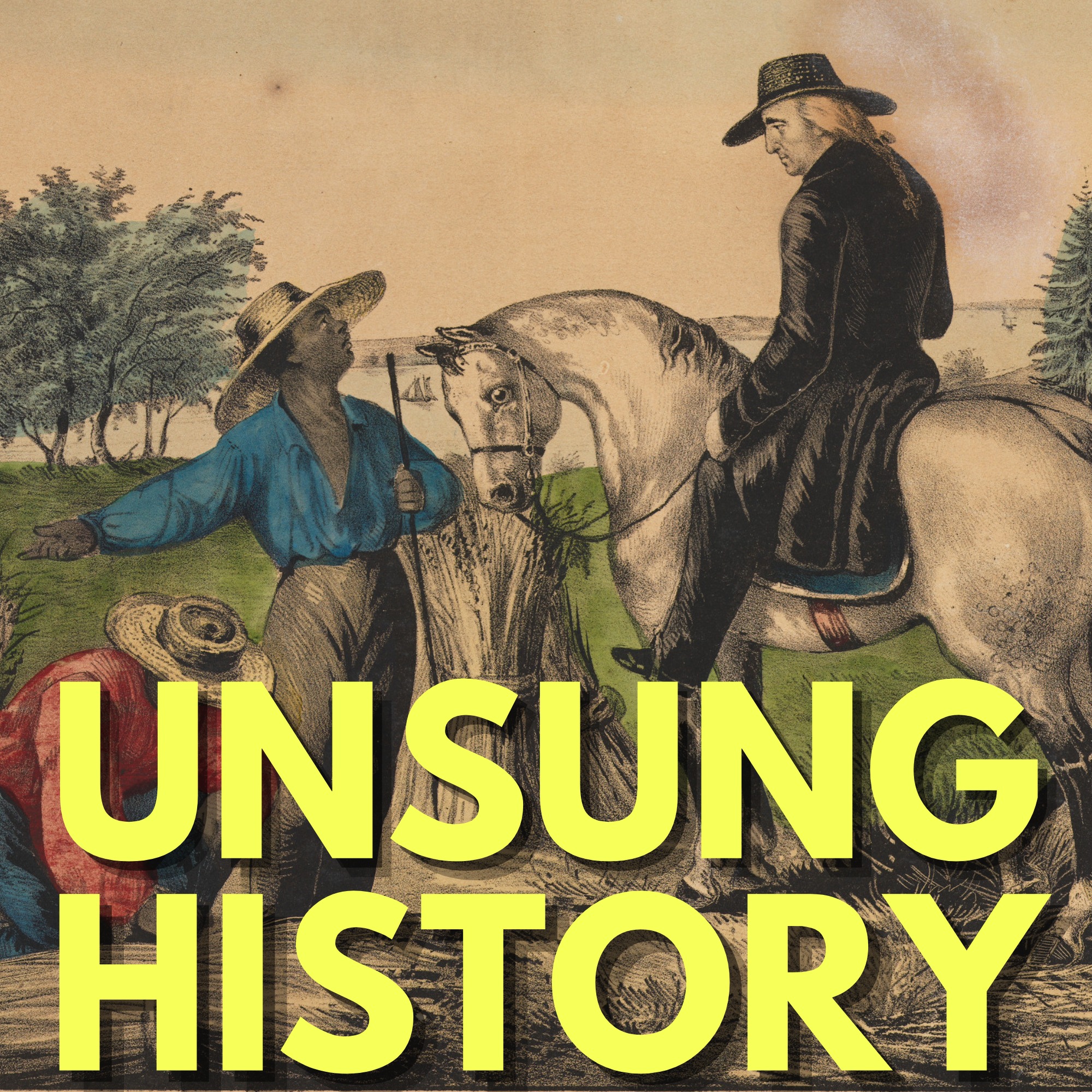
Loading summary
Transcript37 lines
- [00:00]
Kelly Therese Pollack
This is Unsung History, the podcast where we discuss people and events in American history that haven't always received a lot of attention. I'm your host, Kelly Therese Pollack. I'll start each episode with a brief introduction to the topic and then talk to someone who knows a lot more than I do. Be sure to subscribe to Unsung History on your favorite podcasting app so you never miss an episode. And please tell your friends, family, neighbors, colleagues, maybe even strangers to listen to. When future general founding father and President George Washington was 11 years old, his father, Augustine Washington, died. Augustine was a wealthy planter and merchant, and when he died, he left young George several bequests in his complicated will, including a 280 acre farm in Virginia and 10 enslaved people. After his older half brother died, George acquired Mount Vernon and he continued to increase his holdings of both land and people. In 1759, when he was 26, Washington married wealthy widow Martha Dandridge Custis. Upon their marriage, Washington gained control of even more enslaved people, the dower slaves that remained tied to the Custis estate. Washington was not a passive slaveholder. He directed physical punishments and even occasionally hit enslaved people himself, he wrote in a letter in 1797, if the Negroes will not do their duty by fair means, they must be compelled to do it. When physical punishment wasn't enough, he occasionally sold enslaved people to plantations in the Caribbean and in what was known to be brutal conditions. When Washington lived as president in Philadelphia, then the nation's capital, he brought enslaved people with him. Because Pennsylvania law at the time granted the right to freedom to any enslaved person who had been resident in Philadelphia for six months or more, Washington directed a system of shifting enslaved people back and forth between Philadelphia and Virginia to ensure that they couldn't claim their freedom. In 1796, one of those enslaved people in the Washington presidential home escaped. Martha Washington's maid, Ona Judge, fled when they were preparing to return to Mount Vernon for the summer. Three years earlier, Washington had signed into law the Fugitive Slave Law, which gave enslavers the right to recapture by force if necessary, their slaves, who escaped even across state lines. And for years, Washington tried to track down and recapture Judge. At one point she promised to return, but only if the Washingtons promised to emancipate her after their deaths. Washington did not agree, writing, to enter into such a compromise with her, as she suggested to you, is totally inadmissible, for however well disposed I might be to gradual abolition or even to an entire emancipation of that description of people, if the latter Was in itself practicable at this moment. It would neither be politic nor just to reward unfaithfulness with a premature preference and thereby discontent beforehand the minds of all her fellow servants, who by their steady attachments are far more deserving than herself, of favor, unquote. Judge was never caught, and Washington's response highlights his contradiction. In thinking privately, though never publicly, Washington expressed concern about the institution of slavery both in terms of the morality of owning human beings and also in terms of the economic reality. By 1799, Washington felt he enslaved more people than he could profitably employ, and yet by that point, he was principled against selling negroes as you would do cattle in the market, unquote. And he especially did not want to separate family members. Washington never resolved these contradictions in his life. In December 1799, Washington died at age 67 of a throat infection, likely made worse by his doctor's treatments of bloodletting. As he was dying, Washington sent Martha to his study to retrieve two versions of his will. Once she returned with them, he reviewed both of them and instructed her to burn one in the fireplace and save the other. In Washington's final will, signed six months before he died, he wrote, upon the decease of my wife, it is my will and desire that all the slaves which I hold in my own right shall receive their freedom. Unquote. Of the 317 enslaved people at Mount Vernon at the time, 123 were owned outright by Washington and emancipated by his will, which also ensured that those too old or too young to support themselves would continue to be fed and clothed by his heirs. One person, his former valet William lee, was granted immediate freedom and an annuity of $30 for his faithful services during the revolutionary war. Despite his desire to avoid breaking up families, Washington's will did just that. The 123 enslaved people he freed and the dower slaves that he could not free lived as one intermixed community at Mount Vernon. In December 1800, Martha Washington signed a deed of manumission, freeing the 123 on January 1st of the following year. When she died in 1802, around 150 dower slaves were dispersed among her first husband's heirs. The 41 individuals Washington had been renting were also returned to their plantations and remained in slavery. The other three Virginia founding PresidentThomas, Jefferson, James Madison, and James Monroe all condemned slavery while themselves enslaving people. None of the three took the step Washington did to emancipate the people they enslaved upon their deaths, although Jefferson did emancipate a few people in his will, notably his own Sons. In 1929, the Mount Vernon Ladies association placed a commemorative marker at the site of the African American burial ground at Mount Vernon, though the marker referred to the enslaved people buried there as faithful colored servants of the Washington family. In 1983, a new memorial was installed at the site, designed by David Edge, an architecture student at Howard university. As of 2025, archaeologists have documented 87 unmarked burial site there. It's unknown how many enslaved individuals were buried at Mount Vernon because of the activism of the community of descendants of the enslaved people. A podcast called Intertwined explored the histories of the people enslaved at Mount Vernon, and a permanent exhibit at the site called Lives Bound Together tells the stories of some of those individuals. I'm joined in this episode by Dr. John Garrison Marks, the vice President of research and engagement at the American association for State and Local History and author of Thy Will Be George Washington's Legacy of Slavery and the Fight for American Memory.
- [10:10]
Narrator/Chorus
When Yankee Doodle came to town he brought a man of great renown and called him Georgie Washington in history, I'm told he proved a hero bold by winning victories and gold.
- [10:27]
Interviewer
Hi, John.
- [10:27]
Kelly Therese Pollack
Thanks so much for joining me today.
- [10:29]
Dr. John Garrison Marks
Yeah, thanks so much for having me.
- [10:31]
Interviewer
Yeah, so I really enjoyed reading your book. I knew pieces and parts of it, but putting this story together was really fascinating.
- [10:39]
Kelly Therese Pollack
I want to hear a little bit
- [10:40]
Interviewer
about what got you started on writing this book, writing about Washington and slavery and reactions over time to both.
- [10:50]
Dr. John Garrison Marks
Yeah, it was really sort of two streams coming together for me. The first is I started working on the 250th anniversary in 2017, when I started for the American association for State and Local History, where I still work, helping museums and historic sites think about how they were going to commemorate this anniversary. That was at that time, still nine years away. And then a few years after that was the summer of 2020, when we had this massive reassessment of how we think about historical figures who have these ties to slavery and colonialism and racism and things like that. And I knew that that moment and that movement was going to be part of 2026 and going to be part of how the public thought about this anniversary. There was going to be some, you know, continued effort to reassess the Founders, think about our relationship to them, think about how we should understand their role in slavery today. And I was really, you know, struck, like a lot of people were, by the demonstrations that summer, by the efforts to take get Washington statues Taken down the, you know, defacing and graffitiing of George Washington statues. Even efforts just to add contextual panels to Washington statues got a lot of pushback from. From some people. And I was just so fascinated about why Washington, more than anyone else during that conversation, was eliciting such strong reactions from people. And like a good historian, I guess I wondered, you know, is this a new thing? It certainly felt new, and in 2020 and the year that followed. But I started doing a little bit more digging and realized that this was very much the same conversation that we've been having for a very, very long time in this country.
- [12:40]
Interviewer
Usually when I'm interviewing people and I ask about the sources they use to write their book, they have a dearth of sources. You know, they're looking at a very specific kind of thing, and they can't find enough. I imagine with this story, you had just wealth of things you could have pulled from. How did you sort of choose what you wanted to focus on, what sorts of sources you wanted to really highlight in the book?
- [13:06]
Dr. John Garrison Marks
Yeah, it was a really tough process in exactly the opposite way of what I usually work on. You know, my first book looked at the worlds of free black people before the end of slavery. And there, as you described, it's trying to, you know, find enough information to make this thing make sense. And that's how one of the chapters of the book is, I have a chapter about the people that Washington freed from slavery, what happens to them as free people? And there it was the dynamic that I'm really familiar with of trying to piece together meaning from these scraps of census records and city directories and tax records and things like that. But with Washington, it's just the opposite problem. You have so much information that there is a point that you just have to say, I can't follow some of these interesting leads. I can't follow some of these, you know, go down some of these rabbit hol. I have to sort of stay. Stay focused on. On task here. And so there was. It was helpful to focus on only discussions of Washington and slavery. That helped me kind of eliminate other. Other side conversations and other kinds of sources and other things that I could have looked at that I decided, no, you know, that's really interesting, but that's not the kind of story that I'm telling here. And in large part, it was dictated by the era that I was researching. I knew I wanted to be able to tell this story of how Americans have thought about slavery's place in Washington's legacy over, you know, more than two centuries of American history and knew that I would have different kinds of sources in four different time periods and that the sort of nature of that conversation might be different for different time periods. So, for example, in the chapter looking at Washington's will and kind of the first decade or so after his death, I discovered that there are all of these biographies of George Washington that get published within weeks of his death. You know, many of them, you know, more than a dozen in the first year after his death. They're all called the Life of Washington or the Life of George Washington. It was really frustrating and complicated to try to keep track of. And then they go through different editions. And it matters which edition we're looking at because the way they talk about slavery changes. And that was such a, that was such a rich source base that I realized, okay, I can kind of build a chapter around how this myth is being constructed through published copies of his will and, and published biographies in the, in the first couple of years after his death. And then, you know, for, for different eras, I, you know, was looking at would always often start with newspapers. That's something that I've spent a lot of time in for other projects and often have a really kind of rich set of voices and materials for this kind of project. Because I was so interested in how are people relating to history, how are people talking about history, what is sort of the public conversation about Washington, what does it look like, how is it developing? So newspapers were a really great way to get at that. That's in, you know, a big part of one of my chapters about the fight over slavery in the lead up to the Civil War. And then as I sort of discovered different pieces and which, what stories I wanted to tell in different chapters, I realized that there were new things that I could look at that I had never, never researched in before. You know, I'm a historian mostly of the 19th century, and a big chunk of this book is 20th century stuff. And so, for example, I have a chapter about the 1932 George Washington Bicentennial, and there is a five volume set of the records of the George Washington Bicentennial Commission. And so it's, you know, thousands and thousands of pages that are all on arXiv.org thankfully as, as PDFs that are searchable and you could go through them and, and look for things. And then, you know, talking about education, I was like, oh, I can look at textbooks that I've, you know, I've never looked at before. And suddenly I'm looking at like the Textbooks that I had in school in the 1990s and things like that. And so it was really fun to kind of get to do work in different kinds of sources. But it was definitely an exercise in trying to stay focused on this very narrow subject across a very broad period of time.
- [17:32]
Interviewer
So let's talk a little bit about Washington himself. I think one of the most striking things every time I read anything about Washington is that he changed his mind over time about all sorts of different topics. He would learn something, hear something, talk to somebody, and, you know, would change his thinking in a way that I'm not sure many politicians in the US since have been allowed to do. And that's certainly true about slavery, but it's not a kind of straight line from A to B, like a lot of the sort of shorthand ways people talk about Washington might seem. So can you talk some about what, what are the various ways he thought about slavery? What are the various actions he took that don't necessarily match the ways he was talking in private letters and things like that?
- [18:20]
Dr. John Garrison Marks
Yeah, I think it's really easy to tell this linear story of Washington growing up in a world in which the enslavement of African and African descended people was the norm. And then he leads this revolution dedicated to the ideals of liberty and equality. He becomes, you know, more enlightened and gains exposure to these other political ideas and slowly begins to see the evil of slavery. Until this final redemptive moment on his deathbed when he sends Martha Washington downstairs to get two copies, two different copies of his will, and she burns one and retains the one that frees the people that Washington owned outright, the enslaved 123 people that he enslaved. Unfortunately, that story is just far, far too simple and for me is less interesting than the actual, much more complex story of Washington's relationship with slavery, which is that he held utterly irreconcilable views and he never really tried to publicly reconcile them in any real way. So on the one hand, Washington was actively involved in the institution slavery for the entirety of his adult life. This wasn't someone who was a passive slaveholder. He was intimately and explicitly involved in the institution of slavery, in buying and selling people, in punishing them, sometimes with his own hand, in, you know, directing how they were to be, how they were to be treated, how they were to be put to work, in constraining the lives and the worlds of the people he enslaved, of pursuing anyone who dared to try to escape from enslavement at Mount Vernon or elsewhere. And so he is, you know, intimately familiar with the details of slavery. Even while he is president in Philadelphia, even while he's leading the revolution, he's still writing back to his estate managers at Mount Vernon, asking about enslaved people, getting reports about how much work people are doing and when, complaining that people he enslaved aren't working to his satisfaction, even when he is ostensibly busy with more important things. And so he never relents from this role as enslaver. And yet he writes privately again and again about his uneasiness with his own involvement with slavery. This is especially true in the years after the Revolution. He talks about how he doesn't want to buy any other enslaved people, that he doesn't want to gain more enslaved people by purchase. He writes about how he's opposed to separating enslaved families through sale or hiring arrangements, which is causing financial difficulties for him because he thinks he enslaves more people than he can profitably employ. And he writes to friends and associates about his broader views on slavery and his hope to see a plan adopted for the abolition of slavery in the United States. He sees these northern gradual abolition laws that are beginning to take root at the end of the 18th century, and then says he hopes that, you know, the Chesapeake. He hopes South Carolina. He hopes other states will. Will see fit to abolish slavery gradually in their states as well. But he never reconciles these two ideas, you know, so I think the great example is in Philadelphia. He writes approvingly to people about Pennsylvania's gradual abolition law of 1780. He says how he supports it, how he hopes Virginia will adopt something similar. And he's writing those things at nearly the very same time that he is scheming to make sure that the people he personally enslaved in Philadelphia could never take advantage of that law. Right. It said that once enslaved people resided in Pennsylvania for six months, they were entitled to claim their freedom, and Washington rotates them out before they have a chance to do that. And so he's doing one thing and saying another thing and their utterly irreconcilable positions, you know, and then in the end, he frees the people that he enslaves and owns outright. This isn't the. It's not even the majority of the people enslaved at Mount Vernon. It's, you know, a little less than half, but it's the only people there that he owns outright. And he frees them in his last will and testament, says that after he dies and Martha Washington dies, they'll be free. He's the only one of the presidents who enslaved people to take that step. And so he is simultaneously one of the most prolific enslavers in American history. He enslaves more people than any of the other Virginia founders, than any of the other presidents who, who enslaved people. And yet he is also the architect of one of the largest private emancipations before the Civil War. Few people ever enslaved as many people as Washington to have the opportunity to do that, but even fewer ever took the chance and. And really followed through on emancipating more than 100 people from slavery at one time. And so that contradiction is just something that Americans have struggled with ever since.
- [23:36]
Interviewer
Yeah. And perhaps because of that contradiction, it's like Washington's life and writings are almost like the Bible, that people are like, I can take this part of it and use it to justify X. So, you know, that especially comes out in the fights around abolition in the lead up to the Civil War. And it, it's not just like one side's taking one part of his life. It's like the abolitionists themselves are saying, you know, saying, washington good, Washington bad. So what is going on here? How can so many people take one person's life and a. Make it so important that we have to justify what we're doing based on Washington, but also can. Can take just parts of what he's saying and say, well, this, you know, this works for our argument.
- [24:26]
Dr. John Garrison Marks
Yeah, it was a really fascinating kind of dynamic to see in the historical record as I started digging into this more. And part of it is, you know, the seeds are planted in the years after Washington dies because he creates this opportunity for Americans to confront the institution of slavery. Right. Washington kind of presents this model. He writes his will in a way that he knows other people are going to read it. And there's this moment where America could have confronted the institution of slavery because of Washington's decision to free the people he enslaved. And they don't. Instead, they almost immediately turn to building up this mythical Washington, who is the. Who is the United States, essentially. And people have seen him that way basically ever since, all the way up to the present. Washington functions not as a human being or even really as a historical figure. He becomes this avatar for the United States. And whatever people think about the United States and its values and its people, and there's enough complexity and enough ambiguity in Washington's history with slavery that people are able to cherry pick whatever pieces of that story they find most useful in their current political or cultural moment. And you see it really clearly in, in the fight over slavery, as you mentioned. You have some abolitionists who are saying Washington freed the people he enslaved. Thus, what could be more American than ending slavery? Right? They're trying to position abolition not as this radical idea, but as this fundamentally American proposition by tying it to Washington's legacy. You have other abolitionists who are rejecting that argument entirely and instead are resorting to this really blistering criticism of Washington and his hypocrisy and the violence inherent in enslaving other people, and are using that to make the case that slavery is woven into the very fabric of the nation. And only radical action could possibly rooted out. The criticisms that you hear from people like William Lloyd Garrison and Parker Pillsbury and other abolitionists are as aggressive and as mean as any criticisms you hear from people who are criticizing Washington for his involvement with slavery today. And it's really remarkable to kind of look back and see how radical some of those statements are. And then at the very same time, you have pro slavery Southerners who are also claiming Washington's legacy. They're saying, this man enslaved other people for the entirety of of his life. And we agree with that, and we think it's good. And he also fought a revolution to overthrow tyranny and protect his property. And that is what we are doing by fighting the United States, by seceding from the United States, by founding this republic dedicated to human bondage. Right? When the permanent government of the Confederacy is inaugurated in Richmond in 1862, Jefferson Davis does it on George Washington's birthday underneath a giant statue of George Washington, and he tells his audience that their cause is fitly associated with the day and the setting. And so there's just enough here, ambiguity in Washington's legacy. There is enough complexity that anyone in this debate is able to find a piece of Washington that they can then shape into something that will be useful to for their position. And none of these people, and you see this again and again across different generations, none of them are actually interested in understanding the history. Right? None of them are actually interested in kind of building an argument and what does the evidence say? And, you know, what is a historically factual or responsible case to make. And this is true up through the 20th century and to today, most people still aren't interested in doing that. It's always about what version of Washington is going to be most useful to me, what version of Washington can I use to help me win this debate, win this battle, and how can I draw on his legacy of slavery, his involvement with slavery, to help me do that?
- [28:47]
Interviewer
It's interesting when we're Talking about Washington as like avatar, as, you know, something that's not quite human. So when his 200th birthday celebration comes around in 1932, there's both perhaps a little bit of an attempt to understand Washington as a person. You know, the. This whole human experience of Washington, but at the same time, such a reverence to have these enormous celebrations for one person's 200th birthday in the kind of way that we do for the country's birthday. What is going on there? Who all is involved in that conversation? And, you know, are they successful in learning a little bit more about sort of the real human being that is Washington?
- [29:35]
Dr. John Garrison Marks
Yeah, that's a great question. And it was really fascinating to learn that these celebrations of Washington's birthday begin while he's still alive. Right. And I think I say in the book that this is one of the first celebrations of an individual's birthday that happen on this scale for any person whose name doesn't start with saint or pope or king. Basically, you know, this is a new thing to celebrate an individual in this way. And it kind of shows how early the myth making around Washington begins, how early this effort to take him out of humanity and take him out of history and place him on a pedestal, put him in this pantheon where there is. He has no equals and talk about him like that. And it happens, you know, after he dies, the celebration of his birth kind of go into overdrive. People, you know, it becomes this fully fledged national holiday. Businesses close. This is happening, you know, early in the 19th century, which is really remarkable. So by the time you get to near the anniversary of the 200th anniversary of his birth, Calvin Coolidge announces the creation of this commission to commemorate the George Washington Bicentennial. He does it in 1926. So as the nation is celebrating its 150th anniversary, he also launches this commission to create this George Washington Bicentennial Commission. And in his speech announcing the creation of this new kind of organizing body, he talks about how the version of Washington that they have has been poorly transmitted to them. You have again and again in newspaper columns and speeches, people saying that Washington has been marmorialized, which is a word that I had to learn that he's been, you know, demigoded. They talk about all the ways that they recognize that the version of Washington they have is like Theseus's ship, right? It's been had these pieces replaced over time and over time. And then they kind of get to this point in the early, late 1920s, early 1930s, where they're like, is this even a real Washington at all? And there's this genuine effort by the George Washington Bicentennial Commission to reacquaint people with the real George Washington, with a historical version of George Washington that is grounded in evidence, so that you have kind of special editions being published of George Washington's writings. You have new, like, map books that kind of try to picture George Washington's world. There is a historical committee as part of this planning commission that is answering questions from Americans all over the country. They're putting together curricula for teachers so they can learn about Washington better and then convey those lessons to students. So there really is this desire to reacquaint people with a real version of George Washington. And yet, in all of that effort, there is no desire to explore the institution of slavery. And it is a glaring absence. You know, I mentioned earlier, it's thousands and thousands of pages of pageants and scripts and radio programs and newspaper columns and all sorts of stuff, and slavery isn't mentioned anywhere in it. They credit George Washington with inventing ice cream, and they don't acknowledge his involvement in the institution of slavery. And this is at, you know, this is in the 1930s. This is, you know, during the era of Jim Crow. This is the first years of the great migration from the rural south to northern and Western cities. And you have black leaders like Carter G. Woodson, the founder of what's now Black history month, of W.E.B. du Bois. You have black newspaper editors who are saying, if we're gonna make this thing about the real George Washington, then we are going to bring up the issue of slavery. And you have them, these black educators and leaders who are bringing up the issue of slavery again and again and forcing it into the public discourse. And after the 1930s, it has this staying power that it hadn't had before. It works its way into the scholarship on George Washington and on early America. And it kind of becomes this issue that can't be entirely ignored after that commemoration.
- [33:57]
Interviewer
So let's jump forward to the current day, where, of course, these fights have not stopped. We are still arguing over how we should portray George Washington, what we should and shouldn't say about his relationship with slavery. And that's happening in curricula, as you know, in the book, and then also just in the very current moment in signage at things like the President's house. So what does it look like in the current moment? And is this basically just the same fight we've been having for 250 years, or are there new complexities Here.
- [34:33]
Dr. John Garrison Marks
Yeah. You know, nothing is ever exactly the same as it was in the past, but this is pretty close. And I was really struck by the extent to which we have been having the same conversation as Americans about George Washington and slavery. Basically, since Washington himself was still alive. There always seems to be a group that wants to say, now is finally the time that we must confront Washington's history with slavery. We have to reckon with this part of our history. This was happening in the 19th century. It was happening in the early 20th century. It's happening today. And there are always others who are saying, nope, Washington is above all of that. This person is. He is the United States. He is not someone that should be, you know, taken down, back to the realm of historical human beings. He is the, you know, the. This indispensable man. He is, you know, the foundingest father. He is this person who we shouldn't. Shouldn't question. This is happening in eulogies within weeks of Washington's death, and you see it in opinion columns over the last couple of years, people making essentially the same exact arguments. I think what's different about today and what's different about, you know, the past five or six years has been the number of people who are willing to stand up and say, we have to reckon with this part of our history. It feels like it has reached critical mass and in fact, probably is a majority of people now, research that asks Americans, you know, what do you want out of history? What kind of history do you want to encounter in the classroom, at museums, at historic sites? Most people, it's always, you know, between 60 and 70% of people say, I want to learn about all of it. I want to learn about the good things. I want to learn about the bad things. I want to be asked to grapple with complexity. People don't want this kind of whitewashed and censored and narrow, celebratory view of the past. And I think that's part of what is different right now, is that this is what most people want. This isn't a, you know, a small group saying, hey, we have to do this to have an honest look at our past and our present and, you know, create a path to a better future. It is, I think most people who recognize that this is part of Washington's legacy that we have to confront. There's differences in there, in how central people think that should be to the story of Washington. There are some people for whom this is the entire story where it starts and ends at this person enslaved other human beings and treated them and owned them as property. And we don't really need to talk about it further than that if that's something that this person was willing to do. And I don't begrudge anyone for having that opinion. And there are other people who. Who try to still sort of brush it off and say, yes, Washington enslaved people, but he freed them in the end. And kind of point to this redemptive moment as a way of kind of sidestepping the issue. But I think it's only a very small group of people who think we shouldn't encounter this history at all. And that's part of, I think, why we saw the kind of public reaction and outcry that we've seen with the removal of the slavery exhibit from the President's House site in Philadelphia. It just is not a reflection of what most people want.
- [37:52]
Interviewer
As we're talking, it's 2026. The United States is celebrating its 250th birthday. And there's, of course, been lots of attacks on history, the study of history, thinking about history at all. But you've written about how you're still excited about the 250th ways that we can still think about celebrating it and memorializing it. I wonder if you could talk a little bit about that.
- [38:17]
Dr. John Garrison Marks
Yeah, I'd be happy to. You know, like I said earlier, I started thinking about the 250th and helping people plan for the 250th in 2017. And so when I say that no one is more excited for July 4, 2026 to get here than I am, I hope you all will believe me. But I do really think that there is a lot to be excited about here. I have said for years now that I hope this anniversary can be an opportunity for people to encounter a more rich and complex and full version of the American story. I think that is not really what we are getting from federal planning efforts that are focused much more on spectacle or on really broad kinds of categories of programming that don't have very much to do with history. And that's unfortunate. It's a mystery.
- [39:10]
Interviewer
Like UFC fights.
- [39:12]
Dr. John Garrison Marks
Yeah. You know, big giant arches, UFC fights at the White house and an IndyCar race and look like, you know, like, motorsports are cool. If you told me There was an IndyCar race happening in Washington, D.C. and also these huge investments in historical programming, I'd be like, hey, cool, that's awesome. But when that is the only thing we're getting, that is a problem for me. And so, you know, there will always Sort of be this missed opportunity and the sort of weaponization of the. And gutting of cultural agencies like IMLS and neh, the sort of kind of sensor we're seeing in the Park Service, like that is all a missed opportunity for the 250th. We could be making real progress towards supporting history, supporting history organizations, supporting communities as part of this anniversary. And there'll always be part of me that wonders what might have been under different circumstances. But there is so much work that is happening at the state level, at the local level, at individual museums that is really inspiring, that is interesting and thoughtful and years in the making. There's a bunch of museums that have just reopened after major renovations. Mount Vernon just reopened. The national center for Civil and Human Rights in Atlanta just reopened after a major renovation. The Montana State Museum reopened in late 2025. This summer, the Utah State History Museum will open for the first time. It's a brand new institution. There are other cool exhibits, cool new efforts. The new exhibit at the National Archives Museum is fantastic. I got a chance to see that at the end of 2025. Every single state has a state commission for commemorating the 250th. A lot of them have been at this for years and are doing really interesting stuff and really thoughtful stuff and that kind of programming, those museums and exhibits and public programs, those are every bit as much the 250th and a story of the 250th as whatever the White House is planning. And I always try to remind people that all of this is happening, that this is America. You know, the president doesn't get to tell us what America means or how we should commemorate our history or what we should do to celebrate this anniversary or not. That decision is being made in communities all over the country, with civic groups all over the country. It's every week that I'm hearing about new things that I didn't know were coming. And I'm pretty tuned in to what's happening with the 250th. And I'm still being surprised by new announcements that are being made of, of museums doing programming or launching new exhibits, or people from outside the cultural sector and the history sector who are getting involved in this anniversary and trying to tap into this moment. So there is so much that is happening out there. There are more than 21,000 history organizations in this country. You know, that's more than the number of public libraries. It's more than the number of McDonald's. So there is just a lot going on and if people look only at what we're getting from federal planners and assume that that's it, they'll. They'll miss out on a lot of cool things that are happening and miss out on a chance to participate in them.
- [42:18]
Interviewer
Yeah, I really appreciate that because, you know, I, I was one of the people that was feeling a little bit down about, you know, like, not thrilled with what's happening at the federal level. But I, you know, I'm happy to be thinking about the, all the other ways that, that we can celebrate. And for anyone who just really doesn't want to celebrate the fourth of July, that's also my birthday, so you can just celebrate my birthday instead.
- [42:40]
Dr. John Garrison Marks
Well, there you go. Yeah. And I always remind people too, that like, you know, the kind of big celebratory stuff, you know, a super sized firework show, fourth of July kind of thing like, that was always gonna be part of this. Right. There was never a version of the 250th anniversary that wasn't going to include things like that. But if all of us who care about history and who are invested in historical storytelling and want people to encounter complex narratives about the past, if we all throw up our hands and say, well, see, like, I KN this was going to be bad, then it's going to be bad. You know, we're not like, if no one is participating who is invested in that kind of thing, then we're only going to be left with a UFC fight on the White House lawn. And it's the participation of people who care about history really deeply, who go out and support things or participate on their local commission or, you know, help fill in a gap or fill a need that they see out there. That's what's really going to shape this anniversary.
- [43:42]
Interviewer
I would like to encourage listeners to pre order your book. Can you tell them how they can do that?
- [43:48]
Dr. John Garrison Marks
Yes, you can pre order my book anywhere that you get books, pretty much. So if you are a person who uses Amazon or you want to do it through bookshop.org or go into your local bookstore and tell them that you want to pre order it, that's maybe the best way. Or you can go straight through the University of North Carolina Press website. They have links to all sorts of different places that you can pre order the book, but pre order it and leave a review for it after it comes out. And I would greatly appreciate it.
- [44:19]
Interviewer
Is there anything else you wanted to make sure we talk about?
- [44:22]
Kelly Therese Pollack
No.
- [44:23]
Dr. John Garrison Marks
I hope this has been a useful conversation for people. My big hope in writing the book was that it would help people recognize how much our conversation about Washington and slavery has been the same for so long, how much today's conversation is actually informed by our history and shaped by our history. And I hope, you know, listening to this conversation and hopefully reading the book will help people realize that there's maybe a different, more productive conversation that we could be having. And there's, I think, better time to do it than in our 250th anniversary year.
- [44:57]
Kelly Therese Pollack
Yeah.
- [44:58]
Interviewer
Yeah. I love the kind of history that's the messy, nuanced history that there's no clear. Like there aren't good guys and bad guys. There's, you know, things that happen that we should explore.
- [45:10]
Dr. John Garrison Marks
Absolutely.
- [45:12]
Interviewer
Well, John, thank you so much. This was a really fun conversation and I really enjoyed the book.
- [45:17]
Dr. John Garrison Marks
Yeah, thank you so much for having me.
- [45:21]
Narrator/Chorus
I can't forget George Washington. The things that he has said and done have all gone down in his and how they treated him with tears they greeted him. It must have been a psyche.
- [45:39]
Podcast Outro/Host
Thanks for listening to Unsung History. Please subscribe to Unsung History on your favorite podcasting app. You can find the sources used for this episode in a full episode transcript@unsunghistorypodcast.com to the best of our knowledge, all audio and images used by Unsung History are in the public domain or our user's permission. You can find us on Twitter or Instagram unsunghistory or on Facebook nsunghistorypodcast. To contact us with questions, corrections, praise, or episode suggestions, please email kellysunghistorypodcast.com if you enjoyed this podcast, please rate, review and tell everyone you know. Bye.