Loading summary
Transcript183 lines
- [00:00]
A
Aisha I'm Aisha Rascoe and this is the Sunday story from up first. Across the US there are more than 300,000 students categorized as emotionally disturbed. Emotional disturbance is a federally recognized special education category. It's for kids who struggle not with learning or mobility, but with their behavior and emotions. Like all kids with disabilities, students with the emotional disturbance label are guaranteed a free and appropriate public education. It's baked into a law passed more than 50 years ago, the Individuals with Disabilities Education Act. These kids are also legally entitled to services and specialized help. But there's a big question around whether the support they're getting is doing more harm than good. This week on the Sunday Story, a look at one student who was categorized as emotionally disturbed when he was just a young child and what that has meant for the rest of his education.
- [01:07]
B
At home I knew how to act, but at school it was problems. I was a bad kid.
- [01:13]
A
Stay with us.
- [01:21]
C
This message comes from EasyCater, making it easy for organizations to order food for meetings and events from favorite restaurants, set up meal programs for their employees, and manage food. Spend all in one place@easycator.com this message
- [01:36]
D
comes from Wise, the app for international people. Using money around the globe, you can send, spend and receive in up to 40 currencies with only a few simple taps. Be smart, Get Wise. Download the Wise app today or visit wise.com Ts and Cs.
- [01:52]
C
Apply support for NPR and the following Message come from GoodRx Looking for relief from allergies this spring? With GoodRx, you can save on seasonal allergy meds for you and the whole family, even pets too. GoodRx lets you compare prescription prices at over 70,000 pharmacies and instantly find discounts of up to 80%. GoodRx is not insurance, but even if you have insurance or Medicare, GoodRx may beat your co pay. Don't let allergies slow you down. Go to goodrx.com upfirst
- [02:26]
A
I'm Aisha Rascoe and this is a Sunday Story. I'm joined by reporter Lori Stern. She spent years covering education and joins us now to talk about her long term reporting on the disability category called emotional disturbance. Lori welcome to the podcast, Aisha.
- [02:46]
E
It's great to be here.
- [02:48]
A
So I know you have like a specific story to tell, but before we dive into it, can you just help us understand what emotional disturbance is? At least to me this isn't something I'm familiar with.
- [03:02]
E
Yeah, and that's probably because emotional disturbance is a catch all category according to the law that created special ed, the criteria include, and this is some of the law's language, a pervasive mood of unhappiness, an inability to maintain healthy relationships, and inappropriate behavior and feelings under normal circumstances. The experts I talked to all said emotional disturbance is subjective. It's not a medical diagnosis. It's a label that's specifically created for special education. And in most cases, it's up to schools to decide who gets that label.
- [03:47]
A
So if a school gives a child an emotional disturbance label, what kind of support does that child get?
- [03:56]
E
It depends on a lot of things, including the state, where the student lives and what school they go to and how many resources that school has for special education. But the goal in special education is always for kids to learn in the least restrictive environment. But more often than not, kids with emotional disturbance don't learn in regular classrooms.
- [04:23]
A
Okay, so if they're not in regular classrooms, where do they learn?
- [04:27]
E
They learn in separate classrooms. Federal data show students with that emotional disturbance label are three times more likely to be educated out of outside of regular classrooms than the overall population of kids with disabilities. And even the EBD kids who go to regular schools are often placed in their own separate classrooms. To give you a sense of what that's like, I want to tell you about a classroom I spent time in. It was at a high school about a mile from where I live in St. Paul, Minnesota. It's called Central senior high School. It's this concrete building, pretty institutional looking, but it has a great reputation. It's known for accomplished alumni, lots of extracurriculars, and it's also super diverse. Minnesota employs more special ed staff than most other states. So Central has quite a few special ed teachers, including two who run classrooms specifically for kids with emotional disturbance. By the way, Minnesota calls that emotional or behavioral disorders ebd. Other states have different names for the same thing. One of those EBD teachers is Jesse Kwakinut. Everyone calls him Mr. K. Oh, come on in. Come on in.
- [05:48]
A
All right, tell me about Mr. K's classroom.
- [05:52]
E
Okay, Aisha. It's tucked away on the corner of the fourth floor. And I went to his class for the first time back in May of 2024.
- [06:01]
F
Hey, guys, let's get that rocking here. Lecture's the word. I'm gonna get flying on it here.
- [06:05]
E
There were about a dozen kids in the class, and every one of them had an EBD label. Mr. K was the case manager for many of them and also their English and social studies teacher. The day I visited, he started Class with a vocabulary lesson.
- [06:22]
F
Alright, dudes, so the word is lecture. I'm gonna put it up here right now. Make sure that you get.
- [06:25]
E
Mr. K talks fast. So in case you missed it, the word class started with on this day was lecture.
- [06:32]
F
Did anyone look up lect? Just so I know. Did anyone look that up? No, we thought we'd wait for you. Kay.
- [06:38]
B
All right.
- [06:38]
F
Hey, Joel took that.
- [06:40]
A
Okay, so he's given a lecture on.
- [06:43]
F
Lecture.
- [06:45]
E
Yeah, he had the word up on a PowerPoint slide.
- [06:48]
F
Lecture. Anything like that. That is to read, choose, or to gather. You good. And then the URE is act. Process or being right. Pleasure. Rapture.
- [07:01]
E
Mr. K asked me to jump in.
- [07:03]
F
Help me out, Lori. Other things that end with ure. Conjecture.
- [07:09]
E
Feature.
- [07:09]
F
Feature. Excellent. What's that?
- [07:12]
B
Pure.
- [07:12]
F
Pure. Pure. Very nice. I can count on you dudes. Pure. All right, so make sure you okay?
- [07:19]
A
Well, I mean, it sounds like it's a fun class. The kids seem to be engaged and I know that is hard.
- [07:26]
E
Yeah. And Mr. K is really good at keeping it social and fast paced. But soon after this vocab lesson, he put on a video so that he could check in with each student, take their emotional temperature, make sure they knew he cared about them.
- [07:44]
A
So, Laurie, it was in Mr. K's classroom that you met the student that you followed?
- [07:50]
E
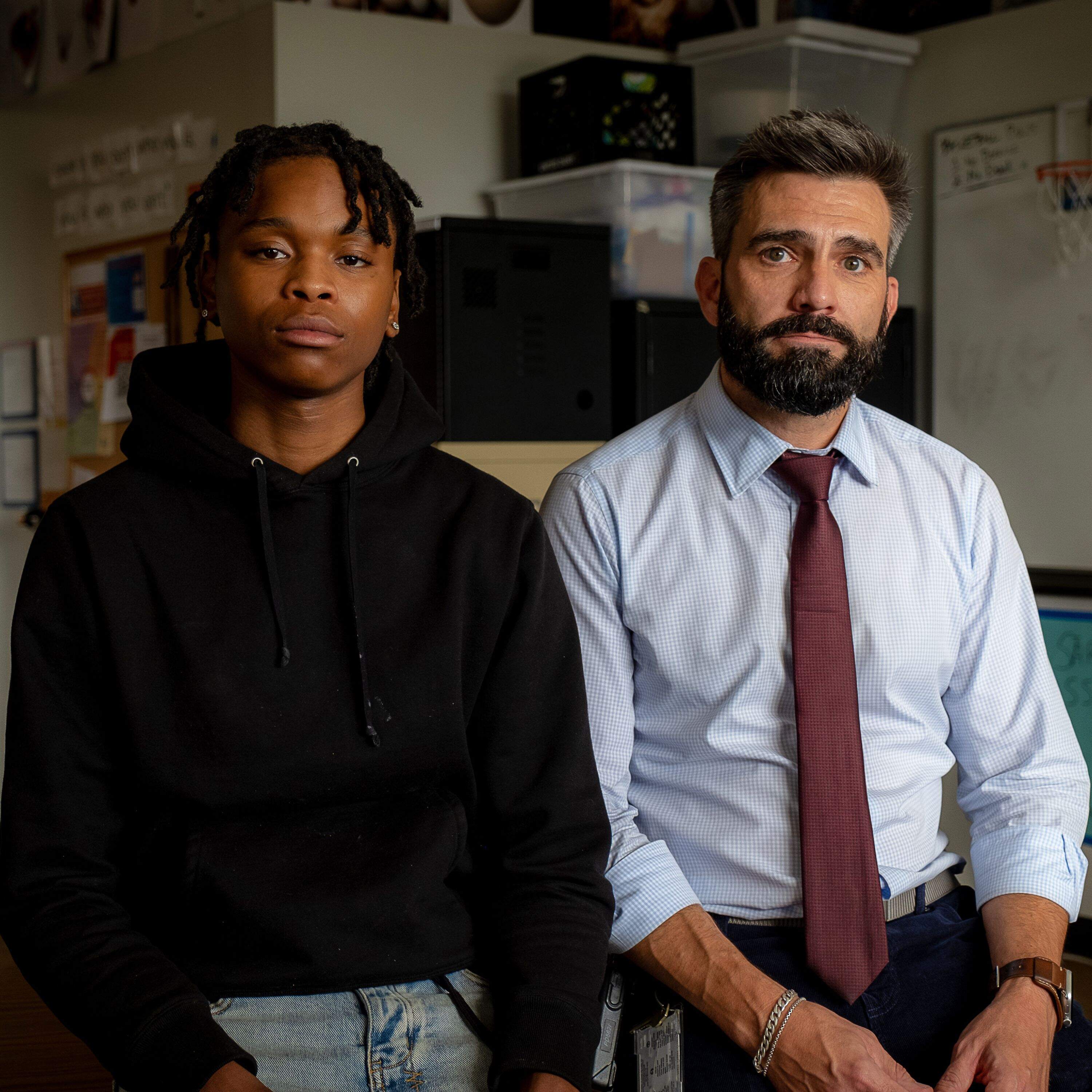
Yeah, that's right. His name is Walt. And we're only using his first name in this story because of the stigma associated with being labeled EBD. When I met him, Walt was in 11th grade and Mr. K had been his teacher and case manager since he started at Central in ninth grade.
- [08:08]
F
He's an amazing, incredibly intelligent, amazing human being.
- [08:14]
E
Mr. K had asked Walt to come up before class started.
- [08:17]
F
How you doing, man?
- [08:18]
B
Okay.
- [08:19]
F
You good?
- [08:19]
B
Yeah, I'm fine.
- [08:20]
F
Excellent. Thanks for swinging up.
- [08:21]
E
I really appreciate it.
- [08:23]
B
Oh, no problem.
- [08:24]
E
The three of us sat down at a table. Walt was tall and lean, with a quick, bright smile. He had on the classic high school uniform. Backpack, dark ripped jeans, sweatshirt. And he was also wearing a big gold medallion with four tiny photos in it. There was a kid and some grownups. I asked him about it. Do you wear that every day? Special days? You do.
- [08:49]
B
I don't never take it off.
- [08:51]
E
Aisha. He later told me those pictures were of family members who died.
- [08:56]
A
Oh, that's really sad. And that he has so many. And he's so young. So why was Walt labeled with an emotional or behavioral disorder?
- [09:12]
E
Well, it was because of how he acted out. But in order to understand it, you have to understand his background. He has seen a lot of trauma.
- [09:23]
A
So what happened to Walt?
- [09:25]
E
So, Aisha, that medallion Walt wears, that's just a glimpse of what he's been through. Walt was born in 2006, and court records indicate his household was violent. Walt's father beat his mother, and he was in and out of jail when Walt was little. His father is now in prison, serving 25 years for sexual assault. Walt was in foster care for a time when he was just five years old after his mother had been hit by a car. She's been in a wheelchair ever since.
- [09:58]
A
I mean, that's a huge amount of trauma and just upheaval for anybody, but especially a child.
- [10:09]
E
It is. The teachers and psychologists I talked to said most kids with the EBD label have similar levels of trauma. In fact, they said if they could come up with a label for kids who end up in EBD classrooms, they'd call it ptsd. But PTSD is not a label that exists in special ed. And by the time Walt was six, he was placed in a school for kids with behavioral problems.
- [10:38]
A
So what was that school like?
- [10:41]
E
Well, it was this completely separate school for kids who administrators believed could not physically be with the general ed population. The students were mostly kids of color. In fact, federal data show black kids are twice as likely as white kids to be labeled ebd. And kids in EBD are disproportionately low income. Walt is both black and from a low income family. The school had pretty intense security, padded timeout rooms, and a focus on behavior more than on academics. Walt said that at school he got in a lot of trouble. Or as he put it, he was rowdy with the staff.
- [11:24]
B
I was just a kid doing too much. Like, I was a bad kid. I was like, don't get me wrong. At home, I knew how to act, but at school, it was problems.
- [11:35]
A
A bad kid. You know, my brother had a lot of behavioral issues growing up. And one thing that my mother said that she was told by his grandmother, actually, it was that you don't label a child as bad. Their behavior may be bad, but the child is not bad. So even if you behave badly at school, that doesn't make you a bad person.
- [12:00]
E
No, it doesn't. But I did hear from a lot of experts that many kids with the EBD label really believe they are bad. They've brought it on themselves. Even though, Aisha, they usually get the label when they're really young.
- [12:16]
A
So, I mean, tell me more about Walt's family. His dad, you said, is in Prison. So was he raised by his mom?
- [12:27]
E
He was. And his mom, Crystal Deramus, she's a big personality. I met her at the small house she was renting in a working class neighborhood of St. Paul. A few of Walt's nine siblings also live there. Crystal is paraplegic, so she guided me up the walkway in her wheelchair.
- [12:49]
B
I don't think it's the push, it's the clipper.
- [12:57]
E
When we got inside, I could hear the smoke alarm going off and I asked her if we could do anything about it. She said no. She was used to it, along with all the other issues in the house.
- [13:07]
B
It's a lot of problems with this house that the landlord don't want to deal with. Like we keep having non working stove or refrigerator. It's an ongoing thing with trying to get the trash bins emptied out.
- [13:22]
E
We talked more about her housing situation and I got to know her preschooler, Dashai.
- [13:28]
A
I did till five.
- [13:30]
E
How was it being five?
- [13:32]
B
Good.
- [13:34]
E
And meeting Deshai put things in perspective for me. Remember Aisha, Walt was around Dashai's age, just five, when he started acting out.
- [13:43]
B
He started biting, he started throwing chairs. And you didn't really have to do nothing. Like if you even touched his desk or you made front of him or you just said hi to him, something like that, he'll just go off, explode.
- [13:58]
C
Yeah.
- [13:58]
A
I mean that type of behavior is so difficult. I mean I've seen it and you know, I hear about it from some of my kids, classmates, they'll say, you know, a certain kid is throwing chairs. And even one of my kids was like, you know, this little boy in class, he needs therapy cause he keeps throwing chairs. Right. Like he has some anger issues, but it's disruptive to the entire class. You know, I've had like my friend's child got injured when a child pushed her. She had to get stitches. So I mean there's a lot of complications with having kids in a class who are kind of having this explosive behavior. But I think also for the mother of the child who's trying to. Whose child gets that label, how challenging that must be for her as well. What was Crystal's reaction and what does she think about him going to a separate school?
- [15:02]
E
Yeah, you're right. It's really complicated. She didn't like the padded timeout rooms and the heavy handed way the school enforced discipline. But she also felt it was a bit of a safety net. And you know how you were talking about your daughter's classmate needing some help? Well, Walter did too. And he actually got some help outside of school.
- [15:23]
B
We did family therapy. They did individual therapy with him. He got a mentor, which took him places, which he still is his mentor to this day.
- [15:34]
A
It sounds like Walt was getting the help that he needed. The close supervision therapy, a mentor. Did it help?
- [15:43]
E
You know, this is where we get back to how hard it is to measure EBD and progress for students with that label. Other special ed designations have measurable goals, but EBD doesn't have goals that are straightforward to measure. Like, how would you measure personal relationships or inappropriate feelings? The bottom line is Walt spent all of elementary school in this segregated school with no interaction at all with students in regular classrooms.
- [16:17]
A
So what happened after elementary school?
- [16:20]
E
Well, by seventh grade, the school team that worked with Walt decided he was ready for a less restrictive environment. A regular middle school. No more locked rooms and holds. The plan was, at his new middle school, he would be eased into regular classrooms, but still, he'd start out in a classroom with other kids in ebd, and that's where his home base would be.
- [16:45]
A
So how did he do in a regular middle school?
- [16:50]
E
Not great. His behavior was still a problem. He got into a lot of fights, and he wasn't really able to handle regular classes. But it could also be that the school didn't have the support he needed as he tried to adjust to a regular classroom.
- [17:07]
A
So if you're getting into fights, did that mean that he was also getting suspended a lot?
- [17:15]
E
That's what it meant.
- [17:17]
A
Okay, so if you're missing class from suspensions, then that's definitely gonna interrupt your learning. And I would think that it would make it harder to successfully transition into a regular school. Right?
- [17:37]
E
Right. You have put your finger on something I keep hearing from the education research world. Putting kids with EBD in separate classes creates a vicious cycle that actually makes it harder for them to improve their behavior. One of the experts I talked to was Chad Rose, an education professor at the University of South Carolina. He's also the head of an international group of academics and educators who work on behavior and emotional health in schools.
- [18:07]
D
We have these classrooms full of kids
- [18:09]
E
that have engaged in challenging behaviors, and
- [18:14]
D
we're not getting them acclimated to communicate and function and collaborate alongside their same
- [18:20]
E
age peer group without disabilities. And that's what happened to Walt. He was surrounded all the time by other students labeled ebd. So he didn't see how most gen ed students behaved, and he wasn't expected to act like them or make the same academic progress. There just wasn't that much time for academic learning when teachers had to focus on behavior.
- [18:45]
A
So Walt spent all of his elementary school years in a school for troubled kids. Then in middle school, he was segregated in classes for troubled kids. And now we're meeting him in high
- [19:01]
E
school, where the pattern continued. He told me about it on a hot day with all the fans in the room on.
- [19:08]
B
I started getting suspended, like, 10th grade. I got suspended, see, 160, 130 times.
- [19:17]
E
You did?
- [19:17]
B
I did, too.
- [19:19]
E
Walt was exaggerating a bit. I checked, and he'd actually been suspended dozens of times, not hundreds.
- [19:27]
A
But, I mean, in a way, like, he's overselling it. He's a little cocky about all of these suspensions that he's had.
- [19:35]
E
Well, he's a teenager, and remember, he'd been in classrooms where that behavior was happening all the time.
- [19:41]
B
As a kid, you watch, you want to follow what other people does. Like somebody doing something cool, you gonna do that automatically. So I say, like, why would you be the only person in the room trying to change, knowing that everybody else in the room trying to follow the clown?
- [19:57]
E
But by the time I met him, Walt told me he had a really strong desire to change. And that's because the summer between sophomore and junior year. So the summer before I met him, Walt was arrested for stealing a car, a robbery he said he didn't commit.
- [20:14]
B
You can touch somebody car, touch it wrong. Do it. Just touch it. Any wrong. You can go to jail. You can do anything to go to jail. It's easy to go to jail. It's hard not to go to jail.
- [20:26]
E
And for Walt, that was a low point. That eventually became a turning point. He spent two weeks in juvie, and. And it was basically a preview of what he thought his future might be.
- [20:38]
B
When I got to jail, people knew who I was. These were people that I already knew. I played basketball with. I knew these kids.
- [20:45]
A
So these were kids he knew from the EBD classes?
- [20:50]
E
Some of them were. And it's not that much of a surprise. There isn't recent data about outcomes for kids with EBD. But about 15 years ago, a study found that youth with EBD are more than twice as likely to get arrested soon after high school than kids with other disabilities. Walt told me he hated juvie. But a few months after he got out, he went on this trip with a nonprofit that works with black youth who'd been through the corrections system. They toured a few historically black colleges, and Walt said the trip shifted something for him. Back when I met Walt at the End of junior year, both he and his teacher, Mr. K, remembered how different Walt was when he came back.
- [21:34]
F
You were like a man on fire. You were on a mission. You had that look in your eye, like you came back and you're like, okay, what are my classes? What have I got to do? What are we doing? What's my plan for after high school?
- [21:44]
E
And Walt had an answer to those questions.
- [21:47]
B
Centralist taught me, like, you want to be. You want to be successful after this place? That's what they're setting me up to do, to be successful after this. I want to go to college.
- [22:02]
A
So it feels like at the end of Walt's junior year, he's sort of on a knife's edge. He's been exposed to some HBCUs, and I have to say, HBCUs are known for giving students second chances for redemption. That is the story of HBCUs, and he's been exposed to that. He wants to turn his life around. He's motivated and smart. But to do that, you have to stay out of trouble. And that can be very hard when you've had a history of getting into trouble.
- [22:43]
E
That's right. And the odds were not in Walt's favor. More than a third of kids with the EBD label don't finish high school with a regular diploma. Their dropout rate is twice as high as it is for all students with disabilities. Walt was behind. He was missing half of the credits he needed to graduate. I asked Walt if I could tag along with my microphone for his senior year, and he said yes. How come you want to do this with me?
- [23:14]
F
Because
- [23:17]
B
a lot of people don't get hurt, don't get talked to. Like, I don't get spoken to at all. Like, I have a lot going on and, like, a lot has. I've been through a lot, and, like, people don't know. Of course I agree to it. Why not? I mean, it's nice to be heard.
- [23:39]
A
When we come back. It's Walt's senior year.
- [23:42]
B
I don't know. I think I'm starting to like school.
- [23:45]
A
And we meet another one of Mr. K's students from a decade ago and hear about a path Walter never got to take. Stay with us.
- [23:56]
C
This message comes from Ezcator, making it easy for organizations to order food for meetings and events from favorite restaurants, set up meal programs for their employees, and manage food. Spend all in one place.
- [24:08]
D
@easycatur.com this message comes from Wise, the app for international people. Using money around the globe, you can send, spend, and receive in up to 40 currencies with only a few simple taps. Be smart. Get Wise. Download the Wise app today or visit wise.com teas and C's apply.
- [24:30]
A
I'm Aisha Roscoe, and we're back with a Sunday story. Reporter Lori Stern has been talking to us about Walt, a student in St. Paul, Minnesota, who has a special education label called emotional or behavioral disorders known as ebd. Students labeled EBD tend to spend more time in their own separate classrooms than kids with other disabilities do. So one of the key questions is, how does separating out these kids affect their future? Lori, you met Walt in an EBD classroom his junior year, and he agreed to let you check in on him during what he hoped would be his final year in high school. And he basically said he wanted to be heard, which is a beautiful thing. What did checking in on him look like?
- [25:25]
E
Well, I went to his classroom. I talked to his teacher, Mr. K. I talked to Walt outside the classroom a few times, and he and I texted back and forth. And the theme, more than anything, he kept telling me he just wanted to graduate with his class.
- [25:42]
A
And as we know, he had a lot of catching up to do, since he was really behind in his credits, that he needed to graduate.
- [25:50]
E
That's right. And then, Aisha, in November of his first semester, I saw this other side of Walt
- [25:59]
A
that. That doesn't sound good.
- [26:02]
E
It wasn't. So picture this. Mr. K was about to start a social studies class when Walt stepped out for a bathroom break. Then all of a sudden,
- [26:13]
F
hey, real quick, real quick, real quick, real quick.
- [26:16]
E
There was a commotion outside in the hallway. Then Walt and this other teacher I'd never seen before came into class yelling at each other. Mr. K shot up from his desk and got in between them.
- [26:29]
B
He walked in the back like, yo, I ain't do nothing. I was standing on my phone.
- [26:33]
E
Walt was worked up because this teacher, Mr. Humphrey, had accused him of smoking in the bathroom. Walt denied it.
- [26:40]
B
Another kid was in there smoking. He instantly, come on, guys. I'm just standing there, so I'm gonna walk out, but I'm sending my girlfriend a text. He stands right there. He's talking about some. Come on, man.
- [26:48]
F
Move.
- [26:49]
E
Mr. K tried to calm Walt down.
- [26:52]
F
Move.
- [26:53]
B
He talking about, come on, move. I'm instant. Can I just send my text message?
- [26:56]
E
Mr. Humphrey also tried to talk to Walt. Walt was too angry.
- [27:00]
B
He talking about, move instantly. Get your goofy ass now. I'm not moving.
- [27:04]
E
Okay, pause, pause, pause.
- [27:05]
F
I hear you. And thank you for that. Thank you for Explaining to me.
- [27:08]
A
So this was Walt losing control. Right. And maybe an example of why he had the EBD label.
- [27:18]
E
Yes. You know, up until this moment, Walt had struck me as pretty level headed, but clearly there he had crossed a line and he wasn't able to stay in control. But then, as fast as the conflict had started, it ended. After Mr. K's intervention, both Walt and Mr. Humphrey calmed down.
- [27:39]
F
I don't got nothing with you personally, man.
- [27:41]
B
But it was just one of those things, man, you know?
- [27:43]
E
And he and Walt hugged.
- [27:45]
F
Get over here, get over here. There we go. There we go. There we go.
- [27:52]
A
Okay. So emotions ran high. I mean, this is a teenage boy with a lot of, you know, testosterone. I mean, people get worked up, but no one was hurt.
- [28:04]
E
That's right. And when I asked Mr. K about the conflict later on, he surprised me. He said Walt actually did pretty well. The argument could have been much worse.
- [28:15]
F
Think about it. They were at a point where Walt might have missed days of school after that. And it could have been like a. A well, F you then. And F you. And then the teacher's like, oh, I know how to deal with this. So the long and short was, as that was going on, the reason I'm praising Walter is because there is something in him that knows that things can be resolved.
- [28:38]
A
So Mr. K is seeing growth in Walt because a lot of this comes down to impulse control. Right? Like, and especially for teenagers, you can be very impulsive and not see kind of the bigger picture.
- [28:54]
E
Oh, yeah. I remember when my son was that age, and I know exactly what you're talking about. And with Walt, he did get better at impulse control gradually, but it wasn't enough for him to graduate from Central. And that's because around the same time as the fight with Mr. Humphrey, he got into a big fight with another student. And as a result, Walt had been suspended for a week, which meant he wouldn't have time to get the credits he needed to graduate.
- [29:24]
F
Even an administration like mine, which is solid, which I work very well with, and respects students from all different walks and really works with students even, they are like, what are we thinking?
- [29:35]
B
For Walter, oh, man.
- [29:38]
A
It seemed like he was doing well. So does this mean that he couldn't finish high school? That he had to drop out?
- [29:47]
E
No. There was one more option. The St. Paul School District has an alternative high school called Journeys that runs a program just for EBD students. It requires them to find and keep a job for 90 days, and they have to complete a checklist of life skills like Open a bank account and cook a meal, and they have until they're 22 to earn that high school diploma. Mr. K said it was Walt's best choice.
- [30:15]
A
So how did Walt feel about this option?
- [30:17]
E
Well, he wasn't very excited about it, and he held off making a decision all winter.
- [30:23]
B
I just feel like I'm missing high school. Like, that's why I haven't fully decided yet.
- [30:31]
E
Finally, in March of his senior year, he decided to go. He realized it was the only way he had to earn the diploma that he'd said was so important. Basically, though, Walt was back where he started. He'd been separated from regular students as a young kid and never rejoined them. And what happened to Walt is not a one off story. Remember, students labeled EBD are disproportionately low income kids of color who may not have a lot of advocates who can make sure they're getting the best education possible. I mean, the prospects for kids with that EBD label haven't improved much in decades.
- [31:12]
A
So nothing has really changed for kids with EBD?
- [31:17]
E
Well, there was an effort to change things about 15 years ago when Barack Obama was president. He encouraged schools to try to close racial disparities in student achievement. And the St. Paul School District made a bunch of changes. It closed, closed EBD only classrooms and sent those students into regular classes, sometimes accompanied by special ed teachers. That approach that was called mainstreaming.
- [31:43]
A
And how did that go?
- [31:45]
E
Well, it was mixed. There was tremendous backlash. A lot of teachers and parents said classrooms got too disruptive, too chaotic. But some families said their students with EBD did much better in regular classrooms. And Aisha, I met one man who said basically mainstreaming saved him.
- [32:05]
A
What was so helpful about mainstreaming for him?
- [32:09]
E
So Tyrone Williams had also been in Mr. K's EBD classroom years before Walt, of course. But like Walt, he was a black kid from a poor family who'd seen more than his share of trauma, and he had a history of getting into fights. But then in 11th grade, the school district implemented mainstreaming and Williams started going to regular classes. So it was just kind of like a shift in the brain, really, like being put in those classes is what
- [32:41]
D
also helped, like, kind of reshape that thought process.
- [32:44]
E
Williams is 27 now. He's got a steady job, and he lives in a renovated mid century apartment in downtown St. Paul. And that's where we met. What would have become of you if you hadn't had those opportunities of going into more challenging classes? I would say one very Important thing would be a little bit lower than what it is now. And that very important thing is confidence. Williams graduated from Central after four years. He said mainstreaming helped him meet kids from different backgrounds. He got involved in extracurriculars, and he even took an advanced placement class. I feel like high school's like, kind of like a smaller version of, like, the real world, really. Yeah. It's just in one building, though. You know, it's a critical age range. The high school age range is that age where you want to, like, push kids into newer and more challenging things.
- [33:50]
A
Well, it sounds like mainstreaming, like being in the classes with other kids who weren't ebd. Like that. That made all the difference for him. Why wasn't that something that could have happened for Walt?
- [34:07]
E
That's actually a pretty long story. But the bottom line is, teachers told me they felt blindsided at the time by all the changes the school district made at once. They said they didn't have enough training or support or time to prepare. And as a result, schools did get more chaotic and violent. And then in 2016, the Superintendent and a lot of the school board were replaced and mainstreaming was scrapped. The school district returned to the old way of doing things. What we have now, separate EBD classrooms.
- [34:41]
A
And that's what Walt got, those separate classrooms?
- [34:46]
E
Yes. And you know, Aisha, when I started following Walt, I was pretty sure this story would end with a scene of him graduating from Central. It's what he said he wanted. It's what Mr. K wanted. And schools like Central are trying to improve their four year graduation rate, but it didn't happen.
- [35:07]
A
I mean, that's. And that's so disappointing. Right? I mean, but all these suspensions, all the missed schoolwork, it just. It didn't happen.
- [35:18]
E
Yeah. And there was turmoil at home, too. His sister got arrested. And not long after Walt changed schools, his family was forced to leave their house because the city declared it unlivable. They had to move to a motel that accepted housing vouchers.
- [35:37]
A
I mean, so still the. The chaos and the disruption, I mean, that's for anybody. That is so difficult to maintain. But imagine being a teenager, a kid trying to deal with all of that. I have to wonder, like, listening to a story like this, like, is there more that the school could have done or Mr. K could have done? I mean, recognizing that Walt does bear some responsibility for staying out of trouble, but still, it does feel like the odds were stacked against him.
- [36:19]
E
Yeah. You know, it's something I talked to Walt about. I. I was Trying to see if he felt responsible for any of the things that were going on at school. And he'd always kind of shrug and say something like, I can't change the past, or school can't change who I am.
- [36:37]
B
It's not changing me. I'm just. I'm learning other ways to do things. I'm still the same person. Nothing changes anybody personally. You're always gonna be the same person.
- [36:51]
E
As for Mr. K, he does think schools could and should do more to include students with that EBD label.
- [36:59]
F
While I do absolutely appreciate the sense of community and the sense of family that they build with each other to survive, I would also argue that we have done a horrible injustice to these children by not allowing them to share space with their peers.
- [37:17]
E
And, you know, Aisha, While teachers like Mr. K keep doing the best they can for their students given the circumstances, there are a few places trying a different approach. They're trying to get students with EBD back into the mainstream with the help of what are called wraparound services. The idea is to address the many needs of these students and their families, from medical care to stable housing, and so that students come to school less stressed and more able to focus on schoolwork.
- [37:49]
A
But that wasn't an option for Walt.
- [37:53]
E
No. That's right. Walt's only option now is to get a diploma through that new school focused on life skills. And he doesn't seem to be in a rush.
- [38:02]
B
It's always cool to just chill and be cool where you at, because your time is coming, and it's patience. That's what gets you far in life, being very patient. And that's what I'm doing right now. I'm being patient. I'm better than I was before, but I'm not where I want to be.
- [38:18]
E
Let's just say that Walt isn't out of time. He has until he's 22 to get that diploma. And he's still in touch with Mr. K, who told me Walt will get back on track. I want to believe that, too.
- [38:35]
A
I'm definitely rooting for him. Lori, thank you so much for bringing us this reporting.
- [38:41]
E
Thank you for having me.
- [38:51]
A
This episode of the Sunday Story was produced by Raina Cohen. It was edited by Jenny Schmidt. It was engineered by Kwesi Lee, and fact checked by Greta Pittenger. Music from Seymour Sound. A big thanks to Louise Treas for shaping the original reporting and to Sarah Wyman and Dan Girma. The Sunday Story team includes Andrew Mambo, Justine Yan, and our senior supervising producer, Leanna Simstrom. Irene Noguchi is our executive producer. I'm Aisha Roscoe. Up first is back tomorrow with all the news you need to start your week. Until then, have a great rest of your weekend.
- [39:41]
D
This message comes from the International Rescue Committee in Gaza, Sudan and crisis zones around the world. The IRC is working to deliver emergency aid to those who need it most. Donate today by visiting rescue.org rebuild this message comes from Rosetta Stone if you have travel coming up, like a spring break or summer vacation, imagine arriving actually understanding the language. Rosetta Stone has been the trusted leader in language learning for over 30 years, with millions of users and 25 languages to choose from. Ready to start learning a new language this spring? Visit rosettastone.com NPR today to explore Rosetta Stone and choose the language that's right for you.
- [40:23]
C
This message comes from Mint Mobile. If you're tired of spending hundreds on big wireless bills, bogus fees and free perks, Mint Mobile might be right for you with plans starting from 15 bucks a month. Shop plans today@mintmobile.com Switch upfront payment of 45 dollars for 3 month 5 gigabyte plan required. New customer offer for first 3 months only, then full price plan options available, taxes and fees extra. See Mint Mobile for details.