Loading summary
Transcript56 lines
- [00:01]
A
This message comes from Carvana, who makes buying and financing your next car easy. Thousands of vehicles, terms up front and 100% online. Even get it delivered to your door. Buy your car the easy way with Carvana. Delivery fee may apply.
- [00:15]
B
I'm Ayesha Rascoe and this is the Sunday Story from Up first, where we go beyond the news of the day to bring you one big story. Couples began flocking to India around 2002 because it was one of the easiest countries where people wanting to have a child could procure eggs and surrogates at about a third of the price it would be. In the United States, a multi million dollar fertility industry boomed and thousands of babies were born of surrogate mothers to the point where one publication called India, quote, a global baby factory. That was until 2021 when much of this industry went underground, in part because of a new law that made it illegal for Indian women to sell their eggs or to be compensated as a surrogate. So this International Women's Day, we go to India to investigate the underground market for human eggs that's taken hold in the past several years. NPR correspondent Dia Hadid and producer Shweta Desai tracked the story for Over Tracing how eggs from impoverished women make their way through a chain of agents and clinics to reach couples who seek them to have a baby. They crisscrossed India from the southern city of Chennai to the holy Hindu city of Varanasi, connecting fertility doctors in high end clinics to women living in slums. And just a heads up, this story contains descriptions of physical abuse and and invasive medical procedures. Dia Hadid takes a story after the break. Stay with us.
- [02:17]
A
Support for this podcast and the following message come from Strawberry Me. If you could go back and talk to your younger self, would you tell yourself that you have a job that truly makes you happy? Many people are stuck in jobs they've outgrown or never really wanted. A career coach from Strawberry Me can help you move on to something you actually love. Benefit from having a dedicated coach in your Corner and get 50% off your first coaching session at Strawberry Me.
- [02:45]
C
NPR this message comes from NPR sponsor the NPR Wine Club, a place to explore the exciting world of wine, including wines inspired by popular NPR shows like Tiny Desk Sauvignon Blanc. Whether buying a few bottles or joining the club, all purchases help support NPR programming and fund quality reporting developed to connect people to their communities and the world they live in. More@NPRWineClub.org podcast must be 21 or older to purchase.
- [03:18]
A
This message comes from Adobe. You need to make a huge presentation in an hour. Luckily, Adobe Acrobat uses AI and Adobe Express to take your files and generate a presentation in a few clicks. Need a last minute pitch deck? Do that with Acrobat need to level up your presentation design? Do that with Acrobat have 30 plus documents that need to be simplified into a proposal? Do that with Acrobat learn more@adobe.com do that with Acrobat
- [03:49]
B
we're back with a Sunday story. Here's NPR's Dia Hadid.
- [03:54]
D
It took us months to find the woman we are calling H. She asks that we don't use her name because she fears for her safety. She works in an industry that is so underground, so secretive, that to find her, my co reporter Shweta Desai has to go through a chain of people, each suspicious of who we are and what we're doing. And then H. Well, Shweta is on the phone with her for weeks before she agrees to meet us in person at a cafe in a commuter town near Mumbai. That's India's sprawling port city. She walks in late wearing a long black robe and a black headscarf, which throws us off. H is Muslim, but we didn't expect her to be religious or conservative. She laughs when we comment on it. She lightly touches her hijab and says she's only wearing it because we're in a Muslim majority area and she doesn't feel comfortable in jeans and a T shirt around here. Aich is one of the countless Indian women who sells her eggs to survive. Couples are in the market for a human egg to have a baby. Like how she looks pale skin, thick hair, an hourglass figure, a pretty smile. She says, I have good eggs. They make good babies. H is 35. She tells us that she started selling her eggs about five years ago, after she left her husband. It was a miserable arranged marriage. H says her conservative Muslim family didn't let her come home. She'd shame them for seeking a divorce. Without a home, she couldn't care for her two children, so her ex husband got custody. She says she moved in with a man who offered her shelter, but when he lost his job, he pestered her for rent. H had no money and no skills, and a girlfriend told her, you're young and you're pretty. Sell your eggs. Lots of girls do it. I've done it. Do it and see. H was confused. It's sounded like sex work. Like most Indian women we meet for this story, she'd never been taught about the human body's reproductive plumbing. Her Friend told her producer Shweta Desai translates the friend said, this is just about providing a part of your body to another person. And once that will work, they will have the babies. Despite India's latest law banning the sale of eggs, the demand continues to be enormous. Fertility clinics and academics tell us it's because women are marrying later, but they still want to have children. So they're turning to the fertility industry for help. At a time when taboos about fertility are shifting, Indian celebrities are openly talking about seeking help to have babies. And there are screwball Bollywood movies like this one called Good News Deepik Eggs
- [07:13]
E
or Aapke Swimmers Go Mare Lab may fertilize Karang.
- [07:16]
C
This process is called in vitro fertilization IVF.
- [07:20]
D
Perfect. Let's do it. About two couples who accidentally have each other's babies. Mr. And Mrs. Batra.
- [07:27]
E
Yes. Are you also Madras?
- [07:32]
A
Yeah. Wow.
- [07:33]
E
We also.
- [07:34]
D
And in India, the ultra rich can buy special VIP services to have a baby.
- [07:42]
E
I've worked with a lot of people from Bollywood and I'm currently a lot of them. In fact, I was with someone yesterday, one of the richest families in Bollywood.
- [07:49]
D
Yesterday, in a noisy cafe, Shweta Desai and I meet a man who runs a boutique reproductive agency with offices flung around the world. He requests. We don't use his name because the work he does, he describes it as operating in a gray zone.
- [08:05]
E
Depending on your economic status, your budget, sexual preferences, single, married, unmarried, etc, etc, whether you want an Asian donor, Caucasian donor, Indian donor, African donor, I can place them anywhere in the world. Hispanic as well. He says basically it's like having what's the Bumble or Tinder? I'm the Bumble or Tinder, but I'm more for surrogacy.
- [08:29]
D
On his folding phone that opens like a tablet, he shows us some of the Indian models and actresses whose eggs he purchases for clients.
- [08:37]
E
So, so this is like what we call a premium donor.
- [08:40]
D
Premium donors.
- [08:42]
E
So I'll show you the database of. Yeah, this is like I have like a batch in March and April. So I'll tell you. These are the girls that have approached us.
- [08:51]
D
He pulls out the profile of one of these women.
- [08:53]
E
Let me just pick up this girl. Okay. This is just a good looking girl from Mumbai. Just see the profile. This is just any other girl you'll
- [08:59]
D
find she's gorgeous on the screen. The young woman has long glossy brown hair, clear olive skin and smiling brown eyes. I'm really curious about the egg donation aspect. What makes someone premium? Like is it skin color, beauty, Is it Education is it age.
- [09:19]
E
It's a combination of all these things, gut feeling and also medical thing as well.
- [09:24]
D
He says these premium donors are paid between $3,000 to $7,000 for their highly sought after eggs. And to extract those premium eggs, he says he has two options. He can arrange a procedure for the woman in India.
- [09:41]
E
Depends, you know, if the clinic in India is willing to do this under the table, behind the scenes, without registering them.
- [09:48]
D
We can do it in India, under the table.
- [09:51]
E
Otherwise we fly them out to Bangkok or to Georgia or to Kenya.
- [09:56]
D
He paints it as a glamorous side hustle for the women involved and talks about a premium donor he's sent to Kenya.
- [10:03]
E
She was supposed to go for a safari today. I kept her one. She's coming back in a few hours. She should be about to land now.
- [10:11]
D
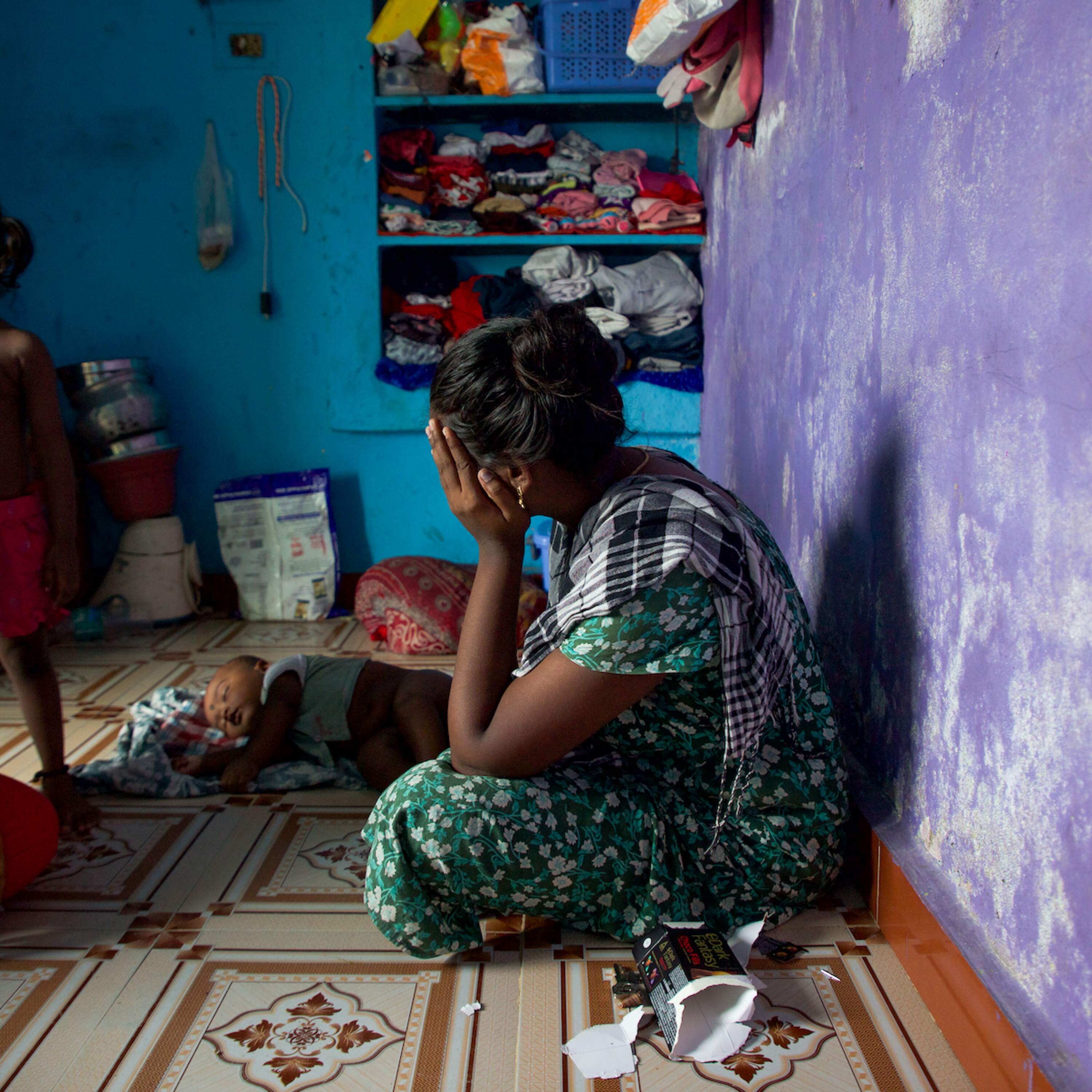
A safari. But for the majority of women who supply their biomaterial to the fertility industry, the reality is far from glamorous. Abhirami is 34 and lives in a slum in the southern city of Chennai, India. Like other women we interview in this slum, she asks to only use her first name because she doesn't want to risk getting in trouble. The women belong to a group at the bottom of South Asia's caste hierarchy. They're known as Parayar, from where the English gets the word Pariah. Abhirami and her girlfriends walk us through their homes, each a tiny room in a row of tiny rooms down a tight alleyway. They're painted bright blues and purples. Where do people sleep? The mats are rolled in one corner, a gas burner for cooking in the other. Abhirami's husband polishes spoons in a steel mill for about a dollar a day. She says he drinks away his wages. They have two daughters, but they live with Abhirami's sister in law. That's because Abhirami has no time to care for them. She works in a toy workshop assembling plastic guns for about $3 a day.
- [11:54]
B
Twice.
- [11:54]
D
Twice, she says she sold her eggs to put food on the table for rent. Abhirami first heard about selling eggs from her neighbour while standing in line for her turn at the water pump. She pleaded with her neighbour, tell me where I can go and do. Abhirami says when she told her husband about her plans, he thought it was sex work. She sniffs. He doesn't understand the difference between thick and thin. Abhirami says her neighbor told her, forget about your damn husband. He's not paying the rent. You'll get 25,000 rupees about $300 more than what she'd make in three months at the plastic gun factory. Her neighbour knew about selling eggs because she had been in and out of hospitals herself. To make ends meet, she used to sell her blood. She once sold her eggs when she was younger. She was once paid to carry a baby and she sold a kidney. She shows us the scars. She took Abhirami to a fertility clinic. Abhirami said she can't read. She only finished school to the second grade. But her neighbor told her it was seven stops away on the bus. So she counted them. Abhirami says in the fertility clinic, she was hustled into a room where patients couldn't see her. A nurse filled out a form on her behalf and told her to sign it with a thumbprint. Abhirami says a nurse put gel on her stomach and scanned her. She says she was told to come back after she got her period, and when she returned, she was injected. She's not sure with what, but it was most likely hormones to stimulate her ovaries to produce more eggs. It hurts. Every day for about 10 days, Abhirami went back to the clinic. She counted seven bus stops to know where she had to get off, and the nurse ushered her into a room to be injected. She says she thought she'd die from the nausea she was experiencing. She began swelling around her stomach. Based on what we've heard from doctors, her response to the injections sounds like she'd been overstimulated, which isn't uncommon. She focused on the money she'd make. But when her husband noticed her swelling, she says he beat her up. Abhirami remembers shouting at him, you drink away your money. I don't have enough for rice. She says she hid at her neighbor's house until it was time for her to have her eggs extracted. For that, a doctor put her under anesthesia. She isn't sure how the eggs came out, but typically they're removed with a long, thin needle that goes through the wall of a woman's vagina. And they're extracted from follicles on a woman's ovaries. The nice thing, Abhirami says, was that she got to sleep overnight in the hospital for the procedure. Even so, she says her pain didn't end after her eggs were extracted. Two years later, she sold her eggs for the same amount. For years, India's for profit fertility industry was under regulated and highly commercial. But after a series of scandals, lawmakers reacted with a dramatic restructuring. In 2021, the assisted reproductive Technology act or art law, as it's called, restricted access to fertility treatments to married heterosexual couples and demanded that women provide their biological material for free. So this is what the underground market looks like now. Marginalised women, often desperate for money, sell their eggs for a fraction of the cost that it would be in the us. And despite the great toll it takes on them and the cash being exchanged, fertility clinics and egg banks call this a donation. Academics who've researched this industry say, as it exists, it's a disaster for vulnerable women.
- [16:50]
F
You've told yourself you've done something, but actually you've only made it worse.
- [16:54]
D
That's Vrinda Marva. She is an assistant professor at the University of South Florida and she studied the fertility industry.
- [17:01]
F
You've created a black market, you've pushed it underground, which means the people participating in it have no protections, they have no bargaining power. If something goes wrong, they're already doing something criminal, something illegal. So who are they going to turn to for help?
- [17:15]
D
We spoke to three members of the regulatory board that oversees implementation of India's assisted reproductive technology laws. They spoke on condition of anonymity because they're not authorised to speak to the media. They said the laws were designed to offer legal clarity for the industry, safety for couples trying to have a baby, and guaranteed medical insurance and care for the women whose eggs were being harvested or who were acting as surrogates. The law was meant to halt the exploitation of those women. The board members we spoke to said they were not aware of the vast underground market that has emerged since these new laws were passed. A senior member of the board was also not aware that in one case, in the northern city of Varanasi, a 13 year old girl was lured into selling her eggs to one of India's largest fertility clinic franchises. We met her at a charity that defends women who've been trafficked. Her parents request we keep her identity anonymous. They say their daughter's been socially stigmatised and she dropped out of school after her classmates found out that she sold her eggs. She's now 15 and she says about two years ago a neighbour told her she'd get $180 for her eggs. She didn't understand eggs like a chicken, But she says she really wanted a smartphone. The teenager's lawyer, Krishna Gopal, believes this is happening to other minors, but there's no incentive for families to come forward. The teenager's neighbour was arrested, but he says the police have not followed up with the clinic that extracted her aches. The clinic in question is part of the Nova IVF Fertility franchise. In a statement, Nova IVF Fertility said that the teenager was screened by a separate company that signed off on having her eggs harvested. Industry professionals who are critical of the new laws say there's just not enough oversight of this massive industry. Consider this. According to the Indian Health ministry, there's nearly 8,600 fertility clinics and egg banks operating in India. Just over 3,200 are actually registered. That's less than half. H says in her experience, the industry does what the industry wants. She says clinics and egg banks don't look very hard at her IDs. She has two, and they're fake. To maximize her exiles, the fake IDs list her as being under 30 because young women get more business. She's also lied about her height. She's on the short side, and she's lied about her faith. H is Muslim, but sometimes she pretends she's converted to Hinduism, if that's needed. Clinic directors say some couples only want eggs from a woman who matches their faith.
- [20:54]
B
Coming up after the break, the middlemen, mostly women who operate in this underground market and how they shield the industry from accountability.
- [21:08]
C
When the Idaho legislature is in session, decisions can move fast.
- [21:12]
D
The Connector breaks it down every weekday
- [21:14]
C
with clear local reporting and the context
- [21:17]
D
you need to understand what's happening and why it matters.
- [21:21]
C
That's the Connector, Idaho Daily News from Boise State Public Radio, part of the NPR network.
- [21:28]
B
We're back. This is the Sunday STORY with more from NPR's Dia Hadid.
- [21:34]
D
Piecing together how the industry functions was not easy. Doctors and clinic directors don't want to go on the record about their clients or their dealings. But here's what one prominent fertility doctor told us about the process on the condition that we don't use her name or voice because she doesn't want to come into the government's crosshairs. We confirmed her account in dozens of other conversations with researchers, fertility clinic directors and women who sell their eggs. The doctor said when a couple comes to her and the woman can't produce her own eggs, she tells them that her hospital will help them, but it's going to cost a little extra. And one way she procures those eggs is through an agent. An agent is the person who will often end up finding women. They move them through the process of extracting their eggs and they pay them. This go between person allows the fertility clinic to plausibly say, we aren't paying women for their eggs, we're paying an agent to recruit women. For us. It was even harder to get an agent to speak to us. But we found one woman. Her name is Ruby. We connected over a crackly zoom call.
- [22:55]
B
Hello?
- [22:57]
D
Hello, Diya, this is Ruby. She asked. We only use her first name, of course her work isn't legal. Ruby says she had a dead end job at a New Delhi call centre and wanted to make more money. Her friend talked her into selling her eggs and then Ruby realised she could make more as an agent. We hear it's common for women who age out of selling their eggs to turn to this hustle. Each month Ruby gets about a dozen requests for egg donors, mostly over WhatsApp. Ruby says clinics mostly want women who are educated, light skinned and pretty normal profile, high profile educated, she calls them high profile women. She finds them through her networks and social media. Ruby will find a donor, agree on a price, get their details. Sometimes she directs women to their scans, arranges their daily hormone jabs, lines up their egg retrieval. Clinics pay Ruby. She takes a cut between 50 to $100 and then passes the rest on. She says her recruits are mostly poor. They've got alcoholic husbands, they're single mothers, they've got money problems.
- [24:23]
F
There is an entire industry that's living off these women's biomaterial right. But then you don't want to pay the women themselves.
- [24:31]
D
This is Prabha Kodaswaran, a professor of law at King's College London. She's filed what's called an intervention in India's Supreme Court to demand women get legally compensated for the work of producing their eggs.
- [24:45]
F
We live in a capitalist society. This is a sector that's generating so much profit for everyone concerned. Everyone else is getting paid without any restrictions.
- [24:53]
D
So she says, why not the women who enable the industry to exist? Kottaswaran acknowledges a lively debate in feminist circles. Some argue all commercial egg donation and surrogacy should be banned because of how it commodifies women, how it commercializes the creation of a baby. If that's the case, if you really
- [25:16]
F
have a problem with commercialisation, why don't you regulate the private IVF sector? Nobody does that, right? But they want to tell the women they shouldn't do it. You know, it's a very paternalistic approach to say you're being exploited, you're a victim, we don't want you to be exploited or your body to be commercialized. So why don't you give up everything for free and then everyone else will use it up for their own purposes and get what they want, pay huge amounts to form their families. But you Won't get anything.
- [25:44]
D
H estimates she's harvested her eggs at least 30 times since she began. If each round of eggs produced one baby, she'd have some 30 biological children. H is sure, though she's made more babies than that. She says if each time they've harvested 20 eggs from my body, you can assume at least 10 kids have popped out. Shweta Desai, who is reporting this story with me, tells her, you are like a super mom. There's little research on the impacts for women who retrieve their eggs repeatedly. Critics say that reflects how little value is given to women who provide their biomaterial once their eggs have been removed. But one known impact is ovarian hyperstimulation syndrome. Mild cases can cause bloating. A severe case can cause respiratory distress. And according to reports published in two medical journals, two women died after these latest laws were passed, after they were stimulated to produce eggs. Is there more? There's no data, no reporting. And who would these women report to? There's one incident that H tells us that has never made it into a police complaint or into data. Two years ago, she says she went to Chennai to harvest her eggs at a fertility clinic there. The agent, unusually, was a man. She'd never worked with him before and she didn't like his vibe. She says when she came out of anaesthesia, she realised her eye was swollen, her lip was cut, she had welts on her back and she was wearing a diaper. She said she fled the hospital as soon as she was able. And she told us, if that man did something to me, may God punish him. Ever since then, H tells us she experiences a sense of terror before she goes under anaesthesia. Weeks after our first meeting, we see H again. This time we meet at a cafe in downtown Mumbai. She's dressed the way she likes, jeans, T shirt, her short hair is fanned out. She's distracted, impatient and constantly checking her phone. She talks to us while complaining that she's feeling bloated, nauseous, breathless, weak. She's nursing a bruise under her right eye. She says her boyfriend is stressed. He lost another job. She says he didn't mean to hit her hard. Besides, her face easily bruises. Shweta asks her about her short hair and tells me what H tells her I had very long hair earlier, but then I just chopped it because of our fight. So I said, what happened? And she said, sadiq held my hair. Her boyfriend dragged her by her hair on a sidewalk, so she cut it off despite him. Maybe also to protect herself, because this is what she said he held her hair and then what she did was she chopped her hair and she's like now hold it and show me. She says she's just been cheated by a new agent. She only got half the money she was promised for harvesting her eggs at a well known hospital. H says she only got $160 because the agent told her she didn't produce enough eggs. H was counting on that money because she's behind on rent. So she says she's taking drugs to try to speed up her next period so she can be stimulated sooner to produce more eggs. H says I don't have a choice. I know this will kill me, but we'll all die someday, right? What comforts her is thinking about her kids. Her 11 year old daughter, her 13 year old son, The ones she birthed herself. They're being raised by her ex husband. She says, I love them so much. Whenever I can, I give them money. They say I don't have to, but my heart doesn't listen. After all, I'm a mother. She has to run. She pushes back her chair to leave. She's got work that she'll be able to see them if she can leg it across town in half an hour. She's got to run.
- [31:16]
B
That was NPR's India correspondent Dia Hadid and co reporter Shweta Desai. This episode of the Sunday Story was produced by Justine Yan. It was edited by Jenny Schmidt and Vincent Nee. It was engineered by Robert Rodriguez. Special thanks to Giselle Grayson and Anupama Chandrasekharan. The Sunday Story team includes Andrew Mambo and our senior supervising producer, Liana Simstrom. Irene Noguchi is our executive producer. I'm Aisha Raska. So up first is back tomorrow with all the news you need to start your week. Until then, have a great rest of your weekend.
- [32:09]
C
This message comes from Capital One Commercial Bank Access comprehensive solutions from a top commercial bank that prioritizes your needs today and goals for tomorrow. Learn more@capitalone.com Commercial Member FDIC. This message comes from Rosetta Stone. Spring Travel coming up, Rosetta Stone has been the trusted leader in language learning for over 30 years. Ready to start learning a new language this spring? Visit rosettastone. Com NPR today.