Loading summary
Transcript43 lines
- [00:00]
Aisha Rascoe
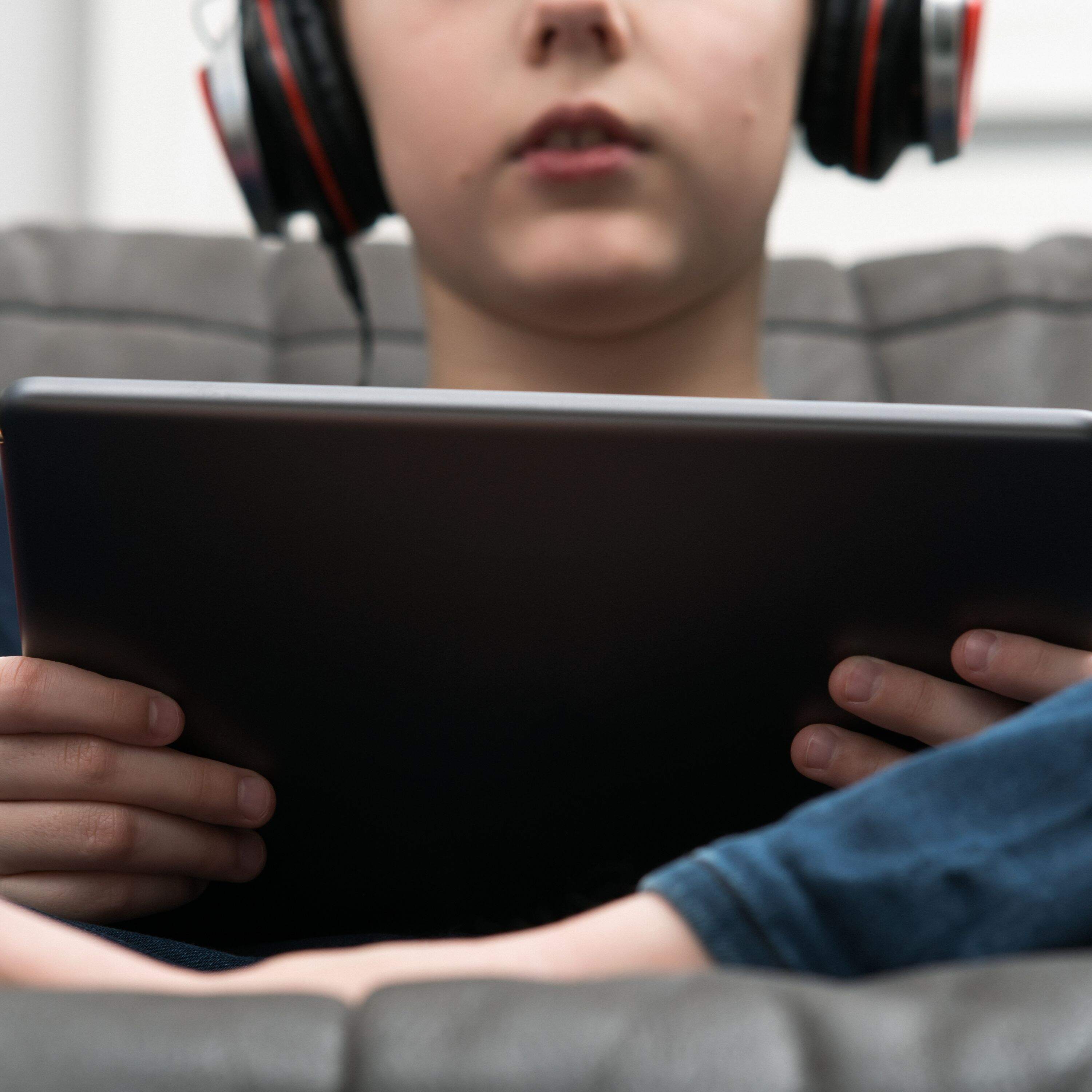
Aisha I'm Aisha Rascoe, and this is the Sunday STORY from Up first, where we go beyond the news of the day to bring you one big story. So the holidays are upon us. And I know in my house right now I am co parenting five children. And if your house is anything like mine, there are a lot of screens. Everybody in the house, all the kids, they're either having a tablet, a phone or a video game. Sometimes they have multiple and they're going a lot of the time, especially during the holidays, because they're not in school. So there's a lot of Roblox and Toca Boca and Minecraft and Fortnite and everybody's playing something on something. And with all those screens and all of these online games, I do kind of worry, what are the implications of this? What is the safety of this in real life? Irl my kids are never out of my sight. Even in the backyard, it's totally fenced in. We can see what they're doing. It's not a lot of unsupervised time in the physical space, but in the digital space, it's different. So you wonder, is it bad that kids are online a lot or just like on screens doing games? To help me understand the consequences of all this, I recently sat down with Eli Stark Elster. He's kind of an expert on this. He studies the evolution of human society at UC Davis. My conversation with Eli Stark Elster after the break. We'll be right back.
- [02:15]
Sponsor/Advertisement Voice
This message comes from BetterHelp. The holidays are a time of traditions like making your grandmother's pudding recipe or watching that movie you've seen a thousand times. Incorporating therapy into your life can help you take time for yourself during what can be a joyful but sometimes tough time of year. And by caring for yourself, you can show up more for the important moments this December, start a new tradition by taking care of you. Visit betterhelp.com NPR for 10% off. This message comes from the National Marine Sanctuary foundation, connecting Americans to their shared maritime heritage. For over 25 years, the protection of important marine habitats and species, cultural heritage and historic shipwrecks creates strong marine economies for America's coastal communities. This giving season, please help keep the ocean coasts and Great Lakes clean, open and accessible to all. Make your gift now@marinesanctuary.org NPR this message comes from.
- [03:18]
Indulge in holiday cravings with the nutrition you need from Cachava's all in One Whole Body Shake. It packs 25 grams of protein, 6 grams of fiber, grains and more high quality ingredients with no fillers or nonsense. Try the newest flavor, limited Edition Chocolate mint. Go to cachava.com and use code NPR for 15% off. That's Cachava. K A C H A V A.com code NPR.
- [03:48]
Aisha Rascoe
We're back with the Sunday Story. I'm here with researcher Eli Stark Elster. Eli, welcome to the show.
- [03:55]
Eli Stark Elster
Happy to be here.
- [03:57]
Aisha Rascoe
All right, so for years, kids played unsupervised outdoors and spent a lot of time together without adults. What changed?
- [04:08]
Eli Stark Elster
Well, to your point, I think many people remember that prior to the 1970s or so, there was much less supervision of childhood in physical space than there is now. But I think an important point to keep in mind is that that difference is not just between, you know, the early part of the 20th century and now, but between now and, as far as we can tell, pretty much the whole course of human history. When you look at the record of childhood across human societies, you find that kids are generally afforded a really high degree of independence and autonomy. One of my colleagues, Dorsa Amir, has a good term for this, that they spend much of their time in independent peer cultures. So with other kids forming their own separate little groups away from the adults, and in the early 1970s or so, the ability for kids to develop these kinds of independent peer cultures drops really precipitously. And that has not changed to the present day.
- [05:01]
Aisha Rascoe
So. Yeah. Why did it change?
- [05:03]
Eli Stark Elster
Yeah, I think one big factor underlying this shift is the urbanization of the United States. More and more people have moved into cities, become increasingly dependent on cars. And so you now have physical environments where one, it is arguably just a little less safe for kids to roam around due to traffic concerns. But parents also have a lot more fear of their kids being unsafe for that reason. And even if parents didn't feel those concerns, often kids are just not home all that close to other kids physically. If they want to hang out with their friends, their parents need to drive them somewhere. So that's a crucial factor. Another, I think underlying concern here is just the fear of not just traffic, but stranger danger.
- [05:42]
Aisha Rascoe
So it's changed in the physical space. There's a lot more supervision, but that hasn't translated to a lot of supervision in the digital space.
- [05:51]
Eli Stark Elster
Yes. Yeah, that's correct.
- [05:52]
Aisha Rascoe
Why do you think that's the case? Is it because it's new or because the safeguards don't exist?
- [05:58]
Eli Stark Elster
Well, on one hand, the safeguards don't exist. The author, Jonathan Haidt, has a good analogy that in some sense putting kids in social Media platforms is a little bit like sending them to Mars. You know, this is a very recent innovation. And so we understand very little about how these kinds of environments actually work and how they're affecting our children. But something I would emphasize as maybe a sort of counterpoint to that, I think we often emphasize what technology is doing to our children. And this move into digital space, the fact that kids spend all this time on their phones and playing video games and so on is often framed as something that they're being sort of tricked into doing by tech companies or what have you. But I think when you look at the trend in human evolution and this desire kids clearly have to build their, you know, sort of secret worlds away from us, I think a different picture kind of arises. And I think the picture that arises is kids are using digital space as sort of the last frontier to get away from us.
- [06:50]
Aisha Rascoe
Is that the evolution of how children play, they seek out these spaces because they are less supervised by it. Adults.
- [06:58]
Eli Stark Elster
Exactly. Yeah. They, from what we can tell, are driven to find spaces away from adults where they can spend time unsupervised with their peers, doing what they want to do, and in particular playing in different ways in physical space. That is now just far too difficult for a variety of reasons. In digital space, though, adults really have no idea what's going on. We have very little control. And so they found this last domain where they can do the same thing, but in digital space instead of physical space.
- [07:25]
Aisha Rascoe
Well, how important is it for kids to have those almost adult free zones?
- [07:31]
Eli Stark Elster
I think immensely important. There's a lot of good data on trends in mental health, starting from when childhood autonomy begins to kind of decline. And we see a very stark trend that different measures of mental health among children begin to decline at around the same time, their autonomy becomes more and more restricted. There's a study conducted at UNICEF every few years called the Innocenti study, where they track independent mobility in different countries. So the amount of freedom kids have to move from place to place by themselves against measures of well being. And you see a very clear trend that greater mobility leads to greater well being and vice versa. So we have a lot of data suggesting that it's extremely important for kids to have these independent spaces away from us.
- [08:13]
Aisha Rascoe
Well, talk to me about some of the online games that kids are using to create their own spaces. Because the kids in my house, my kids are constantly like online playing Roblox with each other, playing Minecraft and other games, but they're playing together.
- [08:31]
Eli Stark Elster
Definitely. I think one, one contrast that's Maybe useful is between two games, both of which kids love. One is Minecraft and the other is Fortnite. Minecraft, I think, is the best selling game in history. Something like 350 million purchases. Fortnite's also immensely popular and kids spend a huge amount of time on both of these games. And understandably, parents, I think sometimes have concerns about this because it strikes them as strange that kids would be spending so much time in these virtual worlds. But when you look at the way that these games are built, I think there are very different reasons that kids are drawn to them. One of those reasons is good and the other one is probably bad. In the case of Fortnite, the company that designs the game has essentially built it like a casino. It is designed to draw kids in, hook their attention, and keep them in these repetitive loops that encourage them to eventually spend lots of money on the game. Minecraft is not built that way. It's a one time purchase. So there's no incentive for the parent company to get kids to stay on there for as long as possible. But kids still love it. I think they love it for a different reason than Fortnite, which is that it's a very open ended exploratory game where you can collaborate with your friends and they have pretty much total control over what they choose to do. So when you zoom out, it can look like these are two instances of a similar thing of kids addicted to video games. When you zoom in on what they're actually doing and how those games are built, you get a very different picture, I think, of what's actually happening in those worlds.
- [09:50]
Aisha Rascoe
And what about the socializing element of it? Because I mean, my kids do play with each other on the screens and even like, I don't know if you know about Toca Boca, but it's like this thing where you get houses and you get characters and you dress them up and stuff and. And they kind of play with them like you would dolls or action figures. It's just like in the game, you know, and then they do it with each other. You have this role. I'm the mommy, you're the baby. Like, is that different from playing with an actual dollhouse?
- [10:22]
Eli Stark Elster
I don't know. I don't know that the research on it is well developed. My sense though, and this is something that people like Peter Gray have written about quite eloquently, I think the key thing to look for here when kids are playing in a physical or a virtual space is do they have the freedom to make their own decisions in this space, are they exploring, are they spending time with other kids? If the answer to all those questions is yes, my sense is that the play is probably just as good regardless of the domain. But I'd also emphasize though, is often this is sort of framed as a trade off, that if kids would simply get off of these virtual spaces, they would go out and play stickball in the streets or what have you. But many of these changes that have led to the state of affairs where physical autonomy is much lower, they're probably not going to change or they will be immensely difficult to change. I think it's worth keeping front of mind that kids need somewhere to go. And if it's not going to be physical space, there has to be some alternative.
- [11:18]
Aisha Rascoe
So is it necessarily a bad thing for kids to spend so much time online?
- [11:25]
Eli Stark Elster
Not necessarily. And I think when we're asking whether it's bad, it really depends on what exactly they're doing. If a kid is spending a huge amount of time just scrolling through TikTok mindlessly, not talking to anyone, that's probably bad. Right? They're not doing anything really on their own. They're not spending time with their friends, they're not getting time in these independent groups of peers that kids really do need to be getting. If they're spending lots of time on FaceTime with their friends, playing Minecraft, exploring a little world, building houses that I think ticks all the checkboxes we're looking for in what kids should be doing in this independent peer time. And so both of those activities maybe look like screen time to us, but they're very, very different kinds. And again, the key question that parents should probably ask is, are my kids getting space to be independent from me, to spend time with their friends unsupervised and to explore in ways that they are determining on their own? And you can ask that question about any virtual space. In some cases the answer will be no. In other cases the answer will be yes. And so when we think about a measure like screen time that often comes up in the studies of the effects of technology on mental health, that's really a bit like trying to measure, let's say, the effect of food on physical health. Right. That's not a very useful measure. You want to break that down into different kinds of screen time in the same way you would break it down into different kinds of food.
- [12:37]
Aisha Rascoe
Well, so what needs to happen in online spaces to allow kids to be kids, but also for them to remain safe?
- [12:46]
Eli Stark Elster
Right. You mentioned Roblox, and I think that's an interesting example because it combines elements that are probably really good for kids, looking from this perspective, autonomy and elements that are probably quite bad.
- [12:55]
Aisha Rascoe
Yes.
- [12:56]
Eli Stark Elster
So on the good side, Roblox, like Minecraft, is very, very user driven. And people playing the game have a lot of freedom to design their own little experiences with the game, to socialize, to collaborate on different kinds of projects. The company that owns Roblox though has also built in many of these kind of slot machine like features, various incentives.
- [13:14]
Aisha Rascoe
That Robux, yeah, they take my money a lot. But let's don't talk about that, let's talk about something else.
- [13:21]
Eli Stark Elster
No, exactly right. And that's an example of something that I think is certainly a negative. But you know, going back to the point of autonomy, I think the good and the bad here reflect different sides of that. It is good for the independence of kids that in this game they can sort of build whatever they want. And it is bad for the autonomy of the kids that the company making this game has added all of these incentives that try to coerce them into making decisions that they probably don't want to make.
- [13:44]
Aisha Rascoe
And also there could be adults in there that aren't kids.
- [13:47]
Sponsor/Advertisement Voice
Absolutely.
- [13:47]
Aisha Rascoe
So that's the other issue, right?
- [13:49]
Eli Stark Elster
Yeah, 100%. It is worth saying though that as with the sort of stranger danger, panic and physical spaces, often the way that people talk about the threat of predators in spaces like Roblox is perhaps a little bit overblown. The data still suggests that most of the times when kids are approached inappropriately on these platforms, it's very often from someone they know, as is the case in physical space. So in some ways the danger is often the same and I think misconstrued in kind of the same way.
- [14:18]
Aisha Rascoe
And so but ultimately, I guess, how do you keep your kids safe?
- [14:22]
Eli Stark Elster
Well, I think we've done quite a lot to keep our kids safe at this point. Right. But one I think perspective here is a trade off between short term safety and long term ability to flourish as an adult. So just as an example, a colleague of mine mentioned this recently. He was at a park with his five year old son and his five year old son had a little toy truck. Some other kid came and pulled it away and so his son and this other kid started fighting. Now in the long term it would actually probably be really good for his son and this other kid to just figure out this conflict themselves. Right. But he and the other parent both jump in and resolve it. And they're doing that because in the short term they want to keep their kids safe, they want to make sure no one gets hit, and so on. In the long term, though, that might not be such a good thing for the safety. And so when we think about the safety of our kids, the real question is, what is going to help them flourish as adults? And in many cases, the measures that we think we're taking to make them safer in the short term are probably harmful in the long term.
- [15:18]
Aisha Rascoe
That's really fascinating. That's Eli Stark Elster. He studies the evolution of human society at UC Davis. Thank you so much for joining us.
- [15:28]
Eli Stark Elster
Thank you.
- [15:32]
Aisha Rascoe
This episode of the Sunday Story was produced by Justine Yan. It was mastered by Jimmy Keeley. The original interview was produced by Dave Blanchard and edited by Hadil Al Shauchi. The Sunday Story team includes Andrew Mambo, Jenny Schmidt and Liana Simstrom. Thomas Coltrane is our intern. Our executive producer is Irene Nagu. I'm Aisha Roscoe. Up first, we'll be back tomorrow with all the news you need to start your week. Until then, have a great rest of your weekend.
- [16:16]
Sponsor/Advertisement Voice
This message comes from Warby Parker. Prescription eyewear that's expertly crafted and unexpectedly affordable. Glasses designed in house from premium materials starting at just $95, including prescription lenses. Stop by a Warby Parker store near you.
- [16:31]
This message comes from Schwab. Everyone has moments when they could have done better. Same goes for where you invest. Level up and invest smarter with Schwab. Get market insights, education and human help when you need it.
- [16:45]
This message comes from Saatva, the official mattress and restorative sleep provider for the U.S. olympic and Paralympic teams. U.S. olympic cross country skiing athlete and Saatva brand ambassador Jesse Diggins talks about the importance of sleep Every night I.
- [17:01]
Aisha Rascoe
Aim for about nine to 10 hours and I realize that sounds like a lot, but I train really hard and so I need a lot of sleep.
- [17:08]
Sponsor/Advertisement Voice
In order to recover. Saatva believes you deserve that kind of restorative sleep, too. Visit saatva.com NPR to save $200 on $1,000 or more.