← We Are For Good Podcast - The Podcast for Nonprofits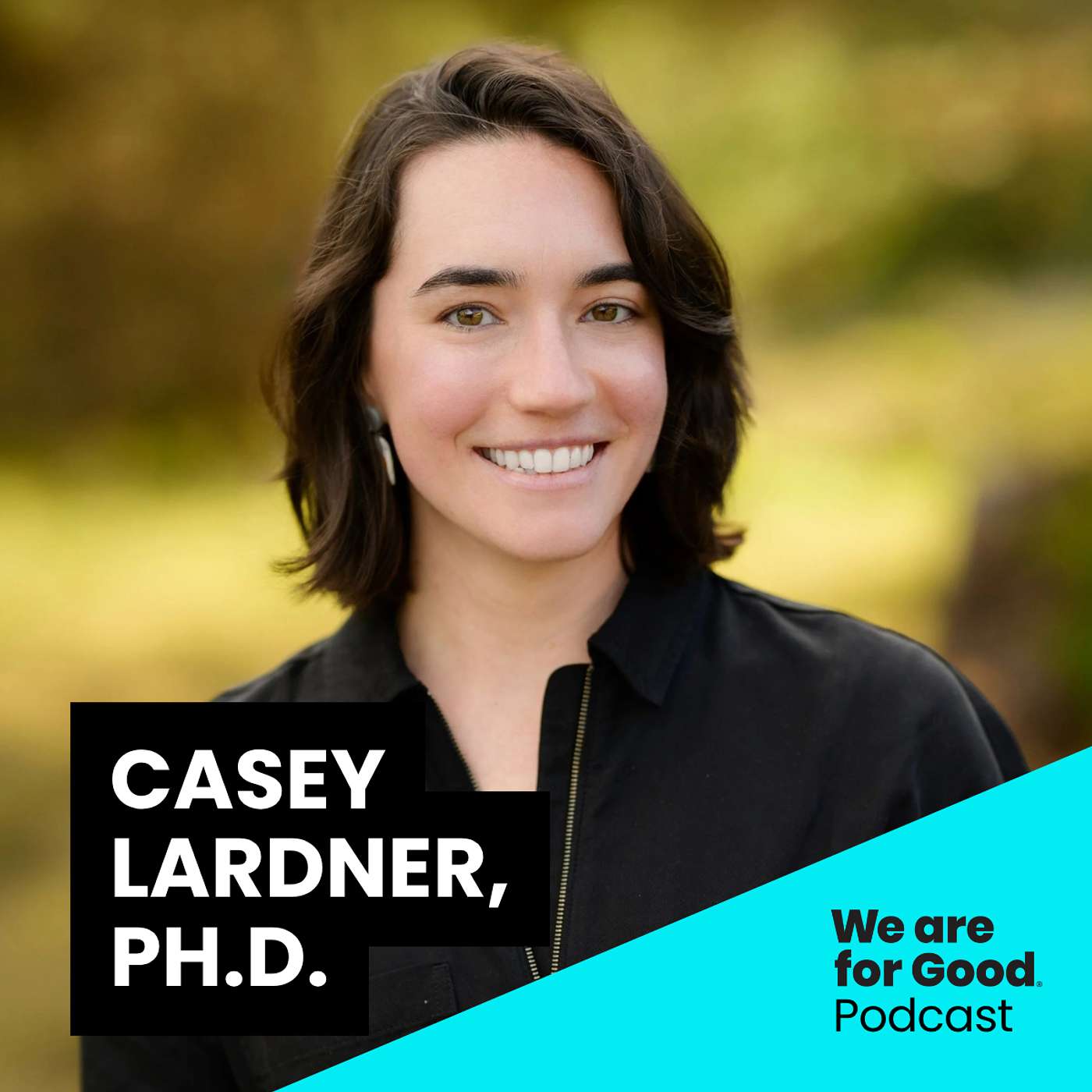
We Are For Good Podcast - The Podcast for Nonprofits
707. How to Break Philanthropy Out of Hypothesis Mode - Casey Lardner, Ph.D., GenSpace
00:30:03
Loading summary
Transcript60 lines
- [00:01]
A
Hey, friend. Before we get started, we wanted to invite you into our global gathering. Four times a year, we bring the We Are For Good community together for one day, one focus. And this Impact up, it's all about storytelling. Impact up story is happening on Thursday, May 14, and we'd love to have
- [00:17]
B
you there because the stories you choose to tell have the power to change everything, and we want to help you tell them better. So join us online from noon to 1:30 Central Standard Time for a free virtual session, including a keynote with storytelling phenom Afdel Aziz and a roundtable conversation with four amazing nonprofit leaders. Then, that evening, in nearly 50 cities around the world, we're gathering with local meetups to keep the conversation going in person.
- [00:45]
A
You can find a meetup near you or join us virtually@weareforgood.com impactup what starts here ripples.
- [00:59]
C
It's a discomfort with uncertainty. But if we are going to continue to lead into doing hard work, the uncertainty is there. It's just like, who is responsible for carrying it? Are we sharing the risk of something going wrong together? Is it fully on service providers and nonprofits to do that? Is it fully on the funder? I mean, maybe. Maybe the answer is a little different depending on the subsector and the situation, but it's there no matter what.
- [01:27]
A
Hey, I'm John.
- [01:28]
B
And I'm Becky.
- [01:29]
A
And this is the We Are For Good podcast.
- [01:32]
B
Let's get started.
- [01:35]
A
Hi, Becky. You jamming over there?
- [01:37]
B
I'm jamming over here. And I'm sitting here thinking about how we talk about the love we have for people that don't necessarily just ask better questions, but they ask bigger questions. And today, we are going into a bigger question. And I want you to think about this concept. Is philanthropy stuck in hypothesis mode right now? And the brilliant individual who is bringing this to us is a friend that we met back in February at the We Are For Good summit. Y', all, I gotta introduce you to Casey Lardner. She is not only a neuroscientist and a community builder, but she also happens to be an executive director in the nonprofit space of an incredible mission called genspace. It's the world's first community biology lab. It's based in Brooklyn, New York. And since 2009, Genspace has been opening the doors of science to everyone. Artists, entrepreneurs, students, researchers, and curious humans of all kind. It's a platform for discovery, and Casey has been watching it produce outcomes no one could have predicted when it opened its doors 16 years ago. So we're going to be diving into that. But today she's not here to talk about biology, even though I'm sure you could Frontwards and backwards.
- [02:56]
A
It's one of my lower grades, so I need the help.
- [02:59]
B
I have one biology high school class under my belt, so I don't think I could do much. But really what she here to talk about is this big idea that has been percolating in her mind about what the social sector could learn from how science funds discovery. And we think it could change the way every funder and nonprofit leader in our audience thinks about impact. As a mom to a budding little girl scientist, I am so excited and leaned in in this conversation. We cannot wait for you to translate it. Casey, welcome to the We Are For Good podcast. We are delighted you're here.
- [03:33]
C
I am delighted to be here. Becky and John, thank you so, so much for having me. This feels like a little reunion. I had such a wonderful time at the summit in February, so I'm just. Thank you for asking me back.
- [03:45]
B
Oh, my gosh, we were so impressed with you. And of course, anybody curated by Brooke Ritchie Babbage is going to be one of the greatest humans on the planet. But this is such a juicy topic. We're so excited to figure out what genspace has discovered and uncovered. But before we get into it, we have to dig, know the human behind the work. So take us back to little Casey and just, you know, couple minutes, tell us what led her to that curiosity to this point to really drive this change. Hmm.
- [04:15]
C
I have always liked science. I think it's hard for me to remember a time. I know.
- [04:23]
B
I love that we're talking about this because I worked at a science museum for my first job, and that was my lowest ACT score of all time. So thank you for just naming this. Keep going and be curious, because the
- [04:35]
C
way we teach and test science doesn't reflect what it's actually like, which is why Gen Space exists. But we can get into that. Yeah, I just. I think there's something like humbling and beautiful about diving into complex living systems and trying to understand how they work. And so that has always been very interesting to me, though I didn't know that you could do science as a job until maybe I was a sophomore in college. I had sort of stumbled into a research program where I went to undergrad at William and Mary, so. So I went to graduate school for neuroscience. That's why I moved to New York. I've been here for about 11 years, and I just fell in love with understanding Brains. I Love nervous systems. I think that they are beautiful and complex and I love that they're systems that evolved to communicate with other beings and the world around us. I could spend all day thinking about that. So I got a PhD in molecular neuroscience and I was working in a lab that was studying how our behavior and our brains change long term after chronic STR stress or exposure to addictive substances. And throughout that, I just started to get a little frustrated with the way science works and the way that incentive systems in science are set up to reward the publication of papers and the winning of grants. That's really what's incentivized. And if you're a great mentor and a great educator, those things can be valued in the right system. But it's not a universal marker of whether or not you're a good scientist or if you're thinking about how your work is having an impact. After that paper, after that grant, and so I started thinking really deeply about that. I had gotten really into science communication as a practice storytelling sometimes in my free time in New York, I guessed on a friend's science comedy trivia show. So just like, how do you get, how do you get science, like out of the lab?
- [06:30]
B
That's the name of that people are going to want to go know. Oh my God.
- [06:32]
C
It's called Fax Machine. It is performed at Cavie.
- [06:36]
B
Yeah, that is so joyful.
- [06:39]
A
Naming goals right there. Wow.
- [06:41]
C
But yeah, I had gotten really into science communication. Just very passionate about that and informal science education, which is this diverse kind of loose space of teaching science outside of a traditional setting. So not in a classroom, not in a lab, you know, what does that look like? And I had co directed a outreach program with some graduate student colleagues at our institution. We would put on a giant brain fair every year and we had a giant inflatable brain that you could walk into. And my hottest take that outreach is not. It's less of a service for people who are not working in a lab and more of a civic responsibility for scientists. You have to be going out and talking about your work with other people and getting their input on it, particularly if it is funded by tax dollars. But anyway, that's a topic for maybe another podcast. But all of this is to say I just really wanted to have a career in science that was not strictly dedicated to the life of an academic. Is. Is kind of what I landed on. And I had found genspace as a, as a participant. I found it through the networks of education and science communication in New York. And I took a class online in 2020. And I was like, this place, it's doing it all. So I started teaching my own neuroscience class, I started volunteering, I started mentoring for some of our programs. I joined the staff in 2023 as the lab manager and I became the executive director about two years ago in 2024.
- [08:09]
A
I am positively obsessed with your story and any scientist that makes space to hang out with artists and entrepreneurs and students and researchers, like, in one place that is beautiful. Like, I see community threaded through your work. And just like wanting to get outside of the wal and actually take the bigger ideas that you're learning. Not just the learnings, but also how you approach learning. It's so helpful to talk to scientists and understand how they see the world. And I think that's what this conversation is going to lead us into. But I want to give space to talk about gin space. How many times can I say the word space conversation? But do you give a little bit of color for our listeners if they're hearing about it for the first time? Like what? How do y' all show up in your machine?
- [08:51]
C
Absolutely. Genspace is the world's first community biology laboratory. And so imagine it is a functional biology lab. But imagine a lab that's also a design studio, that's also a classroom, that's also a community space all in one. And it does look like all of those things. Yeah, it started in a living room in 2009. Our founders had gotten together and wanted. Genspace was born out of a broader do it yourself biology movement which occurred in the 2000s when biology equipment became really cheap. And so it became more accessible to do science outside of traditional academic and industry settings. And we have been in our current location in Sunset park in south Brooklyn since 2017, operating a biology lab where anyone can do hands on science. And so a range of programs for, like you said in the intro, entrepreneurs, artists, students of all ages, adults of all ages. Really, if you can imagine an application of biology or a question, we want to be the place where you can explore that yourself in community, safely.
- [10:05]
B
I love that you are thinking about these things in such a bigger way. Again, we are asking bigger questions. And I mean, everything about the nonprofit sector is about testing and is about figuring out how to optimize whatever we're trying to achieve, solve, help. It is all about piloting. And I want to get back to this hypothesis driven philanthropy, because in science there's this distinction between hypothesis driven research and exploratory experimentation. I can tell you my chemist father is going to Love this episode more than any other that we've had because we are speaking his language. But I want you to take these two, break them down for us, us and talk about why it matters for how we think about funding social impact.
- [10:54]
C
So hypothesis driven science means that you have a prediction, you have an idea about what's going on in your system. You have a pretty good idea and you have a pretty good reason for having that idea that A causes B or X and Y are in relationship with one another somehow. So you design an experiment and crucially, we'll come back to this part. You pick how you're going to measure whether or not that experiment works. Right. That's what metrics and measurements are. You also have to have the right tools at your disposal to know whether or not you're going to be measuring things appropriately if all of that is in place. That's what an experiment is scientifically. Right. Like you are isolating variables to try to determine a causal relationship. Super important. But there is also exploratory science, which is not predicated on a prediction or sometimes really much of an idea about what's going on. But you do say, like, I think there's a landscape here, I think there's a map that we don't have. And we're going to map it. We're going to figure out what this looks like. It's a relationship. Right. You have to do some hypothesis driven work. But if you're never asking the bigger question about what the map looks like.
- [12:07]
A
Okay. I mean, the thing is, Kasey, is that the reason we're so excited about this conversation is because Father Seth, that's what I'll call him now moving forward.
- [12:15]
B
Seth Godin, telling him, you said that
- [12:17]
A
he came into our world and maybe a couple years back now, he said, you know, it's an imperative that we innovate in this sector because we're solving problems that we don't have the answer for. And I do think that that is a missing element. Like, it's great when you have a hypothesis, but. But it's also really great to say these are big, complex, interconnected, systemic issues that need someone to dig deep enough to map toward maybe an unknown ending, toward maybe an ending that's going to lead to a breakthrough, but, like the openness to even explore that. Like, I love that you're calling that out because it is where breakthrough happens. Maybe not every time. So, I mean, you've called most of social sector philanthropy hypothesis driven. What do you think that that's costing us by always having to, like, say, this is gonna be the program and these are gonna be our metrics. What does that cost us in real terms? And what kind of impact do you think that that's leaving on the table?
- [13:17]
C
So grateful to be here talking with you two about this, because it's just like it was just a couple of months ago where I was writing a grant or exploring, you know, how we might fund a program, and I just realized that I was laying out the outcome before it ever happened. And I was like, I don't think that's the right experiment for this context. Sometimes I do think that is appropriate, but the first things that come to mind are just anything that is difficult to ascribe a single outcome to. So funding overhead, funding healthcare for nonprofit staffs, funding institutional capacity, leadership development as a part of a program, instead of just an add on any kind of work that involves, like, complex incremental behavioral change.
- [14:03]
A
Yeah.
- [14:04]
C
Work that depends on complex collaboration, I think would fall into that. That category. Anytime that you are having to work in a complex system, I think that's really difficult to build a hypothesis around. You know, there's actually a phenomenon in science called the novelty penalty, where grants that propose, like, totally new experiments or way of thinking about things are actually found to be consistently lower scoring in peer review processes because reviewers are not as ready to evaluate something they haven't seen before. So I think that's what we're missing. If we're already building towards what we think is going to happen and we're beholden to those outcomes with a hundred percent certainty, then we're not looking at the landscape as a whole.
- [14:48]
A
I think, Kasey, you're, like, poking the bear over here, because I feel like I'm going to go back to the healthcare organization wearing the annual giving hat. It's easier to set goals that you know you're going to achieve, and it keeps you playing a smaller game. And like, I get it, we all want to be successful, but to get in the space where you're kind of limiting what actually could happen if you put us all in the uncomfortable space that we may not hit this, it may not lead to said outcome. It's leaving all that opportunity and gusto behind, a bigger, expansive exploration to happen.
- [15:25]
B
I just think it's a completely different way to think. And are people in the sector, do they feel like they could take this risk and this leap of faith? And I'm looking at funders. I'm not looking at all funders, but I'm looking traditionally at the way we have been funded in the past. When you are expected to put in your grant application what you think the outcomes will be and you're projecting up against that, it would be really hard to say. I don't know. We've had several conversations with people like, I'm thinking about Rena Greifinger over at Maverick Capital. They want to hear that you believe you will fail in the sense they don't want you to fail. But you've taken insights and that's where I want people in the sector to move their mind just a little bit about can we test these pilots? Do we have the backing from our boards, from our staff, from our upper echelon to say we're not sure, but we are watching the behaviors, we're watching the research, we're listening to what our people are saying and this is where we think the next credible step is. And would you support us as we go chase this? I would just love to get your reaction to all of that.
- [16:39]
C
It's a discomfort with uncertainty. It's there. The uncertainty is there. No one can know what's going to happen in any complex system and certainly not in the incredibly complex times that we are living in. But if we are going to continue to lean into doing hard work, the uncertainty is there. It's just like who is responsible for carrying it? Are we sharing the risk of something going wrong together? Is it fully on service providers and nonprofits to do that? Is it fully on the funder? I mean, maybe, maybe the answer is a little different depending on the subsector and the situation, but it's there no matter what. I kept an article on the COVID of my lab notebook when I was in training. The title of the article is the Importance of Stupidity in Scientifically. Yeah, it's a little like heavy handed though.
- [17:33]
B
That's so great. Humble him right off the bat.
- [17:36]
C
Yeah, it's just a one page article published in 2008 that basically just says like, you should feel like you're working hard. If you are working on an important problem, you should not know the answer. And that is not a fun feeling, but it means that you are doing something right. So I was returning to that recently. I was running an orientation for one of our programs and then maybe it was a day or two later when I sat down to write a new grant and I was like, there's a connection here about the problems that me and my team and our community are trying to solve and the way that I am having to talk about it more often than I Would like.
- [18:18]
A
Yeah, I think you're naming something that's absolutely at the core of this because, hello, we're humans doing this work. You know, I think there's a lot of internal things that we have to confront of our own comfort with not knowing what the outcome could be, you know, and opening ourselves up for what that means in front of our peers or in front of other people we respect or whatever that may be. Okay. When you were describing Gen Space earlier, I was actually kind of laughing at the thought of you trying to fit into some certain boxes because like, are you a lab or are you a community space?
- [18:47]
B
And the answer is yes.
- [18:49]
A
So it's like all, all of the above since y' all don't fit neatly probably into a lot of funding boxes. I'm curious what you've learned, being a unique organization about how you go in front of funders or donors and secure exploratory type investment. How do you cast that vision that people latch onto and they're like, oh yeah, I see it.
- [19:11]
C
It's such a good question. I really do have to give a shout out to our funding partners. We have a lot of long term relationships at genspace and they fund our programs, but I think they continue to fund us because they believe in this unexpected. You know, we're creating the conditions for surprising outcomes and I think that, I think that they believe in that as well. I think the first takeaway I can share is when we do have an outcome that we know we can aim for and we feel good about aiming for. So the example I'm going to name is we run a youth research internship program called Biorocket and we believe really strongly. It's a six month program for students from under resourced high schools in New York City who have expressed an interest in science but otherwise have not had an opportunity to get their hands on it. That's who we want in this program. We know that if we create conditions within that program such that they feel like they belong in science, that science is for them, that will lead to a stronger sense of science identity, which is actually like a metric you can measure. And then they will persist in STEM majors and careers beyond college. And so that that is a trajectory that we can measure, then an outcome. I think we can agree on something that is complex. It's not like it's a single thing, but we can agree on that. Again, this relationship between hypothesis driven work and then being open to extraordinary outcomes that can come out of it. So that's the first thing we've Learned. Alternatively, we have a lab membership program at genspace. So it's a fee for service model. You come in, it's like belonging to a gym, but you belong to the lab. You get to come work on a project of your choice. And we have a couple tiers for this. A community project here where you're joining a group of people, you're learning with them. You come to the lab once a week and you work on an area of shared interest. The group comes up with questions together, they figure out how to study the question together, they invite collaborators, they will go find an expert to help them. It functions just like a mini research lab does, but it is community driven and it's often thinking it, meaning the community project entity is often thinking about research in a way that I think all research projects should, which is like, why does this matter and who is it going to impact and how? You know, when I do work on explaining them to other stakeholders, you know, we lead with the people, we lead with the transformations that people in our lab doing, doing their research have been able to make, the careers they've launched, the exhibitions they've put on, the relationships they've been able to form, the empowerment that they feel.
- [21:56]
B
Yeah, to me, this is such community is everything vibes. And I'm trying to bring it back a little bit toward the everyday change maker. And I'm wondering if you're thinking about a nonprofit founder or maybe a shop of three who's really thinking and jiving with this conversation and saying, yes, I want to take on this mindset of a scientist. I want to reimagine the way we test and talk about our organization. What sort of advice would you give them as a starting point?
- [22:31]
C
A big unlock for me recently has been discovering the work of Jennifer Garvey Berger, who writes a lot about leading through complexity. And she pushes an idea of what is safe to fail and what is not safe to fail. So it means defining boundaries on your team, among your stakeholders, in the context of your work, about what absolutely cannot go wrong. So one thing at genspace would be like, we cannot be running an unsafe laboratory. Okay, if that's the boundary, then which direction do we need to go in what is a safe to fail experiment that we can try? How can we play around with different program models, with different funding structures? How can we play around with how we meet as a team or community to just shift things in the direction that we think we want to be going? And as a scientist, because it's paradoxical, right?
- [23:35]
B
Totally.
- [23:37]
C
If we think of scientists as people who find things out. Not that they own that exclusively, but you're only able to find things out in science by constantly, constantly interrogating what it is that you might have wrong. And so that is the first shift. You have to move away from perfection. You have to move away from the right thing to do. The, the, the hundred percent must be this thing. I guess you could phrase that as like a kill your darlings kind of perspective. The other kind of ways to start thinking about this are take stock of your, of your tools, take stock of your metrics and are they really useful? Right. You're only as good as a scientist as your tools are. And if your tools are no longer the right fit for the problem that you're trying to solve, then it's time to sunset them and, and innovate a little bit. And the other unlock I have been thinking about a lot lately is are you really aiming for a specific outcome or are you trying to create conditions that can lead to a range of outcomes? I think those actually might be different things, my friend.
- [24:51]
A
I feel like I've got a scientist friend here, which I'm so grateful for because it was one of my C's in college. Was biology one of my few like C's I still hold in my heart. But I think there's so much to learn from just approaching our work like this to think about things in a better way. You know, we're going to have to ask you about story when you come in the We Are For Good chair. We believe that generosity just like fundamentally changes us. I know that you get to be adjacent to people investing in your mission, but I want to ask you about a moment of philanthropy personally that you've witnessed in your life that's really stuck with you. What would you say?
- [25:26]
C
I'm not sure if this is cheating or not because I am going to talk about Gemspace and something that happened recently.
- [25:31]
B
Oh, it's not cheating at all to say your own. Absolutely. That's what you see up front. Do it.
- [25:37]
C
But we were recently, just this year, within the last six weeks, we were able to grow our team by two people. So we just brought on two additional roles. They are amazing. My team is just the best. They inspire me so much every day. And we were able to do that through some really strong partnerships with funders who believe in what are doing, what we're doing and believe not just in the outcomes that we discuss when we meet with them, when we report to them, but really believe in the platform of Gen space. And for the first time in 16 years, our organization has maybe enough people to do the work.
- [26:19]
B
Oh my gosh.
- [26:20]
C
And what that feels like is. It's just amazing. It's just amazing. So that is, that is my one philanthropy moment right now. And yeah, it really, it really was born out of like, you know, we believe in what y' all are doing.
- [26:37]
B
I Wonder how many EDs out there would say I finally have all the people I need to be able to accomplish our mission. I would love to know the EDS out there that feel like they are there, but we are so grateful because we know what that exhale feels like. So congratulations. And you're familiar enough with we are for good to know. We're going to wrap with the one good thing. And so we want to know what the one good thing is that you want to leave behind for our community today. What's bubbling up, I think for me
- [27:07]
C
right now is curiosity, like as a habit of mind. I don't know for me that that is an easy thing. I, I think that I tend to get a little bogged down. Maybe that's why I needed to come on this podcast and rant with you a little bit about testing and being open minded because I can get, oh, just like blinders on. But the way that's showing up for me right now is just reading everything I can get my hands on. I've been on a really big reading kick, fiction and nonfiction and history, and it's been a real pall for some of the disorientation I feel right now.
- [27:47]
B
The wise soothsayer and beautiful mind of Ted Lasso is always telling us, be curious, not judgmental. And that is the connective tissue that not only brings us together, but it brings big ideas together, it brings sol, it brings opportunity, it brings love and care. And I love that you've brought this topic to us today, my friend.
- [28:10]
A
Yeah, Casey, I mean, I would love for our listeners to know how to find you, how to connect into gen space if they're in Brooklyn or nearby. Like, definitely would love to hear more about how to connect with you. And just like, what are yalls needs as Genspace 2? Our listeners are very leaned in and curious themselves. So please kind of round it out where to find you and how to support Genspace.
- [28:31]
C
Yeah, we www.genspace.org is our website. A lot of information on there. We're on Instagram enspacenyc. That's where you can find a lot of snapshots of our incredible members and artists and founders and the People who are really getting the work out of the lab. So if folks are curious about that, they can find us there. And for anyone who is in New York, we are in South Brooklyn on 36th and 4th Avenue. We're in a little commercial rental building, but we have a lot of public events. We're actually having an open Lab event on May 21, which is our semiannual, biannual showcase of the work that's happening at genspace. And what we are working on right now is I think community biology is civic infrastructure. I. I think that mechanisms to work on tricky problems with other people that you wouldn't encounter otherwise. Any space, whether it's our biology lab or any number of organizations that are creating those opportunities, we need all of that that we can get public collision spaces. So anyone who is interested in kind of working on how we bring our civic spaces back to life and get them the resources that they need, there's space for that at Genspace.
- [29:57]
B
Dr. Lardner, you are absolutely amazing. I am so glad you chased that nudge and that curiosity into science. Keep piloting, keep figuring out how to do this work and come back here and keep teaching because we are here for the iteration and the upscale of the sector. We really deeply appreciate you.
- [30:17]
A
Yeah. Grateful for you.
- [30:18]
C
This was just a joy to get to spend time with the two of you. I can't tell you how grateful I have been to find this community this year. So thank you for what you're doing and thank you so, so much for having me.
- [30:30]
A
Hey, friend. Thank you so much for joining us today. If you find yourself looking for a place to stay connected and keep learning between episodes, I hope you'll come and join us inside the we are for Good community. Yeah, it is free. It's full of incredible nonprofit leaders like yourself, and it's now an app in the Apple App Store and Google Play Store. So you can take this community with you wherever you go. Head over to weareforgoodcommunity.com to find us. We cannot wait to see you inside.