Loading summary
Transcript67 lines
- [00:02]
Red Bull Announcer
Ready to soundtrack your summer with Red Bull Summer All Day Play. You choose a playlist that fits your summer vibe the best. Are you a festival fanatic, a deep end dj, a road dog, or a trail mixer? Just add a song to your chosen playlist and put your summer on track. Red Bull Summer All Day Play. Red Bull gives you wings. Visit red bull.com brightsummerahead to learn more. See you this summer.
- [00:27]
Schwab/ThinkOrSwim Announcer
Trading at Schwab is now powered by Ameritrade unlocking the power of thinkorswim. The award winning trading platforms loaded with features that let you dive deeper into the market. Visualize your trades in a new light on thinkorswim desktop with robust charting and analysis tools all while you uncover new opportunities with up to the minute market news and insights. ThinkOrSwim is available on desktop, web and mobile to meet you where you are. It's built by the trading obsessed to help you trade brilliantly. Learn more@schwab.com trading welcome to We Fixed It.
- [01:00]
Erin
You're welcome. The show where we take over companies.
- [01:03]
Aaron
You come along for the ride and
- [01:05]
Erin
we try to put them back better
- [01:07]
Aaron
than we found them.
- [01:10]
Erin
Let's talk about that little convenience mart
- [01:12]
Aaron
that seems to have existed since the dawn of time, 7:11. For kids and those with a sweet tooth, it's a mini paradise filled with candy and Slurpees. For gamers and long haul truckers, it's a place to get coffee or beverages the size of a bathtub.
- [01:24]
Erin
And so it was, and so it has always been. But with the departure of their longtime
- [01:28]
Aaron
CEO and evolving consumer habits that have led to the closure of hundreds of
- [01:32]
Erin
stores, it was time for a change.
- [01:34]
Aaron
With their IPO now delayed to 2027,
- [01:37]
Erin
at least, they have a relatively short
- [01:39]
Aaron
window to get really profitable.
- [01:41]
Erin
And the direction they've chosen is not
- [01:43]
Aaron
what you might expect. We'll get there and by the end we're going to decide whether 711 is making the right moves to be newly relevant and whether they haven't gone far enough or whether we can come up
- [01:53]
Erin
with a better fix.
- [01:54]
Aaron
And to do that, we're going to need to know more.
- [01:56]
Erin
Chino, give us the lowdown on 7 11.
- [01:59]
Chino
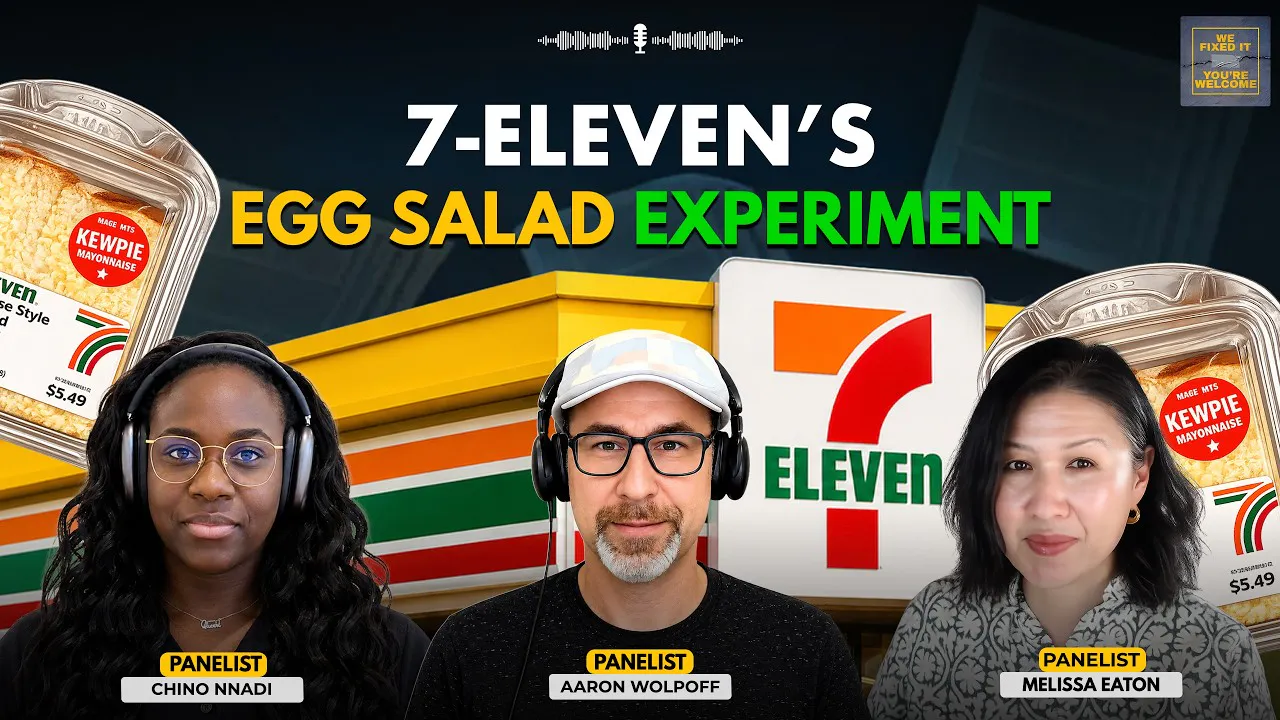
Thanks, Erin. Okay, so this week we're specifically talking about one of the most unexpectedly serious sandwiches in convenience store history, the 711 Japanese egg salad. Now trying to make a leap into North America. And yes, it sounds like a tiny little lunch Item, but for 711 in Japan, this is a really big brand test to move into North America. So some background there in Japan, 711 is not just a gas station stop like we experience in North America. It's a national habit. The chain has more than 21,000 stores there, and almost 80% of Japanese consumers say they frequent it often. The Conbini market itself is massive, so about 13.5 trillion yen, which equates to about 86.7 billion in 2025. Which tells you that this is not just like a novelty culture, it's an everyday food ecosystem. So now here comes North America's version. And the reaction has been a mix when it comes to this egg sandwich of curiosity, hype and a bit of side eye, to be frank. The US version launched in late 2025 and Canada followed in 2026. And critics immediately notice that there is a bit of an awkward part about this introduction in North America. So in Japan, it cost about 230 yen, which equates to about $1.50. But here in North America, it's $5.50. So that is a lot of money for a humble egg sandwich. And so 711 really needs just more than a viral food moment to really up those costs and kind of fill the gap. And North American convenience stores are under a lot of strain. The US convenience store sales have been down for a second year straight in 2024, and 711 North America foot traffic has been down 6% year over year in the recent quarter. So the bigger question is not just will people buy this sandwich? It's can 711 use this sandwich to fix the brand, improve trust and prove it belongs in the same conversation as food like competitors like Casey's and Wawa's and Royal Farms. So because if the answer is yes, this little egg salad sandwich might be the start of something bigger. But if not, it might be a polite reminder that not every Japanese hit translates clearly across the Pacific. So let's dive in and let's see if this egg salad sandwich is going to help save 711 in North America.
- [04:57]
Aaron
So we're doing it all. We're devoting an episode to an egg salad sandwich. This is a, this is a pivotal, but it's a, it's a pivotal sandwich.
- [05:05]
Melissa
7 11, I think. I love, I love this topic. Chino and Aaron. I think it's great because I do think it's about the transformation of 711 and how it applies here. I mean, I remember going to 711 when I was a child getting a quarter and walking down, there was one a block and a half away and standing in front of the candy aisle and being like, oh, My gosh, what am I going to get right? That's dating me 25 cents for candy. But at the same time, I've seen how over my lifetime it's transformed into the Big Gulp. It's the place where you go to grab something at any time, any, you know, any time of day. Then it started, the gas station stuff too, you know, so there was gas there. It wasn't just a convenience store. So really it's become, you know, part of our culture too, in a different way. And so I think, Chino, the point is, you know, right now, with all of this really kind of modern Asian pop culture type of events, this has really become a very like, kind of transcendent event for 711 in terms of can they take what is such huge, wildly successful, you know, customer experience here? 80% of customers go to 7Eleven in Japan to buy this egg salad sandwich. So, Aaron, this is, yes, it's about egg salad versus, like what people go to 711 for here in the States or in North America. So I do think it's a big, you know, it's a big turning point. And as fixers, what are we going to do to offer suggestions for them to be able to make that pivot? And I don't know if the egg salad sandwich is going to be as big of a hit. You know, I think their biggest issue is really operationally, how are you going to make this happen and build the trust with people? Because to your point, Chino, I think it's more than side eye. I think people, you know, joke about the hot dogs on the rotisserie at 711 like that they've been there for four years, you know, or whatever, you know, you, you see viral tiktoks about those hot dogs. So, like, to think that you're gonna get a fresh, soft, amazing egg salad Sandwich Seems like 711 doesn't seem like the place I'd be going. And for that price, we can go to your favorite place, Chino. Subway. Right? You know what I mean? You know, and you can actually see them making it. So I think there's a lot of different things that they're gonna have to do in order to make, know, make this real. They're going to have to consistently execute on that freshness part, the texture, that whole part of the experience, the display and brand. Aaron, like, that's not what we've gone to 711 for, you know, so like, how do we remarket that? And then really it's going to be about building that customer trust, right? And not having it just be a viral moment.
- [08:13]
Aaron
Yeah, it's a full on customer retraining because you know they, yes, they have sandwiches but they're kind of in the back somewhere and they're the triangle ones and you know you question their maybe their freshness. I don't know, they're probably fine but. But to retrain consumers that we have these, this fresh new offering and it's the start of something big. You have to rewire consumers brains about what they even think about 7 11. And there's something that I'd call like the thrill of discovery. So you know, for American consumers or just Americans that have been to Japan and had that personal experience and enjoyed the freshness of the sandwich there. Maybe when it's available in their neighborhood store, even if it's a recreation, maybe it's just not. There's just the uniqueness of it is gone when it's that readily available and maybe it's something that can't be recaptured. There's. I remember when I went to years ago I went to London and there was pret a manger is a chain. I think McDonald's has some ownership of it or something and you know it's on someone young and on the go is relatively cheap. It tastes, it was good. I said oh this is great. I can't believe London has this thing that I don't know about. Years later I was on the East coast in D.C. or New York or something and there's pret a manger. And I tried it there and it was, it was our. It was okay, it was all right. It wasn't the same. So you know, carrying it through to the thrill of discovery if I, you know, I had that experience at a moment in my life being outside of my own culture and you know, enjoying something somewhere else. The minute it was on my own turf, it wasn't good or it didn't have the same impact.
- [09:51]
Chino
It's really interesting. So you know, this is a subject close to my heart as we as I think the resident snacker of the group. So I've been to Japan and when I was there, I kid you not, there was one day we were there for 16 days that we went to 7 11, seven times in a day. And I got an egg salad. Not every time, but at least twice in that day. I think what the viral moment for tourists but you know a regular for people in Japan is just the freshness. So they use you know a milk bread and the egg salad again is quite fresh and so you can See them constantly refilling it. So again, totally different experience, right? You walk into the 7 11, it's not just, you know, some dungy food that you're questioning in the back. You walk in and, you know, you're bursting with fresh, you know, fresh air that comes in. There are a number of different aisles with a variety of different foods that are there, which is interesting. So again, if we go back to looking at kind of the Japanese consumer, it's a part of their food ecosystem, right? People go to 711 to grab and go and get something similar to the predimance, which is again, all over Europe. You see them in airports, but again, not the same because there's not as much frequent, you know, foot traffic. And so the way the aisles even are designed, when you walk in, there's again that selection almost as if you're in a grocery store. And so to your point, Erin, it is a completely different experience going to the Japanese 711 to North America. And I did do a bit of, you know, on the ground research on this, and I did pick up a egg salad yesterday from 7:11 in Toronto. And what I will say is it missed the mark. You know, I've never in all of my times in Japan ever experienced a crust. They cut the crust off. There was a piece of crust that was on this egg salad. I got one from the back and I went there with the purpose. I was buying the egg salad sandwich, but I, you know, picked one in the back, looked a little dingy. I saw that there was two fresh ones on a bowl of ice in the front. So I grabbed that one so it felt fresher. But again, how do I know? And, you know, taking a bite into it, they weren't chopped as finely and so the sandwich itself was not at all at the caliber of what you're looking for, particularly knowing that you're also paying almost five times more to than what you would in Japan. So, Melissa, I'm very curious from like a customer experience perspective just with how Japan does it and how North America has. It has been, you know, treating this convenient 711 experience. How can we translate that into North America to make them successful?
- [13:09]
Erin
Support for today's episode comes from square. Starting your own business is the dream. Running one can keep you up at night, but when you have payments in one place, inventory in another, reporting in a whole different system, and then you still smile and serve customers, that's a lot. Well, get square. Square helps you run your business without running yourself into the ground. Back when I started my first Business. I used Square right away for payments. In fact, I still use it. And when I walk into a shop and I see they use square too, I can tell it's going to be easy. Square does way more than payments. It handles inventory, team schedules, reporting and more all in one place. It, it's smart, transparent and they know what you need to run your business. If you're starting a business or running one that deserves better tools. Square helps you sell, manage and grow without slowing down. Right now you can get up to $200 off square hardware@square.com go wefixedit. That's sq U-A-R-E.com go. We fixed it. Run your business smarter with Square. Get started today.
- [14:09]
Melissa
Well, I think you've got you all. We've all brought up the very important points, right? It's the freshness, the actual quality of the product, which is a problem. The second component is the culture and that customer experience. So Erin, like when you're in a place and you're experiencing it in a manner that is embedded in that culture and like you know, when you were in, in Japan, this is part of what their culture is. So I'm a huge fan of K dramas and all those kinds of things. And whenever you're watching a K drama, they're literally going to these convenience stores and they're getting snacks all times a day, all times of night, all ages, right? And you see that it's a complete experience where they actually have tables outside. They actually, they can go get a sweet, they can go get a sandwich, they can go get a hot pot, whatever they want. So it's something that we haven't really utilized convenience store, you know, like the 711 experience as something like that. We've really kind of leaned into the convenience component of 7 11, right? Where it's like, oh my gosh, I'm out of milk, I gotta run to 7:11. Or you know what? I'm dying for a big Gulp. I need my diet Coke fix whatever it is, right? I need to get gas. Oh, I think I'll go get some candy, right? That it's, it's not like, oh, I'm going to go to 711 because it's on my way every single day and see what, you know, whatever I feel like to eat, right? You know, I'm going to eat that four year old hot dog. So I do think that 711 needs to figure out are they willing in the North America willing to restructure it and reframe it so that it is Something that's more successful as it is in Japan. But they may have to think about where their entry point is going to be. Because I think it's really interesting that they chose egg salad sandwiches as their entry point because that seems to me the most difficult thing to do. To your point, there's the bread, you know, that has to be fresh. You know, the egg salad has to be fresh, you know, how they're presenting it. To your point, you know, it's a turn off when there's a one crust left. That. That seems like quality control there. It hasn't worked exactly. Right. So what about my opportunity, I would say is I think that they should have gone with something like a ramen bar. Right. And. And the reason I say something like that is because the freshness is the consumer actually making the ramen right there. Right. You know, Chino, I'm sure you saw that in Japan where you can go and they sit there and the boiling water and it boils it and you throw an egg in or whatever, packets of different kinds of things. And there's a lot easier control over the fresh ingredients. If it's an egg, green onions, mushrooms, something like that, like, that's a little easier to have quality control over, you know, in. In your store versus having like to continually present egg salad sandwiches out, not knowing, like, are we gonna even sell any today.
- [17:35]
Aaron
Right.
- [17:35]
Erin
Yeah.
- [17:36]
Aaron
And with an egg salad sandwich, there's not much good.
- [17:37]
Chino
Or it's not, you know.
- [17:39]
Melissa
Right.
- [17:42]
Aaron
And thank you, Gina, for taking the head and going undercover for us. Yeah, but, but, but what I was saying is part of it is the, you know, if you're in Tokyo or you're at a pop up at south by Southwest, or you waited in line for three hours to at in and out, Part of it's the experience. So let's say it's exactly the same ingredients, exactly the same food quality, which in Chino's case, didn't deliver. But let's say it is. And you're standing in the. In the middle of a dimly lit 7:11. You didn't have them. You didn't have an experience. You had a product. But, but I remember when the Simpsons movie came out, they did they themed. They did like a limited time theming of some of the 711 locations. And they sold Duff beer and they sold the same donuts they have. They were just bigger with sprinkles. And if you bought a donut, it was like incredible, you know, because you're in the middle of. It looked like, you know, The Kwik e Mart in 7 11, that was cool. You know, it tasted probably the same but people left, you know, high fiving like we just had an experience with 7 11. So I think, you know, product is going to be one challenge. The product they chose is kind of a head scratcher. It's the, they do have Japanese ownership. So it's inherent to, you know, it's part of the brand story, it's part of the culture. But egg salad sandwiches are kind of a novelty anyway. Like is it quite, is it a food staple? Like if you go to a Togo's or a Subway, it's like the 45th item down. Right, Right. Not a big draw. So that, Melissa, I'd like your thinking about what else could there be? Because I think they're on the right track with let's offer something fresh, let's prove we can do it. Let's use that as our jumping off point. But did they choose the right hero to make this all happen?
- [19:30]
Chino
I don't, I don't think so. And you know what's also interesting too? So again, when you go to 7 11, there's a number of things you can get, you can get a hand roll you. The egg salads, there's a, the donuts, the matcha donuts that they had. One thing that also did go viral that I think that was a miss. I think that they chose the wrong product on this one. But it was their ready to go iced coffees. So what you would do in Japan is again during the busy, like, you know, it's an in and out, it's convenience. We're not there for a long time, we have to go to work or wherever. And again, it has become a part of the ecosystem within Japan. And so emulating something that is a little easier and tangible for the North American market. Coffee. Right. We love an iced coffee. You know, I don't want to spend $1,000 at Starbucks for it or having to drive a thousand ways to go find a Starbucks, make an iced coffee now. But they have these cups that they would have and dispensers of this ready made coffee and you can add and do different things. But to your point, Melissa, about kind of the quality control, you know, understanding that it's fresh. Like if your trouble is that people don't trust that it's fresh, one way to make them feel like it's fresh and to know that it's fresh is having them make it with you. Right. And so it's as simple as there's literally just A block of ice in a cup, and you pour your coffee in. And similar to McDonald's tactic, if you remember. And again, Canadian here. So Tim Hortons was a huge rage. You know, you'd go get your Timmy's. You get your double, double every morning. It became a part of the Canadian ethos. And then McDonald's came around with their $1 McCafe drink. Right? And they lowered you in because, like, a dollar. I don't mind spending a dollar on coffee. Let me see. There's McDonald's every which way. Let me go and see. And it changed people's behavior on how they had their morning routine. So instead of driving and piling at the Tim Hortons drive through, you now had access to also go to McDonald's, and you're paying a lot less for it. Of course, McDonald's only does that now during a short time because they've caught you. They sleep. You know, they got your hooks in you. People got addicted to the McDonald's coffee, and they realized, you know what? This is a little bit better. But again, when you look at the North American market coffee, and I think that is the myth that Seven Eleven has done with this egg salad. Again, I love an egg salad sandwich. I think it's very hard to duplicate in a North American market. And I think the way to pivot is looking at their iced coffee so that you can actually change and drive that behavior when it comes to people's morning routines. And I think, to your point, Erin, creating an experience around that, you know, maybe having only select locations in the beginning, but also showcasing. Yes. Putting it near their egg salads and saying, hey, here's different experiences there so that people can experience 711 in North America in a different way.
- [22:40]
Melissa
Yeah, I love that, Gino. I think that's a great. Another great entry point. Cause again, we're talking about things that can be duplicated consistently over time, and it's a lot easier. And I don't know, Aaron, if you've seen the Tiktoks, I mean, obviously Chino and I have of the people going in and getting the coffee, because it's just a cup of ice, and they get to choose all the things. And then you put it in, like, it's like a little blender. You can blend it or you can add the coffee, whatever you want to do. And it's. It's just a very interesting. Because it's a very different way, and it feels unique and, like you're kind of hip and cool that you, like, go in and you grab that cup and you know exactly that. It's just ice, but you're going to be putting all this other stuff in it, and you're making it for yourself. So from a customer perspective, I definitely think that's a great way to go as well, because you're not having to deal with the freshness issue so much. I also love this idea, Chino, of like, you know, with customers today, like, the idea of, like, competition and kind of, you know, Aaron, there's that whole thing of like, oh, my God, there's only five of these. I gotta get them. Labubu, whatever it is, right? You know, I gotta get it. I gotta get into it. I love that idea of 711 being very intentional about having, like, a Japanese 711 pop up in certain locations and having. And even if it's in every 7 11, that, like, one aisle is, like, Japanese signage, like, all the things so that you feel like you're immersed in that experience and you're going in and you see, okay, there's the freezer with the cups already ready to go, and then right next to it is all the drink options, right, for you to use in the cup. Then there's, you know, a hot pot station for, you know, and maybe they don't have the 400 different kinds of ramen that they have, you know, but they have, you know, ten kinds of ramen. And then they have, you know, eggs and green onions and hot peppers, whatever else you want to put in your ramen, you know, and have that ready to go and just have it be. Feel like more, you know, Japanese candy, maybe a fresh, you know, sandwich spot there they have the. The strawberry cream sandwiches, and they have the egg salad sandwiches and all the different kind of sandwiches that they have, and see how that goes. Because, honestly, if it doesn't fly for 711 here, then maybe they should try to figure out what they could do to make it hip. Just the way, you know, like, bring back something, you know, icy, you know, icy, and. And, you know, whatever. I don't know. I mean, I know they still have all of those things, but Slurpees.
- [25:33]
Aaron
Yeah, but you're. But you're saying be selective and do. Do more at fewer stores. So you feel like I'm in a special 7:11 as opposed to trying to do something at scale and not doing it to the degree that it could be carried out.
- [25:46]
Chino
Right.
- [25:47]
Melissa
Just to ensure that you're on the right path. Because even though we know that, like, K Pop and Asian, you know, these types of things are Are very hip right now. It and viral. It doesn't necessarily translate because again, our convenience store experience hasn't been built around the same as in Japan.
- [26:10]
Aaron
Right.
- [26:11]
Melissa
So like, you know, 711 isn't the only player in Japan either. Right. But they're all going, you know, every single person is going to a convenience store every day and they don't look at, I don't think they look at it as like what we consider 711 to be.
- [26:26]
Chino
Right.
- [26:26]
Melissa
Like I go get batteries and then because I'm standing in line, I'll get a lotto ticket. You know, like I don't really look at 7:11 as like the place I'm gonna go get a sandwich for lunch.
- [26:38]
Aaron
Forgetting about the egg salad sandwich specifically is Melissa, is our seven elevens set up? Let's say they do find something fresh at scale R.7 11 is set up with store footprints and with the cost of labor costs and fresh food costs. Are they set up to have some kind of station in the middle of a store? Would that work operationally?
- [27:02]
Schwab/ThinkOrSwim Announcer
Whatever your thing, it could be anything. Canva helps you make that thing a thing. Canva is a simple online tool thing. It's a way to design with our magic AI tools, things you can social media your thing, generate images or videos of your thing, make decks or presentations to show your thing, whatever needs to be done for your thing. Canva can make it an even better and bigger thing. Canva, the thing that makes anything a thing.
- [27:32]
Melissa
But I, you know, I think it would be hard. I think that they're, they need to tighten up their, you know, what they're actually selling in that convenience store. You know, like if you, you know, I'm sure you guys have gone into 711 and you're like, oh my God, that pork and beans has been on the shelf for how long? Right. You know, and I'm always so surprised when I go in and like even certain types of candies, right. You know, you're, you're like, do people even eat, buy those anymore? You know that I think it is something that we've had people talk about and brand positioning and where you put things on the shelf. I think they're going, they would have to do kind of a whole do over makeover. But I think it would be really a great opportunity for them to design seven elevens that have a pop up experience. So you could start the Japanese pop up, you know, but you could also do another pop up a partnership with, you know, Sbarro's pizza or something like that where you're like, hey, we got rid of the hot dogs, but now we have fresh pizza, you know, that kind of thing. And come, come grab a slice and a, and a Slurpee or come grab a slice and a Big Gulp, you know, and we're going to make it, you know, here's a value meal for you, you know, while you're walking out the door. So I do think that there is definitely a lot of work that would have to be done. But if they're leaning into the egg salad, they already are having to make a big. They're having to reposition because that fresh food cabinet has to be in the front too. And that's a whole nother. You know, I don't know where their kitchens are that they're making those and they're bringing them to them. I don't know.
- [29:18]
Aaron
Yeah, I don't know where the test markets were. And if they did consumer data and they ran egg salad versus other potential, you know, sandwiches or fresh offerings and egg salad won and they won with that, or if there was just some mandate from above that said, nope, we're doing this, I don't know, or they're
- [29:34]
Chino
going off of a viral moment of the egg salad. But I do think it's an interesting test case because when we talk about the, I guess ecosystem is the word I'm using today, but the consumer behavior of going to a convenience store, I think of one place that does this a lot. New York bodegas, right? People go and get, you know, a cheese and ham. Like, you know, I'm not from New York, so I'm going to claim to know what the sayings are. But it is one market, that convenience quote, you know, I'm doing air quotes of people that are listening. It's embedded into people's every day. And I think that would be a great place to test again. We talk New York, we pop ups environmental moments and limited time offers. If you did a couple seven elevens that are there and you do the experience and the value and just create spaces and you know, again, the iced coffee I think is the best barrier to entry here. It allows you not to worry about so much of the logistics. Again, across all states, it's very tricky to do. Let's do the iced coffee. Maybe you have, you know, a few egg salad sandwiches, but it's limited. So, you know, you get people lining up at the door saying, okay, I need this now. And oh, you didn't get it. You gotta come back next, next day. But in the meantime, then just like McDonald's hooked the Canadian market. Have this iced coffee, instead of going to your bodega here, maybe you're going into 711 to get this really quick iced coffee and go. And again, getting it as part of the consumer behavior in a market that has a bigger aptitude for. For stopping inconveniencers, have. Has more of that footprint already from that perspective. And I think if you can capitalize and use that as your test to then figure out what products work, what is sold, what's just hype for a second. What, where are the margins? Also with, again, you know, how does that actually work? And I think that a better course of action versus, again, that abysmal egg salad sandwich that I had that I was actually looking forward to.
- [31:51]
Melissa
Well, and I, like you bring up a really good point, Erin, is that if their executive team is embedded in the Japanese Seven Elevens that have really been the category leader, and they probably thought, oh, that translates over here because we know that, like, you know, all these, you know, types of things, pop culture is very strong across the globe. Well, I do think that's, again, not knowing who your customers really are and understanding what your brand looks like and feels like. But I love this idea of introducing this as, you know, if this is how 711 would like to transform and become more of a place to convene, you know, more of a bodega where it's like the neighborhood store, like, they should lean into that and so they should bring in more fresh food. They should bring in some of those things. And then to your point, Erin, about like, space in a 7 11, maybe they don't have the space now for, you know, all the things like the pork and beans and the things that you're not going to, you know, and batteries and whatever else that they, you know, they Scotch tape, whatever they have. You know, maybe they're going to have to figure out a different way to meet those needs of a convenience store. Whether it's. They stock it in the back and they don't put it out in display and they have like a little terminal and you can say, hey, I need, you know, some masking tape and a hammer, you know, and they will say, oh, we have that in the back. Let me go get it for you, blah, blah, blah. That would be great. But it doesn't take up a whole shelf space for like the one person every four years that comes in for that stuff. Or, or even they create their. I mean, I know they don't want to do this, but partner with like, Somebody like Amazon or somebody, and then just say, well, you can come order it here at 7:11 and we'll have it delivered to your house by the time you get.
- [34:04]
Aaron
That's interesting. Well, I love the idea of the cultural immersion and, you know, being introduced to things that are a hit somewhere else in the world that I didn't even know about and then having it, you know, being a part of a themed environment and all, you know, I love that part of what we're saying and capitalizing on one social trend and going all in on it. That's a dangerous thing to do. Yes. It's almost like if they rename themselves six seven, you know, like, and we're, we're going all in on that and you know, what are we gonna do? What are we gonna do a year from now? How's that going to reflect? We, you know, this for, for Japanese culture, that's a, that's a part of everyday life. That's a staple. It's a part, it's, it's habitual for Americans. It's not a curio, a novelty. You know, you tried it once, would you try it again? Based on that experience, I'm gonna give
- [34:55]
Chino
it another go because I believe. I love them. When I was there, like, it was something that we would get every day. But again, I'm curious just to see. I gotta keep the test going. I got my scientist hat on and I gotta test it out. But I do want to say one thing, that going back to your point, Melissa, about, you know, embedding that, you know, the 711 into people's everyday, that's the nugget. That is what 711 needs to do to translate into the North American market. It doesn't matter about what the viral product is. You can put Amazon in it, sure. But if you don't have again, that consumer behavior happening, it's not going to work. This is, you're not going to translate the same success here. And the success in Japan is because it is part of every, the consumer's behavior day to day. So that is what they need to take, tap into and let go of what the trend looks like in that product. And I think by, you know, starting in New York, where there's already an appetite for, for that already and a market there and testing out again, relooking at space with certain areas, of course, and then going from there. But if you can't change the consumer behavior, doesn't really matter about me going in every once in a while to see if this egg Salad sandwich is better than the last one.
- [36:25]
Aaron
Yeah, I agree, Chino. And also, one, one thing just. Melissa, one thing we haven't talked about yet is, you know, part of everyday consumer behavior forever and ever has been filling up your car with gas. And a lot of these seven elevens or gas station adjacent, and that's part of the draw is, well, while I'm here with electric vehicles and hybrid vehicles, you don't make. That's not. It's less habitual. So some consumers have cut out that entirely. I haven't been to a gas station for my car for three years. That means that I, you know, the odds of me stumbling into a 711 because I'm drawn by something in the window, I'm just not going to be near it, right?
- [37:05]
Indeed Announcer
When you need to build up your team to handle the growing chaos at work, use Indeed sponsored jobs. It gives your job post the boost it needs to be seen and helps reach people with the right skills, certifications, and more. Spend less time searching and more time actually interviewing candidates who. Check all your boxes. Listeners of this show will get a $75 sponsored job credit@ Indeed.com podcast. That's Indeed.com podcast. Terms and conditions apply. Need a hiring hero. This is a job for Indeed Sponsored jobs.
- [37:34]
Melissa
You know, and I do think that, like, I love the idea of embedding it in that local neighborhood culture. I think that's really important. I think that's why you see the bodegas working so well in any town. I know that, for example, here in Denver, my son goes to the same corner one every day and gets, you know, coffee, whatever he gets. I don't even want to know. Cigarettes, maybe, you know, whatever he's getting. But he has a relationship now with the owner. You know what I mean? Like, they know each other. They talk about things. The owner will be like, hey, I want you to try this. You know? So, like, I feel like that is what's kind of missing in, like, the 711 culture now. Because, like, to your point, Aaron, it's very transient when you have people coming in just to get gas, right? Or get a lotto ticket. It's not really like, I'm gonna go there and get my coffee and my donut. Chino, like you were saying, like, I, you know, you have this Tim Hortons thing. You know, you have this whole thing where you do it, you know, you habituate that. So somehow they need to hook that into it. And I do think I love the idea of expanding it to become more of a cultural phenomenon. Because 711 does have that brand recognition. But I do think it was probably a miss for them to start with the egg salad. I mean, honestly, I think they should have picked something. I love the idea around the ice drinks. Like that's like kids love that and that. And that's all ages, right? Like, because they have the drinks, the ice drinks ready to go for all different types of drinks. And then like even like you know, having the starting into the fresh food. By starting it while you're, you're making your own ramen, you're doing it yourself. You can see the ingredients going, ramen ingredients going in. But again, I do love the idea of kind of integrating it and I love the idea of having it be like a pop up. And I do, you know, because now you see these pop ups coming up. Like we have them in Denver. We have the.
- [39:50]
Aaron
You.
- [39:50]
Melissa
There's tons in LA right, Of, you know, Japanese convenience stores. Right. Where you can go get the sandwiches like they show you. And they show you them making it, how they make it. So there's that whole thing that like it's going to be hard for 711 to do that unless they really kind of double down on it.
- [40:12]
Aaron
Yeah, they've made some attempts to modernize and make sure that you're, you know, like, again, for someone like me that unless I'm adjacent to it, I'm probably not thinking 7 11. But they have an. I have an. I have their app. They have an app now. They have a rewards program. They have, you know, buy however many copies and get one type of thing. So they are trying to think about ways of courting consumers that have not made 7:11 habitual. And Melissa, like you said, there's sometimes you just, you're there out of necessity. Like I'm here because I functionally need something or I'm here because I'm thirsty and you happen to be here. So. But it's not consumers that chose to be there or wanted to be there or established a preference of 711 over anything else. So that's, that's the hurdle. That's the hill they need to climb right now. Well, should we fix it?
- [40:59]
Erin
I think, I think we're all over this one.
- [41:02]
Aaron
I think we, you know, we can do this. I'm going to throw some stuff into the mix. So. All right, so what they're going to do, we'll go with the pop up idea. We'll go with not just wanting one sandwich that has had mixed success as the flag that we're going to plant. And Say this is the reinvention of 7 11. So we're going to. But we're going to stick with the pop up idea so we can have a fully. But you got to go all in. You got to like fully theme out your store. Make it this immersive experience. You could have a Japanese pop up. You do a K pop, pop up. One thing I was thinking is that there's no, I can't think of a peanut butter and jelly sandwich kind of place where you pop in and you get 7, 8 varieties, 12 varieties of peanut butter and jelly, or you make your own type of thing. So. And kids would love it every, you know, it's convenience food. It's easy to manage. Maybe that's something that they could roll out with and say this is the American equivalent of the egg salad sandwich. So that's a thought. Um, and with the reward program and the audience tracking and the data collection, they could be doing things like, you know, if you're habitual and you build up that relationship and you do your same store and you know, everybody. Who's our biggest fan, you know, who's the biggest fan of this store? These are things that can be shared socially and used to show that there's stimulus and things happening. So who's our biggest fan with seven elevens, you know, across the globe? Who's the, who's the biggest traveler, the most loyal 711 fan wherever they go? Who is the champion of our worst selling product? So who's buying the Vanda Camp's pork and beans that no one else is buying? You know, let's make them a hero for a day type of thing. And, and then let's go with, you know, let's do something fresh, show that we are, are committed to that, that make it yourself type of thing or have it made for you or you know, be. Create an experience beyond just lining up and getting coffee and getting whatever you needed to do. I. Let's go. I like the coffee bar idea. We'll call it be. Be your own barista. And, and you know, you come in, you get your iced coffee any which way. Maybe there's Japanese raisin inspired flavors too. And you get, you get a cultural moment. You get introduced to something you didn't know about that's inherent to the Japanese culture and the ownership of, of the company and the brand. And, and then the, the pop ups, you can't do them at every store, so put care and intentionality into them. Make them really, really experiential where there's things you can only get at that one store that you get until they run out and give people something to really talk about. And while you're doing that, work on the egg salad sandwich and see if you can get it, make it a little better and maybe, you know, that'll catch on somewhere and then you figure out how that fits into the mix. But I think you have a lot of other avenues and priorities you could be addressing first. Before you go double down on the egg salad, Melissa, what do you say? Do we fix it?
- [44:07]
Melissa
I think we definitely have given them a lot of food for thought. I love the idea. Sorry. I love the idea of them upgrading the food food experience, not just one product, so not just the egg salad sandwich. I think they do need to tighten execution because this is really important operationally. This is a lot to transform. And so I'd love to see more better, intentional, controlled pop ups so that they can test out different versions of these food experiences. To your point, Erin, I think there's a lot of different things that they could do and partner with other people too, to bring in, you know, just a different feel. They have to lean into those made fresh cues too, because, like, for Chino, who actually went to, you know, get an egg salad sandwich, not really knowing which one was freshest is not great. Like, you should have something that's very clear so that you can feel very confident in that. And then I think the big thing that we didn't really talk about exactly, but is really repricing their every positioning, the value story, because for $5.50, I'm gonna go to, you know, I'm gonna go to Jimmy John's or I'm gonna go somewhere else where I can watch them do it, you know, make a sandwich. But I will. I would love if that was part of what they transformed into, is that I felt like, oh, my God, a $5 sandwich for 711 is amazing, right? And it's great. So I think that they could use this as a gateway to really a kind of larger reset for 7:11. So I think that this is definitely a starting point.
- [45:51]
Aaron
Thanks, Melissa. Good stuff. Chino, your topic. Did we fix it?
- [45:56]
Chino
We fixed it. 7 11, if you're listening, I do love your egg salad sandwich, but we need to see better. If you're gonna bring out a, you know, stand behind 10 toes on a product, make sure that you're coming, you know, full swinging there, because there are people who are excited to try it. But I think what would be easiest for them to do right now as we are introducing a new product as we're retraining the consumer. Scrap the sandwich, move to the iced coffee. It's an easier barrier to entry and with, you know, experience and inventing yourself into the culture and partnerships and looking at how your store is set up for again, those, you know, fresh cues with food, I think you will have a much better output versus where you're falling flat here. There are people rooting for you. There's a lot of people going to Japan and looking to try this viral moment and I think you can capitalize it using pop ups. But right now I think you need to get back to basics. Use the coffee as the barrier to entry and we can take it from there.
- [47:12]
Aaron
I'm with you. I buy everything you said. Well, that's going to wrap up our 711 episode. Big thanks to Chino for teeing up this conversation and to Chino and Melissa
- [47:23]
Erin
for your amazing insights to our listeners, our fixaholics.
- [47:27]
Aaron
If it's not an inconvenience to you, please give our show a review wherever you get your podcasts. Just like 7 11, all our past episodes are available 24 hours a day, seven days a week.
- [47:37]
Erin
So go grab some chips, grab a
- [47:39]
Aaron
giant soda, maybe an egg salad sandwich.
- [47:41]
Erin
Catch up on what you missed and we will see you next time. We hope you enjoyed this episode of We Fixed It. You're welcome. We go into every episode somewhat cold and and nothing we say should be construed as legal advice, financial advice, or anything that would get us in trouble. All trademarks, IP and brand elements remain property of their respective owners.
- [48:12]
Blinds.com Announcer
Did you know if your windows are bare? Indoor temperatures can go up 20 degree. Get ahead of summer with custom window treatments like solar roller shades from blinds.com and save up to 45% off during the Memorial Day Early Access sale. Whether you want to DIY it or have a pro handle everything, we've got you free samples, real design experts and zero pressure. Just help when you need it. Shop up to 45% off site wide right now during the Early Access Memorial day sale@blinds.com Rules and restrictions apply.