Loading summary
Transcript73 lines
- [00:01]
Seth Schachner
This episode is brought to you by. Prime Obsession is in session. And this summer, prime originals have everything you want. Steamy romances, irresistible love stories, and the book to screen favorites you've already read twice off campus. Elle every year after the Love Hypothesis, Sterling Point and more slow burns, second chances chemistry you can feel through the screen. Your next obsession is waiting. Watch only on prime.
- [00:34]
Aaron
This summer. Serve up the cookout classics, Heinz ketchup and Kraft Singles.
- [00:39]
Melissa
Every good burger needs a layer of
- [00:41]
Aaron
perfectly melty cheese and thick, rich ketchup.
- [00:44]
Seth Schachner
We all know it's not a cookout
- [00:46]
Aaron
without Heinz and Kraft. At its peak, Napster reached tens of millions of users globally, fundamentally changing how people access music.
- [00:54]
Seth Schachner
The COO of Napster called me and said, please call off your lawyers and help save our souls.
- [01:00]
Aaron
And now Napster's attempting another reinvention, this time as an AI powered platform centered on creation, interaction and participation.
- [01:07]
Chino
I think their brand is kind of against the music industry. I think that's been fairly consistent.
- [01:11]
Melissa
They need to figure out why are they essential?
- [01:14]
Seth Schachner
These are the types of things that beset our digital services at the time. And I'm not going to blame the lawyers, but the lawyers were informing a lot of what people like me were doing right now.
- [01:23]
Chino
I think you need to focus and have that focus on look at how these AI tools can help that creator content.
- [01:29]
Melissa
You think about all these people that came up through TikTok, through social media, Justin Bieber, everybody. Like it's pretty impressive.
- [01:36]
Seth Schachner
Americans who buy albums don't have turntables in the house. So they buy like a T shirt or my daughter, a bunch of stuff on the wall, Killing record, whatever it is. And it's about connecting with the artist in some world for the younger generation.
- [01:49]
Aaron
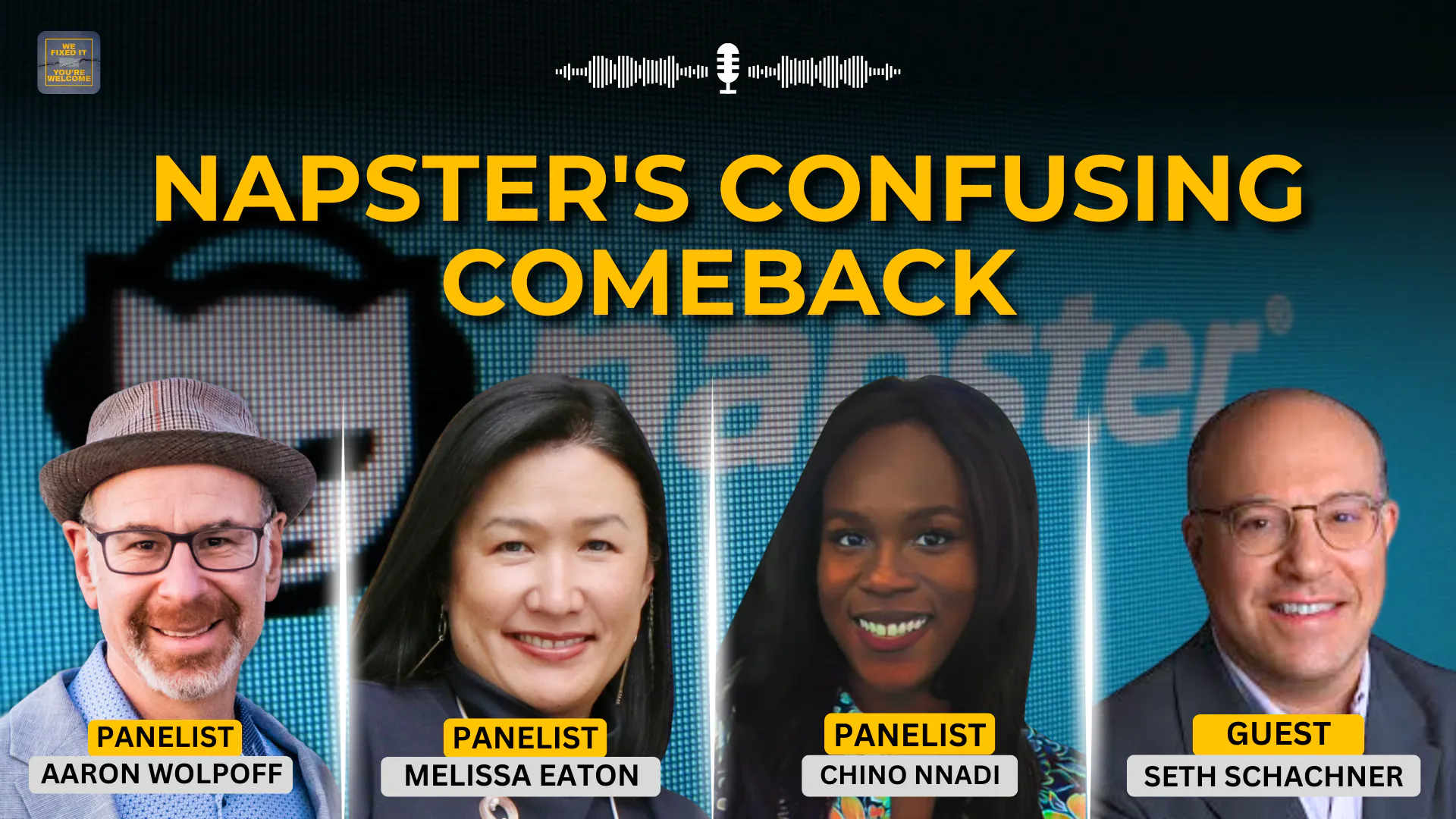
We're living in the future already and Master didn't create that. Welcome to we fixed it. You're welcome. The show where we take over companies, you come along for the ride and we try to put them back better than we found them. Napster once operated in a legal and ethical gray area. People wanted to download music from their favorite artists. Napster let you for free. You could just go get it. Which made music fans very happy. While Napster became enemy number one of the music industry, which lost millions in profits. So of course Napster couldn't stay around forever. The loophole closed. Goodbye. Except Napster is now attempting a comeback and trying to reshape the music industry again, this time as an AI company. It seems like they are trying to take on a lot. None of their ambitions are very clear yet. And AI Music already has vocal critics, especially within the music industry, which Napster was an enemy of before. Which raises the question we're here to fix. Does Napster even belong anymore? And if so, is AI Music going to win them a new generation of fans? Are we all going to say, hooray, Napster? Well, to figure this out, we're joined by Seth Schachner. Seth is the founder of Strat America's, a premier business development consultancy specializing in strategic communications, public relations and partnership development across digital media, entertainment and technology. Seth's background includes senior leadership roles at Sony Music, and I think he's had some run ins with Napster from the label side that I can't wait to get into. He also hosts the new podcast Breaking down the Biz, where he talks shop in an accessible way about the business behind the biz. Thanks for joining us, Seth. Give us a little bit more info.
- [03:30]
Seth Schachner
Great to be here with all you, Aaron, everyone. Yeah, I'm a business development executive by trade. I've worked at a lot of entertainment companies, including places like aol in its earliest days, I was actually their first music exec and Universal Music most a bunch of other places, but a lot of time it's so music in both North America and Latin America, helping them build their initial digital businesses. And Strata Americas is a partnerships consultancy. So I help technology companies, software companies, music and entertainment companies on both sides of the landscape, rights holders and distributors with partnership activity. And I do some communications and public relations work. So I've worked with clients like, like Microsoft a lot of time with something we'll talk today about called Smule, which is social music. And I've got, I think, an unusual amount of experience in Latin America for the typical dude sitting in North America and been based out in LA for six years. So that's me in a nutshell.
- [04:27]
Aaron
Thanks for hopping on with us, Seth. And while you're here, let's all hop into a time machine. Let's talk about the original Napster. When Sean Fanning and Sean Parker launched it in 1999, it scaled at a pace the music industry had never seen it not be denied as at its peak, Napster reached tens of millions of users globally, fundamentally changing how people access music. Instead of just buying CDs, users could instantly download songs from each other for free in seconds. That meant that dorm rooms everywhere were blasting Backstreet Boys, dmx, Christina Aguilera, whatever was popping at the time, and they were getting it for free. As Napster grew and took a real bite out of album sales. The backlash hit fast. The Recording Industry association of America and artists like Metallica Suede, leading to Napster being shut down in 2001 and filing for bankruptcy in 2002. The broader impact was massive, with copycat download services and peer sharing services following. The US recorded music industry revenue fell by roughly half over the next 15 years, which is a decline widely tied to the rise of digital piracy that Napster helped pioneer. They opened the floodgates. But Napster, if they were playing in ethical gray areas, they were also directionally right. They tapped into something right. It proved consumers wanted instant on demand access to music in a buffet type model. All you can consume. The behavior became the foundation for platforms like Apple's itunes and Spotify. And you could arguably say it paved the way for streaming services like, like even Netflix. So Napster didn't win, they got shut out. But it showed what winning could look like. Now Napster's attempting another reinvention, this time as an AI powered. They have AI companions, there's an AI creation engine, there's, there's a creator participation layer, there's fan engagement and immersive experiences. There's an AI platform and an ecosystem with access to AI agents across domains and digital twins and all kinds of stuff. So the challenge is that every one of these categories is already pretty crowded and competitive. The AI assistants, AI music tools, creator platforms, immersive experiences, they're all getting saturated. They exist. We're living in the future already. Napster didn't create that. And AI music's already taking heat for being digital slop and ripping off artists. And unlike 1999, Napster isn't early this time, it's late. Under a name that still carries both brand recognition and a ton of baggage. Well Seth, what do you think?
- [06:56]
Seth Schachner
Well, you said a lot there, so that's a good 25 years. And David will use a kylstery. I don't know, maybe you'd want me to start on the time worry, but maybe I'll go back to, you know, to the turn of the century which is, you know, I think where I had, you know, a bunch of interactions with, with the original Napsters, with, with Hank Berry who ran it for the two Sean's and you know, it was during a time when to your point, the recorded music industry started to enter a period of free fall, you know, of mostly of revenue declines, but certainly profit declines as well. And there were two engines that were driving it actually. I mean the one that you mentioned mentioned is obviously a hugely critical one. As well. That was very much in the public eye. And which people like me. I was head of a label group called Jive Records at the time. So you mentioned one of the artists, the Backstreet Boys. We had artists like NSYNC and Britney Spears and Mystical and R. Kelly and A Tribe Called Klaston and a lot of artists, and me, along with all of our industry compatriots, if you will, and competitors, were trying to seed the first generation of this country's download services, digital services, basically. And we were, you know, we were doing it in as this rising tide of digital piracy was upon us. So to your point, people didn't have to pay for albums. They could select a track and share it. And a lot of these things were dispersed. They were either centralized or decentralized, peer to peer, if you will. And some of them were headquartered in bizarre places. So you, you know, the United States legal system really wasn't much you could do about it. And so that was extremely hard period of time because you try competing with that. But the other piece of it, which people don't talk about a lot but I think was probably equally important was that we didn't protect those CDs that you mentioned. So those CDs didn't have any ability to protect what we call ripping and sharing with your friends, your uncle, your dawn, their night, whatever the heck it was.
- [08:52]
Aaron
Right.
- [08:53]
Seth Schachner
Probably equal maybe actually to the digital stuff. And so that contributed to it as well. And legal landscape there also wasn't so clear. You know, I don't know if there were fair youth laws that said Gino can. Can hand it to Vanessa and me once again and you can all use
- [09:07]
Aaron
it for the itunes. Store flipped the legitimacy pretty quick and flipped consumer behavior pretty quick because not only did you have the, the, the, the store model, you had the hardware to go with it. So as people had the, the ipods and then eventually the iPhone, you know, you're creating this closed loop, appealing and accessible to consumers that maybe had paid $14 for a CD with one good song on it. Now you could buy that song for $1.99 or 99 cents and everybody wins.
- [09:34]
Seth Schachner
The device was an enormous factor. It was the device first because Jobs had this device that was better than all the other devices. I don't know if you know what the Diamond Rio was or I still. I have a shoebox here in my house with. I should have brought it with all these devices. It's sitting right over there with. I have a little I O Manga disk drive that you'd wear in your belt. I mean, just the stupidest stuff. But the device came through and was easy to use and was simple. And he needed music for the device and had to devise, you know, a licensing plan for it. And that's where all this came from. There was a lot of other factors that people also don't talk about. If you think about it, do you really want to be pulling files from a file service? You don't know if they're clean with their viruses in them, what information you want to give, where it came from. You know, the American ethos is if I pay a fair price for something, I buy a carton of milk, it's going to be homogenized or pasteurized. And I know it's fresh and it's coming, you know, it's not that far from that ideology. And we didn't have that with the pirate stuff, obviously.
- [10:33]
Aaron
Yeah.
- [10:34]
Seth Schachner
So there was a bunch of stuff that came along with it. The first iterations of our downloads prior to the itunes store, this is three years prior, I'm sure everyone would laugh at. But you know, I had to sit with people, said, look, we, we were going to put a Beyonce single out and for the first 30 days it's going to be 399 to buy the single in Windows Media or in the Amazon store. And by the way, they wouldn't work with each other. If you bought it in Windows Media, it was just worse. But we had to go from Liquid Audio, Amplified Reciprocal A to B from AT&T Super Tracks from Portland. They had dozens of digital download services vying to be what Jobs was doing. They're all gone now.
- [11:11]
Aaron
Oh yeah.
- [11:11]
Seth Schachner
There was one name that survived, which is Rhapsody. That's going to be tied to what we're talking about today.
- [11:16]
Aaron
Melissa, do you remember this time when it was Wild west and everyone was kind of trying to figure out the legalities and Napster was still viable? Do you remember this time?
- [11:27]
Melissa
I do. And Seth, we're really excited to have you as a guest. This is really informative and interesting to me specifically. I come from a live music family. We are all in. My daughter actually right now works at Live Nation, so went to Berkeley College of Music. So she, she's fabulous. We're, we're very much about going to live shows. We're also very much about our Apple library. And we have also CDs, we have records, we have all the things. And I remember the kids getting their ipods. I remember them having the Sony Discman. All the things And I do think that that's one of the things that's really important to think about from the audience perspective is that we all use Napster. I will admit to that.
- [12:17]
Seth Schachner
Yeah.
- [12:18]
Melissa
But it didn't feel great because you were pirating stuff. So I do think that when Apple itunes came out, you know, even the whole Spotify, the same idea is that you're paying to play and it makes you feel like there's more trust there that you're actually even 99 cents. You know, we've seen all the lawsuits from the artists against Apple too and saying, okay, I get $0.01 for every $0.99 or whatever. I understand that, you know, there's a business to the music side of it, which we could go into too. But I do think that there's an ability to create some form of trust as an audience, you know, as somebody who's participating in the entire ecosystem of streaming music in that you feel better about it than pirating music.
- [13:10]
Seth Schachner
I agree totally. I mean, I sometimes don't know if, you know, we're probably of a certain vintage, whatever, if we remember this. I mean, I think I've got two. They're no longer kids, adult age, young children, whatever. Young adults. And I don't know if they have radically different perceptions of it, but I think it's fair to say that maybe different generations have different perceptions of price and value and than maybe ours does. For sure, no one's going to buy it out. They will buy an album now, for example. But half Americans who buy albums don't have turntables in the house. So they buy like a T shirt or my daughter a bunch of stuff on the wall, you know, Carol Kiln, whatever it is. And it's about connecting with the artist in some way for the younger generation
- [13:55]
Melissa
and not even really understanding to your point that like it's not just one song, which. Aaron, you brought up a very good point that like a lot of people start buying music for just one song versus, you know, a curated album that has, you know, the artist has put it together or the band has put it together in a way that means something to them. And you know, like there are radio stations that play just B sides, you know, all that kind of stuff. And it's, it's an interesting component, I think, to the way we actually take in music and take in entertainment and streaming of everything. I mean, videos, gaming, all these things. It's like such short attention spans. I'm not surprised that we're all about the 99 Cent song, you know, But I think it's an interesting, you know, inflection point for Napster right now as they're trying to recreate some energy around their brand and bring it into this century and into the play the music ecosystem as of today. And so I'd love for us to also talk about that. And I, I can tell Chino, you have something to say. I think that's a really interesting play. And I think, Seth, you bring it up that generationally, you know, like our kids all grew up. Napster was the thing. It wasn't like the turntable wasn't the thing.
- [15:21]
Chino
So, yeah, so I'm, I'm, I'm the in between, Right. I, like, my parents were the ones that had the vinyls. I was a LimeWire Napster kid. Even Napster a little bit early. It was like lime wire.
- [15:35]
Seth Schachner
That's a story. It's one. Right? We're getting into real trouble.
- [15:38]
Chino
Yeah, it's really interesting. And I'm going to the Lily Allen concert tonight, right. Where it was incredibly hard to get a ticket. And we talk about kind of the curation and like the evolution of how we consume music. Right. So for me, it wasn't that, you know, I didn't have the background of like, oh, yeah, you're buying an art. Yes, you were buying albums here and there. But I was the MP3 download generation. Right. The challenge wasn't even I felt bad about for the artist because again, I'm a kid. I'm just wanting to hear great music. You know, you're exchanging your CDs and, you know, your downloads. For me, it was just what's not going to make my home computer crash, which everyone in my generation, like, I've broken at least three computers from all of the bugs that went on it. So there is something to be said about the security, Right. So for our generation, it was just, I don't want to ruin my devices. And so that's what Apple music and what Spotify has brought to us. And it's interesting now, Seth, going back to your point of view, how we're consuming music and now understanding that, yeah, only one cent of that song went to the artist. So people are now caring about artists a lot more because the way that we're interacting with these artists is now often via concerts. That's how you get that intimate experience. People aren't buying CDs as much anymore. You might have a vinyl on a page, but for me, I'm a big, you know, I'm getting some merch. I'm always getting merch at every concert because that's how I get to kind of continue living in this moment without having that physical cd. But going back to Napster and AI and what the challenges that a lot of people are feeling when it comes to music and AI is that everybody is a little bit trepidatious about how they want to experience this AI music. Can we trust it? We've heard a lot of songs coming out from different artists that are AI and so what's interesting about Napster is I think their brand is kind of against the music industry. I think that that's been fairly consistent. But they need to pick a lane. You can't be everything to everyone. With AI, you're second to the table. And I think there is a way in which to use AI for good. If this is like a playing, you know, people learning instruments and how to kind of tweak that, I don't see a world where I'm hearing, you know, a Lily Allen inspired album via AI I will never care to do that.
- [18:35]
Aaron
Support for today's episode comes from Square. Starting your own business is the dream. Running one can keep you up at night. When you have payments in one place, inventory in another, reporting in a whole different system, and then you still smile and serve customers. That's a lot. Well, get Square. Square helps you run your business without running yourself into the ground. Back when I started my first business, I used Square right away for payments. In fact, I still use it. And when I walk into a shop and I see they use Square too, I can tell it's going to be easy. I Square does way more than payments. It handles inventory, team schedules, reporting and more all in one place. It's smart, transparent, and they know what you need to run your business. If you're starting a business or running one that deserves better tools, Square helps you sell, manage and grow without slowing down. Right now you can get up to $200 off square hardware@square.com go wefixedit that's sq U-A-R e.com go. We fixed it. Run your business smarter with Square. Get started today.
- [19:36]
Seth Schachner
I love that you're a Millie Allen fan, by the way. I've done some work with her. You said a bunch of things there because there's a lot of you guys are all saying comments filled with interesting insights. We could definitely do an hour or two more. So one thing just about your points about, I don't know, security and feeling secure. I think if you really took a cold, hard look back at like music consumption over the decades, like so we used to print CDs without copy protection. And the label I worked at which bought Jive BMG, we actually one or two points put that's called copy protection on our CDs. And we got slaughtered in the press over it. And it was like this big public outcry and there was a big public settlement to offer to the public, like I guess was refunds or replacement cds of which like five or six Americans in the whole country took advantage that people just loved having the headlines out there about how bad the record labels were. And I think these security concerns, technology concerns vis a vis our personal data like have rippled throughout everything, including streaming, by the way. I mean look at all the data you give and the social networks in 230. And so like that's to me, like that's always going to exist to me personally, basically. I sort of see it that way. The AI stuff is a different conversation. I'll just say generally AI has been part of music for some time now. And not just the stuff that's the fake drink or the fake weekend or the derivative line usage. It exists in all sorts of quiet productive ways that everyone under the sun, from people creating tailored playlists for advertisers to our own experiences on radio to make playlists sound better, you know, to chat bots. Like I've had some clients this right America. So we did Ring of Stars, Chatbot or a couple of, you know, Easy Ease, right, you know, where you know, tell you automatically then the album's dropping if he's going to be in Houston. Stuff that you can automate in a harmless way that no one's going to be freaked out over. The last Beatles record, Revolver was re engineered by Giles Martin, Sir George Martin's son with a eyes all over it to place the guitars or the drums. So you know, McCartney just pulled a demo tape, an old tape out of Lennon's apartment and released a track two years ago called now and Then came from a. You know, so this is all good stuff. I don't know what anyone have a problem with this stuff. The stuff that everyone's talking about, the recreations of music. Very interesting. There's a bit of a war now in the landscape over Universal, the biggest label group has been very public about basically trying to wall it off with their new partners. The two new partners, the biggest ones being one's called Suno and one is called Udio to me. To your point about Napster, those are probably the likely, whatever the right word is, leaders or successors in this market because, you know, at least one of them is going to offer a combination of music that people can create, and it'll be licensed and it'll probably hue to some of the protocols that folks who own Lily Allen's catalog and the artists themselves will be able to look at and say, hey, this is cool, or this isn't right.
- [22:59]
Aaron
For those who don't know SUNO and Udio, they're like studios where you can go in and to an increasing degree have participation in the music in the AI music that's created. So it started soon. I'm more familiar with suno. It started where you could put in maybe some lyrics, and then the whole rest of the experience is AI created. But now it's getting to the point where you can add your own voice, you can add your own preferences, you can tailor the music styles more and more. And it's becoming more of a blend of an artist and AI software. But there's still. You can't just go upload a track, a Prince track and say, make it sound like this. There's a lot of buffers around it.
- [23:37]
Seth Schachner
Yeah. And I think that's. That's probably the key thing right now that's out there. But, you know, the. The major labels, I think yuio is kind of the favorite Whatever son right now, and that they've agreed to kind of wall it off. If you're. If you own Lily's catalog, for example, you know, I'm using her as an example, but, you know, or Katy Perry, you don't want to see 50 AI derivative, whatever Katy Perry's and Lily Allen's next to her stuff on Spotify because it collides and it hurts the artist. So that's. I think that's where the fight is right now. You know, I bet the monetization of it won't look that differently than streaming, which. So it's probably going to be poor if you're an artist. But, you know, the initial, like, I guess Deezer is one of the bigger streaming services globally. Most Americans don't know about it. It's big in places like France and Latin America. Has reported this enormous number of AI tracks. I don't know if you call it slop that are sitting, you know, on their servers, basically. And have. There's been research that shows that most consumers can't tell the difference sometimes between, you know, the fake and the real. But I'm also reading that consumers aren't that really aren't that interested in it compared to the real stuff. Meaning like, are you going to listen to the your friends Lily Allen derivative or do you want to hear it? You know, it's. So there's some obvious things there. Let me talk about Napster for a second because I know this episode is. I'm going to play the heavy old school so you can push back on me all you want. Okay. You know, I think to your point, Neosa, the value there is probably about that brand name maybe more than anything, right? Because I think in this landscape that's probably, and I don't know how much it means anyway, in the new AI landscape, Napster itself, after it died, it went down. Right. Eric mentioned 2002, something like that. The name was extracted without all the liabilities that were associated from all the copy infringement. Right. And it went into something. This, I think was a game maker called Roxio bought it, this is ancient history, and renamed it 2.0 and it was briefly part of a retailer called Best Buy as well. And that it went into something called Rhapsody. It's had a bunch of iterations. It went through some Web3 companies and I knew those guys that were in Seattle and I don't. Infinite reality, I think is what it. I don't even know who owns it now, but I mean, unless there's something they're doing with their product that's super engaging and is going to compete with bigger entities like Yuhdo or Suno, all of whom are going social and TikTok, we got to mention all these guys have got to have legit AI strategies. So that's a big, big, big mountain to scale if you ask me what I think too.
- [26:27]
Chino
And like Seth, again, as a consumer, I only know Napster as a way to rip music or that used to be there. I think again because they've gone through all of these iterations. This is, you know, we're trying to fix Napster right now. If I were at the head of Napster, what I would say to them is there's a great opportunity for you to lean in on the other aspects of AI that people don't know of. I don't think you need to be, you know, there are players that are creating music. But when you talked about, you know, finding and streamlining, you know, if you were a DJ and you want to, you know, host a party and I know again, I have a lot of friends who are DJs and just the science that goes behind, you know, creating a beautiful curated hour of music. Why don't you do that in office? Like work from Home, there's always different opportunities. Like why can't they rebrand into something that's not doing what other players are doing? You're now going to be second, third fiddle there. But rebranding into a way that we can use the AI in ways that people aren't talking about.
- [27:35]
Melissa
Like, you know, I love what you're saying Chino, because Napster's brand is known for, specifically for being an outlier. Right. And for kind of upending the industry. So they should lean into that. But I do believe I include, you know, Seth, you've kind of brought this up as well. It's only going to be realistic that they can actually monetize this and actually make it successful if they focus. So offering a whole bunch of different things just to say that their AI, you know, you know, congruent, it doesn't make sense. So what they really should do is have a very disciplined strategy underneath this with the shared tech, with their shared brand on identity, the shared music data. Otherwise all these different five offerings that they have currently, it's all just going to become mud and mixed up. So I really say that they really should focus on the strongest offering, which is the repeat thing that keeps coming back, which is the AI collaboration. Right. So like the editing, refining, you know, how do they do that within the tool become like a place where you can, you know, Napster's new app is explicitly built for participation. So it's got the AI companions, AI generated audio co creation tools and those are meant to be used repeatedly. And that brings people back to, to their site and their platform time and time again. And we know from an operations, from a business perspective, repeat customers are your bread and butter. That's what you need. So really they should watch, you know, how they are focusing on that and what that strong retention signal is off of those types of things versus one off listening. Because I don't know that they can really, you know, compete with the Spotify's apples of the world. They're not going to be able to do that, but they can if they can figure out their niche and why they're so important. You know, so to me this is the only realistic way that they can really help to get that focus.
- [29:47]
Seth Schachner
You know, I would add to it, I love it. I think, you know, there's two areas I point out in music that you know, we haven't touched on that to me are probably the most promising areas of opportunity. And I don't define them around the individual technology or kind of the product uses that they're allowing. They're just big buckets of opportunity in general. There's this thing, I guess I call it collaborative music or the music creators economy, if you will. It's actually not particularly new. I'll mention if you know what bandlab is, it's owned out of Taiwan, but it's a global entity. Splice out of New York, which is a creation, a creator economy. I worked with an app called Smule that has gotten smaller, but it's all about singing and creating your own songs together. And these are all fabulous things where music's being created. They're not reliant on licenses or IP from others. They're relying on people recognizing those abilities to create together and share basically. AI could of course be a part of it, probably be a core part of their offering. But I think that would be an area that I would say, you know, make your partner with Splice or buy Band Lab or partner with them or whatever it might be, have them buy you. Those are super important areas that I think are applicable, you know, really broadly and really different from streaming by the way. Just big creation platforms trying to earn that music too. Whether it's the copyrights or, or the recorded music, which are the two trees of rights that are so important. But the other area is they call it streaming 2.0. Universal's dubbed it their strategy. But it's this idea of artists and artists independence from their labels and artists ability to create their own content, whether it's social content, whatever it might be, and for a cost. Spotify's talked about this idea of a premium tier. So if you like Lily Allen or Katy Perry or Taylor Swift or Metallica, maybe you do pay five bucks a month more and you get all this stuff in it. Including AI by the way, might be merch. I mean, some of us are old enough. Remember fan clubs? I'm living a member of some really embarrassing fan clubs in the 70s when I was a teenager, but whatever. I used to love getting my Kiss T shirt in the mail. It was the most fantastic thing in the world to me as a 12 year old or whatever. And that's an area too that like Napster or some entity could really partner in. You know, Band Camp is something that I'd mentioned that's done a little bit of that. And Song Trader, which owns them. There used to be something way back called Artist Direct that was always trying to do this, that kind of went the way of the dodo as well. But those are the two things. Like if I were to point what if you're saying that we're trying to fix Napster, that's where I would send them. I'm not sure I'd say go down the path of licensing music. First you want to license music, by the way, eventually you want to be friends with rights holders. So you don't want to go in and come in the door as someone who's, you know, offending in some way.
- [32:51]
Chino
Girl. Winter is so last season and now spring's got you looking at pictures of tank tops with hungry eyes. Your algorithm is feeding you cutoffs. You're thirsty for the sun on your shoulders that perfect hang on the patio sundress, those sandals you can wear all
- [33:07]
Seth Schachner
day and all night. And you've had enough of shopping from your couch.
- [33:11]
Chino
Done. Hoping it looks anything like the picture when you tear open that envelope. It's time for a little in person spring treat. It's time for a trip to Ross. Work your magic. It's interesting when we talk about music, right? My friends and I, friends who are DJ is talking about, you know, what are the kids listening to these days? Often the top songs right now on Spotify are songs that are derived from TikTok or TikTok songs. And I think where Napster would be really strategically inclined is to if you can create kind of this content music creation for people using these AI tools to help people who don't have a record label to hopefully, eventually maybe you do it enough where you can get to a point of having rights, as you've said, Seth, but if you can introduce the next wave of these like viral TikTok songs that everybody downloads for those three months, because that is a huge opportunity. Influencer marketing is not going away. I don't, you know, especially as Universal and these bigger social media sites have, you know, struggles with the rights. Where you can kind of come in with a gap is having unlicensed songs where anybody can create, leveraging these AI tools that you've built to create these songs and music where again you're still leaning into the like bad boy, you know, outlier, you're leaning into your brand.
- [34:44]
Melissa
But yeah, you're doing it in a
- [34:47]
Chino
way that eventually, hopefully you've done it enough. It's become more legitimized where down the road now you can actually create rights for people who want to jump in and then lean on these AI tools. Like that's, that's myself.
- [35:01]
Melissa
Yeah. I think the value proposition for Napster really is they need to figure out why are they essential, what is their purpose. Right. And I Think Chino, you've really hit on a potential, like a huge, huge opportunity for them to be essential. It's when you solve something and you do it better than everybody else, right? So for them it's again about defining kind of what is that narrow wedge that, you know, it could be like make me a song in this style, Lily Allen style in 60 seconds, using this poem and own that use case, right? Like do that. Well, Napster, you know, saying that they are going to be the, they're the app that's going to be built on collaboration, experimentation, publishing and doing it with ease needs to prove that and they need to show musicians and artists that they can stitch these things together. All the tools, AI tools and other tools, you know. You know, in the music industry there's a lot of, you know, digital engineering, there's a lot of stuff that's going on behind the scenes and how do they take all those separate things and put them into a collaborative platform that's easy to use and it's repeatable? They're going to want to come back, they're going to want to keep coming back and it's going to be like, to your point, you know, it's, it's going to be something like Powered by Napster, right? The song comes out on TikTok and then it's like Powered by Napster would be like amazing for them to be able to be very focused on that area and not be afraid of the AI tools, not be afraid of all of the things that are coming in the forefront. And that kind of leans into their brand, right? That they're like pioneer.
- [36:51]
Aaron
I love that, Melissa. If they came up with something powerful that was creator driven, that actually, you know, was of the moment and stood out. And then it said Napster, like that's a defined. That would be a defining moment for them, right? You know, that'd be a seismic shift and everyone would say, wait, you know,
- [37:06]
Melissa
like their little logo, whatever it might be. I mean it could really be, you know, where, you know, and creators, to your point, Gino, influencers and creators today are coming from everywhere. It's not that you just have to have gone, you know, into the Village recording studio in LA and gotten in time because nobody's going to get that done time, right. Unless you're somebody good. Right? So again, this is for the people that you think about. All these people that came up through TikTok, through, through social media, Justin Bieber, everybody, you know, like, it's, it's pretty, it's pretty impressive.
- [37:44]
Aaron
Yeah, and on the flip side, if they flood the feeds and Spotify with Napster music, you know, with AI music that just looks cheap, sounds cheap, is easy to make, easy, way too easy to reproduce. You can make a thousand of them a minute. And it all says Napster, that's going to have the opposite reaction.
- [38:05]
Chino
Right.
- [38:05]
Seth Schachner
But definitely to Melissa's point too. I've seen just enormous appetite in some of the international markets for collaborative music. I worked with this app Smule for six years bringing artists to them. Looks like live karaoke, artist sings half the track and then people join to upload on their own. And the numbers that I saw in markets like Indonesia, Malaysia are phenomenal. Just enormous. Just people want to sing, they want to share. And so I think that's a really critical thing. And I do think if you focus on the collaborative aspects and creating, you know, a lot of that is not necessarily dependent on rights. If it's one track, you got to have it licensed. You need a music publishing license for the copyright and a master from a label. It's a very powerful proposition. I do think that TikTok is in such an enormous spot influentially right now. But I think there's a lot of questions around the longevity of artists and some of the music that comes out of those, you know, those hit making, taste making platforms. It may not be something that goes for decades. Some of the initial stuff has been its shorter lifespan and so something to think about, you know.
- [39:20]
Aaron
Yeah, and the suit, the Suno and the Udo, the AI tools that are allowing people to come in and make what we'll call AI music. They're either going to learn to play nice with the labels and allow artist content and everyone gets a cut and a royalty, or they're not. And they're going to have to figure out, are they, is that a viable enterprise anymore if they can't have what everyone understands as popular music or mainstream music or the music of their interests and they're just playing with AI music and it never gets legitimized. Are they going to stick around? Maybe they go away. So for Napster to say we're that too and we're all these other things, I think that it's, they're just not hitting the right notes right now. But let's, all right, let's fix it. So we, we gave them, we, you know, let's pull, pull on the advice we gave them. So Napster does want to be, we'll call it still the bad, bad boy of the music industry. Like they still Want to have it rub it in your face a little bit that we're not going to play with the labels. Because even if Suno, like I said, Suno and Udo do, and then Napster says, we'll talk to us too. Seth, you said like historically that's not going to happen. Like people are going to say, napster, get out of here. So we'll stick with that. But there are lots, lots, hundreds, thousands, millions of unsigned creators, independent creators. There are tools out there that help you do different types of production and things like that. But sometimes they're like a one and done type of tool or they're really expensive or. So why don't we create this kind of like level the playing field for independent creators and say, look, we're going to sit side by side with labels. Maybe we're a label or Napster and you're going to come in. AI is going to be a component of what you do. But if you want to play with the AI interface, go ahead. It's sitting here. That's not what we're here to do. That's a toy or, you know, experimentation or something to help with your creative process. We're here for serious artists. We're going to help you. Let's just say with, with mixing, with mastering, with production, with remixing, with curating, licensing, distribution, we're going to do it our way. There's some anarchy involved. There's an edge to it. They're going to need someone. We'll say, well, we've stayed with Lily Allen. They're going to need a, they're going to need a Lily Allen to come say, you're right, I've dropped my label. I'm going with Napster. You know, I'm not saying she'll be the one to do it, but they need someone to cross over and say, what you're doing is the future of the music industry. Everything that my label gives me and supports me with, I can do here. I remastered my album. It's sounds incredible. I'm Team Napster. They're gonna need someone to, you know, to make that declaration and then they're gonna need others to follow. Otherwise that person is going to say, whoops, didn't work. So, But Napster, let's make them a label. Let's give them artists, not just AI outputs, but real artists that are there to have a seat at the table alongside the majors and we'll run with it. So if we do that, Melissa, did we fix it? Ready to soundtrack your summer with Red
- [42:33]
Seth Schachner
Bull Summer All Day Play. You choose a playlist that fits your summer vibe the best. Are you a festival fanatic, a deep end dj, a road dog, or a trail mixer? Just add a song to your chosen playlist and put your summer on track.
- [42:47]
Aaron
Red Bull Summer All Day Play. Red Bull gives you wings.
- [42:50]
Seth Schachner
Visit red bull.com brightsummerahead to learn more. See you this summer.
- [42:56]
Melissa
I think we got them on the right path to being fixed because I do believe they need to pick a lane. I'm very much about the AI co creation or AI companion LED music creation because I think this is a repeatable loop that will and will be easiest to explain and it's also interesting and it's of relevance today. I would cut all the different options that they have right now. When you log into Napster, I replace their 5Bets homepage with, you know, more of a guided curated path that's really personalized with a couple secondary options. I think Napster needs to build trust Rails Gino, you know, labeling AI clearly, copyright issues, etc. Etc. Because that is going to be really important for adoption later on, especially if they blow up and you really want to design for return users and return visits. So have, like I said, personalized experiences, journeys, you know, save your progress, personalized prompts. Just like a lot of different apps we have today, this is what everybody expects in their responsiveness and CX is do you want to continue your track like Netflix, right. Continue your show, resume with your companion. Anything like that I think is really, you know, suggested for you, new artists suggested for you. Those kinds of things I think are really important. So if we do those things, yes, they're on the right track.
- [44:35]
Aaron
Okay, thanks Melissa. Yeah Gina, what do you say?
- [44:39]
Chino
So I don't think Napster needs to recreate Lily Allen's West End Girl and create an East End girl title of her current album. I think as everyone has echoed, you need to pick a lane. I think leaning into this gap of this creator market, these one off songs, I don't want Lily Allen to be the face of Napster's AI and if you're going to take real artists and their music, you better pay them a really pretty penny to have that adapted. So again, I'm not sure that is the lane at this stage for them to go down, but I think looking at an opportunity like Seth had mentioned about all of these different apps, whether it's a karaoke, it's a collaboration and helping real people kind of maybe get a step up in this weird creator economy. These One hit wonders that are three months long and leaning on those AI tools that they're powering those musics to kind of fill that kind of gray space when we're looking for unlicensed music that we can use in other areas. Right. And eventually down the road, maybe it's 5, 10, 20 years from now, then you can start looking into copyright. But for right now, I think you need to focus and have that focus look at how these AI tools can help that creator content.
- [46:05]
Aaron
All right, Seth, what do you think? Napster as a label, as a reasonably priced alternative to the one off tools or the really premium price tools that are a barrier for creatives that keep their work from being heard. Can they bridge the gap there without over excessively relying on AI?
- [46:25]
Seth Schachner
I'm much closer to what Cheeto's saying. I think the idea of allying with or creating themselves, branding themselves as a creative kind of collaborative platform. I think I mentioned Bandlab and Splice. I think that's an area where there's still some opportunity with that brand name and whether that's a partnership, an acquisition, just creating yourself that way, I'm much closer to that. I think music discovery is a really important piece of the pie and that could be part of the strategy as well. But I think you got to pick something very specific that you're good at and not be all things to all people if you go too broad. Don't want the idea of being labeled by the way, because I just think it's labels almost like a black, a black nerd these days or you know, a name that's like a, you know, on the blacklist, whatever you want to call it in terms of like people looking at it. A lot of the artists I work with don't, don't want to hear the word label actually don't want to partner with, you know, with labels. They want to just go independently. But I think I, I sort of hue closer to like the discovery and creation platform. You know, I think about like, if you can put yourself into a very, very specific like niche that's useful to people. I think about, for example, you know, what Shazam is, if you guys still use it. Shazam's been around for like 24 years. Apple bought it. It's. I still use it when I'm sitting in front of Jeffrey and you, if you can think about that type of utility and gravitate closer to that, that's what I'd say. And I also agree to stay away from licensing for as long as you can. Just work with independent artists and creators and build whether it's a catalog of your own licensed music and you can use it for a lot of different things, discovery and you can play the licensing game as well. We didn't talk about TV syncs or license, but there's a lot of other uses that can come out of it. So that's where I I'd come come
- [48:21]
Aaron
on down on yeah, there's long tail revenue. If we talk years into the future, they're creating a nice base for it and a space for creators. Maybe it's an anti label. Well, that's going to wrap up this episode. Once again we want to thank Seth Schachner for being such a great guest. Seth, how can people hear more from you?
- [48:39]
Seth Schachner
Thanks. It was fabulous being on this on this. You can definitely get me on LinkedIn @seth scheckner Sounds it sounds it's a more complicated story, but it's a ch n c h n e r and the new podcast is called Breaking down the Biz. So we're available everywhere and we're going out twice weekly. We're going to have a lot of great not just music, but entertainment and tech guests as well. Thanks so much for having me on Aaron and everyone. Chino.
- [49:03]
Aaron
Thank you Seth. Thank you Melissa and Chino. Couldn't have done it without you. I also encourage you to check out Seth's podcast, Breaking down the Biz. It's a fun lesson for those of you writing into our show. Thank you. We read everything you send us. Share if there's a company or topic we haven't fixed yet and it's keeping you up at night, set it on in at we fixeditpod.com that's we fixed it pod.com we'll be releasing an early 2000s playlist the time with this episode, so look for that on Spotify and we will see you next time. We hope you enjoyed this episode of We Fixed It. You're welcome. We go into every episode somewhat cold and nothing we say should be construed as legal advice, financial advice, or anything that would get us in trouble. All trademarks, IP and brand elements remain property of their respective owners.
- [49:58]
Seth Schachner
Hey Mama, thanks for making all my favorite recipes.
- [50:01]
Aaron
Hi Ma. Thanks for your unfiltered advice.
- [50:04]
Melissa
Hi Mom.
- [50:05]
Chino
Thanks for always being by the phone.
- [50:08]
Seth Schachner
Hey Mom. Happy Mother's Day. When you ship UPS Air at the UPS Store, your items arrive on time or your money back guaranteed at no extra cost. Exclusively at the UPS store US retail locations. Visit theupsstore.com airshipping for full details.
- [50:22]
Melissa
Terms and conditions apply.
- [50:23]
Chino
Send your Mother's Day gifts at the
- [50:25]
Melissa
UPS store, and we'll get your gratitude there on time.