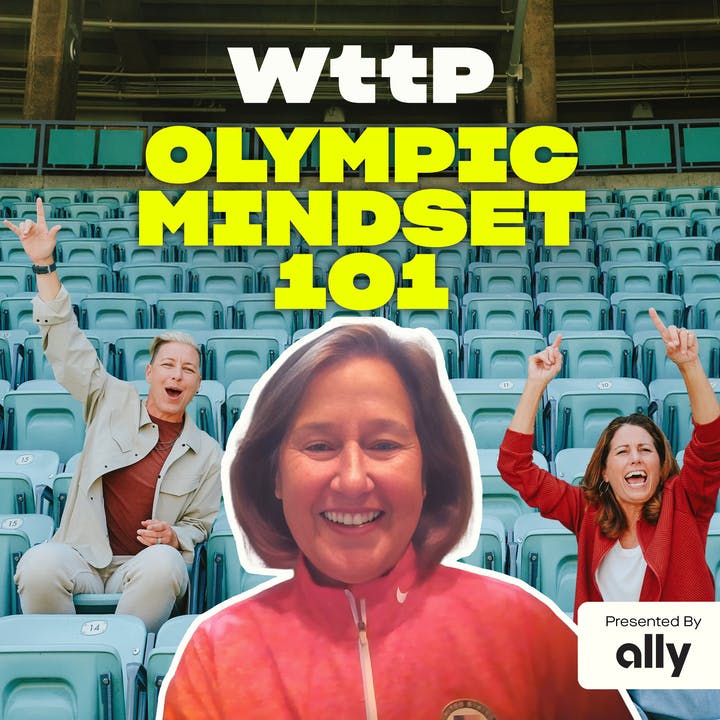
Loading summary
Transcript200 lines
- [00:01]
Celsius Energy Narrator
5:00am I'm up with a crisp Celsius energy drink running 12 miles today. Grab a green juice, quick change and head to work. Meetings, workshops. One more Celsius. No slowing down. Working late, but obviously still meeting the girls for a little dancing. Celsius Live fit. Go grab a cold, refreshing Celsius at your local retailer or locate now@celsius.com.
- [00:26]
Comcast NBCUniversal Narrator
nothing brings people together quite like Team USA at the Olympic Winter Games. From NBCUniversal iconic storytelling to the innovative technology across Xfinity and Peacock, Comcast brings the Olympic Games home to America, sharing every moment with millions. When Team USA steps onto the world stage, people aren't just watching, they're cheering together. This winter, everyone is all on the same. Team Comcast, proud partner of Team usa.
- [00:55]
Dr. Colleen Hacker
These Olympic Games have been a masterclass in performance psychology.
- [01:00]
Billie Jean King
How do we do something like that the way Norway has done?
- [01:03]
Dr. Colleen Hacker
It's possible Americans are telling parents all the things that Norway's doing. They're just not doing it. A lot of Myers. Taylor is driven. She loves it.
- [01:15]
Julie Foudy
Oh, it's gonna crying aloud. I've been giving a lot of tears in the last few weeks.
- [01:20]
Dr. Colleen Hacker
I'm gonna use our U.S. women's ice hockey team. They had all the pressure. You're just feeling it. You look at your mother and said, I'm on the national team for 10 years. You still don't know what position I play. That's so right.
- [01:39]
Abby Wambach
Attention, the party is about to commence.
- [01:49]
Dr. Colleen Hacker
Welcome to the party.
- [01:54]
Julie Foudy
What's up, party people? I'm Julie Foudy.
- [01:57]
Abby Wambach
And I'm Abby Wambach.
- [01:58]
Billie Jean King
And I'm Billie Jean King Kanger.
- [02:01]
Julie Foudy
I love that we're still back together. We have been reflecting on the Winter Olympics a lot. And it occurred to me real quickly because we have the Dr. Colleen Hacker coming up on the show. And this is an amazing episode. But two big things and themes jumped out at us. One, the toll that the Olympics takes on athletes from a physical standpoint. And I mean, just ask Lindsey Vonn. But also from a pressure and mental health standpoint as well. And we saw that in real time on many occasions. And then two, Norway, I mean, this Scandinavian country with a population similar to South Carolina won all these golds in Milan. 18 golds, 41 medals at the Milan Cortina Games. Broke their own records in both of those categories. And wait until you hear what Norway's secret sauce is. Okay, so without further ado, we are going to get right to the parties part of our party and bring in someone who is an Expert on both of these two themes. Dr. Colleen Hacker is one of the most respected mental performance consultants in the world. She has served on six Olympic coaching staffs across multiple sports, including U.S. women's Soccer, USA Hockey, USA Field Hockey, part of teams that have won Olympic gold, silver, and historic World cup titles. She's worked with professional athletes across the NFL, MLB, PGA, LPGA, NWSL, MLS, USA Swimming, and more. And Dr. Hacker has been named by espnW as one of 30 Women who Change the way sports are played. Come on. Dr. Hacker has spin her career helping elite athletes handle the very pressure we watched unfold at the Olympics. And she is currently working with several Winter Olympic athletes who just finished competing in Milan Cortina. So we felt she is the perfect guest to bring to this party. She also happens to be a great friend, BJK's biggest fan, and better known to us as Flash because she brightens everything and everywhere she goes, flash, slash. Dr. Colleen Hacker. Welcome to the party
- [04:17]
Abby Wambach
again. Welcome to the party again.
- [04:21]
Billie Jean King
Love it.
- [04:21]
Abby Wambach
Welcome back.
- [04:23]
Julie Foudy
Welcome back to the party.
- [04:24]
Dr. Colleen Hacker
Yes, you do. You do introductions, Jules. Like you play soccer with joy, with passion, with fun, and you make an impression. You make an impression.
- [04:35]
Billie Jean King
Welcome. Welcome back.
- [04:36]
Julie Foudy
We should say welcome back to the party. Ah. So good to have you. How much fun. I know you were doing the same thing. I was watching and consuming every second that all of us were doing of the Winter Olympics. How much fun was it? And you've been to so many. How was this different for you?
- [04:57]
Dr. Colleen Hacker
Yeah, there's a lot that's the same. I mean, I just. You just try to will the people that you love and care about to perform as well as they can. I don't. I don't want superhuman. I don't want better than. You just. You just want to vibe them that they are as good as they are in the Games. And so it's that it's like, you know, I'm of the belief it's physics, by the way, that energy can't be created or destroyed. So my energy is going somewhere and I just want to make sure that it's positive, it's purposeful, it's productive. And I actually just got a text from one of my clients who is a gold medalist now.
- [05:43]
Julie Foudy
And how cool is that, though?
- [05:46]
Billie Jean King
That's totally cool.
- [05:47]
Dr. Colleen Hacker
And I said it's not just athletes. I don't know if the three of you know about this. There's this thing called five ring fever, and it's the phrase that's given after the Olympic Games because everything is geared to this.
- [06:01]
Julie Foudy
Yeah.
- [06:02]
Dr. Colleen Hacker
And then the games are over and it's like, oh, man, like what? There's just a downer. Like, I don't, I, I won't, you know, go on and on. But you just.
- [06:11]
Julie Foudy
We were talking about this in our last epic episode. Yeah. I didn't know it was called Five Ring Fever. We just called it Post Olympic Blues.
- [06:18]
Dr. Colleen Hacker
Yeah, well, in the literature we call it Five Ring Fever, Post Olympic Blues. It's, you know, tomatoes, tomatoes. And I will just tell you, mental skills coach have it too. It's like, let me prepare for the grocery store today. That, that, that will fill my achievement needs. Let me write this email. It's like for a, for differential period of time, nothing compares.
- [06:45]
Julie Foudy
Yeah, I know, I know.
- [06:48]
Dr. Colleen Hacker
So, yeah.
- [06:49]
Julie Foudy
Wait, what you were saying about the text from your gold medalist.
- [06:53]
Dr. Colleen Hacker
Well, yeah, I was going to read it, but she just said, she goes, doc, I hope you're doing, I hope you're holding up okay now that all your athletes are done, you know that you're not too depressed because our last session that I think we had like maybe two days before the gold medal competition. I don't, I don't want to say more than that. And I just said. Because you want to make them laugh and have fun and think about things. And I just said, yeah, I'm going to, going to need a referral. So if you come across any good mental skills coaches in, you know, like on help you. Yeah. So she's checking in with me to make sure that I'm not around sharp objects. So it's just fun. It's just fun to laugh. That's so true.
- [07:41]
Julie Foudy
Can we start with Norway and their sports system? Because we think an understanding of how Norway operates can help us actually better understand some of the mental challenges these Team USA athletes understandably face at the Olympics. And if party people, you were watching this Winter Olympics, or any Winter Olympics for that matter, and you saw how dominant Norway is and has been. This country of just about what, five and a half million people. It's the size of Montana, literally. And the US has over 330 million people. By the way, Norway is winning at each and every Winter Games. And, and yes, Flash, I know they live in a, a cold, snowy area. Yes, they cross country ski to actually get to places. Yes, playing in the snow is a way of life for them. But that does not explain why they crush every single metric. So please, because I know this is near and dear to you as well, and you have studied this for years. Can you explain what is going on in Norway?
- [08:56]
Dr. Colleen Hacker
Well, yes and no. I mean what I can tell you. And I want to own it. Right. I'm a scholar first. I don't want to succumb. It's a common cognitive bias and it's called the fallacy of causation. So I don't want to say that because they X, that's why they Y. So let me just say it is not complicated. That's what's, that's what's confusing or fascinating to me.
- [09:26]
Julie Foudy
Yeah.
- [09:26]
Dr. Colleen Hacker
Norway's youth sports system is based on an eight page document, not a 30 million dollar commission study across 27 universities by 40 million PhDs. There's not one for soccer and another one for skiing and another one for this state or that you do. You get what I'm saying? It's called the children's rights in sport.
- [09:56]
Abby Wambach
Eight pages.
- [09:58]
Dr. Colleen Hacker
And it basically says kids first. Joy and friendship number one. Joy and friendship number one. So if something matters to you, you prioritize it. Kids have as much a right to choose their activities rather than have them chosen for them. They prioritize trying a multiple multitude of sports. The focus in the eight page document is the joy of sport, not selection, not elitism, not separation of the great from the masses. Clibo who, if he was a country, if the Norwegian skier Kleibo was a country, he would have placed ninth in the world with his six gold medals as an individual, he would have been the 9th most medaled country in the world. If he was a country instead of a Norwegian skier. It's staggering. Kids get to decide what they participate in. When. Jules, you and I have talked about this, about. No scores are kept up through and including age 11. We play to play. We play for love, for joy, to get better, to master it, to be with our friends, to test ourselves. It's intrinsically motivating. I play because I like it. Oh, I don't like it anymore. I'm going to play something else. I'm not on the receiving end of. Well, you know, when you start something, it's important to finish. Do you want to be a quitter? I mean, we've invested a lot of money in this. Do you want to be a quitter? What kids gonna say? Yeah, that, that's what I'm goal setting for. I'm. I'm gonna be a quitter. Just pick a different. Right. They're gonna try different things. They don't travel at all.
- [11:58]
Julie Foudy
Yes, this. I'd love to.
- [12:00]
Dr. Colleen Hacker
Gosh, until 13.
- [12:02]
Julie Foudy
Yeah, you can't even get on a Travel team.
- [12:04]
Dr. Colleen Hacker
And I'm gonna shut up here in a second. And 93% of kids stay in physical activity and sport.
- [12:13]
Billie Jean King
But how do they find something locally?
- [12:15]
Julie Foudy
93%. 93%.
- [12:19]
Dr. Colleen Hacker
It is. It is town. It is town by town by town. Sponsored. Norway believes it's their country's responsibility. We say that sports builds character. We say Ernst and Young that sports builds CEOs. I quote it, you quote it, everybody on earth quotes it. But do our actions reflect our values? And one of the smallest towns in Norway, Voss, the oss home of one of my dearest friends has produced massive number of Olympians. Every town supports is a national point of pride that we want kids to accrue the benefits from sport and physical activity. And so we're going to fund it, we're going to prioritize it. Let me just briefly. And I'm talk. Honestly don't know the elite track in tennis. So I'm not going to. We have an expert on that. But I do know soccer in America and the number of families that are driving. An hour, an hour and a half. They drop their kids off, they play, they get in the car, they drive home. Friends, fun neighborhood. Are they gonna go for pizza that night? No. Cause it's an hour and a half. You kind of get what I'm saying. There's all kinds of downstream effects of that. What is it like for the three of you to see that?
- [13:58]
Julie Foudy
Oh, Kinger, go ahead.
- [14:02]
Billie Jean King
Well, actually, all the things you mentioned, I did, my parents didn't force me. I played sports because I loved it. We had a park and recreational system that supported me and had a Clyde Walker who also taught. And I adored him because relationships are everything. They just are. And he like. The first time I met him was my first time ever getting instruction. It was the second time I picked up a racket. And my dad. The one thing I thought my parents did really well, at least my dad particularly, is that he wouldn't buy me my first racket or my first bat. He said, you're going to have to find a way to get your first tennis racket. And I went to the neighbors and pleaded and begged and they gave me a dime, a nickel, and I had $8.29 and I went and got my first racket. So what you've just said, I actually lived. And it was the Norwegian way, I think, which was really helpful and I'm so lucky. I was born and raised in Long Beach, California, because they have an amazing park and rec system, I think, for sports. And there's that joy that you talk about and the friendships and all the things.
- [15:15]
Dr. Colleen Hacker
I really want to respond to a couple things that you just said. One, I thought you did a beautiful job in your most recent in your autobiography talking about your childhood, the influences, what you needed to do. For anyone who has not read all in, you do a beautiful job describing everything that you just shared and I really lift up that that book to folks. The other thing you mentioned that is critical relationships. Relationships, relationships. There was a 20 year study by Dan Gould and others out of Michigan State. I have so much respect for him. And they looked at 20 years of Olympians, winter and summer males and females, individual team sport. And what they found in the history, the lineage of the medalist is, is they played multiple sports. The Olympians, their coaches, they by their own and they loved it. Were not the best tacticians. They were not the technical experts in town. Their parents didn't seek them out and pay them handsomely to have private. They were caring, loving human beings who love their sport and that passion that gives me goosebumps. Now for realsies. They loved their sport and they were infectious and they loved the kids. So it was multiple sports and the relationship between the early kid and their coach. Speak. Wait, I have to tell one more story. Jules, this is about your dear mother, who I love to pieces. I will never forget. I don't know, we were at some after party and. And I just sit there and hold my face. I laugh so hard when you and your mother get together. But you look at your mother and said I'm on the national team for 10 years and you still don't know what position I play. That's so right.
- [17:34]
Billie Jean King
And I'm like, that's good.
- [17:36]
Dr. Colleen Hacker
And I'm like, judy, can we clone you? You don't even know what position I played. I think that was. You had, you had three double faults in your second set at age seven. And then I noticed you didn't win the four set route. Oh my God.
- [17:55]
Billie Jean King
My mother didn't know how to score in tennis.
- [17:57]
Dr. Colleen Hacker
My mom never knew how to score.
- [17:59]
Billie Jean King
She just said she still doesn't understand add out and add in. She goes, you keep telling me, but I don't, you know, I don't really get it.
- [18:05]
Julie Foudy
Yeah, my mom used to say, oh, honey, I thought you, you played. I remember it was one Olympics where I think the coach put me out on, on the outside and, and I usually play inside because I'm not as fast as Billy knows. Well now after losing to Abby in every minute to win It. And I, and I said, mom, I was awful on the outside. And she's like, what are you talking about? And I go, oh, my gosh. Like, I just played terrible. And she's like, I don't understand what you mean. Like, I thought you played great.
- [18:33]
Dr. Colleen Hacker
She.
- [18:33]
Julie Foudy
You were in a different position today. I was like, oh, my God.
- [18:38]
Dr. Colleen Hacker
You don't even notice that she's.
- [18:40]
Julie Foudy
You played great, honey. You played great.
- [18:42]
Billie Jean King
That's what my mom did. Exactly. Oh, our moms would be great.
- [18:45]
Julie Foudy
I know when you were describing your childhood, and I'll be interested in Abby's. My parents were the exact same way. I. I didn't even realize that I had the Norwegian model as well. It was all people who came from like a 15 mile radius of the team we played on. We were national Champions. Go Soccerttes. Nobody messes with the green. Colleen knows this song way too well as Abby does as well. But that's what we had, right? I didn't play just soccer till I went to college. I was playing softball and volleyball and basketball and tackle football and everything else. And now with my kids, it's a completely different world. Absolutely different. Nothing like that is. Is as it was.
- [19:32]
Dr. Colleen Hacker
Let me just jump in, just so we don't think it's just women or gold medalist or grand slam champions. It's between 92 and 93%. You can find it. If I'm lying, it's just because I'm excited and happy. But 92 to 93% of first round NFL, NFL picks played multiple sports. I mean, it is across the board. Abby, I'm going to ask you. I know some of this, but I literally don't know. You come from a big family. I'm going to go out on a limb and say your parents weren't at every practice, every game, for every child, forever since you were born. Speak to us.
- [20:19]
Abby Wambach
No, I mean, my dad rarely came to games. My mom, as I got older, came to only games there was. Nobody ever came to a single practice, ever. I was, I was like lucky to get to a practice. You know, my mom was. She. We had seven. She had seven children and she would get to two innings of a baseball game, leave, go to a quarter of a soccer game, leave, go to a quarter of another baseball game, you know, like, so she was juggling a lot. And I grew up in a, in like kind of a beautiful little small town in Rochester, New York, where the community rec centers were very popular. When I was really young, I played on a rec league team. My very first soccer team. And then I went into the club system, which is. Was very different than it it is now. Right. Like it wasn't. It was Club of Rochester. Right. And if you did good enough, then you could go to maybe a bigger tournament or whatnot. And then I got more elite into the Olympic development program that, that allowed me to start playing on more elite teams. But those were merit based instead of elective travel, soccer, ECNL programming that was a requirement in order to get seen by college coaches. Right. And the fact that we have allowed these companies essentially to infiltrate and, and start commodifying and, and capitalizing on young children and also it's, it's capitalizing on young, young parents who want the best for their children is really what this is about.
- [22:11]
Billie Jean King
Right.
- [22:11]
Abby Wambach
It's about money. And it's unfair because Julia and I know this. We just went through this with our teenage daughters and son going, you don't want to leave your kid behind because this is the system we're in right now. But how do you break free from it and get to a place like Norway is. You have to have administration in place. You have to have community funding to be able to actually fund some of these programs that, you know, many cities around the United States might not be funding. So it's a mess. It's really a mess. And I feel bad for a lot of these kids because I do think that there is also a sleep statistic and hacker. You might know what it is that I think 98 or 99% of Olympians played multiple sports as a child.
- [23:08]
Dr. Colleen Hacker
Yeah.
- [23:09]
Abby Wambach
Yeah. It's just a very obvious thing that of course I needed multiple sports, I needed basketball in order to be so good at soccer. It's just the truth. Yeah. Not, not just because I needed the break, the mental break, but I needed basketball to help me learn how to jump, to help me learn how to head the ball, to help me learn how to time my jump to become the best header in the world. You know what I mean? Like, there are these things in my world.
- [23:36]
Dr. Colleen Hacker
It's, it's called sorry to interrupt motoric competence. And we are no longer creating motorically competent children. We are creating one trick ponies. Yes, I play volleyball. They're not active. I think all of, well, two of, you know, 40 years ago, I started an intentional practice where I am going to try at least one new sport. This has been written about in Psychology Today because I'm weird. I'm going to try one new sport every year of my life. At least one for 40 years. I have done that. And I'm really proud of that because I want to be a beginner. I want to be taught by like, I went to Seattle Curling Club, which produced our Olympic curlers. I don't just go ask some guy or gal on the street. She's sweeping.
- [24:36]
Billie Jean King
I know. Can you just imagine?
- [24:38]
Dr. Colleen Hacker
I'm telling you, I went to a
- [24:43]
Julie Foudy
bowling club.
- [24:44]
Dr. Colleen Hacker
I went to an Indian national, one of the top two cricketers at Marymore park in Seattle, to have him teach me cricket. Like, I seek out experts because I want to learn truly and authentically. I want to be a beginner. I want to experience all of that of being a beginner. And I want to be in a lifelong quest to expand my motoric competence. Kobe Bryant, I got to work out with him in the Beijing Olympics. He hired soccer players. He grew up playing football in Italy. Soccer in Italy. Where's those stories? I have a Major League baseball all star. Major League Baseball all star. A client of mine who was also a state soccer champion. You know what? Nobody interviews him about soccer, right?
- [25:34]
Julie Foudy
Yeah.
- [25:35]
Dr. Colleen Hacker
So he does interviews and he goes, my dad. I'm making fun of it, but to make a point, my dad. Which is true, and it's beautiful. But understand why I'm being sort of sarcastic. My dad and I played baseball since I was five. Because that's the interview question. So every parent is going to do what? Start playing baseball at 5? They don't know the rest of the story. Kobe Bryant was an amazing soccer player. And even at the height of his NBA career, he's hiring soccer experts for his footwork. Do you get what I'm saying?
- [26:12]
Abby Wambach
Yeah, actually, I think this is really helpful for us when we interview folks. I want to actually throw this into the mix, like, what other sports did you play? Because I think that we are also perpetuating the same kind of mentality around one sport wonders. I think that we can ask our own guests and practice kind of what you're preaching here, Hacker. I think it's great.
- [26:35]
Julie Foudy
The crazy thing too, is that in that eight page. Let's just reiterate that eight pages, y'.
- [26:43]
Abby Wambach
All.
- [26:43]
Julie Foudy
It's an eight page document. Do you know how many pages of shit I have read over the years about how to solve youth sports in this country? It's eight pages. And the quest is not to become the most winningest country in Winter Olympics history or Summer Olympics history that isn't even stated in there. The quest is that they want to create in Norway an attitude where sports and competition and healthy communities in competition People become the way of life so that you're competing for your entire life. And yet here in the United States, 70% of kids are quitting by the age of 13. Contrast that. So they're trying to create a love of the sport and a love of the game and all these beautiful ways, right? You're not traveling until you're 13. You can't even travel until you're 13. We're not keeping score. There's no under eight world championship, right? Like, how ridiculous that we're doing this at 8 years old and 9 years old for these kids. And you're creating joy. And you saw it at the Olympics, right? Alyssa Liu. Can we just talk Alyssa Liu, for a second? This woman at 20 years old, well, she was a prodigy of a skater. Coming in, Colleen, you pick up wherever you want to and tell me if I'm wrong.
- [28:09]
Abby Wambach
I.
- [28:09]
Julie Foudy
But at 16, right? And at 15, she's winning titles. 14, she's winning titles, right? And at 16, she's like, I don't want to do this anymore.
- [28:20]
Abby Wambach
I'm out.
- [28:21]
Julie Foudy
She doesn't even remember winning titles. She says, I have no memories of that because my youth sports experience was so traumatic. She quits for two years. She comes back skating on the ice for fun and says, I can do this, but I will only do this if I do it under my terms. I decide what I wear. I decide what music I get to dance to. I decide when I want to eat, what I want to eat, when I want to practice, how much I want to practice, and who my coaches are. Right? And she finds coaches who embrace the very creativity and joy we're talking about and the freedom to not even think about outcomes. Just skate for your skating heart's desire. Like, skate for your little heart.
- [29:04]
Dr. Colleen Hacker
Yeah. Two things. Our last episode I talked about, right? Self determination theory. What does every human being want? Autonomy. I want to be the master of my own fate. I want to decide how good I want to be. I want to be the best in the world. Be the best in the world. I want to have fun and have fun. Autonomy, mastery. I just want to try to get good. I want to ride this wave to see how good I can get.
- [29:33]
Julie Foudy
Can you see my note I'm holding up? It says, autonomy, mastery and connectiveness.
- [29:41]
Dr. Colleen Hacker
Relationships.
- [29:42]
Julie Foudy
Always have a pen when Colleen. Have a pen in your hand. When Colleen Flash Hacker is talking.
- [29:47]
Dr. Colleen Hacker
Emt. I don't think we can say enough good things about her. Emt. She's a bobsledder. I hope I'm speaking. Okay. On her behalf. She's quite capable of speaking on her own behalf. She's a bobsledder. Because she was cut from USA Softball Olympic team.
- [30:09]
Abby Wambach
There you go.
- [30:09]
Dr. Colleen Hacker
Sometimes our greatest gifts are our denials. So many of our speed skaters. In my day, I'm in the Apollo. Ohno and J.R. selsky. I was an inline skater here and I competed with those guys. Most of our inline short track ice speed skaters were. Were bladers, they were rollerbladers. That transfer. Do you get what I'm saying?
- [30:35]
Julie Foudy
Aaron Jackson is one of those.
- [30:37]
Billie Jean King
Aaron now. That's right.
- [30:38]
Dr. Colleen Hacker
If you think those two are the same thing, you don't know what you're talking about. Multiple. So ent. Doesn't make sense. Softball, that was what she played in college. That was her dream. Four year letter winner. I'm going to make the Olympic team. And now she is the most decorated black athlete in Winter Olympic Games history. You know, because of the whole softball washout thing. And I think she would say both the sting of not making it was part of her motivation and all of that foundational skill that she built in softball. Think about the power. Think about the torque, the rotation. I could talk biomechanics till the cows come home. Summation of forces she had to marshal, all of that. And that helped her move through the bobsled ranks.
- [31:41]
Julie Foudy
Yeah.
- [31:41]
Dr. Colleen Hacker
Is this making sense?
- [31:42]
Julie Foudy
I mean, it's story after story too. I see at the Olympics, Mikaela Schifrin. What was the last thing she said before her last race? When she won gold in the slalom. Did you see that flash?
- [31:51]
Dr. Colleen Hacker
I know you did her three points.
- [31:53]
Julie Foudy
Yeah, go on.
- [31:55]
Dr. Colleen Hacker
Be kind. Think first. Have fun. No, I barely remember. I don't even remember.
- [32:02]
Abby Wambach
I knew.
- [32:02]
Julie Foudy
We always are riding to down the same stuff.
- [32:04]
Dr. Colleen Hacker
I don't know. I don't know what you're talking about.
- [32:06]
Julie Foudy
We talked about Chloe Kim in our last episode and her reaction, I mean, and. And just like her joy for gown Choi winning gold from a different country. Yeah. Huge hug.
- [32:21]
Dr. Colleen Hacker
These Olympic Games have been a master class in performance psychology. They have been a master class about the differential effect of pressure on individuals and teams. It is a learning lab. It is literally a learning lab. No PhD required. No graduate education required. Just open your eyes and watch, open your ears and listen. And you will learn and you will grow.
- [32:53]
Billie Jean King
Yeah. It's about head, heart and guts. You got to get them all together. And when one's missing, you don't win.
- [33:05]
Abby Wambach
Okay, so Jules Peloton is shaping the future of fitness with the brand new Peloton Cross Training Tread Plus Powered. It's the most incredible thing. It's powered by Peloton iq. Yeah.
- [33:22]
Julie Foudy
Have it. It is amazing. And as you can imagine, abs, I'm pretty particular about how I work out because I can't just, like, run on my own anymore. I can't just run like that. Like, obviously, we spent our life doing that and training that way, but it is the hardest thing, and I won't do it. I just won't. I won't do it anymore. It's not enjoyable. And that's why this new Peloton Tread plus is amazing, because you get all the classes, of course, in front of, so you feel like you're in a class, but you can totally mix things up. You're not just running. You can swivel that screen and you can get off and start doing a little boot camp on the side. It's so cool, the swivel.
- [34:06]
Dr. Colleen Hacker
I was like, what?
- [34:08]
Abby Wambach
It's the best. It's also. It's been a game changer for me because, like you, I can't run, but I can't run because I have foot problems. And so the tread and the forgiving nature of the actual tread helps me to be able to actually move. I can walk on there, I can get an incline on there. I can swivel that screen. But I think what I love most is that the screen swivels in a way where I can guide and I can do the Pilates on the ground. I can do weightlifting. I'm, like, literally looking at this Peloton plus tread. It's just.
- [34:41]
Julie Foudy
It's in your basement. It's down in your basement. My wife loves it.
- [34:43]
Abby Wambach
Seriously, I'm stunned at how much I actually didn't know I needed this. It mixes up my weekly routine. It's guides by instructors. Like, I feel like I've got friends and I've got trainers on my side now.
- [34:55]
Julie Foudy
Yeah, yeah. I love it, too. I love it. So let yourself run, lift, sculpt, push, and go.
- [35:02]
Abby Wambach
It does it all.
- [35:03]
Julie Foudy
Explore the new peloton cross training tread +@1peloton.com okay, Jules, so you know, elite
- [35:12]
Abby Wambach
athletes succeed because of the teams behind them. You and I are firm believers of this. You've got your coaches, your trainers, analysts, your support staff. Now, QuickBooks mirrors this by providing a team composed of Intuit AI and trusted experts so business owners never have to build alone. Jules, I don't know if you know this, but I personally feel like I never scored a goal without the help of a teammate. A lot of people, in fact, have said, well, what about penalty kicks, Abby? And my answer to them is, do you know how many hours the goalkeepers stayed after practice while I trained my penalty kick after penalty kick? Thousands and thousands of kicks. The way that I got so good at them was when the goalkeepers would be in there, I'd even tell them, I'm going to go over here. So I'm going to give you an advantage. And I need. This needs to be so particularly, like, accurate and strong and powerful in order to score. Never one goal did I score without the help of a teammate. And. And. And to me, I think that, like, looking forward to the Winter Olympics, that is the thing that I look for the most. I'm looking for the teammates and the athletes who are cheering for each other. Yes, they're competing. Yes, they all want to win gold. But I do think that. I do think that the. The vibe of the entirety of the Winter Olympics for me, in the way that I look at them is I just want to see people celebrating sport and working as hard as they possibly can in order to bring gold home for their country. Jules, I have to tell you about the new hair routine that has fully converted me. Okay. It's from Hair Story. And their new wash method isn't shampoo at all.
- [37:16]
Julie Foudy
It's brilliant.
- [37:17]
Abby Wambach
It's just. It's so much better. Okay, so you start with pre wash, which is this incredibly gentle scalp rinse that, like, melts away.
- [37:27]
Julie Foudy
Scalp brush.
- [37:29]
Abby Wambach
Yeah, that melts away the buildup without that stripped, squeaky feeling. And then you follow it with new wash, this rich, creamy cleanser that replaces, like, both your shampoo and conditioner in just one step. And, Jules, what shocked me the most was how immediate the difference was. My hair felt softer, smoother, and somehow calmer after the very first wash. Like. Like it had reset. And the best part, I don't feel like I have to wash it constantly anymore. It stays balanced and healthy for so much longer. So it's honestly feels like that's the biggest win. Yeah, it feels like I've been overdoing it for years, and this is, like, the first routine that's shown me less can actually be transformational. So if you want your hair to feel healthier, stronger, and more alive, Hair Story is absolutely worth discovering. Try it for yourself. Go to hairstory.com welcome to the party. And use code PARTY15 at checkout for 15% off your order. Hacker, if you could point the party people to a couple of athletes that performed in a way that you felt like, were that, this would be the best masterclass. Is there an event, a team, an athlete that you could point us to and talk or talk about right now?
- [39:10]
Julie Foudy
Yeah.
- [39:10]
Dr. Colleen Hacker
I mean, multiple. Multiple. I mean, Ilana Meyers Taylor until I think, again, I'm doing this from memory. And we know how that works when you have more birthdays, but I don't think she made the Olympic team until a week or two weeks before leaving for Milan Cortina. So it wasn't early. It wasn't six months. She's fighting just to make the Olympic team.
- [39:39]
Julie Foudy
Her fifth Olympics.
- [39:41]
Dr. Colleen Hacker
Yeah.
- [39:43]
Julie Foudy
Yep.
- [39:44]
Dr. Colleen Hacker
If you put down 10 bucks on Alana Meyers Taylor in the Monobob in Vegas, you would be doing this podcast from your own private island in French Polynesia right now. You understand what I'm saying? This is not a sure bet.
- [40:02]
Julie Foudy
Right.
- [40:02]
Dr. Colleen Hacker
So hers is a story of belief. Oh, it's gonna.
- [40:07]
Julie Foudy
Crying aloud. I've been giving a lot of tears in the last few weeks.
- [40:12]
Dr. Colleen Hacker
Let me say this. And your guest on my lower left is a perfect example of this. Alana Meyers Taylor is driven. She loves it. She calls it her me time. Driving at 80 miles an hour is her me time, but she's competing for something bigger than herself. Her boys that age is. Is what you want to make it. And she's competing for her voice. Billie Jean King. If you tell me that the Bobby Riggs match was about tennis, I'm gonna say there's no way you were.
- [40:53]
Billie Jean King
It had nothing to do with tennis.
- [40:55]
Dr. Colleen Hacker
Much bigger. Much bigger.
- [40:58]
Billie Jean King
Social change changing the hearts and minds of people.
- [41:05]
Dr. Colleen Hacker
So I use Alana Meyers Taylor as an example of that. Competing against all odds. Against all odds, Abby. And for something bigger than herself, I'm going to use our US Women's ice hockey team. Very different story. Usa, Canada. Usa.
- [41:24]
Abby Wambach
They.
- [41:27]
Dr. Colleen Hacker
They had all the pressure.
- [41:30]
Julie Foudy
Oh, I was feeling it.
- [41:31]
Dr. Colleen Hacker
I was feeling it. You're gonna do it.
- [41:34]
Billie Jean King
Oh, my gosh.
- [41:35]
Dr. Colleen Hacker
Right?
- [41:36]
Abby Wambach
And.
- [41:37]
Dr. Colleen Hacker
And, you know, they think about that. There's anxiety about that. They worry about that. I love Will Rogers quote. You know me with quotes. But Will Rogers said, worrying is like rocking in a rocking chair. It gives you something to do, but it doesn't get you anywhere. And so we try. What we try to do is turn that worry into fuel, into direction. So, abs. There's two very different ones. Alyssa, Lou, Jules. Edified that so beautifully. But my point in using those three. Michaela, Shifrin. Oh, my gosh. I mean, every time I be quiet, there's another one. What I want to put Point out is that that each one is a different story. It's not the same story. Which is the point. I was privileged to be on the bench, Abby. For a portion of your career. And a portion of yours. I don't know if you know this or want to write this down, but you two competed very differently. You weren't the same before the game. You weren't the same in the game. And I'm still laughing about you talking about your pre game routine. So am I. And then I inhaled, and then I exhaled, and then I inhaled again. And then I'm like, the end, thens, never ending. And then.
- [43:03]
Abby Wambach
And then.
- [43:05]
Dr. Colleen Hacker
And I'm like, I just love your honesty about that. So where I'm gonna go with this? And Jules, you know, I talked in your era, I talked about the ips. Each person has their ideal performance state. Oh, Abby, you can just throw darts at me. I'm gonna say something. I should have asked your permission, but before an Olympic game, you were laying on the locker room reading a paperback novel. That's all I'm gonna say.
- [43:40]
Julie Foudy
That's.
- [43:41]
Dr. Colleen Hacker
I don't know.
- [43:41]
Abby Wambach
An Olympic game.
- [43:43]
Dr. Colleen Hacker
Yeah. And I don't know if you remember that or not earlier in your career.
- [43:46]
Abby Wambach
I have 04.
- [43:48]
Dr. Colleen Hacker
I have a photo of it. What I'm trying to say is if you looked in our locker room and this should be the message for Everybody. You saw 10 different things going on.
- [43:58]
Abby Wambach
Totally.
- [43:59]
Dr. Colleen Hacker
Because you have to know what works for you. If I hear one more person saying, getting angry hurts, then somebody explained John McEnroe's success to me because it didn't hurt him. It fueled him. I don't know if I'm making sense, but there's not just an answer. So you had Jules. It was one of my favorite one liners of yours. So we're in Portugal for the Algarve Cup. I'm emphasizing self awareness, self regulation. Self awareness, self regulation. You need to know what you need, and you need to be disciplined about getting it. All of us don't have to do the same thing at the same time. So we had two different halves. And there was like the training room, serious half. And then the locker room and the. And the. I don't know if you know what I'm talking about. I tell you the city and everything. And they're dancing and they're going to crazy.
- [44:55]
Julie Foudy
I know what half I was on.
- [44:57]
Dr. Colleen Hacker
Yeah, exactly. And then one of the serious people who are listening to their headphones, they're like gearing up. They're like gonna. This is take no prisoners. They deigned to walk over to your side and you said, and I'm like, wow, my life is complete. Get out of here. You're raining on my ipz. Like, no, don't bring that seriousness over here. So my point is that everyone handles pressure differently and that same person in their career. So they might have read a novel to distance themselves, to calm themselves, to not connect with what they were about to do at one point in their career. What I'm trying to say is it's not what you do, it's the change from what you normally do. I don't want to pile on, so I'm just going to use it illustratively, but we'll all know what I'm talking about. You look at a figure skater who hasn't lost in two years. In two years, just like our US Women's ice hockey team team expected to win gold. And the first comment, which was more important to my ears than the performance, the first comment caught on hot mic, was, if I had made the Beijing team, that wouldn't have happened. Which tells you that that skater brought something from the past into the present that they hadn't done for any. Are you with me on this?
- [46:40]
Billie Jean King
We know which one.
- [46:41]
Dr. Colleen Hacker
I will say for a thousand years, excellence leaves clues. Pay attention. Excellence always leaves clues. Pay attention. So I could lift up Michaela Shifrin. I could lift up Alyssa Liu. I could lift up Alana Meyers Taylor. I could lift up our gold medal ice hockey team. Very different stories, but all in a quest for excellence. I don't know, Abby, did I flunk or pass?
- [47:14]
Billie Jean King
I love this. Are you kidding? I'm mesmerized.
- [47:16]
Julie Foudy
I know. We're a very different country. We're much larger geographically than Norway. Right. We are very disjointed and messy. There is not an eight page document telling us to find your joy in sports anywhere that I can find. And. But are there things can we course correct here in the United States? Are there things we can take from Norway's really simple, streamlined approach that could actually apply to the disjointed mess that is youth sports here in the United States of America?
- [47:54]
Dr. Colleen Hacker
Yes. I mean, the second.
- [47:56]
Julie Foudy
Thank you. I needed you to say yes.
- [47:58]
Dr. Colleen Hacker
Second, I can't offer an enthusiastic yes. I'm getting out of academia and education. I believe that education therapy is a form of education. I believe people can change when they're sufficiently motivated to change. I believe people can grow when they're sufficiently motivated to grow. The teacher appears when the student Is ready. That famous Zen proverb. The teacher appears when. When the student is ready so we can change. I'm going to do the negative, but I always try to end with hope. And you can interrupt and you should just say to mute or something, and I'll live a fulfilled life nonetheless. We already know. We already know. And the proof, the bloody proof for me that we already know meaning in America, United States of America. Read everybody's brochure. Look at everybody's athletic website. Listen, read every. But every club is going to develop the whole person. We're going to put the emphasis on the child. We just want your child to. Oh, my God. They all say the same thing. They all know what to say. But there's a disconnect in my world. It's called hypocrisy or lack of accountability. But there's a disconnect between what people know and whether they were going to act and behave based on what they know. Americans are telling parents all the things that Norway's doing. They're just not doing it right.
- [49:43]
Julie Foudy
Yeah, all the time. All the time.
- [49:46]
Dr. Colleen Hacker
Don't tell me how this university's website is substantially different from this university's website. One of my favorite things is one of my colleagues, her kids were going to school. And I don't. I won't say who, but the letter started out, blah, blah, blah. Insert your child's name, blah, blah, blah. And I said, that's the most honest college recruiting letter I've ever heard. Blah, blah, blah, blank. Insert your child's name, blah, blah, blah. Everybody is saying all of the same things. What we lack is a responsibility to act and fulfill our words. Your actions need to reflect your values in my. In my opinion.
- [50:34]
Julie Foudy
How many times. And Abby, you know this well with your kids right now, I have said to my kids, we will play multiple sports as long as we can. We are not specializing. We are not specializing. My daughter Izzy tried to play volleyball and soccer for so long and other sports not beyond that, but volleyball and soccer going into high school. And we went with a club that said, yes, we support you play playing multiple sports. But guess what the first question is, when you cannot come to that soccer tournament, why are you missing for volleyball? How committed are you?
- [51:11]
Billie Jean King
And I'm like, no, how committed are they?
- [51:13]
Julie Foudy
Yeah, exactly. I'm like, wait, didn't we just have this conversation? And then the same thing on the other side. If you're missing for volleyball, for soccer, the volleyball coach is like, wait, what? So Izzy was playing four teams at the same time? Two for volleyball, two for soccer, high school club, high school club for each sport, and was losing her mind because everyone was like, no, no, no, no, no, no, you can't do that. When they all said on the glossy brochure, you can do this. We support you doing this. So it's hard to navigate as a parent. And the other piece of it is, is when you do discover this is bullshit happening with the glossy brochure, excuse my French, I'm leaving. And you try and convince other parents, they'll say, why are you leaving? And I'll say, because the brochure is full of shit, and I'm not buying it anymore. And I'm going somewhere where I could find someone that actually wants to help my kid find the joy in the sport. And you say. And they say, oh, my God, I wish I could do that. I wish I could do that. But I can't because I'm not courageous enough to take that next leap, which would possibly put my child at risk of not winning that scholarship, of not getting to that team that's winning that national championship. And so I do think we as parents have to take more responsibility in vetting out. And it's hard to vet out, and it's hard to leave when you think you're with the program that's winning everything. But if it doesn't feel right for your kid, you got to get the hell out.
- [52:48]
Abby Wambach
Agreed. And here's something that I have been noticing from experiencing the sidelines with my daughter. She has played only soccer, tried out for volleyball, didn't make it. Was heartbroken about that, and just said, you know, so anytime we go on, like, family vacations or whatever, I'm always like, hey, we're gonna. We're gonna do wake surfing, we're gonna get on the boat, and you're gonna learn how to, you know, ski behind the boat, knee board. Like, we're gonna tube. We're gonna do fun things that you're gonna always be learning. But I will say this. The 11th month, the 11 month a year schedule for these girls playing club and then going down a high school, then going back is, I think, biomechanically limiting their abilities because I think it's putting too much stress on the same muscles over and over and over again. And I don't know if this is true, Hacker, but, like, to me, my kid gets more injured than I ever did because she's not having the. The fast twitch muscles, difference between basketball and soccer that I was getting. Can you tell us a little bit about like the reality of the health.
- [54:07]
Dr. Colleen Hacker
Here is the reality. What we lack isn't knowledge, research, science or clarity of voices. The American Academy of Pediatrics ads like the American Academy of Pediatrics, the organization for children not in sport has said early specialization is a rocket ship. My words to higher injury burnout. If your parents don't know about epiphyseal growth plates, there are growth plates that when you're banging, banging, banging, banging, you don't see it when it happens. You don't smoke at 20 and die at 21. That's not how it works. You get what I'm saying? And I feel like parents are watching their kids fall out of a 10 story building and going, well, so so far so good. So far so good.
- [55:15]
Abby Wambach
Yeah. Because what ends up happening, happening is that these kids, they get burnt out or they get cut, they cut from the team or they, they, they end up injured. Yeah, or they get injured and so their careers end and then they've never developed any other skills that potentially they could want to do in their adult life. So for me and Jules, we played professional soccer for all those years. And Billy, you played professional tennis, but Jules and I, we, we play beach volleyball now. We're like, we're like trying to get involved. I want to actually get on a women's hockey league team. I don't know if that'd be fun. And I want to.
- [55:52]
Billie Jean King
Why don't you find one that's good? Because they have these older leagues, don't they?
- [55:55]
Julie Foudy
Yeah, I want to do that.
- [55:55]
Billie Jean King
Oh my God, that'd be great.
- [55:57]
Abby Wambach
Without that confidence in a more well rounded version of athleticism, I think that that limits the way that we can actually be active in our adult years,
- [56:09]
Dr. Colleen Hacker
you know, and the supports, everything you just said.
- [56:13]
Abby Wambach
Go ahead, Billy.
- [56:14]
Billie Jean King
I know, I just been listening a lot to Dr. Hacker and you guys and also my own situation. But the important thing we do from this welcome to the party segment is that we need to come up with a solution. Okay, so how can we as a community of all sports, because we're talking about the Olympics right now. How can we help change things seriously, locally? Because I think you have to start
- [56:42]
Julie Foudy
locally solving for us.
- [56:45]
Billie Jean King
Well, or get the government like we got title nine in 1972. How do we do something like that the way Norway has done? I don't know, but it's possible.
- [56:57]
Dr. Colleen Hacker
It is possible. You just outlined in my world's color called Gibbs Reflective Cycle.
- [57:03]
Abby Wambach
What?
- [57:03]
Dr. Colleen Hacker
So what now what? What? So what now what? You asked the now what question. What's it like to be the smartest person in the room. That's the question. And the now what is? You already are intimating at it. I'm going to use your words. Long beach becomes Norway. That's community.
- [57:26]
Billie Jean King
Absolutely.
- [57:27]
Dr. Colleen Hacker
Literally what you're saying.
- [57:29]
Billie Jean King
What?
- [57:30]
Dr. Colleen Hacker
So what now? What now what? We start with a community and we get community interest. Not this one club, right? Not this one coach. It doesn't work with one off. That's what doesn't work. Any. Any change in any large milieu only occurs. It can start with an individual, but there has to be a collective spirit behind it. The power of the collective. Julie Foudy can talk about her contract till the cows come home and us soccer will sit back and go. Abby Wambach, can you understand what I'm saying? It's not that. Right. Margaret made you. You know, one person can make a difference, right? But it can start with one person, but it can't occur with one person. We've got to bring people along. It has to be collective. It has to be a coalition and we can change it. I believe in my soul now what's the likelihood is a different story. I'm honest to say. But I believe in my soul that we can change this.
- [58:47]
Julie Foudy
Oh, that gives me hope. I needed that. I needed that light. We're not going to solve it. Maybe today, maybe not tomorrow. And Colleen, we are going to have you on a lot more to discuss what we can be doing better the now what so that we can be a part of trying to help solve this flash. We will continue to talk about this for sure. Because this is a topic that is near and dear to all of us, as you know.
- [59:14]
Dr. Colleen Hacker
Well, thank you to all three of you, change makers, icons, influencers. You, your voice. It matters who has the microphone. It matters who has the microphone, metaphorically or literally. And you three are using the microphone for good and for needed change.
- [59:37]
Julie Foudy
Yeah. Thank you.
- [59:38]
Billie Jean King
Thank you.
- [59:39]
Dr. Colleen Hacker
Keep the fight.
- [59:40]
Abby Wambach
Thanks, Hacker.
- [59:41]
Julie Foudy
Can you do it?
- [59:41]
Billie Jean King
Thank you, Dr. Hacker.
- [59:43]
Dr. Colleen Hacker
It's all your fault.
- [59:45]
Abby Wambach
We're gonna do a party pose.
- [59:48]
Julie Foudy
Party pose. And then will you stay and do the usa, usa. USA with us?
- [59:51]
Dr. Colleen Hacker
Oh, game on.
- [59:54]
Julie Foudy
Okay, party pose on three. One, two, three. Okay, party people, don't forget to subscribe to the welcome to the party YouTube channel so you can actually watch the party live. Click that little bell icon so you get updates when episodes go live.
- [60:15]
Abby Wambach
Yeah. And if you take one minute, we would so appreciate it. If you can rate, leave a comment and subscribe to the podcast on Apple Podcast, Spotify or wherever you get your podcast and be sure to follow us on Instagram, YouTube or wherever you get your socials at. Welcome to the Party show where Julie, Billy and I will bring the party straight to your feed. Please also email us at party people questions gmail.com shout out to our friend Kate Diaz for our theme music who wrote and composed it herself, Hacker. Do you want to bring it in?
- [60:44]
Julie Foudy
And you know this better than all of us.
- [60:47]
Dr. Colleen Hacker
312 3.
- [60:55]
Abby Wambach
Welcome to the Party is an independent production brought to you by Treat Media. Treat Media makes art for humans who want to stay human. Initial Digital is our production partner and you can also watch our full conversations on the welcome to the party YouTube channel and follow us at. Welcome to the Party show on Instagram and TikTok. Thanks for listening.
- [61:16]
Julie Foudy
You saw the game winning play once, but have to replay it three times on the way back to the hotel because some moments don't end at the buzzer. Life's a trip. Make the most of it at Best Western, Book Direct and save@bestwestern.com.