Loading summary
Transcript291 lines
- [00:00]
A
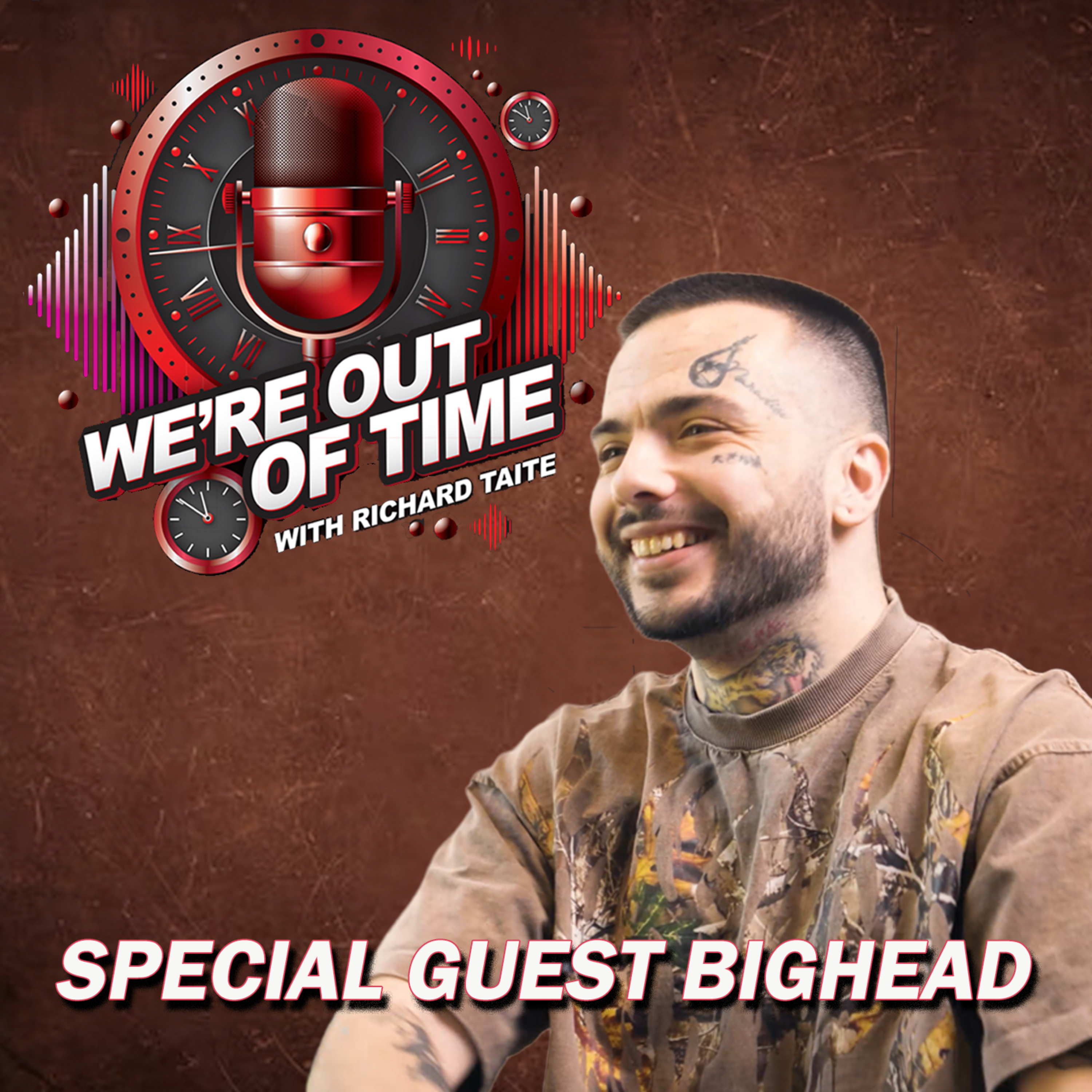
Songwriter, DJ and music producer Big Head joins the we're out of Time podcast.
- [00:04]
B
Fear has driven my whole life, and eventually I started doing music secretly. My dad was a guitar player, but he was like, don't do music. That's just wack. So I got the name Big Head. I would get mad that they called me that, but I was like, I'm embrace it so they don't say it no more, maybe. And I remember being really young, six years old, I'm Big Head. And that became a thing no one ever called me. Nothing else but Big Head. I think that the face tats, especially a lot of people that got them kind of on the same era, it was just to look cool. I literally got these to look cool in front of a girl. I do everything for a woman, dude.
- [00:31]
A
You know, that's how the world works. How long you sober now?
- [00:34]
B
Five years. You know, I thought it was all over. I got sober and I said, the fun's over and I would. I didn't know what was about to happen. The most beautiful life to ever to be like this, dad. To see countries, to love people, to not be angry all the time. You know what I'm saying? And you couldn't sell me on this before. I would have said, there's no way that will happen to me.
- [00:50]
A
Thank you for listening to the we're out of Time podcast with Richard Tate. If you haven't already, please follow the podcast rate and review. And if you're getting value out of we're out of Time, share it with someone else, you know, Big Head, what's good? How you doing, man? Thanks for showing up.
- [01:04]
B
Oh, thanks for having me, dude.
- [01:05]
A
I. I just. I gotta tell you, man, I've had so many underground rappers and I know you're not rapid, right? You're a producer, right? You produce all the beats, right? But I've had so many of you guys come here that I am completely desensitized to the facial tats.
- [01:23]
B
Yeah, yeah, yeah.
- [01:24]
A
Like, seriously, six months ago, I would have been scared, I'd be like, do it. I already just been like, who are these people in my house?
- [01:34]
B
Right? Like that when I walk into places that people are that they're feeling now. Yeah. Especially older ladies and stuff. So I try to be extra nice and smile and.
- [01:42]
A
Dude, you want to know what's funny? After I've met, probably, I don't know, maybe it's 15, 20 guys right now, at least there's one common thread. All kind, all good souls, all showing up just because people are Dying around them and they don't want to see it anymore. You know, I mean, he had a good group of. He had a good community going on here, man.
- [02:14]
B
I think that the. And I think that the face tats, especially a lot of people, I got them kind of around the same era. And I think, like, for me, I'm gonna speak for me. Mine are like, it was just to look cool. I literally got these to look cool in front of a girl. I do everything for a woman.
- [02:27]
A
You know, that's how the world works.
- [02:29]
B
Yeah.
- [02:30]
A
Do you think guys really like driving a Ferrari?
- [02:34]
B
Yeah. Facts.
- [02:35]
A
I mean, how uncomfortable? It's so uncomfortable. The noise is abusive. If you get a scratch, it's 10 grand. It's like, of course. That's the reason.
- [02:47]
B
It's all to impress someone. Yeah. And I think that I just got them because I felt like the insecurities really. Since a child, you know, you just.
- [02:54]
A
Want to fit in and it's like, that's like your thing. Like, you know, what was our thing? I don't even remember what our thing was.
- [03:01]
B
Yeah. I think that your generation was a bit tougher, a bit more not as mentally. Is mentally ill a bad word to say now? Mentally ill? I guess. I think that our yell. I think that. Are you.
- [03:14]
A
Do you want to not stop?
- [03:14]
B
Yeah.
- [03:15]
A
That was beautiful that you said that. Because we don't even know what we can say anymore.
- [03:19]
B
We can't. I know. It's like. And it's just so scary, like, talking at all anywhere. I'm just like, am I saying something that's going to offense? And I say. I walk in on the eggshells and I can't honestly, like, I'm going to keep it real. I just can't stand speaking and being like, being uncomfortable. Like, if I'm going to say it, like just the word mentally ill. I believe my generation is. Is far more mentally troubled and ill than.
- [03:43]
A
Well, it is for me. It is. Because we didn't have social media.
- [03:47]
B
Yeah. I think it's flying us. I do.
- [03:49]
A
Well, it's. It's not just frying us. It's dividing us. Right. Which is a bad deal. But you, as a general rule, it's just. It's ironic to me that the scariest guys or the scariest looking guys are the sweetest guys. I just. It blows me away. It looks scary until you meet the person and then you meet them and you're like, it's all. It's all love.
- [04:20]
B
Yeah. Right.
- [04:21]
A
I want to know from your upbringing, I want to know what it was like to be Little Head and how you got to be Big Head.
- [04:31]
B
Okay.
- [04:32]
A
All right, so tell me about. Briefly.
- [04:35]
B
Yeah, right.
- [04:36]
A
Just over your. Your. Your family life, what it was like growing up.
- [04:41]
B
I grew up. My parents separated in Palme, California, Desert town, racing motocross with my dad on the weekends and sister schizophrenic. So it was. It was chaos. And I was. There's a lot of. I. All my physical needs were. I had a lot of things. I had a dirt bike. I had clothes and skateboarder. I did all this physical stuff. No ball sports. My dad was like, ball sports are lame. You're going to be a motocross racer. But there was cops always at the house. There was a lot of fights. Mom ended up moving back briefly, and we were all fighting a lot of chaos. A lot of schizophrenia. A lot of.
- [05:20]
A
What was the fighting about?
- [05:22]
B
My sister was a dual. Diagnosed from meth. She got schizophrenia eventually from being meth and drugs and. Yeah, she would have delusions and just try to fight my.
- [05:30]
A
Let's go back to that. So your sister was how old when she started doing drugs, roughly?
- [05:39]
B
Teenager. Teenager. I was. So we're 10 years apart. She's 10 years older.
- [05:42]
A
Okay, so let's call it 16.
- [05:44]
B
Yeah, let's say 16 is when it started getting. She was. She was pretty bad. Yeah.
- [05:47]
A
Okay. When did. When did she start doing drugs?
- [05:51]
B
Ooh, somewhere in her 30s, I think. Probably. She finally laid it down. The mental illness got way worse. It's. It's. It's a dysphoria is a gnarly disease.
- [06:01]
A
She might have been something like bipolar.
- [06:04]
B
Oh, for sure.
- [06:05]
A
Right?
- [06:05]
B
For sure.
- [06:06]
A
And that feels schizophrenic.
- [06:08]
B
Well, it was. She was talking to herself, like, out loud.
- [06:11]
A
Dude, I talk to myself. I'm not schizophrenic.
- [06:14]
B
Oh, it was gnarly. About, like, Queen Elizabeth and. And microchips. Like, some of this was like. I was like, man, you're kind of cooking. And now you look. You look at the things that are happening. Well, now I'm like, wait a minute. She's talking about some of this, like, 10 years ago, 20 years ago almost.
- [06:27]
A
You mean to tell me that your sister was talking 10 years ago about stuff that hadn't yet happened?
- [06:34]
B
Dude, it's weird.
- [06:35]
A
I don't know.
- [06:35]
B
It's, like, hard to talk.
- [06:36]
A
Yes or no?
- [06:37]
B
Yes. Yes.
- [06:39]
A
Stop.
- [06:39]
B
Stop for 100%.
- [06:40]
A
We need to get your sister out here, because I could. I could be really nice just to get, like, who's Going to win next year's World Series. I want to know who's going to win the NBA championship. I want to know who's going to, you know, I mean, I want to.
- [06:52]
B
Know all the money.
- [06:54]
A
I want to know who's winning March Madness. I mean, if she can really call that.
- [06:57]
B
Yeah, yeah.
- [06:58]
A
I mean, I want to, you know, not that I'm going to exploit anybody, but.
- [07:02]
B
No, she's, she's, she's awesome now. I love her. But yeah, it was, it, it was these weird delusions that she had and it, it was, it was quite weird. But like it is what it is. You know, I, at the time I would use it like hormi type thing. I couldn't bring homies over.
- [07:19]
A
There was only the. But, but I get it. I grew up with a sick brother. Yeah, okay, but go on.
- [07:24]
B
But. Yeah. So grew up in Palmdale racing motocross teenager. You know, I started seeing girls, got getting girls at 12. My dad was a lot of like, my dad was always like drugs and, and women are gonna ruin your life if you ever do it right. Like you're not gon a good motocross racer. And that was my fear. And I was scared as a boy. That man, dude, riding motocross from five years old and you're lining up with 20 other little kids and going into a first corner and you're tumbling sometimes, dude, it's, it's scary. And, and when you start getting fast, you're 12, 13 and you're racing some fast kids. I started traveling and it was, it was four. Now it's 40 of you 12 year olds going to a corner like on a pretty fast bike. I got ran over all types of injuries and stuff, but it was just, I think it built me tough. God bless my dad for getting me into that. I think that built me to be where I'm at today. You close with your old man today? Yeah, yeah, I am. Well, he passed away three, two years ago or three years I am and but yeah, I was really close to him.
- [08:20]
A
How did he pass?
- [08:22]
B
I don't know. They said on the thing, the thing with the corner. Out here in la, Los Angeles, people don't like to do their job, period. I've noticed in all fields, music industry, any industry, they don't like to do their jobs. So they, when it's an older person, they come and they go, heart failure. Obviously that's like every death is eventually heart failure. That's what dying is. But it said hard failure. But I walked, I got to the house and there was like a cup with like crushed up substance in it. And he's doing like Adderalls and stuff and other substances. I kind of found out towards the end. But he was supposed to be sober. He stopped drinking years ago. But he probably had a little relapse, so he passed away. But I was really close to my dad growing up as well. My mom is like a little Latina lady. That's crazy. I love her. I'm really close to her, especially now. I've tormented that woman, trust me. I used to think it was all her fault and it was all my fault. And she was, she's the best. She's taking great care of me. But I was really close to my dad because of the motorcycle. I was scared to quit racing because of my father.
- [09:18]
A
Right.
- [09:19]
B
I didn't want him. He would be. He was not happy when I did quit.
- [09:22]
A
Right.
- [09:22]
B
He's like, I'm 30 grand in debt. You know, he just was credit card swiping and it's expensive sport. It's not like you go buy a ball and some gloves. This is new tires every week, building the bikes, multi multiple bikes, two a week, practice bike, race bike, stock bike, modified bike. Like it was serious trailer.
- [09:39]
A
Did you do, did you win anything?
- [09:41]
B
Oh, yeah. And I've made some money. I had sponsors. Everything I was. I mean, and when I would go and go to the nationals, like in states and stuff, a lot of the pros that are racing right now, they're about to retire soon. Because you retire early. 30 years old over there in that sport, a lot of them are pro. Now that I was racing, I was getting like 8th. They would kind of smoke me. I was scared. I was scared. Fear has been driven, driven my whole life. There's like that Incubus song and it talks about fear and I absolutely love it. But yeah, it's, it's. If I was just not a little scared, I think I would have been faster. And that played a role my whole life. And eventually I started doing music secretly. My dad, my dad was a guitar player, but he was like, don't do music. That stuff's whack, you know.
- [10:18]
A
But let me, let me, let me, let me go back. Yeah, the fear. The fear is healthy. Yeah, the fear is healthy.
- [10:25]
B
100. Sure.
- [10:26]
A
Because, you know, we're fight or flight people. You know what a man's job was was, you know, he was to, you know, hunt the bear. Yeah, you know, you got to be afraid of the bear. You know, you got to be careful when you hunt Bear right. Fears. Fear's healthy. Here's the thing about fear. Because I get afraid all the time. All the time. I was afraid today and I got reason to be afraid that this is what I do. I lean right into it and then I run right through it. No, because the worst thing is to feel like a coward. Now, I'm not talking about when you're a kid playing sports. When I was a kid playing sports, I got hit. I got cracked the first time I went back to pass and I got cracked but good. Okay. Now there's two things you can do in that moment. Can either dust yourself off, get angry and go, okay, let's go. That's not what I said. Yeah, right. What I said was, oh, you better start learning how to read. Okay. Because this ain't for you. Really?
- [11:40]
B
Yeah. And but see, you got cracked. You had a reason. Like I crashed.
- [11:44]
A
Yeah, dude, you got run over and tumbled up here.
- [11:48]
B
Was not even. There was not even a reason. You know, you're just like fearing maybe this can happen, which is you're saying it is healthy and. But you know, there was days I remember my dad wrote this day down like it was July 7th or something. And I remember that day. I was probably 7 years old and there was this one kid and he was really fast and there's a bunch of them and I would probably get like 5 5th at the time, kind of way back I wasn't jumping the jumps and some of these kids were really fearless and they were jumping these jumps. But that day I woke up, I remember I took a nap. It's a Saturday night race. I took a good ass nap at the track and I wake up and there was no fear. I remember it. I'm getting chills talking about it. And there was no fear. And I was there with my. So I got the name Big Head. I'm going to talk about this real quick. From a guy that was there. It was a racer. I used to stay at their house during the week when my dad was working. And the older bro, he's the older brother, he's probably in his teenage. And he's like, you got a big head. And they'll make fun of me hard and, and like throw us around and punch us and stuff. It's just like kind of like toughen us up. And they'll call me big. And I. And I only know he didn't deal with. It was like, yeah, I'm Big Head. So what? I would get mad that they called me that, but I was like, I'm going to embrace it so they don't say it no more, maybe. And I remember being really young, six years old. I'm Big Head. And that became a thing. No one ever called me nothing else but Big since I was a child. But I. That day at that track, he was there, the guy that calls me Big Head. And there's an open practice. You could ride with the big hits a little. Everyone just does a quick little couple laps around. And he was like, look, follow me on the jumps. He was on a bigger bike, and I followed him. And I just decided to jump him during practice. So I kind of got it down. My dad's super pumped. And then I go to race. There's no fear, dude. I'm like. I felt like something else was controlling me. And I won this race by, like, a lot of distance. Like, I smoked these kids. My dad was the best day of his life. That he wrote it down and brought it up until my adult years. I mean, even until I started in music and success in music. He'll try to, like, bring it up and talk about it and remember that day, July 7th. And he, like, when I was in doubt with music. And I'm like, dude, it's not working.
- [13:52]
A
Do you know what a beautiful story that is? I mean, we're hardwired to my mark, our parents. I say that, but he loved you.
- [14:06]
B
Oh, dude. So much.
- [14:08]
A
And it's so much.
- [14:09]
B
The following weekend, guess what happened? Smoked, didn't jump. Not one of the same jumps. Back to the old normal.
- [14:14]
A
Back to the old.
- [14:15]
B
Back to the fear. From there on, that thing was lingering.
- [14:18]
A
But you just needed somebody to get you psychologically, right? You know, like there was.
- [14:27]
B
It was that older guy, too. Him. Him. From him doing the bully stuff. When I was at their house and on the trampoline or touching me, I wanted to impress him. So when he said, come on, just jump it. I didn't want him to. Like, I was. I trusted him.
- [14:40]
A
That's right.
- [14:41]
B
It was like a big brother role.
- [14:42]
A
All right, let's get on to. I want to go back to the family. You said that there was a lot of fighting at the house. And it can't just be because you've got one sister who's got mental illness. There had to be some drinking or using in the house. Who is drinking and using in the house during the fighting, to be honest?
- [15:06]
B
Well, my mom would drink occasionally, but she does turn. She does turn into a different person when she drinks. She's like. She's the type that drinks and it turns a little different. She's not like.
- [15:13]
A
You see how I know what I'm talking about? Go on.
- [15:16]
B
But most of it was my sister using. And she would come home on these rants and just. I mean, I'm serious. Like a bulldozer coming through. And then I got to an age where I started fighting back. I was like, you're not gonna hit my mom or my mom's not gonna hit my sister. And I. And I just. And I had that anger in me too. And I felt good in the getting angry. And yeah, there. There's these fights. And even me, though, even me, my dad would get these girlfriends and I would want to fight with them, and I don't want them taking my dad away from me a little, you know, being a little kid, teenager even, until I got around 14 or I started getting my own girls at school. And I'm like, that's lame to do that to my dad. But so I was. I'm the same. I got. Me and my mom got that feistiness in us. And I was a little angry child, though. I was angry at the track. I was angry all the time. I like to spaz out. I. I started making beats when I was around 7, 16. And I'd get angry at that too, when I'm not. I mean.
- [16:08]
A
Let's grap to the house. Yeah, let's go back to the house. Okay. So now it's not just your sister.
- [16:16]
B
It's a bad family dynamic.
- [16:20]
A
It's not just the sister who's mentally ill. She's also doing the meth.
- [16:27]
B
Yep.
- [16:27]
A
Okay. You've got the mother who's drinking. Not a lot.
- [16:32]
B
Not a lot. Yeah.
- [16:34]
A
Mom, you don't drink a lot. But when she drinks. Okay. She turns into a different person. Right.
- [16:44]
B
100.
- [16:44]
A
Okay. That would contribute to the fighting.
- [16:47]
B
100.
- [16:48]
A
Was your father sober at that time?
- [16:50]
B
Oh, yeah. Sober and promoting it, like that was his thing.
- [16:53]
A
It was excellent. What did he do when there was all this discord in the house?
- [16:59]
B
So he's like the avoidant time he freeze. Kind of goes, oh, my God. My dad's never been in a fight. He's really soft spoken and goofy. You know, you kind of go, oh my God, I get really stressed out. Until you could push him a little bit. And then he'll get mad, but not hitting on. He just gets mad, but he's really calm. He's really freaks out. He's really soft. And he'll go, sweet. He'll go, oh my God. He freaks out. And he Stresses out. And I remember being a kid looking at my bro, stop freaking out. It's just some fighting. I had that mom toughness. And I was like, bro, we're chilling.
- [17:25]
A
You know, that's right.
- [17:26]
B
He'll think about it for a week later and it would frustrate him.
- [17:29]
A
So let's go into this. I want to talk about your druggies. Tell me about your druggies.
- [17:37]
B
That's fine. I end up being the worst one.
- [17:40]
A
That's why you're here.
- [17:42]
B
Yeah, so, I mean, so I started, like I was making beats at 16, and then there was no drugs and I was. I've never even smelled. I. I tried weed one time as a teenager. I was really scared. Scared of alcohol. I'm the type at the party, 14, 15 people are drinking, and I'm like, yeah, yeah, take a beer. And I go like this. Then set it down far away so no one knows I'm not like. Or just hold it. I'm scared to feel the effect of anything because of what my dad had said about it. He made it sound really scary and turned out like your sister. He told me about how his careers got ruined from drinking, and I believed it. And mom, dad ends up marrying some girl and move a lady and moves away. God bless her, she's a sweet woman too. And he moved away. I moved with mom. And I'm becoming an adult and I'm making beats and I'm making money off of websites. I haven't got a big song yet. And my friends would always make fun of me. Say, you're overthinking. You always overthink. I'd try to make beats in front of them for my little rapper friends from a hometown that you're overthinking, you need to take a Xanax. And finally I was like, maybe you're right, you know? And I. I started taking some Zans. And dude, I remember I took that thing, but I didn't know what the effect was going to be. And I laid down in my bed and I took this quarter piece of a Xanax, not even on. I laid there like, I laid there scared as. Waiting for it to hit me. And it hit me and it was the greatest feeling ever. I got up, walked down to my mom and told her, mom, you're the best mom ever. I gave her a hug. I remember this day, and I was so. Life was so colorful in that moment. And I said, holy, this is exactly what I needed.
- [19:08]
A
Time out for the kids at home. It always starts out all fun. Then you Graduate to fun with problems, and then you graduate to all problems.
- [19:21]
B
Yep, 100 and quick. I'll tell you quick. So I was probably around 18, 19, 19, and I'm making, you know, and then quickly progress. I mean, the next week, I'm doing other drugs. I'm doing cokes, drinking.
- [19:33]
A
Do you know why that is?
- [19:34]
B
Why is that?
- [19:36]
A
Oh, were you happy or were you depressed at that point in your life? Said you were angry.
- [19:41]
B
I think that at that moment when anxious.
- [19:44]
A
Okay, good. But when you're angry. Okay, look, when you're depressed, right? You're in a weakened state. Okay. When you're angry, you're in a stronger state.
- [20:00]
B
Yeah, yeah, yeah, yeah.
- [20:01]
A
Right. Depression feels victimizing.
- [20:04]
B
Angry feels powerful.
- [20:06]
A
It feels powerful.
- [20:07]
B
Yeah.
- [20:08]
A
Okay, so when you take an opioid or a Xanax, what happens is when you're depressed, you're no longer depressed.
- [20:20]
B
Yeah.
- [20:20]
A
Right. And when you have that moment where your head's chewing on you or you're anxious or whatever it is, and you get that relief right away, you want to do it every day. Every day. You don't want to deal with that nonsense that you just, you know, and so. But it always starts and middle. And ends the same. It always starts and ends the same. It's all fun. You graduate to fun with problems, and then it's all problems.
- [20:55]
B
Right. And it's even. It's even more manipular. Tricky than that. Like, I mean, not only did it make me feel amazing, like, the outs. Outer side of my life started becoming really good. I started making more money, the women were better. Everything that tricked me, it's like. It's. It's insane. You know, I'm starting.
- [21:12]
A
Let's unpack that for a second.
- [21:14]
B
Yeah.
- [21:15]
A
Okay. At the beginning, when it's all fun. Meaning it's working.
- [21:20]
B
It's working. Yeah.
- [21:21]
A
Right. Why is it working for you?
- [21:25]
B
Probably it's giving me more confidence. I'm thinking less.
- [21:28]
A
Okay, hold on. Liquid courage.
- [21:31]
B
Yep.
- [21:32]
A
That's an excellent example. If you're in a bar and you see a girl and she's so beautiful, you're a little intimidated. At least what I used to do when I was a kid because I was afraid to talk to. Right. I would suck back a couple shots, wait a couple minutes, walk up and go, hey, babe.
- [21:52]
B
Yep. I don't care if she. If she says no or yeah, I'll walk away if you did. If you turn me down. Okay, next one.
- [21:58]
A
Well, the first question I always asked is, do you have a cat?
- [22:01]
B
Oh, that's good.
- [22:03]
A
I Mean, I don't do the cat thing. I can't do it.
- [22:06]
B
Cat. I like. I'm a dog guy.
- [22:08]
A
I love dogs.
- [22:09]
B
Cats. Cats. I don't think they. With us.
- [22:12]
A
Yeah.
- [22:12]
B
But like cats. So I start, you know, I'm starting to do the normal thing. Partying, doing the party. Drugs and music's going good. I'm making more money making good beats. And that leads to me coming from Palmdale, it's an hour from la, going out here to parties and stuff and meeting people. And there was an underground scene with like, you know, I was around the time little Tracy and Peep and all them are starting to kind of pop off and famous decks. I started. I had somehow long time out.
- [22:39]
A
Can we get those other two cats on the. I. I hate it when the guests talk about people that we haven't had on the show yet. It makes me feel like just less than.
- [22:50]
B
Yeah. And I. And I started meeting these people and. And I. My social life got bigger and. And it wasn't that bad. My drug use wasn't unmanageable at the moment. It was. It was pretty manageable. It looked a little crazy, but it was working and. And I was making money and kinda. And spending a lot of money.
- [23:07]
A
And how did it. How did you start realizing that this was maybe becoming a problem?
- [23:16]
B
So career absolutely blows up. I get a big song or I get a bunch of big songs and I'm around like the Peep, Tracy and the whole goth boy clique. And I had already had songs with famous decks and I'm getting my Instagram's following scoring. Everything's going great. And I had some idea to like. I met this drug dealer and he was giving me op, like pill opiates. And then he ran out and I. He was like a heroin guy. And then finally kind of like, I was so sick of being sick that I tried it. Just a little hit. I was like, oh, I didn't ins. I thought you would do some heroin. And I'm instantly homeless. Yeah. You know how they get the stigma behind it, which is. It's gnarly, you know, but.
- [23:56]
A
Well, it's like. It's not far off.
- [23:58]
B
Yeah.
- [23:59]
A
Instant.
- [23:59]
B
Yeah, it's not instant, but it's quick.
- [24:01]
A
But it's. But it's very quick.
- [24:02]
B
Yeah. So I did it. I was like, oh, that was not. As a matter of fact, it wasn't even as strong as the pills when I first tried it. So I'm like, damn.
- [24:09]
A
How did you do it?
- [24:10]
B
Smoked it. Okay, well, that's one Exactly. So. So I was like, oh, that's not even that bad. And it's cheaper. So like a few days later, I started hitting that guy up, like, let me get some of that stuff. And it was nasty at first. I got used to it. And running that. And then.
- [24:22]
A
So nasty.
- [24:23]
B
And I was on the tinfoil. Oh, yeah. Oh, no, no. I was like a classy guy. You know, I'm like, I'm in the bends with some metal things. Like, not metal things, glass stick things. And yeah, it's called the glass pipe. Not like, like these. They're like these sticks. I know what they are. Or paperclips. You can use paperclips. And I heat up one paper clip and then tap it with the other. And I would smoke it that way. And. And in the meantime, I had just like, I mean, I'm on. And I met Little Pump at that around that time. So we. I've been DJing for pump and now I'm starting to do this heroin thing. And then shortly after that, that same guy, the same drug dealer was a crackhead. Yeah. So doing the heron thing. And I'm. And I'm doing the traveling too with Little Pump doing the DJ thing. And it was really difficult to have drugs and. And all this on the planes and running out, withdrawing in cities. And I would tell I would have to make a lie up and like, I gotta go home because X, Y and Z. But really I was withdrawing and finally I ended up telling everybody I got this problem. And I get sober for a month, go on another tour, come back, relapse, did that cycle for a long time. Met. I eventually started doing crack. And that's when I got gnarly.
- [25:29]
A
Okay, stop. How long were you.
- [25:32]
B
Oh, you're about to hear it, dude. So I made a bunch of money, more money than I've ever seen in my life. These royalty checks were huge. I go home, you know what I'm saying? Every three months, big royalty checks. And I'm doing crack. And when you have a lot of money in your cracker, when do you start smoking crack?
- [25:48]
A
When you run out of money.
- [25:49]
B
When I run out of money. Exactly. So I was. I mean, I was buying ounces a week.
- [25:53]
A
I'm.
- [25:54]
B
I was a little scared. I was like, this is not good for me. I'm the type to do it. And I go, it's beating a little too fast. I gotta go to hospital. I tell like the drug dealer, whoever I'm with, you got to take me to hospital. Like, bro, chill out. It's beating fast. I'm one of those guys I'm annoying to be around on drugs. Yeah, dude, I'm just. And another thing, I would have all these people and I'm, I'm like this producer that's blowing up and I'm doing interviews with like all these companies and I'm on Billboard at the time and I'm just a full on heroin addict and crack addict.
- [26:21]
A
And when did the wheels fall off then?
- [26:23]
B
Quick. I mean, that year 2017, 18. That whole up until 19 years doing the drugs. Well, I lost everything and I had to go, mommy, I need to come home. And my mom's living in like a one bedroom apartment with my sister. And that. They're still fighting. Same thing. It may have been even worse at this point.
- [26:46]
A
Right.
- [26:46]
B
And they're. And I come in with my girl and somehow she's pregnant now.
- [26:56]
A
And somehow she's pregnant.
- [26:58]
B
Yeah, I got her out of.
- [26:59]
A
Only we knew how.
- [27:00]
B
I got her pregnant. And we're about to have a baby and we're in my mom's house. I have nothing and I'm just a full on tweaker. We have the baby. I don't get sober. DCFS is like kind of involved because they see me at the hospital doing weird stuff in the hospital. Like this guy, I don't know.
- [27:17]
A
The Department of Health. Child Services.
- [27:21]
B
Yeah, yeah.
- [27:22]
A
What is this? Because I, I'm sorry, why is Child Protective services coming to you?
- [27:27]
B
Well, they're, they were, they, they caught me in the, in the hospital getting loaded and they're like, wait, where's this baby?
- [27:32]
A
Oh, wow. She's get. While she's delivering.
- [27:35]
B
Yes, yes, yes. The crazier part is in the moment, it doesn't even feel out of the norm. You're trying to just. I'm just trying not to withdraw. And it was. And at this time, I'm doing fentanyl as well. I wasn't even doing heroin no more.
- [27:46]
A
Fentanyl is so much worse.
- [27:49]
B
So it's, it's insanely dangerous, I'll tell you that. Well, I'm in the hospital and the DCFS comes and they want to know where the baby's going. And, and obviously it wasn't going back to a fit household. It was a one bedroom with five of us or four of us in there. So that happens. And I don't get sober till four months later. I woke up.
- [28:06]
A
Did they take the child?
- [28:08]
B
So I went with the other grandma. It was a safer fit. And we all mutually agreed that we should do that.
- [28:14]
A
The department of children's services.
- [28:18]
B
Yeah.
- [28:18]
A
Said they can't go home with you, but they can go home with your girlfriend. Mother.
- [28:24]
B
Yeah. And the girlfriend.
- [28:25]
A
I mean, I know in the moment, that was horrific, right? That it didn't feel as bad as it was, but now that you're sober, okay, how do you feel about. What does that feel like to have. The day your child is born, you. You get caught smoking crack cocaine in a hospital, and you don't even get to take that kid home with you?
- [28:54]
B
At the time, I was pissed because I'm not looking at my part.
- [28:58]
A
I don't care about the time.
- [28:59]
B
Oh, look at the back now.
- [29:00]
A
I care about right now.
- [29:01]
B
Oh, dude. You know, honestly, looking back now, I'm grateful that they were aware and they could did because I don't think it was. I was a safe fit to be. Like, wasn't fit to be a parent.
- [29:11]
A
That is a beautiful answer.
- [29:13]
B
So I'm.
- [29:14]
A
I really. I didn't even. I didn't even see that coming. That's such a beautiful answer.
- [29:19]
B
I was actually really mad at them for a while. That whole department of the world or whatever, dcfs, and. And then I realized, like, God bless them and thank God.
- [29:30]
A
Do you ever feel, like, remorse for that? I would have been like, I. That would have been something that I would have been like. It would have traumatized me forever.
- [29:46]
B
It does. And what even more traumatizing, what if I'd even get better into. What would she be now? She's five. Imagine her dad wasn't there. And I think about that like, oh, my God, I could have missed it all. All the way up until this moment.
- [29:58]
A
And you don't really know what love is until you have a child.
- [30:01]
B
Don't I tell everyone that I want when they. When my homies come, My girlfriend stopped loving me or she wants to have a kid. Every time your K comes, it does anything. As a human, if they throw a ball like this, it's the beautiful thing you've ever seen. Like, you don't understand. Like, your girlfriend, you love her and infatuated at first. Then you guys get used to each other a little bit. Then in bickering your kid, even when she gets in trouble at school, you're like, ha. Look at her getting dry. That's my girl. I love this girl.
- [30:28]
A
Unconditional love. Because before, you know, we have children, you're like, you love your girlfriend, you love your dog, you love pizza, you love ice cream. Whatever it is, it doesn't really matter what it was, okay? Because all of it combined. Does it come close to the love you have for your child?
- [30:45]
B
Oh, dude. I sometimes want to cry looking at her.
- [30:48]
A
I. I do that all the time, dude.
- [30:50]
B
It's all the time. It's incredible, bro. And I could have missed it. And when you said that just made me really gr. Like, in great gratitude because I could have. I don't ever look. Think back to then.
- [30:59]
A
I don't ever want you to forget, though. Okay. What you did, you've clearly forgiven yourself for it, and.
- [31:06]
B
Oh, yeah, it's cool.
- [31:07]
A
Nobody needs to beat themselves up over anything in the past.
- [31:10]
B
Yeah.
- [31:11]
A
But to keep that in your mind and say, that's who I was, that's what I did, and never again.
- [31:20]
B
I have to remember it.
- [31:21]
A
You have to, ma' am.
- [31:23]
B
Yeah. And four months later, though, I woke up just empty one day. No one wanted to lend me no money. I had nothing. I just negative seven to ten grand in my bank accounts, and they wouldn't let me go. More. No more. Negative. Couldn't. I was withdrawing, and I looked in the mirror and I was like, you know what?
- [31:39]
A
What?
- [31:39]
B
A treatment center might have sub boxing and I could get feel better, but I don't have insurance or money. And I called my manager at the time, or he's still my manager, and I was like, hey, I think I'm ready to go to treatment. And he was like this. He was really happy. And that was annoying, too. I was like, okay, bro. So he made a bunch of calls and. Yeah. And I went to a treatment center and. And my life started changing from there on.
- [32:03]
A
How long you sober now?
- [32:06]
B
Five years.
- [32:06]
A
Well, how's your life? Blown up.
- [32:10]
B
Well, everything got better. I got my daughter back at a year sober. I had to do a lot of work to do that. I wasn't allowed to see her that much, only, like, visitations, because I wasn't drug testing or nothing. I was still on drugs for those first four months.
- [32:23]
A
Sure.
- [32:26]
B
You know, I got to sign a bunch of other producers. You know, my music career didn't fully blow up after.
- [32:31]
A
Hold on, hold on. Because it's.
- [32:33]
B
That's.
- [32:34]
A
I just read that you have like 5 billion downloads or streams. Streams, right.
- [32:41]
B
A lot of that was from my past records I had made in addiction. And, you know, that's like a little peep had passed away. And a lot of those songs blew up after his passing. And that happened. He passed away while I was using fentanyl, too. He. He passed away due to a fentanyl overdose. A laced pill. He wasn't trying. I was doing fentanyl knowingly. He wasn't do anomaly. And I think a lot of people. Most people that are dying from fentanyl aren't doing fentanyl, right?
- [33:11]
A
No, no. The people that are doing the fentanyl have. Have acquired a tolerance and they've learned how not to die. Okay. Now they're not always successful. Okay. But the people that are getting. The. The people that are buying cocaine and it's laced with fentanyl, they're dying. And they're dying because they're getting something that they haven't bargained for.
- [33:39]
B
Yeah.
- [33:40]
A
They don't have any tolerance for it. They don't. Right. And the same thing's happening with the press. Perks.
- [33:44]
B
Oh, yeah.
- [33:45]
A
You think you're getting a perk. Okay.
- [33:48]
B
And once one of it could be a little stronger, you know?
- [33:51]
A
Yeah, right.
- [33:52]
B
Even if they're doing those.
- [33:53]
A
No, baby, they're all different. Yeah, they're all different because you got a guy in a. In a hazmat suit.
- [34:00]
B
That's crazy.
- [34:01]
A
Like, stirring it up in a big vat like this, and so. And then they pour them into pill molds. Well, that's not very scientific. That means you're gonna die at some point. Okay. It's not if, it's when.
- [34:14]
B
Yeah.
- [34:15]
A
So that's all it is. But. But what you're telling me is a big part of it happened before you got sober. But. But it was kind of a backhanded accident, if you will, because guy, little peep, he passed away. And when he passed away, his screams went up. Right. And that, you know, was a thing. But that's unlucky. I mean, it may have been lucky in streams or whatever the hell that.
- [34:54]
B
Means, but if he was alive, I think that he would have became a superstar and we would have made more streams than that. I think that we would have made some awesome music.
- [35:02]
A
Right, but you had to have done something. I mean, look, I don't want these guys thinking, yeah, I was great, and, you know, I was killing it and I was loaded. And then I got sober. Oh, And I got my daughter back. It's like.
- [35:16]
B
No, no. Yeah, I know. No, it keeps going. It keeps going. That's not. That's at first. Those first few years, though. So we're. We're a bit stagnant with the music because you got to think it was 2019. I got sober and covet hit.
- [35:29]
A
Right.
- [35:30]
B
So I'm in the house.
- [35:31]
A
But in Covid hit, that's the perfect time to throw.
- [35:34]
B
Yeah, but. But that's the thing when. And. And I'm sure there's people out there that do music and, and actually, I know a lot of people that's got. Try to got sober. And the transition from sobriety to trying to make or from drug use and then sobriety and then trying to get back into music and your flow back is difficult at first.
- [35:51]
A
So it's not that it's. No.
- [35:53]
B
For me. Well, it wasn't difficult.
- [35:55]
A
It is.
- [35:55]
B
Yeah.
- [35:56]
A
You're. You just need your head cleared up.
- [35:59]
B
Yeah.
- [35:59]
A
You're working in a different baseline.
- [36:01]
B
Yeah.
- [36:02]
A
The loaded. You were loaded and that was the baseline.
- [36:04]
B
Yeah.
- [36:05]
A
And that's what you were used to. Right. And then you get sober and your head's just not clear. And it takes a while for it to clear up, but the second it clears up, it's 10 times better than it was.
- [36:17]
B
And you know what I think? And I look back on it even now, is that about my work ethic? Like, even back then, it was a lot of luck. Like, when I was getting loaded, it was a lot of. That was like in the right place, in the right moment because I wasn't putting a big work ethic. I was getting more loaded than I was making music. It was like just these wacky random beats. I was not making a lot of music. I wasn't putting a lot of time into it.
- [36:37]
A
Got lucky, dude.
- [36:38]
B
I know kids that are doing it all day, and I, I would be around those type of kids. Sometimes I'm like, you guys are dorks. You know, I do it easily. I had this crazy ego. And so that work ethic, even though I got sober, that I kind of kept that work ethic and belief. I thought like, so I would be sober. And I, and, and I was still that lazy. Mother was still lazy on drugs. I'm still lazy. And I, I. A guy one time told me, he was like, I told him, he asked me, he's like, why aren't you making that much music? And I go, I know. I go like this. I'm like, I don't like it. I don't like nothing about. He's like, what don't you like about it? Nothing. I don't like putting the opening computer. I don't like looking at the software. I don't like sitting in a chair. I physically get tired when I sit in a chair. I want to put my head down and sleep. Like, that's how I felt. And he goes, hey, I. I want you to do something. This is a random guy. I knew he doesn't do Music. He goes, every day, I want you every day, once a day. Go home and open the computer, but don't make a beat. Open it, open the software, sit there, look at it, close the software. Boom. Close it, and then do whatever you want each day. Do it for as long as two weeks, Whatever.
- [37:36]
A
I love this fan.
- [37:37]
B
Go on by, like two weeks, not even maybe a week of me doing that. I finally opened the program, and I go, I don't listen to his rules. I go. I start making a beat a little bit it, and with it, no expectation. I just start an idea and I go, you know what? Not having feeling it. Close it again. And I started doing that every day, touching it and enclosing it. And I'm already, like two years sober at this time. And eventually I start making beats again a lot. And I start hanging out with other younger guys that make beats that are the new school guys. And they're putting me onto these new artists, and they're giving me the new sauce. Like, you got to do it this way and that way. And I'm just like this. I started loving it again, and I start working, and I put my focus back to what my focus was when I was. When I was doing drugs, was working with the guy that's coming up, like the little Pumps, the famous Dexes that were not mainstream yet, but they had potential, even Peep Tracy. There were these small artists at the time. They didn't have a success yet. I was like, I'm just gonna do the same blueprint now. And I started working with, like, these small artists. Some of them went somewhere, some of them didn't, but some of them were. Some big songs came out of it in sobriety. But I did notice something. And I don't know. This is a whole nother discussion. But streaming used to get paid more easily and used to get paid for one beat way more. I remember I did this NBA youngboy song, and my advance was much bigger than the advances that they give for the same caliber artists now. Because I've had songs from that same label now, and it's cut in half. So inflation's going up, but producers are getting paid way less on advances because so many of us. So that would discourage me in sobriety. It's not that. It's because I got sober and things got bad. I just got a little discouraged at.
- [39:12]
A
Times because the climate or the environment always changes. And I made that mistake. I made that mistake all the time.
- [39:22]
B
Are you kidding me?
- [39:23]
A
I came into this treatment thing. You're the best you're the king. The prop. I walked in and just got my. My butt kicked.
- [39:34]
B
Just.
- [39:34]
A
Oh, yeah, just. Just worked. And then I got really scared and I probably slept two hours to three hours a night for the next year until I figured it out.
- [39:48]
B
Yeah.
- [39:49]
A
But, yeah, our ego, not our amiga.
- [39:53]
B
Definitely not.
- [39:54]
A
Let's talk about who. Have you known who has died of Fentanyl?
- [40:03]
B
Well, little peep. I know my friend Kawhi.
- [40:06]
A
Fentanyl. Yeah, that's how he died.
- [40:08]
B
Yeah. Fentanyl overdose. Lace pill. My friend Kawhi, you know, and. And it's so hard to remember everyone because it's like there's so. I'm in recovery and there's so many guys dying, right? People that we don't know. But I. I have these relationships with them just.
- [40:25]
A
And they're dying of people, like, just. If you're out or you're in, you don't go to the club anymore, do you?
- [40:34]
B
I'll tell you what, I don't see overdoses in any. I go to countries with pump. I don't see overdoses any other country. But if you're in, if you're DJing somewhere in America, you'll see someone fall out 100. There's going to be a person, you know. No, it never happens in any other country I've ever been to. Not even, like, fights, really. Maybe a little bit. A couple fights. Maybe in Italy, like some like, European country, but Asia and all that. You'll never see some drunk fight or even a person out of their mind. It's only in America and mostly Western, even in Europe and stuff.
- [41:16]
A
But.
- [41:17]
B
But I'm not the sober where you're like, I don't want to drink trigger. I'm not triggered right. I'm confident, too. That confidence I got when I was telling you earlier about when I first did some blow or whatever, that confidence was present sober, where I was like, what? What's up, girl? I could talk to girls. I could do that now, most of the time, not these LA girls, but. But I'm like, you know, I'm feeling. I'm like, what a beautiful. And I had to film it, bro. I put my phone in and I got. I had a post on Instagram. I said, like, I said something about sobriety being amazing. How the hell did I end up here, right? You know, I thought it was all over. I got sober and I said, the fun's over. I. It's over. And I would. I didn't know what was about to happen. The most beautiful life to Ever. To be this dad, to see countries, to love people, to not be angry all the time. You know what I'm saying? And I was like, there's no way. You couldn't. You couldn't sell me on this before, I would have said, there's no way that will happen to me.
- [42:09]
A
So I'm just trying to figure my way through this thing, right? I mean, I've never seen a podcast. That's not true. I saw my buddy Chris Bell on a podcast with Joe Rogan. I saw that for 10 minutes. But really, that's the only podcast I've ever seen, and I've never listened to one. So I don't know what the hell I'm doing here. And I'm just trying to figure it out as we go. And, you know, it's funny because one of my best friends looks at me and he goes, you suck. And I said, absolutely. But I'm gonna do this until I get great at it.
- [42:47]
B
I love that. I need that.
- [42:50]
A
That's what you got.
- [42:51]
B
I got that.
- [42:51]
A
No, you got it inside of you. Absolutely, I got that. Yes, sir. You got. You know where you got that? Where you got that? When you were following that guy over that job. That's where you got it. You have it. You just need to access it.
- [43:08]
B
Yeah.
- [43:09]
A
See, that was a zone. That was no different than, you know, hitting four, three pointers in a row. Yeah, you're in a zone, but then you gotta lock into that zone every once in a while. Okay. It's hard to get there, but you can get there. Okay. We talk about that off air. Hey, buddy. Thanks for coming, man. I really appreciate it. It's been a great episode. Where can people find you at?
- [43:36]
B
Kill Big Head on all platforms.
- [43:40]
A
Name the platforms.
- [43:41]
B
Instagram, x Twitter. That's all I use. See you next Tuesday. Is that good enough?
- [43:50]
A
Oh, yeah.