← What A Day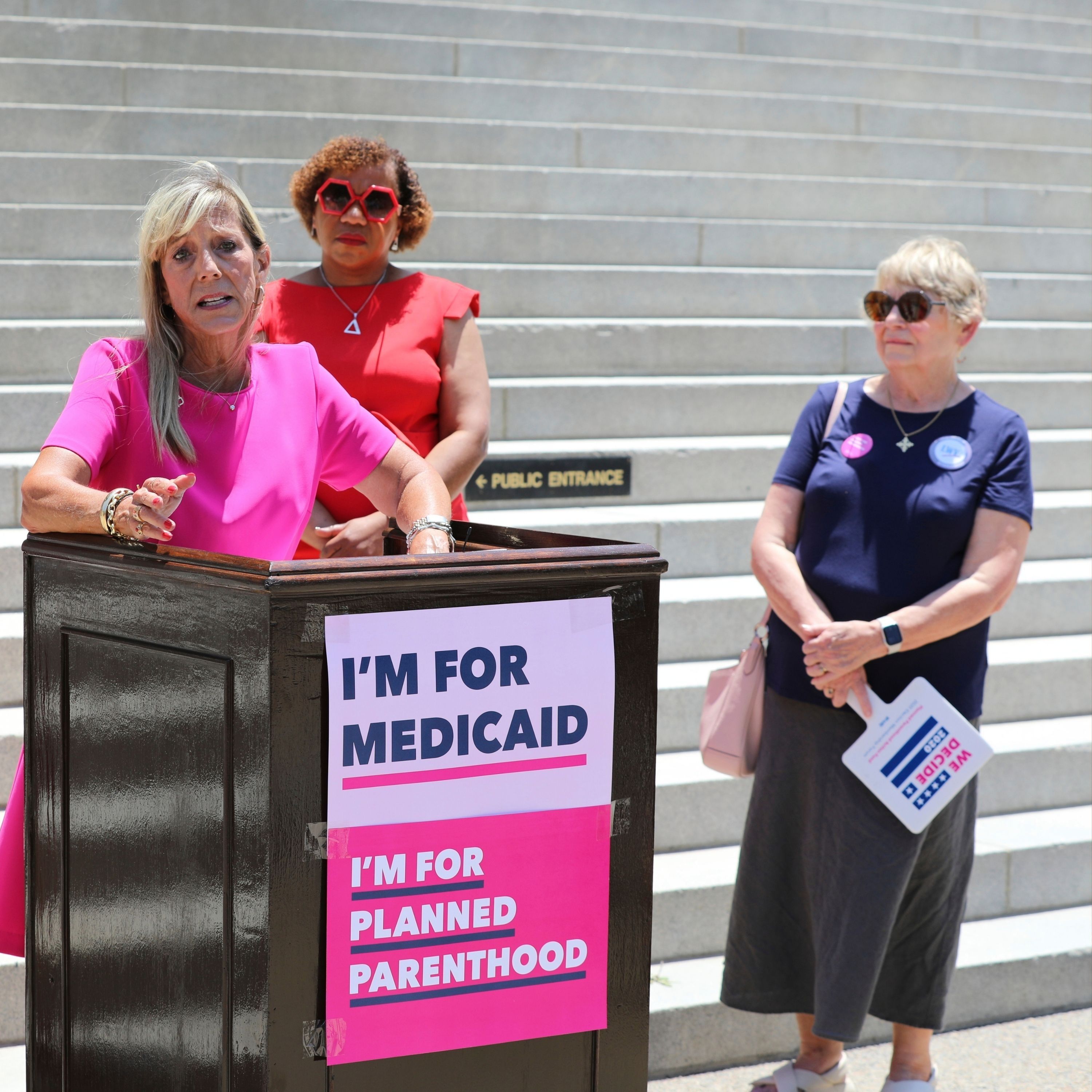
What A Day
A Blockbuster Day For The Supreme Court
00:22:39
The Supreme Court will issue a slew of major opinions today on what’s expected to be the final day of its current term. Still outstanding are decisions in cases over President Donald Trump’s birthright citizenship order, a voting rights challenge in Louisiana, LGBTQ books in schools, and more. On Thursday, the court also paved the way for states to bar Planned Parenthood from receiving Medicaid funds, even for services not at all related to abortion. Jessica Levinson, a law professor at Loyola Low School in Los Angeles, explains the justices' Planned Parenthood opinion and what they might have in store for us today. And in headlines: Republicans are racing to meet a July 4th deadline to pass President Trump’s Big Beautiful Bill despite yet another major setback in the Senate, Congress is still at odds over whether the US strikes on Iran “obliterated” the country's nuclear program, and a CDC vaccine panel made recommendations that could make it harder to get the flu vaccine.
Loading summary
Transcript56 lines
- [00:03]
Jane Coastin
It's Friday, June 27th. I'm Jane Coastin and this is what a day. The show that says happy 10 year plus one day anniversary of Obergefell v. Hodges, the Supreme Court case that legalized marriage equality in all 50 states. Today, marriage equality has a 68% approval rating in the United States. And if that's not surprising or amazing to you in any way, go find an older LGBTQ person and ask them. On today's show, Defense Secretary Pete Higseth whines about news outlets not toeing the White House line on the success of the Iran strikes. And Republicans face another major setback on their big, beautiful bill. But let's start with the Supreme Court. The justices say today is going to be the last day of the current term. And boy howdy, they've set themselves up to release a lot of big decisions in just one day. As of this morning, we're expecting decisions in a case challenging President Donald Trump's executive order to end birthright citizenship. The justices aren't specifically deciding the birthright citizenship part of the case right now, but they are expected to weigh in on how much power lower court judges have to block orders like these from going into effect nationwide. We're also expecting opinions on a big voting rights case out of Louisiana, a case about porn and age verification from Texas. There is an Obamacare challenge, and a case about LGBTQ books in schools. It's a lot, and I'm personally not feeling great about it. On Thursday, the court also issued a bunch of opinions as it winds down its term. The big case the justices decided essentially paves the way for states to block Planned Parenthood from receiving Medicaid funds, even for care that has nothing to do with abortion. Given the zeal for red states to, quote, defund Planned Parenthood, this could put the organization at real risk in some areas and make it even harder for low income people to get care of any kind. So for more on the Medicaid Planned Parenthood decision and the horrors that might await us today, I spoke to Jessica Levinson, law professor at Loyola Law School in Los Angeles. Jessica, welcome back to what A day.
- [02:09]
Jessica Levinson
Thanks so much for having me.
- [02:11]
Jane Coastin
Let's start with yesterday's decision in the Planned Parenthood case. It was another 6:3 decision along ideological lines. What did the conservative justices decide?
- [02:20]
Jessica Levinson
I think the strange thing about this case is that it feels like it has something to do with abortion, and in some ways it does, but in other ways, it actually has nothing to do with abortions. So what's happening here? Are There are a couple of different federal laws. There's a federal law that says that if you're qualified for your state's Medicaid program, then you can go to any qualified provider. Back in 2018, South Carolina's governor signed an executive order saying, basically, we don't want Planned Parenthood to be a qualified provider anymore. Now, we should remember at this moment that federal funds can only be used for abortions in very rare circumstances. Rape, incest, the life of the mother. And so South Carolina is trying to essentially take Planned Parenthood out of its Medicaid program. So Planned Parenthood doesn't get reimbursements for a whole host of things, including cancer screenings, for instance, and, well, women's visits, et cetera. Now, the question was, can a private individual and Planned Parenthood sue when you have this federal law saying you can go to any qualified provider? I know it took a long time to explain that. I don't know a shorter way to explain it. And this is why, to get back to my original comment, this is a case that's about abortion, but it's not about abortion. It's about who gets to sue.
- [03:49]
Jane Coastin
But the end result seems to be states can now block funding to Planned Parenthood altogether. What are the ultimate implications for that organization, even in states that haven't banned abortion?
- [03:59]
Jessica Levinson
So I think the ultimate implications are exactly as you said, is that it will be easier for states to say, you know what, we don't want Planned Parenthood to be a qualified provider in this state. Now, I believe in South Carolina, Planned Parenthood was going to lose less than $100,000 a year as a result of no longer being part of the Medicaid program. Now, in other states, that will be more so. It's part of, obviously an overall effort on behalf of some states to say we don't want Planned Parenthood to be a qualified provider.
- [04:33]
Jane Coastin
I'm aware that this case was both about abortion and not about abortion. It was like Schrodinger's Supreme Court case. But we're three years out from the court's decision to overturn Roe v. Wade and send the issue allegedly back to the states. This has been, you know, the decades long constitutional right to an abortion in this country gone. How does yesterday's decision fit into the bigger story of how this very conservative court has treated cases that touch on reproductive rights?
- [05:00]
Jessica Levinson
I will say this particular question I don't think is directly related, except that we are talking about a state that has banned abortion after six weeks of pregnancy. Now, in terms of Abortion litigation. I think we're seeing that play out, frankly, in different ways. Think about, for instance, access to mifepristone. I think that's where you see a lot of action right now.
- [05:22]
Jane Coastin
So the court says that today is going to be the last day for decisions this term. And there are still some big outstanding ones, among them a decision on President Trump's birthright citizenship case. Can you remind us what the court is weighing there?
- [05:34]
Jessica Levinson
Yes, and this is a birthright citizenship case that actually has nothing to do with birthright citizenship.
- [05:40]
Jane Coastin
Again.
- [05:41]
Jessica Levinson
I know, again. So the biggest case left to be decided, and they left a lot of big cases for that last day. There's six cases, I think four are pretty big is this question of nationwide injunctions. And so to remind everybody what happened, President Trump issued an executive order that in my view was, would undermine the constitutional protection for birthright citizenship, would contravene the 14th amendment. And a number of people sued, they went to federal court and they said, there's a problem with this executive order. And what they got from the federal judge was not a decision that, yes, you're right, and this executive order cannot be applied to you, but what they got was something much broader. Yes, you're right, and this executive order cannot be applied anywhere in the nation. Now, that's a nationwide injunction. And so obviously, this case has implications well beyond birthright citizenship. You can think of any of the executive orders that have been challenged and where there is nationwide injunctions.
- [06:47]
Jane Coastin
I mean, you can even go back to the Biden administration and thinking about student loans, for example.
- [06:53]
Jessica Levinson
That's exactly right. You can think back to the Obama administration and executive orders that he tried to issue with respect to immigration, the, the Biden administration student loans. So it would affect our ability to challenge. You're exactly right. Executive orders by any president and really any types of executive orders.
- [07:15]
Jane Coastin
Now, during oral arguments, the justices seemed pretty torn. On the one hand, conservatives and liberals have complained for years about the ways a lower court district judge can block policy nationwide. On the other hand, the implications of this case are huge. So if the court does side with the administration, what then for this particular issue, will birthright citizenship be based on states while the cases play out?
- [07:38]
Jessica Levinson
So, yes and no. If I could push back a little bit on what's going to happen in terms of birthright citizenship, as I read it, the executive order basically has a 30 day window before it would go into effect. And so I think we still have, after the Supreme Court's decision, I think there's still about a month before it goes into effect, what's going to happen in that month? People will bring class action suits. States will sue. Individuals and groups will bring class action suits. And that, during the oral arguments, was what you kept hearing the Department of Justice arguing, which is, if you want this to stop with respect to a broad group of people, if you don't want the executive order to go into effect, then bring a class action, which is. Which is all a long way of saying, I'm not convinced that this executive order goes into effect in different states. I think there will be immediate suits, and my suspicion is that many, if not all of those suits will be as successful as the prior suits that we saw.
- [08:39]
Jane Coastin
There's also another big decision we're expecting about a voting rights case out of Louisiana. This is about the state's congressional map and a second majority black district. Lawmakers drew what's at stake in this case.
- [08:50]
Jessica Levinson
What's at stake is potentially a lot, or the court could write a fairly narrow decision. So this is an interesting case where Louisiana drew its district lines, and then there was a suit by black voters, by minority voters, saying, you're violating Section 2 of the Voting Rights Act. You need another majority black district. Louisiana went back, they drew another majority black district, and then white voters sued and they challenged, and they said, you. You took race into account essentially too much to the extent that actually these new lines violate the 14th Amendment's Equal Protection clause. Louisiana said, no, it doesn't. So this is a case where I don't think they will. But the court could go really big on this question of the tension between the 14th Amendment and Section 2, which protects people from their voting rights being diluted on the basis of race. For instance, is the court going to say, basically, we're eviscerating Section 2, which is essentially all that remains the Voting Rights Act. I'm not predicting it for today, but again, that case has taken a bit of time, so it's hard to say for sure.
- [10:03]
Jane Coastin
We're also expecting a decision about whether parents who have kids in public school can opt them out of reading books with LGBTQ themes. During arguments, the justices seemed poised to side with the parents, who had cited religious reasons, for example. What's at stake here?
- [10:17]
Jessica Levinson
So I think what's at stake here is this question about whether or not parents can go into court and say, my First Amendment rights are violated because I didn't get notice and an ability to opt out before certain books were read to my kids. And I also heard oral arguments and thought that the court is likely to side with the parents. I think what I'm really looking for is how they write an opinion where I think what they want to do is protect certain parents. For instance, they want, I guess, for lack of a better way of describing it, to make sure that parents can't walk into every school district and say, I don't want my kids to learn algebra. I mean, that's kind of an absurd example, but I'm trying to highlight what I think we need to look at.
- [11:04]
Jane Coastin
I wanted to ask very quickly, there's also an age verification case. Can you tell me a little bit more about that one? And what else should we be keeping an eye out for today?
- [11:14]
Jessica Levinson
Yeah, so this is a case out of Texas where Texas passed a law that basically said if there's a website and more than one third of the content is adult content, then you have to go through an age verification process. Now people have challenged that law saying it violates First Amendment rights and it's content based. It's based on what you're looking at. Texas is defending this law, saying it's necessary to protect children and basically that this is no different than any other age verification law where you have to be a certain age to buy alcohol, to watch certain movies, et cetera. There's another case dealing with the aca, which is popularly known as Obamacare, and a particular government agency that dictates which preventative screenings, for instance, are covered under the law. And there's a challenge to that particular provision. So that's the last case that's kind of on my agenda to really watch for today.
- [12:17]
Jane Coastin
Jessica, thank you so much for joining me.
- [12:20]
Jessica Levinson
Thank you.
- [12:21]
Jane Coastin
That was my conversation with Jessica Levinson. She teaches law at Loyola Law School in Los Angeles. We'll get to more of the news in a moment, but if you like the show, make sure to subscribe. Leave a five star review on Apple Podcasts, watch us on YouTube and share with your friends. More to come after some ads. What a day is brought to you by Bombas. Summer's moving fast. Don't let bad socks and blisters stop you in your tracks. Bombas makes socks, slides and seamless essentials to keep up with however you pace your days running a marathon. Bombasmay socks for that with sweat wicking, blister fighting and impact cushioning built in. Just running errands. They've got pairs to elevate your look while keeping it so, so comfortable. With features like ultra soft cotton and cushy footbeds, plus tagless tees and seamless sweat wicking underwear so good you'll be wondering where it's been all your life. Best of all, they don't just feel good, they do good. One purchased equals one donated to someone who needs it. Neat, right? You can also order Bombas abroad. That's right. Along with the U.S. they now ship internationally to over 200 countries. Head over to bombas.com and use code day for 20% off your first purchase. That's B O M B-A-Com, code day.
- [13:38]
Caroline Levitt
At checkout, close your eyes, exhale, feel your body relax and let go of whatever you're carrying today. Well, I'm letting go of the worry that I wouldn't get my new contacts in time for this class. I got them delivered free from 1-800-contacts. Oh my gosh, they're so fast.
- [13:55]
Jane Coastin
And breathe.
- [13:56]
Caroline Levitt
Oh, sorry. I almost couldn't breathe when I saw the discount they gave me on my first order. Oh, sorry. Namaste. Visit 1-800-contacts.com today to save on your first order. 1-800-contacts DQ presents how to make your summer take flight Just head into DQ for a new Superman Cake Flash Batter Cookie Dough Blizzard Treat. Treat your inner hero to an epic mix of sugar, cookie dough, sprinkles and cake batter flavor. Blend it all with legendary DQ soft serve and it's enough to tempt Superman himself. Fly into DQ for our new Superman Cake Batter Cookie Dough Blizzard Treat before it's gone. And don't miss Superman. Only in theaters July 11th DQ Happy Tastes Good only at participating locations.
- [14:42]
Jane Coastin
Here's what else we're following today.
- [14:43]
Jessica Levinson
Head of Lines.
- [14:48]
Jane Coastin
How many stories have.
- [14:49]
Pete Hegseth
Been written about how hard it is.
- [14:51]
Caroline Levitt
To, I don't know, fly a plane for 36 hours? Has MSNBC done that story?
- [14:56]
Jane Coastin
Has Fox Secretary of Defense Pete Hegseth directed a public temper tantrum towards journalists? At a Pentagon press briefing Thursday morning, Higseth railed against the media's investigations into leaked intelligence that suggests America's recent strikes in Iran may not have been as destructive as some members of the Trump administration claim. He also accused journalists in the room of having a bias against the president. While Hagseth and President Donald Trump are adamant that the weekend strikes obliterated Iran's nuclear facilities, not everyone is on the same page. After receiving a classified intelligence briefing Thursday, Connecticut Democratic Senator Chris Murphy said minimal damage was done to the nuclear sites.
- [15:35]
Jessica Levinson
I walk away from that briefing still.
- [15:37]
Jane Coastin
Under the belief that that we have.
- [15:40]
Jessica Levinson
Not obliterated the program.
- [15:41]
Jane Coastin
Which was sort of confusing because about 30 seconds later, South Carolina Republican Senator Lindsey Graham left the same briefing and had this to say.
- [15:50]
Pete Hegseth
Obliterated is a good word for me to use. I can tell people in South Carolina nobody is going to work in these three sites anytime soon. They're not going to get into them anytime soon. Their operational capability was obliterated. Obliterated.
- [16:06]
Jane Coastin
And then Arkansas Republican Senator Tom Cotton said this.
- [16:09]
Jessica Levinson
It was not part of the mission to destroy all their enriched uranium or.
- [16:14]
Pete Hegseth
To seize it or anything else.
- [16:17]
Jane Coastin
Huh. So what exactly was the point of the mission, Senator? Hmm. Seems like you all need to work on your messaging. In other news that might upset our sensitive snowflake, Pete Hegseth. Iran's Supreme Leader Ali Khamenei claimed in a video message on Thursday that America's strikes had little impact on Iran. So in summation, everyone is taking the exact stance that benefits them politically. Great. Fantastic. On Thursday, the Supreme Court sided with a death row inmate in Texas seeking DNA testing that he hopes will eliminate his eligibility for the death penalty. In 1999, Ruben Gutierrez was convicted and sentenced for capital murder. An 85 year old Brownsville, Texas resident was murdered and robbed of more than $600,000 she kept in her home. Prosecutors allege that Gutierrez attacked the woman and stabbed her with a screwdriver. Gutierrez has maintained since his arrest that he was not inside her home that night. He had helped to plan the robbery. Gutierrez tried multiple times in state court to have DNA evidence from the crime scene tested. His requests were denied in part because of a Texas law that requires a person to demonstrate that DNA evidence would have prevented their conviction in order to have any DNA evidence test in the first place, which is bonkers. But Gutierrez is claiming DNA evidence could help him get off death row. In Texas, a person can be found guilty of capital murder but not be sentenced to death if they were part of an underlying crime that caused someone's death. They can only be sentenced to death if they were found to have directly caused someone's death or intended to. After being denied again in federal court, Gutierrez appealed to the Supreme Court. As a result, he was spared from execution in July of 2024, just 20 minutes before the procedure was scheduled to take place. Remember that meeting of the Centers for Disease Control and Prevention's vaccine panel that Louisiana Republican Senator Bill Cassidy said on Monday shouldn't take place due to the panel's lack of expertise in, you know, vaccines? Well, it happened anyway. And on Thursday, that panel, the Advisory Committee on Immunization Practices, or acip, harnessed its alleged lack of scientific experience to make a bunch of recommendations for the flu vaccine. The panel voted on four proposed recommendations, three of which had to do with thimerosal, a preservative in the flu vaccine that has come under scrutiny in anti vax circles. The group voted to recommend thimerosal free flu vaccines. For years, anti vaxxers have argued that thimerosal is linked to neurological disorders like autism. In fact, Robert F. Kennedy Jr. Called it toxic to brain tissue in his 2014 book. So why does the CDC's own website say that? Numerous reputable studies have concluded that there's no link between the amount of the preservative in vaccines and autism? And on top of that, most flu vaccines administered in the US have little to no thimerosal in them. The ACIP did vote in favor of the existing recommendation for an annual flu shot for everyone six months and older.
- [19:19]
Caroline Levitt
We expect that bill to be on the President's desk for signature by July 4th.
- [19:24]
Jane Coastin
Our good friend White House press secretary Caroline Levitt, who is very normal and very calm, appears undeterred by the Senate parliamentarians ruling on some aspects in the Republican big beautiful bill.
- [19:35]
Caroline Levitt
Look, this is part of the process. This is part of the inner workings of the United States Senate. But the president is adamant about seeing this bill on his desk here at the White House by Independence Day on Thursday.
- [19:46]
Jane Coastin
Senate parliamentarian Elizabeth McDonough, who enforces chamber rules, said some key Medicaid provisions in the spending bill violated Senate rules, a setback in the GOP's race to pass it by July 4, which is a week from today. This obviously flustered many Republicans. Senator Lindsey Graham said he needed to talk to leadership about the deadline.
- [20:06]
Pete Hegseth
I think the whole provider tax is the biggest scam I've ever seen since I've been up here and I saying a lot. So I think we'll take another run at it but have no intention of overruling her. But I think we'll take another shot at it. I definitely don't agree.
- [20:22]
Jane Coastin
Senator Tommy Tuberville of Alabama was much more fired up and called for McDonough to be ousted. He whined online about the quote woke Senate parliamentarian striking down a quote, provision banning illegals from stealing Medicaid from American citizens, which doesn't make any any sense. But hey, that's Tommy Tuberville. And while the Senate continues to figure out what the heck it's doing, President Trump spoke Thursday at what the White House dubbed the one big beautiful event. We'll leave you with this.
- [20:52]
Pete Hegseth
Thank you all for being here to support one of the most important pieces of legislation in the history of our country. And that's everybody saying that. Virtually everybody. The one big beautiful bill to secure our borders, turbocharge our economy and bring back the American dream. That's what's happening, too. It's met with tremendous approval and reception.
- [21:18]
Jane Coastin
You already know what I'm going to say.
- [21:21]
Jessica Levinson
Sure.
- [21:23]
Jane Coastin
And that's the news. Before we go the hosts of Strict Scrutiny dropped bonus episodes this week, one on the Supreme Court's Planned Parenthood decision and another on the wave of major rulings that followed. They break down what they mean and how these decisions could affect people's lives. Listen to Strict Scrutiny now wherever you get your podcasts or watch on YouTube. That's all for today. If you like the show, make sure you subscribe. Leave a review Celebrate Kenyan track superstar Faith Kipyegan on running a mile in an unofficial world record time of 4 hours, 6 minutes and 42 seconds. And tell your friends to listen. And if you're into reading a not just about how Kip Yegan's effort was part of Nike's Breaking4 project, as in breaking a four minute mile, which has no never been accomplished by a woman like me. What a Day is also a nightly newsletter. Check it out and subscribe@crooked.com subscribe I'm Jane Coastin and no, she didn't break four minutes. But to quote Kip Yeagen, it was the first trial. I have proven that it's possible and it's only a matter of time. I think it will come to our way. If it's not me, it will be somebody else. I know one day, one time, a woman will run under four minutes. I will not lose hope. I will still go for it. What a Day is a production of Crooked Media. It's recorded and mixed by Desmond Taylor. Our associate producer is Emily Foer. Our producer is Michelle Aloy. Our video editor is Joseph Dutra. Our video producer is Johanna Case. We had production help today from Greg Walters, Matt Berg, Sean Ali, Tyler Hill and Laura Newcombe. Our senior producer is Erika Morrison and our senior Vice president of news and politics is Adrienne Hill. Our theme music is by Colin Gilliard and Kashaka. Our production staff is proudly unionized with the Writers Guild of America East. Hey, I'm journalist Sam Sanders.
- [23:46]
Caroline Levitt
I'm poet Saeed Jones. And I'm Zach. I am producer Zach Stafford and we are the host of a podcast called Vibecheck.
- [23:52]
Jane Coastin
On Vibe Check, we talk about everything news, culture and entertainment and how it all feels.
- [23:58]
Caroline Levitt
That's right. We talk about any and everything on our show, from real life issues like grief to music and movie critiques and that barely scratches the surface. Yes indeed, and it doesn't stop there. We have got a lot to say so join our group, chat, come to life, follow and listen to Vibe Check wherever you get your podcasts. Foreign Are you having sex with Bileci? Well, if you have low sex drive like millions of other women, you might be missing out. Vyleasi or Bremelanotide is clinically proven to increase sex drive in certain women. It's the first and only FDA approved as needed treatment for low sex drive. Put low sex drive in its place and go to vilesi.com for a telemedicine appointment to learn if Bileci is right for you. That's v y l E-E-S-I.com Bileesi is a prescription medicine used to treat hypoactive sexual desire disorder in premenopausal women who have not had problems with low sexual desire in the past and have low sexual desire. No matter the type of sexual activity, situation or partner, the low sexual desire is troubling to them and is not due to medical, mental health or relationship problems or medicine or other drug use. Do not use Vilesi if you have uncontrolled hypertension or known heart disease. The most common side effects include nausea, flushing, injection site reaction, headache and vomiting. Consult your healthcare professional for more information and see full PI@bileesi.com or call 800-922-1038. Go to bylesi.com for a telemedicine appointment to find out if Vilesi is right for you. That's v y l E-E-S I dot com.