← What A Day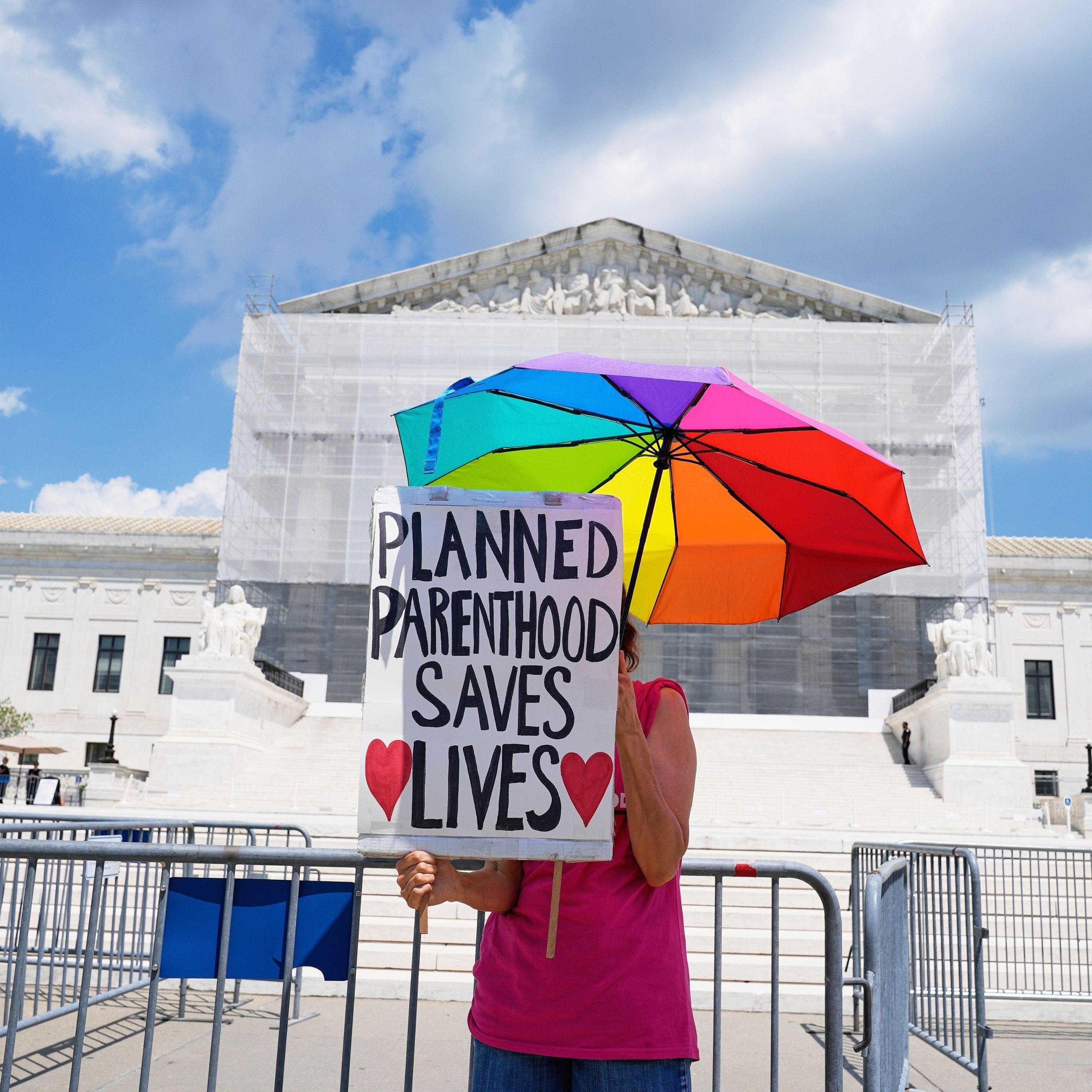
What A Day
Can Planned Parenthood Survive Trump’s Big Beautiful Law?
00:21:43
After the Supreme Court overturned Roe v. Wade three years ago, the question of abortion's legality and availability returned to the states. As of now, abortion remains broadly legal in more than 30 states and Washington, D.C. In some, like Kansas, Missouri and Montana, abortion is still legal largely because of voters. But while Trump spent a lot of time on the campaign trail trying to avoid the topic of abortion, his new tax and spending law proves that the GOP has stayed laser focused on restricting the rights of everyday Americans. It contains a provision that prevents health care nonprofits like Planned Parenthood, the nation's largest abortion care provider, from receiving Medicaid reimbursements for one year for ANY services – even those not related to abortion. Mary Ziegler, a professor at UC Davis School of Law who focuses on the history and politics of reproduction, healthcare and conservatism, explains how the new law could limit your ability to access health care and th...
Loading summary
Transcript33 lines
- [00:02]
Jane Coston
It's Tuesday, July 15th. I'm Jane Coston, and this is what a day. The show that, like former New York Governor Andrew Cuomo refuses to go away. On today's show, President Donald Trump says the US Will send Patriot missiles to Ukraine. And a bunch of states sue the Trump administration for withholding money for after school care and English language programs because Trump cares so, so much about the kids. But let's start with talking about reproductive rights. Following the Supreme Court's overturning of Roe v. Wade three years ago, the question of abortion's legality and availability returned to the states. Abortion remains broadly legal in more than 30 states and Washington, D.C. in some of those states, like Kansas, Missouri, and Montana, abortion is still legal largely because of voters. But it turns out that the people who spent decades trying to make abortion illegal and unthinkable were not satisfied with outlawing abortion in some states and crippling access in others. I know you're very, very surprised to learn this piece of information. While Trump spent a lot of time on the campaign trail trying to discuss the issue of abortion as little as physically possible, his big Republican spending debacle Disaster Adventure Law, otherwise known as the tax and spending law he signed on the Fourth of July, shows that the GOP has stayed laser focused on restricting the rights of everyday Americans. The law contains a provision that prevents health care nonprofits like Planned Parenthood, the nation's largest abortion care provider, from receiving Medicaid reimbursements for one year for any services, even those not related to abortion. Here's MSNBC's Ali Velshi. So much for that promise Trump made to leave abortion up to the states. This bill does the exact opposite. It overrides state protections and imposes sweeping federal restrictions, gutting access in every state, regardless of what the voters in that state have chosen. And if Planned Parenthood clinics are forced to close, those patients could have a very hard time finding qualified family planning care elsewhere. Not just abortions, but everything to do with reproductive health care. That's right, even if you live in a blue state, a purple state, or a red state like Kansas, where voters bucked their state lawmakers and supported access to abortion in 2022. If you're insured through Medicaid, your care won't be covered at a Planned Parenthood location or similar abortion provider for a full year, even if you're getting prenatal support, a breast exam, or getting tested for a sexually transmitted infection. So to learn more about how the big Republican spending debacle Disaster Adventure Law is limiting your ability to access healthcare and could even spell the end of Planned Parenthood. I spoke to Mary Ziegler. She's a professor at UC Davis School of Law and an expert on the law, history and politics of reproduction, healthcare and conservatism. Mary, welcome back to whataday.
- [02:55]
Mary Ziegler
Yeah, thanks for having me.
- [02:56]
Jane Coston
Let's start with Trump's new tax and spending law. There is a provision in there that for one year it will bar state Medicaid payments to any health care nonprofit that is, quote, primarily engaged in family planning services, reproductive health and related medical care, and provides for abortions. Can you just put that into plain speak for us? What does that mean?
- [03:16]
Mary Ziegler
So essentially what it means is that for a year, groups like Planned Parenthood that are abortion providers but provide other services are being kicked out of Medicaid. And that will have pretty significant, although it's sort of a little bit hard to measure how consequential financial costs for providers like Planned Parenthood. Kff, I think, found that about a third of all funding for most Planned Parenthood affiliates came from Medicaid. So then the question becomes, what happens in the next year to all of these abortion providers? If they're losing a third of the money that they use to provide care, are they going to have to close down? Are they going to be able to fundraise to close part of that deficit? Are they going to have to scale back services? And I don't think we really know at this point exactly what that's going to look like, but we know that the effects are going to be significant.
- [04:05]
Jane Coston
Planned Parenthood says this provision is specifically targeted at it. And if you follow conservative media, that seems fairly clear. But who else could feel the effects of cutting off funding like this? Because the law doesn't specifically name Planned Parenthood.
- [04:19]
Mary Ziegler
No, it doesn't. Right. So, I mean, I think that it's fair to say that Planned Parenthood is both the best known and often the most visible and probably easy to find abortion provider in the United States. But there are a lot of other independent clinics in the United States that offer primarily reproductive healthcare but also provide abortions. So those, those places would be affected, too.
- [04:44]
Jane Coston
Also, I, I can vaguely remember something of how this happened, but why just one year? Why not make it permanent?
- [04:51]
Mary Ziegler
Well, I think that there was a lot of back and forth within the GOP about this provision. There are, of course, Republicans in seats that are going to be competitive in 2026 in states like California and New York, particularly in the House and even Senate races where we're seeing people retire that are becoming more competitive, retiring on the GOP side, that is. So I think some of these Republicans in competitive races were saying, we've made the abortion issue, which is bad for us, temporarily go away. Why are we voluntarily bringing it back to the forefront? And then of course, they had to talk to their counterparts who are very socially conservative. So I think the compromise was, if things last only for a year, that gives a win for the anti abortion side, but not so big a win that these endangered Republicans are going to be as fearful about losing their jobs.
- [05:43]
Jane Coston
Right. Because the year will wrap up around the time that they'd be facing midterms.
- [05:49]
Mary Ziegler
Exactly.
- [05:50]
Jane Coston
But can clinics survive a year?
- [05:54]
Mary Ziegler
We don't know. Right. I mean, one of the things I think that we can assume is that the effects will not be the same for every clinic. Right. If you are a clinic in Manhattan or you're a clinic in Beverly Hills or something. Right. Your ability to fundraise may be very different than if you were a clinic in a low income rural area. We also don't know how much clinics are going to be able to pivot or tap into other sources of support from big reproductive rights organizations, if at all.
- [06:23]
Jane Coston
Last week, a federal judge temporarily blocked the measure from going into effect, siding with Planned Parenthood. But if the Trump administration ultimately comes out ahead here, what does that mean for states where abortion is still legal, especially states with large Medicaid populations like California, Illinois and New York?
- [06:39]
Mary Ziegler
That's actually where the effects are going to be the most acute. So if you're thinking about what it looks like in banned states, it looks like potentially a loss of access to other forms of reproductive healthcare. Right. So abortion clinics don't exist in Texas. So a clinic that may have previously provided abortions may be providing other forms of reproductive healthcare. If that clinic can't make up this loss of Medicaid funding, they may close, they may scale back appointments, but that's not going to be limiting access to abortion any more than is already the case. That is not true in states like New York, California and Illinois. And it's also not true of states that passed ballot initiative measures protecting abortion that have large Medicaid populations. Right. I mean, so it's, it's not just blue states, it's purple and sometimes even red states as well. And so those people, notwithstanding, choosing policies that would guarantee abortion access may not have abortion access in the way that they anticipate, either because clinics are gonna close or because clinics are gonna scale back services. And that will mean More delays, potentially more expense. Right. You might see clinics raise their prices to stay open. So it's gonna be felt, I think probably pretty intensely by people in states that really haven't felt the effect of Roe's overruling as much so far.
- [07:55]
Jane Coston
You were quoted in an Atlantic piece before the bill became law that was titled, quote, the biggest anti abortion victory since Dobbs. Dobbs, obviously being the decision three years ago that overturned Roe versus Do you agree with that characterization?
- [08:08]
Mary Ziegler
I think so. I mean, the anti abortion movement hasn't had a lot of wins since Dobbs. And I think part of that is down to the fact that the courts haven't done much. At least the U.S. supreme Court hasn't intervened that much, and the Trump administration really hasn't either in the way that it could. So I think this is sort of a trial balloon version of the Hyde Amendment, which, as you know, bars Medicaid reimbursement for abortion. I think this is the anti abortion movement kind of trying another way to target access for people in Medicaid populations to see if Americans just don't care. Right. If it's lower income people, if they just tune out or aren't as concerned. Obviously, I don't know if that's gonna work because of course if clinics close, that's gonna affect lots of other people, not just patients who rely on Medicaid since Roe fell.
- [09:01]
Jane Coston
Trump, trying to portray this in a way that is advantageous to him, has said repeatedly that abortion is now an issue that should be left up to the states and he doesn't wanna talk about it anymore. But as you've pointed out, given the impact this legislation could have federally, how should we think about those claims?
- [09:18]
Mary Ziegler
It was always impossible, right? I mean, you can't leave abortion to the states when the states are trying to interfere with one another, which was always the baseline that Trump was dealing with. And of course, there was no interest that abortion opponents had in leaving it to the states either. And this bill doesn't leave it to the states. Right. So the question is really, is this kind of throwing the anti abortion movement a bone where Trump says, okay, now I've given you this other thing, I don't owe you anything anymore, please leave me alone. Or whether this is sort of testing the waters toward even bigger moves on abortion? And I don't think we know the answer to that yet.
- [09:54]
Jane Coston
Late last month, the Supreme Court also weighed in on a similar case out of South Carolina. The justices effectively said that the state could block Medicaid funds to planned parenthood for all services. Can you tie the two together? How should we think about that ruling and this new provision in the tax and spending law together?
- [10:10]
Mary Ziegler
Well, so what we're going to see, let's just say we live in a world where the midterm rolls around and the Republican Congress says we don't want to keep this defunding Planned Parenthood provision in the law because then we're going to lose the election. So then what would happen? Well, we've already seen that red states had begun the process of trying to insert similar provisions in their own law to exclud Planned Parenthood and other clinics from their own Medicaid programs. And there had been a question about whether they actually had the authority to do that because part of the Medicaid law seemed to suggest that you have a right to pick your own doctor if you're a Medicaid patient. And the Supreme Court said you actually don't have a right in federal court to fight for this right to a qualified provider under Medicaid. So that opens the door to other states like South Carolina basically doing the same thing and kicking providers like Planned Parenthood out of Medicaid. So what you may see is even if the bill is no longer in effect a year down the road and some clinics have survived the year, we're then going to see some state bills kick in that target those providers in red states, again, primarily with the effect being felt by people who are probably not seeking abortion in the first place.
- [11:27]
Jane Coston
Right. Because, you know, Planned Parenthood provides a lot of services. So given the Supreme Court's decision, do you foresee a world where Planned Parenthood clinics and clinics like them will have to choose between providing abortions and preserving their federal funding so they can continue to provide other kinds of life saving care like cancer screenings and STI testing and prenatal care?
- [11:48]
Mary Ziegler
Yeah, absolutely. Especially in red states. The other, I think again, there's, there's also kind of, if Planned Parenthood has a certain amount of money, there's also a question of, well, if this clinic says, I don't want to make that choice between, between abortions and other forms of care, I just need you, National Planned Parenthood, to help me out with some of this money you need for political advocacy, then that's kind of a Hobson's choice too, because then there's less money for the political advocacy to roll back the changes that are causing this dilemma in the first place. Right. So I think you are going to see a whole lot of difficult changes facing providers like Planned Parenthood as a result of this stuff.
- [12:24]
Jane Coston
Mary, thank you so much for joining me.
- [12:26]
Mary Ziegler
Thanks for having me.
- [12:28]
Jane Coston
That was my conversation with Mary Ziegler, a professor at UC Davis School of Law with a focus on the law, history, and politics of reproduction, healthcare, and conservatism. We'll get to more of the news in a moment, but if you like the show, make sure to subscribe, leave a five star review on Apple Podcasts, watch us on YouTube and share with your friends. More to come after some ads what a day is Brought to you by bombas Summer is moving fast. Don't let bad socks and blisters stop you in your tracks. Bombas make socks, slides and seamless essentials to keep up with however you pace your days running a marathon. Bombas make socks for that with sweat wicking, blister fighting and impact cushioning built in. Just running errands, they've got pairs to elevate your look while keeping it so, so comfortable with features like ultra soft cotton and cushy footbeds, plus tagless tees and seamless sweat wicking underwear. So good you'll wonder where it's been all your life. Best of all, they don't just feel good, they do good. One purchased equals one donated to someone in need. Neat, right? You can also order bombas abroad. That's right. Along with the US they now ship internationally to over 200 countries. Completely true story. I am wearing Bomba socks right now and they are just as comfortable and cushiony as they promised. Head over to bombas.com and use code day for 20% off your first purchase. That's Bombas B O M B A S.com, code day at checkout. Amazon One Medical presents Painful Thoughts. I've been on hold to make a doctor's appointment for 23 minutes now. The automated voice has told me 47 times that my call is very important to them. Hmm, I'm starting to think that they don't think my call is important at all. With Amazon One Medical 24. 7 Virtual Care, you'll get help fast without having to remain on the line to make an appointment. Amazon One Medical Healthcare just got less painful. If your small business has a problem, you could say, just my luck. But you should say, like a good.
- [14:38]
Mary Ziegler
Neighbor, State Farm is there and we'll.
- [14:40]
Jane Coston
Help get you back in business. Like a good neighbor, State Farm is there. Here's what else we're following today. Head of Lines. We will send them patriots, which they desperately need because Putin really surprised a lot of people he talks nice and then he bombs everybody in the evening. So there's a little bit of a problem there and I don't like it. He did not, in fact, surprise a lot of people. On Sunday, President Trump told reporters that the US Would be providing more weapons, including Patriot missile systems, to Ukraine. And during a Monday meeting in the Oval Office with NATO Secretary General Mark Rutte, Trump added that he would impose 100% tariffs on countries that do business with Russia if Russia and Ukraine cannot come to a peace deal in 50 days. The president was careful to specify that the US won't be selling weapons to Ukraine directly, but will instead be selling them to various NATO allies, who will then pass along the weapons to Ukraine. Trump has expressed his mounting frustration with Russian President Vladimir Putin in recent weeks. During last week's Cabinet meeting, Trump complained about being on the receiving end of, quote, a lot of bullshit from Putin, who ended up launching Russia's largest ever drone attack against Ukraine the very next day. During his reelection campaign in 2024, Trump promised to end the war between Russia and Ukraine on day one, despite repeatedly doubling down on that statement. By May, Trump told Time magazine that he'd actually been speaking figuratively. The Senate is staring down the barrel of yet another Voterama as the July 18 deadline to pass Trump's rescissions bill looms. The President's bill proposes more than $9 billion in cuts to pre approved spending. Most of that money is currently allocated towards foreign aid in the form of disaster relief, global health and economic development efforts. The bill also asked to take back more than a billion dollars of funding for public media like NPR and pbs. In a recent post to Truth Social, the President said he wouldn't endorse Republicans who opposed this cut. The rescissions bill barely passed the House in June. All of the Democrats and four Republicans in the House voted against it. Senate Democrats will need to be joined by their Republican peers in order to stop the bill from passing. Numerous Republican Senators like Susan Collins of Maine, Lisa Murkowski of Alaska and Microns of South Dakota have already spoken out against some of the rescissions. But if the big beautiful bill now law taught us anything, it's that while Republicans are great at performative hand wringing, they are very bad at standing up to President Trump. But their brows will be very furrowed when they pass. Shouldn't be too much to ask that the President of the United States followed the law. And yet we've had to sue him 31 times in 25 weeks for breaking the law, undermining Congress's authority and failing to make good on federal financial obligations. As a former businessman, you'd think he'd have learned that you can't rack up a list of unpaid debts and get away with it. But that's actually all he's ever done. Like forever. California Attorney General Rob Bonta announced yet another lawsuit against the Trump administration on Monday. More than 20 states and D.C. are suing the Trump administration for freezing billions of dollars in education funding. A coalition of state attorneys general and governor signed onto the lawsuit, which comes just weeks before the start of the school year in many districts. Bonta says Trump has no right to hold back the funds, which were already approved by Congress, and that the administration didn't give any legal basis for the pause. The administration froze $6.8 billion in federal funding owed to states, a quarter of which should have been available July 1st. Instead, on June 30th, the US Department of Education sent a three sentence long boilerplate email from a nondescript address alerting states that we wouldn't receive the funds we were waiting for. We were relying on planning to use and distribute and disperse. The Trump administration said it's reviewing the programs to make sure they're in line with the president's priorities. Sure, FYI, the money goes towards after school and summer programs and support for English language learning. So really, the Trump administration is just saying fuck them kids. Hello, I'm Andrew Cuomo, and unless you've been living under a rock, you probably know that the Democratic primary did not go the way I had hoped. That is an understatement, my dude. Former Democratic governor of New York Andrew Cuomo announced on Monday that he would stay in the New York City mayoral race after losing the Democratic primary to Zoram Mamdani by 12 points last month. Cuomo said he was weighing whether or not to continue his campaign ahead of the primary, though he created an independent party, the Fight and Deliver Party, which would allow him to stay in the race even if he didn't end up winning the Democratic primary. Only 13% of New Yorkers voted in the June primary. The general election is in November and I am in it to win it. In November's general election, Cuomo will face off against current Mayor Eric Adams, who has also chosen to run as an independent, Democratic nominee Zoramdani and Republican nominee Curtis Sliwa. And while there are other less kind things I could say about Cuomo, I will instead say simply that I wish I had that kind of confidence. And that's the news. Before we go, Trump's reign of terror in Los Angeles just keeps on going. If you want to join us in spreading the word that we're not okay with what the Trump administration and ICE are doing, pick up some merch from the Cricut store. The Friend of Immigrants Tee sends the message that you're standing up for your neighbors and the don't poke the Bear California flag tea is perfect for those of us who love the state and the immigrants who make it amazing. You can find both@crooked.com store. That's all for today. If you like the show, make sure you subscribe, leave a review, Contemplate the fact that the US Military is going to start using Elon Musk's AI Bot Grok just a few days after Grok declared itself to be Mecha Hitler and tell your friends to listen. And if you're into reading and not just about how yes, the United States military is going to use Grok for government to do something mere days after the AI Bot waxed rhapsodic about antisemitism and sexually harassed the now former CEO of Twitter like me, what a Day is also a nightly newsletter. Check it out and subscribe@crooked.com subscribe I'm Jane Coasten and I'm sure this will all go fine. What a Day is a production of Crooked Media. It's recorded and mixed by Desmond Taylor. Our associate producer is Emily Foer. Our producer is Michelle Aloy. Our video editor is Joseph Dutra. Our video producer is Johanna Case. We had production help today from Greg Walters, Matt Berg, Sean Ali, Tyler Hill and Laura Newcombe. Our senior producer is Erika Morrison and our senior Vice president of news and politics is Adrienne Hill. Our theme music is by Colin Gilliard and Kashaka. Our production staff is proudly unionized with the Writers Guild of America eas. If your small business is booming and ready to expand, you might say something like it's happening. Crushed it. But if you need someone who can actually help protect your growing business, just say, like a good neighbor, State Farm. He's there. And just like that, your State Farm agent can help you get the coverage you need for your new space for your small business insurance needs. Like a good neighbor, State Farm is there.
- [23:04]
Mary Ziegler
The world is on the brink. Wars, contentious elections, disinformation spreading at warp speed, and Donald Trump at the center of all of it.
- [23:11]
Jane Coston
But what does it mean for the rest of us?
- [23:13]
Mary Ziegler
Every week on Potsay of the World.
- [23:14]
Jane Coston
Tommy Vitor and I cut through the noise to explain how global power is shifting. No Jargon no homework, just clear, honest conversations about what's happening and why it matters. From breaking news to long, simmering international.
- [23:24]
Mary Ziegler
Conflicts, we dissect it all with critical analysis and some jokes that will surely embarrass our children one day.
- [23:30]
Jane Coston
Tune in to Pod Save the World every Wednesday, wherever you get your podcasts or catch it on YouTube.