← What A Day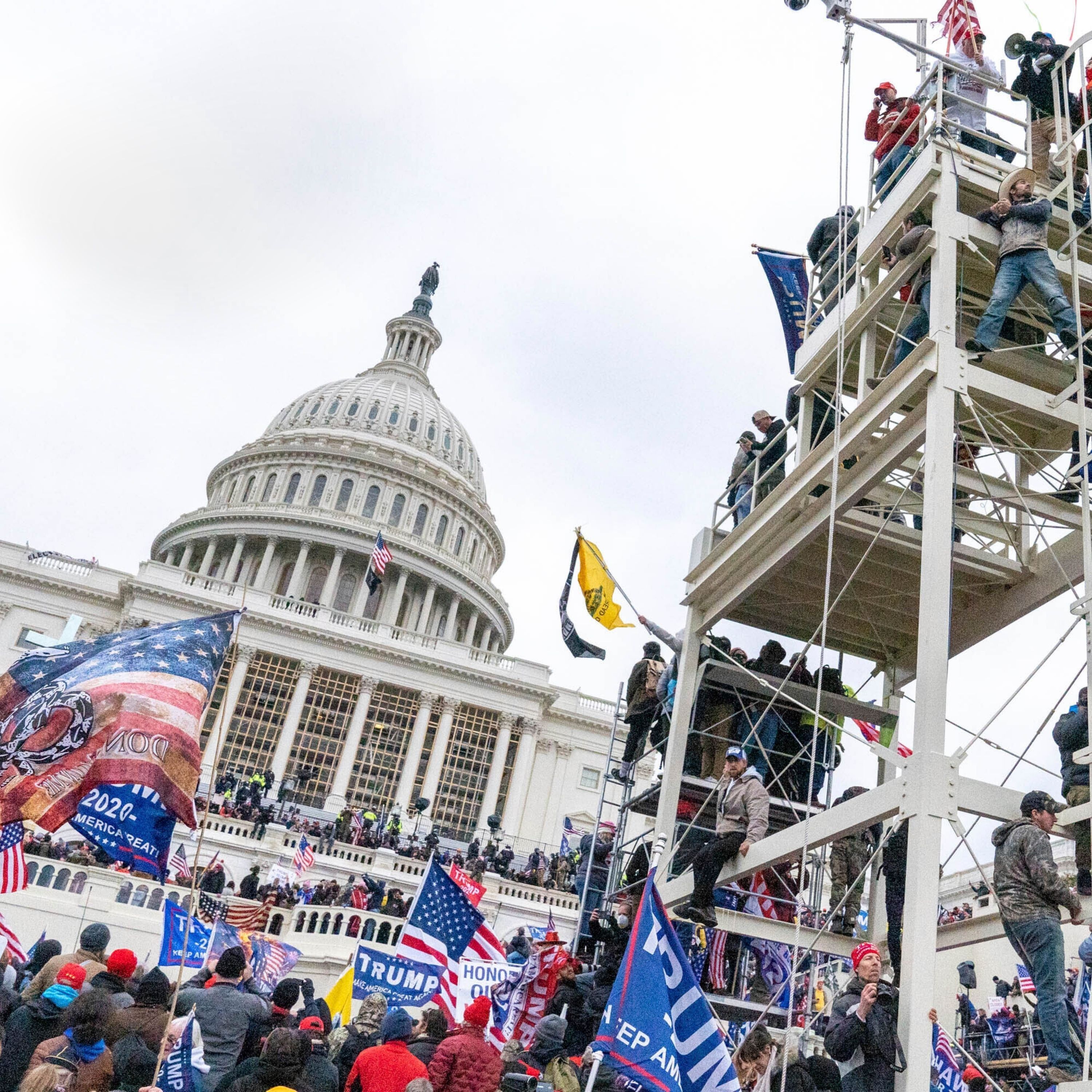
What A Day
Did The J6ers Win?
00:23:00
Five years ago today, supporters of President Trump, emboldened by his false claims that the 2020 election was stolen, stormed the Capitol. Now, with Trump back in the Oval Office, it feels like the January 6th insurrectionists got everything they could have wanted – but did they? On his first day back in office, Trump pardoned more than 1,500 of the rioters. But dozens of those pardoned went on to commit more crimes – and others are furious that they haven’t received restitution for so-called “malicious prosecution.” Many of the groups that helped foment what happened five years ago have never regained the strength they had back then. And in his second term, Trump has disappointed many of the people who backed his insurrection – including some of those willing to go to prison for him. To talk more about January 6th and where the far-right is now, we spoke to Will Sommer, a senior reporter for the Bulwark who focuses on the far right and conservative media. And in headlines, Secre...
Loading summary
Transcript54 lines
- [00:00]
Will Sommer
Foreign.
- [00:04]
Jane Coaston
It's Tuesday, January 6th. I'm Jane Coastin and this is what a day. The show that is not very excited to see our foreign policy apparently decided by South Carolina Republican Senator Lindsey Graham. Here he is on Air Force One on Sunday with President Donald Trump getting very excited about a new potential target of military action.
- [00:21]
Lindsey Graham
You just wait for Cuba. Cuba is a communist dictatorship that's killed priests and nuns. They've preyed on their own people. Their days are numbered. We're going to wake up one day, I hope in 26 in our backyard, we're going to have allies in these countries doing business with America, not narco terrorist dictators killing Americans. This is a big frigging day and everybody in the world is thinking differently than they were just a few days ago because of what you did.
- [00:54]
Jane Coaston
He also had Trump sign a Make Iran great again hat for him, a photo of which he posted on Monday. Because everything's coming up. Lindsay. On today's show, Secretary of War Pete Hickseff escalates his seditious beef with astronaut and known badass Arizona Democratic Senator Mark Kelly. And the Centers for Disease Control and Prevention continues giving up on controlling and preventing diseases. But let's start with this day five years ago when supporters of President Trump, emboldened by his false claims that the 2020 election was stolen, stormed the Capitol. Here is some footage of the insurrection released by the House select committee investigating January 6th. Back in 2022, I was living in D.C. at the time, not far from the Capitol Building. I will never forget the scenes from that day and from the weeks that followed. The National Guard sleeping in the Capitol complex, the National Mall, surrounded by barricades and barbed wire. There was a pizza place nearby that provided free food to members of the National Guard stationed there. And so parts of Capitol Hill smelled like pizza all the time. For months and five years after all of that, after the horrifying violence and the deaths of multiple people, after the images that made so many of us feel like the world had, even in the midst of the pandemic, somehow gone more insane. Donald Trump is president again. It feels like the people who stormed the Capitol got everything they could have wanted. But did they? More than 1500 January 6th rioters received blanket pardons from Trump on his first day back in office. But dozens of those pardoned went on to commit more crimes. And others are furious that they haven't received restitution for so called malicious prosecution. Many of the groups that helped foment what happened five years ago have never regained the strength they had back then. And it seems to me that Trump himself and his second term has disappointed many of the people who backed his insurrection, including some of those willing to go to prison for him. So to Talk more about January 6th and where the far right is now, I spoke to Will Sommer. He's a senior reporter for the Bulwark, who focuses on the far right and conservative media. Will, welcome back to what a Day.
- [03:07]
Will Sommer
Hey, thanks for having me.
- [03:08]
Jane Coaston
So you were actually on the ground in D.C. to report on the January 6th Save America rally in 2021 that turned into what it turned into. What were you seeing and hearing online from different members of the far right ahead of that rally?
- [03:22]
Will Sommer
Yeah, I mean, I think there was. In retrospect, I wish I had seen it coming more. I mean, there had been sort of a lead up. Obviously, there had been protests in D.C. and after Trump lost the election, but before January 6th, you know, proud boys would fight with antifa or other leftist protesters and someone would get stabbed, stuff like that. And I sort of thought that that was going to be the amount of violence on January 6, even though, you know, I was seeing posts about, well, we should occupy federal buildings. You know, where are we all going to sleep? Well, it's, you know, it's the people's house. We should just rush these buildings.
- [03:53]
Jane Coaston
Yeah. People talking about trying to get guns across the river. Like, it is funny looking back and being like, oh, yeah, you probably. You know, I lived in D.C. at that time, and I remember seeing people with like, don't Tread on me flags coming in from Virginia.
- [04:05]
Will Sommer
Yeah. I mean, it was something that, you know, in retrospect, in a way, it felt like, oh, of course it led up to this riot. But then obviously, when it started happening, I mean, it was totally crazy.
- [04:15]
Jane Coaston
Yeah. What was your experience like on the ground outside the Capitol once the marchers started getting really violent?
- [04:21]
Will Sommer
So I was on the east lawn initially, and it really popped off at first on the west Lawn. And so. But I was interviewing people and, you know, a car would roll up and they would think it was Mike Pence, and they would just be like, just calling for his death. They were going crazy. And I thought, you know, geez, like, this is. This is a lot of animosity. And then I heard that they were fighting, the protesters were breaking through the police lines on the west side. I went over there at the, you know, I already was somewhat well known in terms of someone people on the right didn't like. I think if someone decided to target me that the police had better things to do. So I didn't get too deep into it, but I was kind of roaming around on the West Lawn. I saw Nick Fuentes among other people, and it was just this like, you know, incredibly weird atmosphere of, you know, how far could they go? I mean, obviously that was the climbing, the scaffolding, all those iconic images.
- [05:13]
Jane Coaston
Yeah, Nick Fuentes, who now has become a weirdly well known white nationalist far right activist who people keep arguing about. But I think that that actually gets me to some of the leaders of the groups involved in January 6th and where they are now. For example, Enrique Tarrio, the former leader of the extremist group the Proud Boys, wasn't actually at the Capitol on January 6th because he was arrested earlier that week carrying two gun magazines and he was banned from reentering D.C. what has he been doing since Trump pardoned him last year?
- [05:44]
Will Sommer
Well, you know, he, he suffered a real blow to his reputation when he was exposed as a federal informant on unrelated, non. January 6th matters. Yeah, but in his past, and obviously, you know, on the far right, you know, they're constantly accusing each other of being federal agents, federal provocateurs, and when it comes out that you actually did work for the feds, they, you know, that really hurts your image. On the other hand, you know, he's, he's been bouncing back. He's, he has a podcast like a lot of these people. I think like everyone, these, but the, you know, a lot of these groups, I think after January 6th, people really felt that sort of big in person gatherings or protests were, you know, because many of them saw January 6th as a sort of a federal provocation or that they had somehow been entrapped. So I think in general, outside of Trump rallies, people on the right are less interested in what we used to see in the case of the Proud Boys, as like these big kind of Proud Boy marches, things like that.
- [06:39]
Jane Coaston
Yeah, I was curious because I think that after the murder of conservative activist Charlie Kirk, there was talk that the Proud Boys and the Oath Keepers, whom we'll ask about in a minute, they were kind of reactivated and they were gonna be doing more stuff. But like, where has that been going and how active are the Proud Boys today, outside of showing up at Trump rallies?
- [06:58]
Will Sommer
I mean, the Proud Boys are active online. They have kind of a whole universe. I mean, Gavin McGinnis, the Proud Boys founder, also the co founder of Vice magazine, I mean, he's, he has kind of his broader Proud Boys media, but in terms of their real political activism, I'm sure It's going on, but it certainly is not where it was in 2017, 2018, when they were just sort of out there constantly clashing with people. On the other hand, a lot of this stuff happens in the summer and Trump is in office. And I think that mollifies a lot of these people. They don't feel like they have to go fight Antifa. Probably the biggest moment for them was the Portland drama last year where right wing media figures would get in scuffles outside of the ICE building and some of the proud boys went out and kind of you faced off with antifa. But certainly I would say, at least in a visible way, the proud boys are sort of a shadow of what they once were before.
- [07:50]
Jane Coaston
Trump also pardoned Stuart Rhodes and Kelly Muggs, two leaders of the far right militia group the Oath Keepers, who we mentioned a little bit. Wired reported last year that Rhodes was attempting to relaunch the Oath Keepers, but that, quote, former allies are unconvinced. Why have the Oath Keepers not been more emboldened under the second Trump administration?
- [08:09]
Will Sommer
You know, I think the Oath Keeper, Stewart Rhodes, was a divisive leader, I guess I would say, even by the standards of militia leadership. This is a guy who, there were questions about his spending. I think he spent a lot of money on stakes. Those sort of Oath Keepers meant to be buying guns or building out the Oath Keepers. And so this is these figures, I think, like Enrique Tario, they kind of depend on a big moment and they sort of, they kind of float around in the background until they have something like, for example, maybe another Democratic administration that will really galvanize them. And I think at the moment, I mean, Republicans are in power. And so there are disappointments. I think there are things like the Epstein files not getting released, but there's not really a big moment for them to protest around or to somehow plot some kind of scheme.
- [09:01]
Jane Coaston
I'm glad you mentioned the Epstein files, because I think that that seems like a piece of why a lot of the people who I think were Most engaged in January 6th and everything coming around there, they seem pretty disappointed with Trump 2.0. I mean, it's not just former Georgia Republican Representative Marjorie Taylor Greene. A lot of people seem very disappointed with what the second Trump administration has resulted in. What's your sense? Like, what did they think they were going to get and what have they not received?
- [09:27]
Will Sommer
Well, I mean, since we're talking about January 6th, I mean, there have been all kinds of disappointments, I would say. And you mentioned that. I think probably the biggest One is releasing the Epstein files. But in the case of January, six people in particular, I mean, I think they thought they were going to be heroes. And in fairness to them, they had really committed their lives to Trump. They had put a lot on the line. They had been to prison in a lot of cases, and on one hand they did get pardoned or they have their sentences commuted, which is pretty good. But, I mean, I think there are lawsuits for reparations for January 6th, people that aren't going anywhere. I mean, a lot of them, I mean, frankly, I think, already had kind of marginalized beforehand. And rather than being really celebrated, they find themselves back where they were, except, you know, they went to prison for a year or two. And so their lives, I think, are in many ways worse.
- [10:09]
Jane Coaston
Yeah. And to your point, it was interesting to me how many of the people who were pardoned because of January 6th then found themselves in legal trouble again for other stuff.
- [10:18]
Will Sommer
Yes, absolutely. I mean, we've seen people, you know, in trouble for threatening officials for child sex crimes. It's funny because obviously Donald Trump, you know, unleashed these people back on the public again. And, you know, I don't think there's really been a reckoning from the Trump administration with that fact.
- [10:34]
Jane Coaston
I. I'm curious, and obviously this is very recent, but what have you been seeing about how these groups are responding to the capture of Venezuelan President Nicolas Maduro and the possibility of indefinite US Involvement in Venezuela? Something that, like, I seem to remember that there was this whole thing about, like, not getting into foreign wars and America first, but, like, it seems like MAGA media has, like, completely pushed that aside, has the far right.
- [11:00]
Will Sommer
This has been really striking to me as well, as you said, I mean, a lot of these people pitch themselves as America First. People like Nick Fuentes really like the faith, the white nationalists, they're isolationists. They don't want these forever wars in the Middle East. They say all these wars are on behalf of Israel, all this stuff. But in this case, they have really people like Alex Jones, Nick Fuentes, Gavin McGinnis, the Proud Boys founder. They really, you know, for whatever reason, they love this war. And I think it's because they're kind of recasting America first as not sort of like, well, we sort of look inward and focus on building up our own country, don't get in these quagmire wars. But instead they're recasting it as sort of like America is a warlord country and we take whatever we want. In that way, being America First. Well, this country has all the oil, all this, all these mineral resources. Why shouldn't we dominate them? Is sort of the way they've recast it.
- [11:53]
Jane Coaston
What will you be watching most closely on the far right in 2026?
- [11:57]
Will Sommer
Well, I think, you know, we're entering this world where Donald Trump is increasingly looking like a lame duck. And so I think we're gonna see people look beyond Trump. And once that starts happening, I think there's gonna be a lot of knife fighting on the right, whether it's who's to blame if Democrats retake Congress in 2026 or sort of jockeying among people for 2028. I mean, in late December, we saw the Turning Point USA conference where people like Tucker Carlson and Ben Shapiro were tearing into each other. Tucker Carlson said this is sort of a proxy fight about JD Vance because I'm friends with JD Vance. So I think it's gonna be, you know, 2025 was like a really ugly year in right wing media. There was after Charlie Kirk's assassination, there was this real power vacuum. And I think that's really only gonna get amped up this year.
- [12:40]
Jane Coaston
Will, as always, thank you so much for joining me.
- [12:43]
Will Sommer
Thanks for having me.
- [12:45]
Jane Coaston
That was my conversation with Will Sommer, a senior reporter for the Bulwark. We'll get to more of the news in a moment, but if you like the show, make sure to subscribe. Leave a five star review on Apple Podcasts, watch us on YouTube and share with your friends. Come after some ads. What a day is Brought to you by Zebiotics As I get older, I've learned one thing. After a night with drinks, I don't bounce back the next day like I used to. I have to make a choice. I can either have a great night or a great next day. That is, until I found pre alcohol zebiotics. Pre Alcohol Probiotic Drink is the world's first genetically engineered probiotic. It was invented by PhD scientists to tackle rough mornings after drinking. Here's how it when you drink, alcohol gets converted into a toxic byproduct in the gut. It's a buildup of this byproduct, not dehydration, that's to blame for rough days after drinking. Pre alcohol produces an enzyme to break this byproduct down. Just remember to make pre alcohol your first drink of the night. Drink responsibly and you'll feel your best tomorrow. Every time I have pre alcohol before drinks, I notice a difference the next day. Even after a night out, I can confidently plan on working out the next day. Ready to try it. Go to zbiotics.com wadnow you'll get 15% off your first order when you use code WAD at checkout. Plus it's backed with a 100% money back guarantee, so there is absolutely no risk. Subscriptions are also available for maximum consistency. Remember to head to zbiotics.com wad and use the code WAD at checkout for 15% off.
- [14:18]
Andy Richter
Hi there, it's Andy Richter and I'm here to tell you about my podcast the three Questions with Andy Richter. Each week I invite friends, comedians, actors and musicians to discuss these three where do you come from, where are you going, and what have you learned? New episodes are out every Tuesday with guests like Julie Bow and Ted Danson, Tig Notaro, Will Arnett, Phoebe Bridgers, and more. You can also tune in for my weekly Andy Richter Call in show episode where me and a special guest invite callers to weigh in on topics like dating, disasters, bad teachers, and lots more. Listen to the three Questions with Andy Richter wherever you get your podcasts.
- [14:59]
Greenlight Advertiser
Did you know that parents rank financial literacy as the number one most difficult life skill to teach? Meet Greenlight, the debit card and money app for families. With Greenlight, you can set up chores, automate allowance and keep an eye on your kids spending with real time notifications. Kids learn to earn, saving, save and spend wisely. And parents can rest easy knowing their kids are learning about money with guardrails in place. Sign up for Greenlight today@Greenlight.com podcast.
- [15:27]
Jane Coaston
Here's what else we're following today. Head of Lines.
- [15:33]
Chris Murphy
There'S still been no briefing for the United States Senate. They are sort of hiding their intentions. They fired the press at the Pentagon. They aren't briefing members of Congress. But Donald Trump is telling the American people that it's about the oil. And there's no secret that there's a very cozy relationship between Trump and the oil industry.
- [15:57]
Jane Coaston
Connecticut Democratic Senator Chris Murphy told what a Day's Matt Berg that this weekend's military operation in Venezuela doesn't appear to be about drugs, despite the charges against the country's president, Nicolas Maduro. Maduro and his wife, Celia Flores, appeared in court for the first time Monday. When asked for his plea, he spoke through a courtroom interpreter, saying, I am innocent. I am not guilty. I am a decent man, the constitutional president of my country. Flores also pleaded not guilty. Back in Venezuela, Maduro's number two, Delsey Rodriguez, was sworn in as the country's interim president. And even though the US Supported her, she's Starting on thin ice, president Trump told the Atlantic. If she doesn't do what's right, she's going to pay a very big price, probably bigger than Maduro. So that's promising. The Senate is expected to vote this week on another war powers resolution that would block the president from future military operations in Venezuela. But Murphy said he doesn't think the president really cares about getting congressional approval.
- [16:53]
Chris Murphy
Even if that vote were to pass, it's probably likely that he ignore it. And this is what Republicans need to think about, is that I think it's really hard to put this genie back in the bottle. If a president just doesn't believe that the Constitution applies, that law applies, and he can just spend money any way he wants, use the judicial system any way he wants, use the American military any way he wants, I don't know why a future Democratic president wouldn't take advantage of that space, just like Donald Trump has. So Republicans are going to rue the day that they set this machine in motion.
- [17:30]
Jane Coaston
I think the rest of us are already there.
- [17:35]
Mark Kelly
Like us, you all swore an oath.
- [17:37]
Jane Coaston
To protect and defend this Constitution. Right now, the threats to our Constitution.
- [17:42]
Will Sommer
Aren'T just coming from abroad, but from right here at home.
- [17:44]
Mark Kelly
Our laws are clear. You can refuse illegal orders.
- [17:49]
Jane Coaston
Back in November, Arizona Democratic Senator Mark Kelly appeared alongside five other lawmakers with military or intelligence backgrounds, urging active duty service members to remember their legal obligation to reject unlawful orders. Secretary of War slash little boy Pete Hegseth didn't like it then and he doesn't like it now. In a Twitter post Monday, Hegseth said the Pentagon initiated an administrative review of Kelly that could affect the retired Navy pilot's rank and pension benefits. In the same post, Hegseth denounced the video as seditious. Senator Kelly spoke to Pod Save America after Hegseth censured him on Monday and explained why he stands behind the message of the video.
- [18:26]
Mark Kelly
That's all we were trying to do is remind members of the military because we have a president who has talked about killing the family members of terrorists. Family members. That means women and children. He has talked about shooting US Citizens protesters in the legs. He's talked about sending troops into US Cities to use those US Cities as training grounds, which means you're going to use US Citizens for training for the US Military.
- [18:54]
Jane Coaston
Kelly's legal team argued in November that the senator was restating a basic tenet of military law. They also pointed out that Hegseth himself previously made similar remarks about the duty of service members to refuse illegal commands. Like these comments, he made in 2016 at the right leaning Liberty Forum of Silicon Valley.
- [19:11]
Mark Kelly
I do think there have to be consequences for abject war crimes. If you're doing something that is just completely unlawful and ruthless, then there is a consequence for that. That's why the military said it won't follow unlawful orders from their commander in chief. There's a standard, there's an ethos.
- [19:30]
Jane Coaston
So when Pete Hegseth says service members should refuse illegal orders, that's ethos. But when Mark Kelly says it, that's sedition. Cool, cool, cool.
- [19:42]
Tim Walz
In September, I announced that I would seek a historic third term as Minnesota's governor, and I have every confidence that if I gave it my all, we would win the race. But as I reflect on this moment with my family and my team over the holidays, I came to the conclusion that I can't give a political campaign my all. Every minute that I spend defending my own political interest would be a minute I can't spend defending the people of Minnesota against the criminals who prey on our generosity and the cynics who want to prey on our differences.
- [20:13]
Jane Coaston
Minnesota Democratic governor and former vice presidential candidate Tim Walz announced he's dropping his re election bid Monday. The decision comes after weeks of mounting scrutiny over its handling of the state's welfare fraud scandal. President Trump himself has repeatedly used it to make racist comments about Somali immigrants, as many of those charged in the scandal are of Somali descent. Right now, a lot of Republicans have announced they're running, including a few state congresspeople and major Trump supporter Mike Lindell, AKA the My Pillow guy. The most prominent Democrat who's considered a bid for the governor's mansion is Minnesota Senator Amy Klobuchar. The New York Times reported that they even met ahead of Waltz's announcement, and she confirmed her interest in the position. But at the time of our recording Monday evening, all she's done so far is commend Waltz's decision on Twitter. Interesting. The Trump administration announced a major overhaul to the Centers for Disease Control and Prevention's childhood vaccine schedule on Monday. It now says all American kids should get immunized against only 11 diseases, down from 18, according to the White House. Many shots that were universally recommended, like Rotavirus COVID 19, Meningitis, Hepatitis A, Hepatitis B, and the flu, now need to be given through shared clinical decision making, which is basically just talking to your doctor. The vaccine for respiratory syncytial virus, or rsv, is also now recommended only for high risk groups. These changes were made after President Trump asked the Department of Health and Human Services to look at the childhood vaccination guidelines of other developed nations like Denmark and Japan, and consider updating the US Guidelines accordingly because the US Is just like Denmark and Japan. So let's close this update with a friendly and desperate reminder. The American Academy of Pediatrics has its own immunization schedule that's being recommended by doctors. And please get your kids vaccinated because we don't live in Denmark. And that's the news. Before we go following the breaking news out of Venezuela, where the Trump administration launched strikes and arrested President Nicolas Maduro in a special forces raid, Tommy Vitor and Ben Rhodes unpack what happened in the latest episode of Pod Save the World. They break down Trump's claim that the US Will now run the country, why this kind of regime change is illegal, and the global implications of the move. A new episode of Pod Save the World drops Wednesday, covering other major news developments around the world. Make sure you subscribe that's all for today. If you like the show, make sure you subscribe, Leave a review Celebrate the entrance of Nancy Drew and Betty Boop into the public domain and tell your friends to listen. And if you're into reading and not just about how on New Year's Day both fictional characters reached the limit of their 95 year long US copyright and now creators can use and repurpose them without asking for permission. Like me, What a Day is also a nightly newsletter. Check it out and subscribe@crooked.com subscribe I'm Jane Coston and you are not ready for my gritty, hyper, violent Nancy Drew graphic novel. What a Day is a production of Crooked Media. It's recorded and mixed by Desmond Taylor. Our associate producers are Emily Foer and Chris Allport. Our producer is Kaitlin Blummer. Our video editor is Joseph Tutra. Our video producer is Johanna Case. We get production help today from Ethan Oberman, Greg Walters and Matt Burke. Our senior producer is Erica Morrison and our senior Vice president of news and politics is Adrienne Hill. Our theme music is by Kyle Murdock and Jordan Kantor. We had help today from the Associated Press. Our production staff is proudly unionized with the Writers Guild of America East.
- [24:09]
Will Sommer
Hey, I'm Paul Scheer.
- [24:10]
Jane Coaston
I'm June Diane Rayfield.
- [24:11]
Will Sommer
And I'm Jason Manzoukas. And we're the hosts of how did this Get Made? A comedy podcast where we deconstruct, make fun of and celebrate the best worst movies ever made. Have you ever seen a movie that's so bad that it's actually good? That's what we're talking about.
- [24:23]
Jane Coaston
From blockbuster franchises and made for TV.
- [24:27]
Will Sommer
Romances to bonkers 80s action flicks and obscure sci fi musicals, we cover it all.
- [24:32]
Jane Coaston
You can find.
- [24:33]
Will Sommer
How did this get made? Wherever you get your podcasts and don't forget to follow the show so you never miss an episode. Idiot.
- [24:39]
Jane Coaston
VRBO makes it easy to claim your dream summer spot with early booking deals from homes with pools to poolside loungers. When you book a vrbo, you don't have to reserve any loungers, they're all yours. Get that early booking deal@vrbo.com.