← What A Day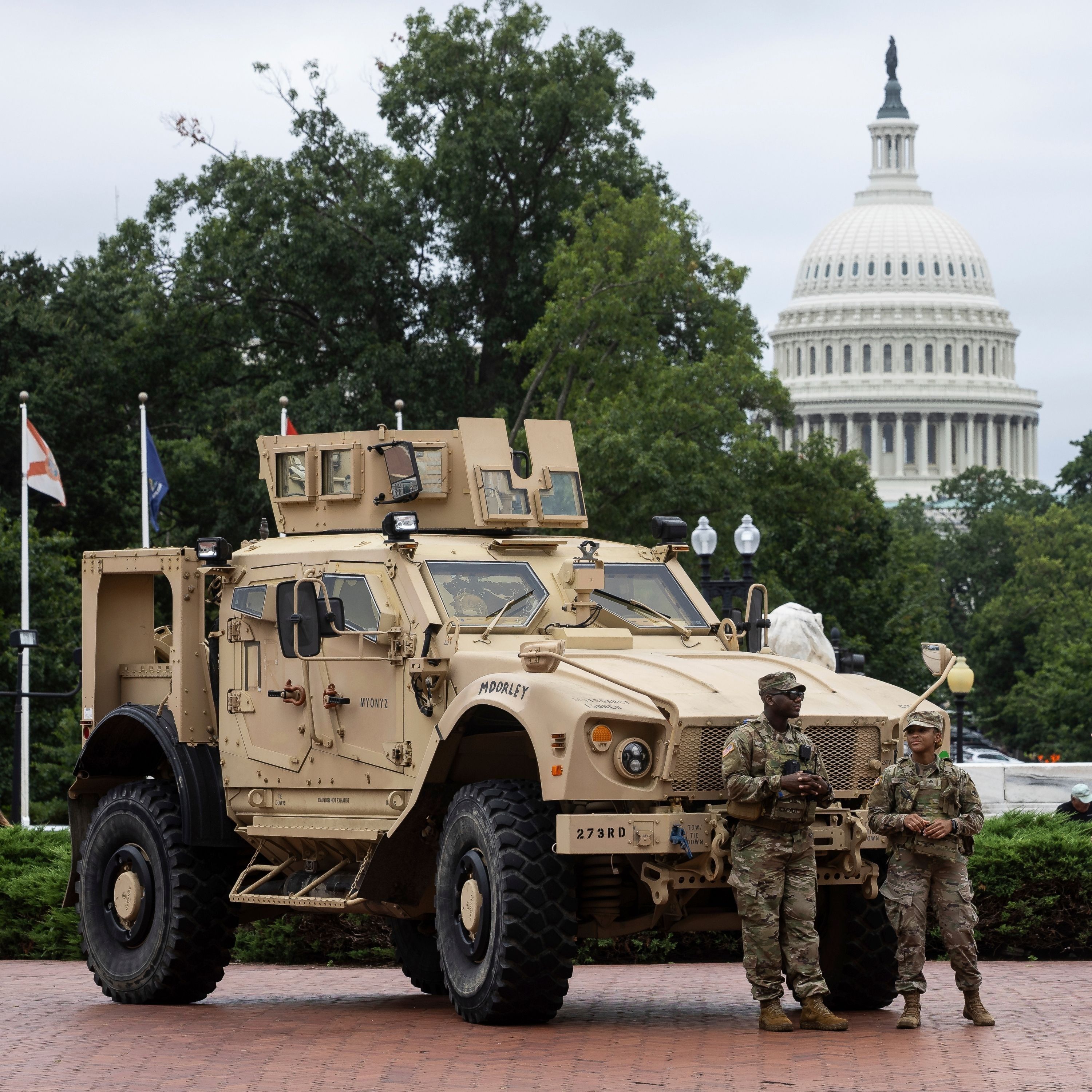
What A Day
Does Washington, D.C. Need Federal Intervention?
00:24:01
On Tuesday, the Department of Justice announced it's launching a much-needed and super important investigation into Washington D.C.'s crime statistics. The DOJ said it's looking into whether the stats have been QUOTE: "manipulated" to make the crime rate seem lower. Why, might you ask, is the DOJ using time, money, and resources to look into this? Probably because it's searching for a way to justify President Donald Trump's takeover of the Metropolitan Police Department and deployment of National Guard troops to the district. However, it has been roughly two weeks since Trump's takeover, and we have some questions. Is DC's crime problem really that bad? And is it better now after federal intervention? We spoke with journalist Josh Barro. He's also co-host of the podcast "Serious Trouble". And in headlines, the Trump administration decides it doesn't want feedback from its federal employees, the White House says arrangements for a meeting between Ukrainian President Volodymyr Zelen...
Loading summary
Transcript52 lines
- [00:03]
Jane Coastin
It's Wednesday, August 20th. I'm Jane Coastin, and this is. What a day. The show that has enough to worry about without the threat of radioactive shrimp at Walmart. Yes, you heard me. The FDA announced Tuesday that some shrimp available for purchase at Walmart may have been contaminated by a radioactive isotope. Again, we've got enough going on. We don't need radioactive shrimp. On today's show, Oklahoma rolls out a special assessment for teachers moving from New York and California to determine if they're too woke to teach. And the federal government tells workers, nah, we're good on your feedback. And cancels an annual employee survey. But let's start with Washington, dc. The Department of Justice announced on Tuesday it's launching a criminal investigation into DC's crime statistics and whether or not they've been, quote, manipulated to make the crime rate seem lower. Now, this isn't a new accusation. Back in May, the Metropolitan Police Department put one of its police commanders on leave amidst allegations that he made changes to crime data. But of course, this isn't really about facts. I mean, it never really is. Remember that President Donald Trump fired his Bureau of Labor Statistics commissioner for a bad jobs report like, three weeks ago. Case in point, according to Trump, speaking in the Oval office on Monday, D.C. was the worst city in the world up until he took over the D.C. police Department. And now it's great, amazing.
- [01:32]
Donald Trump
We have a thing going on right now in dc. We went from the most unsafe place anywhere to a place that now people, friends are calling me up, Democrats are calling me up, and they're saying, sir, I want to thank you. My wife and I went out to dinner last night for the first time in four years, and Washington, D.C. is safe. And you did that in four days.
- [01:56]
Jane Coastin
Now, typically, this would be where I say, sure. The thing I say whenever someone says something objectively insane based on absolutely nothing. I mean, as a general rule, I don't really buy Trump's law and order thing. Like, he pardoned January 6th defendants who beat cops, and now he's very worried about people being mean to law enforcement. Come on. But here I actually want to ask two questions. Was DC's crime problem really that bad? And is it better now, roughly two weeks into Trump's takeover of the Metropolitan Police Department, I lived in D.C. for more than a decade. I lived in a variety of neighborhoods across all four quadrants of the city, and I loved it. But I also knew and know that crime is an actual issue in that city. The New York Times spoke to one woman in Congress Heights, a D.C. neighborhood who said, quote, if Trump is genuinely concerned about safety of D.C. residents, I would see National Guard in my neighborhood. I'm not seeing it, and I don't expect to see it. I don't think Trump is bringing in the National Guard to protect black babies in Southeast. Crime is bad, and Democrats have a hard time talking about it. So how should they be responding to a man who's been charged with dozens of felonies sending the Louisiana National Guard into my old neighborhood? To find out, I spoke to Josh Barrow. He's a journalist and co host of the podcast Serious Trouble. Josh Barrow, welcome back to what A Day.
- [03:14]
Josh Barrow
Hi, Jane.
- [03:15]
Jane Coastin
Thanks for having me on your substack. You wrote a piece called Democrats Must Do Better than Ignore elevated crime in D.C. and there's a line that got me thinking. It reads, quote, so the president is broadly correct to identify Washington as a city facing a public safety crisis. Now, there are two questions that stem off that. If the president said, like, D.C. is a city facing a public safety crisis, what would that mean normally? And then what does it mean when it's Donald Trump? Right.
- [03:42]
Josh Barrow
I mean, well, so the federal government has an important role and important powers related to Washington, D.C. that don't apply to other cities.
- [03:49]
Jane Coastin
Right.
- [03:50]
Josh Barrow
The Constitution gives the federal government a lot of authority over D.C. some of which has been devolved by statute. And the system that has been set up for enforcing laws and prosecuting crimes in Washington, D.C. requires a lot of partnership between the federal government and the city. And that has gone pretty awry in a lot of ways over the last few years. There have been problems with surprising number of crimes where people get arrested by the police in D.C. and then the federal prosecutors who are supposed to prosecute, never bring charges. And there have also been issues with, for example, the city has not had a functioning crime lab for a number of years. Just recently gotten that back. But it went.
- [04:25]
Jane Coastin
Yeah, it was decertified a couple of years ago. I lived in D.C. for 13 years, so this is something that we thought a lot about. Yes. Like, the partnership with the federal government hasn't been working, but it seems like the. Those are actual steps that could be taken. Yes, but that's not what's happening.
- [04:41]
Josh Barrow
No. I mean, you know, for example, there. There are a substantial fraction, something like a fifth to a quarter of the judgeships that exist that are supposed to try ordinary criminal cases in Washington, D.C. are vacant. You could have a push by the White House to try to get those judges confirmed, but he's barely nominated anybody for those positions. In fact, there's been an exodus of staff from the U.S. attorney's office in Washington, D.C. in significant part because of political choices that Donald Trump has made, the pardons of the January 6th rioters and going after certain career staff who are involved in prosecuting the January 6th rioters. There's a lot of specific things that Donald Trump could be doing or that Congress could be doing that would be constructive here in terms of actually improving law enforcement in Washington, D.C. it's unfortunately not what we've seen him actually doing, but it's also not something that's not his business or not his concern.
- [05:31]
Jane Coastin
I want to ask about that. Why do you think that hasn't been happening? It seems to me that those are all steps that could be taken by the White House. Why hasn't it been?
- [05:39]
Josh Barrow
Well, I think it hasn't been happening in part for the reasons that this isn't ordinarily how we structure criminal justice in a city. The same Congress that has to confirm judges to trial courts in Washington, D.C. also has to confirm judges to appeals courts and has to pass the federal budget and all sorts of things that are higher priorities for national legislators than the local issues of Washington, D.C. some of it even has to do with the management of parks in Washington. When people say they're concerned about crime, often they're concerned broadly about disorder, homelessness. And you get homeless encampments in parks in Washington, D.C. you also have parks that just aren't maintained very well and make the public spaces look shabby. Most of those parks, even little tiny neighborhood parks, are the responsibility of the National Park Service. And so you could get the NPS more focused on that, but they also have to focus on Yellowstone national park and all sorts of other things that are of probably greater concern to members of Congress and to the president. And so it's unsurprising that some of these things fall through the cracks and were already falling through the cracks before Donald Trump had come back into office. The big problem with an insufficient number of cases being brought in Washington, D.C. a lot of that was happening in the Biden administration. And again, it was an issue of people knew this was a problem, but there's a long list of problems that have to be dealt with in Washington. And municipal governance has a way of not getting to the top of that.
- [06:58]
Jane Coastin
Now, your piece is about how Democrats have been talking about this issue and talking about the issue of crime more broadly in the wrong ways. And as you can imagine, Democrats in Congress and in blue cities and pretty much everywhere have been very noisy about the federal takeover and the rollout of National Guard troops coming from Louisiana and West Virginia and all of this. So I want to break this up into two parts. One, what's wrong with how Democrats are talking about this issue right now? And two, how should Democrats be arguing about the issue of crime Even outside of D.C. well, I think the problem.
- [07:35]
Josh Barrow
Arises when the statements Democrats make are dismissive of the problem that the president is talking about. And you see this, for example, in the urge to fight with him over the statistics and to say violent crime is at a 30 year low in Washington, D.C. and there are official government statistics that say this. But there's a couple of problems with that. One is that if you look at murder, which is one of the most reliably reported crimes, it's really hard to conceal the fact that there's a dead body that has been falling for the last two years. But it's nowhere near a 30 year low. The murder rate is still, as of last year, was about twice as high as the recent low, which came in 2012. And even at relatively low levels compared to recent years in Washington, D.C. d.C. Continues to have much higher crime than other comparable megacities in the United States. The murder rate in Washington is about six times as high as it is in New York, about eight or nine times as high as it is in Boston. And so the city, not only does it have a crime problem, it has a crime problem that is worse than a lot of its peer cities by quite a wide margin. Some of the D.C. crime that's been in the news over the last few years has been members of Congress being victims of violent crime. Henry Cuellar got carjacked not very far from the Capitol building. Angie Craig was the victim of an assault in her own building, which she escaped from by throwing hot coffee at her assailant. And so I think the precipitating event that got Donald Trump into this, the attempted carjacking of this young staffer, widely known as Big Balls, which also occurred in quite a nice neighborhood in Dupont Circle. This meets a pattern that journalists and that staffers and that elected officials are familiar with, that this is something that you worry about in Washington, D.C. more than you might in New York or in San Francisco or in many other cities, although not all other cities where that knowledge is held. I think these lines that Donald Trump is making up the problem or that there isn't that D.C. if you just point to the 30 year low numbers, I don't think you're getting at the fact that that there is this ongoing significant, elevated concern about violent crime that isn't a comparable problem in other places. And that really does cry out for some sort of policy solution, even though sending out the National Guard to stand around with their rifles is not something that's likely actually to be effective about it.
- [09:46]
Jane Coastin
I love D.C. yeah, I lived there for 13 years. Like I love D.C. huge fan, D.C. stan. But I also recognize that crime is bad and crime is a real issue. But when Trump starts talking about Baltimore and Oakland and New York, New York actually quite low crime, large city.
- [10:07]
Josh Barrow
Yeah.
- [10:07]
Jane Coastin
It becomes to me, and to, I think, other people clear that this isn't really about crime statistics. That's the challenge for Democrats, especially Democrats in blue cities, because you could do crime stat off all day with thinking about New Orleans, Baton Rouge or something like that. And more about a general conservative objection to blue cities writ large cities are full of crime because they're full of Democrats. And that that is why it is permitted to send the national guard into D.C. and you know, I think that that's the concern for me that this is not a good faith conversation about actual issues impacting actual people and more about the kind of ancient hatred between urban liberals and less urban, maybe rural, maybe suburban conservatives.
- [11:01]
Josh Barrow
Look, I don't think that the administration is operating broadly in good faith here, but that doesn't necessarily mean that the best avenue for Democrats is just to complain that the administration is not speaking in good faith because they are speaking about a problem the people do have real good faith concerns about. And if you're setting up a contest between the showmanship that the president is doing, where he's sending in troops in a way that is likely to create a spectacle and not likely to actually fight crime. And if your alternative is basically to complain, that's the wrong thing to do. And you don't have your own alternative about what to do instead, then it's a battle between something that's probably not gonna work and something that isn't something at all. But I think the good News in Washington, D.C. is that several of the idiosyncratic problems that Washington has are really well identified and we know what to do about them. You need more judges appointed. There's. You needed the crime lab re accredited, which has happened fortunately. And you need higher prosecution rates for cases that are brought. I mean, it's kind of strange. The U.S. attorney, Jeanine Pirro, has been very focused on a few laws that allow for relatively light sentences for youthful offenders in Washington, which is not to say minors. It's up to age 25 and is basically complaining. Well, they're supposed to be mandatory minimums and they don't apply and people get short sentences. I really don't think that's where to focus. Criminals are usually not especially good at doing mathematical calculations in their head about how severe a penalty is going to be. The thing that seems to really determine.
- [12:23]
Jane Coastin
Stunning news, the thing that really seems.
- [12:26]
Josh Barrow
To deter crime is believing that you will be caught and punished. And if the federal government wanted to put money toward it, in addition to filling those vacant jobs in the prosecutorial offices and the judgeships, is that you could fund an increase in headcount at the Metropolitan Police Department, which is low compared to what it has been over the last few decades. Unfortunately. The president, I don't think, has a lot of interest in sending more money to the District of Columbia for its own budget. In fact, they passed this bizarre law that prevented the District from spending some of the money that comes in from its own tax revenue. But I think it would be good to hire more police there.
- [13:01]
Jane Coastin
Why should people outside of D.C. and even outside of blue cities care about how this plays out? Even if your area is not likely to have National Guard troops coming in, which is a baffling thing to need to say, why do you think that this matters more broadly?
- [13:16]
Josh Barrow
Well, I mean, first of all, I'm not sure how much people, individuals nationally should care about the crime situation in Washington, D.C. i do think that people might care, as if the Trump administration starts doing counterproductive things in Washington and then seeks to take them national. Now, I would note again that the president has much broader authority to do things in Washington than he does elsewhere. He can control the National Guard there directly. So just because he does something there doesn't necessarily mean that he would legally be able to do it in other cities. But he could try. And it could set up contested questions in the courts about exactly what the president can do with the National Guard elsewhere. I don't think he can fully pick up his playbook here and do it anywhere else, but maybe people should be somewhat concerned that he'll take pieces of it and take it elsewhere.
- [13:57]
Jane Coastin
Josh Barrow, thank you so much for joining me.
- [13:59]
Josh Barrow
Thank you, Jane.
- [14:01]
Jane Coastin
That was my conversation with Josh Barrow, journalist and co host of the podcast Serious Trouble. We'll link to his work in the show Notes. We'll get to more of the news in a moment, but if you like the show, make sure to subscribe, leave a five star review on Apple Podcasts, watch us on YouTube and share with your friends. More to come after some ads. What a day is brought to you by honeylove. Honeylove makes bras and shapewear you won't hate. A monumental achievement if you ask me. HoneyLove is an independent female founded brand. All HoneyLove products are intelligently designed by women who actually wear them, including founder Betsy, who is highly involved in the development of each product. That's why HoneyLove Shapewear is designed to move with you. Say goodbye to pesky shapewear that rolls down as soon as you hit the dance floor and HoneyLove products feature lingerie, inspired design details you want to show off and high quality fabrics that feel like a dream against skin. Treat yourself to the most advanced bras and shapewear on the market. Save 20% off honeylove@honeylove.com wad Use our exclusive link to get 20% off honeylove.com wad to find your perfect fit. After you purchase, they'll ask you where you heard about them. Please support our show and tell them we sent you Experience the new standard in bras and shapewear with Honeylove at Designer Shoe Warehouse.
- [15:24]
Josh Barrow
We believe that shoes are an important.
- [15:26]
DSW Advertiser
Part of, well, everything from first steps to first dates. From all nighters to all time personal bests.
- [15:34]
Jane Coastin
From building pillow forts to building a.
- [15:36]
DSW Advertiser
Life for all the big and small moments that make up your whole world. DSW is there and we've got just the shoes. Find a shoe for every you from brands you love at brag worthy prices at your DSW store or dsw.com.
- [15:55]
Pod T the People Host
If you care about justice, power and what it really means to make change, then Pod T the People is a show for you. Each week I team up with culture critic Myles E. Johnson and education leader Sharonda Bossier to break down the biggest political and cultural stories of the moment with the context that mainstream media usually skips. From the criminal justice system to education protests to pop culture, we connect the dots between policy and lived experience, always with a sharp perspective and often with guests who are driving real change in their communities. Listen to Ponzi of the People every Tuesday. Wherever you get your podcast.
- [16:32]
Jane Coastin
Here'S what else we're following today. Head of lines.
- [16:38]
Donald Trump
Mr. President, what kind.
- [16:39]
Josh Barrow
Of assurances do you feel like you have that going forward and you know, past this Trump administration, it won't be American boots on the ground defending that border?
- [16:52]
Donald Trump
Well, you have my assurance. You know, I'm president and I'm just trying to stop people from being killed. Charlie, look, they're losing from five to 7,000 people a week in that ridiculous war that should have never happened.
- [17:07]
Jane Coastin
President Trump called into his favorite morning program, Fox and Friends Tuesday, promising that U.S. troops will not be sent to Ukraine. That's after leaving the possibility open Monday when he met with Ukrainian President Volodymyr Zelensky and other European leaders of the White House. You know what, it's actually so refreshing to hear that Trump cares about people dying. Like maybe he actually has empathy.
- [17:29]
Donald Trump
Oh, wait, you know, if I can save 7,000 people a week from being killed, I think that's a pretty. I want to try and get to heaven if possible. I'm hearing I'm not doing well. I'm really at the bottom of the totem pole. But if I can get to heaven, this will be one of the reasons.
- [17:46]
Jane Coastin
You know, he's not wrong. But who is telling him he's not doing well in the race to get into heaven anyway? Trump said he's optimistic a deal can be reached, but that Ukraine will have to make a few concessions, specifically giving up any hope of joining NATO or getting Crimea back. Trump says he's arranging a one on one talk between Zelenskyy and Putin first. White House Press Secretary Caroline Levitt said Tuesday that Putin has agreed to that meeting, but the Kremlin has yet to confirm.
- [18:16]
Josh Barrow
If you come to this country as a student, we expect you to go to class and study and get a degree. If you come here to like vandalize a library, take over a campus and do all kinds of crazy things, you know we're going to get rid of these people and we're going to continue to do it. So when we identify lunatics like these, we take away their student visa.
- [18:33]
Jane Coastin
That was Secretary of State Marco Rubio at the White House back in April and, well, it seems like he delivered. The State Department has revoked more than 6,000 student visas so far this year. This is according to a senior State Department official via a statement to Fox News. The official said the visas were retracted because the students either broke the law or expressed support for terrorism, while in the United States, about 4,000 visas were pulled for things like assault, DUIs and burglary. But as for terrorism, the definition is loose. The State department accused between 200 and 300 students of supporting terrorism and gave the example of allegedly raising money for Hamas, the official told Fox. But of course they did not elaborate on exactly how that's being determined. Like, for instance, does donating directly to people in Gaza count as giving money to Hamas? Unclear. We also know the administration has been reviewing the visa status of students who participated in campus protests deemed by them to be pro Palestine. Rubio said at a Senate hearing in May that he would target students who came to, quote, lead campus crusades. Some Democrats have pushed back, arguing that this is a violation of due process and in some cases, freedom of speech. Because it is the Trump administration is canceling an annual survey meant to gauge job satisfaction across the federal workforce. I wonder why. Maybe because of Trump's hostile takeover of federal agencies or the gutting of diversity equity inclusion practices, or the on again off again mass layoffs, AKA the Dojing. Nah. I'm sure government employees have absolutely nothing but good things to say right now. According to the Office of Personnel Management, the Federal Employee Viewpoint Survey serves as a tool for employees to share their perceptions regarding critical topics, including their work experiences, their agency and leadership. Back in February, OPM postponed the survey because it said it needed time to update it. Those updates, they included removing 13 questions about DEI to keep in line with Trump's backwards and seemingly racist policies. Ditto for one's on quote, gender ideology. Looks like the agency needs a lesson from Elon Musk on efficiency, though. Last week OPM said those updates were totally going to be on time next year.
- [20:53]
Josh Barrow
If you're coming from these states, you will take a test through the State Department to show you align to our standards. You're not going to come in here and teach that there's 27 genders, there's boys and girls. That's in our science standards. You're going to come in and you're not going to undermine American exceptionalism by teaching anti American, anti Semitic hate.
- [21:12]
Jane Coastin
A new rule for the Oklahoma Public Schools requires teachers moving there from the liberal bastions of New York and California. Yes, just those two states to pass an ideology test before they're allowed to teach. Oklahoma, are you okay? I mean, clearly something is going on. You just heard Oklahoma Public Schools Superintendent Ryan Walters at a State Board of Education meeting in July. The same Ryan Walters whom you might recall bulk purchasing the Trump endorsed We the People Bible for use in schools. The assessment was created by Prageru, an Oklahoma based conservative nonprofit which, despite the U IS is not an accredited university. The company gave the Associated press the first five of the 50 questions that appear on what Wolters is calling the America First Test and good Lord, here we go. One of them asks why religion is, quote, important to America's identity. The other are just basic trivia about the government, like how many US Senators are there but the CEO of Pragerumber U not for University said there are also several questions that related to, quote, undoing the damage of gender ideology. Maybe they can explain where the 27 genders thing came from because I got to 10 and then gave up. Walters gave his word that as long as he is superintendent, Oklahoma children will be safe from the radical leftist schemers who are trying to turn them into social justice warriors, as opposed to Walters, who is trying to turn them into social justice warriors just in a different direction. He also said that he might expand the test to teacher applicants from states beyond California and New York. In a very related note, Oklahoma is ranked 50th in education. And that's the news. Before we go Trump recently held separate meetings with Putin and Zelensky as Russia's war against Ukraine rages on. On this week's Pod Save the World, Tommy is back with Ben to unpack what those meetings mean, why last week's Alaska summit with Putin flopped, and where the war goes from here. Plus, representative Ro Khanna joins for an interview. New episodes every Wednesday. Wherever you get your podcasts, that's all for today. If you like the show, make sure you subscribe, leave a review, Celebrate Major League Baseball announcers asking the big, big questions. And tell your friends to listen. And if you're into reading, I'm not just about how during a blowout victory for the Philadelphia Phillies on Monday, analyst John Crook got to the real heart of the matter, the question that haunts us all.
- [23:55]
Pod T the People Host
So you know how I think of.
- [23:56]
Josh Barrow
Things when I have free time and I shouldn't? Yep. So I was wondering, the person who invented the clock. Yeah, which one?
- [24:05]
Donald Trump
The digital or the hand?
- [24:06]
Pod T the People Host
The first clock ever.
- [24:07]
Jane Coastin
Okay.
- [24:08]
Josh Barrow
How did that person know what time.
- [24:09]
Jane Coastin
It was like me? What a Day is also a nightly newsletter. Check it out and subscribe@cricket.com subscribe I'm Jayden Costen and honestly, more baseball announcers should be asking the kinds of questions that 8 year olds torture their parents with. What a Day is a production of Crooked Media. It's recorded and mixed by Desmond Taylor. Our associate producer is Emily Foer. Our video editor is Joseph Dutra. Our video producer is Johanna Case. We had production help today from Greg Walters, Matt Berg, Shauna Lee and Gina Pollack. Our senior producer is Erica Morrison and our senior vice president of news and politics is Adrienne Hill. We had help with our headlines from the Associated Press. Our theme music is by Colin Gilliard and Kashaka. Our production staff is proudly unionized with the Writers Guild of America.
- [24:59]
Josh Barrow
Easy Foreign.
- [25:11]
Pod T the People Host
Etsy Buyer Review for handmade home decor by a real Etsy seller. I could not be happier about the quality or the wonderful personal message supplied with it describing its journey into existence. Discover original items created by real people and loved by real people just like you. Special starts on Etsy Shop the Etsy.
- [25:32]
Jane Coastin
App.
- [25:35]
DSW Advertiser
Want to pull off the season's freshest trends? You just need the right shoes. That's where designer shoe warehouse comes in. Loving wide leg jeans? Pair them with sleek low profile sneakers. Obsessed with the sheer trend? Try it with mesh flats. Feeling Boho comfy sandals. Nail the whole free spirited thing. Find on trend shoes from the brands you love like Birkenstock, Nike, Adidas and more at dsw.