Loading summary
Transcript43 lines
- [00:04]
A
It's Monday, April 6th. I'm Jane Coston, and this is what a day. The show that has good news, you absolutely could eat your painted Easter eggs. Bad news, they'd still be hard boiled eggs, the single lowest form of egg. So maybe it's better if you didn't. On today's show, the Trump administration argues construction of its $400 million ballroom is actually a matter of national security. And President Donald Trump shares a heartwarming Easter message. I would repeat it now, but we're going to give you a little more time to cover your children's ears. So let's start with Easter. As in the religious holiday for billions around the world, Sunday marked the Christian celebration of Easter. In Vatican City, Pope Leo XIV gave his first Easter mass as pontiff and took the opportunity to call for peace around the world. This interpretation is provided by Reuters.
- [01:09]
B
Let those who have weapons lay them down. Let those who have the power to unleash wars choose peace. Not a peace imposed by force, but through dialogue, not with the desire to dominate others, but to encounter them.
- [01:25]
A
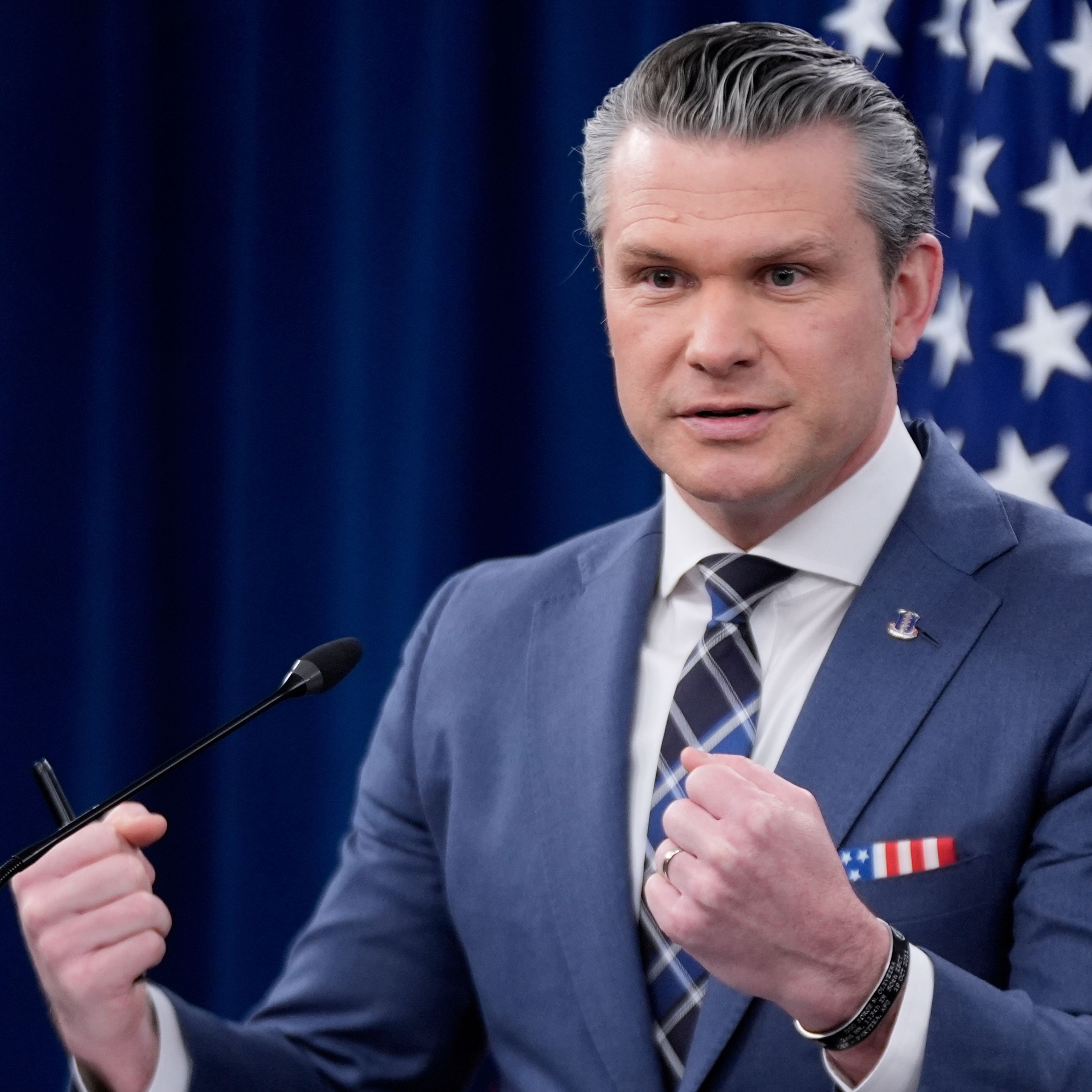
Sounds pretty Christian to me. But in the United States, religious belief is being used a little differently, particularly by politicians looking to give their actions a faithful veneer. The Trump administration has repeatedly used Christianity, or more accurately, Christian nationalism against its enemies. And in the Pentagon, Secretary of War little boy Pete Hegseth is putting Christian nationalism into both the culture and the policy of the armed forces, drawing a ton of concern both inside and outside of the military. As the New York Times detailed in March, Hegseth has made it crystal clear that as far as he's concerned, the war in Iran is actually a war favored by God. And during a press conference of the Pentagon in March, he asked the American people to pray to Jesus Christ that the troops might be kept safe.
- [02:08]
C
And I say the same to every American who wants peace through strength. May Almighty God continue to bless our troops in this fight. And again, to the American people, please pray for them every day on bended knee, with your family, in your schools, in your churches, in the name of Jesus Christ.
- [02:33]
A
Previous military leaders have offered prayer before missions and to protect the troops. But Hegseth's explicit reference to Christianity has rubbed many within the military the wrong way. In fact, according to the Military Religious Freedom foundation, more than 200 members of the military have complained that high level officials are using Christian rhetoric to talk about the Iran war. One allegation involves a commander saying that Trump was, quote, anointed by Jesus to light the signal fire in Iran to cause Armageddon. And mark his return to earth. In previous years, the military made real efforts to make everyone feel welcome. But under Hegseth, that work seems to have been de emphasized in favor of a very particular brand of evangelical Christianity. Michelle Boorstein is the religion reporter at the Washington Post. She recently wrote about the ways Hegseth has changed how faith operates in the US Armed forces. We spoke about Hegseth's own beliefs and how people in the military are reacting to the new regime. Michelle, welcome to Water Day.
- [03:26]
D
Thank you for having me.
- [03:27]
A
For listeners who may not be familiar with Pete Higseth's background, how would you describe his religious beliefs and how central they are to his leadership style?
- [03:36]
D
Well, he has described that he had a Christian background, more of like an evangelical background, but that he had some years of his life when he kind of fell away from regular practice, and that in recent years, since he's been with his current wife, that he has become much more religious. Whether that had to do with his experiences in the military, his experiences with his, you know, different relationships and marriages and children and that kind of thing. He's currently part of a small, very conservative denomination founded by Doug Wilson in Moscow, Idaho. And it's more what people would kind of call like a dominionist, patriarchal kind of faith. It's very much into, you know, religious nationalism, the place of Christianity in the United States, the idea of men as head of the household. His pastor has talked about thinking that women shouldn't have individual rights to vote, families should vote together with the men as the head of the house. So he's part of a very conservative part of evangelical Protestantism. Yeah.
- [04:35]
A
In your article, you mentioned Hegseth has been hosting evangelical worship services at the Pentagon. Who was attending, and how unusual is this?
- [04:44]
D
So he started last year, pretty soon after taking office, holding these monthly worship sessions at the Pentagon with him involved him hosting and different evangelical conservative pastors. And what's unusual? I mean, obviously faith and religion in the military, just like in the country, is, you know, it's a very rich and diverse faith community there. There's chaplains all over the place who are supposed to take care of people of all faiths and no faith. But to have a service like this that is led by the defense secretary, experts tell us, is unprecedented in modern times. And it's sort of a strategy that Hegseth seems to be using to try to fortify that type of Christianity in the military. He recently suspended the Army Spiritual Guide, saying that it was too therapeutic and too focused on emotional health and not Enough on religious or theological truth. So he got rid of that guide. And he also recently announced that he was gonna be cutting down from about, I think, about 200 to 30 faith codes in the military. These groups that sort of have a status in the military. And it makes it possible to know how many people are of that group and if their spiritual needs are being met and that kind of thing. So to have somebody in his position making these kind of theological decisions is really unprecedented in modern times. There have been more civic religion, what we call civic religion, like prayers to God, prayers to a higher force. And a lot of people that we talked to said that faith can be what they call the force multiplier, which is if people feel they're working together for some greater cause, that's a really positive thing. But that this is something different than what military leaders have been trying to do, how they had been trying to use religion or talk about religion.
- [06:34]
A
Yeah. And I'm curious if you've ever been to Arlington National Cemetery. You can see how many tombstones have crosses, but also stars of David and also, you know, symbols for other religions, because there are so many members of the military who ascribe to so many different faiths and to no faiths. What are you hearing from inside the ranks? How are troops responding to this? Are there service members who don't share higsest beliefs, which I'm guessing is a lot of them. And are they feeling sidelined? Are they facing consequences?
- [07:06]
D
We were able to talk to people of different ranks, people who are very high ranking in the military now, people who are civilians working at the Pentagon, people who were, you know, regular sergeant out in the field somewhere overseas. And people told us that there are definitely folks in the military who like this, but that a lot of people said that, that they felt sidelined. And I talked to one gentleman who was quoted in the story. He used to be number two at the National Guard, and now he trains chaplains. And he said he talked to dozens and dozens of chaplains working in the military who feel what he said was sidelined or excluded, literally, like sometimes not invited to meetings, Things like that. People know who's sort of on board with this, or, you know, people who are not. And the people who are not do not feel comfortable saying anything. You know, especially today, this is a period where people are. Who work for the government and in the military. Military are afraid to be on the record. So it's hard for us to know exactly the scope of what kind of support this has. But I spoke to an army general who said, you know, they were just despondent that they had been in the service for 30, 40 years and were just waiting to get out because they were so disturbed by this pattern and just felt it was really dangerous.
- [08:23]
A
Where I started seeing stories about this was how Hegseth and other top military officials were using religion to frame the war with Iran. Can you talk about that a little?
- [08:32]
D
Yes. So the Military Religious Freedom foundation, which is based in New Mexico, came out a couple weeks ago with a report where they said over 200 people who are, you know, either members of their group or people who respond to their group had called in to complain to say that their superiors were framing the war in Iran in religious terms and that they were, you know, very disturbed by this. So unfortunately, again, this is a time when people are just afraid to be identified. So we weren't able to confirm those things. But I mean, I just think the fact that we had such high ranking people speak to us about it was pretty telling that it just seemed like such a change from the past.
- [09:15]
A
Yeah, I want to hammer in on that just a little bit. You wrote, quote, US Military leaders have long understood the power and perils of invoking faith, especially in wartime. And like military leaders and even presidents have clearly prayed publicly before major military events. FDR did before the invasion of Normandy. Eisenhower did when he was supreme Allied commander, also before Normandy. What is different about this moment? Cause clearly it's different. But I'm just interested to hear what you think.
- [09:42]
D
Well, I think there's a few things. First, you know, Hegseth is using and his allies are using, not just kind of general, you know, we all serve a greater purpose kind of God, but very explicit scriptural references which are being debated by the Pope. And I mean, to go into this kind of detail, you know, is unprecedented. But I also think that we have a very diverse military and a very diverse country. So, I mean, these experts said that we had been moving towards more inclusion. Whether that had to do with, obviously, the language issue, allowing people whose faith requires them to, you know, wear their hair a certain way, wear their beard a certain way.
- [10:23]
A
Yeah. I was thinking about for Sikh Americans and others for whom, like, a beard ban would be really problematic, or that they need to be able to wear specific head coverings because of their religious beliefs.
- [10:36]
D
Yeah. And there had been an increase in the things that you mentioned, like on military cemeteries, the, you know, insignia that people have on their stones. Some of the experts we talked to, and not just experts, people who are in the service said it felt like we were making progress and now we just went, you know, tumbling backwards, basically. In terms of inclusion, I know this
- [10:58]
A
is kind of a big question to ask, but is this rhetoric from Hegseth meant to justify US Action in Iran, or do you think Hegseth and other top officials genuinely see this as a holy war?
- [11:10]
D
Do I think that he thinks it's a holy war? Possibly. I don't know. I can't really get into his head. But I do think that using this kind of language deliberately and in a new way definitely seems to be intentional. And we're in a period where the Supreme Court in recent years has really chipped away the establishment clause at what constitutes the government establishing religion and the separation of church and state. So that's something that's like the floodgates kind of opened in recent years because of some court rulings where people said, well, it looks like that's not really an issue anymore. And one of the things that's been debated in courts about the establishment clause is what constitutes coercion. And what constitutes coercion. The bar is getting like lower and lower. You know, Hegseth, you know, I mean, if you look at his body tattoos and his memoir, I mean, he definitely seems to believe that there is a crusade of some kind. So, I mean, to that degree, it seems like it is part of his personal worldview.
- [12:11]
A
Michelle, thank you so much for joining me.
- [12:14]
D
Thank you for having me.
- [12:16]
A
That was my conversation with Michelle Boorstein, religion reporter for the Washington Post, with a link to her piece in the show Notes. We appreciate you no matter what you believe or don't. And if you appreciate us, we'd love it if you made sure to subscribe. Left a five star review on Spotify and Apple Podcasts, watched us on YouTube and shared the show with your friends. We'll be back after some ads. What a day is brought to you by Fast Growing Trees. Did you know? Fast Growing Trees is America's largest and most trusted online nursery with thousands of trees and plants and over 2 million happy customers. They have all the plants your yard or home needs, including fruit trees, privacy trees, flowering trees, shrubs and houseplants, all grown with care and guaranteed to arrive healthy. It's like your local nursery, but anywhere you live with more plants than you'll find anywhere else. Whatever you're looking for, Fast Growing Trees helps you find options that actually work for your climate, space and lifestyle. Fast Growing Trees makes it easy to get your dream yard. Just click, order, grow and get healthy, thriving plants delivered to your door. Their Alive and thrive guarantee promises that your plants arrive happy and healthy. No green thumb required, just quality plants you can count on. Plus, get ongoing support from trained plant experts who can help you plan your landscape, choose the right plants and learn how to care for them every step of the way. My husband and I have loved giving fast growing trees to friends. They arrived healthy and happy and ready to plant. What a perfect gift for spring. Right now they have great deals on spring planting essentials up to half off on select plants and listeners to our show get 20% off their first purchase when using the code WAD at checkout. That's an additional 20% off. Better plants and better growing at fastgrowingtrees.com using the code WAD at checkout fastgrowingtrees.com code WAD now is the perfect time to plant. Let's grow together. Use WAD to save today. Offer is valid for a limited time. Terms and conditions may apply. What a day is brought to you by Acorns so many people are focused on where their money is today. Acorns is a financial wellness app that cares about where your money is going tomorrow. And with the Acorns Potential screen, you can find out what your money is capable of. Acorns is a smart way to give your money a chance to grow. Acorns is easy. You can sign up in minutes and start automatically investing your spare money even if all you've got is spare change and Acorns grows with you. Whether you're just starting out or thinking about settling down, Acorns supports your big and small goals across every life stage. The Acorns Potential screen shows you the power of compounding and how your money could grow over time. Plus, you can quickly adjust how much you're investing every day, week or month to make sure you're building towards your goals. Sign up now and Acorns will boost your new account with a $5 bonus. Investment join the over 14 million all time customers who have already saved and invested over $27 billion with Acorns. Head to acorns.com wad or download the Acorns app to get started. Paid non client endorsement compensation provides incentive to positively promote Acorns tier 2 compensation provided potential subject to various factors such as customers accounts, age and investment settings does not include Acorns fees. Results do not predict or represent the performance of any Acorns portfolio. Investment results will vary. Investing involves risk Acorns Advisors LLC and SEC registered investment advisor view important disclosures@acorns.com wad
- [15:39]
B
quick question. Are you politically engaged and spiritually exhausted
- [15:44]
E
if you said yes to both? Welcome home. I'm Erin Ryan.
- [15:47]
B
And I'm Alyssa Mastromonaco and we're the
- [15:50]
E
hosts of Hysteria, the podcast for women who care about democracy, culture and not losing their minds in the process.
- [15:55]
B
We break down the news, call out the nonsense and spotlight the women actually fighting back on Capitol Hill, in classrooms and everywhere. The stakes are high.
- [16:04]
E
It's sharp, honest analysis featuring women's voices with humor and zero hand holding.
- [16:10]
B
Listen to Hysteria wherever you get your podcasts and watch full episodes on YouTube.
- [16:19]
F
Spring is packed. Patios, parties, wedding weekends, and RK0 proof keeps you in the mix without the morning after regret as the original Zero Proof Spirits brand, RK's warm molecule gives you that real deal burn of whiskey or tequila with none of the alcohol. Zero calories, zero sugar and a whole lot of freedom to enjoy the moment. Sip smarter this season@rk0proof.com.
- [16:48]
A
Here's what else we're following today.
- [16:50]
D
Head of Lines
- [16:54]
C
if your children are watching, be warned the president did not use polite language. Quote Tuesday will be power plant day and bridge day all wrapped up in one in Iran. There will be nothing like it. Open the fucking straight, you crazy bastards, or you'll be living in hell. Just watch.
- [17:14]
A
CNN's Jake Tapper quoted from a not suitable for works true social post sent out by President Trump on Easter Sunday because this is the world we live in, the unhinged violent threat against Iran was the latest sign that maybe those Iran war negotiations Trump keeps talking about are not going so well. In response to Trump's post, Iran's mission to the United nations posted on Twitter, this is direct and public incitement to terrorize civilians. They also said it was evidence of Trump's intent to commit war crimes. Under international law, nations can only target civilian infrastructure if the military advantage outweighs the civilian harm. Over the weekend, Iranian drones reportedly took a Kuwaiti water desalination plant out of service. Officials in Kuwait, Bahrain and the UAE also said that Iran damaged some of their petrochemical facilities. On Sunday, U.S. special Operations forces rescued the second of two Air Force members who were shot down over Iran Friday. The first crew member had been rescued quickly after the crash landing. The second rescue took more work. A U.S. government official told the Associated Press that the CIA tried to mislead Iranian officials by spreading word that they'd already found the second crew member. Prior to the actual rescue, Iran had promised a sizable reward for his capture. In a true social post Sunday President Trump said that the second rescued aviator had, quote, sustained injuries, but he will be just fine. A federal judge in Boston has pushed PAWS on a requirement that colleges collect data proving they do not consider race in admissions. President Trump rolled out the directive in August. His administration had raised concerns that colleges and universities used personal statements and other proxies to illegally consider race. The national center for Education Statistics would collect new data on the race and sex of students who applied, as well as the race and sex of students admitted and enrolled. Education Secretary Linda McMahon has called for the last seven years of data. It was originally due March 18, but a group of 17 Democratic state attorneys general filed suit, saying the universities needed more time and that the policy risked student privacy. In his ruling on Friday, the judge said the federal government likely has the authority to collect the data. However, he noted that the rollout was rushed and chaotic. Sounds extremely Trump administration the temporary block on the requirement only applies to public universities in states that suit, so a win for them. For now. The Trump administration is appealing a federal judge's ruling that halted construction on the president's $400 million East Wing ballroom. The administration argues that pausing ballroom construction threatens the security of both the White House and President Trump Administration lawyers say the project includes new bomb shelters and that the finished ballroom will be heavily fortified. Hmm, it's almost like they didn't read the judge's ruling, the same one that said a pause would not create security risks. Also, if the whole project is as expertly planned as the Trump administration claims, then why did it take until last week for the people designing it to remove a useless grand staircase from outside the ballroom? A staircase that would have led to a set of windows with no door. Of course, Trump hopes to take the case all the way to the Supreme Court because they definitely don't have anything better to do. And that's the news. Before we go. If you've been following the latest headlines around policing, ICE and immigration enforcement, the Empire City Podcast Club from Crooked Ideas is the place to fully unpack it. Each week, host Chenjerai Komanika and special guests dig into the systems behind those stories, how this power was built, who it serves, and what it means for public safety. Right now, every session focuses on a new theme, with space to connect the dots and ask bigger questions. Whether you've been tracking every headline or are just starting to tune in, you can be part of the conversation. We'll send a reminder before we kick things off. The next session is April 14th at 5pm Pacific Time, 8pm Eastern Time. Sign up at cricketideas.org empirecity the link is in the show notes. That's all for today. If you like the show, make sure you subscribe. Leave a review Congratulations to UCLA women's basketball team for winning the national title on Sunday. And tell your friends to listen. And if you're into reading and not just about how CUCLA defeated South Carolina 7951 to clinch the team's first NCAA national championship. Like me, what a Day is also a nightly newsletter. Check it out and subscribe. Subscribe@cricket.com subscribe I'm Jane Coston and special shout out to Lauren Betts, UCLA's 6 foot 7 senior center whose block against Texas on Friday is how the Bruins got to the title game in the first place. What a Day is a production of Crooked Media. It's recorded and mixed by Desmond Taylor. Our associate producer is Emily Foer. Our producer is Kaitlyn Plummer. Our video editor is Joseph Dutra. Our video producer is Johanna Case. We had production help today from Greg Walters, Matt Berg, Sean Ali and Ethan Oberman. Our senior producer is Erica Morrison and our senior vice president of news and politics is Adrienne Hill. Our theme music is by Kyle Murdoch and Jordan Cantor. We had help today from the Associated Press. Our production staff is proudly unionized with the Writers Guild of America East.
- [22:52]
B
Quick question. Are you politically engaged and spiritually exhausted
- [22:57]
E
if you said yes to both? Welcome home. I'm Erin Ryan.
- [23:00]
B
And I'm Alyssa Mastromonaco, and we're the
- [23:03]
E
hosts of Hysteria, the podcast for women who care about democracy, culture and not losing their minds in the process.
- [23:09]
B
We break down the news, call out the nonsense, and spotlight the women actually fighting back on Capitol Hill, in classrooms and everywhere. The stakes are high.
- [23:17]
E
It's sharp, honest analysis featuring women's voices with humor and zero hand holding.
- [23:23]
B
Listen to Hysteria wherever you get your podcasts and watch full episodes on YouTube.
- [23:31]
G
Notice how some homes sell faster in your neighborhood? It's not luck, it's local. Know how RE Max agents know their streets, schools and communities, inside and out. And with RE Max, those local pros are everywhere. Which means when you're ready to buy or sell, you'll get trusted neighborhood insight that puts you a step ahead. Reach out today reMax the experts close to home, each office independently owned and operated.